How to Overcome Nervousness in the UPSC Interview: Stay Present, Think Clearly
You do not have to eliminate nervousness to have a thoughtful interview. Learn how to enter calmly, acknowledge what you do not know, handle challenging questions and return to the conversation after a difficult moment.
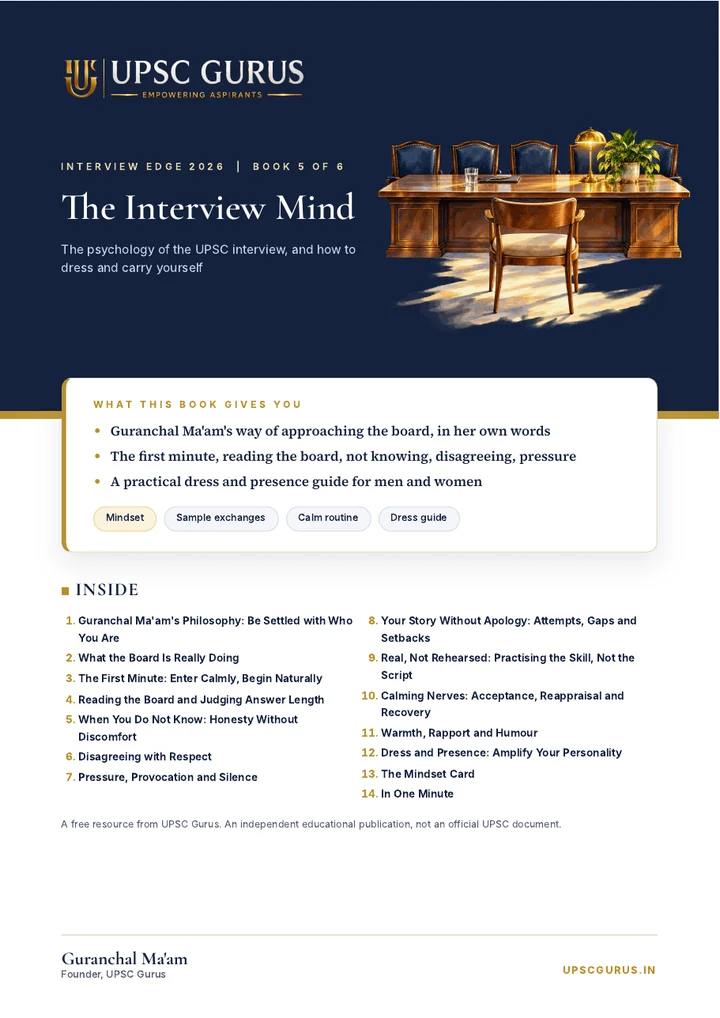
The first minute of your UPSC interview: what should you do?
The first minute begins a conversation, not a test of physical perfection. Guranchal Ma’am advises you to enter calmly, make eye contact, wish the panel, settle and wait. If the chair is too close, move it back slightly. This is an ordinary adjustment.
- Enter: Walk in at a comfortable pace when invited.
- Greet: Acknowledge the chairperson and the panel politely, without an elaborate sequence.
- Sit: Wait to be invited, adjust the chair if needed and settle naturally.
- Listen: Hear the whole first question before responding.
- Answer: Give the information requested, without forcing a prepared introduction.
Sit with relaxed shoulders and resting hands. Face the speaker without forcing continuous eye contact. Speak audibly in your natural voice.
Research on job interviews suggests that first impressions can form quickly, but it does not establish that UPSC marks are decided in thirty seconds. A quiet greeting, an awkward chair movement or a brief pause is recoverable. Begin well, then focus on the question in front of you.
How to overcome nervousness in the UPSC interview without fighting it
Aim for functional calmness: listening, thinking and communicating even when your body feels unsettled. You need not prove perfect composure.
Acceptance: let the feeling be present
Notice the sensation without making it a verdict on your ability. Replace ‘My hands are shaking, so I cannot answer’ with ‘My hands feel unsteady because this matters to me. I can still listen and answer.’ Acceptance does not mean giving up. It means not spending the conversation fighting your own body.
Reappraisal: give the feeling a more useful meaning
A fast heartbeat may signal importance, not lost control. A difficult question needs understanding, not anxious interpretation. One forgotten fact does not define the conversation.
In a randomised simulated job interview involving 82 university students, acceptance and reappraisal reduced anxiety compared with no strategy, while suppression did no better than none. A 2024 review also found a small performance benefit from learning to view stress arousal as useful. These findings are not specific to UPSC boards. They support a practical principle: you can participate while feeling nervous.
Inside: Guranchal Ma'am's philosophy of being settled with yourself; the first minute, uncertainty, disagreement and pressure; practical calming methods and a complete dress guide.
Download The Interview MindSee all six books →A two-minute calming routine before entering the interview room
Use these four steps while waiting. Allow roughly thirty seconds for each. Their purpose is to settle your attention, not to make every physical sensation disappear.
- Ground: Feel your feet supported. Release unnecessary tension in your shoulders and jaw.
- Breathe: Breathe comfortably, without forcing, holding or counting in a way that distracts you.
- Accept: Tell yourself, ‘I may feel nervous, and I can still think clearly.’
- Focus: Give yourself one task: listen fully to the question you are asked.
Practise breathing beforehand if it helps. A 2023 review found that beneficial practices generally involved longer, initially guided sessions repeated over days. This short routine is for attention, not instant anxiety removal. If breathing feels uncomfortable, attend to your surroundings instead.
You do not need a perfect state of mind before entering. You need enough attention to begin listening.
What to say if you do not know an answer in the UPSC interview
You may not have learnt a fact, may not recall it, or may know only the broad idea. Describe that limit truthfully. UPSC names intellectual and moral integrity among the qualities it values.
- Not aware: ‘Ma’am, I am not aware of this, though I will go back and read about it.’
- Cannot recall: ‘Ma’am, I cannot recall this at the moment, though I had read about it.’
- Brief acknowledgement: ‘Ma’am, I apologise, but I am not aware of this.’
- Partial knowledge: ‘I know the broad principle, but not the exact figure.’
- Question unclear: ‘I’m sorry, Ma’am. Could you please repeat the last part?’
Use only a truthful phrase. One acknowledgement is enough. Do not invent details, disguise uncertainty or deliver a speech to conceal the gap.
Asked for his district’s latest forest-cover percentage, Rohan admits he does not know it. When challenged as a birdwatcher, he accepts the relevance of the figure and explains what he observes on his visits, without bluffing.
Revise the foundations of your graduation subject, especially where they relate to your work. Treat the UPSC syllabus as expected knowledge. An honest unknown should be brief, respectful and followed by attention to the next question.
How to handle UPSC interview stress questions and provocation
A direct question need not be hostile. Guranchal Ma’am says provocation is rare and usually tests your response. Use hear, separate, answer: listen fully, separate sharp wording from the issue, then respond with reasons.
If asked, ‘Aren’t you simply looking for a secure government job?’, avoid denying that security can matter. Rohan’s response acknowledges that it is a consideration, but explains his stronger interest in the public decisions behind infrastructure projects, drawn from his work experience. He offers personal evidence rather than a rehearsed claim about pure motives.
With repeated questions, address what changes. Closing an unsafe public facility raises immediate risk, community dependence and whether alternatives are sufficient. Refine your reasoning as each constraint is introduced.
If a question rests on a doubtful premise about your family or ability, you may disagree respectfully and offer relevant evidence. You need not accept an inaccurate assumption or disclose every private detail. Do not assume a challenging exchange means the interview is going badly. Stay sensitive in tone while remaining clear about your stand.
“Be calm, but do not become preoccupied with proving that you are calm.”
Guranchal Ma’am
Founder, UPSC Gurus
What if your mind goes blank, you stumble or the panel falls silent?
Recover simply: speak more audibly after a soft greeting, listen if you answered too early, and adjust an awkward chair without over-explaining.
When your mind goes blank: Return to the actual wording of the question. You may say, ‘May I take a moment, Sir?’ Pause briefly and organise what you know. If you still cannot answer, acknowledge the limit honestly. Silence is better than an invented fact.
When the board is silent: Wait attentively. A member may be thinking, reading or considering the next question. You cannot infer what the silence means. Do not repeat your conclusion or ask whether your answer was correct.
When corrected: Answer the clarified question. If asked why you chose Geography as an optional rather than why you enjoy it, address that distinction.
After an exchange ends, use this recovery sequence: close it, release it, turn, listen, answer. Postpone judging the previous answer. Attend to the new speaker and respond from what you know now. The next question deserves your full attention.

A profile session with Guranchal Ma’am and a mock interview before a panel of seasoned officers, with detailed feedback. Online. State PCS and Hindi medium candidates warmly welcome.
Apply for Interview EdgeHow to practise calm answers before the UPSC Personality Test
Rehearse interruptions, unfamiliar questions and small mistakes with a chair, table and, if possible, an observer.
Five-entry rehearsal
- Enter, greet, wait for the invitation to sit and settle.
- Add an unexpected factual question from your profile.
- Add an interruption or clarification, then answer the corrected question.
- Add a question you cannot answer, acknowledge it and continue.
- Let the observer vary the conversation while you remain natural.
Practise on different days. Ask: Did I rush? Did I listen fully? Was I thinking about the conversation rather than my posture?
Pressure and recovery practice
In an eight-minute conversation, ask your partner to challenge an opinion, request a real-life example, pause after an answer, add a constraint to an administrative problem and change the topic abruptly. The partner stays professional. There is no need to simulate insults. For another short exercise, name a nervous habit, practise acceptance and reappraisal, then answer an unfamiliar question followed immediately by a familiar one.
Explore UPSC Gurus’ free book The Interview Mind. Guranchal Ma’am advises you to observe the room, let it shape your answers without changing your stand, and show who you are.
Frequently asked questions
How can I overcome nervousness in the UPSC interview?
Accept your sensations, reframe what they mean and focus on the present question. Practise entering, answering and recovering from interruptions. The aim is clear participation, not the absence of nerves.
What should I say if I do not know an answer in the UPSC interview?
Say, 'Ma'am, I am not aware of this,' or, if true, 'I cannot recall this at the moment.' Mark the limits of partial knowledge. Do not bluff or repeatedly apologise.
How should I respond to stress questions in the UPSC interview?
Listen fully, identify the question beneath its wording and reply with reasons. Address each new constraint in follow-ups. Disagree respectfully with inaccurate assumptions.
Is it acceptable to pause or ask for a question to be repeated?
Yes. Say, 'May I take a moment, Sir?' to think, or politely ask for the missed part to be repeated. A pause is preferable to answering a question you did not hear.
What if I make a mistake in the first minute of my UPSC interview?
Adjust and continue. Speak audibly after a soft greeting, settle after moving the chair, or listen again after interrupting. One stumble does not define the conversation.
Six free UPSC interview books. 336 pages, nothing repeated.
336 pages of thoughtful guidance, worked examples and practical tools. Everything you need to prepare with clarity, think independently and speak in your own voice. By Guranchal Ma’am, Founder, UPSC Gurus.
Interview Edge Studio
Practise from your own profile: a field-by-field DAF check, 100 questions drawn from your details, feedback on answers you write in your own words, and situation practice from your home state. Built on the method of Guranchal Ma’am, Founder, UPSC Gurus.