UPSC Interview Day Guide: What to Wear, Carry and Expect
Interview day is the point at which preparation becomes a real conversation.
You may have spent weeks reviewing your application, studying current affairs and thinking about your experiences. Now your task is simpler: arrive prepared, follow the official instructions, listen carefully and respond in your own words.
Practical planning can help you approach the day with greater ease.
This guide covers the UPSC e-summon letter, documents, commonly advised interview attire, travel arrangements and conduct during the Personality Test.
It also separates official requirements from personal choices, so that you do not mistake somebody else’s preferences for UPSC rules.
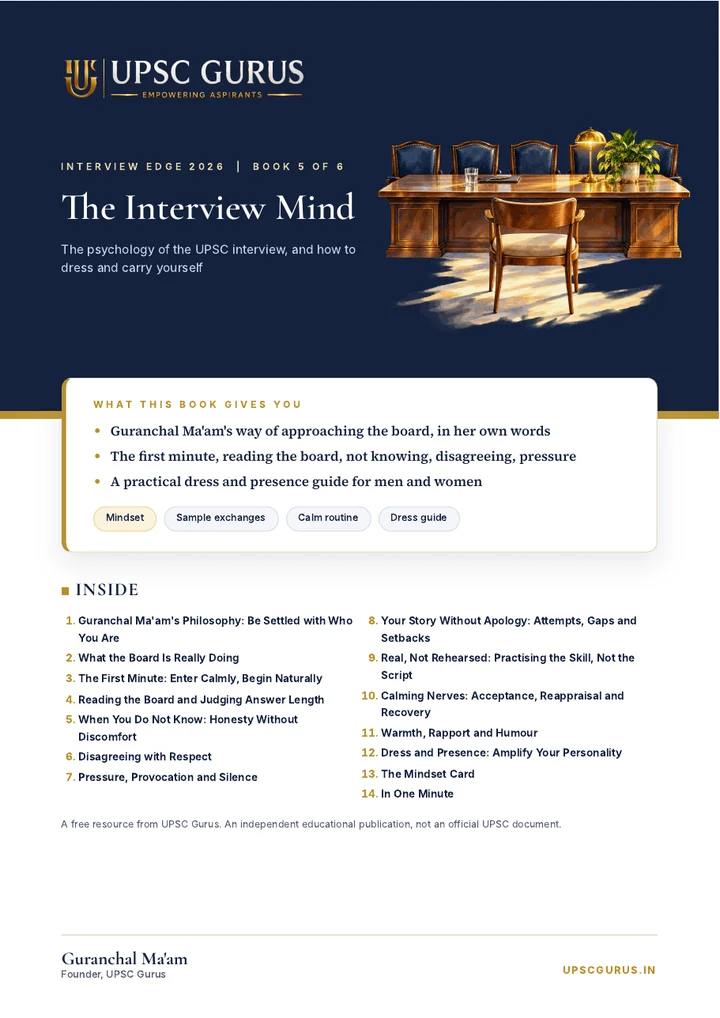
Find your document checklist, interview day routine, dress guidance and practical methods for handling uncertainty, nerves and the boardroom conversation.
Download The Interview MindSee all six books →Start with the official e-summon letter
The e-summon letter is an important document for candidates called to the Personality Test.
Under the UPSC CSE 2026 notification, candidates qualified for the Personality Test must complete the applicable post-Mains update requirements.
The notification specifically requires candidates to log in, verify and finally submit their information even when they have nothing new to update.
This submission is connected to generation of the e-summon letter.
The notification also provides a 15-day post-Mains update window. Candidates must follow the operational dates, document requirements and subsequent instructions announced by UPSC.
Use the official UPSC website and online portal for examination updates.
Do not assume that the interview date, reporting arrangements or required documents will remain identical across examination years.
Source: UPSC CSE 2026 Notification, post-Mains update provisions. Check the notification and interview communications for your year.
What to check on your e-summon letter
When your e-summon letter becomes available, read it completely.
Pay particular attention to:
- Your name, roll number and identifying details.
- Interview date, reporting time and venue.
- Documents and certificates required for your circumstances.
- Identity verification instructions.
- Any special instructions or restrictions.
- Contact information for resolving discrepancies.
If an instruction is unclear, seek clarification through the official UPSC channels.
Keep a securely saved copy and any printed copy required by your specific instructions.
The letter and accompanying official notices take precedence over general checklists found online.
Documents to prepare for UPSC interview day
A useful approach is to maintain a dedicated document folder well before travelling.
Check the current e-summon letter for the exact list.
Depending on applicable requirements, your preparation folder may include:
- The e-summon letter and any required copies.
- The photo identity document specified or accepted under official instructions.
- Original educational certificates and supporting records.
- Category, disability or other relevant certificates where applicable.
- Documents supporting claims that UPSC requires you to verify.
- Any additional forms, photographs or declarations specifically requested.
This is a planning checklist, not an independently prescribed UPSC document list.
The CSE 2026 notification advises candidates to carry the photo identity document whose details were provided in their Universal Registration Profile while appearing for the examination or Personality Test.
It also explains that eligibility verification with reference to original documents is undertaken after qualification for the Personality Test.
Prepare accordingly, while following the specific instructions issued for your interview.
UPSC interview dress code: what should you wear?
A frequent question is whether UPSC prescribes a particular dress code for the Personality Test.
The CSE 2026 examination notification does not specify a universal interview outfit or require candidates to wear a particular colour, garment or style.
That distinction matters.
Formal, understated clothing is often suggested because it reflects the seriousness and professional nature of the interaction. Whatever you decide to wear should reflect the value you give to the interview. However, suggestions about particular outfits, colours or styles should not be presented as official rules.
Guranchal Ma’am’s suggested attire
Guranchal Ma’am, Founder of UPSC Gurus, offers the following suggestions for what to wear to the UPSC interview:
- Women: A comfortable sari or a formal salwar suit.
- Men: A suit in navy, charcoal or black, or a bandhgala in black, navy or charcoal. Black suits and black bandhgalas are dignified choices.
These are suggestions, not rules: wear whatever you are comfortable in. Whatever you decide to wear should reflect the value you give to this interaction. Your clothes reflect how you regard the interview and should complement your personality.
No specific garment or colour should be presented as an official requirement.
Traditional Indian clothing can be entirely appropriate. Equally, professional attire need not erase your cultural identity or personal preferences.
Comfort and accessibility matter
Choose clothing and footwear that allow you to sit, walk and move comfortably.
You do not need unfamiliar footwear, heavy accessories or an entirely new outfit to appear professional.
Candidates using mobility aids, assistive devices or disability-related accommodations should prioritise accessibility and follow the applicable official instructions.
Professional appearance is not defined by gender stereotypes, expensive clothing or a particular physical presentation.
A useful test is simple: can you wear the outfit comfortably without repeatedly thinking about it?
Plan your journey before interview day
Travel preparation deserves attention, particularly if you are coming from another city.
Confirm the interview venue directly from the current official communication.
Then consider:
Travel: Arrange transportation with reasonable allowance for possible delays.
Accommodation: If travelling from outside Delhi or from another distant location, choose accommodation that makes the journey to the assigned venue manageable.
Documents: Keep important papers together in a protective folder.
Food and rest: Choose a familiar meal and a realistic sleep routine.
Personal needs: Account for medications, accessibility requirements and any necessary support arrangements.
Avoid relying on an unofficial claim about precisely how early every candidate must report.
Your e-summon letter and subsequent UPSC instructions determine the reporting requirement. Arriving with a comfortable margin is sensible personal planning.
What happens on the day of the Personality Test?
The precise administrative sequence should be understood from the current UPSC instructions.
Candidates can expect to follow the designated reporting and verification arrangements before being directed through the remaining process.
Allow yourself to follow instructions one step at a time.
You do not need to rehearse every possible movement or interaction.
Inside the interview room, a professional and respectful manner is appropriate.
Listen to the complete question. If something is unclear, a polite request for clarification is reasonable.
Avoid treating every question as a challenge requiring immediate defence.
The official description characterises the Personality Test as a directed and purposeful conversation, not a strict cross-examination.
That provides a useful principle for your conduct: participate in the conversation rather than trying to defeat it.
How to respond when you feel uncertain
Even a well-prepared candidate may encounter an unfamiliar question.
You can take a brief moment to organise your thoughts.
If you understand only part of an issue, distinguish what you know from what you are uncertain about.
If new information changes your assessment, reconsidering your position can be appropriate.
Do not invent facts simply to avoid silence.
Similarly, a difference of opinion need not become a confrontation. Explain your reasoning respectfully, recognise relevant competing considerations and remain open to further discussion.
Your goal is not to perform certainty.
It is to demonstrate thoughtful, responsible engagement.
What to do the evening before your UPSC interview
The final evening is best used for consolidation rather than beginning an entirely new preparation programme.
Review the logistical essentials:
- Confirm the reporting details and travel plan.
- Arrange the required documents and clothing.
- Briefly revisit your DAF and personal preparation notes.
- Review a small number of important current developments.
- Finish your planned work and allow time for rest.
If you practise speaking, keep the exercise gentle and familiar.
You have already undertaken the substantial work of preparation. The last evening need not become another full examination.
After the interview
Candidates sometimes spend hours analysing every question, pause or reaction.
A brief personal reflection can be useful.
You might record which topics you handled clearly, which questions required more thought and what the experience taught you.
But avoid treating a particular facial expression, follow-up question or length of conversation as reliable evidence of your marks.
Your official assessment cannot be inferred from such details.
Complete any subsequent administrative requirements according to UPSC instructions and allow the examination process to proceed.
Prepare with From Result to Board
It brings together practical planning, preparation priorities, reflection and final readiness.
You do not need to become a different person for interview day.
You need to arrive as someone who has prepared carefully, understands their experiences and is willing to think.
You have a conversation to participate in, not a character to perform.
Frequently asked questions
Is there an official UPSC interview dress code?
The CSE 2026 examination notification does not prescribe a universal interview outfit. Neat, professional and comfortable clothing is commonly advised. Always follow any specific instructions issued for your examination year.
Is a suit compulsory for the UPSC interview?
No. The CSE 2026 examination notification does not prescribe a suit or any particular garment as compulsory. Guranchal Ma’am suggests a navy, charcoal or black suit, or a black, navy or charcoal bandhgala for men. For women, she suggests a sari or a formal salwar suit. These are suggestions, not rules: wear whatever you are comfortable in. Choose attire that reflects the value you give to the interaction, while respecting official instructions.
Where can I download the UPSC e-summon letter?
Check the official UPSC website and the online portal identified in the current examination communications. For CSE 2026, candidates must also complete the applicable post-Mains verification and final submission requirements.
Which documents should I carry on UPSC interview day?
Follow the exact list in your e-summon letter and official instructions. Prepare your identity document, educational records and other applicable original certificates or supporting documents as required.
What should I do if I cannot answer a question during the interview?
Listen carefully and acknowledge genuine uncertainty. If you know part of the issue, explain it without speculation. An honest, considered response is preferable to inventing information.
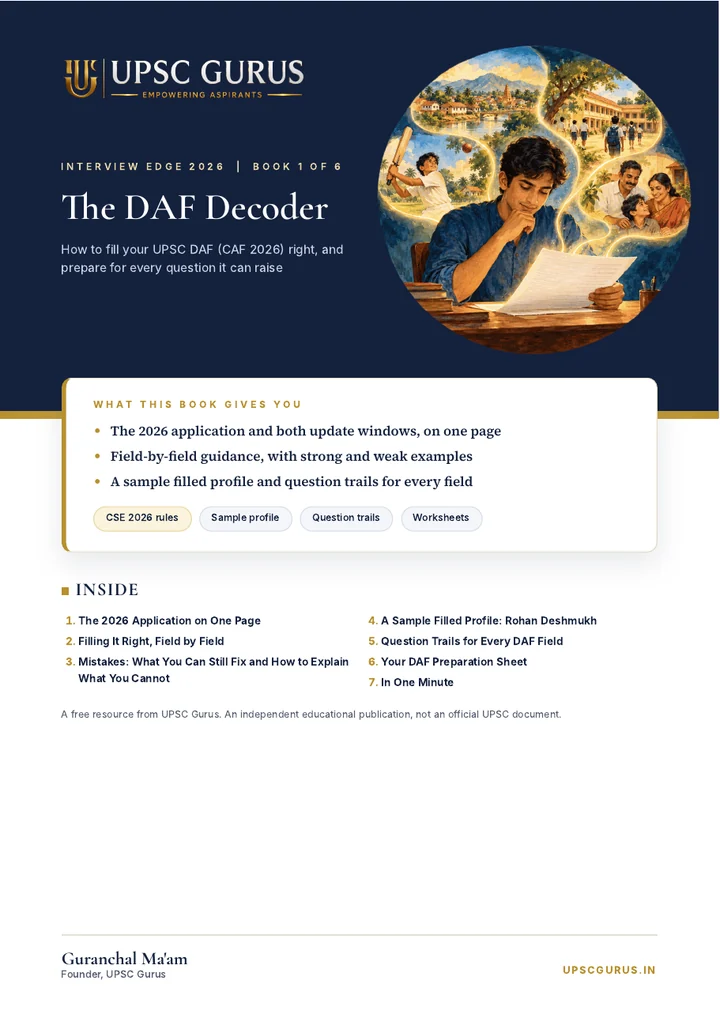
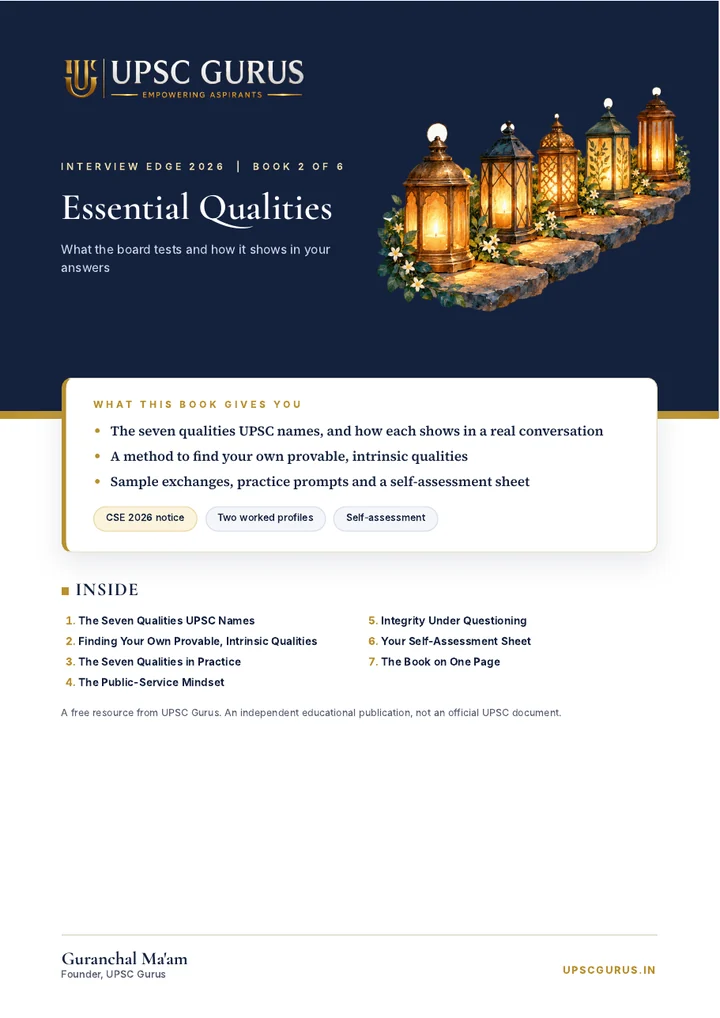
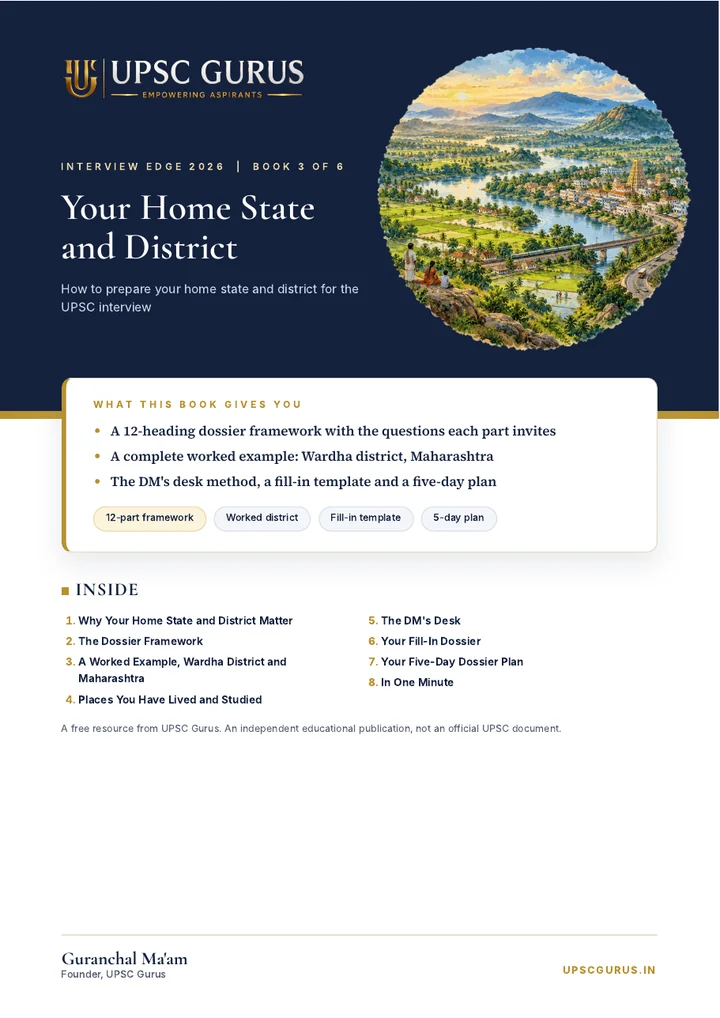
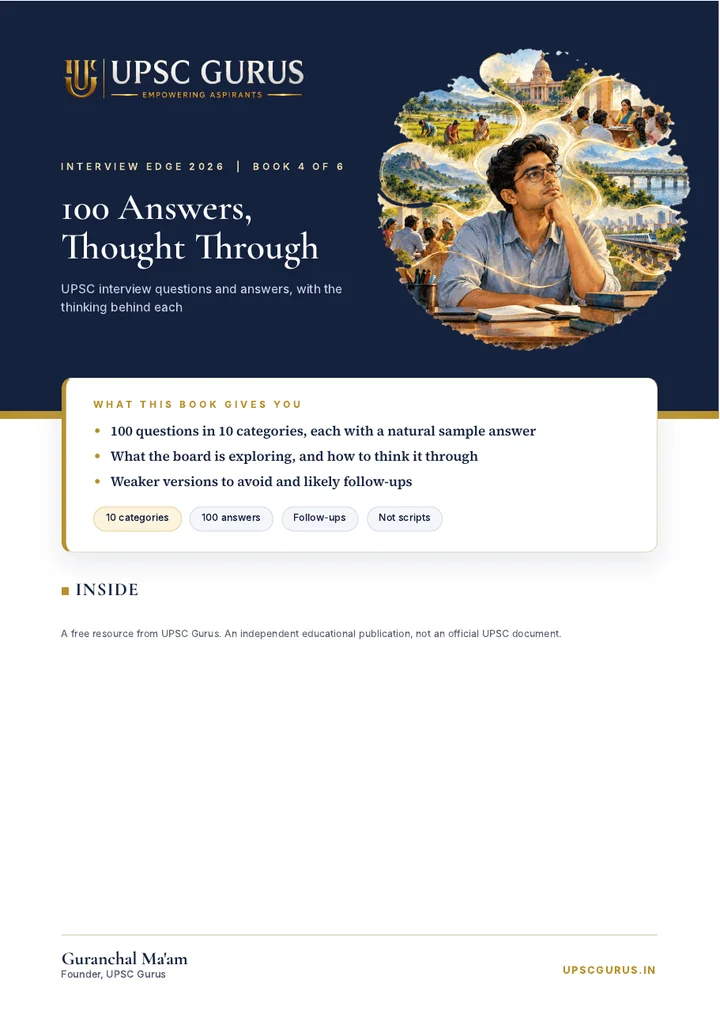
Six free UPSC interview books. 336 pages, nothing repeated.
336 pages of thoughtful guidance, worked examples and practical tools. Everything you need to prepare with clarity, think independently and speak in your own voice. By Guranchal Ma’am, Founder, UPSC Gurus.
Interview Edge Studio
Practise from your own profile: a field-by-field DAF check, 100 questions drawn from your details, feedback on answers you write in your own words, and situation practice from your home state. Built on the method of Guranchal Ma’am, Founder, UPSC Gurus.