UPSC Interview Questions 2026: Think Beyond the Answer
What does a good UPSC interview answer sound like? Explore 10 question categories, 30 examples, a practical answering method and free books to help you think clearly in the Personality Test.
What Are UPSC Interview Questions Really Designed to Explore?
UPSC describes the Personality Test, carrying 275 marks with no minimum qualifying mark, as not that of a strict cross-examination but of a natural, though directed and purposive conversation. This distinction matters.
You are not preparing to deliver a collection of perfect speeches. You are preparing to participate in a conversation whose direction you cannot predict.
UPSC interview questions may begin with your education, employment, family background, hometown or interests. They may move towards public policy, ethical choices, administrative situations or an opinion you have just expressed.
The question itself is only the starting point. What matters is whether you can listen, understand, respond directly, reason thoughtfully and remain open to further discussion.
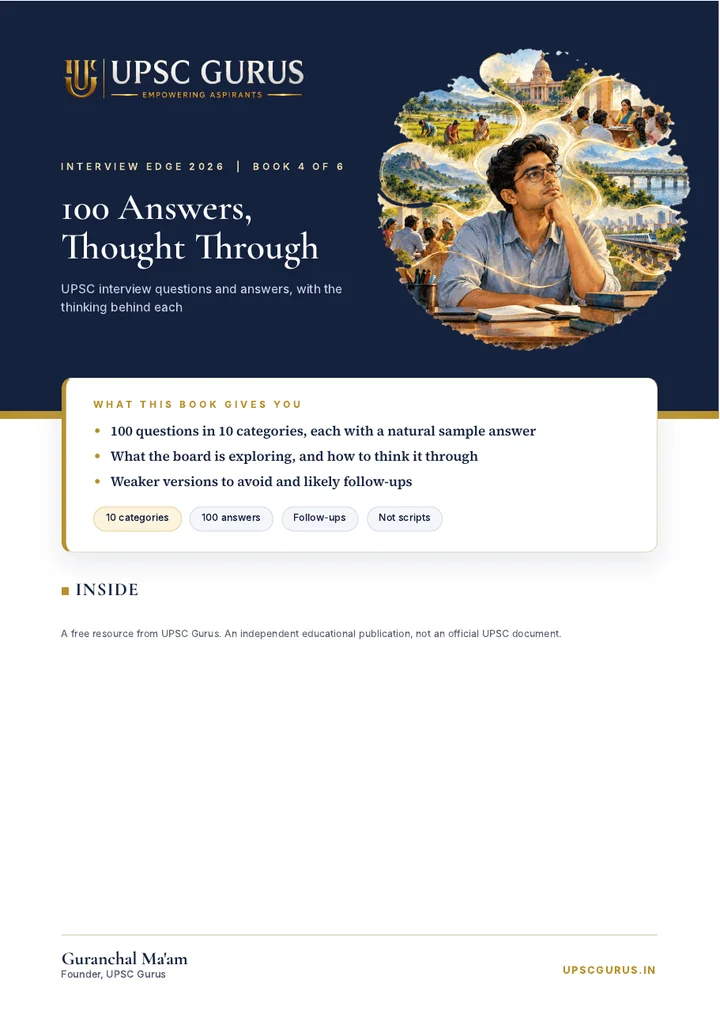
The following 10 categories organise 100 worked questions from the free UPSC Gurus book 100 Answers, Thought Through. Each category includes three illustrative questions from the book. These are practice examples, not predicted questions or a fixed interview syllabus.
Personal Questions Asked in UPSC Interview: Categories 1 to 3
1. Personal Introduction, Motivation and Self-Awareness
These questions invite you to explain who you are, what shaped your choices and how you understand your own development.
- Tell us about yourself
- What is one weakness you are working on?
- This is your third attempt. What has changed in you?
How to approach them: Be specific and factual. For a weakness, describe what you are working to change. For repeated attempts, explain what changed in your understanding or behaviour. Neither requires an apology.
2. Service Preferences and Career Choices
The focus here is your reasoning about different services, responsibilities and personal priorities.
- Why is the IAS your first preference?
- If you are allocated the Indian Foreign Service instead of the IAS, will you join?
- What matters more in your service choice: personal interest or where you can contribute most?
How to approach them: Give your actual preference and explain its basis. Acknowledge the alternatives without making your choice sound automatic or unconsidered.
3. Home State, District and Places You Know
Your hometown is an opportunity to connect local knowledge with development questions and lived observation.
- Tell us about Wardha, your home district
- Wardha grows cotton. Why can cotton farmers still face economic difficulties?
- Thrissur is called the cultural capital of Kerala. Does that description adequately explain the district?
How to approach them: Move beyond descriptive facts. Understand local strengths, challenges and the limits of familiar labels. Connect what you know with what you have personally observed.
Inside: 100 questions across ten important interview categories; natural sample answers with the thinking explained; weaker responses, likely follow-ups and better approaches.
Download 100 Answers, Thought ThroughSee all six books →DAF-Based UPSC Interview Questions: Education, Work and Hobbies
4. Graduation, Optional Subject and Academic Understanding
Academic questions explore your grasp of concepts, your choices and your ability to make specialised knowledge understandable.
- Why did you choose Civil Engineering?
- Can an economy grow rapidly without improving people’s well-being?
- You studied Engineering, but you cannot remember this technical concept. Have you forgotten your graduation subject?
How to approach them: Explain concepts simply. Distinguish knowledge from assumptions. If you genuinely cannot recall something, acknowledge that rather than inventing an explanation.
5. Employment, Career Gaps and Previous Attempts
These questions help you reflect on responsibilities, decisions, professional learning and changes of direction.
- What exactly did you do as a site engineer?
- How do you explain the gap in your employment?
- Three attempts suggest persistence. How do you know it has not become stubbornness?
How to approach them: Describe your responsibilities accurately. Explain gaps without defensiveness. For a difficult personal question, consider the distinction being raised before responding. Your life does not need a polished justification.
6. Hobbies, Interests and Personal Experiences
Interests offer a natural way to discuss observation, practice, enjoyment and what an activity has taught you.
- What attracted you to birdwatching?
- You enjoy Carnatic music. Can you sing for us?
- You enjoy running. What has it taught you?
How to approach them: Speak from actual experience. A concrete observation or lesson communicates more than a general statement about passion. Your hobby need not be presented as an extraordinary achievement.
UPSC Interview Questions on Current Affairs, Ethics and Administration
7. International Relations and India’s Foreign Policy
These questions invite you to explain international issues, evaluate competing interests and make reasoned judgements.
- What does strategic autonomy mean for India? Is it the same as neutrality?
- Does the United Nations Security Council need reform?
- If Indian citizens are stranded during a conflict abroad, what should the government prioritise?
How to approach them: Identify the central issue, present your position and recognise the strongest competing consideration. Avoid treating a complicated decision as a slogan.
8. Economy, Governance and Public Policy
Policy questions often contain genuine trade-offs. A thoughtful answer explains how you would evaluate them.
- Are government freebies harmful to the economy?
- Does digitisation automatically make governance more inclusive?
- Should artificial intelligence be allowed to decide who receives a government welfare benefit?
How to approach them: Distinguish the possible benefits from the limitations. Make your judgement clear and explain the conditions under which it would hold.
9. Ethical Dilemmas and Administrative Situations
These questions ask you to think about action, responsibility and competing needs.
- You are the District Magistrate. A flood warning has been issued, but villagers refuse to evacuate. What will you do?
- An eligible elderly woman has not received her pension because her digital records do not match. What will you do?
- Two villages urgently need drinking-water infrastructure, but the district has funds for only one project. How will you decide?
How to approach them: Identify the immediate priority, establish relevant facts and constraints, explain your action and consider how its outcome would be reviewed.
10. Disagreement, Uncertainty and Challenging Board Questions
Not every question invites a straightforward answer. Some require you to handle disagreement, uncertainty or an uncomfortable observation.
- You are asked a factual question and do not know the answer. What do you say?
- A board member strongly disagrees with your opinion. How should you respond?
- A member says, “Three attempts and no selection yet. Perhaps your judgement is not very good?”
How to approach them: Remain respectful without abandoning your self-respect. Consider a valid objection, revise your view when persuaded and acknowledge what you do not know.
UPSC Interview Questions and Answers: How Do You Build a Good Answer?
Guranchal Ma’am’s answer-building method has six steps. They are a thinking process, not a compulsory six-sentence format.
- Listen: Hear the complete question before responding.
- Understand: Identify what the question is actually exploring.
- Answer first: State your central response clearly.
- Reason: Give the most relevant explanation or example.
- Conclude: Complete the thought without repeating yourself.
- Stop: Allow the conversation to continue.
A Worked UPSC Interview Answer
Question: Is efficiency more important than fairness in public administration?
Illustrative answer:
“I would not treat them as competing goals in every situation. Efficiency matters because delay imposes real costs on citizens, but fairness sets the limit on how we achieve it. An online process may cut waiting time, yet if it shuts out people without digital access, the design needs correcting. Where a genuine trade-off remains, I would give particular weight to legal rights and equal treatment.”
Why this works: The candidate makes a judgement, illustrates it with a concrete situation and explains how to approach a real trade-off.
A weaker answer would be: “Both are equally important and must be balanced.” It sounds reasonable but does not explain how the candidate would decide.
There is no ideal answer length. A factual question may need one sentence. An ethical dilemma may require several linked considerations. The aim is to complete your thought, not to fill a predetermined amount of time.
“Prepare to take part in a conversation, not to deliver a speech.”
Guranchal Ma’am
Founder, UPSC Gurus
Why Do Memorised Answers Fail in the UPSC Personality Test?
A memorised answer prepares you for one particular wording. A real conversation can move somewhere else.
A board member may challenge your assumption, introduce another perspective or ask you to explain an example. If your attention remains on delivering a rehearsed paragraph, you may miss what the member has actually asked.
Prepared speeches can also make personal experiences sound distant. A career gap, a previous attempt or an ordinary hobby does not require an impressive narrative. It requires an accurate, considered response.
Prepare the reasoning, not the wording. Understand why you hold an opinion, what evidence supports it and what might cause you to reconsider.
If you do not know a factual answer, say so calmly. If a member offers a convincing objection, acknowledge it. If you disagree, explain the difference respectfully.
Being open to discussion does not mean changing your position merely to please the board. It means allowing better reasoning to improve your answer.

A profile session with Guranchal Ma’am and a mock interview before a panel of seasoned officers, with detailed feedback. Online. State PCS and Hindi medium candidates warmly welcome.
Apply for Interview EdgeHow to Practise UPSC Interview Questions With Follow-Ups and Free Books
The most useful practice begins before you read a sample answer. Give yourself the opportunity to think independently.
A Simple Self-Mock Routine
- Choose a question relevant to your own profile.
- Read it once and answer aloud without notes.
- Check whether you answered directly and supported your view.
- Read the thinking behind the worked answer.
- Attempt a related follow-up without returning to your original wording.
- A few days later, answer again using fresh words.
Follow-ups help you discover whether you understand your own answer. For example, after discussing evidence for an academic conclusion, consider the follow-up: What result would make you reconsider your conclusion?
After describing a professional decision, consider: Who bore the cost of your decision?
Track your practice using five simple marks: C for clear, K for knowledge gap, R for reasoning gap, F for follow-up difficulty and N/A for questions that do not apply to you. Use the marks to decide what to revisit.
Two Free Books to Continue Your Preparation
100 Answers, Thought Through: Explore all 100 questions across the 10 categories. Each entry explains what the question explores, how to think, a sample answer, why it works, a weaker version and two likely follow-ups.
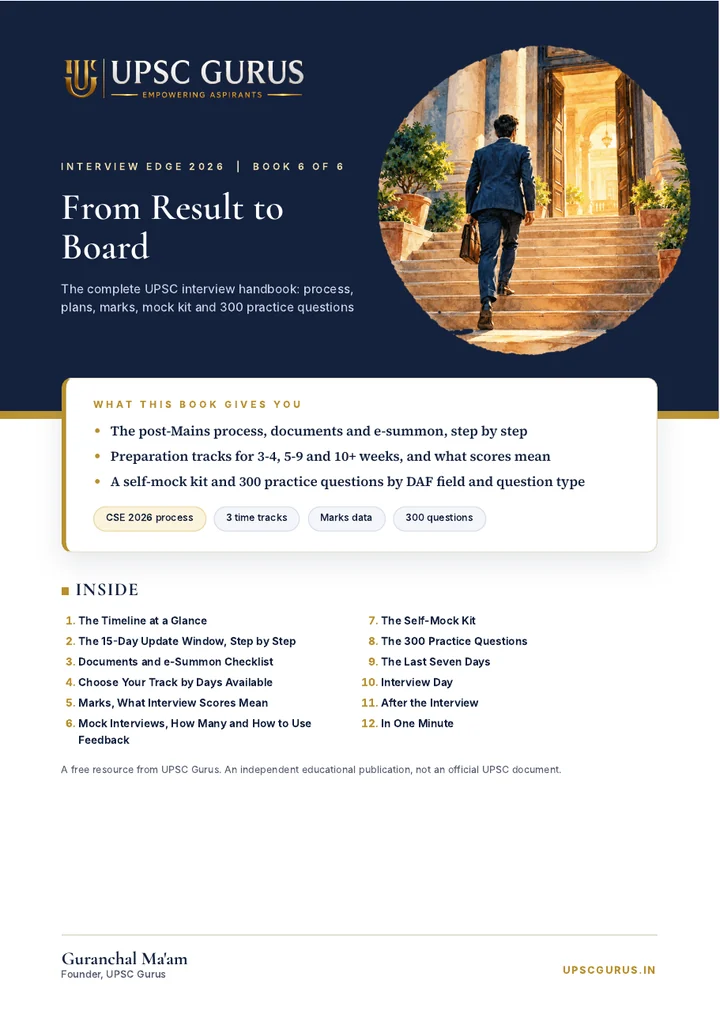
From Result to Board: Practise with 300 questions covering application details and different reasoning skills, including explaining, comparing, judging, counter-arguments and administrative situations.
These books are part of the free Interview Edge resources from UPSC Gurus, led by Guranchal Ma’am. Use them to develop your own thinking, rather than adopt the fictional candidates’ answers as scripts.
The purpose is not to complete the largest number of questions. It is to become more thoughtful with every answer.
Frequently asked questions
What are the most common types of UPSC interview questions?
Useful preparation categories include personal background, service preferences, home state and district, academics, employment, hobbies, international relations, economy and governance, administrative situations, and challenging board questions. These are preparation categories, not an official list of questions UPSC will ask.
How should I answer personal questions asked in the UPSC interview?
State your experience honestly, explain what matters and avoid unnecessary self-justification. For questions about attempts, gaps or weaknesses, focus on factual circumstances, what you learnt and any meaningful change in your behaviour.
Where can I find UPSC interview questions and answers in PDF?
UPSC Gurus offers the free Interview Edge book 100 Answers, Thought Through, featuring 100 worked questions with explanations and follow-ups. From Result to Board provides another 300 questions for independent practice.
What should I do if I do not know an answer in the UPSC interview?
Acknowledge it politely and calmly. You can say, “Ma'am, I am not aware of this, though I will go back and read about it.” Avoid guessing merely to fill the silence. Then allow the conversation to proceed.
How many UPSC interview questions should I practise for 2026?
Choose questions relevant to your own background and practise them thoughtfully. The book suggests approximately 90 to 120 for a shorter preparation period, 150 to 220 for a longer one, or the full 300 when time permits. Quality of reasoning matters more than the count.
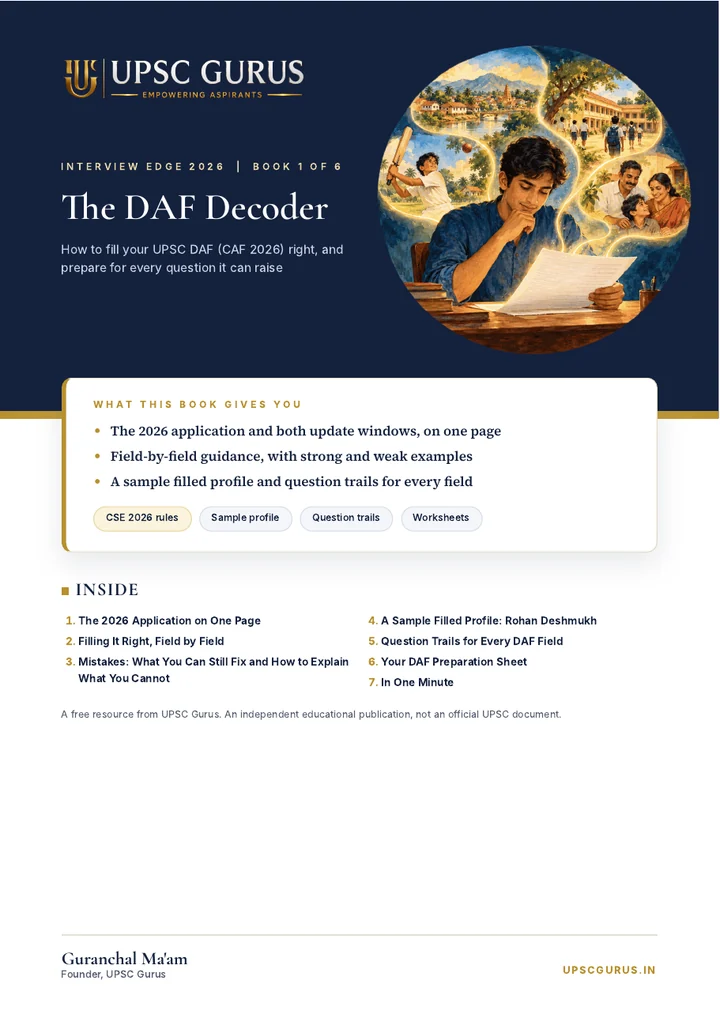
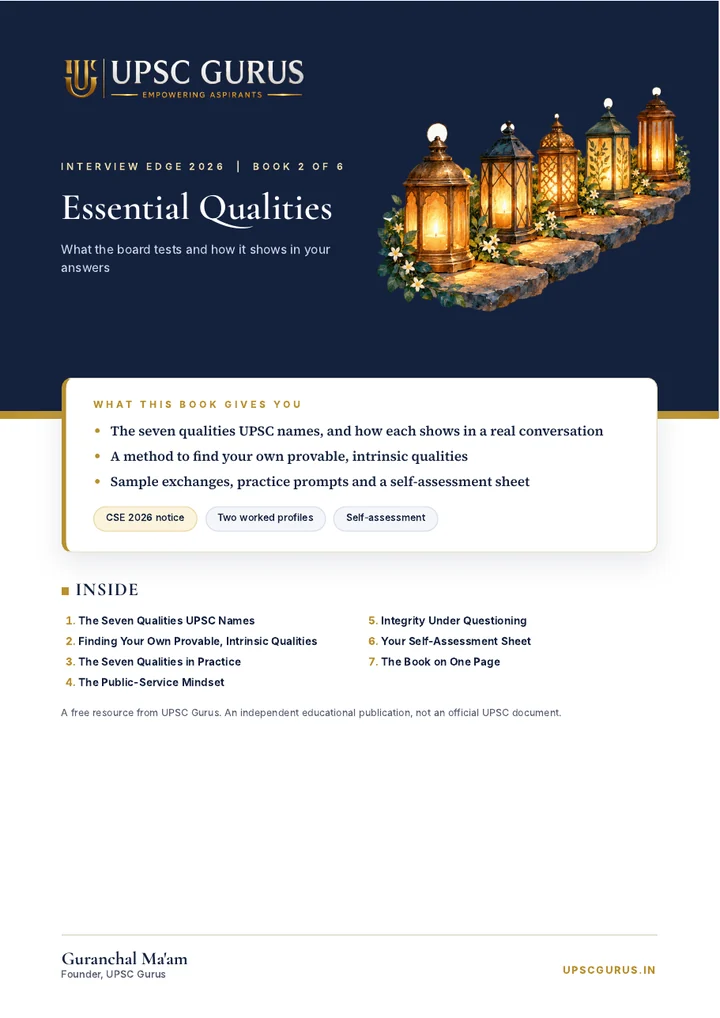
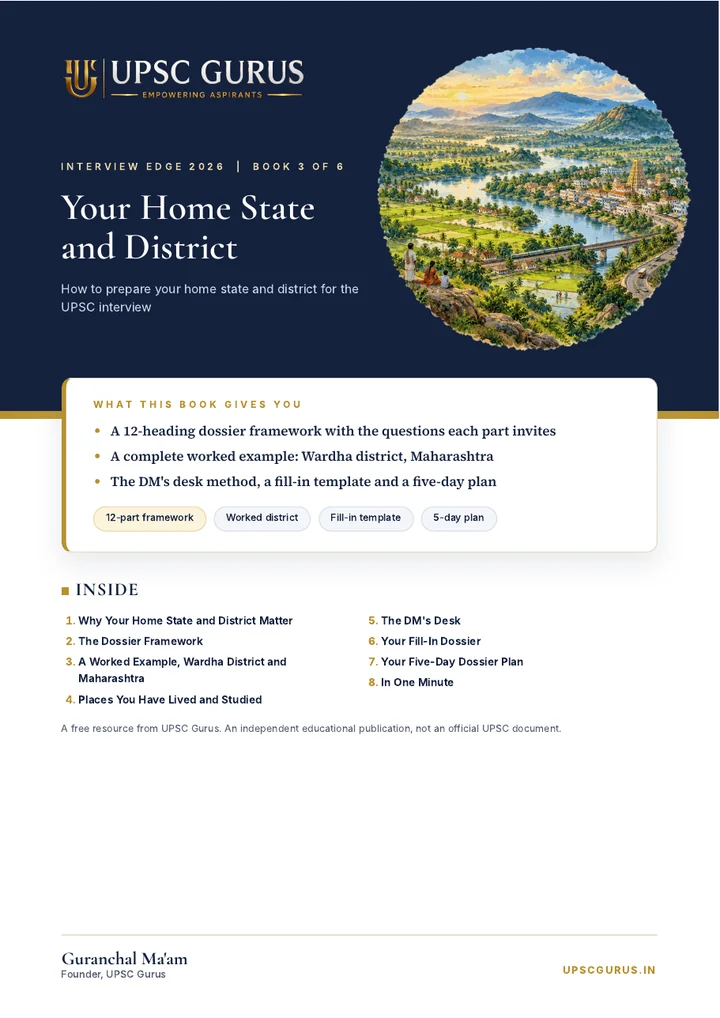
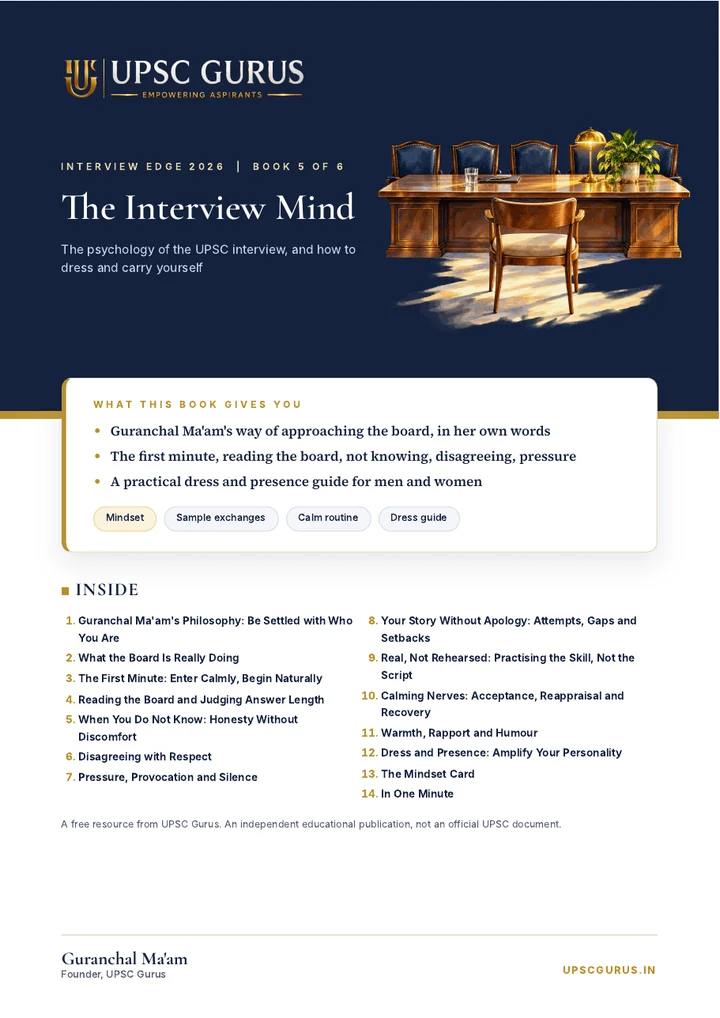
Six free UPSC interview books. 336 pages, nothing repeated.
336 pages of thoughtful guidance, worked examples and practical tools. Everything you need to prepare with clarity, think independently and speak in your own voice. By Guranchal Ma’am, Founder, UPSC Gurus.
Interview Edge Studio
Practise from your own profile: a field-by-field DAF check, 100 questions drawn from your details, feedback on answers you write in your own words, and situation practice from your home state. Built on the method of Guranchal Ma’am, Founder, UPSC Gurus.