UPSC Interview Hobby Questions: Make Your Interests Count
A hobby need not sound extraordinary. Learn how questions can develop from a simple interest, how to prepare honest answers and how to handle thoughtful follow-ups without turning your life into a script.
How do UPSC interview hobby questions unfold?
A hobby in your DAF may lead from why you enjoy it to what you do, then to an observation, limit or ethical choice. These are possible practice trails, not official questions or predictions.
Use this progression to understand the conversation rather than memorise an answer:
| Layer | What to prepare | Birdwatching illustration |
|---|---|---|
| Fact | What the interest is | Observing birds |
| Reason | Why it holds your attention | Enjoying changes in behaviour and surroundings |
| Experience | What you actually do | Keeping a small sighting log |
| Judgement | How you respond to a situation | Choosing not to disturb a nesting bird |
| Boundary | What you cannot claim | A personal log is not a population survey |
The aim is to describe something real with clarity and proportion.
How to prepare hobbies for a UPSC interview in layers
Prepare these five questions for any genuine interest, including cooking, running, listening to music or birdwatching.
- What draws me to it? Give a personal reason rather than a catalogue of desirable qualities.
- What do I do? Identify a repeatable activity: a dish cooked, a running routine, a composition revisited or a sighting recorded.
- What have I noticed? Select one precise detail that came from doing or paying attention.
- What could I be asked to judge? Consider an assumption, a trade-off or an effect on other people.
- Where does my knowledge stop? Separate enjoyment from training, observation from proof and a personal contribution from a team result.
Now practise moving between these layers. Answer the opening naturally, then let the next question narrow the subject. You need not claim that an interest develops leadership or discipline.
For an ordinary hobby, depth means knowing your own experience well. It does not mean presenting yourself as an expert.
Inside: 100 questions across ten important interview categories; natural sample answers with the thinking explained; weaker responses, likely follow-ups and better approaches.
Download 100 Answers, Thought ThroughSee all six books →Birdwatching hobby questions in the UPSC interview: a sample trail
Rohan watches birds around the Bor Tiger Reserve area and keeps a personal log.
- What attracted you to birdwatching? Rohan can describe how identifying birds gradually led him to notice behaviour and the surroundings. The answer begins with curiosity, not a claim that birdwatching made him a leader.
- What do you record in your log? He notes the date, place, approximate time, species he can identify and observations about feeding, calls or movement between trees. An uncertain identification stays uncertain.
- Does a fall in sightings prove fewer birds? No such conclusion follows from his informal notes alone. He would need a more rigorous method to make claims about population changes.
- Can birdwatching harm birds? Approaching nests, disturbing roosting birds or repeatedly attracting attention can interfere with normal behaviour. Distance and local access rules matter.
- What if another visitor approached a nest for a photograph? Think through a respectful, responsible response without putting the photograph ahead of the bird.
Separate observation, inference and evidence.
Cooking as a hobby: from a favourite dish to a thoughtful judgement
Rohan enjoys preparing regional Vidarbha food. Asked to describe a dish, he chooses zunka with bhakri, familiar from home.
He can explain that zunka uses gram flour, onions and spices, with variation between households. He can describe how heat, seasoning, timing and moisture affect texture. Such detail matters more than a generic virtue.
Try this question trail
- Describe a dish you enjoy preparing.
- How would you adapt it for someone who dislikes spicy food?
- How does the cooking you know differ from other Maharashtrian styles?
- Is traditional food necessarily healthier than modern food?
- Should nutrition programmes give attention to familiar regional foods?
The fourth question invites balance. Cultural attachment does not establish nutritional superiority. Preparation, quantity and individual needs matter. Nor should a candidate claim that a widely shared dish belongs exclusively to Vidarbha. Avoid exaggerated uniqueness.
UPSC interview hobbies list: music, running and everyday interests
There is no need to invent an unusual hobby. The examples in these practice materials include birdwatching, regional cooking, listening to Carnatic music and running. Describe your actual involvement.
Listening to Carnatic music
Meera enjoys music as a listener and has no formal vocal training. She can explain that a raga provides a melodic framework and tala organises rhythm, while musicians bring variation to a composition. She can also say that repeated listening reveals details she missed earlier. She need not claim to be a singer.
Running
Meera can speak about learning to adjust her pace instead of judging every run by speed or distance. A natural follow-up is how she decides when to push and when to rest. Another asks whether consistency is always more important than intensity. Her reflection is specific and measured: progress can be uneven.
Prepare interests that genuinely belong to your life.
What if the board asks something beyond your hobby knowledge?
Depth and honesty belong together. If Meera is asked, Can you sing for us?, she can explain that she listens to Carnatic music but has not trained as a vocalist. If comfortable, she can hum a familiar passage without calling it a performance.
That answer does not weaken her interest. Listening is an interest in its own right. Rohan similarly leaves uncertain sightings uncertain and never calls his log a scientific survey.
Prepare a calm boundary sentence for your own hobby: This is what I have observed or practised; I have not studied that part in depth. Explain what you do know rather than inventing technical knowledge.
Resist sweeping descriptions such as the purest music, the healthiest traditional food or a hobby that makes someone fearless. Precision and proportion communicate more than grand claims.
“Your hobby does not need to become a leadership lesson. Let it be something you genuinely enjoy.”
Guranchal Ma’am
Founder, UPSC Gurus
Should you connect hobbies with public life and administration?
Only where the question naturally invites it. Do not attach governance lessons to every activity. If asked about wider consequences, respond thoughtfully.
- Birdwatching and environmental responsibility: Enjoyment has limits when observation disturbs wildlife. Responsible conduct may mean keeping distance or moving away. Consider whether access to sensitive habitats should be restricted in certain seasons.
- Cooking and public nutrition: Respect regional preferences while examining nutritional value separately. Ask how healthier eating can be encouraged without dismissing people’s tastes.
- Running and personal judgement: Discuss pacing, rest and sustainable effort without claiming that a recreational activity proves administrative competence.
Achievements and volunteering can produce related trails, though they are not hobbies. Rohan’s rainwater harvesting model was a team demonstration, not proof that a village’s water scarcity was solved. NSS invites reflection on working with people while respecting their knowledge and choices.
The common thread is proportionate judgement: understand the people affected, recognise evidence and limits, and respond without overstating your role.

A profile session with Guranchal Ma’am and a mock interview before a panel of seasoned officers, with detailed feedback. Online. State PCS and Hindi medium candidates warmly welcome.
Apply for Interview EdgeHow to practise hobby questions using the free Interview Edge books
Write one opening answer in your own words. Then practise moving from activity to detail, judgement and boundary. Avoid a script.
- Describe the interest in your own words.
- Answer a question about what you actually do.
- Give a concrete example or observation.
- Consider one awkward or ethical follow-up.
- State honestly what you do not know.
After each attempt, notice whether you sounded specific or simply recited admirable qualities. Revise the thinking, not every sentence. A good practice answer should still sound like you.
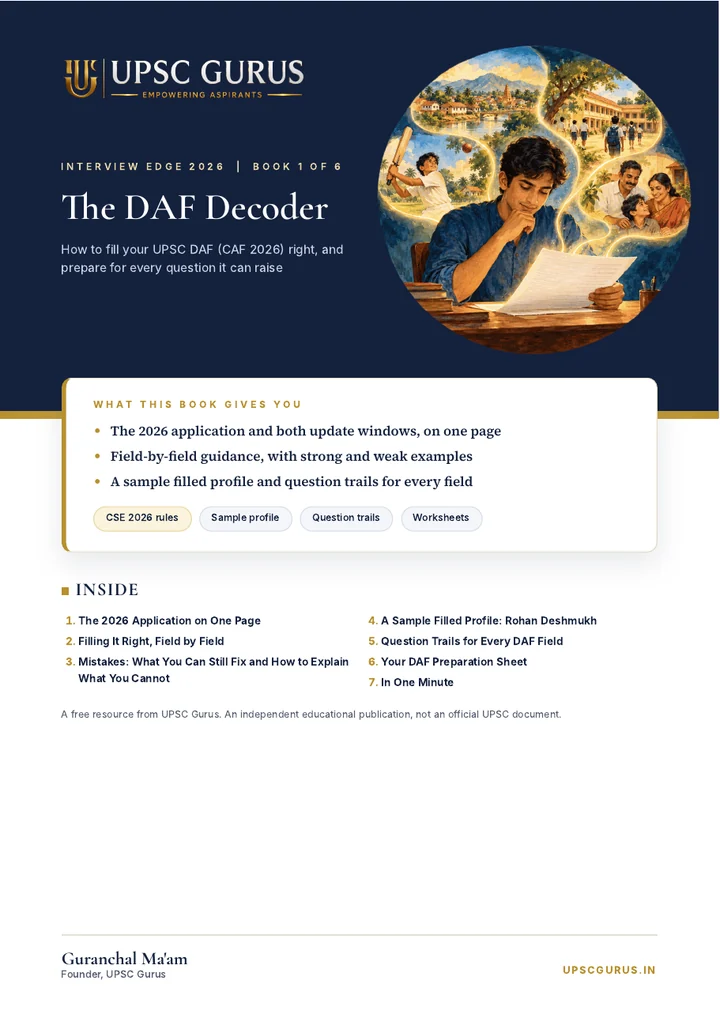
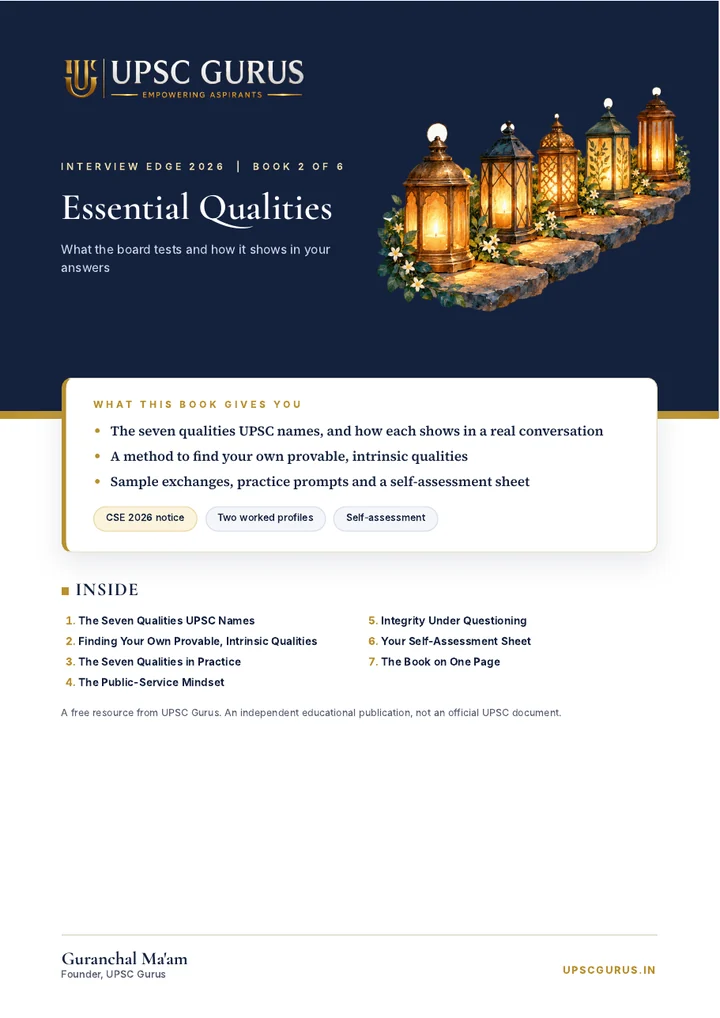
The DAF Decoder helps you build question trails from fields in your form, including hobbies and personal interests. 100 Answers, Thought Through shows how to reason through personal questions, follow-ups and the limits of a claim. Both are free UPSC Gurus Interview Edge books. Use them to prepare your own responses, not to borrow someone else’s personality.
Frequently asked questions
What hobby questions are asked in a UPSC interview?
Possible openings ask why you enjoy an interest and what you actually do. Follow-ups may explore a detail, a practical situation, an assumption or the limits of your knowledge. The birdwatching, cooking and music trails above are practice possibilities, not official questions or predictions.
Is there a UPSC interview hobbies list to choose from?
Examples in this guide include birdwatching, cooking, listening to Carnatic music and running. They are illustrations, not a prescribed or ranked list. Choose language that reflects an interest you genuinely pursue rather than selecting a hobby because it sounds impressive.
How should I prepare an ordinary hobby for the UPSC interview?
Prepare why you enjoy it, what you do, one observation, a possible judgement question and an honest boundary. For cooking, know a dish and its method. For running, reflect on pace and rest. Specific lived experience is enough to begin.
Can I mention music as a hobby if I cannot sing?
Yes. Meera's example treats listening to Carnatic music as a meaningful interest without claiming vocal training. If asked to sing, represent your ability accurately. You can speak about what you listen for, while recognising the difference between appreciation and performance.
Must I connect my hobby to public service?
No. Explain the hobby on its own terms first. If the conversation moves towards public life, discuss a relevant issue thoughtfully, such as protecting birds from disturbance or respecting regional food preferences in nutrition programmes. Do not manufacture a leadership lesson.
Six free UPSC interview books. 336 pages, nothing repeated.
336 pages of thoughtful guidance, worked examples and practical tools. Everything you need to prepare with clarity, think independently and speak in your own voice. By Guranchal Ma’am, Founder, UPSC Gurus.
Interview Edge Studio
Practise from your own profile: a field-by-field DAF check, 100 questions drawn from your details, feedback on answers you write in your own words, and situation practice from your home state. Built on the method of Guranchal Ma’am, Founder, UPSC Gurus.