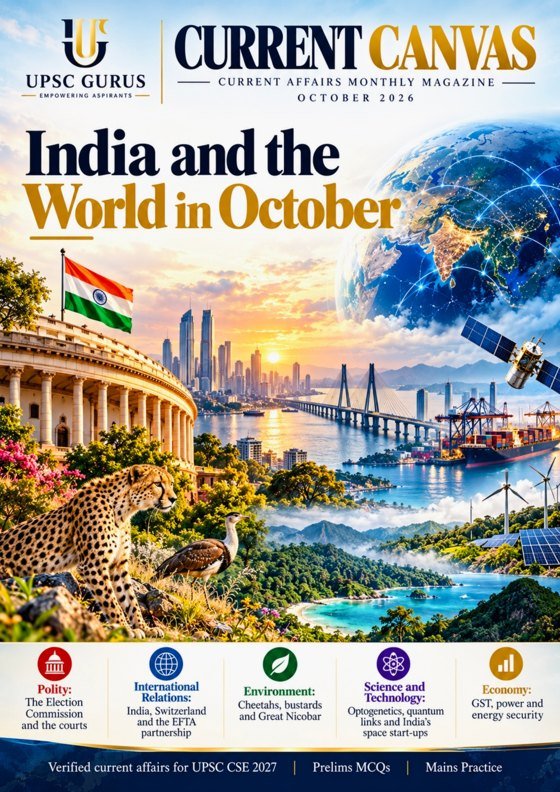
UPSC Interview Dress Code 2026: Amplify Your Personality
What should you wear for the UPSC Personality Test? There is no prescribed dress code. Here is Guranchal Ma'am's practical guidance on choosing attire that reflects the value you give to the interview while keeping you comfortable and confident.
Is There an Official UPSC Interview Dress Code?
No. UPSC does not prescribe an official dress code for the Civil Services Personality Test. The CSE 2026 notice does not specify any compulsory garment, colour or footwear. A sari is not mandatory for women, nor is a suit mandatory for men. No outfit carries marks.
Guranchal Ma’am, Founder of UPSC Gurus, offers a simple principle: Amplify your personality with your clothes. Choose something comfortable, something you feel good in. Your attire should also reflect the value you give to this interaction. Your clothes reflect how you regard the interview. Let them complement your presence without becoming the centre of attention.
Guranchal Ma’am’s suggested attire is a sari or salwar suit for women, and a suit or bandhgala for men. These are suggestions, not rules: wear whatever you are comfortable in.
The five questions to ask before choosing
- Professional: Does it reflect the seriousness and value you attach to this interaction?
- Comfortable: Can you walk, sit and speak naturally?
- Familiar: Are you comfortable wearing this style?
- Well-fitted: Does anything pull, slip, gape or restrict movement?
- Personally suitable: Does the outfit feel like you?
Choose the outfit that satisfies all five. An expensive outfit offers no advantage over a modest, well-fitted one.
UPSC Interview Dress for Men: Suit or Bandhgala?
For men wondering what to wear to the UPSC interview, Guranchal Ma’am suggests a suit in navy, charcoal or black, or a bandhgala in black, navy or charcoal. All three colours are dignified choices. These are suggestions, not rules: wear whatever you are comfortable in.
| Suggested outfit | Suggested combination |
|---|---|
| Two-piece suit | Navy, charcoal or black suit, coordinated light shirt, formal shoes |
| Bandhgala | Black, navy or charcoal bandhgala, coordinated formal trousers and shoes |
Is a tie compulsory for the UPSC interview?
No. A tie is optional. If you choose to wear one with your suit, a plain or subtly patterned design can work well. Select something that feels natural and complements the overall outfit.
Fit matters more than formality alone
Check that your shirt collar feels comfortable, buttons do not pull, trousers fit when seated and your jacket allows free shoulder and arm movement. A bandhgala collar should let you breathe and speak easily.
Practise sitting while wearing your complete outfit. An outfit that looks excellent while standing may become uncomfortable at the interview table. Check trouser hems, prominent logos and stiff fabrics, particularly if the outfit is newly purchased.
The purpose of your attire is to reflect the respect you give to the interaction while allowing you to concentrate on the conversation. Choose a dignified, well-fitted outfit in which you feel comfortable and assured.
Inside: Guranchal Ma'am's philosophy of being settled with yourself; the first minute, uncertainty, disagreement and pressure; practical calming methods and a complete dress guide.
Download The Interview MindSee all six books →What to Wear for UPSC Interview: Female Candidates
For women wondering what to wear to the UPSC interview, Guranchal Ma’am suggests a sari or a formal salwar suit. Both are graceful, dignified choices. She is equally clear that seriousness and professionalism do not depend on wearing a sari. These are suggestions, not rules: wear whatever you are comfortable in.
| Suggested outfit | What to choose | Practical consideration |
|---|---|---|
| Sari | Plain or subtly textured fabric, coordinated blouse | Secure drape and pleats, comfortable movement |
| Salwar suit | Solid colour, comfortable cut, breathable fabric | Well-fitted clothing and a comfortable, secure dupatta |
Should you wear a sari to the UPSC interview?
Choose a sari if you enjoy wearing one, can arrange its pleats securely and feel comfortable walking and sitting in it. Cotton, cotton blends, light silk, silk blends and familiar handlooms can all work. How the fabric behaves matters more than its name.
If you are unfamiliar with draping, the pallu repeatedly slips or the blouse restricts movement, a well-fitted formal salwar suit with a secure dupatta may be more comfortable.
Whatever you decide to wear should reflect the value you give to the interview while remaining true to your personality. Practise sitting, standing and speaking in the complete outfit. Your clothes should support your presence, not become your performance.
Which Colours Are Best for UPSC Interview Dress?
UPSC prescribes no colour for interview clothing. These combinations are practical suggestions, not a compulsory palette. Choose colours that complement you, look professional in indoor light and feel natural to wear. Black is also a dignified choice, including for a suit or bandhgala.
Suggested colour combinations for men
| Main colour and outfit | Pairing |
|---|---|
| Navy suit | White or pale-blue shirt, dark formal shoes |
| Charcoal suit | White or pale-blue shirt, black formal shoes |
| Black suit | White or light-coloured shirt, black formal shoes |
| Navy bandhgala | Coordinated navy trousers, dark formal shoes |
| Charcoal bandhgala | Coordinated charcoal trousers, black formal shoes |
| Black bandhgala | Coordinated black trousers, black formal shoes |
Suggested colour combinations for women
| Main colour for sari or salwar suit | Pairing |
|---|---|
| Deep navy | Ivory or silver-grey blouse, or coordinated dupatta |
| Slate blue | Matching or charcoal accents |
| Soft sage green | Ivory or beige |
| Dusty rose | Muted grey or charcoal |
| Muted maroon | Beige or understated gold-toned accents |
| Ivory or cream | Navy or muted brown |
| Deep teal | Neutral accessories |
| Charcoal | White, pale blue or muted pastels |
| Black | Cream, ivory or restrained neutral accents |
Consider whether glittering fabrics, very busy prints or strong colour contrasts might draw attention away from the conversation. The objective is harmony, not uniformity.
No colour gives you additional UPSC interview marks. Select one you genuinely like, bearing in mind the value you attach to the interaction, then let the discussion take priority.
UPSC Interview Footwear, Fit and Accessories: What Matters?
You do not need a new wardrobe. A familiar outfit that has been properly pressed or altered may serve you better than an expensive new one.
Footwear for men and women
- Men: Clean formal shoes or understated formal footwear that you have worn comfortably with your suit or bandhgala.
- Women: Comfortable formal flats or familiar low-to-moderate heels that complement your sari or salwar suit.
- Indian formal wear: Comfortable, coordinated footwear that supports natural movement.
- Adaptive needs: Your usual orthopaedic or supportive footwear, when needed, takes priority over appearance.
Avoid wearing new shoes for the first time on the day; comfort and safety come before style.
Accessories and finishing touches
Keep accessories simple, secure and quiet. Consider jewellery that does not clink, scarves or dupattas that remain in place and accessories that do not need repeated adjustment. An ordinary watch is acceptable, but not a smart watch.
The CSE 2026 notice prohibits mobile phones, including switched-off phones, and smart watches at UPSC venues. No safe-keeping is arranged. Leave these devices behind.
Keep perfume very light or omit it. Strong fragrance can be uncomfortable in a closed room.
Finally, check for tight collars, slipping dupattas, loose sari pleats, restrictive jackets and uncomfortable waistbands. Correct these through alterations or a different outfit.
UPSC Interview Grooming, Cultural and Religious Attire
A professional appearance does not require abandoning your cultural identity, religious clothing or individual style. Regional sari drapes, turbans, religious head coverings, modest formal clothing and other personally suitable attire are welcome.
Clothing adapted for disability, mobility or sensory comfort is also appropriate. Prioritise safety, ease of movement and necessary assistive devices. Professionalism is expressed through dignity and conduct, not conformity to one style.
A practical grooming checklist
- Keep hair clean and manageable. If it is long, choose a familiar style that stays away from your face.
- Keep your beard or moustache neat in your usual style.
- Ensure nails are clean and clothes are pressed.
- Check for stains, loose threads and unclean shoes.
- Make-up is optional. If worn, choose a familiar, comfortable look.
Avoid drastic changes to your usual appearance immediately before the interview. The CSE 2026 process includes an uploaded photograph, a live photograph during the application and face authentication at UPSC venues. Looking recognisably like yourself is practical.
Your aim is to arrive feeling neat, comfortable and recognisable, ready to participate in a thoughtful conversation.
“Amplify your personality with your clothes; do not let them compete with it.”
Guranchal Ma’am
Founder, UPSC Gurus
UPSC Interview Dress Checklist: Try Your Complete Outfit Before the Day
Select your outfit several days before the Personality Test. Then complete this practical rehearsal. It helps you identify problems that are easy to miss while standing in front of a mirror.
- Wear the complete outfit. Include shoes, belt, tie, dupatta, jewellery and other accessories you intend to wear, as applicable.
- Walk for five minutes. Notice whether your shoes rub, trousers restrict movement or your sari catches.
- Sit for fifteen to twenty minutes. Check the waist, collar, blouse, jacket and drape while seated.
- Practise moving naturally. Stand, sit again and turn towards people on either side. Notice whether you can move comfortably.
- Speak aloud for several minutes. Observe whether anything restricts your breathing, posture or gestures.
- Inspect the complete appearance. Ensure clothes are pressed, appropriately opaque and coordinated. Check that nothing slips, gaps or catches.
- Wear it during a mock interview. Notice whether you can concentrate fully without adjusting your clothing.
- Make your final decision. If something continues to bother you, alter it or choose another outfit, even if you have already purchased it.
On the interview day, move your chair only if it is too close to the table and you need to create enough space to sit comfortably. If you can already sit comfortably, leave the chair as it is. There is no need for unnecessary adjustment.
The strongest result of this rehearsal is simple: you can forget about your clothing once the interview begins.

A profile session with Guranchal Ma’am and a mock interview before a panel of seasoned officers, with detailed feedback. Online. State PCS and Hindi medium candidates warmly welcome.
Apply for Interview EdgeThree UPSC Interview Outfit Examples and One Final Principle
These three examples show how different formal outfits can meet the same standards of comfort, fit and professionalism.
| Candidate | Complete outfit | Final comfort check |
|---|---|---|
| Rohan | Navy two-piece suit, pale-blue shirt, optional plain tie, simple belt and familiar dark formal shoes | Can sit and answer comfortably without jacket restriction |
| Meera | Understated slate-blue sari, coordinated blouse, small earrings and familiar formal flats | Drape remains secure while walking and sitting |
| Candidate choosing a salwar suit | Deep-teal straight-cut salwar suit, secure dupatta, simple accessories and comfortable formal flats | No repeated adjustment of dupatta or sleeves |
None of these outfits is inherently better than another. Their suitability comes from how well each supports the person wearing it.
If you are choosing between two acceptable outfits, favour the one in which you can walk naturally, sit comfortably and speak without adjusting anything.
Continue preparing with The Interview Mind
For more practical guidance on dress, presence and interview readiness, explore The Interview Mind, a free book from UPSC Gurus’ Interview Edge 2026 library.
Guranchal Ma’am’s central message is worth carrying into your preparation: the interview is about the person you are, not the outfit you purchase. Choose your clothes with care, then give your attention to the conversation.
Frequently asked questions
What is the official UPSC interview dress code in 2026?
UPSC does not prescribe an official dress code for the Civil Services Personality Test. The CSE 2026 notice specifies no compulsory garment, colour or footwear. Guranchal Ma'am suggests a sari or salwar suit for women, and a suit or bandhgala for men. These are suggestions, not rules: wear whatever you are comfortable in. No outfit carries marks.
What should a female candidate wear for the UPSC interview?
Guranchal Ma'am suggests a comfortable sari or a formal salwar suit. She does not consider a sari compulsory. These are suggestions, not rules: wear whatever you are comfortable in. Choose attire that reflects the value you give to the interview and allows you to walk, sit and speak without repeated adjustments.
What is the best UPSC interview dress for men? Is a suit compulsory?
Guranchal Ma'am suggests a navy, charcoal or black suit, or a bandhgala in black, navy or charcoal. A black suit or black bandhgala is a dignified choice. Neither a suit nor a tie is compulsory under the CSE 2026 notice. These are suggestions, not rules: wear whatever you are comfortable in, prioritising fit, familiarity and a professional appearance.
Which colour is best for the UPSC interview?
There is no prescribed or marks-winning colour. Navy, charcoal and black are dignified choices for men's suits and bandhgalas. Women may consider navy, sage green, dusty rose, deep teal, muted maroon, cream, charcoal or black for a sari or salwar suit. Choose a colour that complements you and feels natural.
Can I wear traditional, cultural or religious clothing to the UPSC interview?
Yes. Professional regional clothing, turbans, religious head coverings, modest attire and clothing adapted for disability or sensory needs are appropriate. Choose clothing that supports your comfort, mobility and personal identity. Professionalism does not require everyone to dress alike.
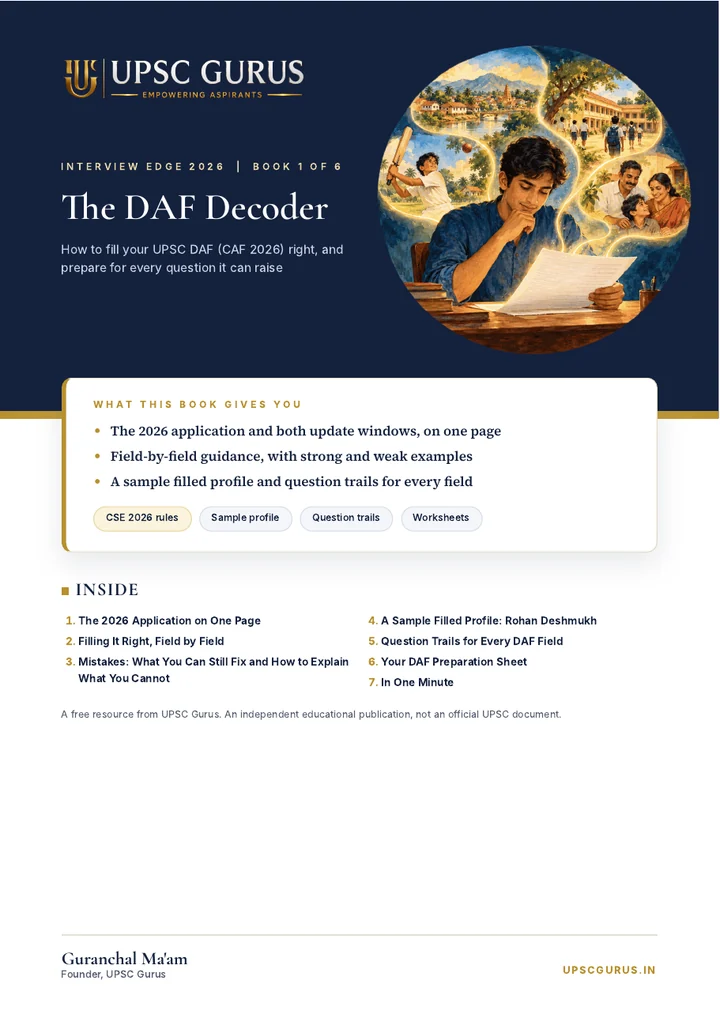
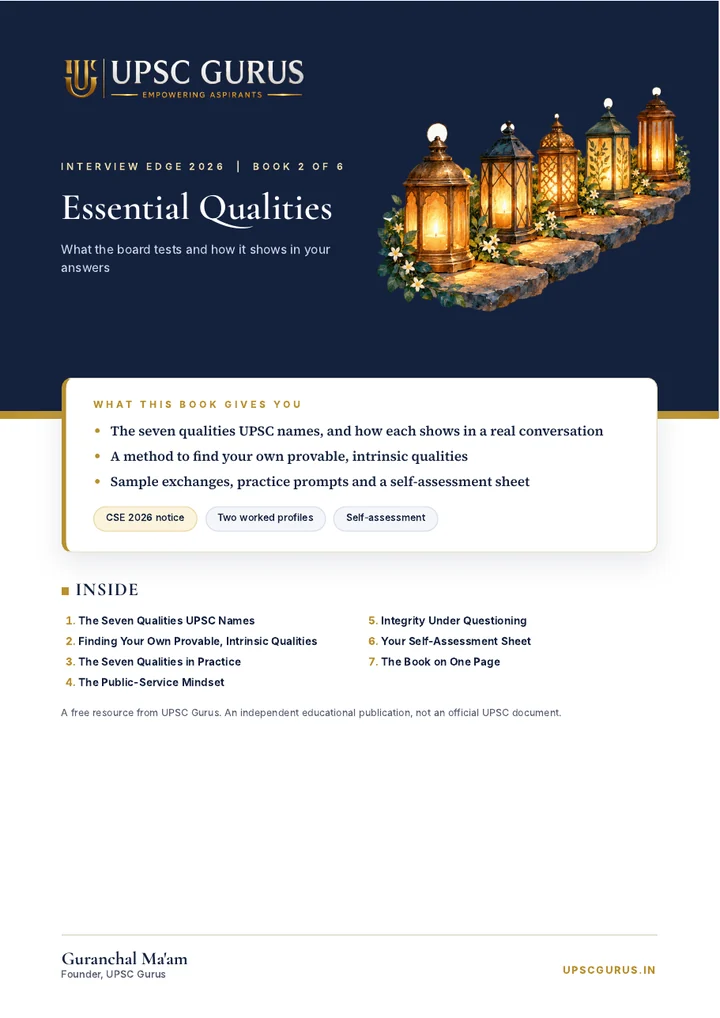
Six free UPSC interview books. 336 pages, nothing repeated.
336 pages of thoughtful guidance, worked examples and practical tools. Everything you need to prepare with clarity, think independently and speak in your own voice. By Guranchal Ma’am, Founder, UPSC Gurus.
Interview Edge Studio
Practise from your own profile: a field-by-field DAF check, 100 questions drawn from your details, feedback on answers you write in your own words, and situation practice from your home state. Built on the method of Guranchal Ma’am, Founder, UPSC Gurus.