State PCS Interview Preparation Think Like an Administrator
Your State PCS interview preparation should connect knowledge of your state and district with sound judgement, clear communication and a genuine understanding of public responsibility. Here is a structured way to prepare.
What Qualities Should You Develop for a State PCS Interview?
A public service interview is an opportunity to demonstrate how you think, listen, assess situations and approach responsibility. Preparation should develop these abilities, not merely increase the number of facts you remember.
The UPSC Civil Services Personality Test framework names seven qualities. Although this is not an official assessment formula for State Public Service Commissions, it offers a useful method for preparing your thinking.
- Mental alertness: Understand the question and recognise when a follow-up changes the situation.
- Critical powers of assimilation: Distinguish facts from assumptions. Identify what further information is needed.
- Clear and logical exposition: Give a direct answer, explain your reasoning and know when to stop.
- Balance of judgement: Consider competing interests before reaching a defensible conclusion.
- Variety and depth of interest: Discuss genuine interests with understanding rather than impressive terminology.
- Ability for social cohesion and leadership: Listen to different perspectives, coordinate and accept responsibility.
- Intellectual and moral integrity: Acknowledge uncertainty, correct mistakes and remain truthful.
How do these qualities appear in an answer?
Suppose you are asked whether private vehicles should be banned from a busy market area. A quick yes or no overlooks important considerations.
A stronger response considers pedestrian safety, public transport, deliveries and the needs of people with disabilities. It may recommend examining timed restrictions or a pedestrian-priority zone before introducing a complete ban. If evidence establishes immediate danger, stronger restrictions may be justified.
The important skill is not avoiding a decision. It is reaching one after considering the relevant facts and people affected.
Remember: Do not announce that you possess these qualities. Allow them to become visible through your answers.
How to Prepare Your Home State and District for a State PCS Interview
Your home state and district deserve careful preparation because they connect your personal experience with the realities of public administration.
Knowing a district means more than remembering its rivers, history or industries. You should understand how geography influences livelihoods, why development differs across regions and which problems deserve administrative attention.
Build your preparation in this order
- District identity: Prepare a clear, accurate introduction to your district in approximately 60 seconds.
- Three important district issues: Understand their causes, affected groups and possible responses.
- State economy: Examine economic strengths and differences between regions without generalising.
- Geography and agriculture: Connect physical conditions, infrastructure and livelihoods.
- History and culture: Know distinctive contributions and their significance.
- Social indicators: Understand selected figures, their dates and what they do or do not establish.
- Governance: Examine implementation challenges and outcomes rather than simply listing schemes.
- Recent developments: Explain their significance and likely consequences.
- Administrative situations: Practise choosing realistic, lawful responses to local problems.
Prepare comparison questions
Consider the question, ‘How is your district different from a neighbouring district?’
Compare geography, economic activity, infrastructure, social conditions and development outcomes. Explain why these differences exist and what they mean for residents.
Avoid describing one district as entirely successful and another as unsuccessful. Specific comparisons demonstrate greater understanding.
Your preparation test: Can you explain one reliable fact, why it matters and what conclusion can reasonably be drawn from it?
Inside: the seven qualities named in the UPSC notice; two worked profiles showing how personal qualities emerge; sample exchanges, practice prompts and self-assessment worksheets.
Download Essential QualitiesSee all six books →How Do You Turn State and District Facts into Strong Interview Answers?
Facts provide the foundation of an answer. Interpretation makes those facts useful.
For local issues, practise a five-level method. You will not need every level for every question, but understanding the sequence helps you respond naturally.
- Identify: State one accurate fact or clearly identify the issue.
- Explain: Discuss the causes or conditions behind it.
- Connect: Identify who or what is affected.
- Evaluate: Consider existing responses, limitations and remaining gaps.
- Respond: Recommend a feasible action and explain how its effectiveness could be assessed.
Worked example: drinking-water reliability
Imagine a district where some settlements experience interruptions in drinking-water supply. This is a hypothetical situation, not a claim about any particular district.
Identify: Some settlements experience unreliable supply.
Explain: Possible causes include seasonal source depletion, inadequate storage, distribution losses and power interruptions.
Connect: Unreliable water affects sanitation, household routines and the time residents spend arranging water.
Evaluate: A new water connection does not automatically guarantee reliable, safe supply.
Respond: Examine habitation-level supply records and complaints, identify interruptions, prioritise repairs and monitor actual reliability.
Notice that the final response does not promise to solve everything immediately. It shows how a responsible decision could be developed.
One distinction matters: A factual question may require only a direct answer. An administrative question requires evidence, judgement and an appropriate course of action.
The DM's Desk Approach: How Would You Handle a District Problem?
Questions beginning with ‘Suppose you are the District Magistrate’ are an opportunity to demonstrate practical judgement.
You are not expected to possess complete administrative experience before entering public service. You can, however, show how you would approach an unfamiliar responsibility.
Use this decision sequence
- Understand the immediate problem: Is there a threat to safety, an essential service or a developing conflict?
- Establish the facts: Identify what is known, what is assumed and what needs confirmation.
- Identify affected people: Consider different groups, particularly those whose needs may be overlooked.
- Recognise your authority: Separate actions within your responsibility from those requiring technical expertise or coordination.
- Choose an immediate response: Address essential needs and prevent avoidable harm.
- Develop a lasting response: Involve relevant officials and stakeholders, and consider practical constraints.
- Assess the outcome: Decide what evidence would show whether the intervention worked.
Worked situation: a dispute between two villages
Board: Two villages are disputing access to a limited drinking-water supply. What would you do?
Illustrative response: ‘Sir, my immediate priority would be to ensure safe drinking water for essential household needs in both villages. I would establish the actual availability and the nature of the dispute, and arrange temporary measures if necessary. For a sustainable solution, I would involve technical officials and representatives of both communities. Allocation should be transparent, based on need and not influenced by the relative power of either group.’
Why this approach works
It identifies an immediate priority, treats both communities fairly, recognises technical constraints and separates temporary arrangements from long-term decisions.
It also avoids promising resources that may not exist.
The principle: Administrative judgement means understanding the problem, choosing a proportionate response and accepting responsibility for the process.
HCS, PPSC and UPPSC Interview Preparation: What Should You Focus On?
Whether you are planning HCS interview preparation, PPSC interview preparation or UPPSC interview preparation, you can use the same foundational method: understand your profile, prepare local issues deeply and practise reasoned responses to public problems.
The examples below organise your preparation. They do not describe any commission’s official questions or marking criteria.
| Preparation area | How to approach it |
|---|---|
| Personal background | Explain your education, interests and experiences accurately and naturally. |
| Home state | Understand its economy, regional differences, history, culture and governance challenges. |
| Home district | Prepare its identity, three important issues and connections between causes and outcomes. |
| Local comparisons | Compare neighbouring areas through evidence rather than broad judgements. |
| Administrative situations | Establish facts, consider affected groups, decide and explain implementation. |
| Interview conduct | Communicate clearly, listen carefully and acknowledge the limits of your knowledge. |
Practise questions with increasing depth
Begin with ‘What is your district known for?’ Then move to ‘Why has industrial development been uneven across your state?’ Finally, consider ‘As District Magistrate, what would be your first priority?’
These questions test different abilities. The first requires an accurate description. The second requires an explanation of causes and regional variation. The third requires a reasoned choice, supported by evidence and awareness of responsibility.
Use your actual experiences wherever relevant. If your understanding comes from data or reporting rather than personal observation, make that distinction clear.
“You do not need to know every administrative answer. You need to show how you would approach responsibility. | Guranchal Ma'am, Founder, UPSC Gurus”
Guranchal Ma’am
Founder, UPSC Gurus
How Should You Speak and Conduct Yourself in a State PSC Interview?
Good communication is not about complicated vocabulary or instant replies. It is about understanding the question and making your reasoning easy to follow.
Six habits for thoughtful interview conduct
- Listen before answering: Notice the precise question, including any changed condition in a follow-up.
- Take a brief pause when needed: Alertness means accurate understanding, not speed for its own sake.
- Answer directly: State your position, give the main reasoning and stop when the answer is complete.
- Acknowledge uncertainty: If you do not know a figure, say so. You can still explain what evidence your assessment would require.
- Disagree respectfully: Recognise the other perspective, identify your concern and explain it calmly.
- Correct mistakes: Do not continue defending a statement once you recognise that it is inaccurate.
How to handle a challenging opinion question
Board: ‘Do you think government employees are less efficient than private-sector employees?’
An automatic agreement or an immediate rejection may overlook the complexity of the issue.
A more considered response would explain that efficiency depends on incentives, resources, accountability and the nature of the work. It addresses the question without relying on an unsupported generalisation.
What if the board challenges your answer?
Listen to the objection and consider whether it changes your reasoning. You may revise your position, clarify it or disagree courteously.
Confidence is not certainty. Courtesy is not agreement. A calm, well-reasoned answer can express either a firm conclusion or genuine uncertainty.

A profile session with Guranchal Ma’am and a mock interview before a panel of seasoned officers, with detailed feedback. Online. State PCS and Hindi medium candidates warmly welcome.
Apply for Interview EdgeYour State PCS Interview Preparation Plan and Free Resources
A useful preparation plan moves from understanding to conversation. Organise your work around a few connected tasks rather than collecting unrelated facts.
Step 1: Prepare your personal and local foundation
Write a short introduction to your district. Identify three issues you understand well. For each, note its causes, affected groups, possible responses and the evidence you would need before reaching a conclusion.
Step 2: Practise four types of questions
- Factual: Give a precise answer without unnecessary additions.
- Explanatory: Show how the main causes produce an outcome.
- Comparative: Identify meaningful similarities, differences and their significance.
- Administrative: Explain priorities, evidence, constraints, decisions and implementation.
Step 3: Follow every answer with another question
If you identify youth migration as a local concern, ask yourself why young people move. Then consider whether all migration is undesirable.
Migration may also represent opportunity. A thoughtful response distinguishes movement by choice from movement driven by limited local options.
Step 4: Review the quality of your reasoning
After a practice conversation, ask whether you answered the actual question, supported important claims, considered affected people and reached a clear conclusion. Identify one aspect to improve in your next attempt.
Three free books from UPSC Gurus
- Essential Qualities: Understand seven qualities associated with public service suitability and how to demonstrate them through answers.
- Your Home State and District: Build connected local knowledge, interpret district issues and approach administrative questions.
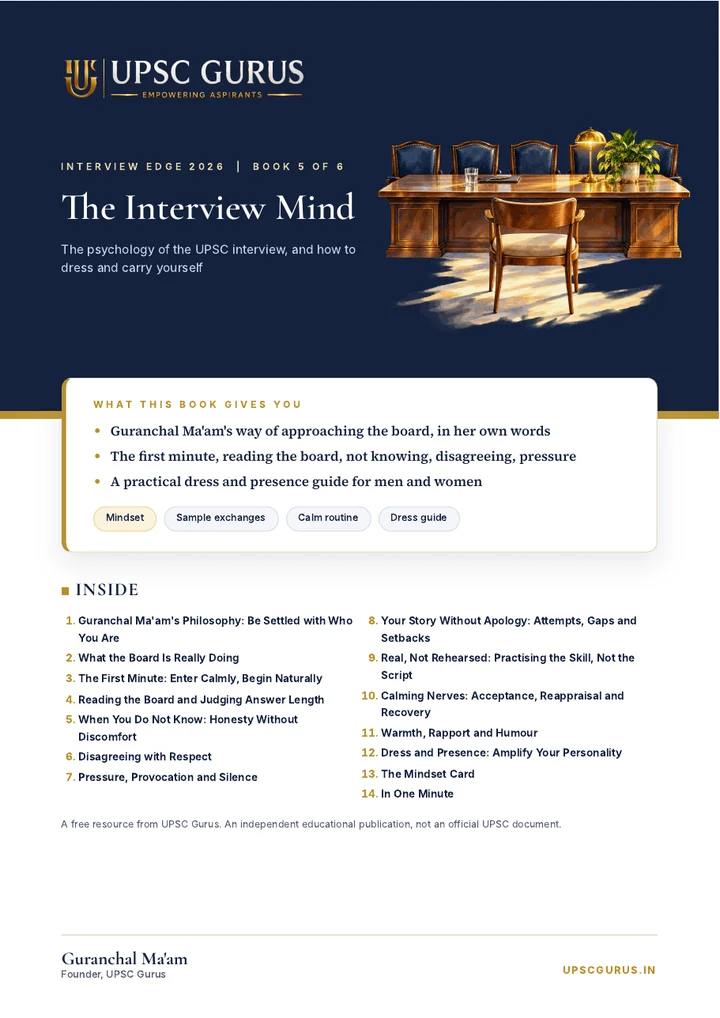
- The Interview Mind: Understand purposeful interview conversations and develop composure, clarity and balanced judgement.
These free books can support a structured approach to your preparation.
Interview Edge welcomes State PCS candidates
UPSC Gurus, led by Guranchal Ma’am, Founder, UPSC Gurus, welcomes State PCS interview candidates through Interview Edge.
The guiding philosophy is simple: prepare to understand your experiences, think carefully about public problems and express your judgement with clarity. Your answers should reflect your own understanding, not a personality constructed for the interview.
Frequently asked questions
How should I start State PCS interview preparation?
Begin with your personal background, home state and district. Prepare three important local issues in depth. Then practise factual, explanatory, comparative and administrative questions. Focus on clear reasoning, balanced judgement and honest communication.
How do I prepare for the HCS interview?
For HCS interview preparation, build strong knowledge of your own state and district, understand local development issues and practise administrative situations. Use facts to explain causes, affected groups, possible actions and implementation challenges. Prepare to discuss your personal experiences naturally.
What should I study for PPSC interview preparation?
Focus on your personal profile, state economy, district geography, regional differences, culture, governance and important local issues. Practise moving beyond factual knowledge to explanations, comparisons and practical decisions. Give particular attention to the clarity and accuracy of your answers.
How can I prepare effectively for the UPPSC interview?
Develop a connected understanding of your state and district. Prepare three significant district issues with causes, consequences and feasible responses. Practise questions about regional development, public services and administrative priorities. Show balanced judgement rather than memorised solutions.
Is Interview Edge available for State PCS candidates?
Yes. Interview Edge at UPSC Gurus welcomes State PCS candidates. You can also explore three free books: Essential Qualities, Your Home State and District, and The Interview Mind. Together, they provide a structured foundation for thoughtful interview preparation.
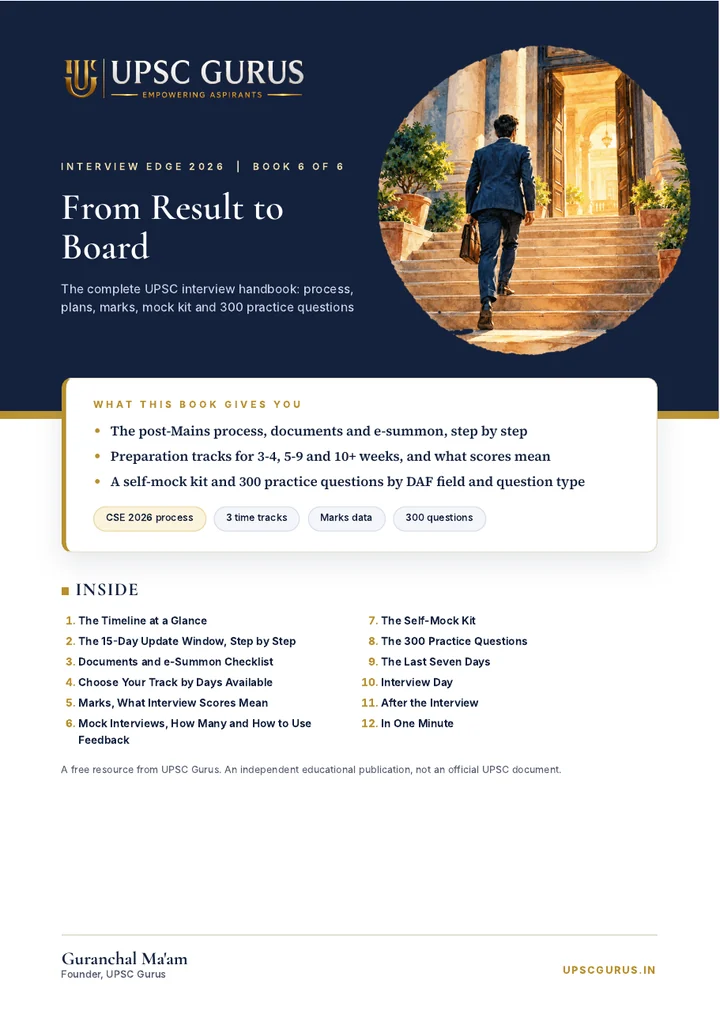
Six free UPSC interview books. 336 pages, nothing repeated.
336 pages of thoughtful guidance, worked examples and practical tools. Everything you need to prepare with clarity, think independently and speak in your own voice. By Guranchal Ma’am, Founder, UPSC Gurus.
Interview Edge Studio
Practise from your own profile: a field-by-field DAF check, 100 questions drawn from your details, feedback on answers you write in your own words, and situation practice from your home state. Built on the method of Guranchal Ma’am, Founder, UPSC Gurus.