UPSC Mains Result: What Next? Your Interview Roadmap
The Mains result begins a new stage. Here is a calm, practical guide to the compulsory update window, document preparation, interview schedule and a study plan shaped by the time you have.
UPSC Mains result: what happens next?
After the Mains result, qualified candidates move towards the Personality Test. First, save the notice and complete the post-Mains submission. Your interview date may be announced later.
| Stage | Your action |
|---|---|
| Mains written result | Save the notice and record your roll number. |
| Post-Mains update | Complete applicable fields, upload proof and finally submit within 15 days. |
| Interview schedule | Record your allotted date and session. |
| e-Summon | Download the letter and note all instructions. |
| Document verification | Arrange originals and labelled copies. |
| Personality Test | Report at the specified venue and time. |
| Medical examination | Complete the prescribed assessment as directed. |
| Final result | Written and interview marks are combined; follow allocation instructions. |
For CSE 2026, the written examination carries 1,750 marks and the Personality Test carries 275, making 2,025 in total. There is no minimum qualifying mark for the Personality Test.
As of 29 October 2026, neither the CSE 2026 Mains result nor interview schedule had been published.
What is the UPSC 15-day post-Mains DAF update window?
The CSE 2026 rules provide a 15-day post-Mains update window, following a separate 10-day post-Prelims window. Both require submission even without changes. The search term DAF update refers here to a process using Universal Registration, the Common Application Form and an examination-specific module.
What must be completed?
- Educational qualification: Complete the fields and upload a degree certificate, final marksheet or provisional degree certificate. Applicable professional degrees need internship proof.
- Applicable profile fields: Review addresses, qualifications, achievements, employment, earlier service allocation, marital status, parental details, examinations and attempts.
- Applicable declarations: Complete applicable PwBD, debarment, OBC/EWS and socio-economic entries.
- Final submission: Log in, verify and finally submit even when nothing needs updating.
Saving a form is not final submission. Failure to finally submit cancels candidature and prevents e-summon issuance. The published closing time governs.
In CSE 2025, the window was 13 to 27 November, closing at 6:00 p.m. This was not the CSE 2026 deadline.
Inside: CSE 2026 process, documents and e-summon checklist; three preparation tracks, interview marks and mock guidance; a self-mock kit and 300 organised practice questions.
Download From Result to BoardSee all six books →How do you complete the UPSC post-Mains update and final submission?
Use your records, not memory. Sign in at upsconline.nic.in using your Universal Registration Number, application number and registered authentication details. Read the facility instructions.
- Open the correct application. Confirm your account.
- Settle education first. Match status to uploaded proof.
- Review the applicable fields. Check addresses, employment dates, achievements, attempts and declarations.
- Handle preferences carefully. Service and Home Cadre preferences have restricted changes under CSE 2026 rules, except as permitted by post-Mains provisions. Not every entry is editable.
- Audit every upload. Match uploads to claims, names and dates.
- Finally submit. Saving alone is insufficient.
- Preserve evidence. Save the acknowledgement, submission time, uploads and application copy where available.
Suggested plan: days 1 to 2, collect records; days 3 to 4, update; day 5, audit and finally submit. This is not an official deadline.
Locked fields are not automatically reopened. Use official channels for discrepancies; do not assume revision after final submission.
Which documents are needed after the UPSC Mains result?
Prepare three matching sets: originals, clear copies and secure scans. Your e-summon controls the precise requirements.
| Document group | What to prepare |
|---|---|
| Identity and interview | e-Summon, application-linked photo ID and submitted application details. |
| Age and education | Matriculation certificate; degree, final marksheet or provisional degree. |
| Reservation or relaxation | Applicable SC/ST, OBC, EWS, PwBD or relaxation certificates. |
| Additional records | Applicable higher qualification, employment, professional degree and internship records. |
| Travel and medical | Tickets, fare details, applicable claim form and medical records or aids. |
CSE 2026 photo ID options include Aadhaar, Voter Card, PAN, Passport and Driving Licence. Category certificates must satisfy the required formats, conditions and dates.
File in order: e-summon and ID, education and age, category, additional qualifications, employment, travel. Check names, dates, legibility and annexures. Separate documents from revision notes.
When will the UPSC e-summon arrive, and how should you plan travel and medicals?
After final submission, the Personality Test e-summon is issued online, not on paper. Unlike the Mains e-admit card, it gives interview-specific date, reporting, venue and document instructions.
- Download it. Check your name, roll number, reporting time, venue and entry instructions.
- Keep digital and printed copies.
- Prepare ordered originals and copies.
- Plan around your actual reporting time.
In 2023 to 2025, sessions were listed at 9:00 a.m. and 1:00 p.m. Your own summons governs.
Medical examination and travel allowance
The prescribed medical examination is mandatory and may happen on another day. Complete directed tests and referrals. Carry relevant prescriptions, aids and medical records; plan your return accordingly.
Past travel allowance rules referenced Second/Sleeper Mail/Express fare, both tickets showing fares and a claim form in duplicate. Preserve these documents and follow your schedule instructions.
“Prepare to explain your own life clearly, not to repeat a prepared paragraph.”
Guranchal Ma’am
Founder, UPSC Gurus
How much time do you get for UPSC interview preparation after Mains?
Preparation time depends on the allotted date. Begin with your profile before dates are announced.
| CSE cycle | Result date | Days to first interview | Days to last interview |
|---|---|---|---|
| 2023 | 8 December 2023 | 25 | 123 |
| 2024 | 9 December 2024 | 29 | 129 |
| 2025 | 11 November 2025 | 27 | 108 |
These are historical calendar-day intervals, not 2026 dates. Manage administration first, preparation steadily and logistics throughout.
Choose your preparation track
| Time available | Practical emphasis |
|---|---|
| Under 5 weeks, especially 3 to 4 weeks | Profile, district, academics, public issues, speaking and focused revision. |
| 5 to 9 weeks | Deeper local and academic work, judgement, mock or self-mock, feedback. |
| 10 weeks or more | Patient understanding, difficult areas and refined speaking. |
Every track covers profile, home district and state, graduation, optional, current affairs, judgement and speaking. Know, connect, judge and speak rather than memorising paragraphs.

A profile session with Guranchal Ma’am and a mock interview before a panel of seasoned officers, with detailed feedback. Online. State PCS and Hindi medium candidates warmly welcome.
Apply for Interview EdgeWhat should you do in the first 48 hours after the UPSC Mains result?
These 48 hours are a suggested plan, not an official deadline.
Day 1: establish your records
- Save the result and record roll and application numbers.
- Record the update deadline.
- List applicable fields and proof.
- Gather records and start your document file.
Day 2: organise the next steps
- Review updates, qualification proof and declarations.
- Finally submit and save confirmation.
- Calendar: interview, reporting, medical, travel and final mock.
- Draft your profile and district summary.
Until the date arrives, cover profile, district, state, academics, spoken exchanges, current affairs and judgement. Reorganise around your actual date, not a prediction.
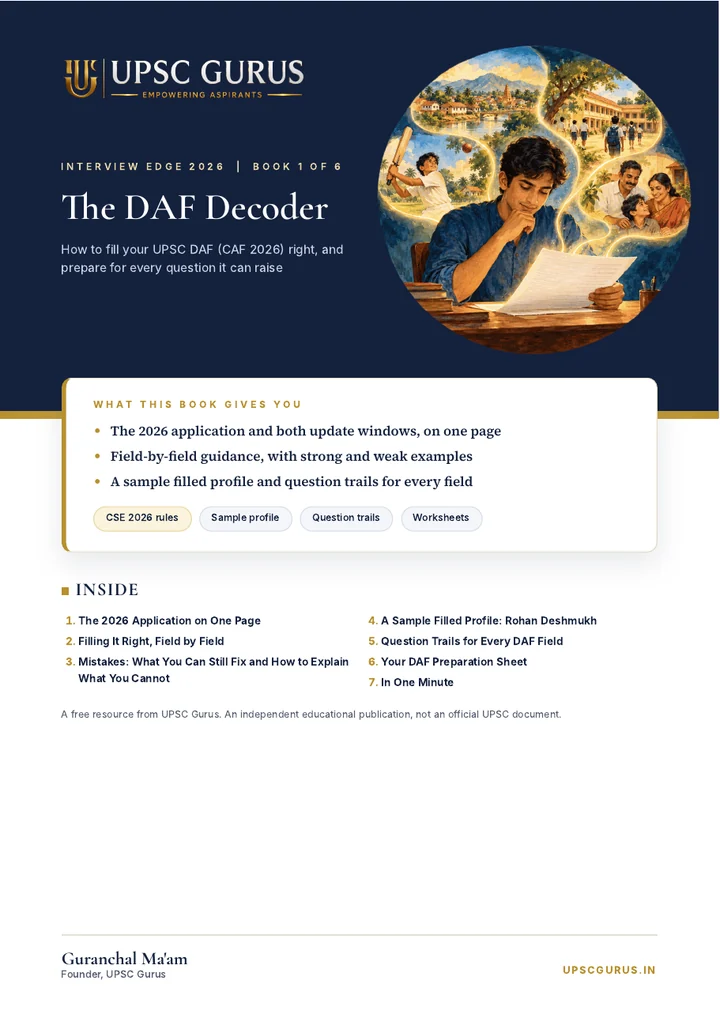
The free UPSC Gurus book From Result to Board brings together timelines, the update process, documents and preparation tracks.
Frequently asked questions
What should I do immediately after the UPSC Mains result?
Save the result notice and your roll and application numbers. Record the post-Mains update dates, sign in, identify required entries and documents, and start the final submission process. Alongside this, begin a personal profile sheet and organise your education and identity records.
Is the 15-day DAF update compulsory if nothing has changed?
Yes. Under the CSE 2026 rules, qualified candidates must log in, verify and finally submit during the 15-day post-Mains window even if they have no changes. Merely saving details is not final submission.
When is the UPSC 2026 interview after the Mains result?
As of 29 October 2026, the written Mains result and interview schedule had not been published. In the 2023 to 2025 cycles, the earliest interviews began 25 to 29 calendar days after the result. Your own allotted date comes from the official schedule and e-summon.
Which documents do I need for the UPSC Personality Test?
Prepare the e-summon, application-linked photo ID, date-of-birth proof and degree or valid proof of passing. Add category, relaxation, internship or other documents where applicable. Carry originals and matching copies, and follow the specific document instructions in your e-summon.
How can I prepare for the UPSC interview in three to four weeks?
First complete administration and build a concise profile. Next cover your district, state, graduation and optional. Practise discussing significant issues and judgement scenarios aloud, then use a mock or self-mock to correct weak areas. Keep the last stage focused on revision and logistics.
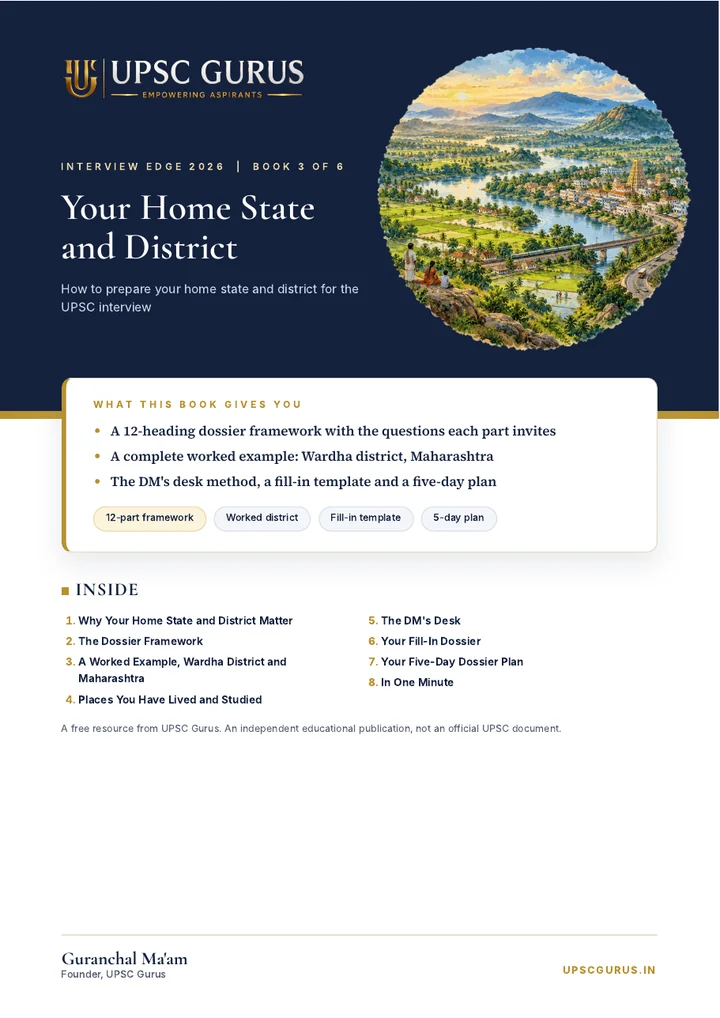
Six free UPSC interview books. 336 pages, nothing repeated.
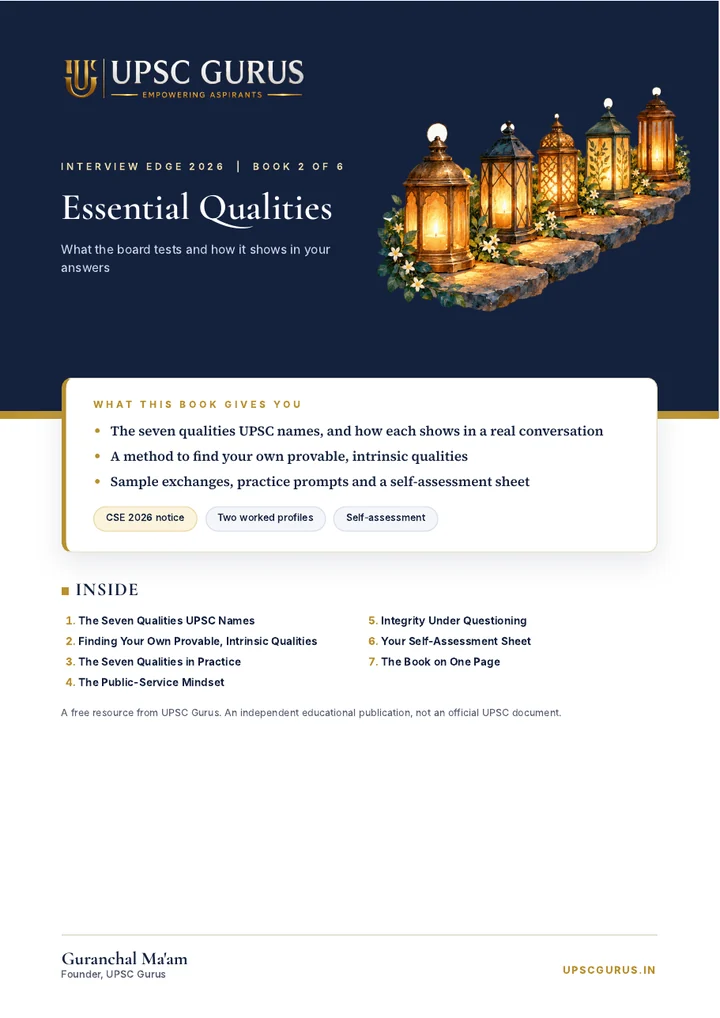
336 pages of thoughtful guidance, worked examples and practical tools. Everything you need to prepare with clarity, think independently and speak in your own voice. By Guranchal Ma’am, Founder, UPSC Gurus.
Interview Edge Studio
Practise from your own profile: a field-by-field DAF check, 100 questions drawn from your details, feedback on answers you write in your own words, and situation practice from your home state. Built on the method of Guranchal Ma’am, Founder, UPSC Gurus.