Why Do You Want to Join Civil Services? Find Your Own Answer
The strongest answer is not the most impressive one. It is the one that belongs to you. Learn to explain your motivation, introduce yourself naturally and speak with quiet confidence.
Why Civil Services? What Is the UPSC Interview Board Exploring?
When a board member asks, ‘Why do you want to join the civil services?’, the question is not an invitation to deliver a speech about patriotism. It is an opportunity to explain a decision that has become important in your life.
The board is exploring whether your motivation is considered, personal and grounded in an understanding of public responsibility.
Your answer should help the listener understand three things:
- Experience: What in your education, work or life helped shape this interest?
- Reflection: What did you understand from that experience?
- Choice: Why does public service now feel like a meaningful direction for you?
You do not need a dramatic childhood incident, an extraordinary achievement or a story of personal sacrifice. A gradual decision can be just as genuine.
Equally important, the civil services involve rules, competing priorities, limited resources and routine responsibilities. An informed motivation makes room for these realities instead of describing public service as unlimited power to change everything.
The guiding principle: Explain what draws you towards responsibility, not simply what attracts you to the position.
How to Answer 'Why Do You Want to Join Civil Services?' in Your Own Words
There is no universal UPSC interview answer to this question. Your reasons may have developed through work, education, observation or several ordinary experiences over time.
Use the following process to discover your answer. It is a thinking exercise, not a script to memorise.
- Identify an experience. Think of something that genuinely influenced your understanding of society, institutions or public responsibility. It need not be your greatest achievement.
- Explain what you noticed. Move beyond describing what happened. What did you learn about people, practical problems or the way decisions are made?
- Connect the experience to your interest. How did that observation influence the kind of work you wanted to do?
- Explain the choice of public service. What responsibilities of the civil services appeal to you? Focus on the work and its consequences, not the status attached to it.
- Acknowledge reality. Show that meaningful public work must operate within institutions, rules, resources and competing needs.
Now ask yourself: Would my answer still make sense if nobody knew which examination I was preparing for?
If it describes your actual experiences and choices, you are moving towards an authentic answer. If it consists mainly of admirable adjectives and grand promises, return to the experiences that made this decision yours.
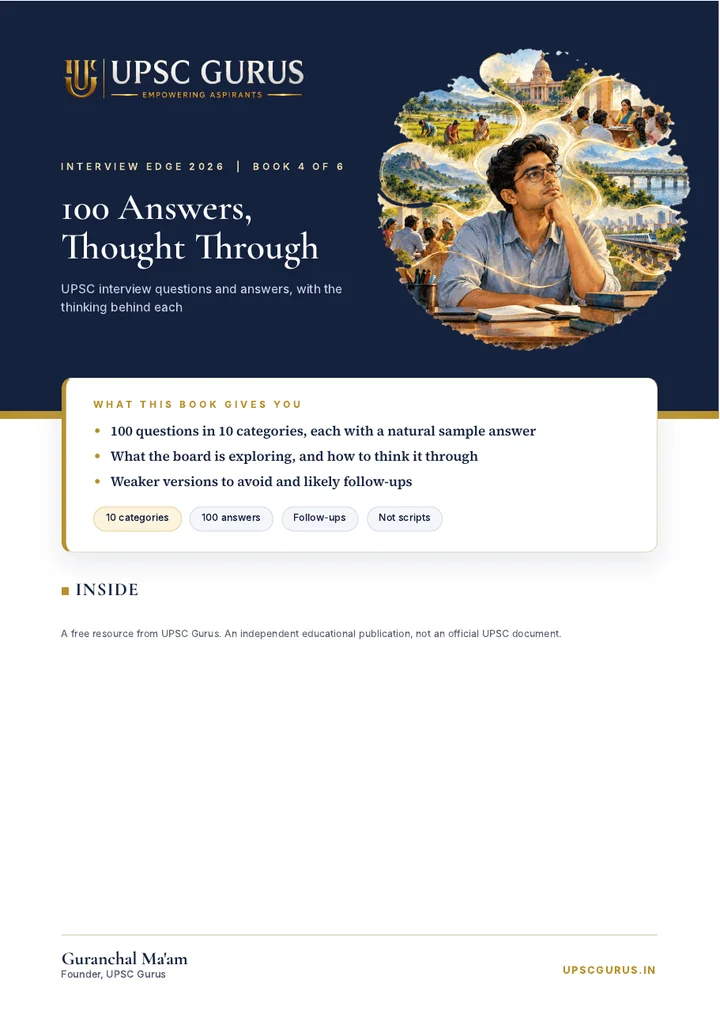
Inside: 100 questions across ten important interview categories; natural sample answers with the thinking explained; weaker responses, likely follow-ups and better approaches.
Download 100 Answers, Thought ThroughSee all six books →An Illustration: How Rohan Finds His Reason for Choosing Civil Services
Consider Rohan Deshmukh, a fictional candidate from Wardha, Maharashtra. He studied Civil Engineering at VNIT Nagpur and worked for two years as a site engineer with an infrastructure company in Pune.
His interest in public service developed gradually. A college rainwater harvesting project introduced him to the practical difficulty of taking an idea beyond the classroom. Site work later made him attentive to the decisions surrounding infrastructure projects.
Rather than giving Rohan a polished model answer, examine the thinking behind his motivation.
| Question Rohan asks himself | What his experience reveals |
|---|---|
| What did I do? | Studied engineering and worked on infrastructure projects. |
| What did I learn? | Technical design alone does not determine project success. Land, public needs, timelines and institutional decisions matter. |
| What interests me now? | The planning, coordination and decisions that influence whom public infrastructure serves. |
| What can I bring? | Practical problem-solving, coordination and experience of project execution. |
| What must I recognise? | Public responsibility involves balancing different needs and working within constraints. |
Notice that Rohan does not need to claim that one incident changed his life. His motivation emerges from the relationship between what he did, what he observed and what he wants to contribute.
Your experiences will be different. Your answer should be different too.
Why Civil Services UPSC Interview Answer: Weaker Versions to Avoid
Some answers sound impressive at first but offer little understanding of the person speaking. The issue is not necessarily insincerity. It is the absence of specific reflection.
| Weaker approach | Why it falls short | Better direction |
|---|---|---|
| ‘I want to serve poor people and transform India.’ | A sweeping ambition without a personal explanation. | Describe what shaped your understanding of public responsibility. |
| ‘I have wanted to become an officer since childhood.’ | A childhood ambition does not explain a considered adult choice. | Trace how your interest actually developed. |
| ‘Civil servants have power and respect.’ | Places status ahead of responsibility. | Discuss the nature of the work and its obligations. |
| ‘Private companies care about profits, but government serves people.’ | Creates an inaccurate moral division between sectors. | Respect your previous profession and explain the contribution you wish to make. |
| ‘I am passionate, dedicated and hardworking.’ | Describes qualities without showing the person behind them. | Use experiences to make your motivation understandable. |
You may genuinely value service, public welfare or the opportunity to contribute to society. These are meaningful motivations. But broad values become more convincing when connected to your own observations and decisions.
Do not manufacture a dramatic origin story. Do not dismiss other professions to justify your choice. And do not promise achievements that depend on circumstances beyond your control.
Tell Me About Yourself: How to Prepare Your UPSC Interview Introduction
‘Tell us about yourself’ is another important personal question. Here, the board is exploring whether you can introduce yourself naturally and present a coherent picture of your journey.
Your introduction opens a conversation. It is not an advertisement.
Begin with where you come from and what you have done. Choose two or three details that explain your journey. Add one specific human detail that helps the listener see you beyond your qualifications.
Build your introduction around four elements
- Identity: Your name and where you come from.
- Education and work: The main stages that shaped your journey.
- Direction: What connects those experiences to your present interest.
- Personal dimension: A genuine hobby or interest that adds individuality.
Return to Rohan. His introduction could draw from his home in Wardha, engineering education, site engineering work and growing interest in public infrastructure. He could also mention birdwatching, his bird log near the Bor Tiger Reserve area, or his interest in cooking regional Vidarbha food.
These details matter because they are real parts of his life. They create natural possibilities for conversation.
A weaker introduction would simply declare that Rohan is disciplined, motivated and passionate. Such descriptions tell the board very little about him.
Ask yourself: Can someone understand my journey without hearing me praise my own personality? If yes, your introduction is taking shape.
What Follow-Up Questions Can the UPSC Interview Board Ask?
Your answer to ‘Why civil services?’ may naturally lead to questions about your earlier choices, understanding of public work and ability to reflect on your experiences.
The following questions are drawn from the same themes as the opening question. They are possibilities for practice, not a prediction of what any particular board will ask.
| Possible follow-up | What to think through |
|---|---|
| What influenced your decision to pursue the civil services? | Was it a person, an experience or a gradual development of interest? |
| Why leave the private sector for public service? | What did your earlier work teach you, and what draws you towards public responsibility? |
| Can a private infrastructure company serve public welfare as well as government? | Can you recognise meaningful contributions outside government? |
| Which skills from your previous work would help you in administration? | What abilities can you demonstrate through actual experience? |
| What would you do if rules prevented you from helping someone immediately? | How do you understand responsibility within institutional limits? |
| Why should we select you? | Can you describe what you bring without comparing yourself with others? |
For a candidate such as Rohan, questions about site work, project coordination and his decision to leave employment would be natural areas to prepare.
Do not prepare a separate speech for every follow-up. Understand your own experiences well enough to discuss them from different angles. Listen to the precise question before deciding which part of your experience is relevant.
“Be very sure about yourself, even if life has been hard. , Guranchal Ma'am, Founder, UPSC Gurus”
Guranchal Ma’am
Founder, UPSC Gurus
How to Practise Your Motivation and Self-Introduction Without Memorising
Preparation should help you become clearer about yourself, not turn your answers into rehearsed performances.
Try this reflective practice with your own experiences.
- Write the facts first. Record the education, work, responsibilities and experiences that genuinely shaped your decision.
- Separate events from lessons. For each meaningful experience, ask what you understood differently afterwards.
- Identify your central reason. Explain why the responsibilities of public service appeal to you without relying on grand statements.
- Speak without reading. Explain your journey conversationally, allowing the wording to change while the meaning remains true.
- Challenge your own explanation. Ask why you made a particular choice, what you learnt, and what limitations you recognise.
- Review the substance. Notice where you used labels instead of evidence, or claimed certainty where a more thoughtful answer was needed.
It is perfectly reasonable for your motivation to include personal ambition alongside a desire to contribute meaningfully. What matters is that you can explain your priorities with maturity and proportion.
Guranchal Ma’am’s philosophy is to be settled and sure about who you are. That means accepting your experiences, knowing your strengths with evidence and admitting your limitations without embarrassment.
You do not need to present a different personality to appear suitable for public service.

A profile session with Guranchal Ma’am and a mock interview before a panel of seasoned officers, with detailed feedback. Online. State PCS and Hindi medium candidates warmly welcome.
Apply for Interview EdgeGo Deeper with the Free Book: 100 Answers, Thought Through
Personal questions are valuable opportunities for reflection. But they are only one part of a wider interview conversation.
In 100 Answers, Thought Through, a free book from UPSC Gurus’ Interview Edge library, you can explore 100 interview questions alongside the thinking that helps build considered responses.
The purpose is not to collect polished sentences to repeat before a board. It is to learn how to understand a question, develop a reasoned response and remain comfortable when the conversation moves beyond what you expected.
Use the book to strengthen your own thinking while keeping your experiences, judgement and personality at the centre of your answers.
Free resource: 100 Answers, Thought Through.
A good place to begin is with the person you already are. Understand that person carefully. Then allow your answers to reflect it.
Frequently asked questions
Why do you want to join civil services? What is a good UPSC interview answer?
A good answer connects your experiences, reflections and considered choice of public service. Explain what shaped your motivation, what responsibilities attract you and how you understand the constraints of government work. Avoid copying an idealised answer. The strongest response should sound like your own life.
How should I answer 'Tell me about yourself' in the UPSC interview?
Begin with where you come from, followed by relevant education, work and experiences that explain your journey. Add a genuine personal interest. Avoid beginning with unsupported adjectives such as hardworking or exceptional. Your introduction should offer a coherent picture of you and open a natural conversation.
Can I say that I want to join civil services to serve the nation?
Yes, if that genuinely reflects your motivation. But serving the nation is a broad aspiration. Explain what it means to you, which experiences helped shape that belief and why public responsibility appeals to you. Specific reflection gives meaning to an otherwise general statement.
Why civil services after engineering or a private sector job?
Respect what your previous profession taught you. Explain how those experiences shaped your interest in public work and which skills you could contribute. Avoid suggesting that one sector is morally superior to another. Show that the career change is a considered choice rather than a rejection of your earlier work.
Should I memorise my 'Why civil services' and 'Tell me about yourself' answers?
Prepare your thinking rather than memorising exact sentences. Know your experiences, the lessons you drew from them and the reasons behind your choices. Practise explaining them naturally and responding to follow-up questions. Your wording can vary while your underlying motivation remains clear and consistent.
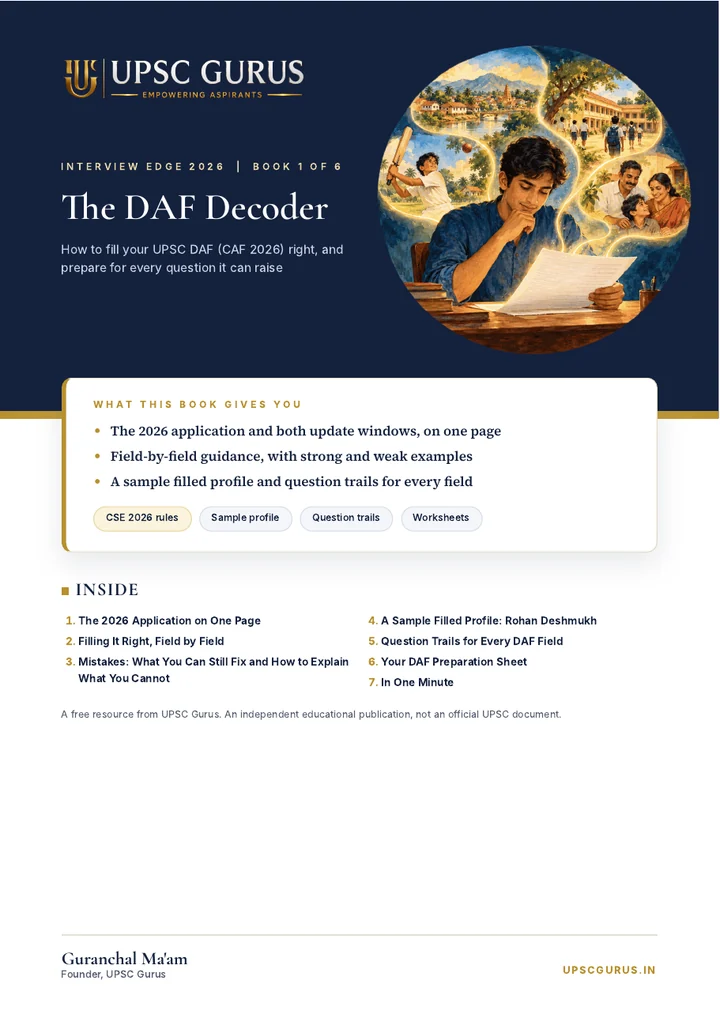
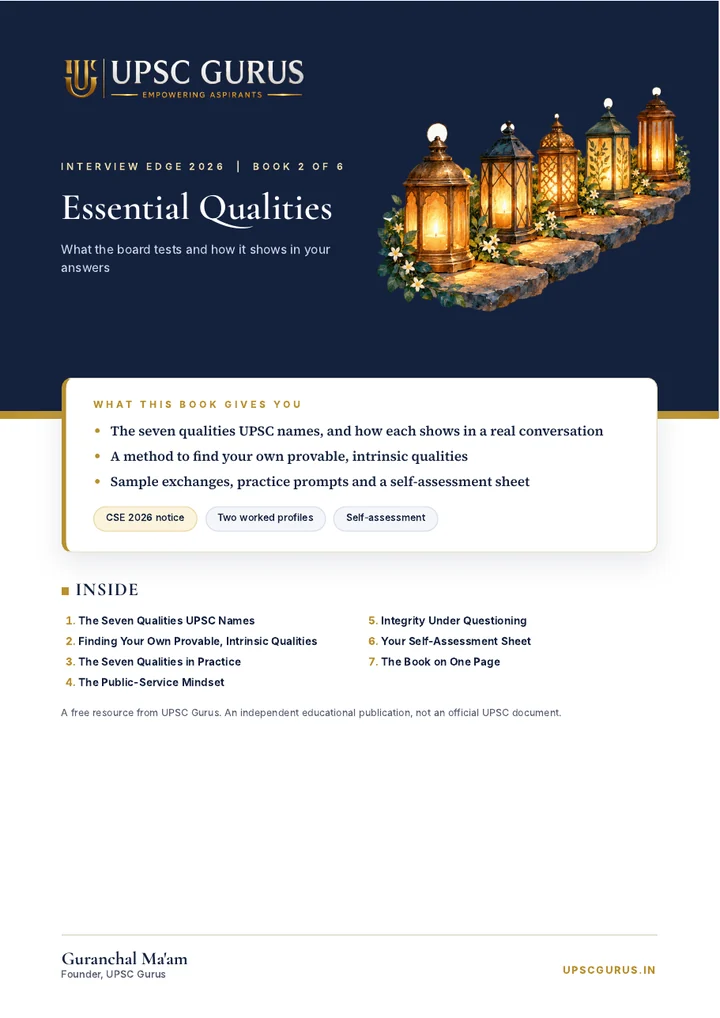
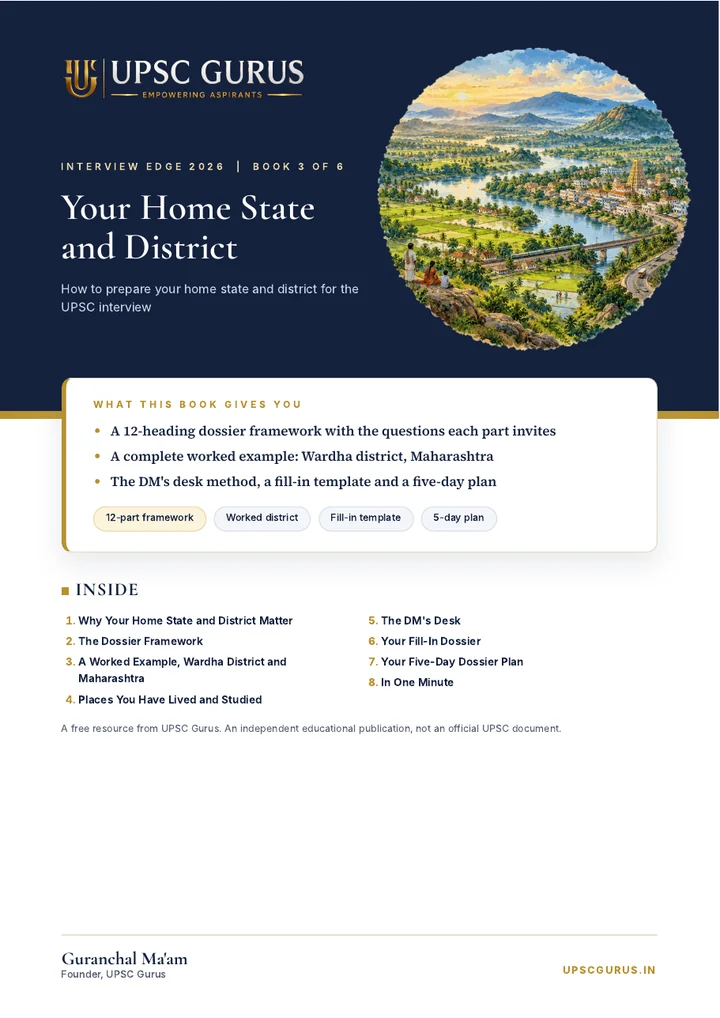
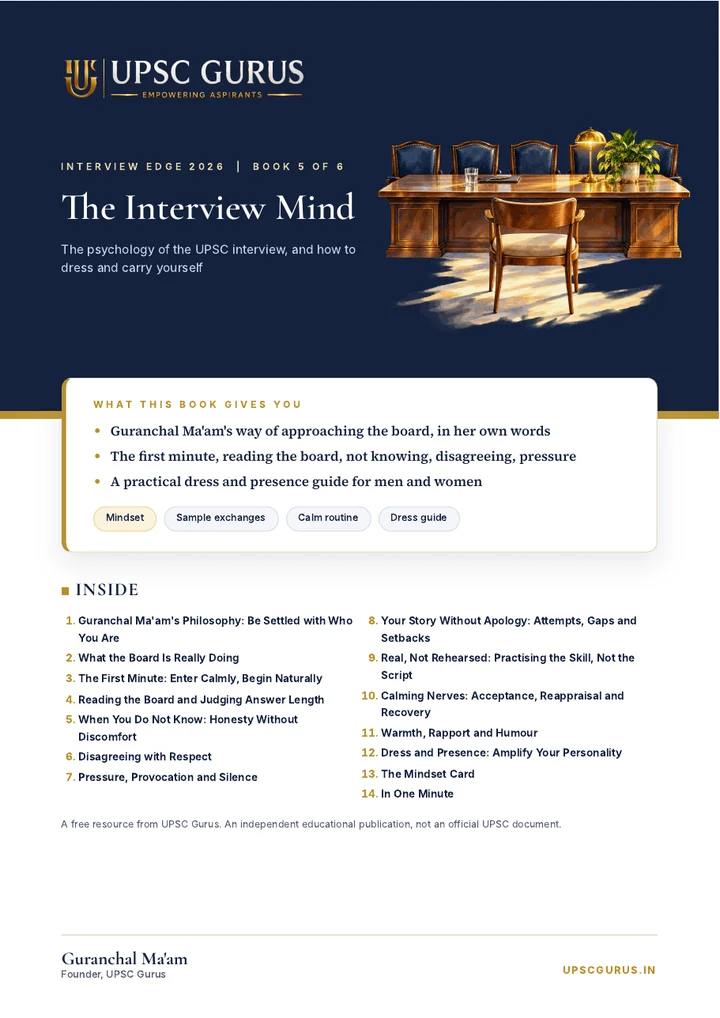
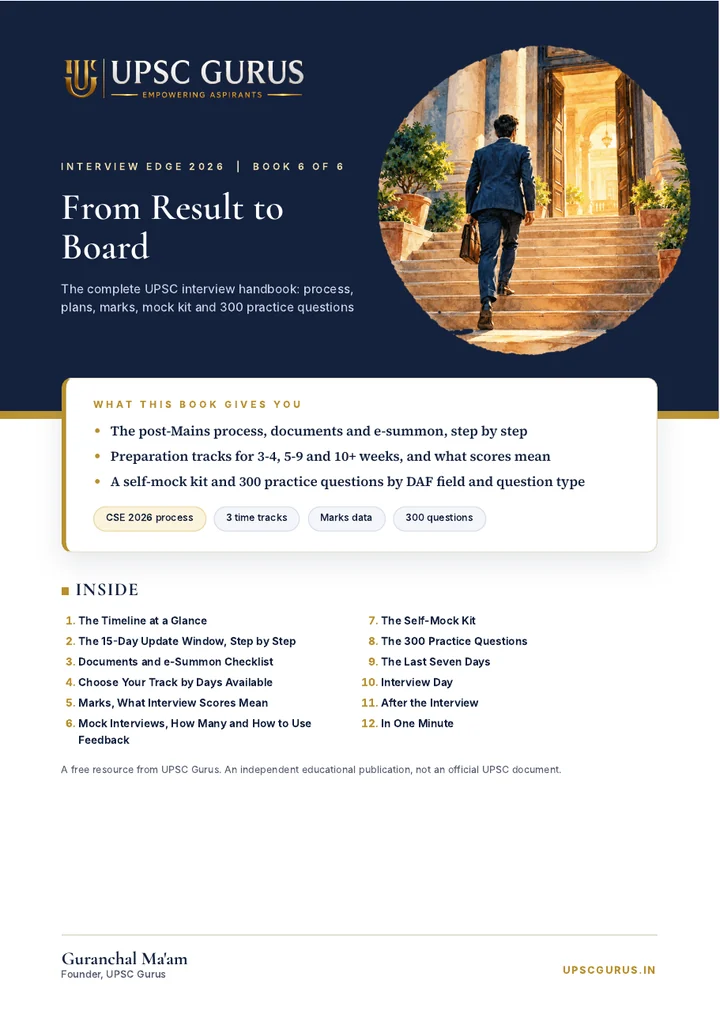
Six free UPSC interview books. 336 pages, nothing repeated.
336 pages of thoughtful guidance, worked examples and practical tools. Everything you need to prepare with clarity, think independently and speak in your own voice. By Guranchal Ma’am, Founder, UPSC Gurus.
Interview Edge Studio
Practise from your own profile: a field-by-field DAF check, 100 questions drawn from your details, feedback on answers you write in your own words, and situation practice from your home state. Built on the method of Guranchal Ma’am, Founder, UPSC Gurus.