UPSC Interview in Hindi: Think Clearly, Speak Naturally
Your language is a vehicle for your thinking, not a measure of your worth. Prepare in Hindi with clarity, practise natural answers and walk into the conversation comfortably as yourself.
हिंदी में पढ़ना चाहते हैं? UPSC Hindi medium page: Interview Edge हिंदी में
UPSC Interview in Hindi: Your Language Is Not Your Limitation
Many candidates preparing for the UPSC interview in Hindi wonder whether their language will affect how confidently they express themselves. The more useful question is: can you explain what you genuinely think, listen carefully and respond with clarity?
Language carries your reasoning. It should not become a performance in which you spend more energy searching for impressive words than expressing a meaningful thought.
Guranchal Ma’am, Founder of UPSC Gurus, offers a principle that applies beautifully to Hindi medium candidates: Be very sure about yourself, even if life has been hard.
Being sure about yourself does not mean knowing every answer. It means accepting your experiences, recognising your strengths and remaining comfortable with what is true about you.
What confidence actually looks like
- Expressing an opinion without apologising for having one.
- Admitting uncertainty without embarrassment.
- Listening to a challenge without becoming defensive.
- Using words that express your meaning accurately, rather than words chosen to impress.
You do not need to manufacture a different personality for the interview. Your task is to become clearer, more thoughtful and more settled in the personality you already have.
How to Prepare for the UPSC Interview in Hindi Medium
Effective Hindi medium UPSC interview preparation begins with your thinking, not with memorised translations. Prepare the substance of your answers in the language in which you can examine ideas comfortably.
Build your preparation around four areas
- Your personal profile: Revisit your education, home district, interests, experiences and important decisions. Know the facts and the reasoning behind your choices.
- Your academic understanding: Practise explaining concepts from your educational background and optional subject without relying entirely on textbook definitions.
- Your judgement: Consider different perspectives on an issue. Learn to state your position and explain why you hold it.
- Your conversational ability: Practise listening to the complete question, answering directly and adjusting when a follow-up changes the direction.
Consider Rohan, a fictional civil engineer from Wardha who has previously reached the interview stage. Asked what was missing earlier, he does not pretend to know the board’s assessment. Instead, he recognises that he sometimes tried to give a complete answer rather than answering the particular question.
That reflection is valuable in any language. Prepare your understanding, not a paragraph that must be delivered word for word.
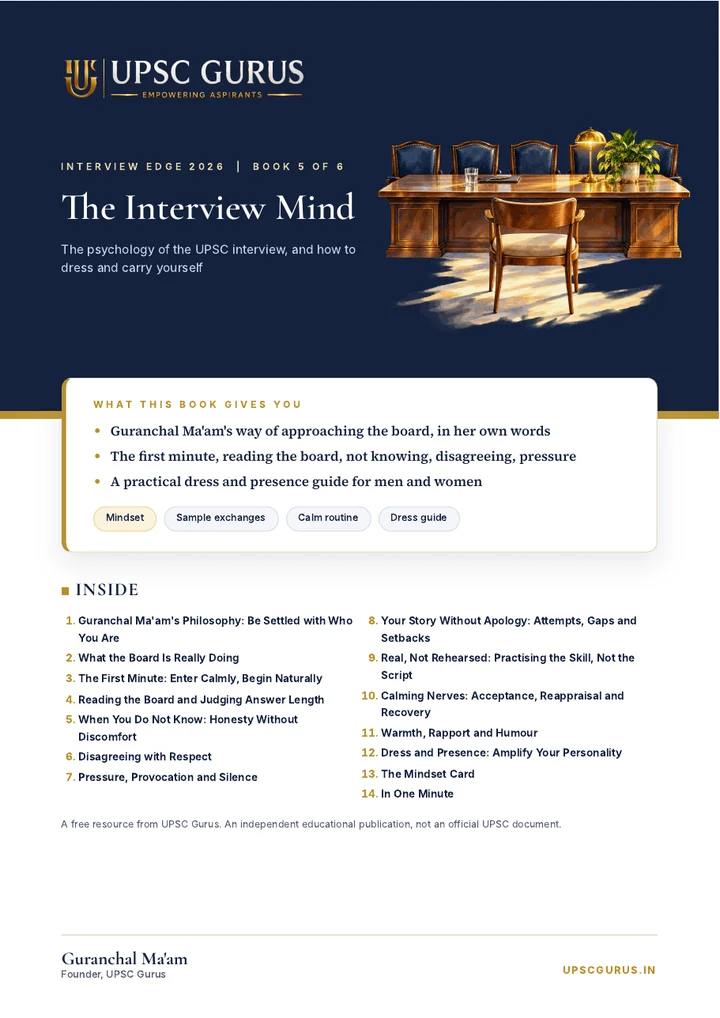
Inside: Guranchal Ma'am's philosophy of being settled with yourself; the first minute, uncertainty, disagreement and pressure; practical calming methods and a complete dress guide.
Download The Interview MindSee all six books →Can You Mix Hindi and English Naturally in Interview Answers?
During preparation, you may find that certain academic or administrative terms come to mind more naturally in English, while your explanation flows more comfortably in Hindi. Do not let the search for an exact translation interrupt your reasoning.
The practical objective is consistency of meaning. Use a familiar technical expression when it communicates the concept accurately, then explain the idea in straightforward Hindi.
Three useful language habits
- Keep familiar terms familiar: Words such as Geography, Sociology and administration can be used within a Hindi explanation when they are part of your working vocabulary.
- Explain the concept: Knowing a term matters less than being able to explain its relevance to the question.
- Avoid forced switching: Do not change languages simply because you think one sounds more impressive. Follow the natural flow of your reasoning.
For instance, the source books discuss whether Geography is more useful for administration than Sociology. A thoughtful candidate does not need an elaborate definition of either discipline. The answer can explain that Geography helps us understand resources, regional differences and spatial patterns, while Sociology offers insight into institutions and communities.
Clarity comes from the relationship between your ideas, not the complexity of your vocabulary. Practise speaking naturally, without turning every sentence into an exercise in translation.
How Should Hindi Medium Candidates Structure UPSC Interview Answers?
Guranchal Ma’am’s guidance is simple: Answer first. Reason next. Illustrate when useful. Stop. Not every question requires all four steps.
A factual question may need only a direct response. An opinion question requires reasoning. A situational question asks how you would approach a problem. The question determines the depth, not a memorised answer length.
| Question type | Your approach |
|---|---|
| Fact | Give the requested information directly. |
| Explanation | State the central reason or distinction. |
| Opinion | Present your view with relevant reasons. |
| Application | Explain your approach, action and safeguards. |
| Follow-up | Address the particular challenge or clarification. |
A practical example
Consider a question about why citizens should trust public institutions.
A brief but incomplete response would merely say that institutions are accountable. A more useful answer connects trust with transparent decisions, fair application of rules, reliable services and the ability to challenge mistakes.
That reasoning can be expressed in straightforward Hindi. There is no need to add unrelated material merely to make the answer longer.
Observe the member’s words. If asked to elaborate, develop the point. If asked to be brief, return to the central answer. Do not assume that a smile, a neutral expression or a member writing something reveals the assessment.
How to Answer Opinion Questions in Hindi with Balanced Judgement
Opinion questions require more than fluent speech. They require a reasoned position. Guranchal Ma’am recommends a straightforward method: Explain both sides, say what you believe, and conclude.
Consider the question about whether Geography is more useful for administration than Sociology. Rather than declaring one subject superior, identify what each contributes and explain why administrative problems may need insights from both.
Use this thinking sequence
- Understand: Identify the central issue being raised.
- Weigh: Recognise the important concerns and competing perspectives.
- Decide: State your assessment clearly, with reasons.
You can practise this entire process in Hindi before attempting a spoken response. First establish what you think. Then decide how to express it concisely.
Do not confuse balance with refusing to take a position. A balanced answer can recognise legitimate concerns on different sides while reaching a considered conclusion.
Equally, do not make disagreement confrontational. Acknowledge the concern raised by the board member and explain why your assessment differs. Respectful independence is more useful than either automatic agreement or unnecessary argument.
Handling Nervousness and Pressure During a Hindi UPSC Interview
Calmness does not mean that you never feel nervous. As Guranchal Ma’am explains, it means staying connected to the conversation even when normal nervousness is present.
For a Hindi medium candidate, that includes allowing yourself to speak naturally instead of constantly monitoring whether every word sounds polished.
Respond to the situation, not to your anxiety
- When you do not know an answer: Acknowledge the gap honestly. Do not invent information to keep speaking.
- When your opinion is challenged: Listen carefully, recognise the concern and explain your reasoning without irritation.
- When you are interrupted: Stop, attend to the next question and follow the conversation.
- When you make an error: Correct it clearly instead of defending an inaccurate statement.
- When your personal history is discussed: Respond factually without apologising for your experiences.
You do not have to fill every conversational moment with additional words. A complete answer followed by a natural pause is preferable to continuing until your main point becomes difficult to identify.
Remember Guranchal Ma’am’s principle: never undervalue yourself, and never look down on the person asking. Maintain a positive, respectful relationship with the board.
“Never undervalue yourself. Never look down on the person asking. Keep a very positive relationship with the board., Guranchal Ma'am”
Guranchal Ma’am
Founder, UPSC Gurus
A Practical Hindi Medium UPSC Interview Preparation Routine
The most useful practice is not repeatedly delivering memorised speeches. It is learning to respond when a question changes, becomes more specific or challenges your original reasoning.
Practise with a simple conversational sequence
- Choose one topic: Begin with your educational background, an important life decision, your optional subject or an experience from your profile.
- Answer a direct question: Explain the central point naturally in Hindi.
- Add a follow-up: Ask yourself why the answer is reasonable, whether there is another perspective or what you would do differently.
- Practise a challenge: Consider what you would say if the questioner disagreed.
- Review your response: Notice whether you answered the question, explained your reasoning and stopped at the right point.
The fictional candidate Meera, an Economics graduate who worked in a rural livelihoods NGO, illustrates this skill. Asked about the biggest obstacle facing women starting small enterprises in the communities she worked with, she identifies dependable buyers. When credit is raised as an alternative concern, she acknowledges its importance without abandoning her evidence about uncertain sales.
That is the quality to practise: listening, adjusting and remaining faithful to what you genuinely know. You are developing conversational judgement, not learning a performance.

A profile session with Guranchal Ma’am and a mock interview before a panel of seasoned officers, with detailed feedback. Online. State PCS and Hindi medium candidates warmly welcome.
Apply for Interview EdgeFree Hindi Medium Guidance Through UPSC Gurus Interview Edge
UPSC Gurus warmly welcomes Hindi medium candidates through Interview Edge. Hindi medium aspirants have been guided here before, and your language preference is respected from the beginning.
Your profiling discussion with Guranchal Ma’am can be conducted in Hindi or English, according to your preference. The purpose is to understand your experiences, academic background, interests and the way you think, rather than to make you adopt an unfamiliar speaking style.
Interview Edge is a complimentary, application-based guidance experience. It includes a profile session with Guranchal Ma’am and a mock interview before a panel of seasoned officers, followed by detailed feedback. Guidance is available online, and State PCS interview candidates are also welcome.
Begin with the free Interview Edge books
The free Interview Edge book library offers structured guidance for preparing your personal profile, understanding interview questions, developing answers, managing nervousness and approaching the conversation thoughtfully.
Use these resources to build understanding in Hindi, prepare your own examples and practise follow-up questions. The aim is not to memorise the books or reproduce another candidate’s answers. It is to develop your own reasoning and expression.
Whether you think most naturally in Hindi or move comfortably between Hindi and English, the foundation remains the same: know yourself, listen carefully, answer sincerely and remain settled in who you are.
Frequently asked questions
Can I give the UPSC interview in Hindi?
Hindi medium candidates can build their interview preparation around Hindi with confidence. Practise expressing your reasoning clearly, responding to follow-ups and using technical vocabulary naturally. This guide addresses preparation and communication, rather than formal interview-language arrangements.
How should I prepare for the UPSC interview in Hindi medium?
Begin with your personal profile, academic background, interests and important decisions. Practise answering direct questions in Hindi, then introduce follow-ups and opposing perspectives. Prepare your understanding rather than memorising fixed responses.
Can I use English technical terms while speaking Hindi?
During practice, use familiar technical terms where they help communicate your meaning accurately. Explain the underlying idea clearly in Hindi. Avoid searching for complicated translations that interrupt your reasoning or make the response unnatural.
What if I become nervous or forget an answer during the interview?
Normal nervousness does not prevent a thoughtful conversation. Listen to the question, answer what you know and acknowledge genuine uncertainty. If you make an error, correct it. Calmness means remaining connected to the conversation, not pretending to know everything.
Does UPSC Gurus Interview Edge help Hindi medium candidates?
Yes. Interview Edge warmly welcomes Hindi medium candidates and has guided them before. Your profiling session with Guranchal Ma'am can take place in Hindi or English, as you prefer. The complimentary, application-based experience includes a mock interview with seasoned officers and detailed feedback.
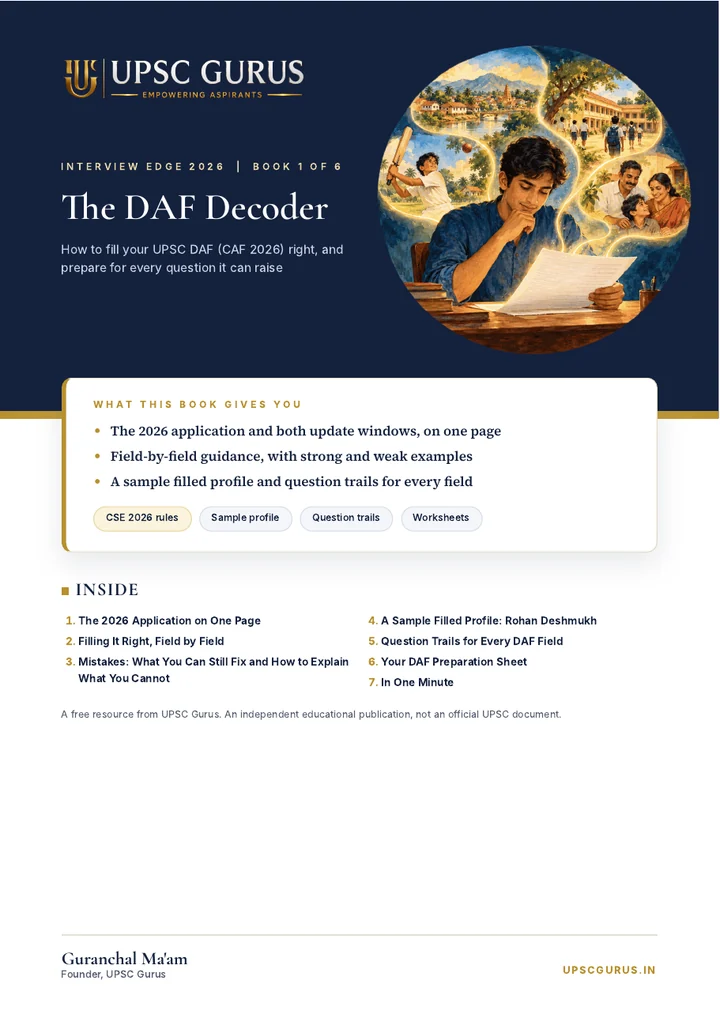
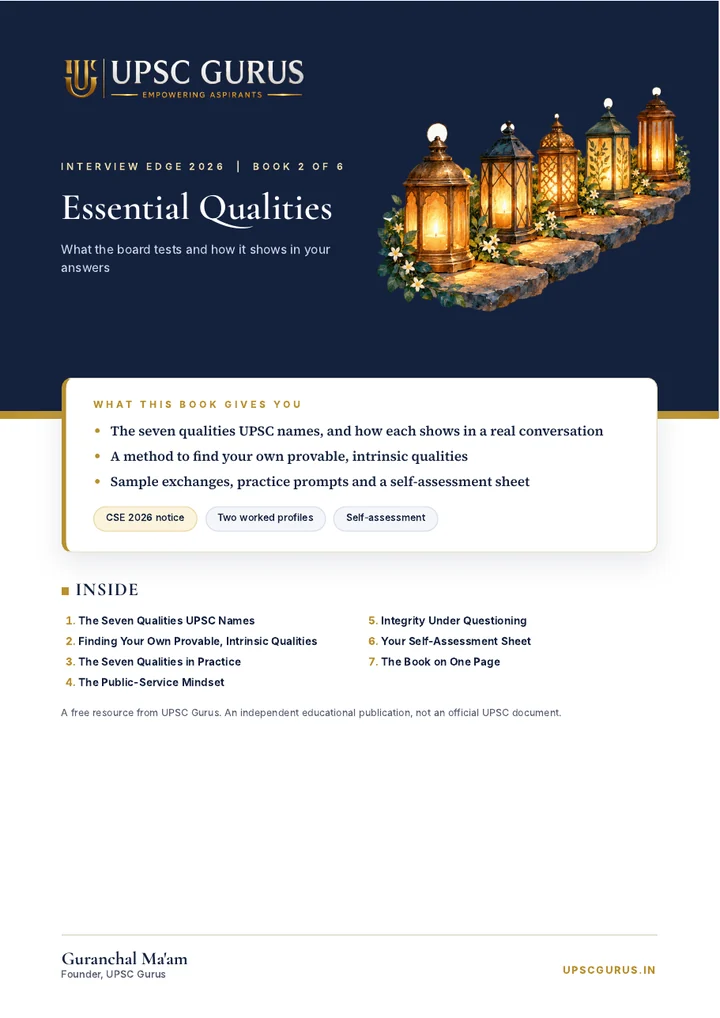
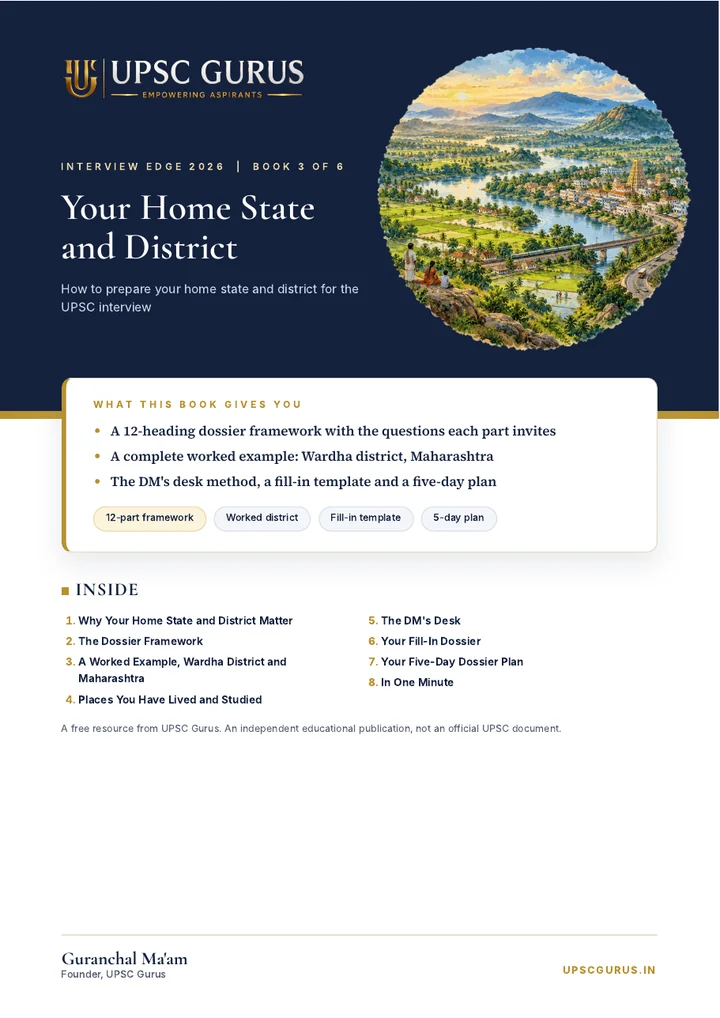
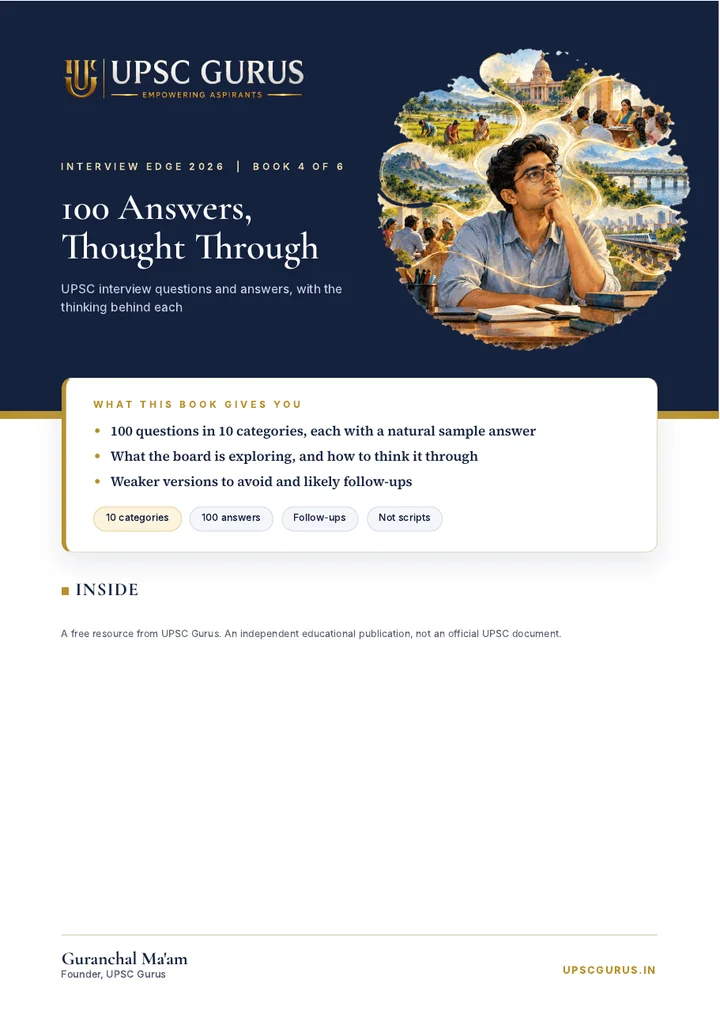
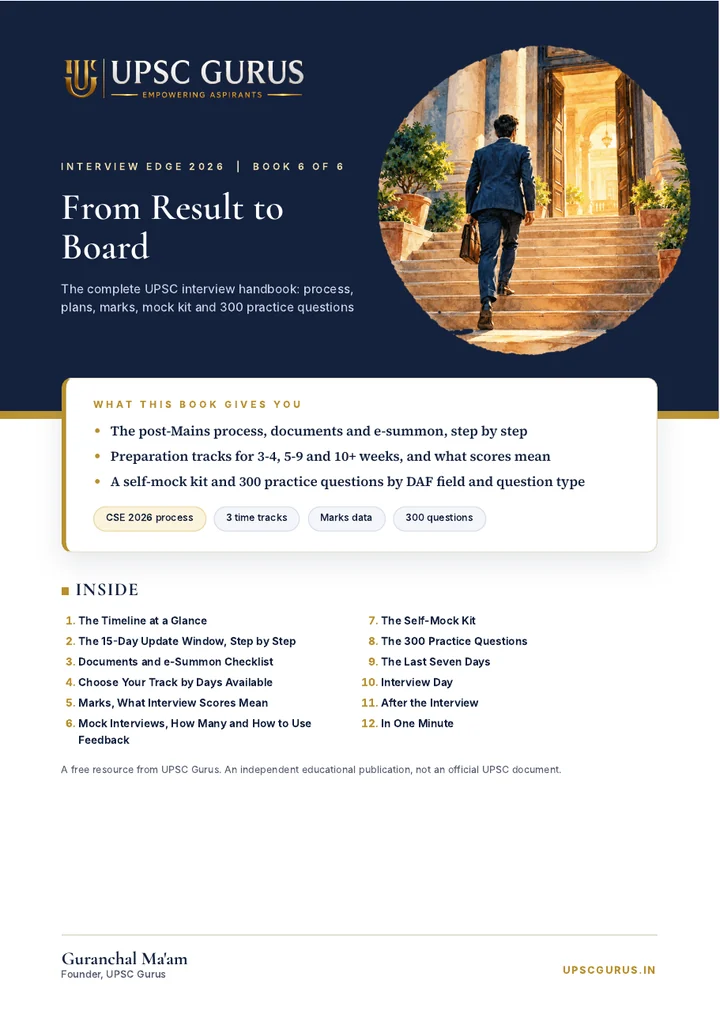
Six free UPSC interview books. 336 pages, nothing repeated.
336 pages of thoughtful guidance, worked examples and practical tools. Everything you need to prepare with clarity, think independently and speak in your own voice. By Guranchal Ma’am, Founder, UPSC Gurus.
Interview Edge Studio
Practise from your own profile: a field-by-field DAF check, 100 questions drawn from your details, feedback on answers you write in your own words, and situation practice from your home state. Built on the method of Guranchal Ma’am, Founder, UPSC Gurus.