UPSC Mock Interview: Practise with Purpose
A good mock interview is not a prediction of your UPSC Personality Test. It is a chance to listen better, answer more clearly and improve through specific feedback.
What is a UPSC mock interview actually for?
A UPSC mock interview is a practice conversation. It helps you hear questions fully, respond aloud, handle follow-ups and notice habits that are hard to see while studying alone. It can also reveal gaps in your knowledge or reasoning.
It cannot reliably predict your marks, recreate your eventual board, tell you the exact questions you will face or guarantee an outcome.
Judge a mock by what it helps you improve. Did your main point arrive too late? Did you speak before the question ended? Both are habits you can practise.
How many mock interviews for UPSC should you take?
How many mock interviews you need depends on your preparation, experience and progress. There is no single ideal number for everyone. The following is Guranchal Ma’am’s suggested range for planning your practice, not a UPSC rule.
| Time before interview | Full mocks | Main purpose |
|---|---|---|
| 3 to 4 weeks | 3 to 4 | Find and correct major weaknesses, then recheck them |
| 5 to 9 weeks | 4 to 6 | Diagnose, improve, test the improvement and build comfort |
| 10 or more weeks | 6 to 8, spaced apart | Build skills progressively and keep them fresh |
The right number varies for every candidate. Someone who already speaks comfortably, or who received good feedback in an earlier attempt, may need fewer mocks. Someone facing the board for the first time, speaking in a second language, or preparing a profile that invites many questions may benefit from more. Let your own feedback guide you. If each mock reveals something new to improve, another may be useful. If the same weaknesses keep appearing, work on them before scheduling another.
Leave a few days between mocks and act on the main feedback before the next. For example, if you answered a related question instead of the one actually asked, your next step should be listening practice, not another immediate full mock. Use short speaking exercises and self-mocks between sessions. The aim is not to complete a fixed number, but to become clearer, more thoughtful and more comfortable in conversation.
Inside: CSE 2026 process, documents and e-summon checklist; three preparation tracks, interview marks and mock guidance; a self-mock kit and 300 organised practice questions.
Download From Result to BoardSee all six books →How do you choose a useful UPSC mock interview panel?
Look for a panel that has read your profile, understands public issues or assessment, asks relevant follow-ups and gives constructive, specific feedback. Seasoned officers can offer administrative perspective, but filter personal style suggestions.
Be cautious of ridicule, hostility presented as realism, unsupported claims about confidential marking, or pressure to imitate another candidate. Ask for examples, not just a mark.
What should you share before the mock?
Provide your actual application and a one-page profile sheet covering:
- Home state and district, education and optional subject.
- Work experience, attempts and any gaps.
- Hobbies, achievements and service preferences.
- Interview medium and two areas where you want diagnostic feedback.
Do not supply a list of answers you have already rehearsed. Unfamiliar turns are part of the practice.
What should you do during a UPSC mock interview?
Listen until the question ends. Identify what is being asked: a fact, an explanation, an opinion or a judgement. Then state your central point before adding what is needed to support it.
Facts may need one sentence; judgement needs reasons and a conclusion. Treat a follow-up as a fresh question, not an invitation to repeat the previous answer. Stop when you have answered.
Practise flexible thinking, not fixed speeches
Consider the practice question: should urban infrastructure projects prioritise speed or environmental safeguards? Rather than memorising a paragraph, retain the considerations: public costs of delay, long-term environmental risks, better project design, monitoring and a proportionate judgement.
A follow-up about emergency repairs differs from one about a large new project. Adapt your reasoning.
How should you use UPSC mock interview feedback?
Ask for two strengths, two behaviours to improve, one knowledge gap, one poorly handled follow-up and one action before the next mock. Request examples.
Use the three-test filter
- Evidence: Does the feedback refer to something you actually said or did?
- Relevance: Would the change improve accuracy, clarity, judgement or interaction?
- Authenticity: Can you make the change without misrepresenting yourself?
If all three tests are met, act. Adapt useful technique, not your identity. Treat pace preferences as optional unless clarity suffers. Reject suggestions that require exaggeration or dishonesty. Claims that a behaviour will definitely cost you marks are not established facts.
A worked example
Rohan, a fictional candidate, describes a college rainwater harvesting prototype. Asked what evidence shows improved water availability, he describes its design again. He has confused building a model with measuring an outcome.
A better response would say that his team developed the model but did not undertake long-term field assessment, so it cannot claim a measured improvement. Improve accuracy, not the story.
Can you practise a UPSC mock interview at home? Use this self-mock kit
Yes. You can practise alone or with one trusted person. Prepare a charged phone or laptop, test the audio, silence notifications and sit in a stable chair against a simple background. A camera at eye level is optional. Get recording consent and preserve privacy.
A 25-minute self-mock format
| Segment | Minutes | Focus |
|---|---|---|
| Opening | 2 | A personal experience |
| Profile | 6 | Education, work, hobbies |
| Knowledge | 5 | Optional, graduation, district |
| Judgement | 5 | A public issue |
| Follow-ups | 5 | Challenges and new constraints |
| Closing | 2 | Reflection or final question |
These are practice timings, not UPSC rules. If alone, choose eight unfamiliar questions and three follow-ups, mix the order and record without restarting. A helper can ask questions, listen and offer occasional challenges without supplying answers.
Review your recording twice
On the first viewing, ignore appearance. Ask whether you answered the actual question, used accurate facts, explained your reasoning and acknowledged uncertainty. On the second, notice listening, voice, attentiveness, distracting movements and recovery after difficult moments.
Use this simple reflection: two things done well, two improvements with exact examples, the hardest moment, one skill and one exercise for next time. Do not judge your personality from a recording.
“A mock should strengthen your clarity and judgement, without asking you to become someone else.”
Guranchal Ma’am
Founder, UPSC Gurus
How do you measure progress without predicting UPSC interview marks?
Use the seven-quality rubric from the UPSC Gurus self-mock kit. Observe mental alertness, critical powers of assimilation, clear and logical exposition, balance of judgement, variety and depth of interest, social cohesion and leadership, and intellectual and moral integrity.
For each quality, record 0 if it was not shown when an opportunity arose, 1 if inconsistent, 2 if clearly shown, or N/O if the session never tested it. This is a self-development tool, not UPSC’s scoring method. Never predict marks from these ratings.
Within 24 hours of a mock, write down feedback, correct clear factual mistakes and select no more than three priorities. Match each priority to an exercise. For long answers, try giving the central point first across five unfamiliar questions. If defensive, practise acknowledging valid objections.
Then test transfer: record ten unfamiliar questions, practise one correction through six short questions, and use ten different questions with follow-ups in the next session. Improvement means responding better to new questions.

A profile session with Guranchal Ma’am and a mock interview before a panel of seasoned officers, with detailed feedback. Online. State PCS and Hindi medium candidates warmly welcome.
Apply for Interview EdgeIs there a free UPSC mock interview? Explore Interview Edge
Interview Edge by UPSC Gurus is complimentary and application-based. It includes a profile session with Guranchal Ma’am, Founder, UPSC Gurus, followed by a mock interview before a panel of seasoned officers, with detailed feedback. It is online.
Candidates preparing for State PCS interviews are welcome. Hindi medium candidates are equally welcome, with guidance available in an inclusive and respectful setting.
The aim is to strengthen clarity while respecting your background and personality. Applying does not guarantee a session.
Continue with the free book: From Result to Board
Read From Result to Board for structured preparation from the Mains result to the interview. Pair it with a self-mock, reflection and one focused improvement exercise. Aim for clearer responses, not memorised speeches.
Frequently asked questions
How many mock interviews for UPSC are enough?
There is no fixed number for everyone. Guranchal Ma'am suggests 3 to 4 mocks with 3 to 4 weeks remaining, 4 to 6 with 5 to 9 weeks, and 6 to 8 with more time. These are flexible recommendations, not UPSC rules. Let feedback guide you.
Can I get a free UPSC mock interview online?
UPSC Gurus offers Interview Edge, a complimentary, application-based online experience. It includes a profile session with Guranchal Ma'am and a mock interview before a panel of seasoned officers with detailed feedback. State PCS and Hindi medium candidates are welcome. Application does not guarantee a session.
How can I practise a UPSC mock interview at home?
Record a 25-minute practice conversation covering your profile, knowledge, judgement and follow-ups. Use unfamiliar questions and do not restart. Review the recording twice, first for content and then for conversation habits. Choose one improvement exercise for your next attempt.
What should I ask after a UPSC mock interview?
Request two strengths, two behaviours to improve, one knowledge gap, one poorly handled follow-up and one action to take next. Ask for specific examples. Filter suggestions for evidence, relevance and authenticity before acting.
Should I memorise answers after receiving mock interview feedback?
No. Correct factual errors and improve the thinking behind the response, but do not memorise a polished script. Practise the same skill with different questions so that you can handle new wording and follow-ups naturally.
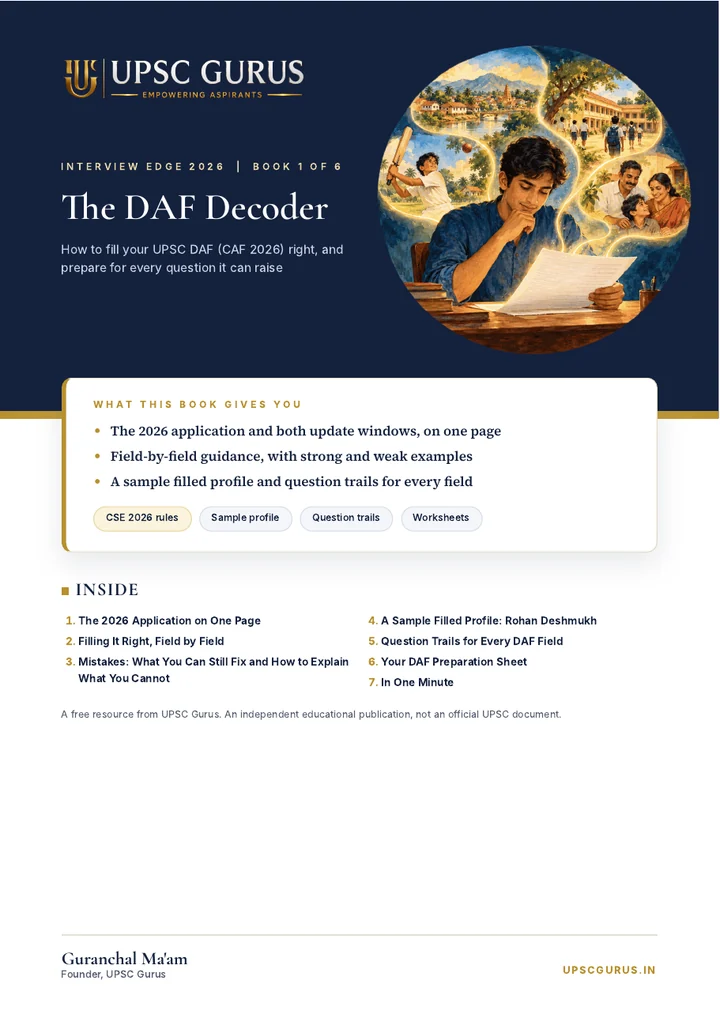
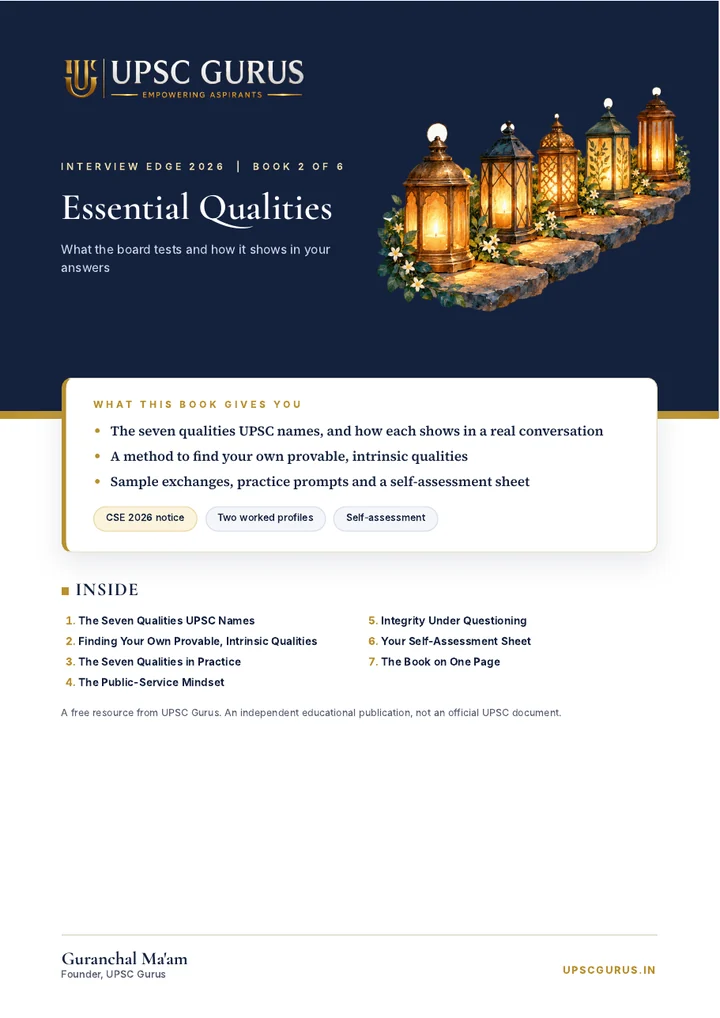
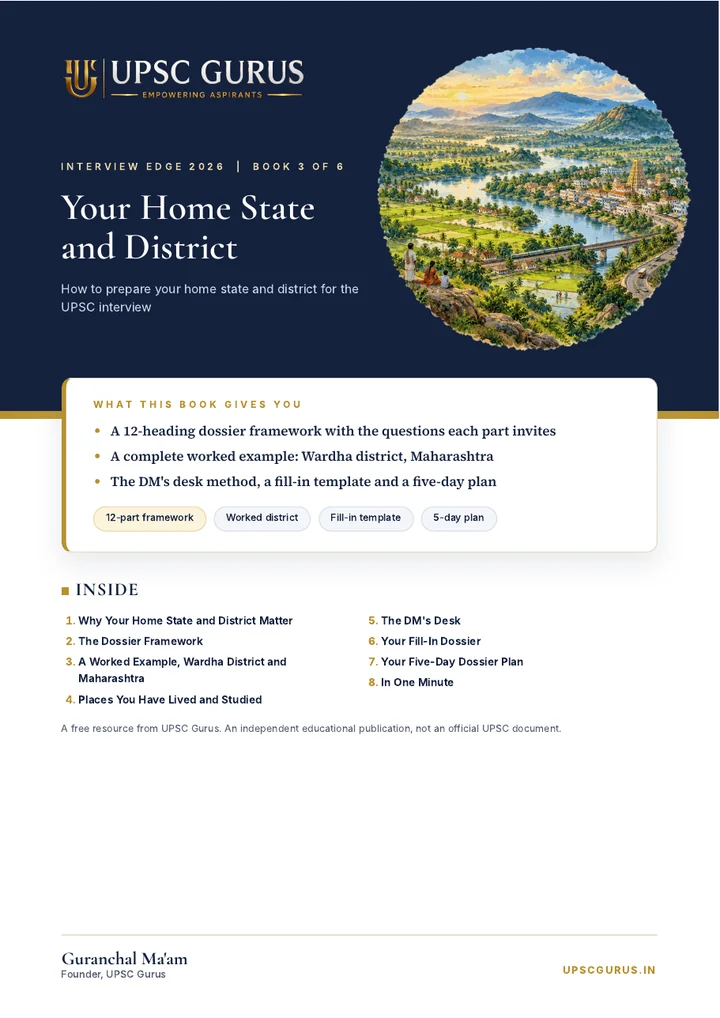
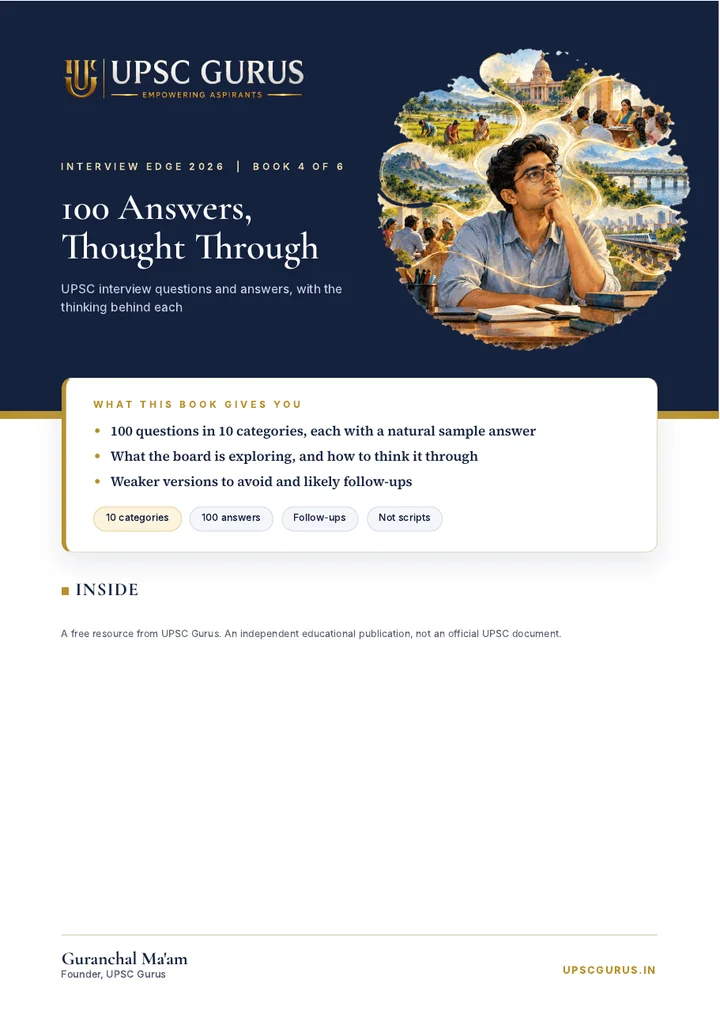
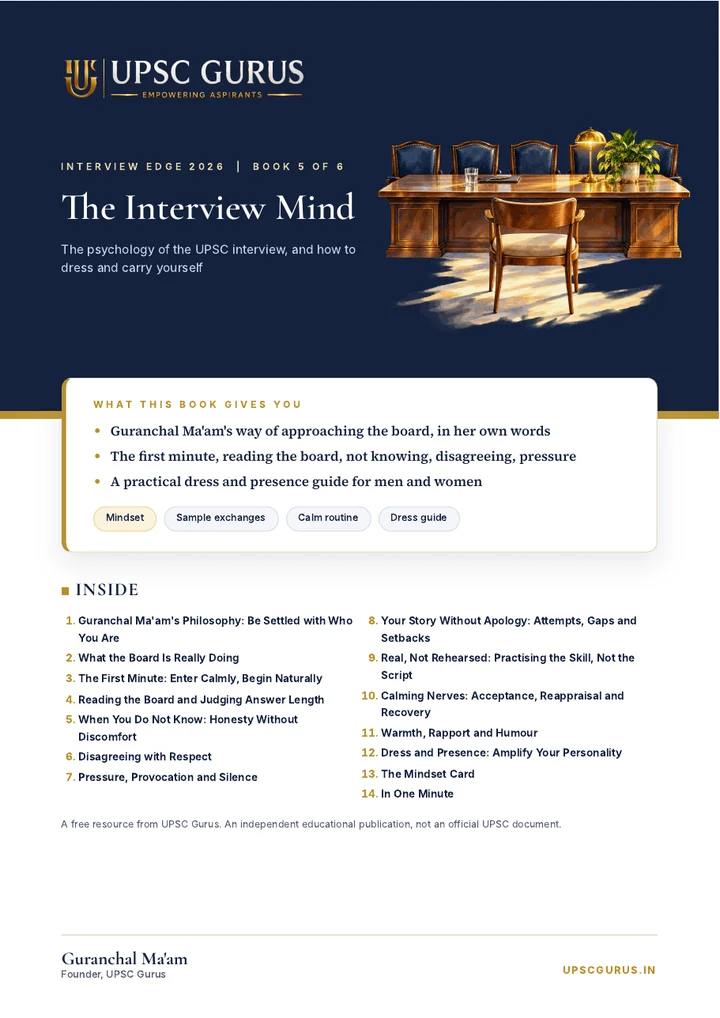
Six free UPSC interview books. 336 pages, nothing repeated.
336 pages of thoughtful guidance, worked examples and practical tools. Everything you need to prepare with clarity, think independently and speak in your own voice. By Guranchal Ma’am, Founder, UPSC Gurus.
Interview Edge Studio
Practise from your own profile: a field-by-field DAF check, 100 questions drawn from your details, feedback on answers you write in your own words, and situation practice from your home state. Built on the method of Guranchal Ma’am, Founder, UPSC Gurus.