How to Prepare Your Home State and District for the UPSC Interview
Every district has a story.
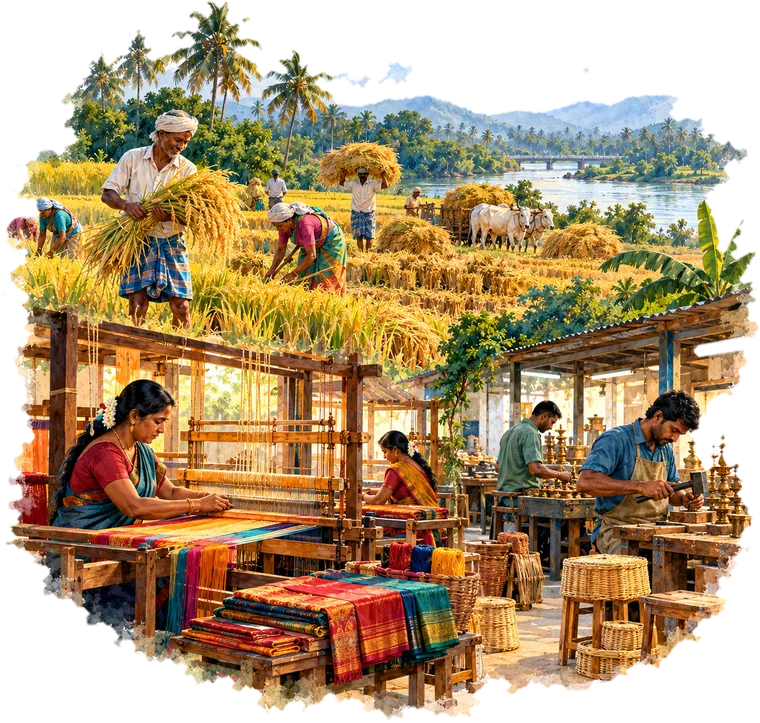
Its geography influences livelihoods. Its history shapes institutions and identities. Its economy creates opportunities and inequalities. Its public services reveal how government decisions reach everyday life.
For the UPSC Personality Test, preparing your home state and district means understanding these connections.
You do not need to memorise every statistic or describe your home district as a model of development.
You need to know its essential features, understand its important challenges and think carefully about how public administration can respond.
This guide explains how to prepare a useful district profile, find reliable information and move beyond factual questions towards thoughtful discussion.
Why prepare your home state and district?
The UPSC CSE 2026 notification describes the Personality Test as an assessment of suitability for public service, including social awareness, judgement, intellectual curiosity and clarity of expression.
It also states that candidates are expected to take an intelligent interest in events around them, including developments within and outside their home state and country.
Your home district offers a practical way to develop that interest.
A question about local water supply can connect geography, municipal administration, public finance and environmental sustainability.
A discussion about migration may involve employment, education, housing and social change.
These connections help you see your district not merely as a collection of facts but as a living administrative and social environment.
Source: UPSC CSE 2026 Notification, Section II(C).
Which places should you prepare?
Begin by identifying the places connected with your application.
These may include:
- Your home state.
- Your home district.
- The city or village where you grew up.
- Places where you studied.
- Places where you worked or lived for a significant period.
These connections are not always identical.
You may have been born in one state, grown up in another and attended university in a third.
You do not have to claim equal familiarity with every place. Prepare the locations meaningfully connected to your experiences, beginning with those you know best.
The three-layer method for district preparation
A strong district profile has three layers: know, understand and think as a public servant.
Layer 1: Know the verified facts
Start with essential information.
Identify your district’s administrative headquarters, geographical characteristics, major rivers, important economic activities, population characteristics and local institutions.
Use reliable sources and record the year attached to every figure.
For instance, a population figure from Census 2011 must be identified as a 2011 figure. It should not be presented as the district’s current population.
Do not confuse an estimate, a survey finding and a census count.
The objective is factual accuracy, not the largest possible collection of statistics.
Layer 2: Understand the causes and consequences
Move beyond describing what exists.
If agriculture is important in your district, ask what influences its cropping patterns, irrigation, productivity and market access.
If the district has significant industrial activity, examine employment opportunities, infrastructure requirements, working conditions and environmental concerns.
If a public health indicator is relatively weak, explore the possible social, geographical and institutional factors.
Distinguish established evidence from your own interpretation.
Understanding means being able to explain why an issue matters, not merely repeating that it exists.
Layer 3: Think as a public servant
Now examine what government can reasonably do.
Identify the responsible institutions, affected communities, available resources and practical constraints.
Consider immediate relief alongside structural improvement.
For example, improving access to a remote village may involve roads, transport services, school staffing, digital connectivity and coordination between departments.
A responsible response must consider implementation, not simply announce an ideal outcome.
This third layer turns district preparation into an exercise in administrative judgement.
Build your district profile: the essential framework
Use the following as a working checklist.
| Area | What to prepare |
|---|---|
| Geography | Location, terrain, climate, rivers, environmental vulnerabilities |
| History | Important historical developments and local cultural heritage |
| Population | Population characteristics, settlement patterns, relevant social indicators |
| Economy | Agriculture, industry, services, employment and livelihoods |
| Education | Schools, higher education, access and major challenges |
| Health | Public health infrastructure, access and relevant health indicators |
| Governance | District administration, local bodies and public-service delivery |
| Infrastructure | Transport, water, electricity, housing and digital access |
| Environment | Local ecological resources, pollution and disaster risks |
| Development priorities | Important ongoing challenges and credible responses |
Do not attempt to fill every row with dozens of facts.
Choose information that helps explain the district and its people.
Where to find reliable district information
Official sources should form the foundation of your dossier.
District administration website
Begin with the official district website for administrative information, departments, public institutions and government initiatives.
Check publication dates. Some district pages may contain material that has not been updated recently.
Census of India
Use Census publications for population, literacy, demographic and settlement-related information.
Always identify the census year and confirm whether the data refer to current or historical district boundaries.
State Economic Survey and Budget
These are useful for understanding state-level economic priorities, infrastructure, expenditure and development challenges.
Be careful not to present a state-level indicator as a district-specific figure.
Government surveys and departmental reports
Health surveys, education statistics, agriculture reports and other departmental publications can provide more specialised information.
Verify their geographical coverage, reference period and definitions.
Keep a simple source register:
Fact | Figure | Year | Source | Date checked
This makes revision easier and prevents outdated statistics from becoming accidental claims about the present.
Home state questions for UPSC interview practice
Use these illustrative questions to build understanding:
- What distinguishes your state’s economy from that of neighbouring states?
- Which social development achievement deserves attention, and what evidence supports it?
- What are the state’s major environmental vulnerabilities?
- How do historical and cultural developments influence its present identity?
- What are the responsibilities of state and local governments in addressing a major public problem?
These questions are reflective exercises, not predictions about the official interview.
District profile questions: moving beyond facts
Consider these additional prompts:
- What are the three most important development challenges in your district?
- Which communities face particular difficulties accessing public services?
- What explains a major livelihood pattern in the district?
- How would you assess whether a district-level programme is working?
- What information would you need before proposing an intervention?
- Which issue receives insufficient public attention locally?
- What could other districts learn from a successful local initiative?
Do not prepare a universal answer to questions about district priorities.
A flood-prone coastal district, a drought-prone agricultural district and a rapidly urbanising district may require very different approaches.
A seven-day district preparation routine
Day 1: Collect official sources and identify administrative and geographical facts.
Day 2: Study history, society, culture and population characteristics.
Day 3: Examine livelihoods, agriculture, industry and employment.
Day 4: Review education, health, infrastructure and public-service delivery.
Day 5: Identify three important challenges and their underlying causes.
Day 6: Consider possible administrative responses and competing priorities.
Day 7: Explain your district aloud in two minutes, then practise deeper follow-up questions.
You can revisit this routine whenever an important local development occurs.
Your district in two minutes
Try preparing a short, factual introduction to your district without memorising a speech.
Cover its location, distinctive characteristics, principal livelihoods and one or two important development issues.
End with an observation that demonstrates understanding rather than exaggerated praise or criticism.
The aim is to speak about your district with accuracy, affection and perspective.
You can care deeply about a place while recognising its challenges.
Build a complete Home State and District Dossier
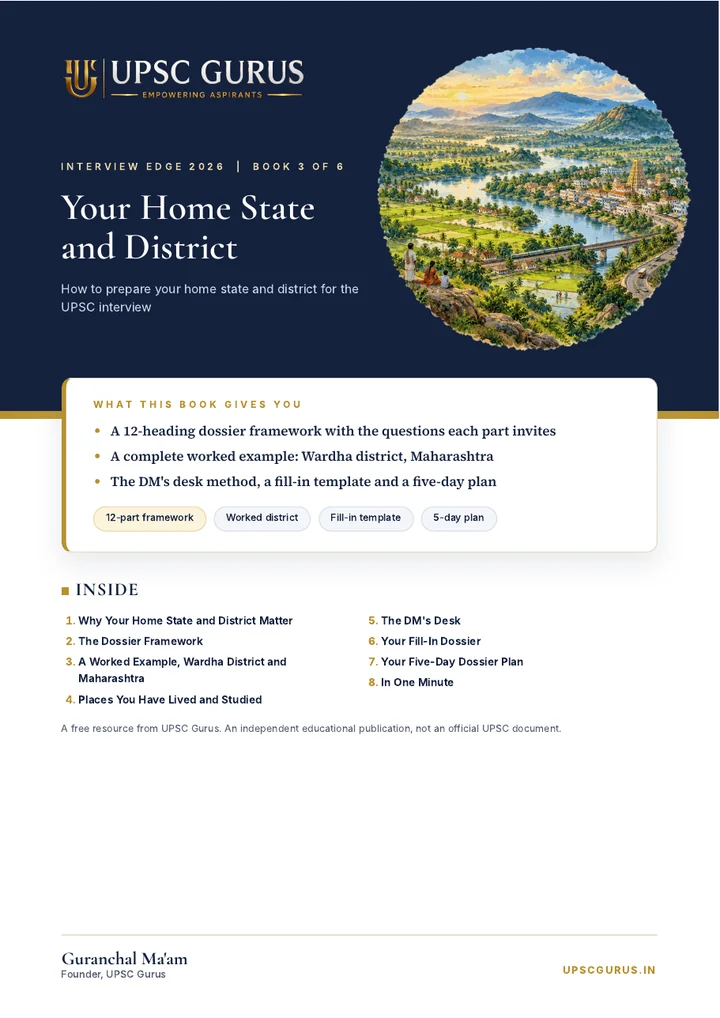
Your Home State and District, a free 49-page Interview Edge book, gives you a 12-part dossier framework, a complete worked district and a fill-in template.
It guides you from verified facts to explanations, administrative reasoning and speaking practice.
A district dossier should not become a collection of downloaded PDFs.
It should become a way of seeing how people, places and institutions connect.
Use a twelve-part framework, a complete Wardha example, practical worksheets and a five-day plan to prepare your state and district.
Download Your Home State and DistrictSee all six books →Frequently asked questions
What home state questions are asked in the UPSC interview?
Home-state preparation may cover geography, history, economy, culture, public services and current issues. There is no fixed official question list, and illustrative practice questions should not be treated as predictions.
How do I make a district profile for the UPSC interview?
Organise information into geography, history, population, economy, governance, infrastructure and development issues. Record reliable sources and years, then practise explaining causes and possible public responses.
Should I memorise population and literacy figures?
Know important verified figures and their reference years. Understanding what the figures mean is more valuable than memorising numerous disconnected statistics.
Should I prepare both my birthplace and my current city?
Prepare the places meaningfully connected to your background, especially those declared in your application. The depth of preparation can reflect how closely you know each place.
What if I do not know much about my home district?
Begin with the official district website and a few reliable publications. Build your understanding gradually. Being unfamiliar with some aspects of a place is a reason to learn, not to feel embarrassed.
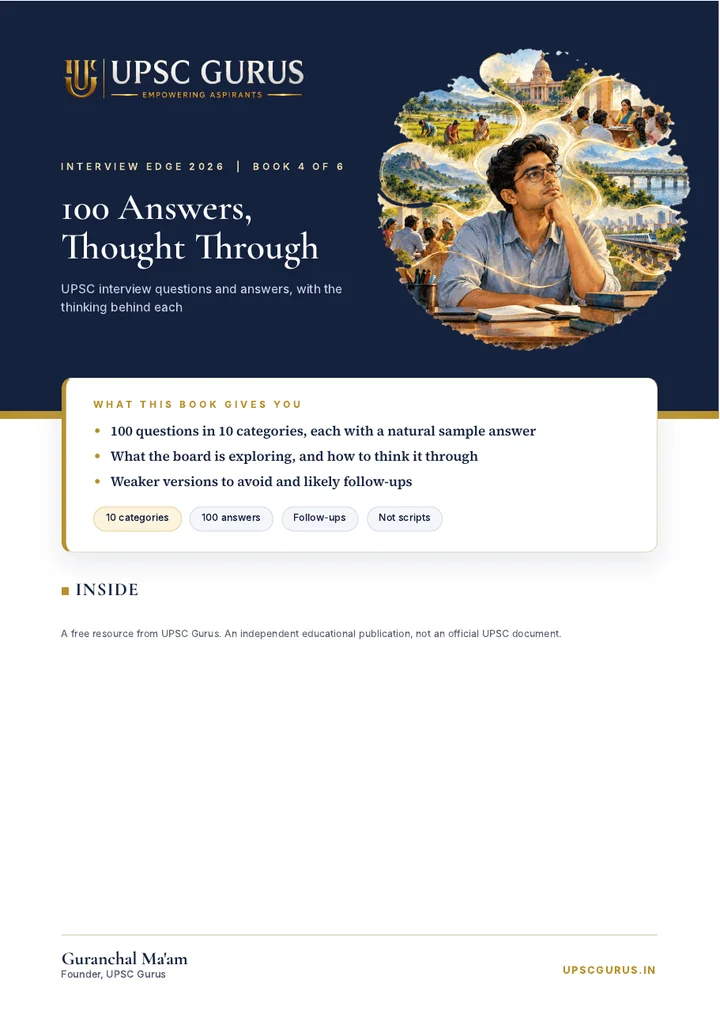
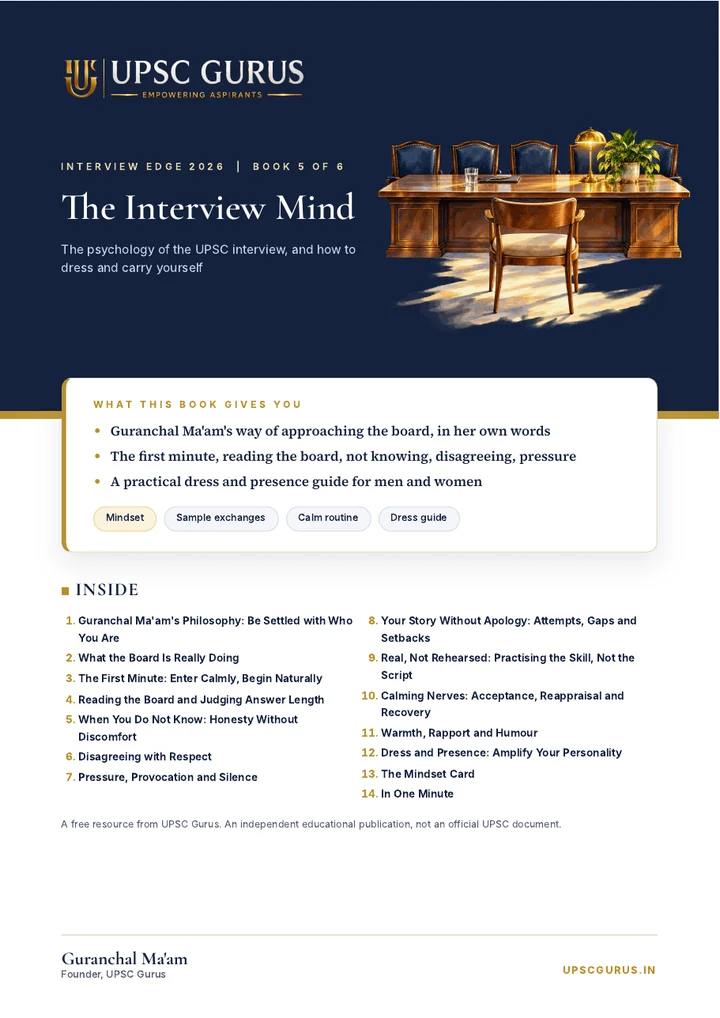
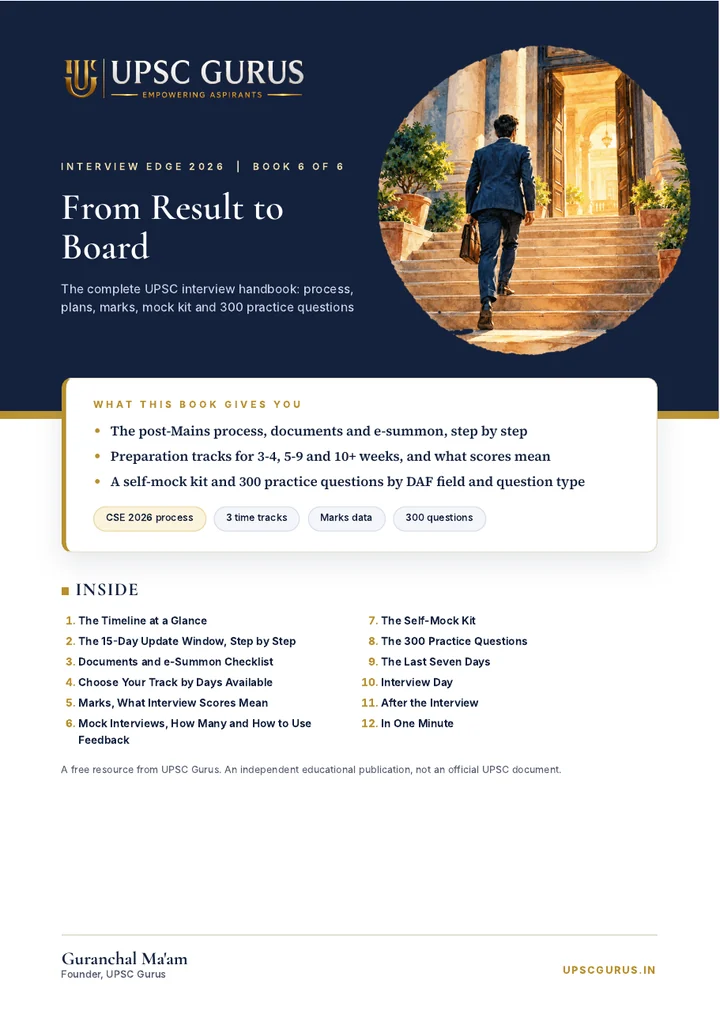
Six free UPSC interview books. 336 pages, nothing repeated.
336 pages of thoughtful guidance, worked examples and practical tools. Everything you need to prepare with clarity, think independently and speak in your own voice. By Guranchal Ma’am, Founder, UPSC Gurus.
Interview Edge Studio
Practise from your own profile: a field-by-field DAF check, 100 questions drawn from your details, feedback on answers you write in your own words, and situation practice from your home state. Built on the method of Guranchal Ma’am, Founder, UPSC Gurus.