UPSC Interview Questions Based on DAF: How to Prepare
Your Detailed Application Form contains more than personal information. It records choices, interests, places, achievements and experiences that are part of your life.
These details can provide useful starting points for interview preparation.
A candidate who studied economics may reflect on economic reasoning and its public applications. Someone who worked in a school may consider the realities of teaching and learning. A candidate who enjoys photography may explore observation, creativity, ethics and technology.
The purpose of preparing UPSC interview questions based on your DAF is not to predict exactly what a board will ask.
It is to develop a deeper understanding of yourself and become comfortable discussing your experiences with clarity and judgement.
This guide offers a practical method, with illustrative questions you can use for independent reflection.
Why is the DAF important for the UPSC interview?
The UPSC CSE 2026 notification states that the interview board will have before it a record of the candidate’s career.
It also explains that the Personality Test assesses qualities such as mental alertness, logical expression, balanced judgement, breadth of interest and integrity.
This makes personal background a useful place to begin.
However, no candidate should assume that every application entry will be discussed or that the board’s questions can be predicted.
Your DAF helps define your preparation areas. It does not define the limits of the interview.
Source: UPSC CSE 2026 Notification, Section II(C).
The DAF Question Trail: a practical preparation method
Instead of preparing isolated answers, build a question trail around each important entry.
Use four levels.
Level 1: Understand the fact
Identify exactly what you have written.
If your DAF mentions a degree in mechanical engineering, begin with your field of study, its core areas and the subjects you found meaningful.
Level 2: Explore the personal connection
Reflect on why you made a choice and what you experienced.
For mechanical engineering, you might examine what interested you, which projects you undertook or what changed in your thinking during the course.
Level 3: Connect with a wider issue
Consider the relationship between your background and contemporary society.
Engineering, for instance, may connect to manufacturing, energy efficiency, industrial safety, employment or technological change.
Level 4: Exercise judgement
Move from knowing about an issue to examining competing considerations.
For example, how should public policy balance industrial expansion with environmental safeguards and the needs of affected communities?
This sequence helps you prepare for deeper conversation without memorising a chain of responses.

UPSC interview questions from educational background
Your educational qualifications are one area worth revisiting carefully.
Illustrative practice questions include:
- Which aspect of your graduation subject interested you most?
- How has your discipline shaped the way you think?
- What practical contribution can your field make to public administration?
- Has anything you learnt academically changed your view of a social problem?
- What would you approach differently if you could revisit your education?
A candidate from a non-technical background need not justify their education as less useful than a professional degree.
Literature, sociology, commerce, medicine, agriculture, science and other disciplines each develop different ways of understanding the world.
Reflect on the actual contribution of your own field.
Work experience and employment-related questions
Work experience can reveal how someone understands responsibility, collaboration and organisational life.
If you have worked, consider these practice questions:
- What did your role involve in practical terms?
- What was one difficult decision you encountered?
- What did you learn from a colleague with a different perspective?
- Which institutional problem did you observe?
- How did the experience change your understanding of public service?
Candidates without formal employment are not required to invent comparable experiences.
Responsibilities at home, voluntary activities, academic projects and other genuine experiences may also support meaningful reflection.
The objective is to understand your own experiences, not to manufacture an impressive profile.
Hobby questions in the UPSC interview
Hobbies often generate interest because they reveal what a person chooses to do beyond compulsory responsibilities.
The depth of your engagement matters more than how unusual the hobby sounds.
If your hobby is reading
Explore these questions:
- What kinds of books do you naturally choose?
- Has a book ever changed your understanding of an issue?
- How do you distinguish a writer’s argument from established fact?
- What makes you disagree with an author you otherwise admire?
If your hobby is gardening
Consider:
- What have you learnt through caring for plants?
- What difficulties arise in maintaining a garden?
- How does gardening connect with water use and local ecology?
- What difference do you see between ornamental and community green spaces?
If your hobby is cricket
You might reflect on:
- What makes teamwork effective under pressure?
- How should a captain respond to an individual mistake?
- What factors affect access to sporting opportunities?
- How do commercial interests influence modern sport?
If your hobby is music
Explore:
- What attracts you to a particular form of music?
- How do musical traditions change over time?
- What role does music play in community identity?
- How can traditional forms remain accessible to younger generations?
These are preparation prompts, not reported or predicted UPSC board questions.
You do not need expert-level knowledge of every aspect associated with a hobby. You should, however, be genuinely interested in what you have declared.
How to handle questions about personal decisions
Your DAF may contain decisions that are important to your life.
You may have changed your academic field, left employment, taken time away from formal study or chosen civil services after pursuing another path.
Reflect on these choices without treating them as defects requiring defence.
A helpful preparation framework is:
Context: What were the circumstances?
Decision: What did you choose?
Reasoning: What considerations influenced you?
Learning: What do you understand now?
You can recognise uncertainty, changed circumstances or an earlier mistake without turning your story into a performance.
Thoughtful reflection is more useful than a perfectly polished explanation.
Building your Personal Evidence Bank
An evidence bank is a private record of incidents that have taught you something.
Choose ordinary, truthful experiences involving responsibility, disagreement, initiative, setbacks or helping others.
For each incident, write:
- What happened?
- What was your actual role?
- What choices were available?
- What did you do?
- What did the experience teach you?
For example, organising a college event may offer insights into cooperation and planning. Helping a family member navigate a public service may offer insights into accessibility and administrative complexity.
The incident need not be extraordinary.
The important part is understanding it accurately, including its limitations.
Practise follow-up questions rather than fixed answers
After reflecting on a topic, ask yourself what might challenge your first conclusion.
If you argue that digital technology improves public services, consider who may still struggle to access those services.
If you favour a particular policy, consider its costs, implementation difficulties and unintended consequences.
Notice whether you can revise a position when new information becomes available.
This is more useful than practising the same opening sentence repeatedly.
Practise with 100 Answers, Thought Through
100 Answers, Thought Through is a free 64-page Interview Edge book: 100 questions in ten categories, each with the thinking behind a natural answer.
It is designed to help you move from personal observations to wider public issues, examine competing arguments and respond to follow-up questions.
The questions are exercises in thinking, not predictions about the official interview.
The best preparation does not give you somebody else’s voice. It helps you understand and strengthen your own.
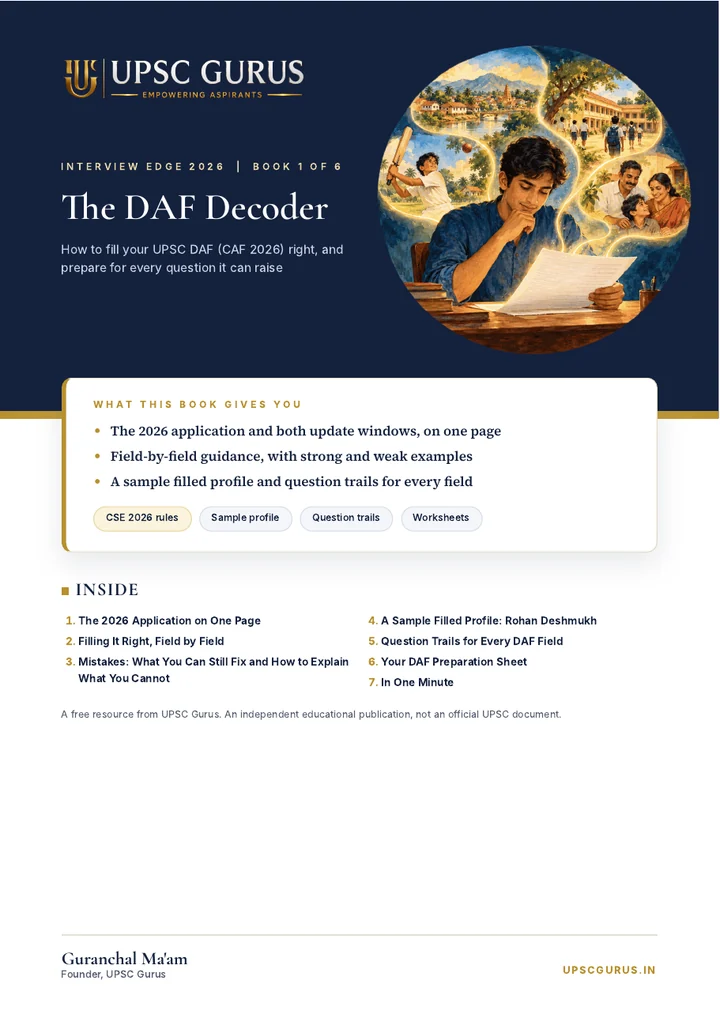
Follow question trails from a filled profile, then practise with 100 answered interview questions that explain the thinking behind each response.
Download The DAF DecoderSee all six books →Frequently asked questions
Does UPSC ask questions directly from the DAF?
The board has a record of the candidate’s career, and personal information can provide useful starting points. However, the official notification does not prescribe a fixed list or proportion of DAF-based questions.
How should I prepare hobby questions for the UPSC interview?
Understand your actual interest, experiences and basic concepts related to the hobby. Explore its connections with society and contemporary issues. Avoid claiming expertise beyond your genuine involvement.
What if my hobby is very ordinary?
An ordinary hobby is perfectly suitable for meaningful reflection. The important questions are why you enjoy it, what you have learnt and how thoughtfully you can discuss it.
Should I memorise answers to common UPSC interview questions?
Practise expressing your thoughts, but avoid memorising complete responses. Fixed scripts may make it harder to respond naturally when a question changes or requires deeper reasoning.
Can I say that I do not know an answer?
Yes. When you genuinely do not know, acknowledge the limitation rather than inventing information. If you have relevant partial knowledge, distinguish it carefully from what you remain uncertain about.
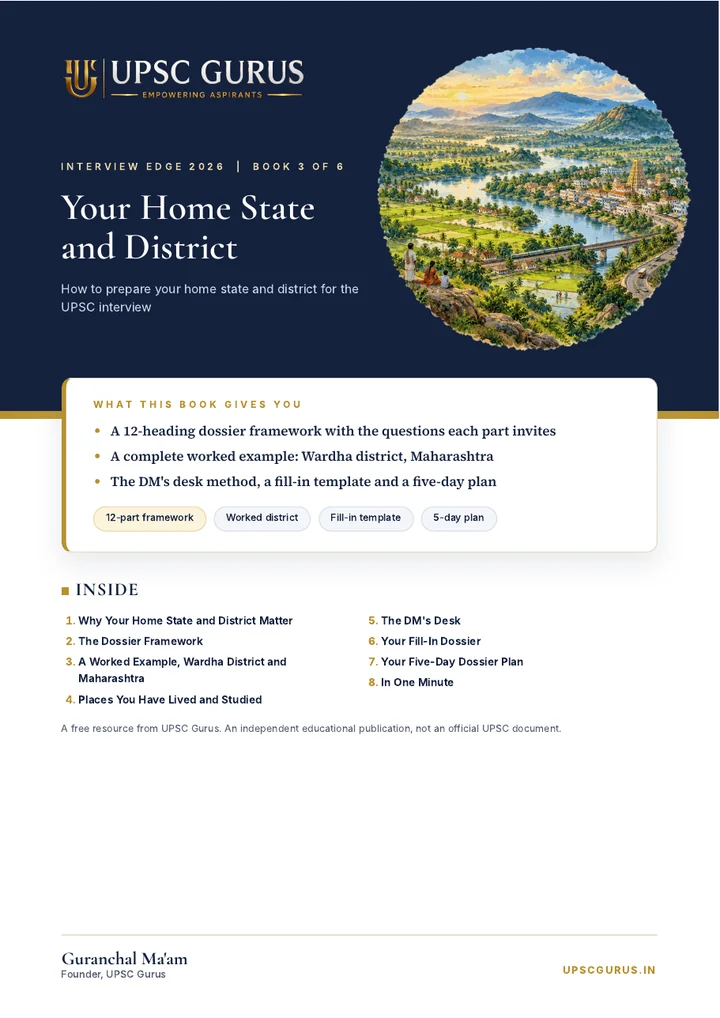
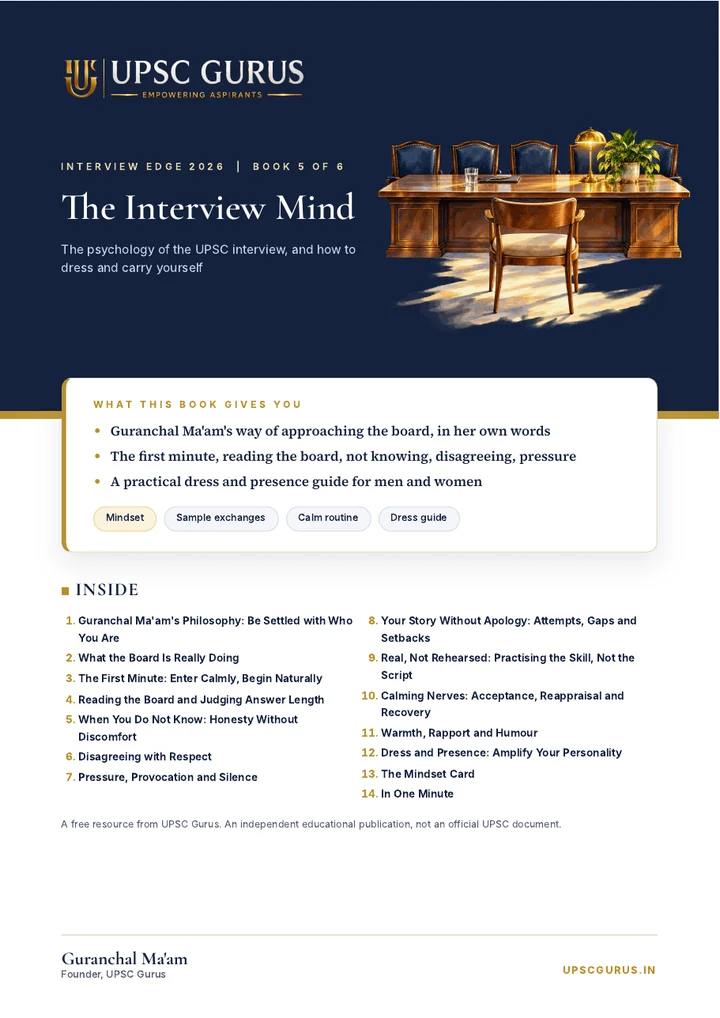
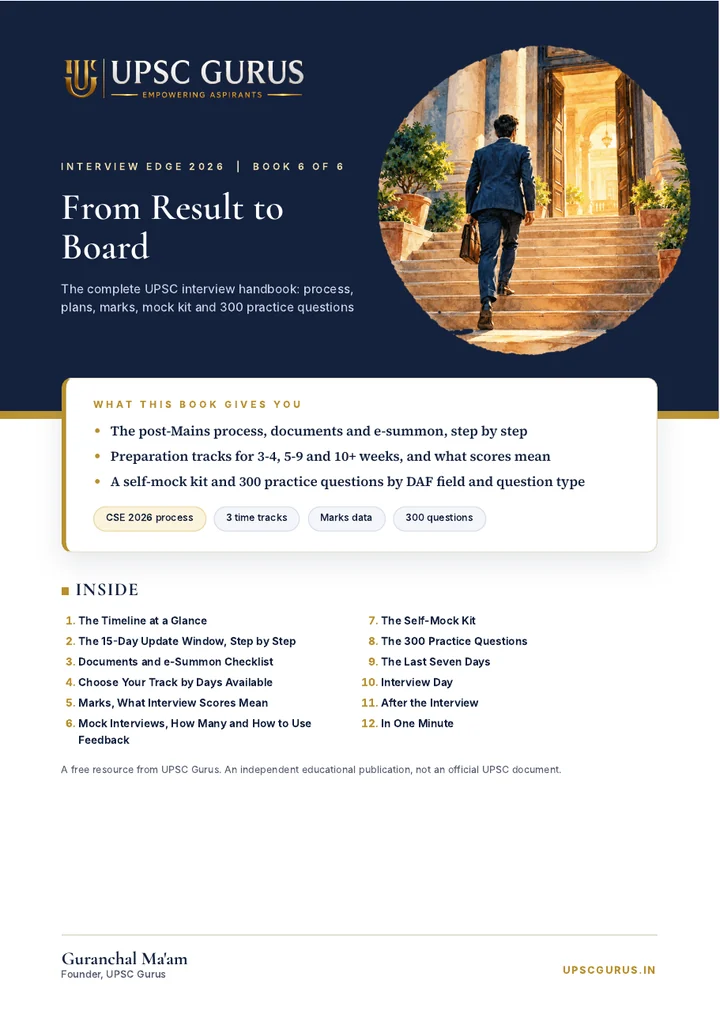
Six free UPSC interview books. 336 pages, nothing repeated.
336 pages of thoughtful guidance, worked examples and practical tools. Everything you need to prepare with clarity, think independently and speak in your own voice. By Guranchal Ma’am, Founder, UPSC Gurus.
Interview Edge Studio
Practise from your own profile: a field-by-field DAF check, 100 questions drawn from your details, feedback on answers you write in your own words, and situation practice from your home state. Built on the method of Guranchal Ma’am, Founder, UPSC Gurus.