UPSC Interview Preparation: A Complete, Practical Guide
Know your story. Think in your own words.
You have spent months preparing for the Civil Services Examination. Now the preparation changes.
The UPSC Personality Test is not another written examination conducted across a table. It is an opportunity to demonstrate how you understand the world, how you approach difficult questions and how you think about a career in public service.
Good UPSC interview preparation does not mean memorising hundreds of polished answers. It means understanding your own background, developing informed opinions, practising balanced judgement and becoming comfortable expressing what you genuinely think.
This guide explains what the Personality Test assesses, where to begin and how to build a preparation routine that remains manageable and meaningful.
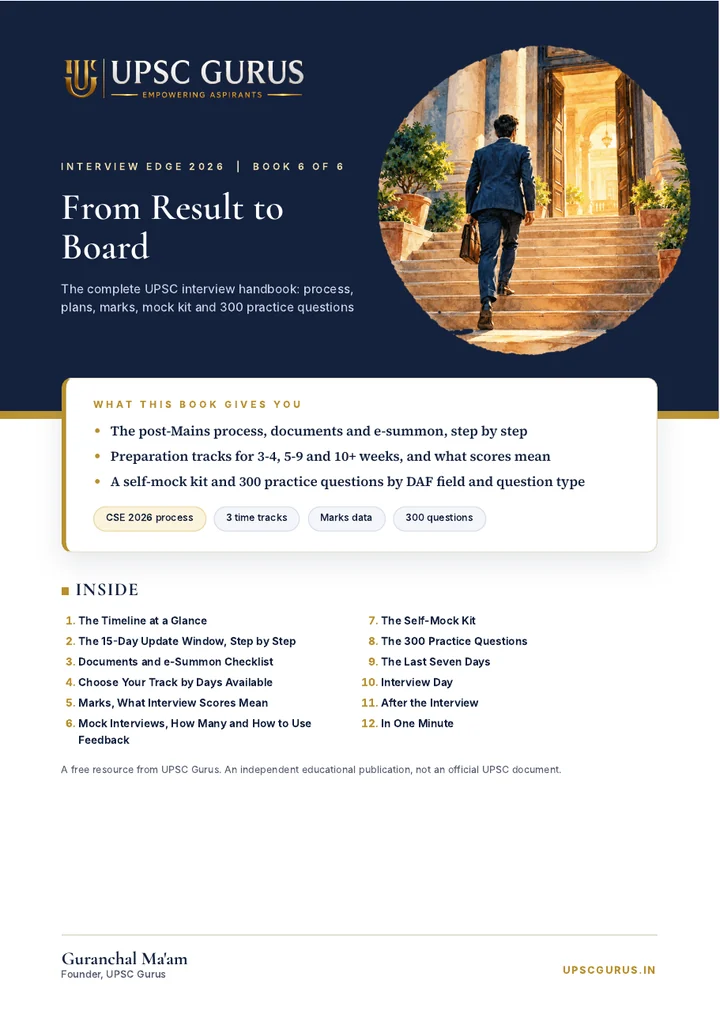
Move from general advice to a clear plan. Explore the process, preparation tracks, essential qualities and interview mindset in three free books.
Download From Result to BoardSee all six books →What is the UPSC Personality Test?
The UPSC Civil Services Personality Test is the interview component of the Civil Services (Main) Examination.
Under the UPSC CSE 2026 notification, the Personality Test carries 275 marks, with no minimum qualifying marks. These marks are added to the 1,750 marks of the written Main Examination to determine the final ranking.
But the marks alone do not explain its purpose.
Section II(C) of the official notification describes the interview as an assessment of personal suitability for a career in public service.
The qualities identified include:
- Mental alertness and the ability to understand questions.
- Clear, logical expression and balanced judgement.
- Intellectual curiosity and depth of interest.
- Social awareness and leadership.
- Intellectual and moral integrity.
UPSC describes the interview as a natural, directed conversation rather than a strict cross-examination. It is not intended to repeat the specialised or general knowledge already tested through written papers.
What this means for your preparation: You need knowledge, but you also need to show how you use it.
Source: UPSC CSE 2026 Official Notification, Section II(C). Always check the notification for your examination year.
How to prepare for the UPSC interview: five essential areas
1. Begin with your DAF and personal background
Your application is one of the most useful starting points for interview preparation.
Review every entry: your name, educational background, places you have lived, work experience, achievements, interests and other information you have provided.
For each entry, ask three questions:
- What do I know about this?
- Why is it part of my story?
- What larger issue could it connect to?
For example, a candidate who studied engineering might reflect on the discipline itself, the decision to pursue civil services and how technical thinking can contribute to public administration.
A candidate who helped run a family business might reflect on financial uncertainty, customers, regulation and the realities of small enterprises.
Neither background is inherently stronger.
The objective is to recognise the meaning and possible connections within your own experiences.
2. Prepare your home state and district
Your home state and district provide a practical entry point into understanding public administration.
Prepare beyond basic facts such as population, rivers and important places.
Explore the local economy, public services, social composition, historical developments and major challenges.
Then move from facts to judgement.
If your district experiences seasonal flooding, for example, consider its causes, the communities most affected, existing institutional responsibilities and realistic long-term responses.
A useful method is to prepare every important topic in three layers:
Know: Establish verified facts.
Understand: Explain the causes and consequences.
Think as a public servant: Consider possible responses, trade-offs and implementation difficulties.
Your aim is not to describe your district as perfect or hopeless. It is to understand it with care.
3. Develop informed views on current affairs
Current affairs preparation for the Personality Test should not become a daily race to collect headlines.
Select important national, international and local developments and examine them through questions of public interest.
For each significant issue, consider:
- What happened, and what is reliably known?
- Why does it matter?
- Who is affected differently?
- What reasonable arguments exist?
- What would responsible public action require?
Distinguish facts from interpretations. When a question involves competing values, examine those tensions rather than searching for a conveniently decisive statement.
You do not need an opinion on every event. You need the ability to form and revise opinions through evidence and reasoning.
4. Practise judgement and ethical reasoning
Public service frequently involves imperfect information, limited resources and competing priorities.
Consider a hypothetical situation: a district faces a shortage of drinking water, and two communities disagree over distribution.
The useful preparation exercise is not to memorise a dramatic solution. It is to identify the stakeholders, relevant rules, immediate needs, possible options and consequences of each decision.
Ask yourself:
- What information must be verified first?
- Who may be vulnerable or unheard?
- What legal and ethical responsibilities apply?
- What would make a decision fair, workable and accountable?
These exercises develop habits of thought that remain valuable beyond the interview.
5. Practise speaking naturally
Reading and thinking are important, but interview preparation also requires speaking.
Choose one question a day and respond aloud without a prepared script.
Listen to whether you understood the question, organised your thoughts and reached a clear conclusion.
Occasional mock interviews can help identify recurring habits. Feedback from seasoned officers or experienced educators may be valuable, particularly when it is specific and constructive.
However, a mock interview is a practice conversation, not a prediction of your UPSC board or marks.
The objective is improvement, not imitation.

A simple 14-day UPSC interview preparation plan
You can adapt this plan to your available time.
| Days | Preparation focus |
|---|---|
| 1–2 | Review your application and identify personal preparation areas |
| 3–4 | Study your education, work, achievements and interests |
| 5–6 | Prepare your home state and district |
| 7–8 | Examine major current affairs and public policy issues |
| 9–10 | Practise ethical situations and questions requiring judgement |
| 11–12 | Hold speaking exercises and one thoughtful mock conversation |
| 13 | Review feedback and revise uncertain areas |
| 14 | Consolidate your notes and establish a calm final routine |
Preparation need not follow a rigid timetable. The important thing is to make steady progress across all five areas.
What to avoid during UPSC interview preparation
Avoid collecting so many questions that you have no time to think about them.
Do not invent hobbies, achievements or experiences to make your profile appear more impressive.
Avoid rehearsing answers until they sound detached from your own voice.
Do not assume that confidence requires immediate certainty. A thoughtful pause, a qualified opinion or an honest acknowledgement of limited knowledge can be appropriate.
Most importantly, do not measure your readiness by comparing your background with somebody else’s.
A candidate from a small village, a first-generation graduate, a working professional, a parent returning to study and a candidate from a major university can each bring meaningful experiences to the conversation.
Continue your preparation with Interview Edge
At UPSC Gurus, we believe interview preparation should begin with the person, not the question bank.
Your background is not something to hide behind polished answers. It is something to understand.
Guranchal Ma’am
Founder, UPSC Gurus
Frequently asked questions
How should I start preparing for the UPSC Personality Test?
Begin by reviewing your application and preparing your personal background. Then work through your state and district, current affairs, judgement exercises and speaking practice. Build depth before expanding the number of topics.
How many marks is the UPSC interview worth?
The UPSC CSE 2026 Personality Test carries 275 marks, with no minimum qualifying marks. Check the official notification for your examination year.
Is the UPSC interview a general knowledge test?
Not primarily. The official notification says the Personality Test is not intended to repeat the specialised or general knowledge tested in written examinations. Awareness, understanding and judgement still matter.
Are mock interviews necessary for UPSC preparation?
They can be helpful for practising communication, listening and composure. They are not a substitute for genuine reflection or subject preparation, and no mock can predict the official board’s questions or assessment.
Can I prepare for the UPSC interview without an expensive programme?
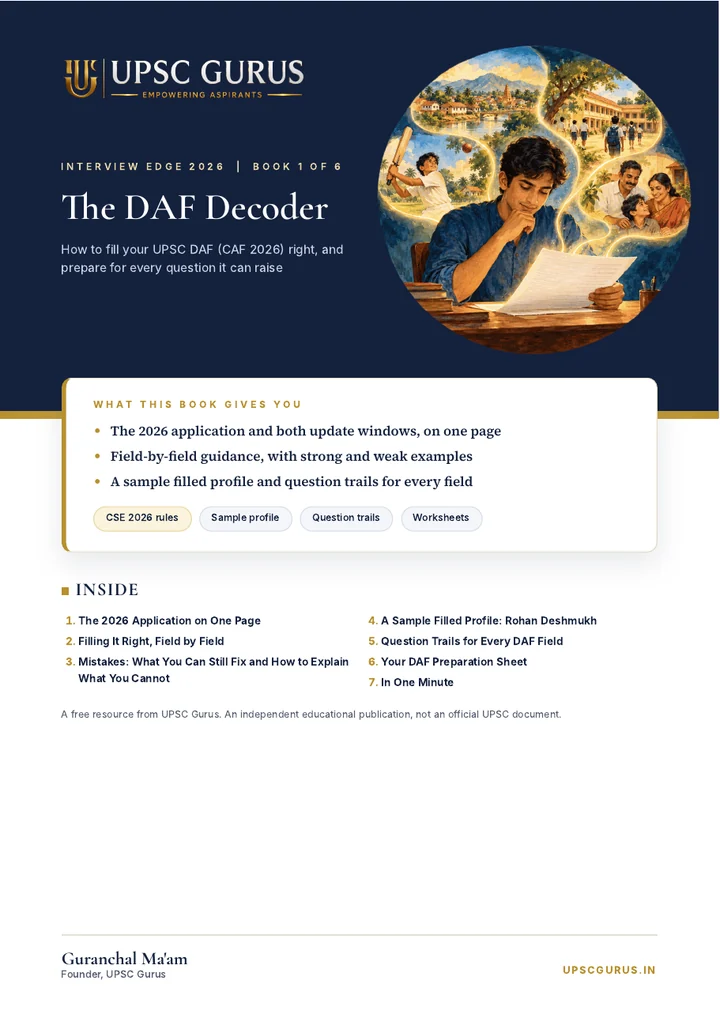
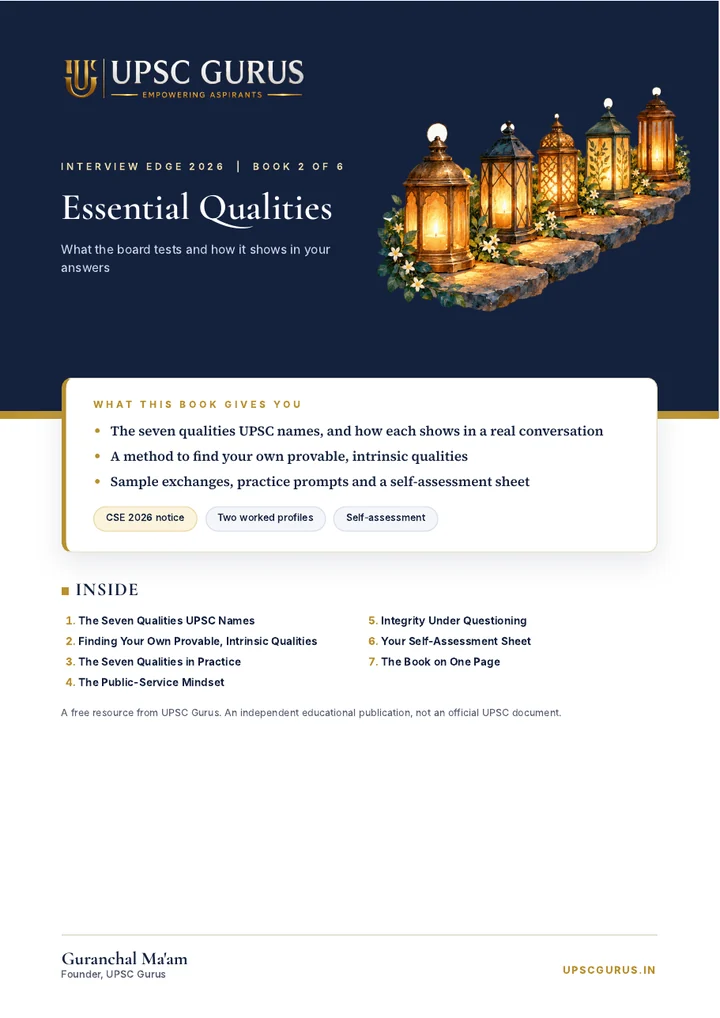
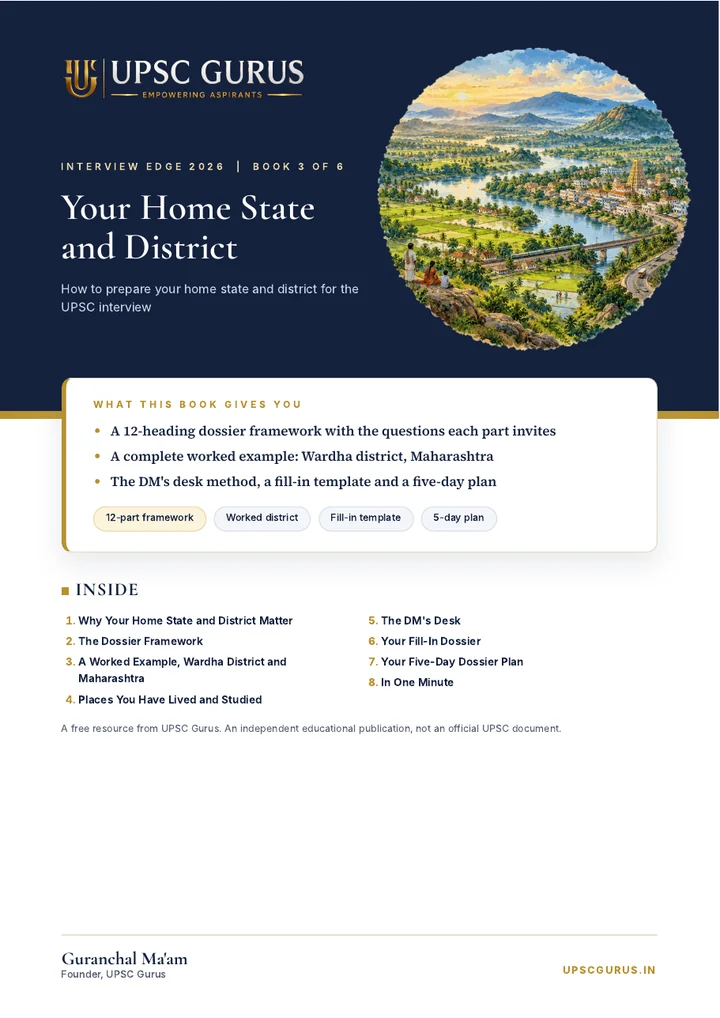
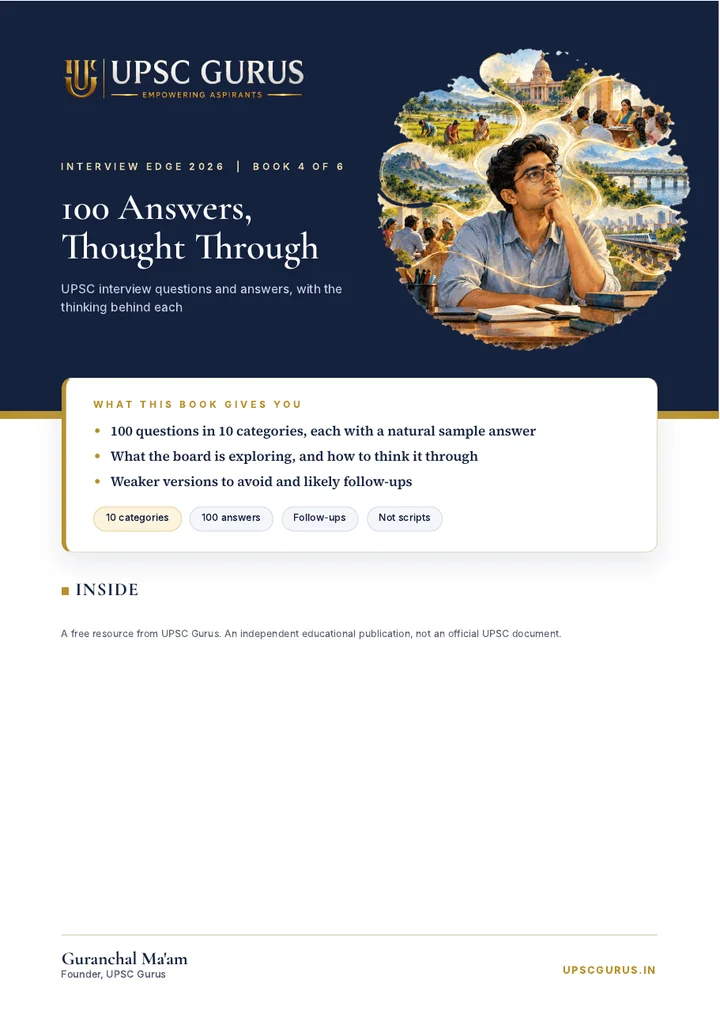
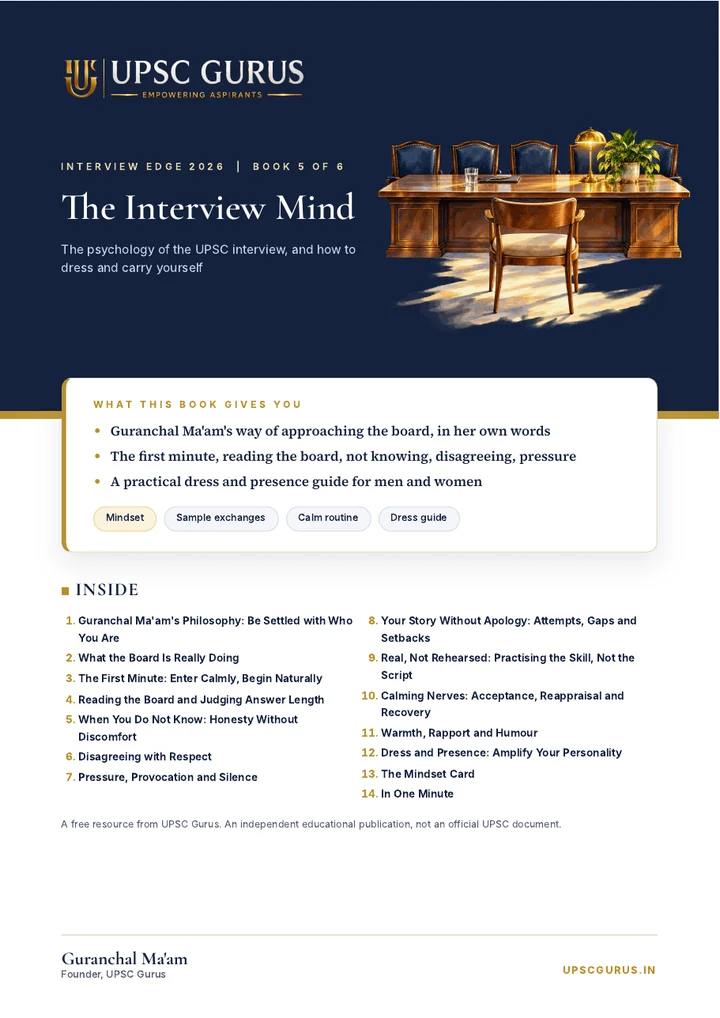
Six free UPSC interview books. 336 pages, nothing repeated.
336 pages of thoughtful guidance, worked examples and practical tools. Everything you need to prepare with clarity, think independently and speak in your own voice. By Guranchal Ma’am, Founder, UPSC Gurus.
Interview Edge Studio
Practise from your own profile: a field-by-field DAF check, 100 questions drawn from your details, feedback on answers you write in your own words, and situation practice from your home state. Built on the method of Guranchal Ma’am, Founder, UPSC Gurus.