 New this week · Free UG Handout 02UPSC Mains Directive Words: 60 Meanings, Trends and PYQsTwo free PDFs: The Guide and the With PYQs edition.Read and download
Today’s Canvas
- Sukhna Wetland and Sauj Jheel named Ramsar sites, taking India’s tally to 103GS III
- Brazil reports Legal Amazon deforestation at its lowest since records began in 1988GS III
- NBA disburses Rs 1.19 crore under Access and Benefit Sharing to 29 State Biodiversity Boards and one UT councilGS III
- Defence Ministry signs Rs 4,106 crore contracts for IAF satellite GSAT-7C and Navy Varunastra torpedoesGS III
- India’s space economy could reach USD 40-45 billion in seven to eight years, says Jitendra SinghGS III
- FSSAI draft proposes residue limits of 20 mg/kg for acetamiprid and 50 mg/kg for imidacloprid in teaGS III
- Chouhan reviews preparations for Khet Bachao Abhiyan to run from 22 OctoberGS III
- Kolkata Durga Puja pandal stampede: 19 dead, 25 injured; SIT headed by a High Court judge announcedGS III
- MEA confirms Jaishankar-Rubio talks in Mumbai on 20 October as US Secretary of State tours Uzbekistan and IndiaGS II
- Jaishankar concludes three-day UAE visit, meets Ruler of Ras Al Khaimah on Gulf situation and trade tiesGS II
- FSSAI draft proposes prohibition on added sucrose and fructose in food for infants up to six monthsGS II
- NPPA caps trade margins at 30 per cent on 137 non-scheduled anticancer drugs; revised prices from 9 NovemberGS II
- International Lead Poisoning Prevention Week begins: WHO urges action “From Detection to Prevention”GS II
- Braj Mohan Ram takes oath as Odisha’s 28th Governor at Lok Bhavan, BhubaneswarGS II
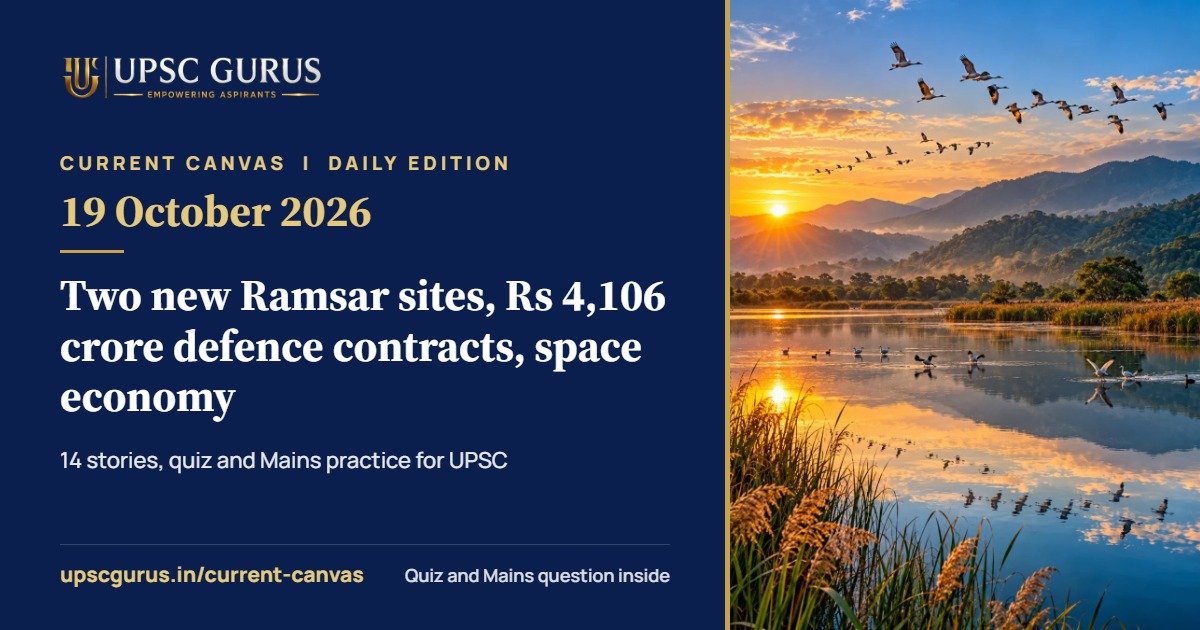
- Sukhna Wetland (Chandigarh) and Sauj Jheel (Uttar Pradesh) are now Ramsar sites, taking India’s total to 103.
- The Defence Ministry signed contracts worth Rs 4,106 crore: Rs 2,563 crore for the GSAT-7C satellite and Rs 1,543 crore for Varunastra torpedoes.
- The NPPA has capped trade margins on 137 anticancer drugs, with price cuts of up to 70 per cent from 9 November.
- Union Minister Jitendra Singh said India’s space economy could grow from about USD 9 billion to USD 40 to 45 billion in seven to eight years.
- A stampede at a Durga Puja pandal in Kolkata killed 19 people and an SIT has been announced; NDMA guidelines set out how crowds at mass gatherings should be managed.
- Brazil reported Amazon deforestation of about 3,335 sq km for August 2025 to July 2026, the lowest since 1988.
- External Affairs Minister Jaishankar will host US Secretary of State Rubio in Mumbai on 20 October.
Environment

Sukhna Wetland and Sauj Jheel named Ramsar sites, taking India’s tally to 103
In short: Chandigarh’s first Ramsar site and a Mainpuri lake in Uttar Pradesh were added on 15 October, lifting India from 101 to 103 sites.
Why in news
Union Environment Minister Bhupender Yadav announced on 15 October 2026 that Sukhna Wetland in Chandigarh and Sauj Jheel in Uttar Pradesh have been designated Wetlands of International Importance under the Ramsar Convention. India’s Ramsar tally rises to 103. Sukhna is Chandigarh’s first Ramsar site, listed as Site No. 2602.
Background
Sukhna is a peri-urban wetland at the foothills of the Outer Himalayas, with habitats from open water to littoral vegetation, scrub and forest. It supports birds on the Central Asian Flyway, including the vulnerable common pochard and the endangered Pallas’s fish eagle, and the black pond turtle. The Chandigarh administration says it will protect the wetland, its catchment and the adjoining Sukhna Wildlife Sanctuary. Sauj Jheel lies in Mainpuri district, beside the Karhal-Kishni road, and is a shallow depression forming part of the Saman Wetland Complex, whose lakes are Important Bird Areas. Glaw Lake in Arunachal Pradesh was the 101st site, added in August 2026, and the network has grown from 26 sites in 2014.
Key facts for Prelims
- Ramsar Convention: intergovernmental treaty of 1971 for conservation and wise use of wetlands; designated sites are Wetlands of International Importance
- India’s Ramsar sites: 103 after the addition of Sukhna Wetland (Chandigarh) and Sauj Jheel (Mainpuri, Uttar Pradesh)
- Sukhna Wetland: Site No. 2602; Chandigarh’s first Ramsar site; adjoins Sukhna Wildlife Sanctuary
- Central Asian Flyway: migratory route used by waterbirds that winter in the Indian subcontinent
- Glaw Lake (Arunachal Pradesh) became India’s 101st Ramsar site in August 2026
Mains analysis and way forward
Mains analysis
- Ramsar listing brings international recognition, scientific oversight and technical assistance, but it does not by itself deliver protection; management plans and enforcement decide outcomes.
- Urban and peri-urban wetlands such as Sukhna face siltation, pollution and encroachment, so catchment management is as important as the water body.
- Wetlands provide flood buffering, groundwater recharge and livelihoods, linking conservation to climate resilience and local communities.
Way forward
- Prepare site-level integrated management plans with community and local-body participation, including catchment protection.
- Track water quality and bird populations regularly and publish the data, so that listing translates into measurable ecological gains.
Connect the dots: GS III: Conservation, environmental pollution and degradation; Geography: wetlands and lakes; international conventions.
Sources: ThePrint: India’s Ramsar sites tally rises to 103, 15 Oct 2026; ThePrint: Sukhna wetland in Chandigarh designated Ramsar site, 15 Oct 2026; Swarajya: India’s Ramsar sites rise to 103, Oct 2026

Brazil reports Legal Amazon deforestation at its lowest since records began in 1988
In short: About 3,335 sq km was cleared in Brazil’s Legal Amazon between August 2025 and July 2026 (INPE PRODES), down 41.8 per cent year on year and the lowest on record; fire and El Nino risks remain.
Why in news
Brazil’s government announced on 16 October 2026 that annual deforestation in Brazil’s Legal Amazon, as monitored by INPE’s PRODES satellite system (this is not the whole Amazon basin), fell to the lowest level since records began in 1988: 3,335 sq km lost from August 2025 to July 2026, down 41.8 per cent year on year. The government says deforestation has fallen 71 per cent since 2023, when President Lula returned to office. Environment groups called the result historic but warned that it depends on policy continuity.
Background
Deforestation rose about 60 per cent during 2019 to 2022, with more than 45,000 sq km cleared, according to official data. Since 2023 Brazil has revived its Action Plan for the Prevention and Control of Deforestation in the Legal Amazon (PPCDAm), launched in 2004, restored satellite-based sanctions for illegal clearing and proposed barring bank loans to properties with illegal deforestation. Degradation from wildfires, logging and drought still affects about 40 per cent of the Amazon. Fire counts were near historic lows this year but have tripled since 4 October, and a strong El Nino could raise fire risk in 2026 and 2027. Separately, DETER near-real-time alerts for August 2025 to July 2026 covered 2,874.38 sq km, the lowest since that series began in 2016.
Key facts for Prelims
- Amazon: world’s largest tropical rainforest; Brazil holds the largest share
- INPE (Brazil’s space research agency) tracks the Amazon by satellite: PRODES gives the annual deforestation rate, DETER gives near-real-time alerts
- Annual period for the deforestation rate runs August to July
- PPCDAm: Brazil’s Action Plan for Prevention and Control of Deforestation in the Legal Amazon, launched 2004
- Brazil has a 2030 goal to halt and reverse deforestation; Lula’s pledge is zero net deforestation by 2030
Mains analysis and way forward
Mains analysis
- Brazil’s record shows that monitoring, enforcement and credit restrictions can bend the deforestation curve within a few years, a lesson for forest governance elsewhere.
- Deforestation and degradation are distinct: fires, logging and drought still affect about 40 per cent of the Amazon, so low clearing rates do not guarantee a healthy forest.
- Gains depend on political continuity and climate conditions; a strong El Nino raises the risk of drought and fire.
Way forward
- Anchor enforcement in law and finance, with sustained funding for satellite monitoring and field agencies.
- Pair forest protection with livelihoods for local and Indigenous communities and with restoration of degraded land.
Connect the dots: GS III: Conservation; climate change; Geography: tropical rainforests, remote sensing applications; El Nino.
Sources: AP via News4JAX: Brazil says Amazon deforestation fell to the lowest level since 1988, 16 Oct 2026; Brazil Ministry of Environment: PRODES 2026 presentation by INPE (Legal Amazon estimate, 2025/2026 cycle); Agencia Brasil: Amazon deforestation alerts fall over past year, Aug 2026
NBA disburses Rs 1.19 crore under Access and Benefit Sharing to 29 State Biodiversity Boards and one UT council
In short: The National Biodiversity Authority released Rs 1.19 crore on 17 October, passing payments for the use of biological resources on to State and UT bodies for conservation.
Why in news
The National Biodiversity Authority (NBA) disbursed Rs 1.19 crore to 29 State Biodiversity Boards and one Union Territory Biodiversity Council under the Access and Benefit Sharing (ABS) mechanism, as reported on 17 October 2026 from a PIB release. The money comes from payments made to the NBA by users of India’s biological resources and is routed to State and UT bodies for biodiversity work.
Background
ABS is a statutory mechanism under the Biological Diversity Act, 2002, which was amended in 2023. Companies and institutions that use biological resources found in India, for commercial purposes or for applications such as intellectual property rights, are required to share a part of the benefits with the country and its providers of resources and knowledge. India’s framework supports its commitments under the Convention on Biological Diversity, the Nagoya Protocol and Target 13 of the Kunming-Montreal Global Biodiversity Framework. Where the resource cannot be traced to specific communities, as with produce bought in open markets, the NBA distributes the proceeds to States and UTs. In September 2026 the NBA crossed Rs 200 crore in cumulative ABS disbursements, and a release of Rs 8.23 crore distributed payments by seed companies for four vegetable crops according to cultivation area. Under Section 32(2) of the Act, State Boards and UT Councils must use the funds for purposes such as People’s Biodiversity Registers, conservation, Biodiversity Heritage Sites, capacity building of Biodiversity Management Committees and community livelihoods.
Key facts for Prelims
- National Biodiversity Authority (NBA): statutory body under the Biological Diversity Act, 2002; State Biodiversity Boards (SBBs) and local Biodiversity Management Committees (BMCs) form the other tiers.
- Access and Benefit Sharing (ABS): fair and equitable sharing of benefits from the use of biological resources and associated knowledge.
- Nagoya Protocol: the Convention on Biological Diversity protocol on access to genetic resources and fair and equitable sharing of benefits.
- Kunming-Montreal Global Biodiversity Framework, Target 13: effective measures for access to genetic resources and benefit sharing.
- Latest release: Rs 1.19 crore to 29 State Biodiversity Boards and one UT Biodiversity Council (17 October 2026).
Mains analysis and way forward
Mains analysis
- ABS links conservation with fairness: those who hold and protect biological resources and traditional knowledge share in the commercial gains from their use.
- Funds reach communities only if State Boards and Biodiversity Management Committees have the capacity to plan, document and spend them, so the last-mile channel matters as much as the headline amount.
- Where resources cannot be traced to a community, area-based distribution to States offers a workable route, though it needs transparent data and reporting.
Way forward
- Publish State-wise utilisation of ABS funds and strengthen the capacity of Biodiversity Management Committees and People’s Biodiversity Registers.
- Widen the base of user compliance through awareness, simple approval procedures and digital tracking, while protecting traditional knowledge holders.
Connect the dots: GS III: Conservation, biodiversity, environmental governance; international conventions (CBD, Nagoya Protocol).
Sources: Infralog (PIB release): NBA disburses Rs 1.19 crore under access and benefit sharing to 29 State Biodiversity Boards and one UT council, 17 October 2026; DD India: National Biodiversity Authority crosses Rs 200 crore milestone in access and benefit-sharing disbursements, September 2026
Security

Defence Ministry signs Rs 4,106 crore contracts for IAF satellite GSAT-7C and Navy Varunastra torpedoes
In short: Two indigenous contracts worth Rs 4,106 crore, one for an Air Force communication satellite and one for heavyweight torpedoes, were signed on 15 October.
Why in news
On 15 October 2026 the Ministry of Defence signed two contracts worth about Rs 4,106 crore in New Delhi. NewSpace India Limited (NSIL), Bengaluru, will supply the GSAT-7C communication satellite for the Indian Air Force for Rs 2,563 crore, and Bharat Dynamics Limited (BDL), Hyderabad, will supply Varunastra heavyweight torpedoes to the Navy for Rs 1,543 crore. The ministry says both deals advance self-reliance under Aatmanirbhar Bharat and Make in India.
Background
GSAT-7C is described as an indigenously designed, developed and manufactured satellite that will give the IAF a dedicated communication capability and improve connectivity among its operational assets. Varunastra is a ship-launched anti-submarine torpedo developed by the Naval Science and Technological Laboratory (NSTL) and built by BDL. It is described as having advanced manoeuvring capabilities and the ability to engage submarines at long ranges. NSIL is a public sector undertaking under the Department of Space. The contracts were signed in New Delhi on 15 October in the presence of A Anbarasu, Additional Secretary and Director General (Acquisition), Department of Defence.
Key facts for Prelims
- NewSpace India Limited (NSIL): public sector undertaking under the Department of Space, Bengaluru; vendor for GSAT-7C
- Bharat Dynamics Limited (BDL), Hyderabad: builds Varunastra, designed by DRDO’s NSTL
- Varunastra: ship-launched heavyweight anti-submarine torpedo developed by NSTL
- Contract split: GSAT-7C Rs 2,563 crore (IAF); Varunastra Rs 1,543 crore (Navy)
- Signed in the presence of A Anbarasu, Additional Secretary and Director General (Acquisition), Department of Defence
Mains analysis and way forward
Mains analysis
- Space-based communication is now a core military enabler; dedicated satellites reduce dependence on shared or foreign bandwidth and support networked operations.
- Giving orders to public sector undertakings such as NSIL and BDL for indigenous systems deepens the domestic defence industrial base, though delivery timelines and quality assurance remain the test.
- Anti-submarine capability matters for a maritime theatre where undersea activity in the Indian Ocean Region is rising; torpedoes complete the layered ASW chain of sensors, platforms and weapons.
Way forward
- Pair procurement with firm delivery schedules, regular public audit of timelines and wider private-sector participation in sub-systems.
- Invest in resilient space segments (redundancy, secure ground stations) so military satellite services stay dependable.
Connect the dots: GS III: Defence technology, indigenisation, space applications; Make in India in defence; DPSUs.
Sources: The Week: Eyes in space, more firepower underwater, 15 Oct 2026; iDRW: MoD signs Rs 4,106 crore deals for GSAT-7C and Varunastra, 16 Oct 2026
Economy and agriculture

India’s space economy could reach USD 40-45 billion in seven to eight years, says Jitendra Singh
In short: The Minister of State said the sector, now about USD 9 billion, must move from technological capability to globally competitive commercial companies.
Why in news
Speaking at a media roundtable on Space, Sovereignty and New Economy organised by the Bloomberg New Economy Forum in New Delhi on 17 October 2026, Minister of State Dr Jitendra Singh said India’s space economy, at around USD 9 billion, is expected to grow to USD 40-45 billion over the next seven to eight years. He said opening the sector to private participation in 2019-20 had produced significant results within five to six years, and that the next priority is turning capabilities into commercially viable businesses. He called for more domestic and foreign investment, predictable demand and approvals within defined timeframes.
Background
The space sector was opened to private players through reforms from 2019-20, followed by the Indian Space Policy 2023, with IN-SPACe acting as the single-window authorising agency. In December 2025 the Minister told Bloomberg that the sector was about USD 8 billion with roughly 400 space startups, and spoke of a space station, the Bharatiya Antariksh Station, by 2035 and a human lunar landing by 2040. ISRO’s Chairman has set a goal of 8-10 per cent of the global commercial space market within ten years, up from about 2 per cent. A Rs 1 trillion Research, Development and Innovation scheme offers concessional financing for deep-tech projects at Technology Readiness Level 4 or above.
Key facts for Prelims
- IN-SPACe (Indian National Space Promotion and Authorization Centre) is the autonomous agency under the Department of Space that promotes and authorises private space activity.
- Indian Space Policy 2023 defines roles of ISRO, NSIL and IN-SPACe and encourages non-government entities across the space value chain.
- Bharatiya Antariksh Station is targeted for 2035 and an Indian crewed lunar landing for 2040.
- Technology Readiness Level (TRL) is a nine-point scale of technology maturity; the RDI scheme supports projects at TRL 4 or above.
- The Minister called for anchor government customers and proof-of-concept support, faster installation and export licences, and GST measures that deliver benefits to space firms.
Mains analysis and way forward
Mains analysis
- Anchor demand from government can de-risk early-stage firms, but a sustainable industry needs commercial customers, including exports.
- Predictable and time-bound regulatory approvals, together with lower costs and stronger supply chains, are central to competitiveness.
- Strategic autonomy and economic growth reinforce each other when indigenous capability is paired with international partnerships and entry into global supply chains.
Way forward
- Use public procurement and proof-of-concept funding to create anchor demand while building private and foreign capital participation.
- Publish clear timelines for licences and approvals, and track outcomes through IN-SPACe.
Connect the dots: GS III: Space technology, industrial policy, investment, startups, strategic autonomy.
Sources: The Hans India: India’s space economy poised to grow to up to USD 45 billion in 7-8 years, 17 October 2026; Sentinel Assam: India’s space economy may reach USD 40-45 billion in 7-8 years, private investment key, 18 October 2026; Outlook Business: India prepares for USD 45 billion space economy driven by private firms, 8 December 2025
FSSAI draft proposes residue limits of 20 mg/kg for acetamiprid and 50 mg/kg for imidacloprid in tea
In short: Draft amendments propose defined benchmarks for two neonicotinoid residues in tea; the limits are proposals open to comment for 60 days and are not in force.
Why in news
The Food Safety and Standards Authority of India published draft amendments titled the Food Safety and Standards (Contaminants, Toxins and Residues) Amendment Regulations, 2026 in the Gazette on 16 October 2026, with a PIB release on 17 October. These are drafts, open for comments for 60 days. They propose Maximum Residue Limits (MRLs) in tea of 20 milligrams per kilogram for acetamiprid and 50 milligrams per kilogram for imidacloprid. The proposed limits are not in force and take effect only after the draft is finalised. The Ministry noted that India’s average pesticide use is below 0.5 kg per hectare, against a global average of 2.38 kg per hectare.
Background
An MRL is the highest concentration of a pesticide residue legally permitted in or on a food. Acetamiprid and imidacloprid are neonicotinoid insecticides. Defined limits help regulators test samples and help exporters meet buyers’ requirements, while the same limits protect domestic consumers. Tea is regulated for quality by the Tea Board under the Ministry of Commerce and for food safety by FSSAI, so clear residue standards also support coordination between the two.
Key facts for Prelims
- Maximum Residue Limit (MRL): the highest permitted concentration of a pesticide residue in a food, expressed in mg/kg.
- Acetamiprid and imidacloprid are neonicotinoid insecticides.
- FSSAI draws its regulation-making power from the Food Safety and Standards Act, 2006.
- The draft proposes 20 mg/kg for acetamiprid and 50 mg/kg for imidacloprid in tea; comments are invited for 60 days.
- Reported pesticide use in India is below 0.5 kg per hectare, against 2.38 kg per hectare globally.
Mains analysis and way forward
Mains analysis
- Science-based residue limits balance consumer safety, farmers’ need for crop protection and export market access.
- Standards help only with testing capacity, farmer training in good agricultural practices and traceability across small growers and factories.
- Alignment with international norms such as those of Codex can ease trade, while domestic conditions and consumption patterns must inform the limits.
Way forward
- Hold wide consultation with growers, the Tea Board, exporters and scientists before finalising the limits.
- Expand laboratory capacity and train smallholders in integrated pest management.
Connect the dots: GS III: Agriculture, food safety, plantation crops, exports. GS II: Regulatory bodies.
Chouhan reviews preparations for Khet Bachao Abhiyan to run from 22 October
In short: The Agriculture Minister reviewed State readiness on 17 October for the campaign on balanced inputs and sustainable farming, to run from 22 October to 30 November 2026.
Why in news
On 17 October 2026 Union Agriculture and Farmers’ Welfare Minister Shivraj Singh Chouhan virtually reviewed preparations for the Khet Bachao Abhiyan with Minister of State Bhagirath Choudhary and agriculture ministers of several States. The campaign, to run from 22 October to 30 November 2026, aims to raise farmers’ awareness of advanced practices, productivity, efficient resource use, sustainable farming and central schemes. States were asked to ensure participation of farmers, agricultural scientists and district administrations, to appoint nodal officers at State and district levels, and to complete preparations on time.
Background
The first Khet Bachao Abhiyan was launched on 1 June 2026 in Raisen district, Madhya Pradesh, as a month-long national campaign to 30 June. It addressed declining soil health, climate stress and excessive or imbalanced use of chemical inputs, with soil testing, balanced fertiliser use, green manuring, natural and low-chemical farming and awareness about counterfeit inputs. At the announcement on 30 May 2026 more than 1,600 teams were formed, including 500 teams for 100 districts with excessive fertiliser use, with Krishi Vigyan Kendras as key coordinators. The present round comes ahead of the rabi season.
Key facts for Prelims
- Krishi Vigyan Kendras (KVKs) are district-level farm science centres under ICAR that run demonstrations and training.
- Soil Health Card scheme provides soil test results and nutrient recommendations to farmers.
- Kisan Credit Card and PM-Kisan are existing support schemes cited in the campaign communication.
- Agriculture is a State subject (List II), with the Union supporting through centrally sponsored schemes.
- Rabi crops, such as wheat and mustard, are sown in October to December and harvested in spring.
Mains analysis and way forward
Mains analysis
- Balanced use of fertilisers protects soil health, lowers input costs and reduces environmental harm, but needs field-level advisory and soil testing coverage.
- Extension through KVKs and scientist-village linkages, with dashboard monitoring, can speed up adoption of practices.
- Campaign-style outreach should be followed by continuous support so that changes in practice last beyond the campaign period.
Way forward
- Link soil test results to crop-wise fertiliser advice and make them available in local languages.
- Combine outreach with action against counterfeit inputs and measure outcomes such as fertiliser use per hectare.
Connect the dots: GS III: Agriculture, soil health, input subsidies, extension services, sustainable farming.
Sources: News On AIR: Agriculture Minister Shivraj Singh Chouhan reviews preparations for Khet Bachao Abhiyan, 18 October 2026; AgNavigator: India launches nationwide campaign to improve soil health and curb input misuse, 9 June 2026; News On AIR: Agriculture Minister calls for nationwide Khet Bachao Abhiyan, 30 May 2026
Disaster management
Kolkata Durga Puja pandal stampede: 19 dead, 25 injured; SIT headed by a High Court judge announced
In short: A rush at the exit of the Chorbagan pandal on 17 October left 19 dead and 25 injured, by provisional figures; the incident revives questions on crowd planning for festival gatherings.
Why in news
On the evening of 17 October 2026 (about 7:40 pm, per Kolkata Police) a stampede-like situation occurred at the exit gate of the Sarada Park (Chor Bagan) Durga Puja pandal in the Girish Park police station area of Kolkata, during rain and heavy footfall. Provisional figures reported by the State are 19 deaths and 25 injured. The Prime Minister announced Rs 2 lakh from the PMNRF for the next of kin of each person who died and Rs 50,000 for each injured person, and West Bengal announced Rs 25 lakh and a Group D government job for each affected deceased family. The Chief Minister announced a Special Investigation Team headed by a sitting Calcutta High Court judge to examine the circumstances; the figures may be updated as the facts are established.
Background
The National Disaster Management Authority (NDMA) published a guide, Managing Crowd at Events and Venues of Mass Gathering, in 2014 for State governments, local authorities and organisers. It groups the causes of stampedes into structural, fire and electrical, crowd control, crowd behaviour, security and lack of coordination, and notes that compressive asphyxia has historically been the commonest cause of death. It lists 13 Indian crowd disasters between 1995 and 2013 and observes that most occurred at religious places. Its recommendations include capacity planning, controlling inflow and outflow through holding areas, separate entry and exit routes, unblocked emergency exits, a unified command with CCTV and public address systems, and mock drills.
Key facts for Prelims
- NDMA is the apex body for disaster management in India, set up under the Disaster Management Act, 2005.
- The NDMA 2014 guide on crowd management recommends a Unified Control structure and the Incident Response System, with an Emergency Operations Centre.
- The guide uses the FIST factors (Force, Information, Space, Time) to explain how crowd disasters develop.
- PMNRF (Prime Minister National Relief Fund) provides immediate relief to families affected by natural calamities and accidents.
- Public order and police are State subjects in the Seventh Schedule (List II, Entries 1 and 2).
Mains analysis and way forward
Mains analysis
- Festival crowds are predictable, which makes capacity assessment, timed entry and separate exits a matter of routine permission conditions rather than post-event response.
- Responsibility is shared among organisers, police and local bodies; clear accountability in permissions and an independent inquiry help build public trust.
- The NDMA guide has advisory force; its adoption depends on State and municipal rules, so uniform minimum standards for large gatherings may be examined.
- Rain, narrow lanes and themed pandal designs increase risk; lighting, signage and communication must be planned for weather as well as footfall.
Way forward
- Make a crowd management plan with capacity limits, entry and exit points and a fire and medical plan a condition of every large pandal permission.
- Use real-time footfall monitoring, public address protocols and regular mock drills; publish the SIT findings and follow through on the recommendations.
Connect the dots: GS III: Disaster management, institutional framework (NDMA, State authorities). GS II: Governance, accountability, State subjects.
Sources: News On AIR: Kolkata Durga Puja stampede kills 19, West Bengal CM announces Rs 25 lakh aid and government jobs, 18 October 2026; Deccan Chronicle: PM Modi announces Rs 2 lakh ex-gratia for Kolkata stampede victims, 18 October 2026; ANI: Kolkata pandal stampede, PM announces Rs 2 lakh ex-gratia, 18 October 2026; NDMA: Managing Crowd at Events and Venues of Mass Gathering (2014)
International relations
MEA confirms Jaishankar-Rubio talks in Mumbai on 20 October as US Secretary of State tours Uzbekistan and India
In short: Rubio’s tour covers Uzbekistan, Mumbai and Jamnagar; the Mumbai talks on 20 October are expected to cover energy, trade, defence and critical technologies.
Why in news
At its weekly briefing on 16 October 2026, MEA spokesperson Randhir Jaiswal confirmed that External Affairs Minister S Jaishankar will host US Secretary of State Marco Rubio for bilateral talks in Mumbai on 20 October. Rubio is on a tour from 17 to 22 October covering Samarkand in Uzbekistan, then Mumbai and Jamnagar. The talks are expected to cover energy, trade and investment, defence, and critical and emerging technologies (Reuters, 16 October), and MEA said the talks would bolster the Comprehensive Global Strategic Partnership.
Background
This is Rubio’s second visit to India since May 2026, when he attended the Quad Foreign Ministers’ meeting in New Delhi. After the talks, Jaishankar will be guest of honour at the US Consulate in Mumbai’s celebration of 250 years of American independence. Jaishankar will also host the UAE Deputy Prime Minister and Foreign Minister Sheikh Abdullah bin Zayed Al Nahyan in Mumbai from 19 October. Responding to questions on the choice of venue, Jaiswal noted that bilateral talks outside New Delhi are not unusual and cited visits by the Spanish Prime Minister to Vadodara, the German Chancellor to Ahmedabad and the Mauritian Prime Minister to Varanasi. The US State Department said the visit aims to strengthen energy cooperation; Jamnagar hosts Reliance Industries’ refinery.
Key facts for Prelims
- C5+1: US diplomatic format with Kazakhstan, Kyrgyzstan, Tajikistan, Turkmenistan and Uzbekistan; Uzbekistan is part of Rubio’s 17 to 22 October tour
- India-US relationship is termed a Comprehensive Global Strategic Partnership
- Quad Foreign Ministers’ meeting was held in New Delhi in May 2026
- Jamnagar (Gujarat): site of Reliance Industries’ refinery, described as the world’s largest single-site refinery with 1.4 million barrels per day capacity
- Talks venue: Mumbai, 20 October; US Consulate event marks 250 years of US independence
Mains analysis and way forward
Mains analysis
- Energy cooperation is a convergence area: India seeks diversified, secure supply, while the US seeks market access for its energy exports.
- Holding talks in cities outside the capital reflects a wider diplomatic practice of showcasing economic centres and linking diplomacy with business engagement.
- India-US ties span trade, defence and technology; managing differences while sustaining strategic convergence is the core diplomatic task.
Way forward
- Convert the energy agenda into predictable, long-term commercial arrangements consistent with India’s energy security needs.
- Use the technology and defence tracks to anchor the partnership through periods of trade friction.
Connect the dots: GS II: India and its bilateral relations; effect of policies of developed countries on India; energy security.
Sources: ThePrint: Jaishankar to host Rubio in Mumbai, 16 Oct 2026; Business Today: Jaishankar, Rubio to hold talks in Mumbai on October 20, 16 Oct 2026; Business Today: Rubio’s India visit, Jamnagar on cards, 14 Oct 2026; RFE/RL: Rubio heads to Central Asia, 16 Oct 2026
Jaishankar concludes three-day UAE visit, meets Ruler of Ras Al Khaimah on Gulf situation and trade ties
In short: On the last day, 16 October, the External Affairs Minister discussed ties, economic cooperation and the Gulf situation with Sheikh Saud bin Saqr Al Qasimi.
Why in news
External Affairs Minister S Jaishankar met Sheikh Saud bin Saqr Al Qasimi, Supreme Council Member and Ruler of Ras Al Khaimah, on 16 October 2026, the last day of a three-day UAE visit. They discussed strengthening India-UAE relations, expanding economic and trade cooperation, and the current situation in the Gulf. The visit also included the second Raisina Middle East event in Abu Dhabi and talks with UAE Foreign Minister Sheikh Abdullah bin Zayed Al Nahyan.
Background
Jaishankar arrived in Abu Dhabi on 14 October to review progress in the India-UAE Comprehensive Strategic Partnership. The India-UAE Comprehensive Economic Partnership Agreement (CEPA) took effect in May 2022, and cooperation has widened across trade, investment, energy, defence and security. Indians are the largest ethnic community in the UAE, about 35 per cent of the population, with about 4.3 million resident Indian nationals in 2024, according to the Indian Embassy. Ras Al Khaimah, one of the seven emirates, is a northern UAE emirate on the Arabian Gulf, near the Strait of Hormuz. During the visit Jaishankar also met Georgia’s Foreign Minister Maka Botchorishvili.
Key facts for Prelims
- UAE is a federation of seven emirates; Ras Al Khaimah is a northern UAE emirate on the Arabian Gulf, near the Strait of Hormuz
- India-UAE CEPA: in force since May 2022
- Raisina Middle East: second edition held in Abu Dhabi in October 2026; the inaugural edition was held there last year
- Indians form about 35 per cent of the UAE population (about 4.3 million in 2024)
- India-UAE ties are framed as a Comprehensive Strategic Partnership
Mains analysis and way forward
Mains analysis
- Engaging individual emirates alongside the federal government reflects the UAE’s decentralised structure and opens investment avenues at the sub-national level.
- The large Indian diaspora and energy interdependence make Gulf stability a direct Indian interest; India’s approach combines dialogue with all sides and attention to the safety of its nationals.
- CEPA shows how bilateral trade pacts can be anchored by strategic partnerships in West Asia.
Way forward
- Deepen CEPA utilisation, particularly for MSMEs, and diversify cooperation into technology, food security and clean energy.
- Sustain high-level engagement with Gulf partners to support collective regional security approaches.
Connect the dots: GS II: India and its neighbourhood and extended neighbourhood; Indian diaspora; bilateral groupings; West Asia.
Sources: DT Next: Jaishankar meets ruler of Ras Al Khaimah, 16 Oct 2026; Gulf Today (WAM): Ras Al Khaimah and India discuss strengthening economic, trade ties, 16 Oct 2026; AIR News: EAM Jaishankar discusses prevailing Gulf situation with UAE leader, 16 Oct 2026; Devdiscourse (ANI): Jaishankar embarks on UAE visit, 14 Oct 2026
Health and social sector
FSSAI draft proposes prohibition on added sucrose and fructose in food for infants up to six months
In short: A draft amendment to the 2020 infant nutrition regulations, open for comments for 60 days, proposes to disallow added sugars in foods for babies up to six months; it is not yet in force.
Why in news
The Food Safety and Standards Authority of India (FSSAI) published a draft amendment to the Food Safety and Standards (Foods for Infant Nutrition) Regulations, 2020 in the Gazette on 16 October 2026, with a PIB release on 17 October. It is a draft: the proposed limits are not in force. It would prohibit the addition of sucrose and fructose in food products meant for infants up to six months of age. Stakeholders have 60 days to submit comments, and FSSAI will consider them before finalising the amendment.
Background
The 2020 Regulations currently allow sucrose and fructose in infant foods only where needed as a carbohydrate source, and together they must not exceed 20 per cent of total carbohydrate content. FSSAI told a parliamentary committee that the permitted amount works out to about 13.25 grams of sugar, or 53 kilocalories. The Standing Committee on Consumer Affairs, Food and Public Distribution presented its report on sugar in baby products on 23 July 2026; it did not recommend changing the limit but asked for risk-based re-verification and stronger surveillance. It noted that only about 1,100 of more than 4 lakh inspections in 2024-25 involved infant food manufacturers. Front-of-pack labelling rules, first proposed in September 2022, remain to be finalised.
Key facts for Prelims
- FSSAI is a statutory body under the Ministry of Health and Family Welfare, established under the Food Safety and Standards Act, 2006.
- Draft regulations are published in the Gazette for objections and suggestions (here 60 days) before final notification; until then they are not in force.
- The Food Safety and Standards (Foods for Infant Nutrition) Regulations, 2020 govern infant milk substitutes, infant foods and complementary foods.
- Sucrose is table sugar; fructose is fruit sugar; both are classed as added sugars when put into a product.
- Parliamentary standing committee reports are recommendatory; the government replies through an Action Taken Report.
Mains analysis and way forward
Mains analysis
- Early exposure to sweetness shapes food preferences; limiting added sugar in the first six months supports healthy growth and reduces dietary risk factors linked to childhood obesity.
- Rules matter only if compliance can be verified: laboratory tests cannot separate added from natural sugar, so enforcement relies largely on manufacturer records.
- The measure connects food regulation, child nutrition and consumer information, and needs coordination between FSSAI and the Department of Consumer Affairs.
Way forward
- Finalise the amendment after consultation and align it with front-of-pack labelling so that parents can read sugar content clearly.
- Reserve a fixed share of inspections for infant food manufacturers and publish compliance data separately.
Connect the dots: GS II: Health, child nutrition, regulatory bodies, parliamentary committees. GS III: Food processing and consumer protection.
Sources: News On AIR: FSSAI proposes prohibition on added sucrose and fructose in infant food for babies up to six months of age, 18 October 2026; The South First: India caps sugar in infant formula but scientific verification remains on paper, 29 July 2026
NPPA caps trade margins at 30 per cent on 137 non-scheduled anticancer drugs; revised prices from 9 November
In short: The pricing regulator has rationalised trade margins on 137 anticancer drugs, with MRP reductions of up to 70 per cent depending on existing price structures.
Why in news
The National Pharmaceutical Pricing Authority (NPPA) capped trade margins at 30 per cent of MRP on 137 identified non-scheduled anticancer drugs, as reported on 17 October 2026. Revised prices take effect from 9 November 2026 and remain in force until further orders. Reductions of up to 70 per cent are expected, depending on existing price structures. The list covers targeted therapies and immunotherapies such as pembrolizumab, nivolumab and osimertinib, and includes patented medicines unless exempted.
Background
The NPPA acts under the Drugs (Prices Control) Order (DPCO), 2013, which fixes ceiling prices for scheduled drugs and lets the authority monitor the prices of non-scheduled drugs. The present step uses the extraordinary powers in Paragraph 19 of the Order. The trade margin is the gap between the price at which a manufacturer sells to a stockist or distributor and the MRP. A 2019 pilot of trade margin rationalisation covered 42 non-scheduled anticancer drugs; the Ministry has said the 30 per cent cap then led to MRP reductions of up to 90 per cent across 526 brands. The list of 137 drugs follows the recommendation of an expert committee under the Directorate General of Health Services. The revised MRP is worked out from manufacturers’ net sales realisation for March 2026, and manufacturers must display revised prices at retail outlets and hospitals. The Supreme Court had heard a matter on cancer drug margins on 22 September 2026.
Key facts for Prelims
- National Pharmaceutical Pricing Authority (NPPA): regulator for drug prices, working under the Drugs (Prices Control) Order, 2013.
- Scheduled drugs carry ceiling prices; non-scheduled drugs are monitored, and the NPPA can intervene in extraordinary circumstances under Paragraph 19 of DPCO 2013.
- Trade margin: difference between the price to stockist or distributor and the MRP.
- First trade margin rationalisation: 2019, for 42 non-scheduled anticancer drugs, with a 30 per cent cap.
- Present order: 137 non-scheduled anticancer drugs; 30 per cent cap on trade margin; revised prices from 9 November 2026.
Mains analysis and way forward
Mains analysis
- Large gaps between the price paid by retailers and the MRP place a burden on patients, who often pay out of pocket for cancer treatment; capping margins addresses the pricing chain without fixing the manufacturer price.
- Targeting non-scheduled drugs shows how a regulator can use extraordinary powers when most new cancer therapies fall outside the essential medicines list and its ceiling prices.
- Industry concerns about supply and availability, and the need for access to innovative patented drugs, call for monitoring after implementation.
Way forward
- Monitor availability and compliance after 9 November, with State Drug Controllers and hospitals reporting violations.
- Combine price measures with wider procurement, insurance coverage and local manufacture so that access improves for patients in smaller towns.
Connect the dots: GS II: Health, issues relating to development and management of social sector services; regulatory bodies. GS III: Pharmaceuticals industry.
Sources: The Tribune: Govt caps trade margins on 137 anti-cancer drugs at 30%; revised prices from November 9, 17 October 2026; Medical Dialogues: 137 cancer drugs to get cheaper, prices may drop up to 70%, October 2026; The Week: Cancer drug prices set to fall, 8 October 2026
International Lead Poisoning Prevention Week begins: WHO urges action “From Detection to Prevention”
In short: From 18 to 24 October, WHO calls for phasing out lead paint and testing exposure; up to 815 million children are affected.
Why in news
International Lead Poisoning Prevention Week runs from 18 to 24 October 2026 under the theme “From Detection to Prevention”. WHO says lead poisoning should not be stealing children’s potential in 2026 and urges countries to phase out lead paint through legally binding controls, reduce exposure among children and women of childbearing age, and monitor blood lead levels. According to estimates of the Institute for Health Metrics and Evaluation (IHME) cited by WHO, more than 3.5 million deaths and more than 71 million disability-adjusted life years (DALYs) in 2023 were attributable to lead exposure.
Background
WHO says up to 815 million children, about one in three globally, are affected, and about 90 per cent of lead-linked deaths occur in low- and middle-income countries. Exposure can lower cognitive functioning, educational attainment and lifetime income. As of 16 January 2024, 48 per cent of countries had confirmed legally binding controls on lead paint. WHO previewed its PREVENT Technical Package on Lead Poisoning Prevention at the 79th World Health Assembly in May 2026; the 2026 overview is a consultation draft, and the full package, with a draft Global Action Plan on Lead Mitigation, is planned for 2027. Under the Lead Poisoning Prevention Initiative, which WHO joined in 2025, planned laboratory support covers five Indian states, among other countries.
Key facts for Prelims
- International Lead Poisoning Prevention Week: 18 to 24 October 2026; theme “From Detection to Prevention”
- Global Alliance to Eliminate Lead Paint: led by WHO and UNEP since 2011
- Most lead consumption goes into lead-acid batteries for motor vehicles
- WHO PREVENT Technical Package: six actions (prioritise sources, respond, engage, verify, enforce, track); 2026 overview is a consultation draft, full package planned for 2027
- 48 per cent of countries had legally binding lead paint controls as of 16 January 2024
Mains analysis and way forward
Mains analysis
- Lead poisoning is a preventable environmental health burden with outsized effects on children’s learning, linking public health, environment and human capital.
- Sources include paint, batteries, recycling and consumer products, so a multi-sector regulatory response with enforcement and testing capacity is needed.
- Low- and middle-income countries carry most of the burden, making laboratory capacity and surveillance central to equity.
Way forward
- Adopt and enforce binding limits on lead in paint and consumer products, and strengthen safe battery collection and recycling.
- Expand blood lead testing and laboratory capacity, targeting children and pregnant women.
Connect the dots: GS II: Health, issues relating to children; GS III: Environmental pollution; international organisations (WHO, UNEP).
Sources: WHO: International Lead Poisoning Prevention Week 2026; Devdiscourse (WHO release, 15 Oct 2026): Lead is stealing children’s futures; WHO: PREVENT Technical Package on lead poisoning prevention, 18 May 2026
Polity
Braj Mohan Ram takes oath as Odisha’s 28th Governor at Lok Bhavan, Bhubaneswar
In short: Appointed on 12 October, Braj Mohan Ram took oath on 18 October as Odisha’s 28th Governor, succeeding Hari Babu Kambhampati, who had taken charge on 3 January 2025.
Why in news
Braj Mohan Ram took oath as the 28th Governor of Odisha at Lok Bhavan, Bhubaneswar, on 18 October 2026, as reported by All India Radio. President Droupadi Murmu had appointed him on 12 October. Under Article 159 the oath is administered by the Chief Justice of the High Court of the State; Harish Tandon is the Chief Justice of the Orissa High Court. Mr Ram succeeds Hari Babu Kambhampati, who assumed charge on 3 January 2025. Mr Ram is a three-time former BJP Member of Parliament who represented Palamu in undivided Bihar in 1996, 1998 and 1999, and he was a member of the Bihar Assembly from 1991 to 1995.
Background
The Governor is the constitutional head of a State and acts as the link between the Union and the State. Article 153 provides for a Governor for each State, Article 155 for appointment by the President by warrant under hand and seal, and Article 156 for holding office during the pleasure of the President, with a normal term of five years. The oath under Article 159 is administered by the Chief Justice of the High Court of the State. The Governor acts on the aid and advice of the Council of Ministers, except in matters where the Constitution gives discretion, such as reserving a Bill for the President or inviting a party to form a government when no party has a clear majority.
Key facts for Prelims
- Article 153: there shall be a Governor for each State; one person may be Governor of two or more States (Seventh Amendment, 1956).
- Article 155: Governor is appointed by the President by warrant under hand and seal.
- Article 156: Governor holds office during the pleasure of the President; term of five years does not bar earlier removal or continuation until the successor takes charge.
- Article 159: oath of office is administered by the Chief Justice of the High Court or the senior-most judge available.
- Article 161: Governor has the power to grant pardons, reprieves, respites, remissions and commutations in respect of offences against laws relating to matters to which the executive power of the State extends.
Mains analysis and way forward
Mains analysis
- Appointment on the basis of political background, rather than a fixed consultation process, has been debated since the Sarkaria Commission recommended consultation with the Chief Minister.
- The discretionary functions of the Governor are limited; judicial pronouncements stress that the office does not hold a parallel executive authority.
- Cooperative federalism depends on cordial Governor-State relations, especially in assent to Bills and timelines for decisions.
Way forward
- Adopt transparent norms for appointment, with consultation, and for timelines in assent to Bills as courts have indicated.
- Strengthen conventions so that the Governor acts as a constitutional facilitator across party lines.
Connect the dots: GS II: Functions and powers of Governor, Union-State relations, Sarkaria and Punchhi Commissions.
Sources: News On AIR: homepage headline, Braj Mohan Ram takes oath as Odisha Governor, 18 October 2026; Outlook India (PTI): Braj Mohan Ram to assume charge as new Odisha Governor on Oct 18; ThePrint (PTI): Odisha CM congratulates new Guv Braj Mohan Ram
In brief
- Personality in the news: Subrahmanyan Chandrasekhar: Astrophysicist Subrahmanyan Chandrasekhar was born on 19 October 1910 in Lahore. He shared the 1983 Nobel Prize in Physics with William A. Fowler, his half of the prize recognised work “for his theoretical studies of the physical processes of importance to the structure and evolution of the stars”. He worked at the University of Chicago and died on 21 August 1995 (NobelPrize.org; Britannica).
- World Menopause Day 2026: Ayush Ministry on a holistic approach: The Ministry of Ayush issued a release on World Menopause Day, observed on 18 October 2026, highlighting an Ayurvedic, holistic approach to menopausal health (PIB).
- AIIA marks 10th Foundation Day: PIB reported that the All India Institute of Ayurveda marked its 10th Foundation Day with two MoUs, academic publications and digital launches, alongside the three-day International Conference on Kaumarabhritya, KAUMARACON 2026.
- Nasha Mukt Yuva Abhiyan enters Month 2: MY Bharat and NSS launched Month 2 of the Nasha Mukt Yuva Abhiyan with a nationwide observance of Yoga evam Aatm-Suraksha Diwas on 16 October (PIB release, 17 October 2026).
- Leveraging FTAs outreach programme in Jaipur: PIB carried a release on the Department of Commerce organising a Leveraging FTAs outreach programme in Jaipur to strengthen export opportunities. A national workshop in September had planned outreach to all 780 districts, led by the Department of Commerce and DPIIT (Policy Edge, 3 September 2026).
- Rubio in Uzbekistan: US Secretary of State Marco Rubio’s tour from 17 October includes Uzbekistan, where he is to meet the C5+1 grouping of five Central Asian republics, before he travels to Mumbai and Jamnagar (RFE/RL, 16 October).
- US Ambassador on Mumbai talks: US Ambassador Sergio Gor said on 15 October at the Bloomberg New Economy Forum that he expects Dr Jaishankar to join the US delegation in Mumbai (ThePrint, 16 October).
- Second Raisina Middle East: The second edition of Raisina Middle East was held in Abu Dhabi during Jaishankar’s 14 to 16 October visit to the UAE; the inaugural edition was held in Abu Dhabi last year.
- UAE Foreign Minister to visit Mumbai: Jaishankar will host UAE Deputy Prime Minister and Foreign Minister Sheikh Abdullah bin Zayed Al Nahyan in Mumbai from 19 October, MEA said on 16 October.
- Northeast monsoon forecast: IMD declared the onset of the northeast monsoon over Tamil Nadu, Puducherry and coastal Andhra Pradesh on 15 October. Its forecast of 15 October expects fairly widespread to widespread rain over Tamil Nadu, Puducherry and Karaikal during 15 to 19 October, and isolated heavy rain in Tamil Nadu, Kerala and Puducherry until 21 October (The Week, 16 October).
- Glaw Lake, 101st Ramsar site: Glaw Lake in Arunachal Pradesh became India’s 101st Ramsar site in August 2026, before Sukhna Wetland and Sauj Jheel took the tally to 103 on 15 October (Swarajya).
- Lead paint controls: The Global Alliance to Eliminate Lead Paint, led by WHO and UNEP since 2011, backs legally binding measures to phase out lead paint in every country; WHO urges all Member States to act under its Chemicals Roadmap (WHO, 2026).
Prelims practice: 5 questions
Choose an option to see the answer and explanation. Your score appears when all five are answered.
Mains practice
With 103 Ramsar sites, India has the largest network of wetlands of international importance in Asia, yet many wetlands continue to shrink. Discuss the ecological and economic significance of wetlands and the challenges in conserving them, with suggestions.
Show the answer outline
Introduction (about 30 words)
- In October 2026 Sukhna Wetland and Sauj Jheel became Ramsar sites, taking India to 103; designation recognises value but does not by itself secure protection.
Significance
- Ecological: biodiversity and migratory bird habitat, groundwater recharge, flood buffering, carbon storage.
- Economic and social: fisheries, water supply, livelihoods, tourism and cultural value; urban wetlands such as Sukhna cool cities and store water.
Challenges
- Encroachment and land-use change, especially in urban areas.
- Pollution from sewage, agriculture and industry; siltation and invasive species.
- Fragmented governance and weak enforcement of the Wetlands (Conservation and Management) Rules, 2017; limited data on wetland health.
Suggestions
- Notify wetlands under the 2017 Rules with clear boundaries and zones of influence.
- Integrated management plans with catchment treatment, under the National Plan for Conservation of Aquatic Ecosystems and the Amrit Dharohar scheme.
- Community participation (wetland mitras), regular health cards and satellite monitoring.
Conclusion (about 30 words)
- Ramsar listing should mark the start of stewardship; wetlands repay protection many times over through water security, climate resilience and livelihoods.
Tip: Use the new Ramsar sites as the hook, balance ecological and economic value, and name the 2017 Rules and NPCA in the suggestions.
Current Canvas is prepared by the UPSC Gurus editorial desk. Every fact is checked against official releases and reliable reporting, with sources listed under each story. Editions are compiled each month into Current Canvas Monthly, a free magazine.
About images: photographs and illustrations in Current Canvas are AI-generated for illustration only. They are not news photographs of the events described.