
One word in a UPSC GS Mains question can change the work your answer must do. This guide explains 60 directive words and question forms using a study of 1,222 GS Mains questions and parts from 2013 to 2026, and offers two free handout editions.
At a glance
- Clear meanings for 60 directive words and question forms.
- Five families to distinguish related instructions.
- Trend highlights from 1,222 GS Mains questions and parts, 2013 to 2026.
- The Guide: a free 50-page handout on meanings, expectations and distinctions.
- With PYQs: a free 94-page edition applying directives to 159 official GS I to IV questions.
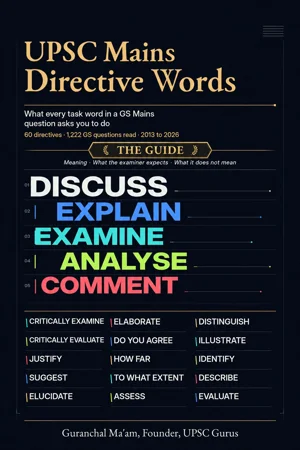
UPSC Mains Directive Words: The Guide
All 60 directive words and question forms, each with what it means, what the examiner expects, what it does not mean and what not to confuse it with. 50 pages.
Download The Guide (PDF)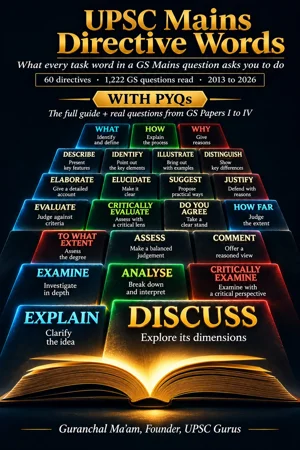
UPSC Mains Directive Words: With PYQs
Everything in The Guide, plus each directive applied to real questions from GS Papers I to IV (2013 to 2026), with what the word demanded in each. 94 pages.
Download With PYQs (PDF)Why the directive word decides your marks
The topic is only half of a UPSC Mains question. Its directive tells you what to do with your knowledge: explain a mechanism, explore dimensions, scrutinise a claim, make a judgement, draw a distinction or propose a feasible measure. An answer can contain relevant facts yet remain incomplete if it performs the wrong task.
Directive words shape the selection and order of points. Discuss asks for a connected exploration, Analyse for parts and relationships, and Evaluate for a judgement against criteria. Reading the full question, including qualifiers and additional instructions, helps you devote space to the reasoning the question actually requires.
All 60 directive words, explained
The 60 directive words and question forms are organised into five families: Explain and unfold; Weigh and judge; Reason, defend and reflect; Pinpoint, compare and propose; and When the question is the directive. Use these families to find your starting point, then read each entry for its distinct demand.
Explain and unfold
Make an idea clear through its meaning, context, working, dimensions or examples, giving the reader a fuller understanding.
306Discuss: To discuss is to explore a subject through its relevant dimensions and explain how those dimensions shape our understanding of it.uses2013 to 2026
To discuss is to explore a subject through its relevant dimensions and explain how those dimensions shape our understanding of it. The task is not simply to present different views, but to develop a connected line of reasoning using causes, consequences, relationships or competing considerations, as the question requires. A good discussion leaves the reader with a considered understanding of the central issue, not just a collection of information.
- Identify the central issue and select the dimensions needed to understand it.
- Develop each major point by explaining its causes, implications or connection to the issue.
- Use relevant evidence or examples to substantiate the discussion rather than merely naming facts.
- Draw the strands together into a reasoned understanding, giving greater weight to what matters most.
- It does not mean writing advantages and disadvantages for every subject, especially when the question asks about causes, developments or ethical responsibilities.
- It does not mean listing every related fact without explaining its relevance to the central issue.
- It does not require artificial balance where evidence clearly supports one position.
Explain concentrates on making a reason, mechanism or relationship understandable. Discuss develops a fuller understanding by examining the relevant dimensions of the issue and how they fit together.
Examine calls for a close inspection of a claim, arrangement or problem to establish what it reveals. Discuss gives greater scope to developing the connected considerations that define the issue, although both can require scrutiny and a reasoned conclusion.
UPSC used Discuss in 306 questions from 2013 to 2026, with 93 in GS II, 91 in GS III, 65 in GS I and 57 in GS IV, making it prominent across all four papers.
5Critically discuss: To critically discuss is to explore an issue while testing its claims, assumptions and practical results, rather than accepting the stated position at face value.uses2013 to 2026
To critically discuss is to explore an issue while testing its claims, assumptions and practical results, rather than accepting the stated position at face value. It requires you to understand what an idea, policy or institution seeks to achieve, then scrutinise its strengths, limitations and competing explanations using reasoning or evidence. The finished answer should produce a qualified and defensible understanding of how far the proposition holds, and why.
- Establish the proposition or objectives before judging their merits or results.
- Test the important claims against evidence, practical experience or logical objections.
- Identify strengths, weaknesses and qualifications that genuinely affect the proposition.
- Reach a reasoned conclusion that reflects the relative weight of the arguments.
- It does not mean finding faults alone or assuming that criticism is the entire task.
- It does not mean producing two disconnected lists of pros and cons without assessing their importance.
- It does not mean rejecting the proposition automatically because the word critically appears.
Discuss develops understanding through the relevant dimensions of an issue. Critically discuss additionally requires sustained scrutiny of the claims, assumptions and limitations within those dimensions.
Critically evaluate places stronger emphasis on an overall judgement of merit, effectiveness or validity against suitable criteria. Critically discuss emphasises searching examination of the issue and its competing considerations, although a reasoned conclusion is still important.
UPSC used Critically discuss in 5 questions from 2013 to 2026, all appearing in 2013 to 2015, with 3 in GS III, 1 in GS I, 1 in GS II and none in GS IV.
121Explain: To explain is to make something understandable by revealing how or why it works.uses2013 to 2026
To explain is to make something understandable by revealing how or why it works. You must move from identifying a concept, cause or condition to showing the reasoning, mechanism or connection that produces a particular result. A successful explanation allows the reader to follow the logic from starting conditions to outcome, rather than merely accepting a statement as true.
- Identify what needs explaining, whether a concept, process, cause or relationship.
- Show the mechanism or reasoning linking the relevant factors to the result.
- Make the sequence or causal connection clear wherever the subject involves stages or interacting influences.
- Use a focused example or application when it helps demonstrate the explanation.
- It does not mean repeating the question in different words or offering only a definition.
- It does not mean naming causes or features without showing how they produce the stated effect.
- It does not require an extended merits-versus-demerits debate unless another part of the question asks for judgement.
Describe establishes what something is like, including its characteristics or forms. Explain establishes how it works or why a particular feature, event or outcome arises.
Explain makes a concept, cause or mechanism understandable through reasoning. Elucidate is especially concerned with revealing the meaning or underlying connection in a proposition that may otherwise remain unclear.
UPSC used Explain in 121 questions from 2013 to 2026, with the highest count in GS III at 41 questions, followed by 30 in GS I, 28 in GS II and 22 in GS IV.
22Elaborate: To elaborate is to take a briefly stated idea and develop its full substance by unfolding the dimensions, details and implications that the original statement leaves compressed.uses2013 to 2026
To elaborate is to take a briefly stated idea and develop its full substance by unfolding the dimensions, details and implications that the original statement leaves compressed. The task is to show what lies within the proposition and why its different parts matter, using relevant connections and illustrations. A strong answer turns a short assertion into a well-developed account with depth and breadth, without losing sight of its central claim.
- Identify the central proposition and the specific aspects that need development.
- Unfold its major dimensions with substantive detail rather than restating the assertion.
- Connect each dimension to the main idea through reasons, implications or illustrative evidence.
- Give the proposition sufficient depth while keeping the expansion relevant and proportionate.
- It does not mean making the answer longer by repeating the same point in different forms.
- It does not mean adding unrelated background simply because more detail is requested.
- It does not mean accepting an absolute claim without qualification where the supporting facts require nuance.
Explain concentrates on making the mechanism or reasoning understandable. Elaborate develops the fuller content of an idea, including its dimensions, significance and implications, even when a single causal mechanism is not central.
Elucidate brings clarity to the underlying meaning or logic of a proposition. Elaborate gives that proposition greater breadth and substance by developing the relevant details and dimensions.
UPSC used Elaborate in 22 questions from 2013 to 2026, concentrated in GS I with 10 and GS III with 9, alongside 2 in GS II and 1 in GS IV.
20Elucidate: To elucidate is to bring clarity to the underlying meaning or logic of a proposition, especially when its important connections are not immediately obvious.uses2013 to 2026
To elucidate is to bring clarity to the underlying meaning or logic of a proposition, especially when its important connections are not immediately obvious. You must identify what the statement is really saying, then unfold the reasoning or relationships that make it intelligible through carefully chosen facts and examples. The finished answer should make a seemingly complex, compressed or contradictory idea clear and convincing, with necessary qualifications.
- Identify the central relationship or proposition that needs to be made clearer.
- Uncover the underlying logic connecting its main elements.
- Use carefully chosen evidence or examples to make the relationship understandable.
- Resolve apparent tension or ambiguity without concealing important qualifications.
- It does not mean paraphrasing the statement without revealing the reasoning behind it.
- It does not mean providing maximum detail on every related topic when only the central connection needs clarification.
- It does not require uncritical endorsement of the proposition if its validity depends on conditions or qualifications.
Elaborate expands an idea by developing its details and dimensions. Elucidate concentrates on making its essential meaning and the relationships within it especially clear.
Clarify resolves ambiguity about what a claim means or establishes. Elucidate goes further into the underlying reasoning that connects the elements of the claim and explains why the relationship matters.
UPSC used Elucidate in 20 questions from 2013 to 2026, with 9 in GS I and 7 in GS II, compared with 3 in GS III and 1 in GS IV.
27Describe: To describe is to present an accurate and organised picture of a subject by setting out its defining characteristics, forms, features or identifiable aspects.uses2013 to 2026
To describe is to present an accurate and organised picture of a subject by setting out its defining characteristics, forms, features or identifiable aspects. Your answer must help the reader recognise what the subject consists of and what distinguishes its important parts, using precise categories and relevant details. A successful description provides sufficient factual clarity and completeness without turning an essentially descriptive task into an unnecessary argument.
- Identify the subject accurately and establish its relevant characteristics.
- Organise the important features or types into clear categories where appropriate.
- Use precise distinguishing details to show how the parts differ or what each contributes.
- Keep the coverage relevant and proportionate to the particular aspects requested.
- It does not mean offering only a definition when the question asks for characteristics, forms or multiple aspects.
- It does not mean explaining every underlying cause when the immediate task is to establish features or details.
- It does not mean evaluating merits and shortcomings automatically unless another instruction requires it.
Describe establishes what something is, what features it has and what forms it takes. Explain reveals how or why those features or outcomes arise.
Give an account presents a connected account of developments, arrangements or actions. Describe concentrates on accurately representing the relevant features, forms or characteristics of the subject.
UPSC used Describe in 27 questions from 2013 to 2026, most often in GS III with 15 questions, followed by 6 in GS IV and 3 each in GS I and GS II.
8Illustrate: To illustrate is to make an argument, concept or relationship clear through well-chosen examples that show how it operates in reality.uses2013 to 2026
To illustrate is to make an argument, concept or relationship clear through well-chosen examples that show how it operates in reality. The examples must perform an intellectual task: they should demonstrate a specific claim, distinction or implication, not merely decorate the answer. A strong illustration helps the reader see why the argument holds, how it appears in practice and where its limits may lie.
- Establish the point that each illustration is intended to demonstrate.
- Choose specific, relevant examples rather than broad or unrelated references.
- Explain the link between example and argument so the illustration actually proves or clarifies something.
- Use contrasting or qualifying examples where they are needed to support a fair conclusion.
- It does not mean adding names, incidents or cases without interpretation.
- It does not mean substituting examples for the central answer or assuming that a collection of cases explains itself.
- It does not mean drawing universal conclusions from isolated examples without recognising their limitations.
Explain establishes the reasoning or mechanism that makes a point understandable. Illustrate makes the point concrete by showing, through examples, how that reasoning or relationship appears in practice.
Substantiate asks for evidence sufficient to support a claim. Illustrate places particular emphasis on examples that make a claim visible and understandable, although those examples should still support the argument.
UPSC used Illustrate in 8 questions from 2013 to 2026, with 5 in GS IV, 2 in GS I, 1 in GS II and none in GS III.
2Clarify: To clarify is to remove uncertainty about what a statement means or why it is justified.uses2013 to 2026
To clarify is to remove uncertainty about what a statement means or why it is justified. The task is to identify the point that might otherwise remain vague and use precise facts, distinctions and relationships to make it understandable. A successful answer leaves the reader with a definite and properly qualified understanding of the assertion, without unnecessary expansion into surrounding topics.
- Identify the precise claim or uncertainty that needs clarification.
- Define or distinguish the essential elements that make the claim meaningful.
- Supply the facts and connections that explain why the stated condition exists.
- Resolve the ambiguity directly, with qualifications where necessary.
- It does not mean repeating an assertion more confidently without supporting it.
- It does not mean providing broad historical or policy background without resolving the specific issue.
- It does not require a full merits-versus-demerits assessment when the main need is conceptual or factual clarity.
Elucidate unfolds the underlying meaning or relationships within an idea. Clarify focuses more directly on removing a particular ambiguity and establishing exactly what the proposition signifies.
Explain often follows a process or causal mechanism to show how or why something happens. Clarify may use such reasoning, but its central purpose is to resolve uncertainty about a specific statement or condition.
UPSC used Clarify in 2 questions from 2013 to 2026, with 1 in GS I in 2017 and 1 in GS III in 2019, and none in GS II or GS IV.
3Write a note: To write a note is to produce a compact, self-contained account of a specified subject that gives the reader its essential meaning, relevant particulars and significance.uses2013 to 2026
To write a note is to produce a compact, self-contained account of a specified subject that gives the reader its essential meaning, relevant particulars and significance. The intellectual task is one of selective completeness: you must decide which information is necessary for understanding the subject without expanding into a full essay. The final note should be coherent, economical and responsive to any qualifier, such as short or critical, that changes the required treatment.
- Introduce the subject briefly so the note makes sense on its own.
- Select the most relevant facts, features or implications within the available space.
- Organise the content into a coherent account rather than disconnected fragments.
- Follow qualifiers and word limits precisely, including any requirement for critical appraisal.
- It does not mean writing everything known about the topic regardless of relevance or space.
- It does not mean presenting an unconnected collection of facts without a central focus.
- It does not mean ignoring words such as critical or short, which materially alter what the note must achieve.
Describe specifies the intellectual task of presenting relevant features or characteristics. Write a note additionally calls for a compact, self-contained form of response whose content and depth depend on the stated subject and qualifiers.
Discuss develops the relevant dimensions and connections of an issue through reasoning. Write a note prioritises an economical account, although a critical note may also require a brief, reasoned appraisal.
UPSC used the Write a note, Write a critical note and Write short notes formulations in 3 questions from 2013 to 2026, with 2 in 2013 and 1 in 2022, distributed equally across GS I, GS III and GS IV, and none in GS II.
3Introduce: To introduce is to establish the essential identity, purpose and basic elements of a subject so that the reader knows what is being discussed.uses2013 to 2026
To introduce is to establish the essential identity, purpose and basic elements of a subject so that the reader knows what is being discussed. It requires a clear first understanding of a concept, programme or system, including the background or features necessary to orient the reader. A successful introduction prepares the ground for further analysis or application without attempting to perform every subsequent task at once.
- Identify the subject accurately and explain what it fundamentally refers to.
- State its core purpose or defining idea in accessible terms.
- Present the essential features or components needed for initial understanding.
- Provide only the necessary background, leaving applications or evaluation to the relevant later tasks.
- It does not mean writing a decorative opening paragraph without identifying the substance of the subject.
- It does not mean covering every detail or technical complexity before the reader understands the basic idea.
- It does not mean treating later application or evaluation tasks as optional simply because the question first asks for an introduction.
Introduce establishes what a subject is, why it exists and what its basic elements are. Explain goes further into the reasoning or mechanism that shows how or why something works.
Describe presents the relevant characteristics or forms of a subject, often in greater detail. Introduce is more selective and foundational, giving the reader enough information to understand the subject before proceeding.
UPSC used Introduce in 3 questions from 2013 to 2026, with 1 in GS I in 2016 and 2 in GS III in 2023, and none in GS II or GS IV.
2Give an account: To give an account is to present a connected factual explanation of what happened, what exists or what was undertaken in relation to a subject.uses2013 to 2026
To give an account is to present a connected factual explanation of what happened, what exists or what was undertaken in relation to a subject. The answer must bring together the principal developments, arrangements or actions in an order that makes the whole subject understandable, using chronology where appropriate and functional organisation where more useful. A good account provides a coherent picture supported by relevant particulars, without adding evaluation unless the question separately requires it.
- Establish the relevant background or setting needed to understand the subject.
- Select the principal developments, provisions or actions that form the account.
- Organise them in a meaningful sequence, chronological or thematic as appropriate.
- Show how the main elements connect to form a coherent factual picture.
- It does not mean dumping facts in no particular order or offering an unstructured list.
- It does not mean forcing a chronological narrative onto a subject better explained through functions or arrangements.
- It does not require judging success or failure automatically unless another directive calls for assessment.
Describe sets out the defining features or characteristics of a subject. Give an account connects facts, developments, arrangements or actions into a coherent account of the whole.
Trace concentrates on the progression of a subject through time, showing its stages and changes. Give an account may use chronology but can equally organise information around provisions, functions or actions.
UPSC used the Give an account and Present an account formulations in 2 questions from 2013 to 2026, with 1 in GS I in 2016 and 1 in GS III in 2020, and none in GS II or GS IV.
3Throw light: To throw light on a subject is to make its important meaning, relevance or implications clearer by focusing on the aspects that best illuminate it.uses2013 to 2026
To throw light on a subject is to make its important meaning, relevance or implications clearer by focusing on the aspects that best illuminate it. The task is not to cover everything, but to select and explain what helps the reader understand the subject more deeply, particularly its significance, present position or practical usefulness. A strong answer makes a previously underexplained aspect of the issue visible and meaningful through relevant context and evidence.
- Identify the particular aspect whose meaning, relevance or status needs illumination.
- Select the most revealing facts or considerations rather than attempting exhaustive coverage.
- Explain why those details matter to the interpretation of the subject.
- Connect the selected evidence to a clear understanding of the significance or implication requested.
- It does not mean mentioning important points without explaining their relevance.
- It does not mean writing an exhaustive account of the entire topic when the question asks for one specific aspect.
- It does not mean repeating an earlier task when Throw light follows another directive and identifies a distinct requirement.
Highlight singles out the most salient features or distinctions. Throw light uses selected information to make the meaning, relevance, status or implications of a subject clearer.
Elucidate concentrates on revealing the underlying logic or relationship within a proposition. Throw light more broadly illuminates an aspect of a subject, often its significance, implementation or practical usefulness.
UPSC used Throw light in 3 questions from 2013 to 2026, with 1 each in GS I, GS II and GS III, appearing in 2016, 2018 and 2026, and none in GS IV.
15Bring out: To bring out is to make important features, effects or relationships clearly visible, especially where their significance is not immediately apparent from a simple description.uses2013 to 2026
To bring out is to make important features, effects or relationships clearly visible, especially where their significance is not immediately apparent from a simple description. You must identify the relevant elements and draw out what they reveal about the subject, whether a consequence, contrast, contribution or state of affairs. A strong answer makes the specific significance of those elements unmistakable, showing the reader what follows from them and why it matters.
- Identify exactly what must be brought out, such as effects, importance, contrasts or preparedness.
- Select the relevant facts or developments that reveal those features.
- Draw explicit connections or implications instead of leaving the reader to infer their importance.
- Establish the significance of each major point in relation to the question’s central concern.
- It does not mean naming relevant points and leaving their significance unexplained.
- It does not mean presenting broad background material without drawing out the specific effects or relationships requested.
- It does not require a full critical evaluation in every question unless another directive or qualifier asks for it.
Highlight concentrates attention on the most prominent features or distinctions. Bring out more explicitly develops the significance, consequences or relationships that those features reveal.
Explain focuses on how or why something happens. Bring out focuses on making the relevant effects, qualities, connections or implications apparent, using causal explanation wherever it helps.
UPSC used Bring out in 15 questions from 2013 to 2026, with 6 in GS I, 4 in GS III, 4 in GS IV and 1 in GS II.
11Highlight: To highlight is to direct attention to the most significant features, distinctions or contributions of a subject.uses2013 to 2026
To highlight is to direct attention to the most significant features, distinctions or contributions of a subject. The task requires judgement in selection: you must recognise which points deserve prominence and present them clearly enough for their importance to be understood. A successful answer gives the reader a sharply focused picture of what matters most, rather than an exhaustive treatment of every connected detail.
- Select the most salient points that directly answer the question.
- Make distinguishing features or contrasts visible through clear organisation.
- Explain briefly why each selected point matters instead of merely naming it.
- Prioritise significance over exhaustive coverage, keeping less relevant details out.
- It does not mean making a long list of every feature without distinguishing the most important ones.
- It does not mean using headings or emphasis alone without substantive explanation.
- It does not mean ignoring another directive when the question separately asks for discussion, examination or explanation.
Bring out makes the relevant consequences, connections or significance explicit. Highlight places stronger emphasis on selecting and presenting the most distinctive or important points, without necessarily developing every underlying relationship.
Describe seeks a clear and sufficiently complete picture of the requested features or forms. Highlight is more selective, directing attention to the features or contrasts that are particularly significant.
UPSC used Highlight in 11 questions from 2013 to 2026, with 5 in GS II, 4 in GS I, 2 in GS III and none in GS IV.
Weigh and judge
Break claims into parts, examine evidence and limitations, and offer a reasoned judgement when the directive calls for one.
73Examine: To examine is to put a specific claim, issue or process under close scrutiny, asking what the evidence reveals about how it works, why it matters and whether its stated implications hold.uses2013 to 2026
To examine is to put a specific claim, issue or process under close scrutiny, asking what the evidence reveals about how it works, why it matters and whether its stated implications hold. The finished answer should move from careful investigation to a supported finding, making clear what closer inspection establishes rather than simply describing the subject.
- Identify the precise claim or issue requiring examination, including any distinct parts of the question.
- Investigate the relevant evidence, mechanisms and relationships to establish what is actually happening and why.
- Consider qualifications, exceptions or limitations that affect the strength or reach of the explanation.
- Present a clear finding that follows from the examination and directly addresses the question.
- It does not mean writing a general account of everything known about the topic.
- It does not mean automatically finding faults or rejecting the proposition.
- It does not mean presenting evidence without explaining what that evidence establishes.
Analyse primarily breaks a subject into components to explain how their relationships produce an outcome. Examine investigates a particular issue or claim more closely to establish what the evidence supports, including its implications and limits.
Both require scrutiny, but Critically examine makes the deliberate testing of assumptions, counterarguments and weaknesses more prominent. Examine still requires care and qualification, but does not necessarily demand the same intensity of adversarial testing.
From 2013 to 2026, UPSC used Examine in 73 questions: 13 in GS I, 25 in GS II, 19 in GS III and 16 in GS IV, with 11 questions each in 2025 and 2026.
31Critically examine: To critically examine is to investigate a proposition while actively testing its foundations: the evidence supporting it, the assumptions it depends on, the objections it faces and the conditions under which it may not hold.uses2013 to 2026
To critically examine is to investigate a proposition while actively testing its foundations: the evidence supporting it, the assumptions it depends on, the objections it faces and the conditions under which it may not hold. The finished answer should give a fair but searching judgement, showing how far the claim survives scrutiny rather than treating either agreement or disagreement as the starting point.
- Identify the central proposition and its underlying assumptions, separating distinct claims where necessary.
- Test the supporting evidence and causal reasoning, asking whether they adequately establish the proposition.
- Confront counterevidence, alternative explanations and limitations rather than presenting only one side.
- Reach a qualified judgement that specifies what is convincing, what remains doubtful and why.
- It does not mean criticising everything or treating the proposition as necessarily false.
- It does not mean mechanically listing advantages and disadvantages without testing the central argument.
- It does not mean allowing a balanced presentation to replace a defensible conclusion.
Examine investigates an issue closely to establish what the evidence reveals. Critically examine places stronger emphasis on challenging assumptions, testing contrary evidence and exposing weaknesses before reaching a finding.
Critically analyse places particular weight on breaking down the relationships and mechanisms behind a proposition before testing them. Critically examine more directly investigates the strength of the claim, its evidence and its possible objections.
From 2013 to 2026, UPSC used Critically examine in 31 questions: 6 in GS I, 13 in GS II, 2 in GS III and 10 in GS IV, with 5 questions in 2022.
45Analyse: To analyse is to break a complex subject into its important parts and explain how those parts interact, influence one another or combine to produce a particular outcome.uses2013 to 2026
To analyse is to break a complex subject into its important parts and explain how those parts interact, influence one another or combine to produce a particular outcome. The finished answer should reveal the underlying causes, mechanisms and relationships, enabling the reader to understand why something happens or how it works, rather than merely knowing its characteristics.
- Identify the principal components or factors relevant to the outcome or issue in the question.
- Explain the causal connections and mechanisms through which those factors operate.
- Show interactions, dependencies or trade-offs where individual factors cannot adequately explain the outcome alone.
- Bring the analysis together into a coherent explanation, supported by relevant examples or evidence.
- It does not mean simply listing factors without explaining how they influence the outcome.
- It does not mean breaking a topic into headings while leaving the relationships unexplained.
- It does not automatically require a final verdict for or against something unless the question also calls for one.
Analyse concentrates on explaining the internal structure, causes and relationships of a subject. Examine concentrates on investigating an issue or claim to establish what closer scrutiny reveals.
Discuss develops the relevant dimensions and arguments surrounding a question. Analyse demands a stronger explanation of how the components are connected and why those connections produce particular consequences.
From 2013 to 2026, UPSC used Analyse in 45 questions: 9 in GS I, 15 in GS II, 14 in GS III and 7 in GS IV, with 7 questions each in 2013, 2017 and 2026.
8Critically analyse: To critically analyse is to unpack a proposition into its component claims and relationships, explain the mechanisms connecting them, and then investigate whether those connections are convincing.uses2013 to 2026
To critically analyse is to unpack a proposition into its component claims and relationships, explain the mechanisms connecting them, and then investigate whether those connections are convincing. The finished answer must combine causal or conceptual explanation with rigorous testing of assumptions, evidence and alternative explanations, ending in a judgement that reflects both what the analysis establishes and what it cannot establish.
- Separate the proposition into distinct claims, factors or relationships that can be investigated.
- Explain how the proposed mechanisms work, showing the reasoning that connects causes, processes and outcomes.
- Test the explanation against contrary evidence, competing causes and important exceptions.
- Reach a qualified conclusion that reflects the strength and limitations of the relationships examined.
- It does not mean presenting a detailed breakdown without evaluating whether the proposed connections are valid.
- It does not mean rejecting the proposition simply because the instruction says critically.
- It does not mean assuming that an observed correlation proves causation or that a plausible mechanism necessarily explains every case.
Analyse explains the components and relationships that produce an outcome. Critically analyse additionally requires testing the assumptions, validity and limitations of those relationships against competing evidence or explanations.
Critically examine tests the strength of a claim and its supporting evidence. Critically analyse gives greater emphasis to first explaining the proposition’s internal mechanisms and relationships, then challenging their validity.
From 2013 to 2026, UPSC used Critically analyse in 8 questions: 1 in GS I, 2 in GS II, 1 in GS III and 4 in GS IV, with 2 questions each in 2014 and 2024.
24Evaluate: To evaluate is to judge the value, effectiveness, success or impact of something by asking what it was meant to achieve, what results it produced and how those results compare with relevant standards.uses2013 to 2026
To evaluate is to judge the value, effectiveness, success or impact of something by asking what it was meant to achieve, what results it produced and how those results compare with relevant standards. The finished answer should make an explicit evidence-based judgement, showing how well, how far or for whom the subject has delivered, rather than leaving the evidence to speak for itself.
- Establish the appropriate criteria for judgement, drawn from the subject’s purpose or the outcomes named in the question.
- Examine actual achievements, effects or performance against those criteria using relevant evidence.
- Weigh limitations, costs, unintended effects and differences in outcomes where they materially affect the evaluation.
- Give a clear overall verdict about effectiveness, impact or worth, supported by the preceding comparison.
- It does not mean describing objectives, features or activities without judging their results.
- It does not mean offering an unweighted list of positives and negatives while avoiding a conclusion.
- It does not mean using personal approval or disapproval in place of identifiable criteria and evidence.
Assess primarily establishes the extent, importance or effectiveness of a role, condition or contribution. Evaluate more explicitly asks for a judgement of value, performance or success against suitable criteria.
Both require an evidence-based verdict, but Critically evaluate demands more deliberate testing of weak assumptions, contrary evidence, risks and trade-offs before deciding how favourable that verdict should be.
From 2013 to 2026, UPSC used Evaluate in 24 questions: 6 in GS I, 7 in GS II, none in GS III and 11 in GS IV, with 4 questions each in 2013 and 2014.
19Critically evaluate: To critically evaluate is to reach a reasoned judgement of value, performance or desirability while subjecting the available arguments and evidence to particularly demanding scrutiny.uses2013 to 2026
To critically evaluate is to reach a reasoned judgement of value, performance or desirability while subjecting the available arguments and evidence to particularly demanding scrutiny. The finished answer should test assumptions, counterevidence, adverse consequences and competing criteria, then explain whether, how far and under what conditions the subject deserves a favourable judgement.
- Identify what is being judged and by which criteria, including any competing objectives.
- Consider the strongest supporting arguments and evidence without overlooking genuine achievements or benefits.
- Test limitations, contrary evidence, hidden costs and trade-offs, including effects on different groups.
- Reach a defensible, qualified verdict that explains why some considerations carry greater weight than others.
- It does not mean beginning with a negative judgement and searching only for reasons to support it.
- It does not mean treating all advantages and disadvantages as equally important regardless of their consequences.
- It does not mean avoiding a decision by saying that both sides have merit without determining what follows from that comparison.
Evaluate judges performance, value or success against relevant criteria. Critically evaluate applies more intensive scrutiny to the evidence, assumptions, counterarguments and risks before reaching that judgement.
Critically analyse prioritises explaining and testing the components and relationships underlying a proposition. Critically evaluate prioritises deciding the subject’s overall merit, value or desirability after testing the relevant evidence and competing considerations.
From 2013 to 2026, UPSC used Critically evaluate in 19 questions: 3 in GS I, 6 in GS II, 3 in GS III and 7 in GS IV, with 6 questions in 2015.
12Assess: To assess is to determine the extent, significance or effectiveness of a role, condition, problem or intervention by weighing the evidence that shows how much it matters.uses2013 to 2026
To assess is to determine the extent, significance or effectiveness of a role, condition, problem or intervention by weighing the evidence that shows how much it matters. The finished answer should establish the degree of contribution or influence, recognise relevant limits, and offer a measured judgement about its actual importance rather than merely describing its existence.
- Identify the specific role, contribution, condition or problem whose significance must be established.
- Use relevant evidence and examples to determine its reach, influence, effectiveness or seriousness.
- Weigh relative importance, limitations and variations, including other factors that influence the outcome.
- Conclude with a proportionate judgement indicating how significant or effective the subject has been.
- It does not mean giving a descriptive account of a subject without indicating its importance.
- It does not mean crediting the subject with every associated outcome while ignoring other contributing factors.
- It does not mean making an absolute success-or-failure judgement when the evidence supports a more limited conclusion.
Assess establishes how significant, extensive or effective something is. Evaluate more directly judges its performance, success or worth against defined criteria, often requiring a clearer verdict on overall value.
Appraise places particular emphasis on determining the value of a contribution or role. Assess is broader and can judge the extent or seriousness of a problem, the influence of a factor, or the effectiveness of an institution.
From 2013 to 2026, UPSC used Assess in 12 questions: 5 in GS I, 6 in GS II, 1 in GS III and none in GS IV, with 3 questions in 2018.
1Critically assess: To critically assess is to determine how far a proposition or contribution is valid, significant or effective, while rigorously testing the assumptions and evidence on which that judgement depends.uses2013 to 2026
To critically assess is to determine how far a proposition or contribution is valid, significant or effective, while rigorously testing the assumptions and evidence on which that judgement depends. The finished answer should establish the actual degree of support for the claim, weigh competing explanations and limitations, and state a qualified finding that neither accepts nor dismisses the proposition without justification.
- Identify the precise claim and the standard by which its validity or significance can be judged.
- Examine the supporting evidence and practical mechanisms that would make the proposition credible.
- Test assumptions, contrary considerations and limitations that may weaken or qualify the claim.
- State a measured judgement about how far the proposition holds, specifying the conditions or areas in which it is strongest.
- It does not mean accepting the proposition as established without testing its assumptions and supporting evidence.
- It does not mean rejecting every claimed benefit or contribution merely because weaknesses, uncertainties or limitations are present.
- It does not mean replacing a focused assessment with a broad descriptive account of the surrounding subject.
Assess weighs the extent, significance or effectiveness of something. Critically assess makes the testing of the proposition’s assumptions, evidence, limitations and counterarguments an explicit part of reaching that judgement.
Critically evaluate primarily judges overall merit, success or desirability against competing criteria. Critically assess can focus more narrowly on how far a particular claim is valid or a stated contribution is significant, without necessarily delivering a broad verdict on policy desirability.
Used once, in GS II in 2026, through the equivalent instruction ‘Make a critical assessment’; it has not appeared in GS I, GS III or GS IV.
1Appraise: To appraise is to make a considered judgement of the value or importance of a contribution, examining what it has added and why that contribution matters in its particular setting.uses2013 to 2026
To appraise is to make a considered judgement of the value or importance of a contribution, examining what it has added and why that contribution matters in its particular setting. The finished answer should distinguish meaningful influence from mere participation, weigh the reach and limitations of that influence, and establish its overall significance through relevant evidence.
- Identify the principal contributions directly relevant to the subject and its stated context.
- Explain why those contributions matter to the affected economy, society, institution or process.
- Weigh their reach, relative importance and limitations, recognising differences across settings where relevant.
- Offer a supported judgement of overall significance rather than merely acknowledging the subject’s presence.
- It does not mean producing an inventory of activities without explaining their value.
- It does not mean offering unqualified praise simply because the question refers to an important role.
- It does not mean treating a broad global contribution as proof of equivalent importance in the specific region or context asked about.
Assess determines the extent, significance or effectiveness of a role, condition or contribution. Appraise focuses more specifically on judging the value and importance of a contribution within its context.
Evaluate can judge the success, performance or desirability of policies, outcomes and interventions against criteria. Appraise places the emphasis on understanding and judging what a person, group or institution has contributed and how much that contribution matters.
From 2013 to 2026, UPSC used Appraise in 1 question, in GS II in 2017, and in no questions in GS I, GS III or GS IV.
1Review: To review is to take stock of a subject’s actual working, development and present position, examining what has happened, what has been achieved and what remains unsatisfactory.uses2013 to 2026
To review is to take stock of a subject’s actual working, development and present position, examining what has happened, what has been achieved and what remains unsatisfactory. The finished answer should provide an organised assessment of the record, using relevant evidence and illustrations to show where the subject now stands, rather than repeating its formal design or original purpose.
- Establish the relevant scope and period of the subject whose record is to be reviewed.
- Examine actual functioning, developments and outcomes, not merely constitutional or administrative provisions.
- Identify achievements, shortcomings and variations, using suitable examples to illustrate the evidence.
- Present a measured account of the present position and the most important findings from the review.
- It does not mean reproducing the formal rules or structure without examining actual functioning.
- It does not mean offering a chronological list of events with no assessment of their significance.
- It does not mean treating the original purpose of an institution as proof of its present performance.
Examine investigates a particular claim or issue to establish what the evidence reveals. Review takes stock of a subject’s record, functioning, developments and current position, often across several dimensions.
Evaluate directly judges effectiveness, success or value against relevant criteria. Review gives greater emphasis to examining what has happened, how something has worked and where it currently stands, while still allowing a measured judgement about the findings.
From 2013 to 2026, UPSC used Review in 1 question, in GS II in 2021, and in no questions in GS I, GS III or GS IV.
1Estimate: To estimate is to make a reasoned approximation of the magnitude or significance of something when its full value may not be directly measurable.uses2013 to 2026
To estimate is to make a reasoned approximation of the magnitude or significance of something when its full value may not be directly measurable. In historical and cultural questions, this means using representative evidence to gauge the scale, influence and lasting importance of a contribution, producing a proportionate judgement rather than merely describing achievements.
- Identify the specific fields of contribution whose importance must be estimated.
- Select representative achievements and supporting evidence that reveal the contribution’s reach and quality.
- Judge its relative significance and lasting influence, distinguishing attributable contributions from wider developments.
- Present a reasoned estimate of importance that matches the strength and scope of the available evidence.
- It does not necessarily mean performing a numerical calculation when the subject calls for qualitative historical judgement.
- It does not mean listing famous achievements without gauging their significance.
- It does not mean making an exaggerated claim of unique or total credit where a contribution forms part of a broader historical process.
Assess weighs the importance, extent or effectiveness of a subject more broadly. Estimate places particular emphasis on gauging how substantial a contribution is, using the available evidence even when a precise measurement is impossible.
Quantify asks for a magnitude expressed numerically, using appropriate measures or data. Estimate asks for a reasoned approximation and may also require a qualitative judgement when numerical measurement is unsuitable. In the Pallavas question, the task is to gauge historical and cultural significance, not to invent numerical values.
From 2013 to 2026, UPSC used Estimate in 1 question, in GS I in 2024, and in no questions in GS II, GS III or GS IV.
45Comment: To comment is to offer an informed and reasoned position on a specific statement, development or issue, making clear what you think the evidence allows you to conclude.uses2013 to 2026
To comment is to offer an informed and reasoned position on a specific statement, development or issue, making clear what you think the evidence allows you to conclude. The finished answer should combine a clear judgement with supporting explanation, acknowledge necessary qualifications and show why that position is justified, rather than simply repeating the proposition or surveying the entire topic.
- Identify the exact claim or issue on which a reasoned view is requested.
- State a clear position that responds directly to that claim rather than remaining indefinitely neutral.
- Support the position with relevant reasoning, evidence and examples, not unsupported opinion.
- Recognise important qualifications or limits and finish with a judgement consistent with the reasoning.
- It does not mean expressing a casual personal opinion without evidence.
- It does not mean paraphrasing the statement and treating agreement as a complete answer.
- It does not mean writing a general discussion of every related dimension while leaving the requested position unclear.
Discuss explores the important dimensions, arguments and implications surrounding a subject. Comment more directly asks the writer to take and defend a reasoned position on a particular claim or issue.
Comment requires an informed, supported judgement with appropriate qualifications. Critically comment adds a stronger obligation to test the claim’s assumptions, factual basis, weaknesses and alternative explanations before stating that judgement.
From 2013 to 2026, UPSC used Comment in 45 questions: 16 in GS I, 20 in GS II, 8 in GS III and 1 in GS IV, with 7 questions in 2023.
1Critically comment: To critically comment is to take a reasoned position on a proposition after testing whether its claims deserve acceptance, including the factual assumptions and causal explanations on which it rests.uses2013 to 2026
To critically comment is to take a reasoned position on a proposition after testing whether its claims deserve acceptance, including the factual assumptions and causal explanations on which it rests. The finished answer should expose weak or incomplete reasoning, consider credible alternatives and deliver a clear, qualified judgement that explains which parts of the claim are convincing and which are not.
- Separate the proposition into testable factual and causal claims, rather than accepting its framing as established.
- Examine the evidence supporting each claim, distinguishing observed developments from explanations offered for them.
- Consider counterevidence, competing causes and overlooked factors that might change the interpretation.
- State a clear, qualified position about the credibility and explanatory strength of the proposition.
- It does not mean assuming that the problem described in the statement is an established fact.
- It does not mean accepting the proposed causes as the only possible explanation.
- It does not mean replacing an evidence-based judgement with general criticism or personal dissatisfaction.
Comment asks for a supported position on a specific issue or statement. Critically comment requires more deliberate examination of the truth of the premise, the strength of its reasoning and the adequacy of its proposed explanation before forming that position.
Critically examine focuses on investigating the validity of a claim through supporting and opposing evidence. Critically comment similarly scrutinises the claim but gives particular prominence to presenting the writer’s clear, reasoned position on what should be accepted, rejected or qualified.
From 2013 to 2026, UPSC used Critically comment in 1 question, in GS III in 2014, and in no questions in GS I, GS II or GS IV.
Reason, defend and reflect
Judge the reach of a claim, defend a position with reasons and evidence, explain causes where required, or reflect on deeper values and responsibilities.
19How far: Determine how much of a claim actually holds when tested against evidence, rather than treating it as wholly true or false.uses2013 to 2026
Determine how much of a claim actually holds when tested against evidence, rather than treating it as wholly true or false. The task is to establish the claim’s valid reach and its limits, then give a clear judgment about its accuracy, explanatory strength or practical success. A good answer shows not merely that exceptions exist, but whether those exceptions materially change the overall conclusion.
- Identify the precise claim or outcome whose validity or success must be assessed.
- Establish where and why it holds, using relevant evidence, mechanisms or examples.
- Test its limits and competing explanations, distinguishing substantial qualifications from minor exceptions.
- Give a calibrated final judgment that makes the degree of validity or success unmistakable.
- It does not mean writing a yes-or-no answer followed by a general description of the topic.
- It does not require equal space for both sides when the evidence supports one side more strongly.
- It does not mean identifying a few limitations and leaving the degree of validity unresolved.
Both demand a qualified judgment. How far often tests how successfully a particular proposition or initiative holds up, while To what extent more explicitly invites assessment of the scope, degree or contribution involved; in practice, their central requirement of an evidence-based judgment substantially overlaps.
From 2013 to 2026, UPSC used ‘How far’ in 19 questions, with 11 in GS Paper II, 4 in GS Paper III, 3 in GS Paper I and 1 in GS Paper IV.
12To what extent: Establish the degree and scope of a contribution, relationship, achievement or claim by examining how strongly the available evidence supports it.uses2013 to 2026
Establish the degree and scope of a contribution, relationship, achievement or claim by examining how strongly the available evidence supports it. The answer must distinguish what the stated factor genuinely explains or accomplishes from what lies beyond its influence or reach. Its conclusion should tell the reader how significant the contribution is, not simply whether some contribution exists.
- Specify what is being measured or judged, whether influence, responsibility, contribution or achievement.
- Demonstrate the strength and scope of the stated relationship using evidence and examples.
- Separate its contribution from other causes, actors or conditions that also shape the outcome.
- Reach a proportionate judgment about how substantial, limited or conditional the contribution is.
- It does not mean proving merely that a factor played some role without judging its importance.
- It does not mean assigning exclusive credit or blame when several forces contributed to an outcome.
- It does not require a numerical percentage when a reasoned qualitative assessment is more appropriate.
Both ask for an evidence-based assessment of degree. To what extent particularly encourages you to establish the scope and relative significance of a contribution or effect, while ‘How far’ often frames the same intellectual task as a test of how well a claim holds.
From 2013 to 2026, UPSC used ‘To what extent’ in 12 questions, comprising 6 in GS Paper II, 4 in GS Paper I, 2 in GS Paper III and none in GS Paper IV.
27Do you agree: You are given an identifiable proposition and must take a defensible position on whether it is correct.uses2013 to 2026
You are given an identifiable proposition and must take a defensible position on whether it is correct. Your answer should test the proposition against relevant evidence, principles or examples and explain why you accept, reject or partly accept it. The finished response must make your position clear while qualifying any part of the claim that is exaggerated, incomplete or conditional.
- State a clear position on the precise proposition, preferably near the beginning.
- Build the case for that position using relevant reasons, evidence or principles.
- Examine serious counterarguments or qualifications that could alter the verdict.
- Finish with a consistent judgment that follows from the reasoning rather than contradicting it.
- It does not mean automatically agreeing because the question presents a statement confidently.
- It does not mean remaining neutral throughout without answering whether you agree.
- It does not mean treating partial agreement as indecision; a qualified position can be the strongest conclusion.
Do you agree asks you to assess and respond to an existing claim. Do you think can demand a wider independent judgment about a possibility, choice, comparison or future outcome without first requiring acceptance or rejection of a stated proposition.
From 2013 to 2026, UPSC used ‘Do you agree’ in 27 questions, with 9 in GS Paper IV, 8 in GS Paper II and 5 each in GS Papers I and III.
22Do you think: Form an independent, reasoned judgment about a possibility, proposition, comparison, prediction or preferred course of action.uses2013 to 2026
Form an independent, reasoned judgment about a possibility, proposition, comparison, prediction or preferred course of action. Decide what criteria should govern the answer, examine the evidence or principles against those criteria, and explain why your conclusion is more convincing than plausible alternatives. Unlike a request for personal preference, the finished answer must be intellectually defensible to a reader who may initially disagree.
- Identify the exact decision or judgment the question asks you to make.
- Apply relevant criteria and evidence rather than relying on intuition or personal preference.
- Consider realistic alternatives, limitations or uncertainties that affect the conclusion.
- Express a clear, supported verdict and complete any additional tasks separately.
- It does not mean offering an unsupported personal opinion simply because the wording asks what you think.
- It does not require agreement with a given statement when the question asks you to assess a possibility or choose between alternatives.
- It does not mean making an absolute prediction when the available evidence supports only a conditional conclusion.
Do you think allows a more independent assessment, including a prediction, comparison or choice. Do you agree specifically asks you to accept, reject or qualify an identifiable statement already placed before you.
From 2013 to 2026, UPSC used ‘Do you think’ in 22 questions, including 10 in GS Paper II, 7 in GS Paper IV, 4 in GS Paper I and 1 in GS Paper III.
29Justify: Establish why a particular claim, decision, principle or course of action deserves acceptance by building a defensible case for it.uses2013 to 2026
Establish why a particular claim, decision, principle or course of action deserves acceptance by building a defensible case for it. Identify the proposition that needs support, supply reasons and evidence that genuinely establish its validity or appropriateness, and address objections that could undermine it. The finished answer should show why the proposed position can be defended, not simply repeat what the position says.
- Identify the specific claim or action requiring justification, including any qualification in its wording.
- Build a logical defence using the most relevant evidence, examples, principles or mechanisms.
- Respond to substantial objections or apparent contradictions without losing the central argument.
- Show why the supporting grounds are sufficient and complete any separately requested explanation or recommendation.
- It does not mean blindly endorsing every word of a proposition without examining its scope or assumptions.
- It does not mean providing unconnected examples that fail to establish the claim.
- It does not mean treating a moral or constitutional defence as identical to proving a purely factual statement.
Substantiate chiefly asks whether a claim has sufficient evidence behind it. Justify asks why the claim, decision or course of action is defensible, which may require factual evidence, ethical principles, institutional reasoning or a combination of these.
Giving reasons identifies the grounds supporting an answer or explaining an outcome. Justify goes further by using those grounds to establish the validity or appropriateness of a particular position or action.
From 2013 to 2026, UPSC used ‘Justify’ in 29 questions, with 16 in GS Paper IV, 5 each in GS Papers I and II and 3 in GS Paper III.
6Substantiate: Demonstrate that a claim or interpretation has a solid evidential foundation by presenting facts, examples and reasoning that directly support it.uses2013 to 2026
Demonstrate that a claim or interpretation has a solid evidential foundation by presenting facts, examples and reasoning that directly support it. Each piece of evidence must be connected to the specific part of the proposition it helps establish, so the answer becomes a demonstrated argument rather than an asserted conclusion. Where the proposition is broad or contested, credible substantiation also recognises evidence that qualifies its reach.
- Break the proposition into specific claims that can be supported.
- Choose directly relevant historical, social or other evidence rather than general background information.
- Explain how each example supports the proposition, making the link between evidence and conclusion explicit.
- Recognise significant exceptions or contrary evidence where they affect the strength of the original claim.
- It does not mean repeating the statement in different words and treating repetition as proof.
- It does not mean offering examples without explaining their relevance to the claim.
- It does not require uncritical acceptance of an absolute claim when the evidence supports only a qualified interpretation.
Substantiate concentrates on establishing that a proposition is supported by adequate evidence. Justify concentrates on establishing why a claim or action is valid or defensible, sometimes through ethical or conceptual reasoning that goes beyond empirical proof.
From 2013 to 2026, UPSC used ‘Substantiate’ in 6 questions, all in GS Paper I, with 2 in 2016 and 1 each in 2013, 2017, 2018 and 2026.
3Argue: Construct and defend a coherent line of reasoning on a proposition, contested explanation or institutional choice.uses2013 to 2026
Construct and defend a coherent line of reasoning on a proposition, contested explanation or institutional choice. Your answer should move logically from a clear position through supporting grounds, relevant illustrations and engagement with objections towards a persuasive, reasoned conclusion. The examiner is testing not merely what evidence you know, but whether you can use it to make an argument that holds together.
- Establish a clear central position or contention that the answer will defend.
- Develop connected reasons showing how each point strengthens the overall case.
- Engage with important alternative explanations or objections rather than ignoring them.
- Use illustrations as evidence and close with a conclusion that follows logically from the argument.
- It does not mean taking an aggressive or one-sided tone or dismissing opposing views.
- It does not mean presenting a disconnected list of advantages and disadvantages without a defensible position.
- It does not require absolute certainty when the best argument supports a qualified conclusion.
Argue primarily requires building and defending a coherent position, even while considering objections. Debate places competing positions and their relative merits more explicitly at the centre of the examination before a judgment is reached.
Argue emphasises the construction and defence of a connected case on a contested issue. Justify emphasises establishing the validity or defensibility of the particular claim, action or principle under consideration.
From 2013 to 2026, UPSC used ‘Argue’ in 3 questions, with 2 in GS Paper I and 1 in GS Paper II, all appearing in 2018 and 2020.
1Debate: Bring competing interpretations or positions into direct examination rather than discussing an issue from only one angle.uses2013 to 2026
Bring competing interpretations or positions into direct examination rather than discussing an issue from only one angle. Establish what each side claims, test the strength of its evidence and assumptions, and identify where the positions conflict, overlap or depend on particular conditions. A successful answer reaches an informed judgment after weighing the disagreement, without assuming that every position deserves equal acceptance.
- Identify the central disagreement and the distinct positions involved.
- Present the strongest relevant reasoning supporting each major position.
- Test assumptions, evidence, limitations and implications through direct comparison.
- Arrive at a reasoned resolution or qualified judgment that reflects the relative strength of the arguments.
- It does not mean listing pros and cons mechanically without examining how the arguments challenge one another.
- It does not require false equivalence when one position has substantially stronger support.
- It does not mean avoiding a reasoned conclusion merely to appear impartial.
Discuss calls for an organised examination of relevant dimensions, which may not involve explicit disagreement. Debate makes the clash between competing claims and the assessment of their relative merits the organising principle of the answer.
Argue centres on defending a position through connected reasoning. Debate requires more sustained examination of opposing positions before deciding which interpretation is stronger or how they can be reconciled.
From 2013 to 2026, UPSC used ‘Debate’ in 1 question, which appeared in GS Paper I in 2015.
30Give reasons: Provide the specific grounds that explain an outcome or support a conclusion, making the logical connection between each reason and what the question asks.uses2013 to 2026
Provide the specific grounds that explain an outcome or support a conclusion, making the logical connection between each reason and what the question asks. When the question asks why something happened, identify the factors and mechanisms responsible; when it asks for a judgment, present arguments that make the chosen position credible. A complete answer shows why the reasons matter, how they operate and which ones carry the greatest explanatory or persuasive weight.
- Determine whether the task seeks causal explanations or supporting arguments, or both.
- Identify the most relevant factors or grounds instead of collecting every possible point.
- Explain the cause-and-effect or logical connection between each reason and the outcome or position.
- Use evidence and examples selectively and link the reasoning to any further task, such as proposing remedies.
- It does not mean giving a bare list of factors without showing how they explain or support the answer.
- It does not mean repeating the question’s claim as its own evidence.
- It does not mean using generic arguments that could support almost any conclusion.
Give reasons/arguments asks for the explanatory or supporting grounds behind an answer. Justify specifically asks you to establish why the resulting claim, decision or action deserves acceptance as valid or defensible.
Account for focuses on explaining why an observed outcome, trend or discrepancy has arisen. Give reasons/arguments is broader because it can also demand logical support for an opinion, prediction or judgment that does not concern an already observed outcome.
From 2013 to 2026, UPSC used ‘Give reasons/arguments’ in 30 questions, including 10 in GS Paper III, 7 each in GS Papers I and IV and 6 in GS Paper II.
7Account for: Explain why an observed outcome, pattern, change or discrepancy has occurred, identifying the forces that produced it.uses2013 to 2026
Explain why an observed outcome, pattern, change or discrepancy has occurred, identifying the forces that produced it. Begin with the specific phenomenon that needs explaining, then trace the relevant causes and show how they combine to produce the result, distinguishing decisive drivers from background conditions. The finished answer should make an otherwise surprising or unexplained outcome intelligible.
- Define the specific observed pattern or change that requires explanation.
- Identify the underlying causal factors rather than merely describing the phenomenon.
- Show how the causes operate and interact, explaining their relative importance where relevant.
- Connect the explanation to appropriate evidence or examples and address any separately requested remedies.
- It does not mean giving a descriptive account or chronology without explaining why the outcome occurred.
- It does not mean listing general characteristics of the subject that do not cause the observed pattern.
- It does not mean jumping to suggested solutions before establishing the causes when the question asks for both.
Explain can ask you to clarify a concept, demonstrate a process or establish a causal relationship. Account for more specifically begins with an observed result, pattern or discrepancy and requires you to identify why it came about.
Both can require causal reasoning. Account for emphasises a complete explanation of the particular outcome or change, whereas ‘Give reasons’ can also ask for supporting grounds behind an opinion or judgment.
From 2013 to 2026, UPSC used ‘Account for’ in 7 questions, with 5 in GS Paper I, 1 each in GS Papers II and III and none in GS Paper IV.
1Reflect: Think beyond the surface meaning of an idea or role and offer a considered interpretation of its deeper significance, responsibilities and implications.uses2013 to 2026
Think beyond the surface meaning of an idea or role and offer a considered interpretation of its deeper significance, responsibilities and implications. Examine the principles and tensions within the subject, connect them to practical conduct, and develop an ethically grounded understanding of what the idea demands. The finished answer should reveal thoughtful judgment, not merely familiarity with definitions or accepted virtues.
- Begin with the essential meaning or underlying purpose of the idea or role.
- Examine its values, obligations and deeper implications rather than stopping at description.
- Consider important tensions or competing responsibilities that arise in practice.
- Show what the reflection means for real decisions and conduct, arriving at a coherent ethical understanding.
- It does not mean giving only a dictionary definition or list of desirable qualities.
- It does not mean expressing unexamined personal feelings without grounding them in relevant principles.
- It does not mean offering abstract moral statements without connecting them to practical responsibilities and choices.
Discuss requires an organised examination of relevant aspects, arguments or dimensions of a topic. Reflect specifically asks for a considered interpretation of the subject’s meaning, values and practical implications, with greater attention to thoughtful ethical judgment.
Comment generally calls for a concise, reasoned observation or assessment of a proposition. Reflect calls for deeper consideration of the underlying responsibilities, values or tensions and what they imply for conduct.
From 2013 to 2026, UPSC used ‘Reflect’ in 1 question, which appeared in GS Paper IV in 2019.
Pinpoint, compare and propose
Identify exactly what is asked, draw clear distinctions, trace developments or offer specific proposals where required.
57Suggest: To suggest is to move from understanding a situation to designing a useful response to it.uses2013 to 2026
To suggest is to move from understanding a situation to designing a useful response to it. The answer must offer specific, feasible measures that address the problem’s actual causes, constraints or institutional gaps, and make clear what could change in practice. A strong suggestion is not merely desirable; it has a credible route to implementation.
- Problem-linked proposals that respond to the causes or gaps identified in the question.
- Concrete actions explaining what should be done, rather than naming broad goals.
- Implementation clarity, including responsible institutions, mechanisms or practical conditions where relevant.
- Workable choices supported by brief reasoning, with a coherent model when one is explicitly requested.
- It does not mean offering generic solutions such as improving awareness or strengthening coordination without explaining how.
- It does not mean repeating the problem in the language of recommendations.
- It does not necessarily mean selecting one best solution when several complementary measures are appropriate.
Both ask for action, but Suggest opens up workable measures, while Recommend places greater weight on choosing and justifying a preferred course. Suggest can accommodate several complementary proposals without ranking them.
From 2013 to 2026, Suggest appeared in 57 questions, with the largest shares in GS Paper IV (24 questions) and GS Paper III (18 questions), and its highest annual count was 8 questions in 2024.
15Identify: To identify is to recognise and isolate the specific elements that satisfy the question’s description or arise from its facts.uses2013 to 2026
To identify is to recognise and isolate the specific elements that satisfy the question’s description or arise from its facts. The intellectual task is one of accurate selection and classification: deciding what genuinely belongs in the answer, rather than presenting everything known about the subject. The finished answer should leave no doubt about which factors, issues, features or choices matter in the stated context.
- Relevant selection of factors, traits or issues that directly match the question’s scope.
- Precise naming of each element, avoiding vague or overlapping labels.
- Clear separation between distinct factors, categories or ethical dimensions.
- Completion of accompanying tasks, such as discussing the identified factors or justifying their inclusion.
- It does not mean providing an unfiltered catalogue of everything associated with the topic.
- It does not mean retelling the background instead of recognising the requested elements.
- It does not mean that naming alone completes a question that also asks for discussion, justification or suggestions.
List focuses on presenting requested items, whereas Identify emphasises recognising which items genuinely qualify in the particular situation. Identification therefore requires careful relevance and accuracy even when the final presentation is brief.
From 2013 to 2026, Identify appeared in 15 questions, including 9 questions in GS Paper IV, and its highest annual counts were 3 questions each in 2019 and 2021.
11Distinguish: To distinguish is to establish where and how related things differ by examining them against meaningful common criteria.uses2013 to 2026
To distinguish is to establish where and how related things differ by examining them against meaningful common criteria. The answer should make their conceptual, functional or operational boundaries unmistakable, especially when they appear similar at first glance. Its purpose is to produce clarity through direct contrasts, not two independent descriptions.
- Common comparison criteria that allow differences to be examined directly.
- Decisive contrasts that explain what separates the concepts, institutions or processes.
- Technical and contextual accuracy, including qualifications where boundaries are not absolute.
- Illustrative examples or additional analysis when the question expressly requires them.
- It does not mean writing two separate descriptions and expecting the examiner to infer the differences.
- It does not mean focusing mainly on similarities while leaving the boundaries unclear.
- It does not mean forcing false oppositions between ideas that share some features.
Compare examines relevant similarities and differences, whereas Distinguish concentrates on the differences needed to separate related items. Similarities may establish context, but they should not dominate a distinction.
In UPSC answer writing, Distinguish and Differentiate have essentially the same practical demand. Both require direct contrasts on relevant common criteria. Neither imposes an exclusive answer format; the question’s subject and accompanying instructions determine the appropriate presentation.
From 2013 to 2026, Distinguish appeared in 11 questions, including 5 in GS Paper III and 3 in GS Paper IV, with 2 questions in 2024.
4Differentiate: To differentiate is to make the meaningful differences visible between related concepts, situations, processes or causes.uses2013 to 2026
To differentiate is to make the meaningful differences visible between related concepts, situations, processes or causes. The answer must place them on shared, relevant criteria and explain the contrasts that change how each should be understood. Its success lies in clear separation without artificial differences, supported by examples when necessary.
- Direct comparative structure using criteria relevant to the particular subject.
- Specific distinguishing features, not merely differences in wording.
- Accurate treatment of overlaps without presenting related ideas as complete opposites.
- Contrasting examples or conditions when they help demonstrate how the difference operates.
- It does not mean giving isolated definitions without showing their relationship.
- It does not mean inventing a rigid distinction where two concepts substantially overlap.
- It does not mean treating every difference as equally important rather than selecting decisive ones.
Both demand direct, meaningful contrasts, and UPSC usage does not establish a reliable technical difference between them. Apply the same disciplined comparison method to either word, adapting the criteria to the question.
Differentiate foregrounds differences, while Compare also gives deliberate attention to similarities where they help answer the question. A differentiation answer need not devote equal space to common features.
From 2013 to 2026, Differentiate appeared in 4 questions, with 3 in GS Paper IV and 1 in GS Paper I, including 2 questions in 2023.
6Compare: To compare is to examine two or more subjects through the same relevant lenses so that their relationship becomes clear.uses2013 to 2026
To compare is to examine two or more subjects through the same relevant lenses so that their relationship becomes clear. The answer should reveal meaningful similarities and differences, showing which characteristics are shared, which are distinctive and why those observations matter. The finished comparison must offer one integrated understanding, rather than parallel accounts that never meet.
- Common criteria applied consistently to every subject being compared.
- Relevant similarities that establish shared characteristics or functions.
- Significant differences that clarify variations in nature, operation or consequences.
- Balanced coverage of all named subjects and any specifically prescribed dimensions.
- It does not mean writing one full description followed by another without direct comparison.
- It does not mean searching only for differences while ignoring important common ground.
- It does not mean imposing false equivalence between subjects with substantially different contexts.
Distinguish primarily establishes differences, whereas Compare deliberately examines common ground as well as contrasts. The exact dimensions named in a comparison question take precedence over a generic format.
Contrast concentrates on differences. When UPSC writes Compare and contrast, it explicitly asks for both the shared features and the significant differences.
From 2013 to 2026, Compare appeared in 6 questions, with 4 in GS Paper II and 2 in GS Paper I, including 2 questions in 2026.
7Enumerate: To enumerate is to set out the relevant points systematically, covering the categories, reasons, provisions or developments that answer the question.uses2013 to 2026
To enumerate is to set out the relevant points systematically, covering the categories, reasons, provisions or developments that answer the question. It asks for disciplined completeness, with distinct items arranged logically and briefly clarified where their relevance is not self-evident. The result should give the examiner a clear and sufficiently comprehensive account without turning every point into a lengthy discussion.
- Systematic coverage of the main items required by the question.
- Distinct and non-repetitive points arranged through numbering, grouping or another clear structure.
- Brief clarifications where necessary to establish each item’s meaning or relevance.
- Correct treatment of categories, exceptions and follow-up tasks expressly included in the question.
- It does not mean presenting a random collection of facts without clear coverage.
- It does not mean developing a lengthy essay for every item when compact treatment is sufficient.
- It does not mean ignoring exceptions or parallel categories that the question explicitly requests.
List generally permits concise naming, whereas Enumerate calls for a more systematic and sufficiently complete presentation, often with a short explanation of each point. Neither automatically demands detailed evaluation.
Enumerate establishes what the relevant points are, whereas Discuss develops their meaning, connections and implications. When both appear, the structured set of points must support a fuller discussion rather than replace it.
From 2013 to 2026, Enumerate appeared in 7 questions, including 3 each in GS Papers I and III, with 1 question in each year from 2016 to 2021.
4List: To list is to provide the requested items directly, using clear, concise and individually identifiable entries.uses2013 to 2026
To list is to provide the requested items directly, using clear, concise and individually identifiable entries. It places the emphasis on correct selection, number and coverage, not on developing a detailed argument for each entry. A good list lets the examiner verify every required item quickly while leaving space for any additional tasks.
- Accurate naming of the items, factors or considerations requested.
- The specified number of entries, where the question imposes a numerical limit.
- Distinct and relevant items without repetition or unnecessary overlap.
- Concise presentation that preserves room for accompanying explanation or analysis.
- It does not mean providing lengthy explanations for every item unless separately requested.
- It does not mean adding more entries than specified when the question asks for an exact number.
- It does not mean including loosely related facts merely to make the list longer.
List prioritises concise identification, while Enumerate more often calls for systematic coverage with brief clarification. The question’s scope, specified number and other directives determine how much detail is appropriate.
Identify emphasises recognising the qualifying elements within a topic or situation, while List emphasises presenting those elements directly. A List question still requires accurate selection, but does not by itself demand a detailed explanation of why each entry qualifies.
From 2013 to 2026, List appeared in 4 questions, divided equally between GS Paper III (2 questions) and GS Paper IV (2 questions).
12Mention: To mention is to bring the specifically requested information into the answer briefly and clearly.uses2013 to 2026
To mention is to bring the specifically requested information into the answer briefly and clearly. It requires selecting the most relevant facts, features, reasons or contributions without developing each into a complete explanation. When used alongside a stronger analytical instruction, Mention establishes the essential points that must be covered, while the other instruction determines where deeper reasoning is needed.
- Direct inclusion of the information or features the examiner has asked for.
- Priority to defining or salient points, especially when the question uses those qualifiers.
- Brief, accurate statements instead of unnecessarily extended descriptions.
- Proportionate space allocation when Mention accompanies Explain, Discuss or another substantial task.
- It does not mean offering every available detail about the subject.
- It does not mean giving vague references that leave the requested information unidentified.
- It does not mean allowing a brief mention task to displace the question’s main analytical demand.
Both seek direct information, but Mention particularly signals brief inclusion of relevant points. State emphasises clear and explicit formulation of each requested fact, objective, principle or measure.
Mention identifies the important point, while Explain develops how or why that point works or matters. When both appear, the answer should not treat a brief mention as sufficient explanation.
From 2013 to 2026, Mention appeared in 12 questions, with 8 in GS Paper III and 4 in GS Paper I, including 3 questions in 2025.
5State: To state is to express the requested information explicitly and without ambiguity.uses2013 to 2026
To state is to express the requested information explicitly and without ambiguity. The answer should formulate the relevant facts, objectives, measures, principles or values so that each stands as a clear proposition, rather than being buried inside a lengthy discussion. State establishes what must be known or asserted, leaving further reasoning to accompanying directives when present.
- Clear and explicit statements of every required point.
- Accurate terminology suited to the concept, policy or professional context.
- Separation of requested categories, such as objectives and measures.
- Observance of specified numbers and follow-up instructions without unnecessary expansion of the stating task.
- It does not mean offering vague hints from which the examiner must infer the answer.
- It does not mean developing lengthy causal explanations when only direct statements are requested.
- It does not mean merging distinct categories that the examiner has expressly separated.
State makes the point explicit, whereas Explain develops how or why it is true, operates or matters. A statement can be complete in one sentence, while an explanation usually requires supporting reasoning.
Mention gives brief attention to relevant information, whereas State requires the requested proposition to be clearly formulated. The distinction is one of emphasis, not a fixed difference in answer length.
From 2013 to 2026, State appeared in 5 questions, with 4 in GS Paper III and 1 in GS Paper IV, across five separate years.
6Indicate: To indicate is to direct attention to the particular provisions, issues, circumstances or options that matter in the stated situation.uses2013 to 2026
To indicate is to direct attention to the particular provisions, issues, circumstances or options that matter in the stated situation. It requires selective and accurate specification, often without the depth of explanation demanded by Discuss or Analyse. The finished answer should make the relevant possibilities or elements clearly visible, so that any subsequent evaluation can proceed from them.
- Clear identification of the provisions, issues or alternatives directly relevant to the question.
- Selective coverage that gives priority to the most pertinent elements.
- Accurate contextual placement of each provision, issue or possible action.
- Separation of options from evaluation when the question asks for both.
- It does not mean making indirect allusions without identifying the requested items.
- It does not mean providing an unrelated catalogue of laws, problems or possible actions.
- It does not mean presenting one preferred option as the only available choice when alternatives are requested.
Mention briefly presents requested information, while Indicate emphasises pointing to the elements most pertinent to a specific context. The difference is especially useful when the question asks for possible options, applicable provisions or particular issues.
Indicate can ask the writer to identify available choices, whereas Suggest asks the writer to formulate useful measures or courses of action. Indicating options does not by itself amount to evaluating or recommending them.
From 2013 to 2026, Indicate appeared in 6 questions, including 4 in GS Paper IV and 2 in GS Paper I, with 2 questions each in 2013 and 2014.
3Point out: To point out is to bring particular facts, consequences, measures or roles into clear focus because they answer the specific issue raised.uses2013 to 2026
To point out is to bring particular facts, consequences, measures or roles into clear focus because they answer the specific issue raised. The writer must select what deserves attention in that context and state it directly, adding supporting explanation when the question requires it. A successful answer makes the relevant result or contribution unmistakable without drifting into an account of the entire subject.
- Direct identification of the particular results, measures or roles requested.
- Close relevance to the proposition, event or problem in the question.
- Clear distinction between causes, actions and outcomes where the question separates them.
- Supporting explanation or evidence proportionate to any additional wording.
- It does not mean offering a general overview of everything associated with the topic.
- It does not mean repeating preceding information when the question asks for its consequences.
- It does not mean limiting the answer to bare names when the wording requires detail or substantiation.
Mention briefly includes relevant information, while Point out foregrounds the particular results, measures or roles that need to be noticed in the stated context. Both can be concise, but Point out often carries a stronger emphasis on the specific significance of the selected points.
Both direct attention to important material. Highlight stresses significance and prominence, while Point out stresses clearly identifying the particular matter requested; UPSC usage does not justify treating them as rigidly separate methods.
From 2013 to 2026, Point out appeared in 3 questions, with 2 in GS Paper I and 1 in GS Paper II, in 2021, 2023 and 2024.
3Define: To define is to establish what a term or concept precisely means by stating its essential characteristics.uses2013 to 2026
To define is to establish what a term or concept precisely means by stating its essential characteristics. A strong definition identifies the features that make the concept what it is and, where necessary, separates it from related ideas. The finished definition should provide a reliable conceptual starting point for any further explanation, application or analysis demanded by the question.
- Precise conceptual meaning expressed in accurate subject-specific language.
- Essential defining characteristics rather than secondary details or consequences.
- Clear conceptual boundaries that prevent confusion with related terms.
- A concise foundation for subsequent tasks, such as explaining causes, determinants or applications.
- It does not mean replacing a definition with an example or illustration alone.
- It does not mean giving a vague description that could apply equally to several concepts.
- It does not mean allowing extended background discussion to obscure the exact meaning.
Define establishes what the concept is, whereas Explain shows how or why it works, arises or matters. When combined, the definition should be accurate but concise, leaving room for the substantive explanation.
Define identifies the essential meaning and boundaries, while Describe presents the characteristics or features of the subject, potentially in greater detail. A description may contain a definition but is not necessarily a precise definition.
From 2013 to 2026, Define appeared in 3 questions, with 2 in GS Paper III and 1 in GS Paper I, in 2018, 2019 and 2020.
1Outline: To outline is to present the main contours of a subject in an organised overview.uses2013 to 2026
To outline is to present the main contours of a subject in an organised overview. It calls for identifying the major categories, features or dimensions and showing how they fit within the larger topic, without pursuing every detail. A strong outline gives the reader a complete structural picture at the appropriate level, making the subject intelligible through careful selection and arrangement.
- Major categories or dimensions that collectively capture the subject’s scope.
- Logical organisation that shows the relationship between the principal elements.
- Brief explanatory substance sufficient to make each element understandable.
- Proportionate coverage without excessive detail or illustrative digressions.
- It does not mean producing a single vague summary sentence that leaves out major dimensions.
- It does not mean attempting an exhaustive treatment of every subtopic or example.
- It does not mean replacing a structured overview with a random list of facts.
Outline presents the principal contours and structure, whereas Describe can provide a fuller account of the subject’s characteristics. An outline should be informative enough to stand independently without becoming exhaustive.
Enumerate systematically presents the requested points, while Outline organises the major dimensions into an overall picture. An outline may use numbered points, but the relationship between categories matters as much as their inclusion.
From 2013 to 2026, Outline appeared in 1 question, in GS Paper III in 2013.
2Trace: To trace is to reconstruct how a development unfolded over time, from its origins through significant stages to the period specified in the question.uses2013 to 2026
To trace is to reconstruct how a development unfolded over time, from its origins through significant stages to the period specified in the question. The answer must connect turning points, changes and their consequences, explaining how one stage contributed to the next rather than merely arranging dates chronologically. A successful trace reveals the process of transformation, not just its beginning and final condition.
- A clear chronological framework with the appropriate starting point and endpoint.
- Major stages and turning points selected for their importance to the development.
- Connections between stages showing continuity, change or cumulative effects.
- Coverage of specified dimensions within the overall sequence of development.
- It does not mean providing an unconnected timeline of names, dates and events.
- It does not mean describing only the initial and final states while skipping the intervening process.
- It does not mean giving separate static descriptions when the examiner asks how a process developed.
Describe presents what a subject is or was like, while Trace follows how it emerged and changed through successive stages. Chronology and meaningful development are essential to Trace.
Explain establishes how or why something happened, whereas Trace follows its development over time. A strong trace often incorporates explanation, particularly at turning points, but retains the chronological progression.
From 2013 to 2026, Trace appeared in 2 questions, both in GS Paper I, in 2021 and 2025.
1Underline: To underline is to bring the most significant features or changes into sharp focus so that the central point of the question stands out.uses2013 to 2026
To underline is to bring the most significant features or changes into sharp focus so that the central point of the question stands out. The answer must select and emphasise the developments that matter most, using precise contrasts or relevant evidence rather than a comprehensive narrative. When the question concerns two periods, the finished answer should make the direction and substance of change unmistakable.
- Selection of the most important changes or features rather than exhaustive coverage.
- Direct contrasts where the question concerns different periods or conditions.
- Concrete supporting facts that demonstrate the significance of the highlighted points.
- Coverage of all named dimensions with clear emphasis on the central transformation.
- It does not mean physically underlining words or merely formatting an answer.
- It does not mean giving a complete historical narrative in which the important changes become difficult to find.
- It does not mean offering unsupported claims of change without identifying what actually became different.
Underline and Highlight both emphasise significant points, and UPSC usage does not establish a reliable technical distinction between them. Both require selecting and substantiating the most important features or changes rather than providing an undifferentiated account of the subject.
Trace reconstructs the stages of development, whereas Underline concentrates on the most important differences or features. When two historical periods are named, Underline may be answered through direct contrasts without narrating every intervening stage.
From 2013 to 2026, Underline appeared in 1 question, in GS Paper I in 2024.
1Show: To show is to demonstrate that a particular relationship, difference or proposition is valid, rather than merely asserting it.uses2013 to 2026
To show is to demonstrate that a particular relationship, difference or proposition is valid, rather than merely asserting it. The answer must use clear reasoning, relevant evidence or concrete illustrations that allow the examiner to see how the point operates. A successful response makes the claimed distinction or connection observable and convincing through the material presented.
- A clearly established proposition or difference that the answer is demonstrating.
- Relevant evidence or examples chosen specifically to establish that point.
- Reasoning that connects the illustration to the claim, rather than leaving the example unexplained.
- Visible demonstration of the relationship or contrast requested in the question.
- It does not mean asserting a difference without showing how it operates.
- It does not mean providing examples without interpretation of what they demonstrate.
- It does not mean replacing a focused demonstration with broad descriptive material.
Explain develops the reasoning behind a point, while Show emphasises demonstrating the point through an illustration, evidence or a clear contrast. A strong Show answer often includes explanation, but the demonstration must remain visible.
Illustrate uses examples to make an idea understandable, while Show uses reasoning or examples to establish a particular claim or relationship. When the question explicitly says Giving examples, concrete illustrations become part of the required demonstration.
From 2013 to 2026, Show appeared in 1 question, in GS Paper IV in 2016.
When the question is the directive
Read the question form or shared quotation instruction as the task, even when no separate command word appears.
331What: A ‘What’ question asks you to identify the precise thing being sought, whether it is the meaning of a concept, the principal causes of a problem, the provisions of a law or the ethical challenges in a situation.uses2013 to 2026
A ‘What’ question asks you to identify the precise thing being sought, whether it is the meaning of a concept, the principal causes of a problem, the provisions of a law or the ethical challenges in a situation. The intellectual task is to recognise the kind of answer required and supply the relevant information with enough explanation to establish its significance, without drifting into a general account of the topic. A strong answer leaves the examiner with a clear and specific response to the question actually asked.
- Identify the object of the question: a definition, set of causes, legal provisions, consequences, challenges or possible actions.
- For ‘What is’, establish the essential meaning and distinguishing features of the concept before moving to any additional task.
- For ‘What are’, select the principal relevant items and briefly establish how each relates to the problem or situation.
- When another instruction follows, complete both tasks distinctly rather than allowing the initial identification to consume the answer.
- It does not mean writing everything known about the subject without identifying what the question specifically seeks.
- It does not mean that every ‘What’ question requires only a dictionary definition; some seek causes, provisions, consequences or ethical judgements.
- It does not mean that naming items is always sufficient; their relevance or function may need to be established, especially when another task follows.
‘What’ primarily establishes what something is or which elements are involved. ‘How’ establishes the process or mechanism through which something happens, works or produces an outcome.
‘What’ can request the identification or specification of a subject across several possible kinds of information. ‘Which/Who’ more directly requires identifying particular eligible persons, categories or choices under stated conditions.
UPSC used ‘What’ in 331 questions from 2013 to 2026, with the largest numbers in GS Paper IV (143) and GS Paper III (113), compared with 35 in GS Paper I and 40 in GS Paper II.
162How: ‘How’ asks you to reveal the working connection between a cause, action or condition and its result.uses2013 to 2026
‘How’ asks you to reveal the working connection between a cause, action or condition and its result. Instead of merely establishing that something happens or is desirable, you must show the mechanism, sequence, channels or practical means through which it happens or can be achieved. The finished answer should make the relationship intelligible enough for the reader to understand how the stated outcome follows, or how a proposed course of action could realistically produce it.
- Identify the starting condition and intended outcome, then establish the connection between them.
- Explain the specific mechanisms or channels through which the effect is produced, rather than merely naming contributing factors.
- For ‘How would you’ or ‘How can’, provide feasible steps or strategies and show how they advance the stated objective.
- Where several outcomes or additional tasks are named, address each distinctly and complete accompanying instructions such as ‘Discuss’ or ‘Suggest’.
- It does not mean simply listing why something happens without explaining the process connecting causes to results.
- It does not mean describing features, advantages or desirable goals as substitutes for mechanisms or practical methods.
- It does not mean proposing general recommendations without showing how they would work.
‘Why’ establishes the reasons behind an outcome or judgement. ‘How’ follows the mechanism or process through which the outcome emerges or the objective can be achieved; a factor identified under ‘Why’ may need a further explanation under ‘How’.
‘Suggest’ asks you to propose suitable measures. ‘How’ requires explaining how those measures would operate or achieve the objective, especially when the question asks how a future course of action should be undertaken.
UPSC used ‘How’ in 162 questions from 2013 to 2026, most often in GS Paper III (64) and GS Paper I (49), followed by GS Paper IV (38) and GS Paper II (11).
40Why: ‘Why’ asks you to uncover the reasons that explain a situation or support a judgement, rather than merely describe what is happening.uses2013 to 2026
‘Why’ asks you to uncover the reasons that explain a situation or support a judgement, rather than merely describe what is happening. The task is to identify the underlying causes, conditions or grounds and demonstrate why they produce the observed pattern, make a particular institution valuable or support an ethical position. A convincing answer should establish explanatory or justificatory connections, so that each reason genuinely advances the answer rather than appearing as an unrelated fact.
- Identify the central outcome, pattern or proposition whose reasons must be established.
- Present the principal explanatory factors or grounds, giving priority to those most relevant to the question.
- Show why each factor matters, connecting it to the specified outcome, institutional value or ethical conclusion.
- Match the reasoning to the subject: causal explanation for physical and social outcomes, or reasoned justification for institutional and ethical judgements.
- It does not mean restating the situation in different words or providing background information without explaining its causes.
- It does not mean offering an unconnected list of possible factors without showing their contribution to the outcome.
- It does not mean treating an ethical or institutional judgement as self-evident when the question specifically asks for its grounds.
‘Why’ asks for the factors or reasons responsible for something. ‘How’ asks for the process through which those factors operate; a question may require both when identifying causes alone does not explain their effects.
‘Why’ may seek either causal explanation or grounds for a judgement, depending on the question. ‘Justify’ specifically requires a reasoned defence of a position or claim, normally with supporting arguments and attention to relevant objections.
UPSC used ‘Why’ in 40 questions from 2013 to 2026, with 25 in GS Paper I, compared with 2 in GS Paper II, 8 in GS Paper III and 5 in GS Paper IV.
17Which, Who: ‘Which/Who’ asks you to move from a general subject to a specific identification or selection: who qualifies, which requirements apply or which available option is most appropriate.uses2013 to 2026
‘Which/Who’ asks you to move from a general subject to a specific identification or selection: who qualifies, which requirements apply or which available option is most appropriate. ‘Who’ commonly requires identifying persons or categories under defined eligibility conditions, while ‘Which’ may require choosing between alternatives using relevant legal, procedural, practical or ethical criteria. A complete answer must make the identification or choice explicit and, where the question asks for judgement, establish why that choice is preferable.
- Determine exactly what must be identified or selected, including whether the question concerns persons, eligible groups, procedures or alternatives.
- Apply the relevant eligibility rules, conditions or decision criteria rather than relying on broad impressions.
- Where alternatives are involved, compare them against the situation’s requirements before making a clear selection.
- When justification is required, defend the selected answer and separately address any additional task in the question.
- It does not mean providing a general description of the topic without identifying the persons, categories or choices requested.
- It does not mean selecting an option through personal preference or convenience when legal, factual or ethical criteria are relevant.
- It does not mean that identifying an option completes the answer when the question also asks for reasons, assessment or comparison.
‘What’ can ask for a concept, set of factors or other information without necessarily requiring a choice. ‘Which/Who’ directs attention to particular eligible persons, categories or selected alternatives, often under explicit conditions.
‘Should’ asks whether a proposed action ought to be taken. ‘Which’ asks which option ought to be selected when alternatives must be considered, so comparative suitability becomes central to the judgement.
UPSC used ‘Which/Who’ in 17 questions from 2013 to 2026, with 15 in GS Paper IV and 2 in GS Paper II, and none in GS Papers I or III.
66Is, Are, Can, Does: A yes/no question asks you to test a particular proposition and reach a reasoned position on whether it is true, possible, justified or advisable.uses2013 to 2026
A yes/no question asks you to test a particular proposition and reach a reasoned position on whether it is true, possible, justified or advisable. The intellectual task is to examine the proposition against relevant evidence, conditions, legal rules or ethical principles, recognising qualifications that genuinely affect the judgement. The finished answer must communicate an identifiable conclusion, even when the defensible response is conditional, and then satisfy any accompanying instructions.
- Identify the exact claim or proposed action being tested before deciding how to answer.
- State a clear position, which may be yes, no or a carefully qualified conclusion supported by reasoning.
- Examine the decisive evidence, conditions or competing considerations that determine whether the proposition holds.
- Complete additional tasks such as Illustrate, Discuss, State or Suggest instead of treating the initial judgement as the entire answer.
- It does not mean giving a one-word answer or an unsupported declaration of agreement or disagreement.
- It does not mean presenting both sides without reaching a position when the question expressly asks whether something is true or appropriate.
- It does not mean forcing an absolute yes or no where the evidence or ethical conditions require a precise qualification.
‘Discuss’ requires a reasoned examination of relevant dimensions and arguments. A yes/no question additionally requires a recognisable judgement on the proposition, even when ‘Discuss’ appears as a second instruction.
‘Assess’ asks for an evidence-based judgement of merit, extent or performance. A yes/no question centres that judgement on whether a stated proposition can be accepted, although the reasoning may involve assessment.
UPSC used yes/no questions in 66 questions from 2013 to 2026, most frequently in GS Paper II (29), followed by GS Paper I (14), GS Paper IV (12) and GS Paper III (11).
29Quotations (GS IV): A quotation question asks you to interpret the ethical idea conveyed by a statement, including the deeper distinction, tension or insight expressed through its language.uses2013 to 2026
A quotation question asks you to interpret the ethical idea conveyed by a statement, including the deeper distinction, tension or insight expressed through its language. You must move beyond literal paraphrasing to explain what moral principle the statement communicates and why it matters, while developing a thoughtful understanding of its relevance to contemporary life and public service. The finished answer should bring together accurate interpretation, reasoned reflection and meaningful application, particularly when the shared instruction asks what the quotation means to you in the present context.
- Identify the central ethical insight of the quotation, paying attention to contrasts, metaphors or qualifications in its wording.
- Explain the moral reasoning behind the statement, not merely its literal meaning or the reputation of the person quoted.
- Connect the principle to recognisable contemporary situations, especially choices, duties and dilemmas in public life.
- Where the instruction asks what it means to you, develop a considered personal interpretation supported by ethical reasoning and relevant examples.
- It does not mean offering only a literal paraphrase or literary interpretation without identifying the ethical principle.
- It does not mean writing a biography of the thinker or listing philosophical theories that do not illuminate the quotation.
- It does not mean replacing interpretation with general moral statements or unrelated examples that could fit almost any quotation.
An ordinary ‘Explain’ question primarily requires clarifying a concept, relationship or process. A quotation question requires interpreting the ethical insight within a particular statement, including its wording and relevance to the present context.
‘Comment’ usually invites a reasoned observation or judgement on a statement or issue, which may include agreement, qualification or criticism. A quotation question under the shared GS IV instruction primarily asks you to bring out its meaning and contemporary ethical significance, rather than treating agreement or disagreement as the main task.
UPSC used the quotation-based shared instruction in 29 questions from 2013 to 2026, all in GS Paper IV, with none in GS Papers I, II or III.
See every directive applied to real GS Paper I to IV questions in the With PYQs edition.
How UPSC’s directive words have changed
The two four-year periods, 2013 to 2016 and 2023 to 2026, contain 356 and 358 questions and parts respectively. Comparing their directive counts reveals changes in the relative frequency of particular instructions. These categories overlap because a single question can carry more than one instruction. The comparisons describe these two periods, not an uninterrupted year-by-year trend.
When one question sets two tasks
Of 1,222 GS questions and parts, 445 contain more than one task word. The most common consecutive combinations show how UPSC builds layered demands. Identify every instruction and the relationship between them, then give each task appropriate attention. The order of words helps reveal the question’s structure, but it does not prescribe a fixed sequence or proportion for every answer.
How to use this page and the handouts
- Read the complete question. Mark the directive, subject, qualifiers and each part.
- Open the relevant entry. Check its meaning, expected work and easily confused neighbours.
- Use With PYQs to see the directive applied to actual questions from GS Papers I to IV.
- Plan and write an answer, then check whether each part responds to the instruction.
UPSC Mains Directive Words: The Guide
All 60 directive words and question forms, each with what it means, what the examiner expects, what it does not mean and what not to confuse it with. 50 pages.
Download The Guide (PDF)UPSC Mains Directive Words: With PYQs
Everything in The Guide, plus each directive applied to real questions from GS Papers I to IV (2013 to 2026), with what the word demanded in each. 94 pages.
Download With PYQs (PDF)Frequently asked questions
What are directive words in UPSC Mains questions?
Directive words are instructions that tell you what intellectual task a question requires. Discuss asks you to explore connected dimensions, Analyse asks you to explain parts and relationships, and Evaluate asks you to judge against relevant standards. Not every question has a separate command word. Forms such as What, How and Why can themselves define the task. Always read the directive with the subject and qualifiers.
What does Discuss mean in UPSC Mains?
Discuss means exploring a subject through its relevant dimensions and explaining how they connect. You may need to address causes, consequences, relationships or competing considerations, depending on the question. It is not a request to list every possible point or automatically divide the answer into pros and cons. Aim for a connected line of reasoning that leaves the reader with a considered understanding of the issue.
What is the difference between Discuss and Examine in UPSC Mains?
Discuss asks you to explore an issue through its relevant dimensions and build a connected understanding. Examine asks you to place a claim, issue or process under close scrutiny, using evidence to establish what closer inspection reveals. Both can require multiple perspectives, but Examine needs a supported finding from investigation. For either directive, the subject and qualifiers decide which evidence and dimensions belong in the answer.
What does Critically examine mean in UPSC Mains?
Critically examine means investigating a proposition while actively testing its evidence, assumptions, objections and limits. Do not begin by assuming that the claim is either right or wrong, and do not treat criticism as finding faults alone. Explain what supports the proposition, where it is weaker, and under what conditions it holds. Finish with a fair, searching judgement about how far it survives scrutiny.
What is the difference between Analyse and Critically analyse?
Analyse asks you to break a subject into important parts and show how those parts interact or cause an outcome. Critically analyse adds a further test: whether the proposed connections are convincing, given the assumptions, evidence and alternative explanations. Both require more than description. For Critically analyse, your conclusion should distinguish what the analysis establishes from what remains uncertain or insufficiently supported.
What is the difference between Evaluate and Assess in UPSC Mains?
Evaluate asks for an explicit judgement of value, success, effectiveness or impact against relevant criteria. Assess asks you to determine the extent, significance or effectiveness of a role, condition or intervention by weighing how much it matters. They can overlap, but neither is satisfied by a list of achievements and limitations. State the basis of your judgement, weigh the evidence and reach a measured conclusion.
How should I answer What, How or Why questions without a directive word?
Treat the question form as the instruction. What asks for precise identification or information, with enough explanation to make the answer clear. How asks you to show a mechanism, sequence, channel or practical means. Why asks you to establish causes or grounds and their explanatory connection to the outcome. If the question contains additional instructions, follow those too rather than relying on the opening word alone.
Use Mains Replay to practise with actual GS papers, then review whether your answers fulfil each question’s directive. For structured feedback or continued preparation, you can explore Paper Evaluation and the Mains Mastery programme. Mains Replay · Mains 2026 GS Analysis