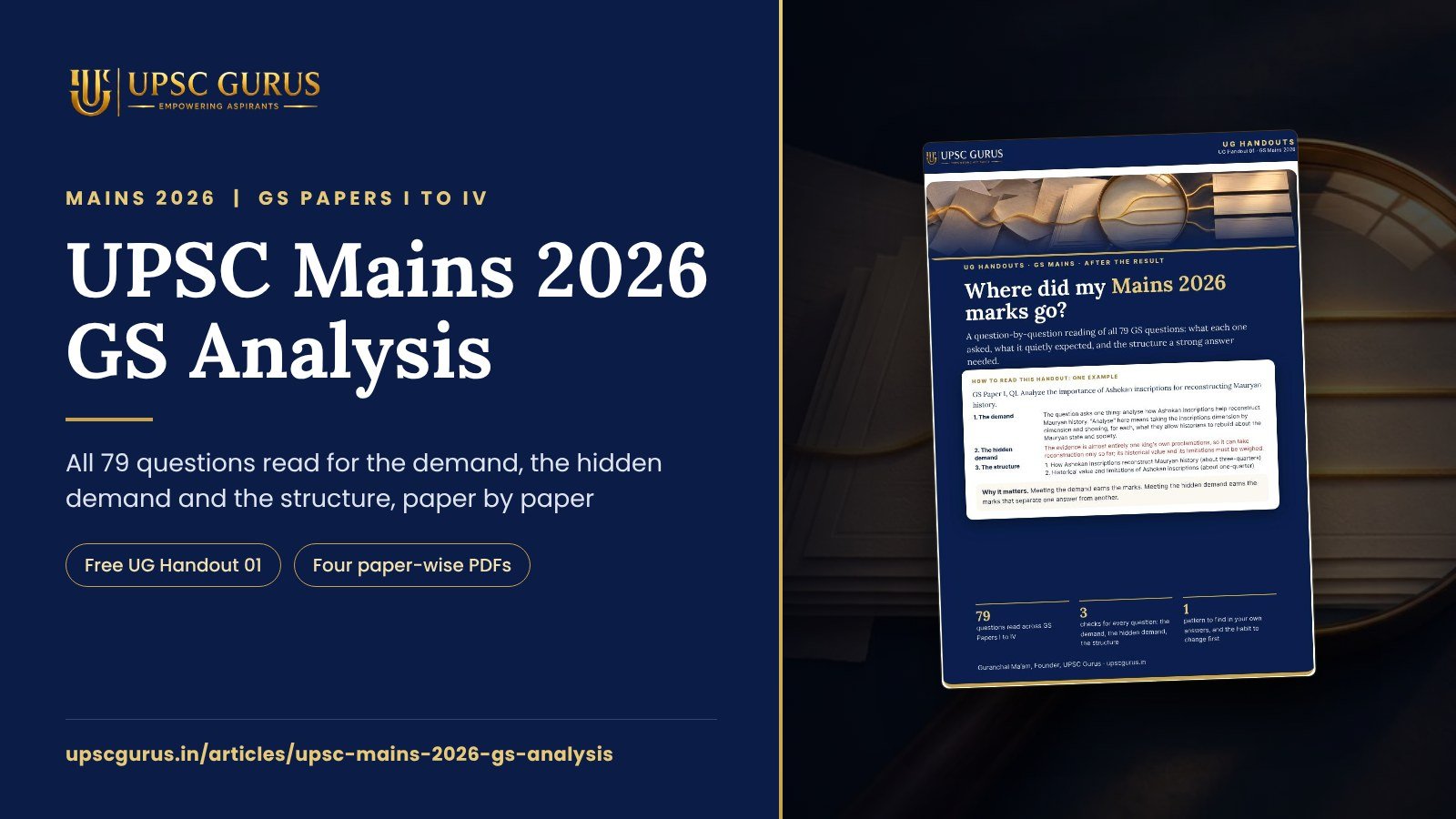
Once a Mains paper is over, a question often looks different from the way it appeared in the examination hall. You may remember the points you wrote, but not whether those points addressed every part of the question. This UPSC Mains 2026 GS analysis examines all four General Studies papers, question by question, through the demand, the hidden demand and a possible answer structure. The 79 questions and subparts are drawn from the official papers; the interpretation is UPSC Gurus’ own and is also available in our free UG Handout 01, Where did my Mains 2026 marks go? Use this page to review coverage, balance and judgement, not to predict a score.
At a glance
- 79 questions and subparts across GS Papers I to IV, worth 1,000 marks in total.
- GS Paper I: 100 marks in geography, 75 in history and culture, and 75 in society.
- GS Paper II: 110 marks in polity and constitutional institutions; GS Paper III spread 200 marks across four equally weighted major areas.
- GS Paper IV: 130 marks in short ethical questions and 120 marks in six case studies.
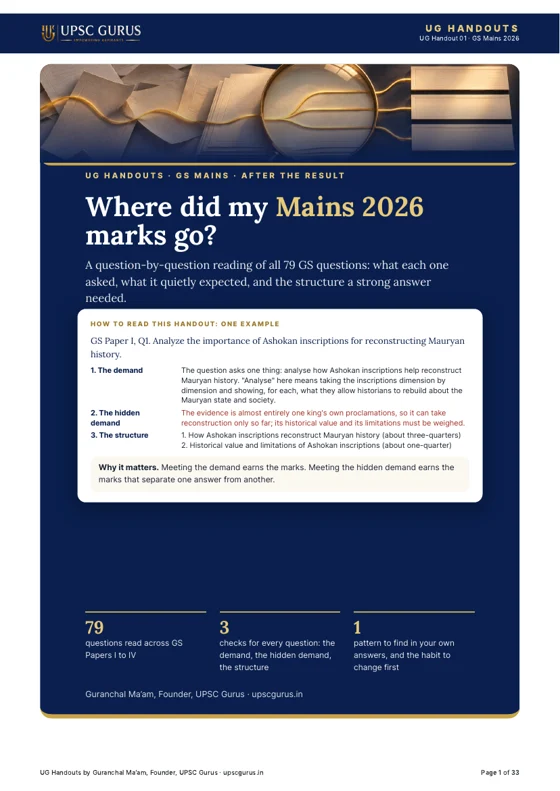
Where did my Mains 2026 marks go?
All 79 questions, with tick boxes for the demand, the hidden demand and the structure, plus a paper-wise tally to identify recurring gaps. Download, print and review your answers at your own pace.
Download the free handout (PDF)Prefer one paper? Download GS I GS II GS III or GS IV separately.How each question is read here
Every question below opens to three elements. The demand is what the question explicitly asks, following its task words and the order of its parts. The hidden demand is UPSC Gurus’ reading of what a complete answer is also expected to address, though the question does not say so; it is often what lifts an answer above the rest. The structure suggests how to organise the answer, with an approximate share of space for each part; the part in red carries the hidden demand. Introductions and conclusions are not prescribed, because effective answers can begin and end in different ways.
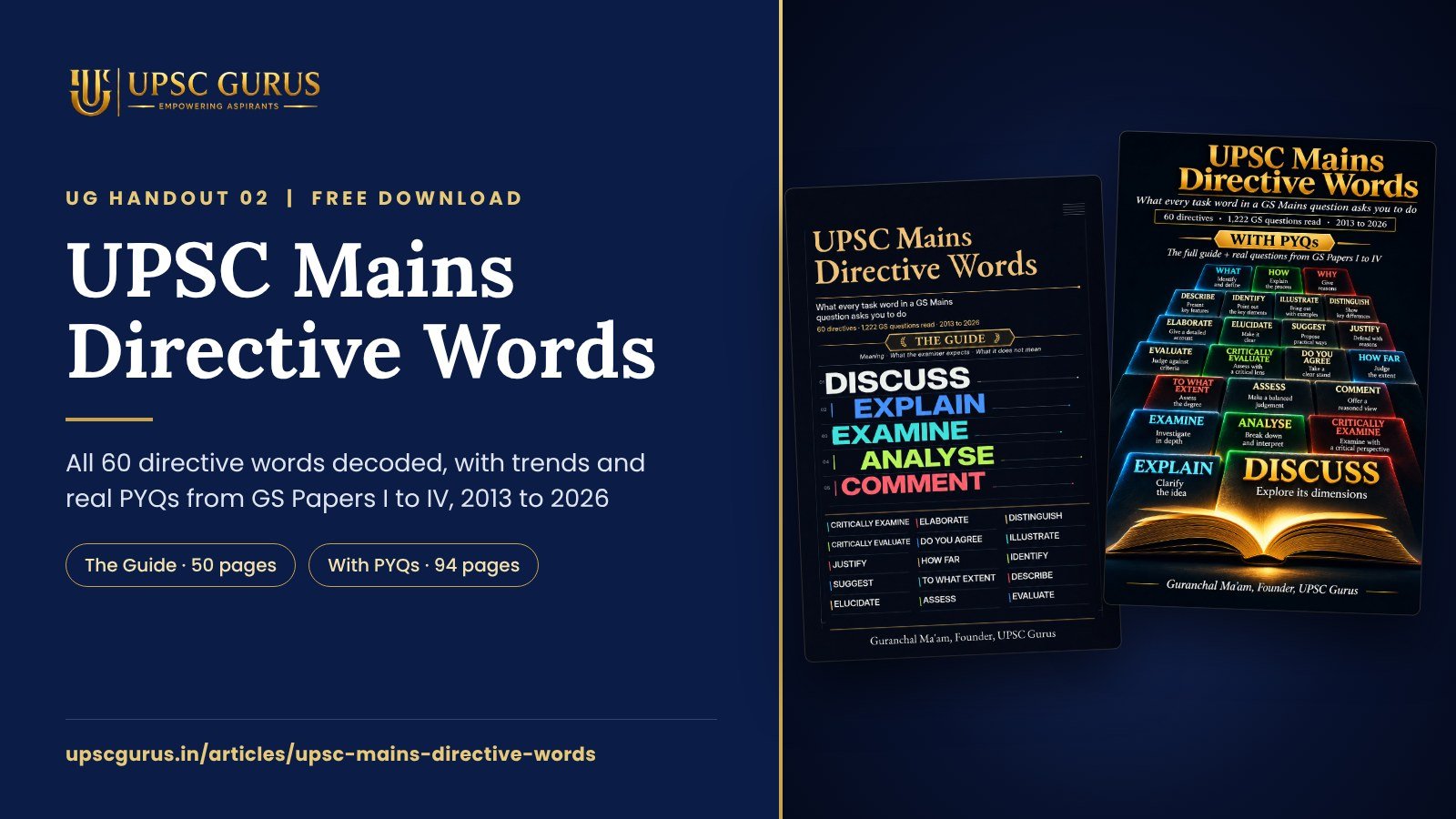
To understand what Discuss, Examine, Analyse and other task words require, explore our free UPSC Mains Directive Words guide, built from 1,222 GS Mains questions and parts.
Tap a question to open its full decode
- Understand the demandSee the task word and every part the question asks you to address, in order.
- Discover the hidden demandThe deeper reasoning a complete answer needed, though the question did not say so.
- Review the structureA suggested answer framework, and how to balance space across its parts.
Compare each decode with what you wrote, and notice what you covered and what you missed. To read a whole paper at once, use Expand all.
UPSC Mains 2026 GS Paper I: History, Geography and Society
GS Paper I moved across ancient and colonial history, independence-era choices, physical geography, resources and society rather than relying on one subject block. Geography accounted for 100 marks in this primary-topic classification, compared with 75 for history and culture and 75 for society. The history questions asked candidates to interpret evidence and causation: Ashokan inscriptions as sources, Macaulay’s Minute through its consequences, Gandhian movements through mobilisation, and planning through regional imbalance. Geography combined process explanations, such as the Fujiwhara effect and aeolian action, with spatial arguments about trade, land use and water. Society called for qualified judgements on diversity, disability, digital empowerment, caste and demographic change. A repeated demand was to test a proposition while acknowledging where it needed qualification, not merely to recall associated facts. The 2024 and 2025 papers also addressed climate, geography and social change; in 2026, several questions expressly set two claims or outcomes against each other, including ecological fragility and economic value.
Each question is counted once under its primary syllabus area, even where it connects multiple subjects. The figures represent the marks allocated to questions, not marks obtained by candidates.
All twenty questions of GS Paper I, decoded
Q1Analyze the importance of Ashokan inscriptions for reconstructing Mauryan history.Open the decode10 marksAnalyse
The question asks one thing: analyse how Ashokan inscriptions help reconstruct Mauryan history. “Analyse” here means taking the inscriptions dimension by dimension and showing, for each, what they allow historians to rebuild about the Mauryan state and society.
The evidence is almost entirely one king’s own proclamations, so it can take reconstruction only so far; its historical value and its limitations must be weighed.
- How Ashokan inscriptions reconstruct Mauryan history (about three-quarters)Inside: identity and chronology; extent; administration and justice; statecraft; economy and welfare; religion
- Historical value and limitations of Ashokan inscriptions (about one-quarter)
2013 GS I, 2015 GS I, 2018 GS I, 2020 GS I, 2022 GS I
Q2Discuss the impact of Macaulay’s Minute on colonial administration and education in India.Open the decode10 marksDiscuss
The question asks about two impacts of the Minute: its impact on colonial administration, and its impact on education in India. “Discuss” means examining each with evidence and reaching a view; the subject is what the Minute changed, not what it said.
Whose interests did the new education serve, and with what unintended result?
- Impact on colonial administration (about two-fifths)Inside: Persian replaced from 1837 mainly by regional languages; English at higher levels; an English-educated intermediary class in public service
- Impact on education in India (about two-fifths)Inside: Anglicists over Orientalists; Bentinck’s resolution of 7 March 1835; downward filtration; neglect of vernacular and mass education
- Whose interests it served (about one-fifth)
2016 GS I, 2017 GS I, 2019 GS I, 2021 GS I, 2023 GS I, 2025 GS I
Q3The significance of the Gandhian movements lay in the masses they mobilized. Elucidate.Open the decode10 marksElucidate
The question asks why the significance of the Gandhian movements lay in the masses they mobilized. “Elucidate” requires showing how mass participation changed the reach and character of these movements, rather than merely naming campaigns or the groups involved.
Were all sections of society mobilized equally, and was mass participation the whole of these movements’ significance?
- Significance of the Gandhian movements in the masses they mobilized (about four-fifths)Inside: social breadth of participation; forms of mass mobilization; expansion beyond political elites; transformation of nationalist politics
- Reach and limits of mass participation (about one-fifth)
2013 GS I, 2015 GS I, 2016 GS I, 2019 GS I, 2020 GS I, 2021 GS I, 2024 GS I
Q4What is the Fujiwhara effect? Explain its impact on the movement and intensity of tropical cyclones.Open the decode10 marksExplain / What
The question asks what the Fujiwhara effect is, followed by its impact on the movement and the intensity of tropical cyclones. “Explain” requires tracing how interaction between cyclones produces each kind of change, not assuming that both outcomes always occur.
No single outcome: depending on size, strength and distance, the storms may orbit, merge or pull apart, which makes tracks and landfall harder to forecast and warn against.
- What the Fujiwhara effect is: the mechanism (about one-quarter)
- Impact on movement (about three-eighths)Inside: mutual rotation; changes in track and speed; merger or separation
- Impact on intensity, and why outcomes vary (about three-eighths)Inside: strengthening or weakening; forecasting and warning challenges
2014 GS I, 2013 GS I, 2016 GS I, 2022 GS I, 2024 GS I
Q5“Tundra regions are ecologically fragile but economically important.” Examine this statement critically.Open the decode10 marksExamine
The question asks you to test both claims about tundra regions: that they are ecologically fragile and that they are economically important. “Examine critically” means assessing the basis and limits of each claim before judging the tension between them.
Fragility and importance interact: warming opens resources and routes while deepening the tundra’s stress.
- Ecological fragility (about one-third)Inside: short growing season, slow recovery; permafrost and ice-rich ground
- Economic importance (about one-third)Inside: minerals, oil and gas; routes and Indigenous livelihoods
- Critical assessment: where the claim holds and where it needs qualifying (about one-third)
2015 GS I, 2018 GS I, 2021 GS I, 2019 GS I, 2017 GS I, 2025 GS I
Q6Discuss the role of aeolian processes in desertification and land degradation.Open the decode10 marksDiscuss
The question asks for the role of aeolian processes in desertification and in land degradation. “Discuss” requires explaining how wind-driven processes produce each outcome and assessing their importance, not merely defining the processes or treating the two outcomes as identical.
Wind acts both directly and as an amplifier: declining cover exposes soil, wind strips fertile particles, and degradation weakens cover further. Show the loop and how to break it.
- Aeolian processes: erosion, transport, deposition (about one-quarter)Inside: deflation and abrasion; suspension, saltation, creep
- Role in desertification and land degradation (about two-fifths)Inside: topsoil and nutrient loss; burial by sand; dust
- Weighing against other causes, and remedies (about one-third)Inside: drought and land use as intensifiers; shelterbelts, dune stabilisation, grazing control
2020 GS I, 2013 GS I, 2016 GS I, 2014 GS III
Q7“Water resources are both an asset and a source of conflict in South Asia.” Examine this statement giving examples.Open the decode10 marksExamine
The question asks you to examine water resources in South Asia first as an asset and then as a source of conflict, using examples for both. “Examine” requires testing the two-sided claim and showing why the same resources can generate benefits and disputes.
When do shared water resources encourage cooperation rather than competition, and what makes that difference?
- Water resources as an asset in South Asia (about two-fifths)Inside: livelihoods and agriculture; energy and development; shared regional benefits
- Water resources as a source of conflict in South Asia (about two-fifths)Inside: transboundary river disputes; allocation and upstream-downstream interests; competing domestic uses
- Conditions for cooperation over shared waters (about one-fifth)
Q8Unity in diversity remains the defining feature of Indian society despite the challenges from communalism and regionalism. Comment.Open the decode10 marksComment
The question asks whether unity in diversity remains the defining feature of Indian society despite challenges from communalism and regionalism. “Comment” requires a reasoned judgement on that claim, weighing the strength of unity against each challenge rather than simply praising diversity.
Does every expression of regional identity weaken national unity, or can regional diversity also sustain it?
- Unity in diversity as the defining feature of Indian society (about three-tenths)Inside: social and cultural plurality; shared civic and national bonds
- Challenges from communalism and regionalism (about half)Inside: communalism; regionalism; their effects on social cohesion
- How unity can endure without erasing diversity (about one-fifth)
Q9How do you understand disability? Substantiate the need for inclusive policy framework in India in this regard.Open the decode10 marksHow / Substantiate
The question asks first for your understanding of disability and then for a substantiated case for an inclusive policy framework in India. The first requires a clear conception of disability; “Substantiate” requires showing why that conception makes inclusion necessary, rather than merely listing policies.
Can a policy be called inclusive if it recognizes rights but leaves barriers to equal participation intact?
- Understanding disability (about three-tenths)Inside: medical and social understandings; rights and dignity
- Need for an inclusive policy framework in India (about half)Inside: removal of barriers; equal access and participation; accommodation and support; implementation and accountability
- From formal inclusion to substantive equality (about one-fifth)
Q10Do you think digital technology promotes social empowerment? Explain with examples.Open the decode10 marksExplain
The question asks whether digital technology promotes social empowerment and requires an explained position supported by examples. “Explain” means demonstrating how technology can change people’s ability to participate and exercise agency, not simply listing digital services or asserting that access equals empowerment.
Who is excluded from these benefits, and when does digital access fail to become genuine social empowerment?
- Whether digital technology promotes social empowerment (about four-fifths)Inside: access to information and services; education and capabilities; voice and participation; economic and social agency; examples across social groups
- Limits of empowerment through digital access (about one-fifth)
Q11Vijayanagara architecture exemplifies the amalgamation of past traditions with contemporary practices. Elucidate with examples.Open the decode15 marksElucidate
The question asks how Vijayanagara architecture brought together past traditions and practices contemporary to its own period. “Elucidate with examples” requires demonstrating the amalgamation through identifiable architectural features and buildings, not presenting two unrelated inventories of styles.
Did inherited and contemporary elements merely coexist, or combine to produce a distinctive architectural identity?
- Past traditions in Vijayanagara architecture (about two-fifths)Inside: inherited temple forms; established artistic and structural conventions; continuities with earlier regional styles
- Contemporary practices in Vijayanagara architecture (about two-fifths)Inside: Indo-Islamic arches, domes and vaults; secular and courtly buildings; larger gopurams and pillared mandapas
- Distinctive synthesis of past and contemporary practices (about one-fifth)
Q12Linguistic reorganization of Indian States was driven by popular pressure from below. Comment.Open the decode15 marksComment
The question asks whether popular pressure from below drove the linguistic reorganization of Indian States. “Comment” requires weighing the causal force of public mobilization against other influences on state decisions, not merely recounting the sequence of reorganizations.
Popular pressure forced the question, but the Union leadership decided how and when linguistic demands were accepted, weighing them against national integration.
- Popular pressure from below that drove the linguistic reorganisation of States (about three-quarters)Inside: linguistic identity and regional aspirations; mass movements and agitations; the turning point of 1952 to 1953; demands that followed the 1956 reorganisation
- Was popular pressure decisive? The role of the leadership and the State (about one-quarter)
Q13The model of planned economy was adopted in India to address the regional imbalances left behind by colonial rule. Comment.Open the decode15 marksComment
The question asks whether addressing regional imbalances left behind by colonial rule explains India’s adoption of the planned economy. “Comment” requires judging how important that objective was in the choice of economic model, rather than narrating successive Plans or assuming it was the only motive.
Was correcting colonial regional imbalance the principal reason for planning, and did adoption of planning necessarily mean that imbalance was corrected?
- Planning as a response to the regional imbalances left behind by colonial rule (about three-quarters)Inside: the colonial legacy of uneven development; why planned intervention was chosen; instruments meant to balance regions
- Other aims of planning, and whether the imbalances were in fact corrected (about one-quarter)
Q14Compare the Loo, Chinook and Foehn winds with respect to their regions of prevalence, their nature and climatic impacts.Open the decode15 marksCompare
The question asks for a direct comparison of the Loo, Chinook and Foehn winds in three stated respects: their regions of prevalence, their nature and their climatic impacts, in that order. “Compare” requires applying the same criteria to all three winds to reveal both similarities and differences, not writing three separate descriptions.
Which apparent similarities conceal different mechanisms and, therefore, different local climatic effects?
- Regions of prevalence of the Loo, Chinook and Foehn winds (about three-tenths)
- Nature of the Loo, Chinook and Foehn winds (about three-tenths)Inside: origin and mechanism; temperature and moisture characteristics; seasonality
- Climatic impacts of the Loo, Chinook and Foehn winds (about three-tenths)Inside: temperature and humidity changes; snowmelt and dryness; effects on local weather
- Distinctions obscured by their apparent similarities (about one-tenth)
Q15Analyze the role of satellite-based technologies in achieving climate-smart agriculture and food security in India.Open the decode15 marksAnalyse
The question asks how satellite-based technologies contribute to achieving climate-smart agriculture and food security in India. “Analyze” requires tracing the link from satellite-derived information to agricultural decisions and outcomes for each goal, rather than cataloguing satellites or applications.
Can satellite data deliver either goal unless the information is timely, usable and accessible to farmers?
- Role of satellite-based technologies in climate-smart agriculture in India (about two-fifths)Inside: climate and crop monitoring; resource-efficient decisions; risk anticipation and adaptation
- Role of satellite-based technologies in food security in India (about two-fifths)Inside: production and yield assessment; early warning of crop stress; planning of food availability
- Conditions for translating satellite intelligence into farm-level outcomes (about one-fifth)
Q16“The centre of global trade is gradually shifting from the Atlantic region to the Indo-Pacific region.” Examine this statement.Open the decode15 marksExamine
The question asks whether the centre of global trade is gradually moving from the Atlantic region to the Indo-Pacific region. “Examine” requires assessing evidence of the geographical shift, its extent and counter-evidence, rather than treating the proposed change as an established fact.
Is the Atlantic being displaced as the centre of trade, or is global trade becoming more widely distributed across interconnected regions?
- Evidence of a shift in the centre of global trade towards the Indo-Pacific (about three-quarters)Inside: changing trade flows; new centres of production and consumption; shipping routes and ports
- Extent and limits of the shift: the Atlantic’s continuing weight (about one-quarter)
Q17Analyze the major drivers of human-induced land-use changes in India and their geographical consequences.Open the decode15 marksAnalyse
The question asks for the major drivers of human-induced land-use changes in India and their geographical consequences. “Analyze” requires connecting each important driver to the resulting spatial and environmental changes, rather than giving two disconnected lists.
Why do similar land-use pressures produce different consequences across India’s varied regions?
- Major drivers of human-induced land-use changes in India (about two-fifths)Inside: urbanization and infrastructure; agricultural expansion and intensification; industry and extraction; policy and demographic pressures
- Geographical consequences of human-induced land-use changes in India (about two-fifths)Inside: changes in land cover and habitats; soil and water systems; settlement and landscape patterns; regional environmental risks
- Why geographical consequences vary across regions (about one-fifth)
Q18Is caste disappearing in urban India? Illustrate your answer with examples.Open the decode15 marksIllustrate
The question asks for a judgement on whether caste is disappearing in urban India, illustrated with examples. “Illustrate” requires testing that judgement through concrete urban situations showing both weakening and persistence of caste, not merely asserting that cities are more equal.
Does caste becoming less visible in some public settings mean it has ceased to shape private choices, opportunities and power?
- Evidence that caste is weakening in urban India (about two-fifths)Inside: everyday social interaction; occupational mobility; changing public practices
- Evidence that caste persists or changes form in urban India (about two-fifths)Inside: marriage and kinship; housing and social networks; inequality and exclusion; urban examples
- Disappearance or transformation of caste? (about one-fifth)
Q19Critically examine the challenges of demographic transition in contemporary India.Open the decode15 marksCritically examine
The question asks for the challenges of demographic transition in contemporary India. “Critically examine” requires probing which challenges arise from changing population structures, how their severity differs and whether transition creates opportunities as well as pressures.
Can India be treated as one demographic unit when different regions are at different stages of transition?
- Challenges of demographic transition in contemporary India (about four-fifths)Inside: regional differences in transition; employment and human capital; ageing and care; gender and health inequalities; migration and urban services
- Uneven challenges and opportunities across regions (about one-fifth)
Q20Evaluate the impact of globalization on Indian youths with reference to social, political, economic and cultural spheres.Open the decode15 marksEvaluate
The question asks for an evaluation of globalization’s impact on Indian youths in four spheres, in order: social, political, economic and cultural. “Evaluate” requires weighing gains and costs in each sphere and reaching an overall judgement, rather than giving an unbalanced list of changes.
Do globalization’s gains and costs fall equally on all young Indians, and how much control do they retain over these changes?
- Impact of globalization on Indian youths in social, political, economic and cultural spheres (about four-fifths)Inside: social sphere: relationships and identities; political sphere: participation and civic outlook; economic sphere: work and opportunities; cultural sphere: practices and values
- Unequal gains, vulnerabilities and overall judgement (about one-fifth)
Download GS Paper I with tick boxes (PDF) · Read the complete paper, or write it again under a three-hour clock, on Mains Replay: GS Paper I 2026.
UPSC Mains 2026 GS Paper II: Polity, Governance, Social Justice and International Relations
GS Paper II gave 110 marks to constitutional questions, institutions and political processes, with the remaining 140 shared among governance, social justice and international relations. Its constitutional questions moved from privacy and women’s reservation to the Speaker, electoral rolls, the Governor, judicial legislation, federalism and separation of powers. Governance questions examined how institutions perform, including the generalist civil service, corporate influence and public trust. Welfare questions asked whether commitments to tribal development, nutrition, education and rights-based services translate into equitable outcomes. International relations required careful assessment of IPMDA, BRICS, the diaspora and the Belt and Road Initiative rather than a description of those initiatives alone. Many questions had multiple explicit parts, so completeness required answering them in sequence and giving each sufficient space. The 2024 and 2025 papers likewise examined federal relations and judicial institutions. The 2026 questions often located those continuing themes in specific institutional decisions, notably electoral-roll revision and assent to State bills.
All twenty questions of GS Paper II, decoded
Q1Right to privacy relating to self-identity is very dear to every human being and well protected under Article 21 of the Constitution. In this context, examine the effect of the amendment in 2026, to the Transgender Persons (Protection of Rights) Act, 2019.Open the decode10 marksExamine
The question asks you to examine the effect of the 2026 amendment to the Transgender Persons (Protection of Rights) Act, 2019, on the right to privacy relating to self-identity, protected under Article 21. “Examine” requires testing the amendment’s provisions against that constitutional protection, identifying their consequences for self-identity and reaching a reasoned judgement on their compatibility with the right.
Can the State regulate the recognition of gender identity without transferring control over a person’s identity from the individual to an external authority?
- Effect of the 2026 amendment on the right to privacy relating to self-identity under Article 21 (about four-fifths)Inside: constitutional protection of privacy and self-identity; changes introduced by the 2026 amendment; effect on self-identification and recognition; implications for dignity, autonomy and privacy; constitutional scrutiny of the amendment
- Reconciling State regulation with the individual’s right to self-identity (about one-fifth)
2015 GS II, 2017 GS II, 2023 GS II, 2024 GS II
Q2“Women as a class neither belong to a minority group nor are they regarded as forming a backward class.” In the light of this statement, discuss the evolution of women’s reservation from local bodies to Parliament.Open the decode10 marksDiscuss
The question asks you to discuss how women’s reservation evolved from local bodies to Parliament, read in the light of the statement that women as a class are neither a minority group nor a backward class. “Discuss” requires showing why women needed a distinct constitutional basis for reservation, and how that basis was extended step by step, rather than listing amendments.
If women do not constitute a conventional minority or backward class, what justifies their reservation, and does representation of women as a whole adequately address inequalities among women?
- In the light of the statement: the basis for reserving seats for women as a class (about one-quarter)Inside: women as neither a minority nor a backward class; why representation still required reservation
- Evolution of women’s reservation from local bodies to Parliament (about three-fifths)Inside: 73rd and 74th Constitutional Amendments (1992); States raising the share in local bodies; repeated attempts in Parliament; the 106th Constitutional Amendment (2023) and its operational conditions
- Does reservation for women as a class reach inequalities among women? (about one-sixth)
2017 GS II, 2018 GS I, 2019 GS II, 2023 GS II
Q3Examine whether the constitutional office of the Lok Sabha Speaker has become vulnerable to partisan politics under the current anti-defection regime. What institutional changes are required to ensure the neutrality of the Lok Sabha Speaker in managing a polarised House?Open the decode10 marksExamine / What
The question asks two things: whether the Lok Sabha Speaker’s constitutional office has become vulnerable to partisan politics under the current anti-defection regime, and what institutional changes are needed to preserve the Speaker’s neutrality in a polarised House. “Examine” requires testing the first concern against the office’s powers and actual functioning; the second requires specific reforms addressing the vulnerabilities identified.
Can neutrality depend on the Speaker’s personal impartiality when the institutional design itself creates incentives for partisan conduct?
- Vulnerability of the Lok Sabha Speaker to partisan politics under the current anti-defection regime (about half)Inside: constitutional position and expected neutrality; Speaker’s powers under the anti-defection regime; scope for partisan influence; consequences for parliamentary functioning
- Institutional changes to ensure the neutrality of the Lok Sabha Speaker in a polarised House (about half)Inside: selection and security of office; reform of anti-defection adjudication; procedural safeguards and accountability; protection of impartial House management
2013 GS II, 2014 GS II, 2019 GS II, 2020 GS II, 2022 GS II, 2023 GS II
Q4Is the right to vote a fundamental right? Discuss the position of the Election Commission of India while undertaking the revision of electoral rolls. Can it also examine the question of citizenship of voters?Open the decode10 marksDiscuss / Examine
The question asks three things in order: whether the right to vote is a fundamental right; the position of the Election Commission of India while revising electoral rolls; and whether the Commission can also examine voters’ citizenship. The first requires a precise legal classification; “Discuss” requires explaining the Commission’s authority and responsibilities in revision; the third requires a clear determination of its jurisdiction over citizenship.
Roll integrity against inclusion: the burden of proof, the documents asked for and the speed of correction decide whether revision protects or erodes the franchise.
- Status of the right to vote (about one-third)
- The ECI’s position in revising rolls (about one-third)
- Citizenship: limited verification, not final determination (about one-third)
2017 GS II, 2018 GS II, 2019 GS II, 2020 GS II, 2022 GS II, 2024 GS II, 2025 GS II
Q5Do constitutional bodies like the National Commission for Scheduled Castes (NCSC) and the National Commission for Scheduled Tribes (NCST) possess adequate enforcement powers to secure substantive social equality? Suggest measures to enhance their institutional effectiveness.Open the decode10 marksSuggest
The question asks whether the NCSC and NCST possess adequate enforcement powers to secure substantive social equality, followed by measures to improve their institutional effectiveness. The first requires judging what these bodies can actually enforce, not merely identifying their constitutional powers; “Suggest” requires workable reforms that address the shortcomings established.
The weakness lies in practice as much as in law (delayed reports, vacancies, dependence for staff and funds), and court-like powers would blur a watchdog’s role.
- Powers of the NCSC and NCST (about one-fifth)
- Limits on enforcement (about two-fifths)
- Measures to strengthen them (about two-fifths)
2018 GS II, 2020 GS II, 2021 GS II, 2022 GS II
Q6Does India’s tribal development policy reflect the aspirations for a socially grounded and equity-based governance? Justify your answer.Open the decode10 marksJustify
The question asks whether India’s tribal development policy reflects the aspirations for socially grounded and equity-based governance. “Justify” requires taking a defensible position and supporting it through the policy’s treatment of tribal rights, participation, cultural identity and equitable outcomes, rather than merely describing development schemes.
Can governance be considered socially grounded if development priorities are determined for tribal communities without their meaningful participation and consent?
- Extent to which India’s tribal development policy reflects socially grounded and equity-based governance (about four-fifths)Inside: recognition of tribal identity and aspirations; participation and self-governance; land, forest and livelihood rights; equitable access to development; gaps between policy commitments and outcomes
- Whose aspirations determine the meaning and direction of tribal development? (about one-fifth)
Q7Malnutrition in India is not merely a public health concern; it is also a challenge of social equity, human development and effective welfare governance. Discuss.Open the decode10 marksDiscuss
The question asks you to discuss malnutrition in India not merely as a public health concern but also as a challenge of social equity, human development and effective welfare governance, in that order. “Discuss” requires examining how each dimension shapes the problem and its resolution, rather than reducing malnutrition to dietary inadequacy or medical treatment.
Can malnutrition be sustainably reduced without addressing the social inequalities and governance failures that reproduce it?
- Malnutrition as a public health concern in India (about three-tenths)Inside: health and nutritional consequences; maternal and child health; public health response
- Malnutrition as a challenge of social equity, human development and effective welfare governance (about six-tenths)Inside: social equity: unequal exposure and access; human development: capabilities and life opportunities; welfare governance: programme design and delivery; coordination and accountability across interventions
- Why nutrition outcomes require an integrated equity-based response (about one-tenth)
Q8Analyse the advantages and limitations of the generalist structure of the Indian Civil Services in contemporary governance.Open the decode10 marksAnalyse
The question asks for the advantages and limitations of the generalist structure of the Indian Civil Services in contemporary governance. “Analyse” requires identifying how the generalist model produces particular administrative strengths and weaknesses, and judging its suitability for present governance demands rather than simply favouring generalists or specialists.
Is the central problem the generalist model itself, or the failure to combine broad administrative competence with specialised expertise?
- Advantages of the generalist structure of the Indian Civil Services in contemporary governance (about two-fifths)Inside: administrative versatility; interdepartmental coordination; policy integration and implementation; leadership across varied assignments
- Limitations of the generalist structure of the Indian Civil Services in contemporary governance (about two-fifths)Inside: specialised knowledge requirements; complexity of contemporary administration; effects of frequent role changes; technical capacity and policy outcomes
- Reconciling generalist leadership with specialised competence (about one-fifth)
Q9“IPMDA (Indo-Pacific Partnership for Maritime Domain Awareness) bridges the gap between India’s SAGAR (Security and Growth for All in the Region) vision and the Quad’s collective Indo-Pacific strategy.” Make a critical assessment of the statement focusing on IPMDA.Open the decode10 marksCritically assess
The question asks whether IPMDA bridges India’s SAGAR vision and the Quad’s collective Indo-Pacific strategy, with IPMDA as the central focus. “Critically assess” requires showing where IPMDA advances the objectives of both frameworks, testing the limits of that convergence and reaching a reasoned judgement rather than separately describing SAGAR and the Quad.
Does cooperation in maritime domain awareness amount to genuine strategic convergence, or does it connect only selected interests within two distinct regional visions?
- How IPMDA bridges India’s SAGAR vision and the Quad’s Indo-Pacific strategy (about three-fifths)Inside: IPMDA’s purpose and method; alignment with SAGAR’s regional objectives; alignment with the Quad’s collective strategy; practical value to small littoral states
- Where the bridge falls short (about one-quarter)Inside: differing priorities of SAGAR and the Quad; capacity and data-sharing limits; perceptions in the region
- Genuine strategic convergence, or a selective overlap of interests? (about one-sixth)
Q10“BRICS acts as a powerful counterweight in global governance, actively amplifying the voice and influence of the Global South.” Explain the role of BRICS in projecting itself as an alternative to other groupings.Open the decode10 marksExplain
The question asks how BRICS projects itself as an alternative to other groupings by acting as a counterweight in global governance and amplifying the Global South’s voice and influence. “Explain” requires showing the institutional and political means through which BRICS pursues this role, not simply listing its members or meetings.
Does BRICS seek to replace established global institutions and groupings, or to increase the Global South’s bargaining power within an existing international order?
- Role of BRICS as a counterweight in global governance and an alternative to other groupings (about four-fifths)Inside: representation of Global South interests; demands for global governance reform; alternative institutional and financial arrangements; collective diplomatic influence; constraints on BRICS cohesion and effectiveness
- BRICS as an alternative or a complement to the existing global order (about one-fifth)
Q11Discuss the position of the Governor in the federal polity of India. What is the nature of his power while giving assent to a bill passed by the State Legislature? Is he bound by the aid and advice of his Council of Ministers in all his functions?Open the decode15 marksDiscuss / What
The question asks three things in order: the Governor’s position in India’s federal polity; the nature of his power when giving assent to a State bill; and whether he is bound by ministerial aid and advice in all his functions. The first is discussed; the second asks for his options under Articles 200 and 201 and how far each is open to him; the third asks for a clear verdict with its exceptions.
Is the office a constitutional head serving federalism, or an agent of the Centre straining it?
- Position of the Governor in the federal polity (about three-tenths)
- Nature of his power while giving assent to State bills (about three-tenths)
- Whether he is bound by aid and advice in all his functions (about three-tenths)
- Making the office serve federalism (about one-tenth)
Q12What is meant by judicial legislation? In this context, discuss the verdicts of the apex court allowing “passive euthanasia” and a “living will”.Open the decode15 marksDiscuss / What
The question asks first what judicial legislation means and then requires discussion of the apex court’s verdicts allowing passive euthanasia and a living will. The first needs a precise distinction between judicial interpretation and lawmaking; “Discuss” requires examining the reasoning, scope and safeguards of the verdicts in relation to that distinction.
When courts recognise rights and prescribe procedures in areas lacking legislation, are they filling a constitutional gap or crossing into the legislature’s domain?
- Meaning of judicial legislation (about one-quarter)Inside: distinction from judicial interpretation; constitutional limits
- The apex court’s verdicts allowing passive euthanasia and a living will (about three-fifths)Inside: Aruna Shanbaug (2011); Common Cause (2018) and the right to die with dignity; guidelines framed in the absence of a statute; the simplified procedure of 2023
- Filling a legislative vacuum, or crossing into the legislature’s domain? (about one-sixth)
Q13How far has the Indian federal framework been successful in accommodating regional and cultural diversities? Highlight the role of asymmetric federalism and suggest measures to make dispute resolution mechanisms more effective.Open the decode15 marksHow far / Highlight / Suggest
The question asks three things in order: how successfully India’s federal framework accommodates regional and cultural diversities; the role of asymmetric federalism in that accommodation; and measures to improve dispute resolution mechanisms. “How far” calls for a balanced assessment of success and gaps; “Highlight” requires bringing out asymmetric federalism’s distinct contribution; “Suggest” requires practical reforms to the mechanisms identified.
Can India’s federal arrangements preserve differentiated regional identities while maintaining constitutional equality and sufficient trust between governments?
- Success of the Indian federal framework in accommodating regional and cultural diversities (about three-tenths)Inside: constitutional accommodation of diversity; regional autonomy and cultural recognition; achievements and continuing tensions
- Role of asymmetric federalism in accommodating regional and cultural diversities (about three-tenths)Inside: meaning and constitutional basis; differentiated arrangements; contribution to accommodation and integration; limitations and tensions
- Measures to make dispute resolution mechanisms more effective (about three-tenths)Inside: intergovernmental consultation; institutional dispute resolution; timely and credible decisions; cooperative and negotiated approaches
- Balancing diversity, constitutional equality and federal trust (about one-tenth)
Q14Examine how the separation of powers is practised in India compared to the rigid presidential model of the United States of America. In this context, compare the actual authority of the Indian Prime Minister with that of the President of the USA.Open the decode15 marksExamine / How
The question asks first how separation of powers operates in India compared with the rigid presidential model of the United States, and then how the actual authority of the Indian Prime Minister compares with that of the US President. “Examine” requires testing constitutional design against institutional practice; the subsequent comparison requires judging effective powers and constraints, not merely contrasting official titles.
Does a formally stricter separation of powers necessarily produce stronger checks on executive authority than a parliamentary system?
- Practice of separation of powers in India compared with the rigid presidential model of the USA (about two-fifths)Inside: constitutional design in both systems; relationship between legislature and executive; judicial role and institutional checks; separation and overlap in actual practice
- Actual authority of the Indian Prime Minister compared with the President of the USA (about two-fifths)Inside: sources of executive authority; control over government and legislative agenda; political and institutional constraints; effective decision-making power
- Constitutional separation versus actual concentration and accountability of power (about one-fifth)
Q15To what extent do pressure groups, social movements and corporate lobbies deepen pluralistic democracy in India by representing excluded interests? Analyse whether the growing convergence of corporate wealth and political power poses a threat to the autonomy of formal democratic institutions.Open the decode15 marksAnalyse / To what extent
The question asks two things: to what extent pressure groups, social movements and corporate lobbies deepen pluralistic democracy by representing excluded interests; and whether the growing convergence of corporate wealth and political power threatens the autonomy of formal democratic institutions. The first requires distinguishing the representative contribution of each actor; “Analyse” requires tracing how the convergence affects institutional independence and democratic equality.
Can a democracy remain genuinely pluralistic when the ability to influence decisions depends more on economic resources and political access than on the strength of excluded interests?
- Extent to which pressure groups, social movements and corporate lobbies deepen pluralistic democracy by representing excluded interests (about two-fifths)Inside: pressure groups and interest representation; social movements and excluded voices; corporate lobbies and the limits of representation; contribution to democratic pluralism
- Threat posed by the convergence of corporate wealth and political power to the autonomy of formal democratic institutions (about two-fifths)Inside: channels of corporate political influence; effects on policy and institutional autonomy; risks of unequal access and institutional capture; democratic safeguards and accountability
- Whether formal pluralism can survive unequal political influence (about one-fifth)
Q16“Transparency and accountability in governance are not about controlling corruption but about creating the trust of stakeholders in the policy process by following the Rule of Law and Participatory Governance.” Comment.Open the decode15 marksComment
The question asks whether transparency and accountability in governance should be understood less as instruments for controlling corruption and more as means of creating stakeholder trust in the policy process through the Rule of Law and Participatory Governance. “Comment” requires judging this proposed distinction, examining both purposes and explaining their relationship rather than accepting the statement’s contrast uncritically.
Is controlling corruption separate from building public trust, or is credible corruption control itself an essential foundation of that trust?
- Transparency and accountability in controlling corruption (about three-tenths)Inside: prevention of arbitrary exercise of power; answerability and oversight; deterrence and corrective action
- Transparency and accountability in creating stakeholder trust through the Rule of Law and Participatory Governance (about half)Inside: trust in the policy process; Rule of Law and institutional credibility; participation and stakeholder voice; responsiveness and legitimacy
- Corruption control and stakeholder trust as mutually reinforcing objectives (about one-fifth)
Q17Can the constitutional mandate of rights-based welfare be effectively realised in the context of non-integrated governance and minimal public investment? Examine.Open the decode15 marksExamine
The question asks whether the constitutional mandate of rights-based welfare can be effectively realised under two conditions: non-integrated governance and minimal public investment. “Examine” requires testing how each condition affects the delivery and enforceability of welfare rights, and reaching a reasoned conclusion about the feasibility of their effective realisation.
Can welfare genuinely be called rights-based when the State recognises entitlements but fails to create the institutional capacity and resources required to fulfil them?
- Realisation of rights-based welfare in the context of non-integrated governance (about two-fifths)Inside: constitutional mandate and welfare entitlements; fragmentation of responsibilities; coordination and delivery gaps; consequences for access and accountability
- Realisation of rights-based welfare in the context of minimal public investment (about two-fifths)Inside: adequacy of financial commitments; infrastructure and service capacity; effects on coverage and quality; equity and enforceability of entitlements
- Conditions for converting welfare rights into effective guarantees (about one-fifth)
Q18Should education be treated primarily as a welfare obligation of the state or as a strategic investment for building a globally competitive, knowledge-driven nation? Critically evaluate.Open the decode15 marksCritically evaluate
The question asks whether education should be treated primarily as a welfare obligation of the State or as a strategic investment in a globally competitive, knowledge-driven nation. “Critically evaluate” requires weighing the rationale, strengths and limitations of both approaches and deciding whether one should take precedence or the distinction itself is misleading.
Can education fulfil its strategic national purpose without first meeting the State’s obligation to provide equitable access and meaningful learning?
- Education as a welfare obligation of the State (about two-fifths)Inside: constitutional and social obligations; equitable access and inclusion; human development and citizenship; strengths and limitations of the welfare approach
- Education as a strategic investment for a globally competitive, knowledge-driven nation (about two-fifths)Inside: human capital and productivity; research, innovation and knowledge creation; global competitiveness; strengths and limitations of the investment approach
- Whether welfare obligation and strategic investment are competing or complementary purposes (about one-fifth)
Q19“India’s global diaspora acts as a living bridge, as a critical economic factor and knowledge network in transforming cultural heritage into geopolitical influence and strategic leverage worldwide.” Critically examine this statement.Open the decode15 marksCritically examine
The question asks you to critically examine India’s global diaspora as a living bridge, as an economic factor and knowledge network, and as a means of transforming cultural heritage into geopolitical influence and strategic leverage. “Critically examine” requires testing how these roles connect, how far they translate into actual influence and where the claim encounters limitations.
Does cultural affinity or economic contribution automatically make diaspora communities instruments of India’s strategic interests, when they possess independent identities and loyalties?
- India’s global diaspora as a living bridge (about one-fifth)Inside: cultural connections and heritage; people-to-people relationships; links between India and host societies
- India’s global diaspora as a critical economic factor and knowledge network (about two-fifths)Inside: economic contributions; investment and commercial networks; knowledge and professional connections; skills and innovation linkages
- Transformation of cultural heritage into geopolitical influence and strategic leverage worldwide (about three-tenths)Inside: cultural influence and soft power; diplomatic and political connections; strategic opportunities; constraints on translating diaspora influence into State leverage
- Limits of treating a diverse diaspora as a unified instrument of national strategy (about one-tenth)
Q20“China’s Belt and Road Initiative (BRI) has transformed South Asia from a regional space into a theatre of great power competition.” Analyse the strategic implications of the BRI for India’s security and regional influence in South Asia.Open the decode15 marksAnalyse
The question asks you to analyse the claim that China’s Belt and Road Initiative has transformed South Asia into a theatre of great-power competition, followed by its strategic implications for India’s security and regional influence. “Analyse” requires establishing how the BRI changes the regional strategic environment and tracing the resulting consequences for each Indian interest, rather than merely listing BRI projects.
Are South Asian countries merely arenas of China-India competition, or do their own choices and strategic interests determine how the BRI affects India’s position?
- China’s BRI and the transformation of South Asia into a theatre of great-power competition (about three-tenths)Inside: BRI’s regional economic and strategic reach; changing patterns of influence; emergence and extent of great-power competition
- Strategic implications of the BRI for India’s security in South Asia (about three-tenths)Inside: territorial and border concerns; maritime and connectivity security; strategic vulnerabilities and dependencies
- Strategic implications of the BRI for India’s regional influence in South Asia (about three-tenths)Inside: bilateral relations with neighbours; economic and diplomatic influence; competition over regional connectivity; India’s strategic responses
- Agency of South Asian states in shaping the regional strategic balance (about one-tenth)
Download GS Paper II with tick boxes (PDF) · Read the complete paper, or write it again under a three-hour clock, on Mains Replay: GS Paper II 2026.
UPSC Mains 2026 GS Paper III: Economy, Agriculture, Technology, Environment and Security
GS Paper III allocated 50 marks each to economy and energy, agriculture, science and technology, and internal security. Environment and disaster management accounted for 25 marks each. This spread matters because questions frequently connected one area to another: biotechnology to farmers’ outcomes, energy security to sustainability, infrastructure to disaster risk, and development in border areas to local confidence. Technical subjects required mechanisms, not just terminology. The Digital Rupee question separated meaning, working and progress; the reactor question distinguished criticality from its wider energy implications; Mission Drishti and agentic AI required an explanation of capability followed by its significance and limits. Agriculture questions linked policies, markets, subsidies and production to food security. Internal security moved between disinformation, border governance, Jammu and Kashmir, and terror finance. The 2024 and 2025 papers also featured practical technologies, agriculture and security. In 2026, several questions made the distinction between a promising intervention and a demonstrated outcome especially explicit.
All twenty questions of GS Paper III, decoded
Q1What do you mean by Digital Rupee? In this context, explain the working and progress of India’s Central Bank Digital Currency (CBDC).Open the decode10 marksExplain / What
The question asks three things in order: what the Digital Rupee means; how India’s Central Bank Digital Currency (CBDC) works; and how far its implementation has progressed. “Explain” requires showing the mechanism of the CBDC and assessing its actual stage of development, rather than merely describing digital payments or announcing its introduction.
What distinguishes a central bank digital currency from existing electronic money, and does progress in experimentation amount to widespread adoption?
- Meaning of the Digital Rupee (about one-fifth)
- Working of India’s Central Bank Digital Currency (about two-fifths)Inside: issuance and distribution; retail and wholesale forms; transaction and settlement mechanisms; distinction from existing digital payment systems
- Progress of India’s Central Bank Digital Currency (about three-tenths)Inside: pilot implementation; expansion of participation and use cases; adoption and operational readiness
- Distinction between technological progress and meaningful adoption (about one-tenth)
2015 GS III, 2016 GS III, 2021 GS I, 2022 GS III, 2023 GS III
Q2Examine the view that financial inclusion is an integral part of social and economic inclusion in a country like India. Also throw light on the usefulness of the R.B.I.’s Financial Inclusion Index.Open the decode10 marksExamine / Throw light
The question asks you to examine the claim that financial inclusion is integral to both social and economic inclusion in India, and then bring out the usefulness of the RBI’s Financial Inclusion Index. “Examine” requires establishing and testing the relationship between access to finance and broader inclusion; “Throw light” requires identifying what the Index measures and how that measurement is useful.
Does access to financial services necessarily produce meaningful inclusion, and can an aggregate index reveal inequalities in their actual use?
- Financial inclusion as an integral part of social and economic inclusion in India (about two-fifths)Inside: relationship with social inclusion; relationship with economic inclusion; barriers and unequal access; limits of access without effective use
- Usefulness of the RBI’s Financial Inclusion Index (about two-fifths)Inside: dimensions and measurement; tracking progress; identifying policy priorities; interpretative limitations
- Whether measured financial inclusion reflects substantive social and economic inclusion (about one-fifth)
2014 GS III, 2015 GS III, 2016 GS III, 2021 GS II, 2022 GS III, 2022 GS II, 2023 GS III, 2025 GS III
Q3Describe the various Technology Missions initiated in Indian agriculture and examine their role in food security.Open the decode10 marksDescribe / Examine
The question asks first for a description of the various Technology Missions initiated in Indian agriculture and then for an examination of their role in food security. “Describe” requires identifying the missions and their principal objectives; “Examine” requires assessing how their interventions contribute to food security and where that contribution remains limited.
Do improvements in agricultural production through Technology Missions necessarily translate into affordable, accessible and nutritionally adequate food?
- The Technology Missions (about two-fifths)Inside: major missions and their objectives; crops and sectors covered; technological and institutional interventions
- Their role in food security, with limits (about three-fifths)
2013 GS III, 2017 GS III, 2018 GS III, 2021 GS III, 2023 GS III, 2024 GS III
Q4Explain the factors responsible for inefficiency of agri-produce marketing. How e-commerce helps to reduce inefficiency of agri-produce marketing? Explain.Open the decode10 marksExplain / How
The question asks two things: the factors responsible for inefficiency in agri-produce marketing, and how e-commerce helps reduce those inefficiencies. “Explain” requires establishing why each factor obstructs efficient marketing and then showing the specific mechanism through which e-commerce addresses it, rather than presenting an unrelated list of digital platforms.
Can e-commerce overcome structural weaknesses in agricultural markets without corresponding improvements in physical infrastructure, access and market institutions?
- Factors behind inefficient agri-produce marketing (about half)Inside: market fragmentation and intermediation; information and price discovery; storage and logistics; market access and bargaining power
- How e-commerce reduces inefficiency, with a closing line on its limits (about half)
2014 GS III, 2015 GS III, 2018 GS III, 2020 GS III, 2022 GS III, 2023 GS III, 2025 GS III
Q5Explain by giving two examples, how biotechnology has helped the Indian farmers in processing their perishable crops.Open the decode10 marksExplain / How
The question asks how biotechnology has helped Indian farmers process their perishable crops, shown through two examples. “Explain” requires tracing, for each example, the biotechnological intervention, how it aids processing and the benefit that reaches the farmer, rather than naming crops or describing conventional preservation.
Are both examples genuinely applications of biotechnology in processing, and is the benefit shown at the farmer level rather than assumed from technological potential?
- First example: how biotechnology helps farmers process a perishable crop (about two-fifths)Inside: the crop and its perishability problem; the biotechnological intervention; how it aids processing; the benefit to farmers
- Second example: how biotechnology helps farmers process a perishable crop (about two-fifths)Inside: the crop and its perishability problem; the biotechnological intervention; how it aids processing; the benefit to farmers
- Separating genuine biotechnological gains from ordinary post-harvest handling (about one-fifth)
Q6Distinguish between a Fast Breeder Reactor (FBR) and a thermal nuclear reactor. In the context of first indigenously developed prototype FBR at Kalpakkam, explain the term ‘criticality’. What are its implications for clean energy future of our country?Open the decode10 marksDistinguish / Explain / What
The question asks three things in order: how a Fast Breeder Reactor differs from a thermal nuclear reactor; what ‘criticality’ means in the context of the indigenous prototype FBR at Kalpakkam; and its implications for India’s clean energy future. “Distinguish” requires a direct technical comparison, “Explain” requires clarifying the operational meaning of criticality, and the final part requires assessing its significance for India’s energy prospects.
Does achieving criticality establish readiness for sustained commercial electricity generation, or is it a distinct milestone in a longer technological journey?
- Distinction between a Fast Breeder Reactor and a thermal nuclear reactor (about three-tenths)Inside: neutron characteristics; fuel and breeding mechanisms; moderation and reactor operation; fuel utilisation
- Meaning of criticality in the prototype FBR at Kalpakkam (about three-tenths)Inside: technical meaning of criticality; self-sustaining chain reaction; significance as an operational milestone
- Implications for India’s clean energy future (about three-tenths)Inside: long-term energy availability; fuel efficiency and energy security; low-carbon electricity potential; technological and operational challenges
- Difference between reactor criticality and commercially viable clean energy deployment (about one-tenth)
Q7Discuss how the contradiction between ‘rapid infrastructure development’ and ‘disaster-risk reduction’ in ecologically-sensitive areas of India can be managed, with suitable examples.Open the decode10 marksDiscuss / How
The question asks how the contradiction between rapid infrastructure development and disaster-risk reduction can be managed in India’s ecologically-sensitive areas, using suitable examples. “Discuss” requires examining the competing demands and assessing practical approaches that reconcile them, rather than simply listing development projects or disaster-management measures.
Can every infrastructure project be made sufficiently safe through mitigation, or must some projects be restricted, relocated or reconsidered altogether?
- Managing the contradiction between rapid infrastructure development and disaster-risk reduction in ecologically-sensitive areas of India (about four-fifths)Inside: nature of the development-risk conflict; hazard-sensitive planning and location; environmental and disaster-risk assessment; resilient design and construction; regulatory and institutional safeguards; suitable Indian examples
- Limits beyond which development cannot be reconciled with acceptable disaster risk (about one-fifth)
Q8Discuss the aim and goals of Kunming-Montreal global biodiversity framework. Mention India’s commitments and initiatives to achieve the goals and targets of this framework giving suitable examples.Open the decode10 marksDiscuss / Mention
The question asks first for the aim and goals of the Kunming-Montreal Global Biodiversity Framework, and then for India’s commitments and initiatives towards achieving its goals and targets, supported by examples. “Discuss” requires explaining the framework’s intended outcomes; “Mention” requires identifying India’s relevant commitments and concrete actions without confusing global targets with national implementation.
Do India’s commitments and announced initiatives demonstrate measurable progress towards the framework’s goals, or merely formal alignment with them?
- Aim and goals of the Kunming-Montreal Global Biodiversity Framework (about two-fifths)Inside: overall aim and long-term vision; principal biodiversity goals; major targets and implementation priorities
- India’s commitments and initiatives to achieve the framework’s goals and targets (about two-fifths)Inside: national commitments and targets; policy and institutional initiatives; conservation and restoration measures; suitable examples of implementation
- Gap between commitments, implementation and measurable biodiversity outcomes (about one-fifth)
Q9Explain how fake news and disinformation pose threat to Internal Security and Public Order in Indian context? In this regard, discuss salient features of amendments in respect of Information Technology (Intermediatory Guidelines and Digital Media Ethics Code) Rules 2021.Open the decode10 marksExplain / Discuss
The question asks two things in order: how fake news and disinformation threaten Internal Security and Public Order in India; and the salient features of amendments to the Information Technology (Intermediatory Guidelines and Digital Media Ethics Code) Rules, 2021. “Explain” requires tracing how disinformation creates each kind of threat; “Discuss” requires identifying the relevant regulatory changes and their significance for addressing those threats.
Can the State counter disinformation effectively without undermining freedom of expression, due process and the independence of online information?
- Threats posed by fake news and disinformation to Internal Security and Public Order in India (about two-fifths)Inside: threats to internal security; threats to public order; mechanisms of amplification and mobilisation; specific vulnerabilities in the Indian context
- Salient features of amendments to the Information Technology Rules, 2021 (about two-fifths)Inside: relevant amended provisions; intermediary obligations and responsibilities; content regulation and grievance mechanisms; implications for controlling disinformation
- Balancing disinformation control with constitutional freedoms and procedural safeguards (about one-fifth)
Q10Ladakh is strategically located between China and Pakistan. As a measure to win hearts and minds of locals, discuss the Border Area Development Programmes (BADP) by the Central Government and civic actions by the Army. Also discuss demand of promulgation of provision of the Sixth Schedule of constitution for Ladakh.Open the decode10 marksDiscuss
The question asks three things in Ladakh’s strategic context: the Central Government’s Border Area Development Programmes, the Army’s civic actions to win local confidence, and the demand for extending Sixth Schedule provisions to Ladakh. “Discuss” requires examining the purpose and effectiveness of both forms of outreach and the constitutional rationale behind the demand, not merely listing developmental activities.
Can development and civic outreach secure lasting local confidence without addressing demands for political participation, cultural protection and institutional autonomy?
- Central Government’s Border Area Development Programmes in Ladakh (about three-tenths)Inside: objectives and strategic context; development interventions; contribution to local welfare and confidence; implementation challenges
- Civic actions by the Army to win the hearts and minds of Ladakh’s local population (about three-tenths)Inside: nature of civic action; community engagement and welfare; civil-military relations; scope and limitations
- Demand for extending Sixth Schedule provisions of the Constitution to Ladakh (about three-tenths)Inside: grounds for the demand; constitutional protections sought; implications for local governance; institutional and legal considerations
- Relationship between developmental outreach and constitutionally protected local self-governance (about one-tenth)
Q11Explain the key challenges for India’s energy security. What measures do you suggest for ensuring energy security along with economic growth and sustainability?Open the decode15 marksExplain / Suggest
The question asks two things: the key challenges to India’s energy security, and the measures you suggest to ensure it along with economic growth and sustainability. “Explain” means showing why each challenge threatens reliable, affordable supply; the measures must each be tested against both conditions.
Security, growth and sustainability pull against each other.
- Key challenges to India’s energy security (about two-fifths)
- Measures for energy security along with growth and sustainability (about two-fifths)
- Balancing the three goals (about one-fifth)
Q12How are startups in India promoting entrepreneurship, innovation and employment? Discuss the global and domestic challenges in their working and suggest suitable measures to overcome these challenges.Open the decode15 marksDiscuss / Suggest
The question asks three things: how Indian startups promote entrepreneurship, innovation and employment; the global and domestic challenges affecting their functioning; and suitable measures to overcome those challenges. “Discuss” requires examining the nature and significance of each contribution and challenge; “Suggest” requires remedies directly matched to the problems identified.
Does an expanding startup ecosystem necessarily produce sustainable enterprises and durable employment, or must success be judged beyond the number of startups created?
- How startups in India promote entrepreneurship, innovation and employment (about three-tenths)Inside: entrepreneurship; innovation; employment generation; wider economic contribution
- Global and domestic challenges in the working of Indian startups (about three-tenths)Inside: global market and financing challenges; international competition and technological dependence; domestic regulatory and financing constraints; talent, infrastructure and market-access challenges
- Suitable measures to overcome global and domestic challenges (about three-tenths)Inside: access to finance and markets; regulatory and institutional support; innovation and capability building; sustainable growth and employment
- From startup creation to sustainable enterprise and employment outcomes (about one-tenth)
Q13How Indian agriculture has been transformed from food scarcity to food surplus level? Explain the various government policies implemented for diversification of Indian agriculture.Open the decode15 marksExplain / How
The question asks first how Indian agriculture was transformed from food scarcity to food surplus, and then for an explanation of government policies implemented to diversify agriculture. The first requires tracing the causes and stages of that transformation; “Explain” requires showing how the policies encourage diversification and what changes they seek to produce.
Has the success in achieving aggregate food surplus created a sustainable and diversified agricultural system, or does dependence on the earlier production model persist?
- Transformation of Indian agriculture from food scarcity to food surplus (about two-fifths)Inside: initial conditions of food scarcity; technological transformation; institutional and policy support; production and food availability outcomes
- Government policies implemented for diversification of Indian agriculture (about two-fifths)Inside: crop diversification policies; horticulture and allied-sector promotion; incentives and institutional support; market and value-chain development; effectiveness and constraints
- Reconciling food surplus with diversification, sustainability and nutritional security (about one-fifth)
Q14Discuss the different types of subsidies and supports provided by the Government of India to agricultural sector. Examine the related issues pertaining to Agreement on Agriculture of World Trade Organisation (WTO).Open the decode15 marksDiscuss / Examine
The question asks first for the different types of subsidies and support provided by the Government of India to agriculture, and then for the issues arising under the WTO Agreement on Agriculture. “Discuss” requires distinguishing the forms and purposes of support; “Examine” requires testing their compatibility with the Agreement’s rules and identifying the resulting disputes and policy constraints.
How can India protect farmers and food security while meeting international trade obligations and preserving sufficient policy flexibility?
- Different types of subsidies and support provided by the Government of India to agriculture (about two-fifths)Inside: input subsidies; price and procurement support; income and investment support; credit, insurance and other assistance
- Issues relating to the WTO Agreement on Agriculture (about two-fifths)Inside: classification of domestic support; permissible support and limits; public stockholding and food security; trade-related disputes and obligations; implications for Indian agricultural policy
- Balancing domestic agricultural priorities with WTO commitments (about one-fifth)
Q15Mention salient features of ‘Mission Drishti’. Discuss the imaging techniques used in the satellite launched on 3rd May 2026. Why it is being considered world’s first satellite of its kind?Open the decode15 marksMention / Discuss / Why
The question asks three things about Mission Drishti: its salient features; the imaging techniques used in the satellite launched on 3 May 2026; and the reason it is considered the world’s first satellite of its kind. “Mention” requires a concise identification of features, “Discuss” requires explaining the imaging techniques, and “Why” requires establishing the precise basis of the claimed uniqueness.
What exactly makes the satellite a world first, and what it adds to India’s earth-observation capability once proven in orbit.
- Salient features of Mission Drishti (about three-tenths)Inside: mission objectives; principal technological features; intended applications
- Imaging techniques used in the satellite launched on 3 May 2026 (about three-tenths)Inside: imaging technologies employed; working principles; distinctive imaging capabilities; operational applications
- Why the satellite is considered the world’s first of its kind (about three-tenths)Inside: precise basis of the claim; technological novelty; comparison with previous satellite capabilities
- What the world-first capability means for India’s earth observation (about one-tenth)
Q16What is agentic Artificial Intelligence (AI)? Explain its working. Describe its applications with suitable examples. Discuss the advantages, risks and challenges associated with agentic AI systems.Open the decode15 marksExplain / Describe / Discuss
The question asks four things in sequence: what agentic AI is; how it works; its applications with suitable examples; and its advantages, risks and challenges. “Explain” requires making its autonomous working clear, “Describe” requires concrete applications, and “Discuss” requires a balanced assessment of its benefits and the problems of its deployment.
When AI systems can independently take consequential actions, where should the boundary of human control lie, and who remains accountable for their decisions?
- Meaning and working of agentic Artificial Intelligence (about three-tenths)Inside: meaning and defining characteristics; goal-directed planning; tools, actions and feedback; degree of autonomy
- Applications of agentic AI with suitable examples (about three-tenths)Inside: administrative and business applications; scientific and technical applications; personal and service applications; suitable examples
- Advantages, risks and challenges associated with agentic AI systems (about three-tenths)Inside: advantages and productivity gains; safety and security risks; reliability and accountability; governance and implementation challenges
- Human oversight and accountability for autonomous AI actions (about one-tenth)
Q17What are the challenges to solid waste management in India? Discuss the governmental policy framework on solid waste management. Discuss the success/failure cases of Delhi and Indore cities highlighting the salient feature of their solid waste management initiatives.Open the decode15 marksDiscuss / What
The question asks three things in order: India’s challenges in solid waste management; the governmental policy framework addressing them; and the successes or failures of Delhi and Indore, highlighting their initiatives. “Discuss” requires linking challenges to policy responses and assessing each city’s actual experience, rather than merely listing schemes or assigning success and failure labels.
What explains differences between municipal outcomes, and can successful practices be transferred without accounting for differences in scale, capacity and public participation?
- Challenges to solid waste management in India (about three-tenths)Inside: waste generation and segregation; collection and transportation; processing and disposal; institutional and financial constraints
- Governmental policy framework on solid waste management (about one-fifth)Inside: legal and regulatory framework; national programmes and policy instruments; institutional responsibilities and implementation
- Success and failure cases of Delhi and Indore, highlighting their solid waste management initiatives (about two-fifths)Inside: Delhi: principal initiatives; Delhi: achievements and failures; Indore: principal initiatives; Indore: achievements and limitations; comparison of outcomes and practices
- Conditions for replicating successful municipal waste management practices (about one-tenth)
Q18“Community participation is the cornerstone of effective disaster management”. Analyse this statement with suitable examples from India. Also discuss the challenges to community participation and measures to strengthen it.Open the decode15 marksDiscuss / Analyse
The question asks you to analyse why community participation is the cornerstone of effective disaster management, using Indian examples, and then discuss the challenges to participation and measures to strengthen it. “Analyse” requires demonstrating how participation changes disaster-management outcomes; “Discuss” requires identifying obstacles and linking each proposed measure to them.
Is community participation genuinely empowering when communities are consulted but excluded from planning, resources and decisions?
- Community participation as the cornerstone of effective disaster management, with examples from India (about two-fifths)Inside: risk identification and preparedness; early warning and response; relief, recovery and resilience; suitable Indian examples
- Challenges to community participation in disaster management (about one-quarter)Inside: institutional and capacity constraints; social exclusion and unequal participation; resources and coordination; continuity of engagement
- Measures to strengthen community participation (about one-quarter)Inside: community-based planning; capacity building and resources; inclusive local institutions; integration with formal disaster-management systems
- From symbolic consultation to meaningful community ownership (about one-tenth)
Q19Separatist movements have been one of the major factors contributing to militancy and instability in Jammu & Kashmir (J & K). Bring out actions taken by the Government to bring J&K into national mainstream. Discuss pre and post abrogation status of Articles 370 and 35A. Also bring out positive impacts of abrogation of both articles in mainstreaming the state.Open the decode15 marksDiscuss / Bring out
The question asks three things in order: government actions to bring Jammu and Kashmir into the national mainstream; the position of Articles 370 and 35A before and after abrogation; and the positive impacts of their abrogation on mainstreaming. “Bring out” requires identifying the significant actions and outcomes, while “Discuss” requires explaining the constitutional changes rather than merely stating that abrogation occurred.
Which claimed improvements can be credibly attributed to abrogation itself, and does constitutional integration necessarily establish durable political and social integration?
- Government actions to bring Jammu and Kashmir into the national mainstream (about three-tenths)Inside: political and administrative measures; security and counter-militancy measures; development and connectivity initiatives; public participation and integration
- Status of Articles 370 and 35A before and after abrogation (about three-tenths)Inside: constitutional position before abrogation; changes following abrogation; legal and institutional implications
- Positive impacts of abrogation of Articles 370 and 35A in mainstreaming Jammu and Kashmir (about three-tenths)Inside: constitutional and administrative integration; governance and development outcomes; security and economic implications; political and social integration
- Distinguishing constitutional integration from demonstrated and lasting mainstreaming (about one-tenth)
Q20Discuss counterfeit currency and money laundering as major sources of terror funding in India. State the actions being taken at International level to check these menaces. Highlight the role of Financial Action Task Force (FATF) and methods of compliance by its member states in preventing terror funding.Open the decode15 marksDiscuss / State / Highlight
The question asks three things in order: how counterfeit currency and money laundering serve as major sources of terror funding in India; international actions to check them; and the FATF’s role alongside member states’ compliance methods. “Discuss” requires explaining the financing mechanisms, “State” calls for precise international measures, and “Highlight” requires bringing out FATF’s distinctive functions and practical implementation.
Do international anti-terror-financing standards produce real disruption of terrorist networks without effective domestic enforcement, intelligence-sharing and institutional capacity?
- Counterfeit currency and money laundering as major sources of terror funding in India (about three-tenths)Inside: counterfeit currency and terror financing; money laundering and terror financing; channels and mechanisms; internal security implications
- International actions to check counterfeit currency and money laundering (about three-tenths)Inside: international conventions and cooperation; financial intelligence-sharing; cross-border investigation and enforcement; financial monitoring and preventive measures
- Role of FATF and methods of compliance by member states in preventing terror funding (about three-tenths)Inside: FATF’s mandate and standards; monitoring and evaluation mechanisms; national legal and regulatory compliance; financial-sector due diligence and reporting; enforcement and international cooperation
- Converting international compliance into effective prevention of terror financing (about one-tenth)
Download GS Paper III with tick boxes (PDF) · Read the complete paper, or write it again under a three-hour clock, on Mains Replay: GS Paper III 2026.
UPSC Mains 2026 GS Paper IV: Ethics, Integrity and Aptitude
GS Paper IV divided its marks between thirteen 10-mark subparts in Section A (130 marks) and six 20-mark cases in Section B (120 marks). Section A ranged from AI-assisted academic evaluation and displacement to medical decisions, civil disobedience, trusteeship, efficiency, international ethics and rules versus empathy. Section B placed candidates in decisions about consent to surgery, AI-based policing, corruption in land administration, biometric welfare access, inter-community violence and defence exports. The recurring test was not simply which value sounded desirable, but what action could reconcile competing duties while recognising evidence, legal limits and affected people’s agency. Each case asked for a diagnosis of ethical issues and a justified choice, not a narrative retelling. The 2024 paper asked whether AI is a dependable input for administrative decision-making (Q1(a)), and both the 2024 and 2025 papers examined public-service ethics and applied dilemmas. In 2026, those concerns appeared in particular situations involving automated decisions, exclusion from welfare and informed medical consent. This combination called for careful reasoning across concrete constraints.
All nineteen questions and parts of GS Paper IV, decoded
Q1(a)Owing to paucity of time, a university professor generates a Ph.D. evaluation report using Artificial Intelligence and submits it with some modifications. Discuss this from the perspective of accountability and integrity.Open the decode10 marksDiscuss
The question asks you to assess a professor’s use of AI to prepare a Ph.D. evaluation report, first from the perspective of accountability and then integrity. “Discuss” requires judging whether submitting a partly modified AI-generated report fulfils the professor’s professional responsibilities and ethical obligations, rather than merely assessing the usefulness of AI.
Does modifying an AI-generated report establish genuine independent evaluation, or does the professor remain personally responsible for every judgement submitted under his authority?
- Accountability in the professor’s use of AI for a Ph.D. evaluation report (about two-fifths)Inside: personal responsibility for evaluation; accuracy and independent verification; answerability to the candidate and university
- Integrity in the professor’s use of AI for a Ph.D. evaluation report (about two-fifths)Inside: honesty and transparency; academic judgement and professional diligence; confidentiality and fairness
- Whether time constraints or partial modification can justify delegating academic judgement to AI (about one-fifth)
2013 GS IV, 2014 GS IV, 2015 GS IV, 2017 GS IV, 2021 GS IV, 2024 GS IV, 2025 GS IV
Q1(b)A business house is working on a project that could displace a forest community from their habitat. As the administrative officer of that district, what ethical challenges are you likely to face?Open the decode10 marksWhat
The question asks you to identify the ethical challenges you would face as the district administrative officer when a business project could displace a forest community from its habitat. The focus is on competing obligations, affected interests and moral dilemmas in the officer’s decision-making, not merely the legal procedure for project approval.
Who has the authority to define development in this situation, and can a decision be ethically legitimate without the meaningful participation of the community bearing its costs?
- Ethical challenges faced by the district administrative officer when a business project could displace a forest community (about four-fifths)Inside: development interests versus community rights; livelihood, habitat and cultural identity; consent and meaningful participation; equity, rehabilitation and distributive justice; administrative impartiality and competing pressures; environmental and intergenerational responsibility
- Legitimacy of development decisions when affected communities lack equal power (about one-fifth)
2013 GS III, 2016 GS IV, 2017 GS I, 2021 GS IV, 2022 GS IV, 2025 GS IV, 2025 GS I
Q2(a)An endangered tribe has developed a severe skeletal deformity. A university research has identified a mineral supplement as a possible remedy, though clinical trials are yet to be conducted. Should the District Magistrate (DM) use this research on the tribe? Discuss from the perspective of medical and administrative ethics.Open the decode10 marksDiscuss
The question asks whether the District Magistrate should use an untested mineral supplement, identified by university research as a possible remedy for a severe skeletal deformity, on an endangered tribe. “Discuss” requires judging that decision first through medical ethics and then through administrative ethics, and reaching a reasoned verdict.
Does the urgency of suffering justify exposing a vulnerable community to an unproven intervention, particularly when its members may have limited power to refuse?
- Medical ethics of using the untested supplement on the tribe (about two-fifths)Inside: beneficence and non-maleficence; evidence and safety before clinical trials; free and informed consent of a vulnerable community
- Administrative ethics of the District Magistrate’s decision (about two-fifths)Inside: duty of care and protection of an endangered tribe; limits of lawful authority; accountability for the outcome; the ethical alternative: an approved, consented clinical trial
- Whether urgency of suffering can justify an unproven intervention on a community with limited power to refuse (about one-fifth)
2021 GS IV, 2023 GS IV, 2024 GS IV
Q2(b)Discuss how national security can be balanced with concerns of human rights.Open the decode10 marksDiscuss / How
The question asks how national security can be balanced with concerns of human rights. “Discuss” requires examining the ethical tensions between security measures and rights protections, then establishing principles for reconciling them rather than treating either objective as automatically overriding the other.
At what point do measures intended to protect the nation undermine the rights and constitutional values that national security is meant to safeguard?
- Balancing national security with concerns of human rights (about four-fifths)Inside: legitimate security needs and human rights obligations; necessity and proportionality; legality and procedural safeguards; accountability and independent oversight; protection of vulnerable groups; ethical limits on exceptional security measures
- Human rights protection as a condition of legitimate and sustainable national security (about one-fifth)
2014 GS II, 2015 GS III, 2017 GS II, 2018 GS IV, 2019 GS III, 2021 GS II, 2023 GS III, 2024 GS III, 2025 GS IV
Q3(a)Dr. B. R. Ambedkar had cautioned that employing civil disobedience within a constitutional democracy equates to endorsing ‘anarchy’. How should modern democracies navigate the ethical dilemmas posed by civil disobedience movements that aim to promote social justice against policies that may raise genuine concerns?Open the decode10 marksHow
The question asks how modern democracies should navigate the ethical dilemmas of civil disobedience movements seeking social justice against policies that raise genuine concerns, in light of Ambedkar’s warning about anarchy in constitutional democracy. “How” requires identifying the competing ethical claims and proposing a defensible democratic response, rather than simply endorsing or condemning civil disobedience.
Ambedkar’s caution was conditional: protesters should first try open constitutional remedies, and democracy must keep those remedies genuinely open.
- The ethical dilemmas (about one-third)
- Navigating them: duties of the State and of protesters (about two-thirds)
2013 GS IV, 2016 GS IV, 2018 GS IV, 2019 GS IV, 2023 GS IV, 2025 GS IV
Q3(b)In what ways can an Indian Administrative Officer apply Gandhi’s notion of ‘trusteeship’ to ensure fairness in governance?Open the decode10 marksIn what ways
The question asks how an Indian Administrative Officer can apply Gandhi’s notion of trusteeship to ensure fairness in governance. “In what ways” requires translating the ethical principle into specific administrative conduct and decisions, rather than merely explaining Gandhi’s philosophy or listing desirable qualities of an officer.
Does trusteeship require an officer to exercise benevolent discretion on behalf of citizens, or to recognise that public authority and resources are held in trust and must remain answerable to them?
- Application of Gandhi’s notion of trusteeship by an Indian Administrative Officer to ensure fairness in governance (about four-fifths)Inside: public office as a trust; fair allocation of public resources; protection of disadvantaged groups; integrity and restraint in exercising authority; participatory and accountable decision-making; fairness in public service delivery
- Trusteeship as accountable stewardship rather than paternalistic benevolence (about one-fifth)
2013 GS IV, 2016 GS IV, 2025 GS IV
Q3(c)Shakespeare in Henry IV says, “The arms are fair when the intent of bearing them is just”. What ethical implications does this have in governance?Open the decode10 marksWhat
The question asks for the ethical implications in governance of Shakespeare’s claim that the use of arms is fair when the intention behind it is just. “What ethical implications” requires examining the relationship between intention, the exercise of coercive authority and the legitimacy of governmental action, rather than merely interpreting the quotation.
The line is a rebel’s self-justification: everyone claims a just intent, so intent is necessary but never sufficient.
- What the line rightly implies for governance (about two-fifths)
- Why intent is not enough: evidence, fair means, accountability (about three-fifths)
2013 GS IV, 2016 GS IV, 2018 GS IV, 2024 GS IV, 2025 GS IV
Q4(a)Citing the serious adverse effects of long-term medication, a doctor convinces the family of a female patient for surgery. This led the patient to reluctantly consent for the surgery, though her original choice was to opt for medication. Explain the concepts of paternalism and beneficence by analysing the doctor’s action.Open the decode10 marksExplain
The question asks you to explain paternalism and beneficence, by analysing the doctor’s decision to persuade a patient’s family towards surgery despite her original preference for medication. “Explain” requires demonstrating how each ethical concept operates in the doctor’s conduct and judging whether the patient’s reluctant consent resolves the ethical concern.
Can a recommendation made for the patient’s welfare become paternalistic when persuasion through her family may compromise her free and informed choice?
- Beneficence in the doctor’s action (about two-fifths)
- Paternalism in the doctor’s action (about one-third)
- The ethical course (the rest)
2014 GS IV, 2021 GS IV, 2023 GS IV, 2024 GS IV, 2022 GS IV
Q4(b)Efficiency is doing things right, while effectiveness is doing the right thing. How do you strike a balance between the two to enhance productivity?Open the decode10 marksHow
The question asks how efficiency, understood as doing things right, can be balanced with effectiveness, understood as doing the right thing, to enhance productivity. “How” requires explaining how an administrator should reconcile the quality of processes with the value of outcomes, rather than merely defining the two concepts.
Can higher productivity be regarded as genuine administrative success if resources are used efficiently to achieve objectives that are themselves inappropriate or inequitable?
- Why each alone fails (about one-third)
- Striking the balance to enhance productivity (about two-thirds)
2013 GS IV, 2019 GS IV, 2022 GS IV, 2024 GS IV, 2025 GS IV
Q5(a)Usually schools, working in remote areas, do not fully comply with government regulations. However, if the rules are enforced strictly, it would lead to most schools closing down. How should an administrator strike a balance between enforcement of rules and educational rights of children?Open the decode10 marksHow
The question asks how an administrator should balance enforcement of government regulations with children’s educational rights when strict enforcement could close most schools in remote areas. “How” requires developing an ethically defensible administrative response that addresses non-compliance without unnecessarily depriving children of education.
Rules and the right serve the same end; the administrator helps schools comply rather than only punishing failure.
- Values in tension (about one-third)
- The graded balancing method (about two-thirds)
2015 GS IV, 2022 GS IV, 2020 GS IV, 2023 GS IV
Q5(b)In international relations, ethical considerations are often subjugated to the strategic interests of nation-states. Discuss this from an ethical perspective.Open the decode10 marksDiscuss
The question asks you to examine, from an ethical perspective, the tendency of nation-states to subordinate ethical considerations to strategic interests in international relations. “Discuss” requires assessing the moral justifications and consequences of this priority, rather than merely describing power politics or assuming strategic interests are necessarily unethical.
Avoid both cynicism and moralism: prudence is itself a duty to one’s own citizens, while trust and legitimacy are strategic assets.
- Why interest prevails (about one-third)
- The ethical costs (about one-third)
- Reconciling ethics and interest (about one-third)
2015 GS IV, 2020 GS IV, 2022 GS IV, 2023 GS IV, 2024 GS IV
Q6(a)On the request of his Personal Assistant (PA), the District Magistrate (DM) stops the transfer of a schoolteacher who takes private tuition for his daughter diagnosed with learning disability. In this context, discuss the aspects of empathy versus compliance with rules.Open the decode10 marksDiscuss
The question asks you to discuss empathy versus compliance with rules in the District Magistrate’s decision to stop a schoolteacher’s transfer at his Personal Assistant’s request. “Discuss” requires judging the compassionate grounds arising from the daughter’s learning disability against the obligations of impartial, lawful and fair administration, not merely deciding whether the transfer should proceed.
Does an officer’s empathy become ethically compromised when relief is granted through personal access and influence rather than a fair process available to everyone similarly situated?
- Empathy in the District Magistrate’s decision to stop the schoolteacher’s transfer (about two-fifths)Inside: child’s learning disability and need for support; compassion and sensitivity to hardship; legitimate scope of compassionate accommodation
- Compliance with rules in the District Magistrate’s transfer decision (about two-fifths)Inside: transfer rules and administrative discretion; impartiality and equal treatment; conflict of interest and personal influence; procedurally fair alternatives
- Providing compassionate relief without turning personal influence into administrative privilege (about one-fifth)
Q6(b)Some moral philosophers argue that spending some of your resources—without significantly affecting your financial stability—to help other people who badly suffer is our moral duty and not merely a matter of charity. Justify this claim by explaining the distinction between duty and charity.Open the decode10 marksJustify
The question asks you to justify the claim that helping people who suffer severely, when one can do so without significantly affecting one’s financial stability, is a moral duty rather than mere charity. “Justify” requires giving ethical reasons for the obligation and explaining how duty differs from charity, rather than simply praising generosity.
If preventing serious suffering at modest personal cost is a duty, where does that obligation end, and how should competing responsibilities be weighed?
- Justification of helping those who suffer severely as a moral duty (about two-fifths)Inside: moral responsibility towards suffering; capacity to help and proportional sacrifice; ethical grounds for positive obligations; limits and competing duties
- Distinction between duty and charity (about two-fifths)Inside: moral obligation versus voluntary generosity; justice and beneficence; what may legitimately be expected of an individual; ethical significance of the distinction
- Determining the reasonable limits of the duty to assist others (about one-fifth)
Q7Case study: Lata, a mother of two children, was admitted to a hospital for acute abdominal pain.Open the decode20 marksDiscuss
Lata, a mother of two children, was admitted to a hospital for acute abdominal pain. Her sister-in-law, Sujatha, accompanied her. Dr. Mansi examined Lata and recommended a diagnostic laparoscopy. Lata’s consent was taken to conduct the medical procedure under general anesthesia. During the laparoscopy, Dr. Mansi’s team discovered a tumor in Lata’s uterus. A closer examination suggested that the tumor could be malignant. One option before Dr. Mansi was to extract a sample for biopsy. In that case, if the tumor was malignant, Lata would have to undergo another surgery for removal of the uterus. An alternative was to remove the uterus immediately. Dr. Mansi had to take a quick decision. As Lata was under general anesthesia, Dr. Mansi explained the situation to Sujatha. Sujatha agreed with Dr. Mansi’s recommendations for a hysterectomy, wherein Lata’s uterus would be removed to avoid the risk and pain of undergoing another surgery. Dr. Mansi removed Lata’s uterus after receiving Sujatha’s consent in writing. Lata was informed of this the next day. She was very upset and felt betrayed as she had not consented to the removal of her uterus. Lata complained to the police who tried to convince her that Dr. Mansi had acted with good intention to help a patient. Sujatha was of the same opinion, however Lata was not convinced and decided to approach the court. (a) Discuss the ethical issues involved in this case. (b) Discuss the moral conduct of the doctor in this situation.
The question asks two things: (a) the ethical issues involved in this case, across everyone in it (Lata, Dr. Mansi, Sujatha, the hospital and the police); and (b) the moral conduct of the doctor in this situation, judged through her intention, her act and the alternatives open to her.
Good intention does not license overriding a patient’s consent for an irreversible procedure that was not an emergency; a relative’s signature is not the patient’s consent.
- (a) Ethical issues involved in the case (about half)
- (b) Moral conduct of the doctor (about two-fifths)
- What the doctor should have done (about one-tenth)
Q8Case study: Ravi is a senior police officer with vast experience in riot control and cyber-policing.Open the decode20 marksDiscuss / Justify
Ravi is a senior police officer with vast experience in riot control and cyber-policing. Since one year, he has been the Superintendent of Police (SP) of a district with a history of frequent rioting. Last year, Ravi had sought installation of an AI enabled software for predictive policing. This system has been operational for approximately six months. This new system employs advanced algorithms for capturing the biometric data of persons in a crowd and swiftly relating it to a data library. This has enabled the police to identify the persons involved in various crimes. The system has identified an immigrant and low-income neighbourhood as a centre for gang violence and drug trafficking. Aided by this AI analysis, the local police has focused its patrolling, preventive detentions and establishing checkposts. Consequently, public order and law enforcement has visibly improved. Last week, some community leaders, civil rights lawyers and human rights activists visited Ravi’s office. They submitted a memorandum that the new system is faulty as it is based on incorrect historical data caused by social biases and discriminatory policing. The memorandum also alleges that the increased surveillance has created a climate of tension amongst residents. This feeling is aggravated by the fact that the residents are not aware of the data noted against their names. (a) What are the ethical issues including biases involved in the use of AI in data-driven policing? (b) Place yourself in Ravi’s role and discuss the alternatives available. Justify the action that optimises compliance with ethics.
The question asks two things: (a) the ethical issues, including biases, arising from Ravi’s AI-based predictive policing system, considering both its reported improvements in public order and the residents’ complaints; and (b) the alternatives available to Ravi as SP, followed by a justified choice that optimises ethical compliance. “Discuss” requires weighing each option’s consequences and obligations; “Justify” requires demonstrating why the chosen course best meets competing ethical requirements.
Does improved public order establish ethical success when discriminatory historical data may determine who is surveilled, detained and treated as suspicious, without meaningful transparency or recourse?
- (a) Ethical issues, including biases, involved in AI-based data-driven policing (about two-fifths)Inside: historical data bias and discriminatory profiling; privacy and biometric surveillance; fairness in preventive detention and policing; transparency, consent and accountability; public safety versus community trust
- (b) Alternatives available to Ravi and justification of the action optimising ethical compliance (about half)Inside: continuation of the existing system; suspension or withdrawal of the system; conditional use with independent scrutiny and safeguards; assessment of consequences for public order and rights; selection and ethical justification of the preferred action
- Ensuring that improved public order does not conceal discriminatory policing or deny residents effective remedies (about one-tenth)
Q9Case study: Seema is a senior bureaucrat with a reputation of honesty and professional efficiency.Open the decode20 marksDiscuss / Justify
Seema is a senior bureaucrat with a reputation of honesty and professional efficiency. She has recently been posted as the District Collector (DC) to Surinder Nagar, where a large industrial area is being established. The new industrial area had caused many farmers to submit applications for change of land use (CLU) to convert their farmlands into residential areas. There is an unusually large backlog of these applications awaiting processing. Seema noticed that some applications had been approved selectively with no visible chronological pattern. The case files showed a few complaints of some approvals being subject to receipt of large bribes from the applicants. On further fact-finding, Seema realized that a small group of touts was controlling this illegal activity through some subordinate officials in the Collectorate. This had created a fear in the other employees who were reluctant to process any application. The resultant backlog has been piling up thereby hindering local economic progress and causing public dissatisfaction. Seema was faced with a major moral and administrative challenge of dismantling this corruption network without hampering daily administrative operations. An aggressive internal investigation would result in institutional resistance and, possibly, a backlash from labour unions. Conversely, ignoring this situation would encourage the wrongdoers and unnecessarily continue this avoidable harassment to the populace. (a) What are the ethical issues involved in this case? (b) Discuss the options open to Seema. Identify the recommended option and justify it.
The question asks two things: (a) the ethical issues arising from selective approvals, bribery, intimidation and the growing CLU backlog in Seema’s Collectorate; and (b) the options available to her, followed by identification and justification of the recommended option. “Discuss” requires evaluating how each option affects integrity, employee confidence and uninterrupted public service, while “Justify” requires defending the most ethically and administratively sound response.
How can Seema dismantle a corruption network without creating indiscriminate suspicion, paralysing honest employees or denying due process to those accused?
- (a) Ethical issues involved in the CLU approval corruption case (about two-fifths)Inside: corruption and abuse of public office; selective approvals and procedural unfairness; intimidation and organisational integrity; public hardship and delayed service delivery; institutional accountability and public trust
- (b) Options open to Seema, recommended option and its justification (about half)Inside: aggressive internal investigation; inaction or limited intervention; targeted investigation with procedural safeguards; protection of employees and continuity of operations; recommended course and ethical justification
- Restoring both institutional integrity and normal public service without sacrificing fairness (about one-tenth)
Q10Case study: Vikas is a government officer with over a decade of service in public administration.Open the decode20 marksWhat / How / Discuss
Vikas is a government officer with over a decade of service in public administration. He has recently moved as the District Collector (DC) of Nainipura, a remote hilly district bordering a forest. Due to Nainipura’s low levels of economic development, one of his major duties is to ensure proper functioning of the public distribution system (PDS) amongst the economically weaker sections (EWS). During his on-site visits, Vikas was apprised of a typical administrative challenge in operating the PDS. To prevent leakages, all distributors were required to carry out real-time biometric identification of the beneficiaries, whose fingerprints were tallied with identity card records. This was creating problems as the operating system sometimes rejected fingerprint matching in the cases of growing children, manual labourers and senior citizens. The problem was further compounded in periods of low WiFi connectivity. The distributors, in such cases, resorted to personal discretion when they could identify the recipient. Vikas had to address this problem on priority. Strictly adhering to government regulations would ensure fiscal probity but would greatly trouble the proposed beneficiary, i.e., EWS. It may even impinge on their fundamental right to life as per Article 21 of the Constitution. Conversely, leaving the resolution solely to the discretion of the distributors could lead to misuse and leakages. (a) What are the options open to Vikas? How should he balance fiscal probity with empathy towards the designated beneficiaries? (b) Discuss the ethics of using technology as a gatekeeper for welfare schemes.
The question asks two things: (a) the options available to Vikas when biometric authentication failures obstruct PDS access, and how he should balance fiscal probity with empathy for eligible beneficiaries; and (b) the ethics of using technology as a gatekeeper for welfare schemes. The first requires comparing workable administrative choices and reaching a justified balance; “Discuss” requires assessing the ethical legitimacy of making welfare access dependent on technology.
If technology intended to prevent leakages excludes rightful beneficiaries from essential food, can procedural compliance be considered ethical when it threatens the very right the scheme is designed to protect?
- (a) Options open to Vikas and balancing fiscal probity with empathy towards designated beneficiaries (about half)Inside: strict biometric authentication; distributor discretion without additional safeguards; alternative verification and monitored exceptions; prevention of leakages and misuse; protection of eligible beneficiaries and justified choice
- (b) Ethics of using technology as a gatekeeper for welfare schemes (about two-fifths)Inside: efficiency and prevention of fraud; exclusion caused by technological failure; equity, dignity and the right to life; accountability for automated decisions; human oversight and accessible grievance redressal
- Ensuring that technological verification remains a means of welfare delivery rather than a barrier to entitlement (about one-tenth)
Q11Case study: Rajapuram is a border district.Open the decode20 marksDiscuss / What
Rajapuram is a border district. Jhara and Biru, its two major communities are in continual conflict with each other. The social fabric is fractured and demands mending. Ethnic tensions between the two communities have erupted into violence resulting in a large number of deaths. The stated causes are conflicting land claims, uneven resource allocation and inadequate political representation in government bodies. Separate relief camps had to be created for the two communities. The situation is volatile and appears to be getting out of control. Rajan has been appointed the District Magistrate (DM) of Rajapuram and tasked to quickly get the situation under control. His immediate tasks include restoring administrative authority, reopening the highway and initiating peace talks. On taking over his appointment, Rajan realized that the inter-community rivalry had even seeped into the local administration and police. With functional neutrality being the immediate casualty, it had made both communities distrustful of the government. The neighbouring country could utilize the opportunity to spur insurgent activity and further aggravate the situation. Rajan favoured a controlled approach starting with opening the highway to restore food and medical supplies. He toyed with the idea of requisitioning CRPF units to help restore administrative control. (a) Discuss the ethical issues that need to be addressed in this case. (b) What are the options open to Rajan? Which option would ensure protection of his non-partisan image without compromising ethics?
The question asks two things: (a) the ethical issues Rajan must address amid communal violence, displacement, administrative bias and threats to security in Rajapuram; and (b) his available options, followed by a choice that protects his non-partisan image without compromising ethics. “Discuss” requires examining the duties and conflicts facing the DM; the second part requires comparing responses and determining which best restores order, neutrality and public confidence.
Can Rajan establish genuine impartiality merely by appearing neutral, when the administration itself has become partisan and the communities have unequal confidence in State protection?
- (a) Ethical issues that need to be addressed in the Rajapuram conflict (about two-fifths)Inside: protection of life and humanitarian relief; administrative and police impartiality; equity in land, resources and political representation; restoration of public order and essential supplies; community trust and risk of external interference
- (b) Options open to Rajan and the choice that protects his non-partisan image without compromising ethics (about half)Inside: restoration of the highway and essential supplies; requisitioning CRPF and use of lawful force; correction of administrative and police bias; peace talks and impartial community engagement; comparison of options and justification of the preferred approach
- Establishing neutrality through demonstrably equal protection and fair action rather than the appearance of impartiality alone (about one-tenth)
Q12Case study: Ajit has been recently promoted as the Head of the Department of Weapon Sales (DWS) in the Ministry of Defence Production (MDP).Open the decode20 marksDiscuss / How
Ajit has been recently promoted as the Head of the Department of Weapon Sales (DWS) in the Ministry of Defence Production (MDP). His charter of duties includes international sales of weapons produced domestically by MDP. In two recent wars, MDP weapons have performed admirably, resulting in many countries showing interest in buying them, particularly long-range artillery and missiles. Country A and country B have asked for these weapons. However, production constraints restrict DWS to accept only one purchase order. Country A is a developing nation with a sound technology base. MDP is planning R&D collaboration with it for the next generation of weapons. It is not part of any security alliance and needs weapons for protection from a troublesome neighbour. It seeks a large acquisition on a long-term loan. Country B is also a developing nation. Military strength is its priority, with the military budget often ingressing into allocations for human resources and infrastructure development. It is in security alliance with a superpower who has a large military base there and periodically allots it financial grants. It is a member of an economic bloc with which the government is currently negotiating a free trade agreement. It is not a signatory of NPT but possesses smaller nuclear weapons and delivery systems. It supports some guerrilla forces abroad. It has sought a smaller acquisition and is prepared to make some advance payment. It is currently negotiating arms purchases from another nation too. Ajit discussed this case with his counterparts in the related departments. Therein, the significant economic benefits, employment generation and stronger diplomatic relations arising from this sale were highlighted. It was also emphasized that refusing the deal could result in country B purchasing weapons from some other supplier. Ajit was aware that in arms sales, due diligence at each stage was pivotal to ensure conformity to national policy and international treaties. (a) Discuss the options available to Ajit. Which option should he select and why? (b) How can Ajit balance nation’s economic and strategic interests with ethical considerations?
The question asks two things: (a) the options available to Ajit when only one weapons order can be accepted from Countries A and B, which option he should select and why; and (b) how he can balance the nation’s economic and strategic interests with ethical considerations. “Discuss” requires comparing both countries’ circumstances, risks and benefits, and justifying the choice through due diligence; the second part requires establishing principles for responsible arms sales.
Does the possibility that a rejected buyer will obtain weapons elsewhere reduce the seller’s moral responsibility for foreseeable misuse, or must ethical accountability remain independent of commercial opportunity?
- (a) Options available to Ajit, selection of the preferred option and justification (about half)Inside: sale to Country A: benefits, risks and conditions; sale to Country B: benefits, risks and conditions; deferral or refusal pending satisfactory due diligence; comparison of economic, strategic and ethical consequences; recommended option and reasoned justification
- (b) Balancing the nation’s economic and strategic interests with ethical considerations (about two-fifths)Inside: economic benefits and employment; strategic and diplomatic interests; national policy and international treaty obligations; humanitarian risks and possible diversion; end-use verification and accountability; principles for responsible defence exports
- Moral responsibility for foreseeable consequences of arms exports despite commercial and geopolitical pressures (about one-tenth)
Download GS Paper IV with tick boxes (PDF) · Read the complete paper, or write it again under a three-hour clock, on Mains Replay: GS Paper IV 2026.
What the hidden demands of 2026 have in common
- Rights on paper versus rights in practice. Formal recognition of a right or the existence of a service did not settle whether people could use it. The additional test was whether institutions, resources and access converted promises into outcomes.
Examples: GS Paper II, Q17; GS Paper III, Q2. - A proposition that needs testing. Several questions began with a persuasive statement but required evidence for both its strengths and its limits. The answer needed a reasoned judgement rather than automatic agreement or rejection.
Examples: GS Paper I, Q16; GS Paper II, Q16. - Mechanism before claimed impact. Naming a technology or initiative was only a starting point. A complete explanation had to show how it works, whose decisions it changes and why anticipated benefits may not follow automatically.
Examples: GS Paper III, Q1; GS Paper I, Q15. - Participation and unequal power. A policy could pursue a public purpose while leaving affected communities with little influence over decisions. The underlying question was whose aspirations, consent and interests shaped the outcome.
Examples: GS Paper II, Q6; GS Paper IV, Q1(b). - Choices under competing obligations. Public goals such as safety, service delivery and development were not always compatible in practice. The task was to make and justify choices without treating either side of the conflict as disposable.
Examples: GS Paper III, Q7; GS Paper IV, Q10.
How to use this analysis
- Read the question. Read each official question again, including every task word and separately stated part. Recall what you actually wrote, not what you know now.
- Mark your answer. Compare your response with the handout’s demand, hidden demand and suggested structure. Mark a cross wherever an essential part was absent, unsupported or given too little space.
- Count the crosses. Use the tally in the free UG Handout 01, Where did my Mains 2026 marks go? Look for recurring gaps across papers; treat the result as a review tool, not a marks estimate.
Take this further
Reading a question precisely is one skill; writing a complete answer within the examination’s time limit is another. These UPSC Gurus resources help you practise both.
- UG Handout 01, Where did my Mains 2026 marks go? All 79 questions, with tick boxes and a paper-wise tally, free to download and print.
- Mains Replay: 170 UPSC Mains papers from 2017 to 2026 (GS I to IV, Essay and six optionals), each with a built-in three-hour exam clock.
- Mains Mastery: daily answer writing and a Mains test series with model answers, written evaluation and a personal session after every test.
- Get a 2026 paper evaluated: write any 2026 GS paper again and have it evaluated with personal feedback.
- Current Canvas: daily current affairs at 7 am, organised the way the syllabus is.
If you would like to talk through your own answers and what to change first, a Preparation Counselling session on Mentor’s Desk with Guranchal Ma’am is the natural next step, and the first call to see whether it fits you is free.
Frequently asked questions
Was UPSC Mains 2026 GS Paper II tough?
There is no reliable difficulty verdict from the question paper alone. GS Paper II contained several questions with two or three explicit tasks, including the Governor’s role, assent to State bills and ministerial advice in Q11. A useful review is whether your answer addressed each task, supported its judgement and used the space proportionately, rather than comparing impressions of difficulty.
What was the topic-wise weightage of GS Paper I in 2026?
In our primary-topic classification, geography contributed 100 marks, history and culture 75, and Indian society 75. These figures cover all 20 questions and total 250 marks. Some questions naturally cross syllabus boundaries, such as satellites in agriculture or post-independence planning, so each has been assigned once to its dominant area to keep the distribution transparent.
What were the main topics in UPSC Mains 2026 GS Paper III?
Economy and energy, agriculture, science and technology, and internal security accounted for 50 marks each in our classification. Environment and disaster management contributed 25 marks each. Questions covered CBDC, food security, biotechnology, reactor technology, agentic AI, biodiversity, disinformation and terror finance. The more useful distinction is often between explaining an intervention and establishing what it has achieved.
How many case studies were in GS Paper IV 2026?
GS Paper IV contained six Section B case studies, Q7 to Q12, each worth 20 marks, totalling 120. Section A contained thirteen 10-mark subparts, totalling 130. The cases concerned medical consent, predictive policing, administrative corruption, biometric welfare delivery, inter-community conflict and defence exports. Review both your identification of ethical issues and the reasons for the action you proposed.
How can I analyse my UPSC Mains 2026 answers before the result?
Begin with the official question, not a model answer. List each requirement, then compare it with what you can accurately recall writing. Use UPSC Gurus’ question-by-question demand, hidden demand and structure to identify omissions, weak links or disproportionate coverage. Record recurring patterns across questions. This makes your review more specific without assuming how an examiner has marked your script.
Does this UPSC Mains 2026 GS analysis predict my marks?
No. The analysis is an editorial reading of the papers, not an official answer key or an evaluation of your answer booklet. A missed dimension may matter, but its precise effect depends on the answer as a whole and the examiner’s assessment. Use the handout’s cross tally to recognise writing patterns and plan a more balanced response next time.
Sources
- Union Public Service Commission: Civil Services (Main) Examination 2026, General Studies Paper I
- Union Public Service Commission: Civil Services (Main) Examination 2026, General Studies Paper II
- Union Public Service Commission: Civil Services (Main) Examination 2026, General Studies Paper III
- Union Public Service Commission: Civil Services (Main) Examination 2026, General Studies Paper IV
- Union Public Service Commission: previous question papers archive
- GS Papers I to IV, 2017 to 2026, on Mains Replay