 New this week · Free UG Handout 02UPSC Mains Directive Words: 60 Meanings, Trends and PYQsTwo free PDFs: The Guide and the With PYQs edition.Read and download
Today’s Canvas
- Mann Ki Baat 139th: Vocal for Local reaches Greece and the Maldives; Heval river revival cited as a model of community actionGS II
- Allahabad High Court strikes down injury-report condition for POCSO survivors’ aid under Uttar Pradesh welfare schemeGS II
- DGHS asks States to stop reuse of single-use medical devices in public and private hospitalsGS II
- Mizoram’s Living Museum draws over 9,600 visitors in first year; Tribal Affairs Ministry advises States to replicate the modelGS I
- 12th BRICS Parliamentary Forum opens in Delhi on 26 October; Iran’s Speaker Ghalibaf to skip itGS II
- Saudi Arabia says it intercepted Houthi missiles; Houthis deny targeting Mecca and MedinaGS II
- DRDO’s indigenous AIP energy module enters Setting to Work Phase 2 at Hazira; fitment on a Kalvari-class boat due 2027GS III
- IAF marks its 94th anniversary with Wings Over Ganges air show at Namo Ghat, Varanasi; PM watches the concluding displayGS III
- PM inaugurates RBI’s second data centre and a cybersecurity training institute near BhubaneswarGS III
- Forex reserves fall by about $5 billion to $721 billion in week ended 16 OctoberGS III
- NCAER Business Confidence Index rises to 107.8 in July-September quarter after four quarters of declineGS III
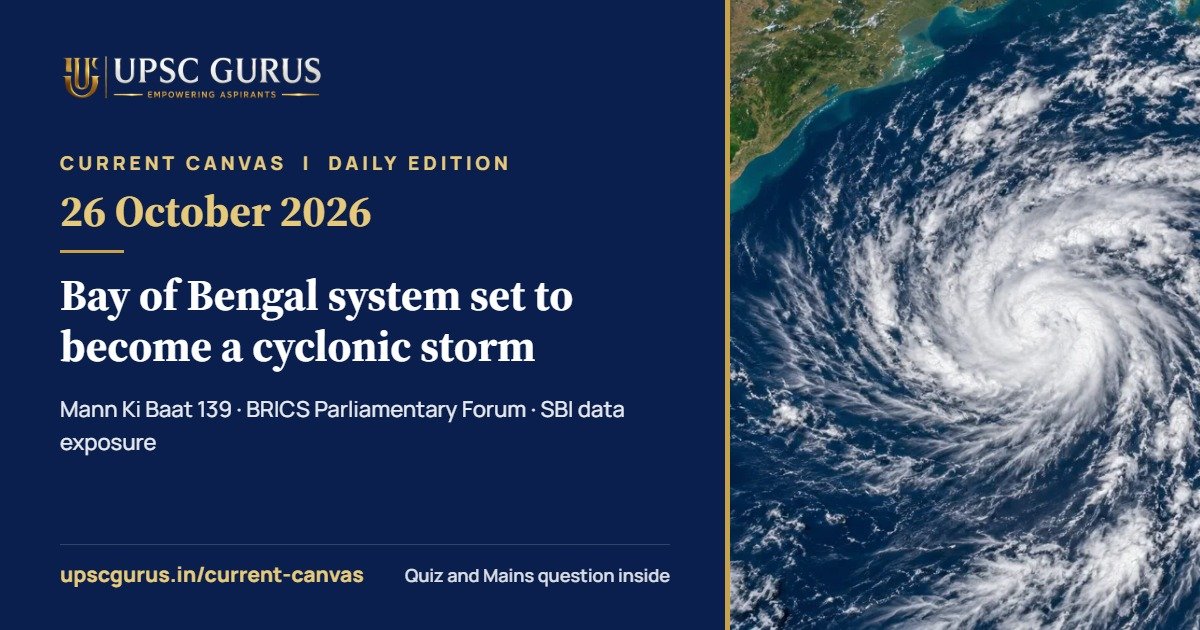
- Bay of Bengal low forecast to become a cyclonic storm by Monday; Odisha and Andhra Pradesh on alertGS III
- COP17 Yerevan: 14 decisions adopted in week one; ministers arrive for 27-28 October segmentGS III
- SBI notifies customers after suspected data exposure: 3,897 records with personal information identifiedGS III
- ESTIC 2026 opens on 27 October at Bharat Mandapam: three Nobel laureates, 12 thematic sessionsGS III
Polity and governance
Mann Ki Baat 139th: Vocal for Local reaches Greece and the Maldives; Heval river revival cited as a model of community action
In short: The 139th Mann Ki Baat on 25 October links local products, tribal design and community water conservation with festival-season cleanliness.
Why in news
In the 139th episode of Mann Ki Baat, broadcast on Sunday, 25 October 2026, the Prime Minister said the spirit of Vocal for Local is taking Indian products to markets around the world. He cited Purnia makhana reaching Greece, Kalaburagi arhar dal reaching the Maldives, and the tribal initiative Shabari Naturals, whose packaging won Japan’s Good Design Award. He also praised the community revival of the Heval river in Uttarakhand and asked citizens to join cleanliness drives before Diwali and Chhath.
Background
Mann Ki Baat is a monthly radio address on Akashvani and Doordarshan, available on the AIR News website and app, with regional-language versions following the Hindi broadcast. The programme began on Dussehra, 3 October 2014 and completed 12 years in October 2026. The Prime Minister described it as a pilgrimage that honours the diligence, service and devotion of ordinary citizens. The Heval river, in Tehri Garhwal district, had seen falling water levels and drying springs; residents and the district administration worked together on rainwater conservation, groundwater recharge and large-scale plantation, and dozens of natural water sources have been revived. The episode also paid tribute to physicist Narinder Singh Kapany ahead of his 100th birth anniversary on 31 October.
Key facts for Prelims
- Mann Ki Baat: monthly radio programme, first aired on Dussehra, 3 October 2014; the 139th episode was broadcast on 25 October 2026.
- Vocal for Local: a call to prefer indigenous products, linked to the Atmanirbhar Bharat goal; examples cited were Purnia (Bihar) makhana in Greece and Kalaburagi (Karnataka) arhar dal in the Maldives.
- Shabari Naturals (Maharashtra): tribal-led venture selling honey, mahua, chironji and bamboo-based products; its tribal-art packaging won Japan’s Good Design Award.
- Heval river: in Tehri Garhwal district, Uttarakhand; revived through rainwater harvesting, groundwater recharge and plantation by residents and the district administration.
- Narinder Singh Kapany (born 31 October 1926, Moga, Punjab): known as the Father of Fibre Optics; awarded the Padma Vibhushan posthumously in 2021.
Mains analysis and way forward
Mains analysis
- Mann Ki Baat as a channel of citizen engagement: how a one-way broadcast can support participatory governance, and its limits as a feedback mechanism.
- Vocal for Local and market access: how GI-style branding, packaging design and e-commerce can link farmers, artisans and tribal enterprises to export markets.
- Community-led water conservation: why locally owned, low-cost revival of springs and rivers complements large infrastructure under water security policy.
Way forward
- Support producer groups with design, standards and export-readiness training so that local successes scale beyond individual stories.
- Document and replicate community water-revival models with technical support from district administrations and local bodies.
- Pair cleanliness appeals with civic infrastructure such as segregation and collection, so that behaviour change is sustained after the festive season.
Connect the dots: GS II: citizen-state interface, participatory governance. GS III: inclusive growth, export promotion, water conservation. GS I: society and tribal enterprise.
Sources: ANI: Spirit of Vocal for Local taking Indian products to world markets, PM Modi in 139th Mann Ki Baat, 25 Oct 2026; Telangana Today: PM praises Uttarakhand villagers for reviving Heval, 25 Oct 2026; NewsBytes: PM calls Mann Ki Baat a pilgrimage in 139th episode, 25 Oct 2026; Newsonair: Prime Minister to share his thoughts in Mann Ki Baat programme on Akashvani today, 25 Oct 2026
Social justice and health
Allahabad High Court strikes down injury-report condition for POCSO survivors’ aid under Uttar Pradesh welfare scheme
In short: A Division Bench held that denying aid for want of an injury report is arbitrary under Article 14 and ordered Rs 3 lakh.
Why in news
The Allahabad High Court, in a judgment reported on 24 October 2026, declared unconstitutional the requirement of an injury report indicating penetrative sexual assault for claiming assistance under the Uttar Pradesh Rani Lakshmi Bai Mahila Evam Bal Samman Kosh Scheme, 2015. The Bench of Justice Saral Srivastava and Justice Garima Prashad found the condition manifestly arbitrary under Article 14. It quashed the rejection of the claim of a girl who was eight years old at the time of the alleged incident and directed the State to release Rs 3 lakh within ten days.
Background
Entry 7 of Annexure 1 to the scheme provides Rs 3 lakh for aggravated penetrative sexual assault under Section 6 of the POCSO Act. The child had been medically examined a day after the alleged incident on 28 January 2024 but did not consent to the specific examination for penetrative assault, so no injury report could be prepared; the District Steering Committee rejected her claim after the charge-sheet was filed. The Court noted that penetrative sexual assault under Section 3 of POCSO does not require visible injury, relying on Dalip Kumar alias Dalli v. State of Uttarakhand, and that medical examination cannot be conducted without consent under Section 164-A(7) of the CrPC and Section 184(7) of the BNSS. It held that a legally protected refusal cannot be used to exclude a victim from a welfare scheme. A separate Bench of the same High Court had on 20 October 2026 held, by interpretation, that the absence of injuries cannot be a ground to deny compensation under the same scheme.
Key facts for Prelims
- POCSO Act, 2012: Section 3 defines penetrative sexual assault and Section 6 prescribes punishment for aggravated penetrative sexual assault.
- Article 14: equality before law; arbitrary State action, including a rule with no rational nexus to its object, is open to challenge.
- Section 164-A CrPC (now Section 184 BNSS): medical examination of the victim of rape, which requires consent.
- Uttar Pradesh Rani Lakshmi Bai Mahila Evam Bal Samman Kosh Scheme, 2015: a State fund for assistance to women and child victims; Rs 3 lakh for aggravated penetrative sexual assault.
- Writ jurisdiction of High Courts under Article 226 can be used to quash administrative decisions and direct payment of benefits.
Mains analysis and way forward
Mains analysis
- Victim compensation schemes should be judged by their purpose of immediate relief and rehabilitation; procedural conditions that a survivor cannot lawfully meet defeat that purpose.
- Consent in medical examination protects bodily autonomy; linking aid to an examination the survivor may decline creates an unfair choice between dignity and relief.
- Judicial review of welfare rules under Article 14 shows how courts police administrative paperwork that excludes the most vulnerable.
Way forward
- States may review their victim-assistance schemes to align documentary requirements with the POCSO Act and the survivor’s right to decline examination.
- Steering committees can be sensitised through clear guidelines that charge-sheet and FIR material is sufficient evidence of the offence for aid.
- Time-bound disbursal and a simple, child-friendly claim process can reduce delays that add to the survivor’s hardship.
Connect the dots: GS II: vulnerable sections, child protection laws, welfare schemes, judiciary. GS IV: compassion and dignity in public service.
Sources: LiveLaw: Allahabad High Court declares mandatory injury report requirement under UP financial assistance scheme for POCSO survivors unconstitutional, 24 Oct 2026; LiveLaw: Allahabad HC on UP Mahila Samman Kosh, compensation cannot be denied for absence of injury, 20 Oct 2026
DGHS asks States to stop reuse of single-use medical devices in public and private hospitals
In short: The Director General of Health Services has warned of cross-infection and patient-safety risks and asked States and Union Territories for strict vigilance and enforcement.
Why in news
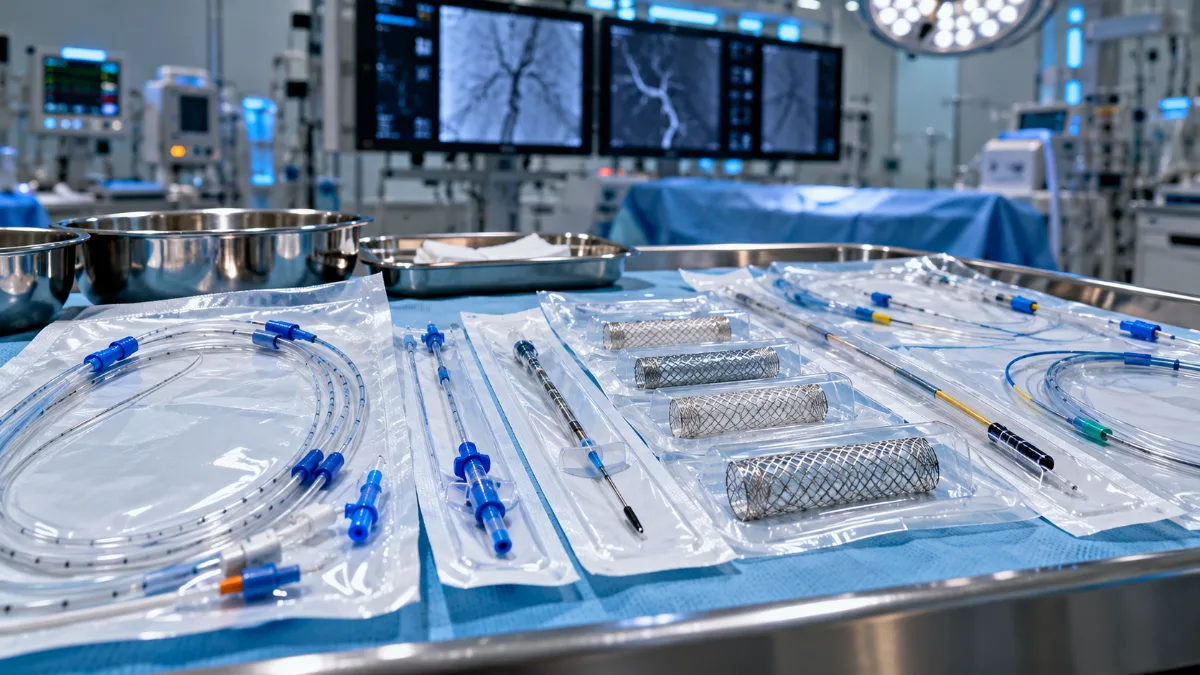
The Directorate General of Health Services wrote to the Chief Secretaries, Health Secretaries and Directors of Health Services of all States and Union Territories in a letter dated 16 October 2026 (reported from 23 October), warning against reuse of single-use medical devices and disposable surgical items. The letter said certain private and corporate hospitals were sterilising and reusing such items, particularly in cardiology, nephrology, oncology, cardiothoracic and vascular surgery, and neurosurgery. It asked for strict vigilance and effective enforcement.
Background
Single-use devices are designed and labelled for one procedure; reprocessing can leave the material degraded or contaminated and can cause device malfunction, loss of performance and cross-infection. The DGHS letter cited patient safety, infection prevention and control, regulatory compliance and healthcare expenditure as concerns. Health and hospitals are State subjects under the Seventh Schedule, so enforcement rests largely with State health departments and drug regulators. Medical devices are regulated in India under the Medical Devices Rules, 2017, framed under the Drugs and Cosmetics Act, 1940.
Key facts for Prelims
- Directorate General of Health Services (DGHS): the technical wing of the Union Ministry of Health and Family Welfare on medical and public health matters.
- Single-use devices: items intended for use on one patient during one procedure; reuse after sterilisation is the practice flagged in the advisory.
- Medical Devices Rules, 2017: framed under the Drugs and Cosmetics Act, 1940, to regulate manufacture, import, sale and distribution of medical devices.
- Public health and hospitals are in the State List of the Seventh Schedule; the Centre issues advisories and States enforce.
- Hospital-acquired infections and cross-infection are central concerns of infection prevention and control.
Mains analysis and way forward
Mains analysis
- Patient safety as a regulatory challenge: how cost pressures in private healthcare can lead to unsafe practices such as device reprocessing.
- Centre-State roles in health regulation: an advisory has moral and administrative weight, but enforcement depends on State inspection capacity.
- Transparency and informed consent: patients are rarely told whether a device has been reused, which raises an ethical question about trust in clinicians and hospitals.
Way forward
- States may step up inspections of hospitals in the specialities named in the advisory and publish the outcomes.
- Hospitals can maintain device traceability and audit logs so that single-use items are verifiably used once.
- Clear labelling, clinician training and patient awareness can support accountability, with action under existing law where violations are found.
Connect the dots: GS II: health, Centre-State relations, regulatory bodies. GS IV: ethics in healthcare, accountability.
Sources: Newsonair: DGHS warns against reuse of single-use medical devices, 24 Oct 2026
Art and culture
Mizoram’s Living Museum draws over 9,600 visitors in first year; Tribal Affairs Ministry advises States to replicate the model
In short: Zokhua Falkawn’s weekly programme, run with community bodies, has marked its first anniversary with half its visitors from outside Mizoram.

Why in news
The Living Museum at the Zokhua-Mizo Typical Village in Falkawn, Mizoram, marked its first anniversary, with more than 9,600 visitors in its first year, about half of them from outside the State, according to a report of 24 October 2026. The initiative began on 25 October 2025 and is organised every Saturday by the Art and Culture Department. The Ministry of Tribal Affairs praised the model and advised other States and Union Territories to replicate it.
Background
Each Saturday programme offers folk music, dance, indigenous games, local cuisine and traditional attire. Partners include the Young Mizo Association, Mizo Upa Pawl and Mizo Hmeichhe Insuihkhawm Pawl, which are community bodies of youth, elders and women. The Zokhua Falkawn village itself was set up by the Mizoram Art and Culture Department as a cultural centre in 1992, with replicas of the chief’s house (Lal In), the young men’s dormitory (Zawlbuk) and the blacksmith’s workshop (Pum), and demonstrations of backstrap loom weaving, basketry and wood carving. It also presents glimpses of the Chapchar Kut and Pawl Kut festivals.
Key facts for Prelims
- Zokhua Falkawn: cultural village south of Aizawl, Mizoram, set up by the State Art and Culture Department in 1992.
- Living Museum: a heritage model in which traditions are demonstrated by community members rather than only displayed; launched here on 25 October 2025.
- Zawlbuk: the traditional dormitory of Mizo young men, a centre of training and community life.
- Chapchar Kut: the spring festival held after forest clearing for jhum cultivation; Pawl Kut: the post-harvest thanksgiving festival.
- Ministry of Tribal Affairs: nodal ministry for tribal welfare; it has advised States and Union Territories to replicate the Living Museum model.
Mains analysis and way forward
Mains analysis
- Intangible cultural heritage is best preserved when communities practise and transmit it; a living museum links preservation with livelihoods and tourism.
- Community ownership through youth, elders and women’s organisations makes heritage programmes inclusive and sustainable.
- Cultural tourism in the North-East can spread benefits to local artisans, performers and food producers if visitor numbers are managed with care.
Way forward
- Other States can adapt the model with local communities, rotating performers and artisans so that benefits are widely shared.
- Documentation of crafts, oral traditions and festivals, in partnership with research bodies, can support long-term preservation.
- Visitor management and fair payment to practitioners will help the model remain authentic as numbers grow.
Connect the dots: GS I: Indian culture, art forms, tribal heritage. GS II: role of community organisations. GS III: tourism and livelihoods.
Sources: Newsonair: Mizoram’s Living Museum attracts over 9,600 visitors in first year, 24 Oct 2026; Incredible India: Zokhua Falkawn
International relations and security
12th BRICS Parliamentary Forum opens in Delhi on 26 October; Iran’s Speaker Ghalibaf to skip it
In short: Iran’s Parliament Speaker will not attend the Delhi forum, though an Iranian delegation will; Saudi Arabia and Ethiopia are also reported to be absent.
Why in news
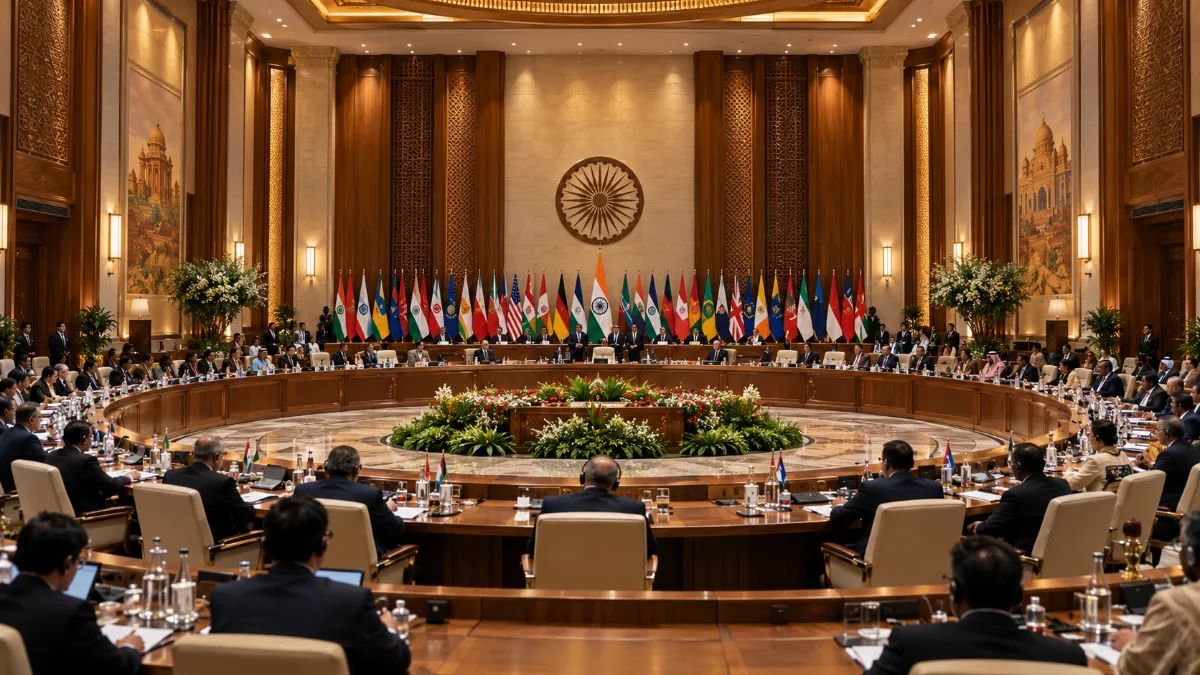
The 12th BRICS Parliamentary Forum meets on 26 and 27 October at the Central Hall of Samvidhan Sadan in New Delhi, with Lok Sabha Speaker Om Birla in the chair. On 24 October it was reported that Iranian Parliament Speaker Mohammad-Baqer Ghalibaf will not attend, with the Iranian embassy citing unforeseen circumstances. An Iranian parliamentary delegation will still take part, and Mr Birla is reported to have said that Saudi Arabia and Ethiopia will also be absent.
Background
The forum is held under India’s BRICS presidency in 2026, after the 18th BRICS Summit held in New Delhi in September. Its theme is Strengthening Parliaments for People-Centric Development, and the agenda has four plenary sessions covering consensus-based parliamentary dialogue, parliamentary cooperation, and artificial intelligence and digital technologies. The previous, 11th, forum was held in Brazil in June 2025. Parliamentary diplomacy complements the executive-level BRICS track by bringing legislators from member states into the dialogue.
Key facts for Prelims
- BRICS Parliamentary Forum: parliamentary track of BRICS; the 12th edition is hosted by India on 26 and 27 October 2026 at Samvidhan Sadan, New Delhi
- Theme: Strengthening Parliaments for People-Centric Development; four plenary sessions
- Chair: Lok Sabha Speaker Om Birla
- India holds the BRICS chair in 2026; the 18th BRICS Summit was held in New Delhi in September 2026
- The 11th forum was held in Brazil in June 2025
- Parliamentary diplomacy: engagement between legislatures alongside government-to-government diplomacy
Mains analysis and way forward
Mains analysis
- Parliamentary diplomacy lets legislators build consensus on issues such as terrorism, digital governance and AI, extending the reach of BRICS beyond governments.
- Absence of senior leaders from some members shows how West Asia tensions can spill into multilateral forums.
- As host, India can use the platform to promote its preference for people-centric development and reformed multilateralism.
- The forum’s outcomes are non-binding, so their value lies in agenda-setting and national legislative follow-up.
Way forward
- Use the forum to push consensus language on counter-terrorism and responsible AI governance.
- Keep bilateral channels open with members who send lower-level delegations so that BRICS cohesion is maintained.
- Encourage Parliament’s own committees to track and report on BRICS commitments.
Connect the dots: Syllabus link: GS II India and groupings, role of legislatures in foreign policy, effect of West Asia developments on India.
Sources: The Week: Iran’s Parliament Speaker Ghalibaf to give Delhi BRICS forum a miss, 24 Oct 2026; Dynamite News: BRICS Parliamentary Forum in Delhi, Om Birla to chair key October meet, 15 Sep 2026; MEA: PM Modi meets Malaysian PM on sidelines of 18th BRICS Summit, 12 Sep 2026
Saudi Arabia says it intercepted Houthi missiles; Houthis deny targeting Mecca and Medina
In short: Saudi authorities reported interceptions of two ballistic missiles on 24-25 October; the Houthis said they target energy sites and military bases, not holy cities.
Why in news
On 24 October, Saudi Arabia issued emergency alerts in Mecca, Jeddah, Yanbu and Taif, and the coalition spokesperson said air defences destroyed two ballistic missiles fired by the Houthis, which AIR reported as aimed at Taif and Yanbu. A report published on 25 October said Saudi authorities described two intercepted missiles as headed towards Mecca and Medina, with debris falling in the Mecca and Medina regions and in Jeddah, Taif and Rabigh. The Houthis denied targeting the holy cities and said their operations focus on Saudi oil facilities and military bases.
Background
The attacks follow the 10 October strike on King Khalid International Airport in Riyadh, in which, according to the Indian Embassy’s advisory, an Indian national was killed. On 18 October the Indian Embassy in Riyadh urged nationals to follow emergency instructions issued through Saudi Arabia’s National Early Warning Platform: stay calm, move to an interior room, and avoid taking photographs. The incidents come amid the wider Gulf conflict, which has also affected shipping and oil prices. Reports reaching the media differ on which cities were targeted, so claims by the parties should be read with care.
Key facts for Prelims
- Houthis: Iran-backed group (Ansar Allah) controlling large parts of Yemen
- Saudi emergency alerts were issued through the National Early Warning Platform for Emergencies; emergency number 911 (998 in some regions)
- Cities named in alerts on 24 October: Mecca, Jeddah, Yanbu and Taif
- Mecca and Medina are the two holiest cities of Islam
- Indian Embassy in Riyadh advisory of 18 October: stay indoors, avoid photographing, follow official directions
- The 10 October attack on Riyadh airport killed an Indian national, per the Embassy advisory
Mains analysis and way forward
Mains analysis
- Attacks near holy cities and civilian airports raise humanitarian and diplomatic concerns for Gulf states with large expatriate communities, including India.
- India has large energy, trade and diaspora interests in Saudi Arabia, so escalation affects both security of nationals and crude supply.
- Contested claims show the information environment in the conflict; verification from independent sources matters.
- India’s approach of advisories, consular support and calls for de-escalation reflects strategic autonomy in West Asia.
Way forward
- Maintain active consular helplines and updated advisories for Indian nationals in the Gulf.
- Continue diplomatic engagement with all sides to support de-escalation and safe shipping and aviation.
- Diversify energy sourcing and build strategic reserves to reduce exposure to regional shocks.
Connect the dots: Syllabus link: GS II India and West Asia, welfare of the diaspora, energy security.
Sources: AIR News: Saudi Arabia issues emergency alerts over aerial threat in four cities, 24 Oct 2026; The Week: Saudi Arabia says it intercepted Houthi missiles targeting Mecca and Medina, 25 Oct 2026; Business Today: Indian Embassy urges nationals in Saudi Arabia to follow emergency safety directives, 18 Oct 2026
DRDO’s indigenous AIP energy module enters Setting to Work Phase 2 at Hazira; fitment on a Kalvari-class boat due 2027
In short: The indigenous air-independent propulsion module for Navy submarines moved to its next testing stage on 24 October, ahead of integration at Mazagon Dock.
Why in news
On 24 October, the Naval Materials Research Laboratory (NMRL) of DRDO inaugurated the Setting to Work Phase 2 activity for its air-independent propulsion (AIP) energy module at L&T’s facility in Hazira, Gujarat, according to a defence ministry release reported by The Week. The next step is to energise the module for power production and test it under Navy protocols. It will then be handed to Mazagon Dock Shipbuilders for integration on a Kalvari-class submarine in early 2027.
Background
AIP lets a conventional diesel-electric submarine stay submerged for longer by reducing its dependence on atmospheric oxygen, which lowers the need to surface or snorkel and so makes detection harder. DRDO’s system is fuel-cell based. An earlier report from 8 October quoted the Defence Secretary as saying sea trials are expected in July-August 2027, with induction targeted for 2028, and INS Khanderi, the second Kalvari-class boat, is to be the first to receive it during a refit at Mazagon Dock under a contract worth about Rs 1,990 crore. At the Hazira event the Defence Secretary, also holding additional charge as DRDO Chairman, joined virtually and stressed the safety culture that hydrogen and fuel cell systems require.
Key facts for Prelims
- AIP (air-independent propulsion): lets a non-nuclear submarine operate submerged for longer without surfacing
- Developed by Naval Materials Research Laboratory (NMRL), a DRDO laboratory; fuel-cell based
- Phase reached: Setting to Work Phase 2 of the AIP energy module, at L&T, Hazira (Gujarat)
- Integration on a Kalvari-class submarine by Mazagon Dock Shipbuilders Ltd is planned for early 2027
- INS Khanderi, the second Kalvari-class boat, is reported to be first to get the AIP plug
- Kalvari-class: diesel-electric submarines built in India at Mazagon Dock under Project 75
Mains analysis and way forward
Mains analysis
- AIP raises the endurance and stealth of conventional submarines, an important gap in India’s underwater capability while nuclear boats are limited in number.
- The programme is an example of industry-DRDO-Navy partnership, with a private firm and a public shipyard both involved.
- Delays between development and induction remain a recurring concern in indigenous defence projects.
- Hydrogen and fuel cell systems demand strict safety standards, as the Defence Secretary noted.
Way forward
- Hold to the announced testing and integration timeline, with transparent milestones.
- Plan for fitment across more boats through retrofits and in new-build projects.
- Build a domestic supply chain for fuel cells and hydrogen storage to cut import dependence.
Connect the dots: Syllabus link: GS III defence technology, indigenisation, role of DRDO and private industry, maritime security.
Sources: The Week: Indian Navy’s submarines to get major upgrade as indigenous AIP system enters crucial testing phase, 24 Oct 2026; Indian Defense News: India’s indigenous AIP submarine set for 2027 sea trials, induction planned in 2028, Oct 2026
IAF marks its 94th anniversary with Wings Over Ganges air show at Namo Ghat, Varanasi; PM watches the concluding display
In short: The Indian Air Force closed a multi-day aerial display over the Ganga at Varanasi on 25 October, with joint-service flypasts highlighting indigenous platforms.

Why in news
Prime Minister Narendra Modi, with Defence Minister Rajnath Singh, watched the concluding day of the Indian Air Force Aerial Display 2026, titled Wings Over Ganges, at Namo Ghat in Varanasi on 25 October. The display marks the 94th anniversary of the IAF. Navy and Army aircraft joined the IAF to show joint operational capability.
Background
Before the event, IAF officials said about 100 aircraft would take part: 52 fighters, 15 transport aircraft and 32 helicopters, among them the Rafale, Su-30MKI, Tejas, C-295, C-17 and Chinook, plus the Navy’s Kamov-31. The Surya Kiran aerobatic team and the Sarang helicopter display team were scheduled to perform, alongside a formation called Tridev that brings Army, Navy and IAF helicopters together. Officials described the show as a way to showcase combat capability and indigenous defence technology under the Atmanirbhar Bharat initiative. Around 11,900 security personnel were deployed for the final day. Public air shows of this scale are meant to build awareness of the armed forces among citizens.
Key facts for Prelims
- Wings Over Ganges: official name Indian Air Force Aerial Display 2026, held at Namo Ghat, Varanasi, to mark the 94th anniversary of the IAF
- Planned participation: about 100 aircraft (52 fighters, 15 transport aircraft, 32 helicopters), as stated by IAF officials before the event
- Surya Kiran is the IAF’s aerobatic team; Sarang is its helicopter display team
- Tridev formation: Army, Navy and IAF helicopters together, to show tri-service coordination
- Indigenous platforms in the line-up include Tejas (LCA) and LCH Prachand
- Air Force Day is observed on 8 October; the IAF was raised in 1932
Mains analysis and way forward
Mains analysis
- Public outreach by the armed forces can build civil-military understanding, but displays must be balanced against cost and security deployment for the host city.
- Tri-service formations reflect the push towards jointness and theatre-level integration in military planning.
- Showcasing indigenous platforms supports defence self-reliance, yet operational credibility depends on production rates and timely induction.
- Taking the IAF’s anniversary beyond the national capital to a city such as Varanasi can connect defence heritage with regional pride.
Way forward
- Pair large public displays with sustained outreach in schools and colleges on careers in the armed forces.
- Publish clear induction timelines for indigenous aircraft so that visibility translates into capability.
- Continue joint exercises and training that turn tri-service formations into everyday practice.
Connect the dots: Syllabus link: GS III security and defence, indigenisation of defence production, civil-military relations.
Sources: AIR News: PM Modi to visit Uttar Pradesh and Odisha today, attend IAF air show in Varanasi, 25 Oct 2026; The Week: Wings over Ganges, PM Modi in Varanasi to attend air show at Namo Ghat, 25 Oct 2026; ThePrint (PTI): IAF to hold Wings Over Ganges aerial display in Varanasi, 20 Oct 2026; ThePrint: Rajnath reaches Varanasi to attend final day of IAF aerial display, 24 Oct 2026
Economy
PM inaugurates RBI’s second data centre and a cybersecurity training institute near Bhubaneswar
In short: The Reserve Bank’s Odisha facility adds a second site for its core systems and a training institute for cybersecurity and emerging technologies.
Why in news
Prime Minister Narendra Modi inaugurated the Reserve Bank of India’s Data Centre and Enterprise Computing and Cybersecurity Training Institute at Jatni, near Bhubaneswar, on 25 October 2026. The project is estimated at about Rs 170 crore (reports give Rs 169 to 170 crore). It is the RBI’s second data centre in the country and is meant to strengthen data security and the resilience of India’s digital financial infrastructure.
Background
The RBI’s primary data centre is at Kharghar, Navi Mumbai, and the Odisha site complements it. The then Governor, Shaktikanta Das, laid the foundation stone on 22 March 2023 for a campus of 18.55 acres. The facility supports currency management, payment and settlement systems and regulatory data operations. The training institute will offer training, research and capacity building in enterprise computing and cybersecurity, and in emerging areas such as artificial intelligence and quantum computing. Its siting in Khordha district is reported to reflect distance from seismically vulnerable zones and from major subsea cable landing points.
Key facts for Prelims
- The RBI’s primary data centre is at Kharghar, Navi Mumbai; the new Odisha facility is its second data centre.
- Foundation stone: 22 March 2023; campus area: 18.55 acres at Info Valley-II, Khordha district.
- Estimated cost: about Rs 170 crore; the campus also houses the Enterprise Computing and Cybersecurity Training Institute.
- The Reserve Bank of India was established under the RBI Act, 1934 and began operations on 1 April 1935.
- Data centres host systems for payments, settlement and currency management; redundancy across geographically separate sites supports business continuity.
- CERT-In is the national agency for cyber incident response under Section 70B of the Information Technology Act, 2000.
Mains analysis and way forward
Mains analysis
- Critical financial infrastructure such as payment and settlement systems needs geographically separate, fault-tolerant sites; discuss how a second data centre improves systemic resilience.
- As digital payments expand, cyber risk becomes a financial stability issue; examine the case for capacity building within regulators and banks.
- A site in eastern India also serves balanced regional development and skills creation; assess how such institutions can anchor local digital ecosystems.
Way forward
- Pair physical redundancy with regular disaster recovery drills and independent audits of critical systems.
- Use the training institute to build a pipeline of cybersecurity professionals for regulated entities, including smaller banks and cooperative institutions.
- Align technology investment with data protection norms so that resilience and privacy advance together.
Connect the dots: Role and functions of the RBI; payments and settlement systems; cyber security and critical information infrastructure; regional balance in infrastructure.
Sources: News On AIR: PM Modi to inaugurate RBI’s Data Centre and Cybersecurity Training Institute in Odisha today, 25 Oct 2026; Odisha Bytes: RBI’s Rs 169 Cr Greenfield Data Centre in Odisha set for Oct 25 launch; Free Press Journal: RBI builds high-security data centre in Odisha; RBI press release, 22 March 2023: foundation stone
Forex reserves fall by about $5 billion to $721 billion in week ended 16 October
In short: Foreign currency assets drove the decline, while gold, SDRs and the IMF reserve position edged up, according to RBI data reported on 23 October.
Why in news
India’s foreign exchange reserves declined by about $5 billion to $721 billion in the week ended 16 October 2026, according to Reserve Bank of India data reported on 23 October. Foreign currency assets, the largest component, fell by $5.7 billion to $591.8 billion. Gold holdings rose by $706 million to $105.8 billion.
Background
The previous week’s data, covered earlier, showed reserves down $8.58 billion to $726.03 billion in the week ended 9 October. Reserves are published every Friday in the RBI’s Weekly Statistical Supplement. Foreign currency assets are affected by the RBI’s market intervention and by revaluation of non-dollar holdings such as the euro, pound and yen. SDR holdings rose by $30 million to $18.5 billion, and the reserve position with the IMF rose by $11 million to $4.79 billion. Reserves act as a buffer against external shocks and help manage rupee volatility.
Key facts for Prelims
- Components of forex reserves: foreign currency assets (FCA), gold, Special Drawing Rights (SDRs) and reserve position with the IMF.
- FCA is the largest component and includes the effect of valuation changes in non-dollar currencies held in reserves.
- SDR is an international reserve asset created by the IMF in 1969; its value is based on a basket of currencies.
- Week ended 16 October 2026: total about $721 billion; FCA $591.8 billion; gold $105.8 billion; SDRs $18.5 billion; IMF reserve position $4.79 billion.
- The RBI publishes data on forex reserves every week in its Weekly Statistical Supplement.
Mains analysis and way forward
Mains analysis
- Explain how reserves are drawn down or built through central bank intervention and valuation changes, and why weekly movements need not signal stress.
- Assess the adequacy of reserves in the context of import cover, short-term external debt and volatile energy prices.
- Examine the trade-off between smoothing rupee volatility and preserving reserves.
Way forward
- Judge adequacy through multiple indicators (import cover, debt ratios, flows) rather than a single headline number.
- Deepen domestic markets and stable capital inflows to reduce reliance on intervention.
- Communicate the RBI’s intervention framework clearly to anchor expectations.
Connect the dots: Balance of payments; exchange rate management; role of the IMF and SDRs; external sector vulnerability.
Sources: News On AIR: Country’s FOREX reserves decline by $5bn to $721bn, 23 Oct 2026; News On AIR: Country’s forex reserves decline over $8.5bn during last week
NCAER Business Confidence Index rises to 107.8 in July-September quarter after four quarters of decline
In short: The survey of 502 firms shows improved sentiment on the economy, investment climate and capacity use, with large firms more upbeat than MSMEs.
Why in news
The National Council of Applied Economic Research (NCAER) reported on 23 October 2026 that its Business Confidence Index rose to 107.8 in the second quarter of the fiscal year from 99.8 in the previous quarter. Sentiment had fallen for four consecutive quarters before this. The survey was conducted in September 2026 among 502 firms across six cities.
Background
Business confidence surveys capture firms’ expectations about the economy, finances, investment and costs, and are watched as a forward-looking signal alongside hard data. In this round, 50% of firms expected economic conditions to improve over the next six months (43% earlier) and 41% expected their own financial position to improve (37%). Firms viewing the investment climate positively rose to 30% from 26%, and those expecting capacity utilisation near or above optimal levels rose to 94% from 91%. The index for MSMEs rose to 100 from 93, while that for large firms rose to 120.3 from 111.6. Business prospects improved in domestic and external markets, and cost sentiment moderated.
Key facts for Prelims
- NCAER is an independent economic policy research institution based in New Delhi.
- Business Confidence Index (BCI), Q2 of this fiscal: 107.8, up from 99.8; sample: 502 firms in six cities, surveyed in September 2026.
- MSME BCI: 100 (from 93); large firms: 120.3 (from 111.6).
- Firms expecting capacity utilisation near or above optimal levels: 94% (from 91%).
- Opinion-survey indices are diffusion indices; a reading above 100 is commonly read as optimism relative to the base.
Mains analysis and way forward
Mains analysis
- Discuss how sentiment surveys complement GDP, PMI and IIP data in assessing the economy, and their limits (sample size, coverage, perception bias).
- The gap between MSME and large-firm confidence points to uneven recovery; analyse the factors, such as credit access and input costs.
- Examine whether improved sentiment translates into private investment, and what policy supports that link.
Way forward
- Read sentiment alongside hard indicators such as credit growth, capacity utilisation and capital expenditure.
- Target credit and compliance support at MSMEs so that confidence converts into expansion.
- Maintain policy predictability to support the investment climate.
Connect the dots: Economic indicators and surveys; MSME sector; investment and capacity utilisation; role of research institutions in policy.
Environment and disaster management
Bay of Bengal low forecast to become a cyclonic storm by Monday; Odisha and Andhra Pradesh on alert
In short: IMD expects the Bay of Bengal system to reach cyclonic storm strength on 26 October and approach the north Andhra Pradesh and south Odisha coasts around 28 October.
Why in news
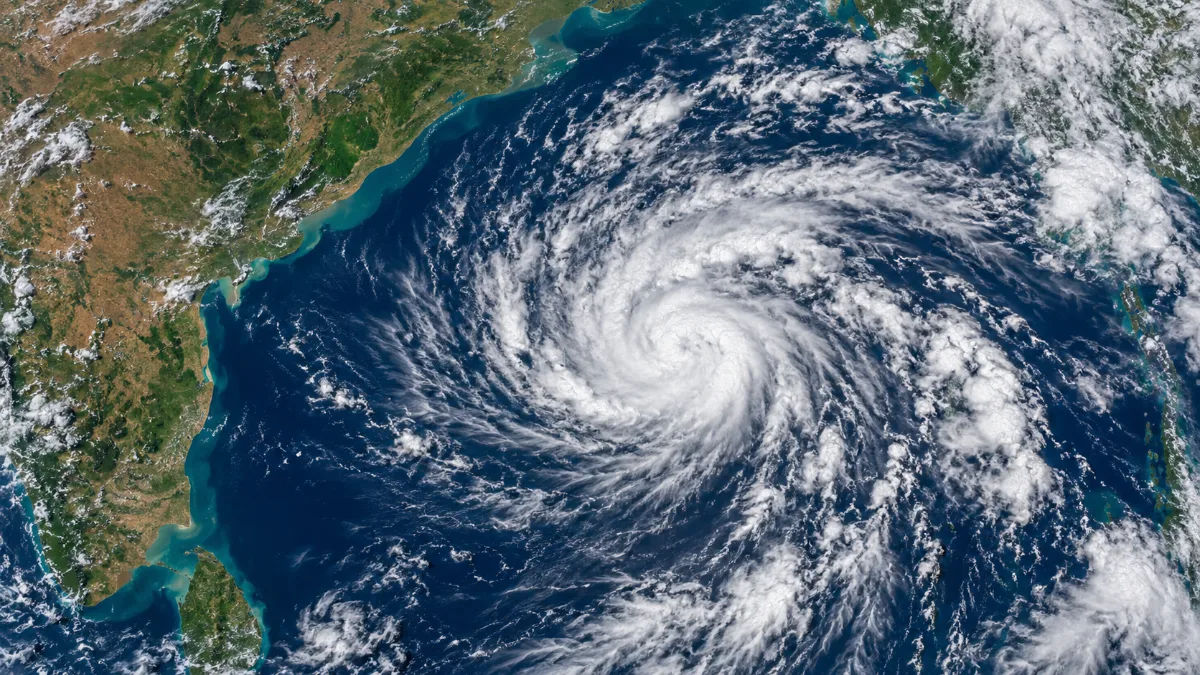
The depression over the east-central and adjoining southeast Bay of Bengal, which formed on the evening of 24 October, is forecast by the India Meteorological Department to intensify into a deep depression on 25 October and a cyclonic storm over the west-central Bay of Bengal by Monday morning, 26 October. Earlier on 24 October, AIR reported that the system is expected to approach the north Andhra Pradesh and south Odisha coasts around 28 October. Odisha has placed all 30 districts on alert, with 16 districts receiving extra attention.
Background
IMD classifies cyclonic disturbances by the maximum sustained wind speed near the centre: a depression has winds of 17 to 27 knots, a deep depression 28 to 33 knots, and a cyclonic storm 34 to 47 knots. IMD functions as the Regional Specialised Meteorological Centre for tropical cyclones over the north Indian Ocean and names storms from a list agreed by WMO/ESCAP Panel member countries. October to December is the post-monsoon cyclone season, and the Bay of Bengal produces more cyclones than the Arabian Sea. The Northeast monsoon set in over the south peninsula on 15 October, and a strong El Nino is persisting this year. Early warning, evacuation and the use of cyclone shelters have helped India reduce loss of life in recent cyclones.
Key facts for Prelims
- IMD is the nodal agency for cyclone warnings in India and the WMO-designated Regional Specialised Meteorological Centre (RSMC) for the north Indian Ocean.
- IMD scale: depression 17 to 27 knots; deep depression 28 to 33; cyclonic storm 34 to 47; severe cyclonic storm 48 to 63 knots.
- IMD colour codes: green (no action), yellow (watch), orange (be prepared), red (take action).
- Ordinary forecast terms: heavy rain is 64.5 to 115.5 mm, very heavy 115.6 to 204.4 mm and extremely heavy above 204.4 mm in 24 hours.
- The National Disaster Management Authority (NDMA) is chaired by the Prime Minister under the Disaster Management Act, 2005; State Disaster Management Authorities are chaired by Chief Ministers.
- Cyclone names come from a rotating list prepared by the WMO/ESCAP Panel on Tropical Cyclones; a system is named only after it reaches cyclonic storm strength.
Mains analysis and way forward
Mains analysis
- Preparedness shows in three links: accurate lead-time forecasts, timely evacuation and last-mile communication. Odisha’s district-level alerts and shelters illustrate how State agencies convert an IMD bulletin into action.
- The threat from a Bay of Bengal storm is often rain and flooding inland, not only wind and storm surge near the coast. Warnings for coastal Andhra Pradesh, Odisha and Telangana for extremely heavy rain reflect this.
- Warming seas and a strong El Nino year complicate seasonal patterns, so impact-based forecasting and urban drainage planning become as important as track prediction.
- Fishing communities and low-lying settlements remain the most exposed; their livelihoods need insurance and relief mechanisms alongside advisories to stay ashore.
Way forward
- Keep strengthening impact-based, district-level forecasts and multi-language alerts that reach fishers and remote hamlets.
- Maintain cyclone shelters, embankments and drainage, and rehearse evacuation plans before landfall rather than after it.
- Link relief with livelihood protection through insurance and quick post-event assessments.
Connect the dots: Syllabus links: Geography (tropical cyclones, monsoon, El Nino); GS III Disaster Management (Disaster Management Act, 2005, NDMA, early warning, community preparedness).
Sources: News On AIR: IMD forecasts cyclonic storm over Bay of Bengal by Monday, warns of heavy rainfall, 24 Oct 2026; News On AIR: IMD forecasts heavy to very heavy rainfall in Odisha, Andhra Pradesh, 24 Oct 2026
COP17 Yerevan: 14 decisions adopted in week one; ministers arrive for 27-28 October segment
In short: The first week of the UN biodiversity conference closed with 14 decisions; harder questions on finance and the global review move to the ministerial segment.
Why in news
Armenpress reported on 25 October that 14 decisions were adopted in the first week of CBD COP17 in Yerevan (19 to 30 October), covering biosafety, invasive alien species, gender equality, awareness-raising, compliance and monitoring. Armenia, which holds the COP presidency for two years, said an important week of negotiations lies ahead. More than 70 ministers and around 40 deputy ministers have confirmed attendance for the ministerial segment on 27 and 28 October.
Background
The Convention on Biological Diversity (CBD) is a treaty of the 1992 Rio Earth Summit with three objectives: conservation of biodiversity, sustainable use of its components, and fair and equitable sharing of benefits from genetic resources. COP15 adopted the Kunming-Montreal Global Biodiversity Framework in December 2022, with four goals and 23 targets for 2030, including protecting 30 per cent of land and sea (Target 3). The Cali Fund, agreed at COP16 in 2024, is meant to channel contributions from companies using digital sequence information from genetic resources. Armenian officials say a “Yerevan Pathway” setting next steps for the Framework is expected to be adopted, alongside financial matters and issues concerning indigenous peoples. This COP also carries the first global review of progress on the nature targets.
Key facts for Prelims
- CBD: adopted at the Rio Earth Summit in 1992; India is a Party; domestic law is the Biological Diversity Act, 2002 (NBA at Chennai).
- Kunming-Montreal Global Biodiversity Framework (2022): 4 goals, 23 targets by 2030; Target 3 is the “30 by 30” goal.
- Cartagena Protocol on Biosafety (to the CBD) governs transboundary movement of living modified organisms; Nagoya Protocol governs access and benefit sharing.
- Cali Fund: set up at COP16 (Cali, Colombia, 2024) for benefit sharing from digital sequence information.
- COP17 is being held in Yerevan, Armenia from 19 to 30 October 2026; ministerial segment on 27 and 28 October.
- Invasive alien species are addressed by Target 6 of the Framework.
Mains analysis and way forward
Mains analysis
- The Framework’s credibility depends on finance and implementation: the first global review will test whether national action plans add up to the 2030 targets.
- Benefit sharing from digital sequence information links biodiversity to the technology and pharmaceutical sectors; India, a megadiverse country, has a direct interest in an equitable Cali Fund.
- Procedural decisions on biosafety, compliance and monitoring look technical but build the reporting system that makes later accountability possible.
- Ministerial politics matter because contested items, such as finance and indigenous peoples’ rights, are resolved only with political backing.
Way forward
- Back predictable, accessible finance for developing countries alongside domestic mobilisation and the reform of harmful incentives.
- Align national biodiversity strategies with the global review and report progress transparently.
- Give indigenous peoples and local communities a real role in decisions and in benefit sharing.
Connect the dots: Syllabus links: Environment (CBD, biodiversity conventions, Biological Diversity Act, 2002); International Relations (multilateral environmental diplomacy, climate and biodiversity finance).
Sources: Armenpress: COP17, 14 decisions adopted during the first week, 25 Oct 2026; Armenpress: Armenia seeks consensus among stakeholders in COP17 negotiations, 23 Oct 2026
Science and technology
SBI notifies customers after suspected data exposure: 3,897 records with personal information identified
In short: The bank says balances and funds are safe and operations are normal; it has appointed a CERT-In empanelled agency to assess the incident.

Why in news
State Bank of India said on 23 October 2026 that it has individually informed customers whose personal data was identified in a suspected cyber incident, adding that account balances and funds remain safe. Preliminary analysis of about 375,000 records found 3,897 customer records containing personal information such as names, mobile numbers, email addresses, dates of birth and residential addresses. The bank reported no material impact on operations or finances.
Background
SBI received alerts on 16 October about suspected exposure of customer data on the dark web from its threat intelligence service provider, the Defence Cyber Agency and CERT-In. It activated its cyber incident response and containment measures and appointed an independent cybersecurity agency empanelled by CERT-In to assess the incident. The bank advised customers never to share one-time passwords, PINs or banking passwords and to be cautious with unsolicited calls, messages and emails. The episode shows how personal data, even without financial credentials, can enable phishing and impersonation.
Key facts for Prelims
- CERT-In (Indian Computer Emergency Response Team) is the national nodal agency for cyber security incidents under the Information Technology Act, 2000.
- The Defence Cyber Agency is a tri-service body of the armed forces for cyber operations.
- Figures reported: about 375,000 records analysed; 3,897 customer records contained personal information.
- Alerts were received on 16 October 2026; customers were notified individually, as reported on 24 October.
- The Digital Personal Data Protection Act, 2023 governs processing of digital personal data and places obligations on data fiduciaries.
Mains analysis and way forward
Mains analysis
- Personal data leaks pose risks even when funds are untouched; discuss how exposed identity data feeds fraud and what obligations regulated entities carry.
- Evaluate the role of coordinated detection, with threat intelligence providers, CERT-In and defence agencies, in limiting damage.
- Examine how transparency in notifying affected customers builds trust in the banking system.
Way forward
- Strengthen detection and disclosure protocols, with timely, individual notification of affected customers.
- Promote customer awareness on phishing and verification of unsolicited communication.
- Encourage periodic independent audits and data minimisation across banks.
Connect the dots: Cyber security; data protection and privacy; banking sector regulation; role of CERT-In and critical information infrastructure.
Sources: News On AIR: SBI assures customers of safe funds after suspected data breach, 24 Oct 2026
ESTIC 2026 opens on 27 October at Bharat Mandapam: three Nobel laureates, 12 thematic sessions
In short: The three-day science and technology conclave in New Delhi brings public research, startups and industry together around AI, quantum, semiconductors and ocean technologies.
Why in news
The second Emerging Science, Technology and Innovation Conclave (ESTIC) will be held from 27 to 29 October 2026 at Bharat Mandapam, New Delhi, and the Prime Minister is scheduled to inaugurate it. Speakers include Nobel laureates Joachim Frank, Richard J. Roberts and Kostya Novoselov. It has 12 thematic technical sessions, and the technology exhibition opens to the public on the second day.
Background
The first ESTIC was inaugurated on 3 November 2025 at Bharat Mandapam, where the Prime Minister launched the Rs 1 lakh crore Research, Development and Innovation (RDI) Scheme Fund. The Department of Science and Technology held the 2026 curtain-raiser on 15 October, when the focus on autonomous systems, physical AI and robotics was highlighted. Thematic areas include advanced manufacturing, energy technologies, synthetic biology, ocean and maritime technologies, quantum communication, semiconductors, agri-tech, generative and autonomous AI, advanced healthcare, immersive technologies and space science. Dr Jitendra Singh said India now has over 2.3 lakh startups, with 50 to 60 per cent coming from small towns, and wants ESTIC outcomes to carry from one edition to the next.
Key facts for Prelims
- ESTIC-2026: 27 to 29 October, Bharat Mandapam, New Delhi; second edition (the first was on 3 to 5 November 2025).
- RDI Scheme Fund: Rs 1 lakh crore, launched at ESTIC 2025 to support research and innovation in public institutions and the private sector.
- Nobel laureates listed: Joachim Frank (Chemistry, cryo-electron microscopy), Richard J. Roberts (Physiology or Medicine, split genes) and Kostya Novoselov (Physics, graphene).
- Physical AI refers to AI systems that sense and act in the physical world, such as robots and autonomous machines.
- Ministry linkage: DST is under the Ministry of Science and Technology; CSIR is a network of national laboratories.
Mains analysis and way forward
Mains analysis
- Bringing ministries (13 took part in the inaugural edition), laboratories and startups onto one platform tackles the fragmentation of India’s innovation ecosystem; the test is whether it yields funded collaborations.
- The RDI Fund and a startup base of over 2.3 lakh point to a shift toward private-sector-led research, which needs patient capital for deep-tech.
- Focus on robotics, physical AI and quantum places emphasis on solutions that are reliable, safe, affordable and suited to Indian conditions, as DST Secretary stressed at the curtain-raiser.
Way forward
- Set measurable milestones for each edition so that announcements convert into projects.
- Strengthen links between national laboratories, universities and small-town startups, with shared testing facilities.
Connect the dots: Syllabus links: GS III Science and Technology (Indian achievements, new technologies, AI, quantum, robotics), innovation ecosystem and startups.
Sources: IBEF: Curtain-raiser for ESTIC 2026 underlines autonomous systems, physical AI and robotics, Oct 2026; DD India: PM Modi to inaugurate ESTIC 2026 in Delhi on Oct 27, Jitendra Singh; IBTimes India: PM Modi inaugurates ESTIC 2025, launches Rs one lakh crore RDI scheme fund
In brief
- Personality and history: Ganesh Shankar Vidyarthi, and the Instrument of Accession: Ganesh Shankar Vidyarthi, journalist, freedom fighter and founder editor of the Hindi newspaper Pratap, was born on 26 October 1890 in Allahabad; he died on 25 March 1931 in Kanpur while trying to calm communal violence. The Instrument of Accession of Jammu and Kashmir is dated 26 October 1947, signed by Maharaja Hari Singh, and was accepted by Governor-General Lord Mountbatten on 27 October 1947.
- Narinder Singh Kapany centenary: In Mann Ki Baat on 25 October 2026, the Prime Minister paid tribute to Narinder Singh Kapany, known as the Father of Fibre Optics, ahead of his 100th birth anniversary on 31 October. Born in Moga, Punjab, in 1926, he coined the term fiber optics in 1960 and received the Padma Vibhushan posthumously in 2021.
- Background: Kashi Tamil Sangamam 5.0 from 28 November: The fifth edition of Kashi Tamil Sangamam will run from 28 November to 12 December 2026 on the theme Thirukkural Payilvom – Thirukkural Abhyas Karen, with about 1,400 participants from Tamil Nadu visiting Varanasi, Prayagraj and Ayodhya. The Ministry of Education runs it, and registration through the IIT Madras portal is open from 22 October to 13 November (Newsonair, 25 October).
- Kedar Nath Sahani birth centenary: Union Minister J P Nadda paid tribute to Kedar Nath Sahani, former Delhi BJP president and former Governor, on his birth centenary in New Delhi on 24 October 2026, recalling his loyalty to party ideology and his role in building party traditions.
- SEBI Chairman: next wave of retail broking from towns and villages: Speaking at ANMI’s 16th International Capital Market Convention on 24 October 2026, SEBI Chairman Tuhin Kanta Pandey said brokers should guide investors rather than only execute trades. He cited over 15 crore unique investors and mutual fund assets of about Rs 83 lakh crore, and said SEBI is reviewing short selling and securities lending and borrowing.
- Benchmark indices snap two-week winning streak: Market background: in the week ended Friday, 23 October 2026, the Sensex fell 1,605 points (2.14%) to 73,124 and the Nifty 50 lost 546 points (2.35%) to 22,600, with higher crude prices linked to the West Asia conflict cited. Market capitalisation of BSE-listed companies fell by nearly Rs 21 lakh crore.
- SEBI’s investor awareness campaign: SEBI’s ‘Samajh Se Investing Simple’ campaign, launched on 5 October, has drawn over 15 crore social media views, the Chairman said on 24 October 2026; he noted that about six in ten investors rely on unregistered advisers and influencers.
- Jaishankar: India-Africa ties rest on shared history: On 24 October, External Affairs Minister S. Jaishankar told African Heads of Mission in New Delhi that the partnership is built on shared histories, common goals and deep South-South solidarity, and discussed Africa’s growing role in a multipolar world.
- Odisha alert: all 30 districts: On 24 October, AIR reported that Odisha has placed all 30 districts on alert for the Bay of Bengal system, with extra focus on 16 vulnerable districts; heaviest impact is expected from Tuesday to Thursday, and fishermen are advised to stay ashore.
- Red warning for Kerala and Tamil Nadu rain: IMD issued a red warning for heavy to very heavy rainfall, with isolated extremely heavy rainfall, over Kerala, Mahe, Tamil Nadu, Puducherry and Karaikal for 25 October (AIR, 24 October).
- Background: COP17 presidency: As host of CBD COP17 in Yerevan, Armenia holds the COP presidency for the next two years and oversees implementation of the decisions; more than 70 ministers are due for the 27 and 28 October segment (Armenpress, 23 October).
Prelims practice: 5 questions
Choose an option to see the answer and explanation. Your score appears when all five are answered.
Mains practice
Data breaches at large financial institutions test both cyber security and the protection of personal data. Discuss the institutional framework for responding to such incidents in India, and suggest measures to strengthen it.
Show the answer outline
Introduction (about 30 words)
- Begin with the October 2026 SBI case: alerts from CERT-In and others on 16 October, and 3,897 records with personal information identified in a preliminary review.
Existing framework
- CERT-In under the IT Act, 2000: incident response, and its April 2022 directions to report specified incidents within six hours.
- RBI’s cyber security framework for banks and its supervision of IT risk; sectoral CSIRT arrangements for finance.
- Digital Personal Data Protection Act, 2023 and its Rules: duties of data fiduciaries, breach intimation to the Data Protection Board and affected persons.
- National Critical Information Infrastructure Protection Centre for critical sectors, including banking.
Gaps
- Staggered commencement of data protection duties; overlapping reporting to several regulators.
- Third-party and vendor risk, legacy systems and weak data minimisation.
- Limited public communication and remedies for affected customers.
Measures
- One harmonised reporting window shared by CERT-In, RBI and the Data Protection Board.
- Mandatory data minimisation, encryption and vendor audits; regular red-team exercises.
- Clear, timely notice to customers with steps to stay safe from phishing, and accessible grievance redress.
Conclusion (about 30 words)
- Trust is the currency of digital banking: quick detection, honest disclosure and real remedies turn a breach into a test the system can pass.
Tip: Name the institutions and their specific roles, then match each gap with a precise measure.
Current Canvas is prepared by the UPSC Gurus editorial desk. Every fact is checked against official releases and reliable reporting, with sources listed under each story. Editions are compiled each month into Current Canvas Monthly, a free magazine.
About images: photographs and illustrations in Current Canvas are AI-generated for illustration only. They are not news photographs of the events described.