 New this week · Free UG Handout 02UPSC Mains Directive Words: 60 Meanings, Trends and PYQsTwo free PDFs: The Guide and the With PYQs edition.Read and download
Today’s Canvas
Today’s edition is about how institutions earn trust. A parliamentary panel sets out reforms for the agency that runs India’s largest entrance examinations, the Supreme Court weighs the right to protest against the right to move freely, and two hearings turn the spotlight on tribal communities. The RBI acts to steady the rupee, and new reports track the health of the planet’s wildlife and Delhi’s air. Each story is checked against official releases and reliable reporting, and linked to the syllabus.
- Parliamentary panel recommends computer-based NEET-UG, permanent staff and Parliament oversight for NTAGS II
- Supreme Court calls for proportionate transport restrictions ahead of Delhi demonstrationGS II
- Supreme Court flags Jharkhand DGP rule as prima facie contrary to Prakash Singh; amicus to review other StatesGS II
- Supreme Court seeks responses to PIL concerning reported deaths of Baiga children in Madhya PradeshGS II
- Forest Rights Act review in Kolkata: about 11 lakh claims pending nationally, states asked to speed disposalGS II and III
- World Mental Health Day 2026: Tele MANAS crosses 47.75 lakh calls; Health Ministry highlights MANN JaagritiGS II
- RBI opens dollar window for IOC, BPCL, HPCL from 12 October; introduces 20% reserve on some forex hedgesGS III
- UNCTAD Trade and Development Report 2026: India projected to grow 7.3% in 2026, global growth to slow to 2.6%GS III
- Critical minerals stockpiling policy likely within a month, says Mines SecretaryGS III
- Centre says satcom framework is non-discriminatory; three licensed operators await pricing and security stepsGS III
- Living Planet Report 2026: monitored wildlife populations down 73% on average since 1970GS III
- CAQM expert panel proposes phase-out of BS-IV vehicles by 2030 and 100% zero-emission new cars in NCRGS III
- Rajnath Singh addresses Exercise Tarang Shakti 2026 at Jodhpur; seven foreign air forces, 32 observer nationsGS III
- Raksha Mantri presents 15 SIDM Champion Awards, calls for larger private role in defence productionGS III
- Coast Guard commissions fast patrol vessel ICGS Ajit; Navy to commission ASW craft Mangrol on 12 OctoberGS III
- A parliamentary panel recommended a phased move of NEET-UG to computer-based tests and permanent staff for the National Testing Agency.
- The Supreme Court said there should be no complete halt of Delhi Metro and trains for a demonstration, and asked for proportionate restrictions.
- The Supreme Court issued notice on a PIL concerning reported deaths of Baiga children in Balaghat, Madhya Pradesh.
- The RBI opened a dollar window for the three oil marketing companies and introduced a 20% reserve on some forex hedges.
- UNCTAD projects India to grow 7.3% in 2026, with global growth slowing to 2.6%.
- WWF’s Living Planet Report finds monitored wildlife populations fell 73% on average between 1970 and 2022.
Polity and governance

Parliamentary panel recommends computer-based NEET-UG, permanent staff and Parliament oversight for NTA
Why in news
On 9 October 2026, the Department-related Parliamentary Standing Committee on Education, Women, Children, Youth and Sports presented its 382nd report, on reforms and strengthening of the National Testing Agency (NTA). It recommends a phased shift of NEET-UG to computer-based testing, a large and continuously updated question bank, permanent in-house staff, annual equity audits and a framework making the NTA accountable to Parliament. These are recommendations; the government has yet to respond.
Background
The NTA is a society registered under the Societies Registration Act, 1860; it is not directly accountable to Parliament and does not lay an annual report before it. Between 2018 and 2026 it conducted more than 270 examinations for over 6.6 crore candidates, and in 2024-25 it was a party to 474 court cases, 356 of them linked to NEET-UG 2024. On 23 July 2024 the Supreme Court declined to cancel NEET-UG 2024 (about 24 lakh candidates), finding no material showing a systemic breach. In June 2024 the Ministry of Education set up a high-level committee chaired by former ISRO Chairman Dr K. Radhakrishnan to recommend NTA reforms, and the Public Examinations (Prevention of Unfair Means) Act, 2024 came into force on 21 June 2024. The panel cites the cancellation of NEET-UG 2026 (held on 3 May, cancelled on 12 May amid paper-leak allegations) as showing further improvement is needed.
Key facts for Prelims
- Committee: Department-related Parliamentary Standing Committee on Education, Women, Children, Youth and Sports; 382nd report, presented on 9 October 2026.
- NTA staffing cited by the panel: only 23 of 39 sanctioned posts filled, all on deputation (about 41% vacancy); the Director General post was held as additional charge from June 2024 to April 2026.
- Public Examinations (Prevention of Unfair Means) Act, 2024 (as enacted; an amendment Bill has been introduced): in force from 21 June 2024; offences are cognisable, non-bailable and non-compoundable; individuals face 3 to 5 years imprisonment and fines up to Rs 10 lakh; organised crime 5 to 10 years and a fine of not less than Rs 1 crore.
- The 2024 Act covers examinations of UPSC, SSC, Railway Recruitment Boards, IBPS, central ministries and departments, and the NTA, among others.
- Radhakrishnan committee (2024): high-level expert committee on NTA reforms chaired by former ISRO Chairman Dr K. Radhakrishnan.
Mains analysis and way forward
Mains analysis
- Institutional accountability: a society-form agency running exams for crores of candidates sits outside direct parliamentary scrutiny; annual reporting on cases under the 2024 Act and public disclosure of investigations would strengthen trust.
- Capacity before scale: a 41% vacancy rate and reliance on deputation limit specialist expertise in psychometrics, examination security and data analytics; the panel also asks the NTA to refocus on admission tests, in line with the Radhakrishnan committee view that additional functions should follow capacity.
- Technology and its limits: CBT removes the printing and transport of papers, but the panel itself conditions the shift on major investment in government-owned test centres and mock tests, so that candidates from smaller towns are not disadvantaged.
- Equity and candidate welfare: annual audits by state, gender, board, medium and social category, a defined “duty of care” (possibly including compensation for administrative cancellations) and timelines for grievance redressal place candidates at the centre of reform.
- Contested areas: age and attempt limits, a two-stage NEET format and regulation of private coaching centres raise questions of fairness, federal roles and implementation, and will need wide consultation.
Way forward
- A time-bound, budgeted plan for government-owned CBT centres in every district, prioritising Tier-II and Tier-III cities, with mock tests for candidates.
- A statutory or parliamentary accountability framework for the NTA, with an independent security audit mechanism and a national registry of blacklisted exam vendors.
- Consultation with states, medical education regulators and students before deciding on age and attempt limits or a two-stage NEET.
Connect the dots: Links to GS II statutory and non-statutory bodies, parliamentary committees, and issues in education and human resource development.
Sources: Business Standard: Panel seeks NTA overhaul, stronger accountability and tighter exam security, 9 October 2026; The Tribune: Parliamentary panel seeks CBT-mode NEET-UG, age and attempt limits, govt-owned centres in every district, 9 October 2026; ThePrint (PTI): NEET UG paper leak: RS panel for mechanism to ensure NTA’s accountability to Parliament, 9 October 2026; AIR News: High-level committee of experts constituted by Ministry of Education to recommend reforms in NTA, 28 June 2024; Verdictum: Public Examinations (Prevention of Unfair Means) Act, 2024 effective June 21, June 2024; The Tribune: No systemic breach of exam sanctity, SC refuses to order NEET-UG retest, 23 July 2024
Supreme Court calls for proportionate transport restrictions ahead of Delhi demonstration
Why in news
On 9 October 2026, a Bench of CJI Surya Kant, Justice Joymalya Bagchi and Justice V Mohana said there should be no complete halt of Metro and train services in Delhi ahead of a demonstration planned for 10 October. Delhi Police had initially proposed restrictions affecting 57 Metro stations; after the hearing the proposed restrictions were reduced to 45 stations. The Court asked authorities to keep restrictions proportionate, publicise them widely and report compliance.
Background
The demonstration at Jantar Mantar was called by a political group and student organisations, and Delhi Police had declined permission, citing a late application and concerns from an earlier demonstration, and issued prohibitory orders for New Delhi District. The petitioners invoked the rights to equality, expression, assembly, movement and life. The Solicitor General told the Court the measures were proportionate and would be reviewed. The Court focused on the ordinary commuter travelling into Delhi for work; it did not rule that every individual restriction was unlawful, and it did not bar the authorities from regulating the event.
Key facts for Prelims
- Article 19(1)(b) guarantees the right to assemble peaceably and without arms; Article 19(1)(a) protects speech and expression; restrictions on speech fall under Article 19(2) and on assembly under Article 19(3), including in the interests of public order.
- Amit Sahni v Commissioner of Police (7 October 2020, three-judge Bench): public ways cannot be occupied indefinitely; dissent should be expressed at designated places; protesters’ and commuters’ rights must be balanced.
- In July 2018, in the Mazdoor Kisan Shakti Sangathan matter, the Supreme Court held there cannot be a complete ban on demonstrations in Central Delhi, though they can be regulated.
- Anuradha Bhasin v Union of India (January 2020): internet suspension can be only temporary, must be proportionate, is subject to judicial review and orders must be published.
- Bench on 9 October 2026: CJI Surya Kant, Justice Joymalya Bagchi, Justice V Mohana.
Mains analysis and way forward
Mains analysis
- Proportionality as the touchstone: the Court did not question the power to regulate, but asked whether a blanket shutdown of mass transit was the least restrictive measure available.
- Third-party rights: the order centres the ordinary commuter, recognising that freedom of movement (Article 19(1)(d)) and livelihood can be affected by sweeping public-order measures.
- State perspective: the police cited past violations, short notice and security inputs; public order is a legitimate ground for restriction, and pre-emptive planning is part of policing large gatherings.
- Transparency of restrictions: directions to publicise barricades, alternate routes and advisories reflect the principle, also seen in Anuradha Bhasin, that restrictions must be known and reviewable.
- Designated protest spaces: the Court asked the Centre to consider the question of Jantar Mantar as the designated venue, linking to the 2018 and 2020 rulings on balancing dissent with public convenience.
Way forward
- Codify clear, time-bound and published standard operating procedures for large assemblies, including graded transport and internet measures with review clauses.
- Strengthen dialogue between organisers and police on routes, timings and numbers so that permissions and conditions are negotiated well in advance.
- Develop adequately sized, accessible designated venues so that the right to protest and the rights of other citizens can co-exist.
Connect the dots: Links to Fundamental Rights (Articles 19 and 21), reasonable restrictions, judicial review, and police and public order.
Sources: ANI: Can’t impose absolute ban on Delhi metro, trains: SC asks Centre to reconsider restrictions, 9 Oct 2026; The Tribune: Delhi protest plea in SC against proposed metro stations closure, 9 Oct 2026; The South First: Supreme Court asks Centre to not completely halt trains, Metro, 9 Oct 2026; SCC Online: Shaheen Bagh protests judgment (Amit Sahni), 7 Oct 2020; LiveLaw: Anuradha Bhasin internet shutdown guidelines
Supreme Court flags Jharkhand DGP rule as prima facie contrary to Prakash Singh; amicus to review other States
Why in news
On 8 October 2026, the Supreme Court (CJI Surya Kant, Justices Joymalya Bagchi and V Mohana) said a Jharkhand provision allowing an officer with less than six months of residual service to be appointed DGP appears to conflict with the Prakash Singh judgment. The State was given a week to revisit the rule or defend it, and Senior Advocate Raju Ramachandran, as amicus curiae, was asked to examine DGP appointment laws of other States, with UPSC to assist.
Background
The Union challenged the Jharkhand Head of Police Force Rules, 2025 (notified January 2025) and appointments made under them. It cited the appointment of Anurag Gupta in February 2025 with about three months of service left and of Tadasha Mishra on 30 December 2025, a day before her scheduled retirement. Under Prakash Singh, the DGP is chosen from three senior-most officers empanelled by UPSC and ordinarily gets a minimum two-year tenure. The Court issued notice to the serving DGP since setting aside the rule could affect her appointment, and noted it could act prospectively. Counsel for Jharkhand said the State had no objection to revisiting the rules and pointed to similar issues in other States.
Key facts for Prelims
- Prakash Singh v Union of India judgment: 22 September 2006; seven directives on police reform.
- Directives include State Security Commission, DGP selection from UPSC panel with minimum two-year tenure, Police Establishment Board, Police Complaints Authority, separation of investigation and law and order, and a National Security Commission.
- Minimum two-year tenure also applies to operational officers such as SP and SHO under the directives.
- Police and public order fall in the State List of the Seventh Schedule.
- Amicus curiae in the matter: Senior Advocate Raju Ramachandran.
Mains analysis and way forward
Mains analysis
- Why tenure matters: a fixed, merit-based tenure for the police chief was meant to insulate operational leadership from frequent transfers and short-term pressures.
- Federal dimension: police is a State subject, so States frame their own rules; the Court’s review tests whether such rules dilute binding judicial directions.
- Continuity versus compliance: appointing officers on the eve of retirement can secure continuity but may bypass the UPSC panel process intended to ensure merit and transparency.
- Systemic review: asking the amicus to examine all States’ laws turns a single dispute into a wider audit of compliance two decades after the 2006 judgment.
- Separation of powers: the Court indicated it may act prospectively, balancing legal correctness with administrative stability.
Way forward
- States could harmonise police Acts and rules with the Prakash Singh framework, with timely proposals to UPSC well before vacancies arise.
- Publish selection criteria and timelines for DGP appointments to build public confidence.
- Complete pending institutional reforms such as functional State Security Commissions and Police Complaints Authorities.
Connect the dots: Links to police reforms, Centre-State relations, role of UPSC, and judicial directions under Article 142.
Sources: ANI: Supreme Court questions Jharkhand rule allowing DGP appointment despite less than 6 months service, 8 Oct 2026; LiveLaw: Supreme Court questions Jharkhand DGP appointment rule, asks amicus to examine other States, 8 Oct 2026; CHRI: Seven steps to police reform
Social justice and health
Supreme Court seeks responses to PIL concerning reported deaths of Baiga children in Madhya Pradesh
Why in news
On 9 October 2026, a Supreme Court Bench of CJI Surya Kant, Justice Joymalya Bagchi and Justice V Mohana issued notice to the Union, the State, the NHRC and other respondents on a PIL (Ajab Lal Lilhare v Union of India). According to the petition, more than 35 children of the Baiga community, a Particularly Vulnerable Tribal Group (PVTG), died in the Birsa and Baihar blocks of Balaghat district; this figure is the petitioner’s, not a toll established by the Court. The petition asks for action under the Epidemic Diseases Act, 1897.
Background
The petition alleges a mix of measles-rubella infection and severe acute malnutrition, gaps in vaccination, surveillance, transport and referral, and disruptions in supplementary nutrition and take-home rations; these are the petitioner’s claims, not findings of the Court. Some villages are said to be 35 to 40 km from community health centres. In August 2026 the Centre deployed a National Joint Outbreak Response Team and an ICMR team; officials listed measles, malaria, respiratory distress, dehydration, malnutrition and anaemia among the circumstances, and reported 7,711 children with severe acute malnutrition identified and an additional Measles-Rubella dose to 14,637 children aged 1 to 10. The Madhya Pradesh High Court is separately hearing a PIL on these deaths.
Key facts for Prelims
- Baiga is a PVTG; India has 75 PVTGs.
- PM-JANMAN (approved 29 November 2023): Rs 24,104 crore outlay for 75 PVTGs in 18 States and the UT of Andaman and Nicobar Islands, with 11 interventions across 9 ministries.
- Relief sought by the petitioner: action under the Epidemic Diseases Act, 1897 for the two blocks; the Court has so far only issued notice.
- Articles cited in the petition: 14, 21, 39(f) and 47 (duty of the State to raise nutrition levels and improve public health).
- The petition invokes District Mineral Foundation funds under the MMDR Act, 1957, arguing mining-related funds meant for health and nutrition did not reach beneficiaries.
Mains analysis and way forward
Mains analysis
- Convergence challenge: child survival in remote tribal habitations depends on immunisation, nutrition, safe water, transport and primary care working together; a gap in any one link raises risk.
- Last-mile access: distance to health facilities, home deaths without records and limited diagnostics make early detection and accurate attribution difficult.
- Data and accountability: verbal autopsies, retrospective case reviews and transparent reporting help separate causes and target responses.
- Scheme design versus delivery: PM-JANMAN, Dharti Aaba Janjatiya Gram Utkarsh Abhiyan and DMF funds exist; outcomes depend on timely release, local capacity and community trust.
- Role of courts and NHRC: judicial and rights-body oversight can push systemic correction while respecting the executive’s primary role.
Way forward
- Institutionalise community-based surveillance with ASHAs and Anganwadi workers, plus mobile medical units and assured referral transport in PVTG habitations.
- Guarantee uninterrupted supplementary nutrition and household rations, with social audits involving Gram Sabhas.
- Use DMF and PM-JANMAN resources for permanent health and water infrastructure in mining-affected tribal blocks.
Connect the dots: Links to PVTGs, Directive Principles (Article 47), public health governance, and vulnerable sections.
Sources: LiveLaw: Supreme Court seeks response on plea to declare parts of MP district epidemic prone, 9 Oct 2026; Bar and Bench: Very serious: Supreme Court on malnutrition deaths in tribal areas, 9 Oct 2026; ETV Bharat: Centre steps up outbreak response in MP tribal belt, 5 Sep 2026; Housing.com: Cabinet approves PM-JANMAN, 30 Nov 2023

Forest Rights Act review in Kolkata: about 11 lakh claims pending nationally, states asked to speed disposal
Why in news
On 9 October 2026, the Ministry of Tribal Affairs held the Second Regional Review Conference on implementation of the Forest Rights Act, 2006 in Kolkata with eight states. As on 31 August 2026, over 54 lakh claims had been received nationally, about 25 lakh titles distributed, over 18 lakh claims rejected and about 11 lakh pending at various stages. States were urged to dispose of pending claims, review rejections and speed up Community Forest Resource (CFR) and PVTG habitat rights.
Background
The Scheduled Tribes and Other Traditional Forest Dwellers (Recognition of Forest Rights) Act, 2006 recognises individual and community rights of forest-dwelling communities, with the Gram Sabha initiating the process. The Kolkata meeting covered West Bengal, Assam, Tripura, Jharkhand, Odisha, Bihar, Madhya Pradesh and Chhattisgarh, with district officials from high-pendency districts; Madhya Pradesh, Odisha and Assam account for substantial pendency. The first regional conference was held in Bengaluru on 10 September 2026 for southern states. The Ministry referred to its advisory of 24 June 2026 on entering forest rights into revenue and forest records and its Habitat Rights guidelines of 5 January 2026. Andhra Pradesh was invited to share practice on digitisation and credit for right holders, and Odisha and Chhattisgarh were recognised for pioneering PVTG habitat rights.
Key facts for Prelims
- FRA figures as on 31 August 2026: over 54 lakh claims received, about 25 lakh titles distributed, over 18 lakh rejected, about 11 lakh pending.
- Section 3(1)(e) of FRA recognises community tenures of habitat and habitation for primitive tribal groups and pre-agricultural communities (habitat rights for PVTGs).
- Section 3(1)(i) of FRA recognises the right to protect, regenerate, conserve or manage any community forest resource traditionally protected for sustainable use (CFR rights).
- Other Traditional Forest Dwellers must show residence in forest land for three generations (75 years) before 13 December 2005; the Gram Sabha is the authority to initiate the process of determining rights (Section 6).
- A joint advisory of the Ministry of Tribal Affairs and the Ministry of Environment, Forest and Climate Change seeks to integrate CFR management plans with Forest Department working plans, keeping the Gram Sabha central.
- The Ministry demonstrated a national FRA portal and FRA mobile app, and urged states to integrate records through an API.
Mains analysis and way forward
Mains analysis
- Scale and pendency: with about 11 lakh claims pending and over 18 lakh rejected, timely disposal and review of rejections are central to the Act’s promise of correcting historical injustice.
- From title to use: rights recorded in revenue and forest records with accurate maps make titles usable for credit, housing and livelihood schemes, which is why record incorporation is a priority.
- Community rights: CFR rights need Gram Sabha capacity to prepare and implement management plans; recognition without capacity can leave rights on paper.
- PVTG habitat rights: recognition requires roadmaps prepared with traditional institutions, given the distinct cultures and territories of these communities.
- Cooperative federalism and data: implementation rests with states, so reconciling monthly progress reports and digitisation are essential for transparent monitoring.
Way forward
- Time-bound, district-wise action plans for disposal and review, with suo motu review of rejections where procedure was not followed.
- Strengthen Gram Sabhas through awareness, post-claim support and assistance for CFR management plans.
- Integrate FRA records digitally with land records and convergence schemes so that right holders benefit in practice.
Connect the dots: Links to GS II welfare of vulnerable sections and Fifth/Sixth Schedule governance, and GS III conservation and land reforms.
Sources: India Education Diary (official release text): Second Regional Review Conference on Implementation of the Forest Rights Act held in Kolkata, 10 October 2026; The Hans India (IANS): Tribal Affairs Ministry says 25 lakh titles distributed under Forest Rights Act, 10 October 2026

World Mental Health Day 2026: Tele MANAS crosses 47.75 lakh calls; Health Ministry highlights MANN Jaagriti
Why in news
In a release on 9 October, the Union Health Ministry announced its observance of World Mental Health Day on 10 October 2026, with the global theme “Lived experiences heard: real voices, real change”. Tele MANAS, the national tele-mental health helpline 14416 launched on 10 October 2022, has received 47,75,644 calls through 53 cells covering all 36 States and UTs.
Background
The Ministry highlighted MANN Jaagriti, a community awareness initiative across schools, colleges, workplaces and health facilities to build mental health literacy, reduce stigma and encourage timely help-seeking. Of 13,35,275 recorded caller profiles on Tele MANAS, 54.18% were men and 43.78% women, and 73.2% were aged 18 to 45. Common concerns included emotional distress, exam, work and relationship stress, anxiety and sleep disturbances. The District Mental Health Programme is sanctioned in 767 districts under the National Health Mission, and over 1.83 lakh Ayushman Arogya Mandirs offer mental health services within the Comprehensive Primary Health Care package.
Key facts for Prelims
- World Mental Health Day: 10 October; 2026 theme “Lived experiences heard: real voices, real change”.
- Tele MANAS helpline: 14416, free, confidential, 24×7, launched 10 October 2022.
- Tele MANAS: 53 operational cells covering all 36 States and UTs; 47,75,644 calls as of October 2026.
- District Mental Health Programme: sanctioned in 767 districts under NHM.
- Over 1.83 lakh Ayushman Arogya Mandirs provide screening, psychosocial support and referral for mental health.
Mains analysis and way forward
Mains analysis
- Access through technology: a single toll-free number lowers barriers of cost, distance and stigma, especially for first contact.
- Demographic signal: three in four recorded callers being 18 to 45 points to stress linked to education, work and relationships among young adults.
- Continuum of care: helplines work best when linked to district services, primary care and specialist referral so that callers receive follow-up.
- Lived-experience approach: the 2026 theme encourages involving people with lived experience in designing and reviewing services.
- Gender lens: the caller profile suggests outreach to women and other groups who may face barriers to seeking help.
- Call volumes measure service use, not the number of unique people treated, so outcome data on follow-up and referral would show impact more clearly.
Way forward
- Strengthen referral links from Tele MANAS to DMHP and Ayushman Arogya Mandirs, with outcome tracking.
- Expand school, campus and workplace programmes on mental health literacy and peer support.
- Build the workforce of counsellors, psychologists and psychiatric social workers, especially in underserved districts.
Connect the dots: Links to health as a social sector, National Health Mission, and the rights-based approach of the Mental Healthcare Act, 2017.
Sources: PIB: Union Health Ministry to observe World Mental Health Day 2026, 10 Oct 2026; WebIndia123 (ANI): Health Ministry to observe World Mental Health Day 2026, Tele MANAS receives 47.75 lakh calls, 9 Oct 2026
Economy
RBI opens dollar window for IOC, BPCL, HPCL from 12 October; introduces 20% reserve on some forex hedges
Why in news
On 10 October 2026, the Reserve Bank of India said it will meet the entire daily US dollar requirement of Indian Oil Corporation, Bharat Petroleum and Hindustan Petroleum by selling dollars through designated banks from 12 October, until further notice. Through A.P. (DIR Series) Circulars No. 25 and 26 of the same day, it also barred rebooking of cancelled rupee derivative contracts, cut the threshold for hedging without proof of underlying exposure from USD 100 million to USD 5 million, and introduced a 20% Foreign Exchange Risk Reserve (FERR) on certain contracts.
Background
The rupee closed at 96.73 per dollar on 9 October, close to its all-time low of 96.96 touched in May 2026 (Business Today). Forex reserves fell by USD 12.95 billion to USD 734.60 billion in the week ended 2 October, the fourth straight weekly fall; the RBI had earlier raised the repo rate. State oil marketing companies are among the largest buyers of dollars, as crude imports are paid largely in dollars; supplying them directly takes that demand out of the spot market. India used a similar route in August 2013, when the RBI opened a forex swap window for IOC, HPCL and BPCL through a designated bank, closed later that year as the rupee stabilised. Authorised dealers handle foreign exchange under the Foreign Exchange Management Act (FEMA), 1999, and the RBI regulates them through A.P. (DIR Series) circulars.
Key facts for Prelims
- FERR: authorised dealers must keep a cash reserve with the RBI equal to 20% of the rupee equivalent of the notional amount, for rupee derivative contracts above USD 2 million notional that hedge current account exposures where the user buys foreign currency against the rupee; it applies to contracts undertaken after issuance.
- The threshold for hedging contracted exposures without proof of underlying exposure fell from USD 100 million to USD 5 million equivalent, across all authorised dealers; the same USD 5 million limit applies to exchange-traded rupee currency derivatives across recognised stock exchanges.
- Rebooking of rupee derivative contracts (deliverable or non-deliverable) cancelled after the directions is barred; rollovers on maturity remain permitted.
- Users must give an undertaking that the same exposure has not been hedged with another authorised dealer, to curb duplicate hedging.
- The OMC window covers IOC, BPCL and HPCL, starts on 12 October 2026 and runs until further notice; a forex swap window for the same three firms was opened on 28 August 2013.
Mains analysis and way forward
Mains analysis
- Targeted relief: a large, steady source of dollar demand moves off the market, which can ease day-to-day pressure on the rupee without a broad intervention.
- Curbing speculation: the rebooking ban, the lower no-documentation limit and the FERR raise the cost of positions not backed by genuine trade, consistent with the RBI’s stated aim of an orderly market.
- Cost to reserves: dollars for OMCs come from reserves, which were already falling; the measure buys time but does not change the underlying current account and capital flow position.
- Hedging costs for genuine users: importers and corporates face higher costs and more paperwork, and smaller firms may find hedging harder, a trade-off between stability and market depth.
- Effectiveness depends on crude prices, foreign portfolio flows and global dollar movements, as the 2013 experience also showed.
- The 20% FERR is a reserve requirement on authorised dealers for specified contracts, not a tax on every company buying dollars; the oil-company window is a market intervention, not a subsidised facility.
Way forward
- Treat the window as temporary, with a clear exit linked to market conditions, as in 2013.
- Pair short-term measures with structural steps: diversifying crude sourcing, encouraging rupee trade settlement and attracting stable long-term capital.
- Monitor the impact of FERR on genuine hedgers and adjust thresholds if liquidity in the forward market thins sharply.
Connect the dots: Links to GS III balance of payments, exchange rate management, the role of RBI, and energy security.
Sources: Business Today: RBI’s rupee defence: special dollar window for oil firms, tighter forex derivative rules, 10 October 2026; Business Today: RBI opens special dollar window for three state-run oil companies from October 12, 10 October 2026; The Hans India (IANS): RBI bars rebooking of cancelled rupee derivative contracts, cuts threshold to $5 million, 10 October 2026; OrissaPOST (IANS): RBI opens dollar supply window for IOC, HPCL and BPCL from October 12, 10 October 2026; Business Standard (PTI): RBI opens special window for forex purchase by oil companies, 28 August 2013
UNCTAD Trade and Development Report 2026: India projected to grow 7.3% in 2026, global growth to slow to 2.6%
Why in news
UN Trade and Development (UNCTAD) presented its Trade and Development Report 2026 in Geneva on 9 October 2026. It projects global growth slowing to 2.6% in 2026 from 2.9%, and India growing at 7.3% in 2026, against 5.2% for Indonesia and 4.5% for China. World trade volume is expected to grow about 4%.
Background
The report’s central theme is “geoeconomics”: governments increasingly using industrial, trade, financial and technology policies for economic and national security goals. Global trade reached a record US$35 trillion in 2025 and is expected to grow about 4% in real terms in 2026, while China-United States trade has fallen more than 20% since 2024. UNCTAD finds strategic sectors rose to 44% of global greenfield investment in 2025 from 16% in 2020, led by AI infrastructure, the semiconductor value chain and energy transition technologies, with capital still concentrated in Europe and North America.
Key facts for Prelims
- UNCTAD: UN body on trade and development, headquartered in Geneva; publishes the Trade and Development Report and the World Investment Report.
- TDR 2026 global growth projection: 2.6% in 2026, down from 2.9%.
- Growth projections for 2026: India 7.3%, Indonesia 5.2%, China 4.5%; world 2.6% (GDP), world trade volume about 4%.
- Strategic sectors’ share of global greenfield investment: 16% (2020) to 44% (2025).
- Greenfield investment: new facilities built from the ground up, as distinct from mergers and acquisitions.
Mains analysis and way forward
Mains analysis
- Strong domestic demand, manufacturing capacity and public infrastructure programmes are cited as growth drivers.
- Strategic-sector investment in AI, chips and clean technology remains concentrated in advanced economies.
- Geoeconomics raises entry barriers through export controls and investment screening, making it harder for new entrants to move into higher-value activities.
- Trade diversion away from US-China flows creates openings for India, but converting them into lasting industrial upgrading needs supplier linkages and technology absorption.
- UNCTAD’s recommendations, such as tying foreign investment to local suppliers and technology transfer and stronger regional cooperation, align with India’s industrial policy debates.
Way forward
- Use production-linked and design-linked incentives to deepen domestic supplier networks around greenfield projects.
- Invest in skills, power and logistics to attract strategic-sector investment in semiconductors, AI infrastructure and clean energy.
- Strengthen regional trade and investment partnerships to hedge against fragmentation.
Connect the dots: Links to FDI, industrial policy, global value chains, Make in India, international economic institutions.
Sources: UN Geneva Newsroom: UNCTAD press conference, Trade and Development Report 2026, 9 October 2026; The Hans India (IANS): UN report projects India’s GDP growth at 7.3%, 9 October 2026

Critical minerals stockpiling policy likely within a month, says Mines Secretary
Why in news
Mines Secretary Keshav Chandra said on 9 October 2026, at an Assocham event in New Delhi, that the Ministry of Mines is likely to finalise a critical minerals stockpiling policy within a month. He said the policy will lay down release protocols covering when, how much and to whom stocks are released.
Background
The National Critical Mineral Mission, approved by the Union Cabinet on 29 January 2025, combines Rs 16,300 crore of government expenditure with an expected Rs 18,000 crore from PSUs and others, and itself proposes a domestic stockpile of critical minerals. In September 2025 the Cabinet approved a Rs 1,500 crore incentive scheme (FY 2025-26 to FY 2030-31) to recover critical minerals from e-waste, lithium-ion battery scrap and other scrap, targeting at least 270 kilo tonnes of annual recycling capacity. The Union Budget 2026-27 announced rare earth corridors in Odisha, Kerala, Andhra Pradesh and Tamil Nadu. KABIL, a Ministry of Mines joint venture, is exploring overseas assets.
Key facts for Prelims
- National Critical Mineral Mission (approved 29 January 2025): Rs 16,300 crore government outlay plus Rs 18,000 crore expected from PSUs and others.
- Critical mineral recycling incentive scheme: Rs 1,500 crore, FY 2025-26 to FY 2030-31; target of at least 270 kilo tonnes annual recycling capacity and about 40 kilo tonnes critical mineral production.
- KABIL, a Ministry of Mines joint venture: acquired about 15,703 hectares in Argentina’s Catamarca province for lithium exploration.
- Rare earth corridors announced in Budget 2026-27: Odisha, Kerala, Andhra Pradesh, Tamil Nadu.
- Black mass: the processed residue from lithium-ion battery recycling that contains recoverable metals.
Mains analysis and way forward
Mains analysis
- A strategic stockpile acts as a buffer against supply shocks and export restrictions, similar in logic to strategic petroleum reserves.
- Clear release protocols are vital so that stocks are drawn down for genuine disruptions and priority sectors such as defence, electronics and clean energy.
- The Secretary flagged a gap between auction and production, noting a tendency to acquire mines and not operationalise them quickly.
- Recycling and domestic processing of black mass can reduce import dependence and capture value that is now exported.
- Stockpiling involves costs of procurement, storage and price risk, so it must be balanced against investment in exploration, processing and overseas assets.
Way forward
- Publish a transparent stockpiling framework with defined trigger events, priority users and periodic review.
- Enforce timelines for operationalising auctioned critical mineral blocks.
- Build domestic processing and refining capacity alongside recycling to close the value chain.
Connect the dots: Links to mineral resources, energy transition, MMDR Act, supply chain resilience, industrial policy.
Sources: Business Standard: Critical minerals stockpile policy likely in a month: Mines secretary, 9 October 2026; narendramodi.in: Cabinet approves National Critical Mineral Mission, 29 January 2025; PM India: Cabinet approves Rs 1,500 crore incentive scheme to promote critical mineral recycling, 3 September 2025
Centre says satcom framework is non-discriminatory; three licensed operators await pricing and security steps
Why in news
Communications Minister Jyotiraditya Scindia said at India Mobile Congress 2026 in New Delhi on 9 October 2026 that “India does not allow a monopoly in any sector”. He said three companies, Starlink, Jio Satellite Communications and Eutelsat OneWeb, hold satcom licences and can begin services after meeting security norms, with spectrum to be assigned on a revenue-sharing basis once the framework is finalised.
Background
The government has decided to assign satellite spectrum administratively rather than through auction. TRAI recommended in May 2025 a spectrum charge of 4% of Adjusted Gross Revenue, with other proposed charges; in September 2026 the Digital Communications Commission reportedly approved a charge of 5% of AGR. Commercial launch depends on completing the remaining approvals, spectrum assignment and each operator meeting security requirements set with the Ministry of Home Affairs, including data localisation, gateway access and ground terminal security. Starlink received its licence in July 2025.
Key facts for Prelims
- Satcom licensees: Starlink, Jio Satellite Communications, Eutelsat OneWeb.
- Satellite spectrum: assigned administratively, not auctioned.
- TRAI recommendation (May 2025): spectrum charge of 4% of AGR, with a proposed minimum charge and an urban subscriber charge (recommendations, not final tariffs).
- Digital Communications Commission (September 2026): reportedly approved 5% of AGR.
- NGSO: non-geostationary orbit constellations, such as low Earth orbit systems.
Mains analysis and way forward
Mains analysis
- Satellite broadband can reach remote areas, islands and oceans where terrestrial networks are costly, supporting digital inclusion.
- Administrative assignment reflects the shared, non-exclusive nature of satellite spectrum, but pricing must balance revenue with affordability.
- Security conditions on gateways, data localisation and lawful access are essential for sovereignty, yet should be clear and time-bound to avoid delays.
- A level playing field among domestic and foreign operators supports competition and consumer choice.
- Combining terrestrial and satellite networks can extend connectivity to remote areas and islands and strengthen communications during disasters.
Way forward
- Notify the final spectrum pricing framework early to provide regulatory certainty.
- Publish standard security compliance checklists with defined timelines for all operators.
- Consider support for user terminals in remote areas, as suggested by TRAI.
Connect the dots: Links to telecom regulation, TRAI, space economy, digital inclusion, internal security in communications.
Sources: News On AIR: India does not allow monopoly in any sector, says Jyotiraditya Scindia, 9 October 2026; ANI: Center says no monopoly in satcom; Starlink among 3 licensed operators awaiting next steps, 9 October 2026; Outlook Business: TRAI releases service conditions for satcoms, proposes 4% AGR spectrum charge, 9 May 2025; News On AIR: Starlink receives licence to launch satellite internet service in India, 31 July 2025
Environment

Living Planet Report 2026: monitored wildlife populations down 73% on average since 1970
Why in news
WWF released the Living Planet Report 2026, subtitled “The Science of Hope”, on 7 and 8 October 2026 (WWF’s US and UK releases respectively). Its Living Planet Index, produced by the Zoological Society of London (ZSL), shows an average 73% decline in monitored vertebrate population sizes between 1970 and 2022. This is an average proportional change, not the loss of 73% of all wild animals; the report also documents recoveries such as tigers and green sea turtles.
Background
The 2026 index tracks 35,803 population trends covering 5,790 vertebrate species over 1970-2022. WWF stresses that the 73% figure is the average proportional change in population sizes, not the number of animals lost, and that about half of monitored populations are stable (7%) or increasing (43%). Freshwater populations fell the most (85%), followed by terrestrial (69%) and marine (59%). Regionally, Latin America and the Caribbean recorded the steepest fall (95%), followed by Africa (80%) and Asia-Pacific (49%). Habitat loss and degradation is the leading threat, followed by overexploitation, climate change, pollution, invasive species and disease.
Key facts for Prelims
- Living Planet Report: WWF flagship report; the Living Planet Index is produced by the Zoological Society of London (ZSL).
- LPR 2026 dataset: 35,803 population trends, 5,790 vertebrate species, 1970-2022.
- Ecosystem declines: freshwater 85%, terrestrial 69%, marine 59%.
- Regional declines: Latin America and Caribbean 95%, Africa 80%, Asia-Pacific 49%, North America 28%, Europe and Central Asia 23%.
- Recoveries cited: global wild tigers rose from about 3,200 (2010) to about 5,700 (2025); green sea turtle downlisted in 2025 from Endangered to Least Concern.
- Finance gap: about US$7.3 trillion flowed to nature-harming activities in 2023 versus about US$220 billion for protecting or restoring nature.
Mains analysis and way forward
Mains analysis
- Freshwater systems show the sharpest decline, linking biodiversity loss to river fragmentation, wetland conversion, pollution and over-abstraction, all relevant to India’s river and wetland management.
- The report balances alarm with evidence of recovery: tiger numbers, green sea turtles and bluefin tuna show that sustained protection, enforcement and science-based quotas work.
- WWF frames three tipping points: energy (already under way through cheaper solar, wind and batteries), food (the next to trigger, through national food strategies and subsidy reform) and finance (still at an early stage).
- Methodological caution matters: successive editions are not directly comparable because 967 populations and 295 species were added since LPR 2024, and the index measures average proportional change.
- The findings are relevant to implementing the Kunming-Montreal Global Biodiversity Framework, where finance flows and harmful subsidies remain contested between developed and developing countries.
Way forward
- Integrate freshwater ecological flows and wetland protection into river basin planning and infrastructure appraisal.
- Redirect harmful agricultural and fishing subsidies towards nature-positive practices, as the report recommends for the food tipping point.
- Scale up long-term population monitoring so that recoveries and declines are tracked with comparable, transparent data.
Connect the dots: Links to biodiversity conservation, IUCN categories, Kunming-Montreal GBF, wetlands and freshwater ecology, Project Tiger.
Sources: WWF-UK: Living Planet Report 2026 press release, 8 October 2026; WWF (via 3BL Media): Wildlife population sizes decline 73% on average, 7 October 2026 (US time)
CAQM expert panel proposes phase-out of BS-IV vehicles by 2030 and 100% zero-emission new cars in NCR
Why in news
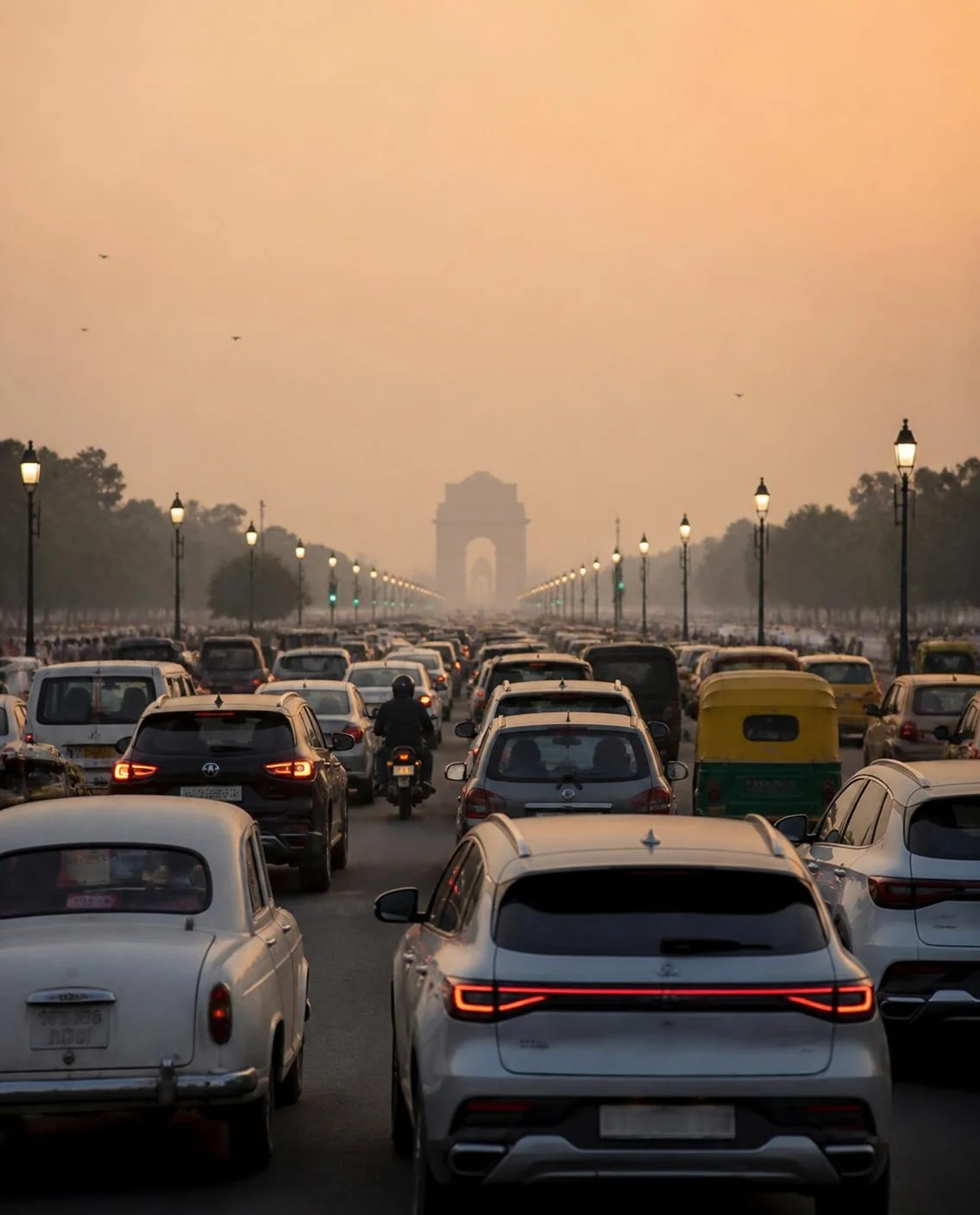
An interim report of the expert committee constituted by the Commission for Air Quality Management (CAQM) on vehicular emissions in Delhi-NCR was made public on 8 October 2026. It recommends immediate exit of BS-I to BS-III vehicles, a phased exit of BS-IV vehicles by 2030, and a rising zero-tailpipe-emission share of new private car sales reaching 100% by 2030.
Background
CAQM constituted the 15-member expert committee in December 2025 to draw up a multi-pronged roadmap for cutting vehicular emissions in NCR; it submitted its interim report on 18 August 2026. The report notes that NCR has about 2.21 crore vehicles, of which only about 3.6 lakh (1.6%) are electric and about 57% are BS-IV or older. BS-I to BS-III vehicles form about 30% of the fleet but contribute about 74% of particulate emissions, while BS-VI vehicles, over 41% of the fleet, contribute about 7%. The proposals are recommendations that CAQM will consider.
Key facts for Prelims
- CAQM: statutory body for air quality management in NCR and adjoining areas.
- Proposed phase-out: BS-I to BS-III immediately; BS-IV by 2030; BS-VI two-wheelers by 2035; BS-VI four-wheelers by 2040.
- Proposed zero-emission share of new private four-wheeler sales: 20% (2027), 45% (2028), 70% (2029), 100% (2030).
- NCR fleet: about 2.21 crore vehicles; EVs about 1.6%.
- Commercial segments such as three-wheelers, two-wheeler taxis, delivery vehicles and light goods vehicles to go zero-emission from 1 April 2027.
- Status: proposals in an interim expert report; any curbs need a separate regulatory process.
Mains analysis and way forward
Mains analysis
- The emission data make a strong case for targeting the oldest vehicles first: a minority of the fleet produces most particulate pollution.
- Sales mandates on manufacturers shift responsibility upstream, but their feasibility depends on charging infrastructure, battery supply and vehicle affordability.
- The panel flags leakage: scrapped or restricted vehicles could move to other Indo-Gangetic Plain cities, so it calls for mechanisms to prevent such transfers.
- Equity concerns arise for owners of older two-wheelers and commercial vehicles; scrappage incentives and finance for replacement will shape public acceptance.
- Vehicles are only one source; the report also lists road dust, construction, waste burning, industries, diesel generators and crop residue burning, underlining an airshed approach.
Way forward
- Pair restrictions with time-bound scrappage incentives and low-cost finance for small operators and lower-income households.
- Expand public charging and a legal right to charge in residential parking before mandates bite.
- Coordinate with neighbouring states across the Indo-Gangetic Plain so that pollution is reduced, not relocated.
Connect the dots: Links to air pollution, Bharat Stage norms, electric mobility policy, CAQM Act 2021, urban governance.
Sources: ThePrint (PTI): CAQM panel proposes phasing out BS-VI four-wheelers by 2040, BS-VI two-wheelers by 2035, 9 October 2026; The Tribune: Pollution plan proposes exit of BS-4 vehicle by 2030, 9 October 2026; News On AIR: CAQM forms expert committee to reduce vehicular emissions in NCR, 12 December 2025
Security and defence

Rajnath Singh addresses Exercise Tarang Shakti 2026 at Jodhpur; seven foreign air forces, 32 observer nations
Why in news
On 10 October 2026, Raksha Mantri Rajnath Singh addressed participants of Exercise Tarang Shakti 2026, the second edition of the Indian Air Force-hosted multinational air exercise, at Air Force Station Jodhpur. The exercise runs from 26 September to 12 October 2026 with Australia, Bangladesh, France, Germany, Sri Lanka, the UAE and the United States, and 32 observer nations. He stressed self-reliance in defence alongside cooperation with partners.
Background
Tarang Shakti began in 2024 as India’s first multinational air exercise, held in two phases at Sulur, Tamil Nadu (6 to 14 August) and Jodhpur, Rajasthan (29 August to 14 September). The 2026 edition, themed “Power in Partnership”, began its operational phase at Jodhpur on 27 September and covers combat, transport, surveillance and air-to-air refuelling. Aircraft reported include the F-35, Rafale, F-16, A400M, MRTT, C-130, C-130J and KC-30A, with Indian platforms such as the LCA Tejas and LCH Prachand. The Chief of Defence Staff General N.S. Raja Subramani, Chief of the Air Staff Air Chief Marshal A.P. Singh and Chief of the Naval Staff Admiral Krishna Swaminathan attended the event. The Minister cited indigenous programmes including Tejas, Dhruv, Rudra, Prachand, the Light Utility Helicopter, Akash, AESA radars and the AMCA programme.
Key facts for Prelims
- Exercise Tarang Shakti 2026: second edition, hosted by the Indian Air Force at Jodhpur, 26 September to 12 October 2026.
- Participating foreign air forces (7): Australia, Bangladesh, France, Germany, Sri Lanka, UAE and USA; 32 nations attend as observers.
- First edition (2024): Phase 1 at Sulur, Tamil Nadu (6 to 14 August 2024); Phase 2 at Jodhpur, Rajasthan (29 August to 14 September 2024).
- LCH Prachand is an indigenous light combat helicopter; AMCA is India’s fifth-generation fighter programme.
- Theme of the 2026 edition: “Power in Partnership”.
Mains analysis and way forward
Mains analysis
- Interoperability: flying with diverse platforms and doctrines builds shared procedures useful for humanitarian relief and coalition operations.
- Defence diplomacy: participation by Indo-Pacific, European, Gulf and South Asian partners, and 32 observers, signals India’s convening role and outreach to neighbours.
- Showcasing indigenous capability: displaying Tejas and Prachand supports Atmanirbhar Bharat and potential defence exports; the Minister framed self-reliance as capability-building, not isolation.
- Changing nature of air power: the Minister said “Future military power will be defined less by the number of platforms we possess”, pointing to speed of sensing and decision-making.
- Challenges: sustaining such large exercises needs funding and infrastructure, and squadron strength and timely indigenous production remain areas of attention.
Way forward
- Institutionalise Tarang Shakti as a regular exercise with structured learning exchanges.
- Use partnerships for co-development, co-production and training, as the Minister suggested.
- Link exercise experience to faster induction of indigenous platforms.
Connect the dots: Links to GS III security challenges, defence technology and indigenisation, and GS II India’s bilateral and multilateral defence relations.
Sources: India Education Diary (official release text): Raksha Mantri addresses participants of Exercise Tarang Shakti 2026 at Jodhpur, 10 October 2026; Punjab Kesari English (IANS): Tarang Shakti-2026: Rajnath Singh emphasises self-reliance in defence and international cooperation, 10 October 2026; ETV Bharat: Operational phase of IAF’s Tarang Shakti 2026 begins at Jodhpur Air Force Station, 27 September 2026; AIR News: India to host first multinational air exercise Tarang Shakti 2024 from August 6, 1 August 2024
Raksha Mantri presents 15 SIDM Champion Awards, calls for larger private role in defence production
Why in news
Defence Minister Rajnath Singh presented 15 SIDM Champion Awards at the 8th Annual Session of the Society of Indian Defence Manufacturers in New Delhi on 9 October 2026. Recalling record defence exports of Rs 38,424 crore in 2025-26 (first announced in April 2026), he called for the private sector’s share of domestic defence production, about 24% today, to reach 50%.
Background
Defence exports rose to Rs 38,424 crore in FY 2025-26 from Rs 23,622 crore in FY 2024-25, a growth of 62.66%, according to the Ministry of Defence. Defence PSUs contributed 54.84% and the private sector 45.16% of exports. The government has set an export target of Rs 50,000 crore by 2029. The session theme was “Sovereign Capabilities, Contested Frontiers: Accelerating India’s Strategic Autonomy in an Era of Disruption”. SIDM was founded in 2017.
Key facts for Prelims
- Defence exports FY 2025-26: Rs 38,424 crore (FY 2024-25: Rs 23,622 crore; growth 62.66%).
- Share of defence exports FY 2025-26: DPSUs 54.84%, private sector 45.16% (exports, not total production).
- Defence export target: Rs 50,000 crore by 2029.
- Private sector share of total defence production: about 24%.
- Policy tools named: iDEX, Positive Indigenisation Lists, SRIJAN portal, Defence Acquisition Procedure, Defence Procurement Manual.
Mains analysis and way forward
Mains analysis
- Export growth reflects maturing indigenous platforms and rising global acceptance of Indian defence products.
- A higher private share in production can widen the industrial base, add capacity and spur competition with DPSUs.
- The Minister urged manufacturers to treat R&D spending as an investment that strengthens operational preparedness; low private R&D remains a constraint.
- MSMEs and start-ups need predictable orders, testing infrastructure and timely payments to scale.
- Exports serve strategic aims too, building partnerships and interoperability with friendly countries.
Way forward
- Provide assured long-term procurement and shared testing facilities to private and MSME suppliers.
- Incentivise industry R&D and co-development with DRDO and academia.
- Streamline export authorisations and export financing to reach the 2029 target.
Connect the dots: Links to defence indigenisation, Atmanirbhar Bharat, defence industrial corridors, DAP 2020.
Sources: rajnathsingh.in: Raksha Mantri presents SIDM Champion Awards 2026, 9 October 2026; News On AIR: India’s defence exports hit record Rs 38,424 crore in 2025-26: Rajnath Singh, 9 October 2026; News On AIR: Ministry of Defence reports record defence exports of Rs 38,424 crore in FY 2025-26, 2 April 2026
Coast Guard commissions fast patrol vessel ICGS Ajit; Navy to commission ASW craft Mangrol on 12 October
Why in news
The Indian Coast Guard commissioned ICGS Ajit, an indigenously built fast patrol vessel from Goa Shipyard, at Goa Shipyard on 9 October 2026; it will be based at Okha, Gujarat. On 9 October the Navy also announced that Mangrol, the third Anti-Submarine Warfare Shallow Water Craft built by Cochin Shipyard, will be commissioned at Naval Dockyard, Mumbai, on 12 October 2026.
Background
ICGS Ajit, delivered on 25 August 2026, is part of an eight-vessel fast patrol vessel programme at Goa Shipyard for the Coast Guard; it is 52 metres long, displaces about 320 tonnes and has more than 60% indigenous construction content. Mangrol has over 80% indigenous content and carries the Abhay hull-mounted sonar, lightweight torpedoes, an indigenous anti-submarine rocket launcher and the Mareech advanced torpedo decoy system. It is named after the fishing harbour town of Mangrol in Gujarat’s Junagadh district, carrying forward the legacy of the minesweeper INS Mangrol that served until 2004. Vice Admiral Sanjay Vatsayan, Flag Officer Commanding-in-Chief, Western Naval Command, will preside.
Key facts for Prelims
- ICGS Ajit: fast patrol vessel built by Goa Shipyard Limited; 52 m, about 320 tonnes; base Okha, Gujarat.
- Mangrol: third ASW Shallow Water Craft built by Cochin Shipyard Limited; over 80% indigenous content.
- Mangrol propulsion: three diesel engines with waterjets, suited to shallow waters.
- Mangrol sensors and weapons: Abhay hull-mounted sonar, lightweight torpedoes, indigenous anti-submarine rocket launcher, Mareech decoy system.
- ICGS Ajit was presided over at commissioning by Dr Sirish Choudhary, Principal Integrated Financial Adviser of the Coast Guard.
Mains analysis and way forward
Mains analysis
- Shallow coastal waters are difficult for large warships; dedicated ASW craft close a gap in protecting ports, harbours and approaches.
- Fast patrol vessels strengthen surveillance against smuggling, illegal fishing and infiltration along a long coastline.
- Basing Ajit at Okha adds presence on the western seaboard near the Gulf of Kutch.
- High indigenous content supports domestic shipbuilding, MSME suppliers and self-reliance in maritime security.
- Layered coastal security needs coordination among the Navy, Coast Guard, marine police and fisheries departments.
Way forward
- Keep shipbuilding schedules on track through stable orders and supplier development.
- Integrate new platforms into the coastal radar chain and information-sharing networks.
- Invest in crew training and maintenance support to maximise availability at sea.
Connect the dots: Links to coastal security architecture, maritime security challenges, defence indigenisation, shipbuilding.
Sources: Raksha Anirveda: ICGS Ajit joins Indian Coast Guard fleet, 10 October 2026; Baird Maritime: Indian Coast Guard takes delivery of seventh Adamya-class patrol vessel, 26 August 2026; News On AIR: Indian Navy to commission third ASW shallow water craft Mangrol on Oct 12, 9 October 2026; ANI: Indigenous anti-submarine warfare ship to be commissioned in Mumbai on Oct 12, 9 October 2026
In brief
- RBI OMO sale of G-secs: On 9 October 2026, the RBI announced an open market operation sale of Government of India securities for an aggregate Rs 25,000 crore across six securities maturing 2030 to 2034, with the auction on 13 October 2026, after a review of liquidity conditions.
- Draft guidelines for expenditure-side GSDP: On 9 October 2026, the National Statistics Office (MoSPI) released draft guidelines for compiling Gross State Domestic Product by the expenditure approach with base year 2022-23, covering PFCE, GFCE, GFCF, inventories, valuables and net exports; comments are invited until 28 October 2026.
- India at ITU roundtable on telecom fraud: At an ITU roundtable on combating fraudulent communications on the sidelines of IMC 2026 in New Delhi on 9 October 2026, Minister of State for Communications Dr Chandra Sekhar Pemmasani said over 82 lakh fraudulent mobile connections had been disconnected using the ASTR tool and that losses to such fraud exceeded Rs 22,800 crore in 2024.
- India Post and Blue Dart parcel agreement: On 9 October 2026 in New Delhi, the Department of Posts and Blue Dart Express Limited signed an agreement for India Post parcel services, giving Blue Dart access to about 1.64 lakh post offices for last-mile delivery, including cash-on-delivery and OTP-based delivery in rural and remote areas.
- Attack on Riyadh airport: On 8 October 2026, Riyadh’s King Khalid International Airport was struck during attacks claimed by Yemen’s Houthi movement. Saudi aviation authorities said three Saudi citizens, including a Saudia pilot, were killed and several people injured, and flight operations were disrupted.
- US licence on Russian diesel: On 9 October 2026, the US Treasury’s Office of Foreign Assets Control issued General License 135, temporarily authorising specified transactions for the sale, delivery and import of Russian-origin diesel until 7 April 2027. It is a time-bound, transaction-specific licence, not a general lifting of sanctions on Russia.
- Nameri gets CA|TS status: Assam’s Nameri Tiger Reserve (464 sq km, Sonitpur district) has received Conservation Assured | Tiger Standards (CA|TS) approved status, accorded on 10 September and announced on 8 October 2026. All four tiger reserves of Assam, Kaziranga, Manas, Orang and Nameri, now hold CA|TS status.
- Women and Child Development summit: On 9 October 2026, Prime Minister Narendra Modi chaired the valedictory session of the two-day National Departmental Summit on Women and Child Development at Sushma Swaraj Bhawan, New Delhi. Ministers and senior officials of States and UTs discussed nutrition and early childhood care, child protection, women’s safety and empowerment, and service delivery through convergence.
- IPU President elected: On 9 October 2026, Milton Dick, Speaker of Australia’s House of Representatives, was elected the 32nd President of the Inter-Parliamentary Union with 56% of the vote in a single secret-ballot round at the 153rd IPU Assembly in Arusha, Tanzania (5-9 October). He succeeds Dr Tulia Ackson of Tanzania for a three-year term.
Prelims practice: 5 questions
Choose an option to see the answer and explanation. Your score appears when all five are answered.
Mains practice
Constitutional protections and targeted welfare programmes are essential but not sufficient by themselves to secure substantive equality for Particularly Vulnerable Tribal Groups. Examine with reference to access to healthcare, nutrition and the implementation of forest rights.
Show the answer outline
Introduction (about 30 words)
- PVTGs face overlapping disadvantages of isolation, livelihood insecurity and limited access to services; substantive equality needs enforceable rights and responsive public institutions together.
Constitutional and legal framework
- Article 21: life and dignity, including access to health.
- Article 46: promotion of the educational and economic interests of Scheduled Tribes.
- Article 47: nutrition and public health.
- Forest Rights Act, 2006: individual, community and habitat rights.
Challenges
- Uneven access to primary healthcare, referral and trained staff.
- Undernutrition and preventable infections; gaps in immunisation and surveillance.
- Incomplete recognition of habitat and community forest rights.
- Distance, coordination gaps and communication that is not culturally suited.
Lessons from recent developments
- Baiga PIL (9 October 2026): the need for investigation, prevention and accessible remedies; the petition’s claims remain to be established.
- Forest Rights Act review: pending claims, the role of Gram Sabhas and support after rights are recognised.
- PM-JANMAN: a convergence framework across housing, water, health, nutrition, education and connectivity.
Way forward
- Culturally responsive primary healthcare and mobile outreach.
- Reliable surveillance, immunisation and nutrition services.
- Timely, lawful disposal of forest rights claims and habitat rights recognition.
- Gram Sabha participation and transparent monitoring of outcomes.
Conclusion (about 30 words)
- Meaningful inclusion needs more than formal entitlements: responsive health systems, recognised community rights, accountability and the active participation of the communities themselves.
Tip: Use the Baiga PIL and the Forest Rights Act review from today’s edition as current examples, and keep allegations distinct from findings.
Current Canvas is prepared by the UPSC Gurus editorial desk. Every fact is checked against official releases and reliable reporting, with sources listed under each story. Editions are compiled each month into Current Canvas Monthly, a free magazine.
About images: photographs and illustrations in Current Canvas are AI-generated for illustration only. They are not news photographs of the events described.