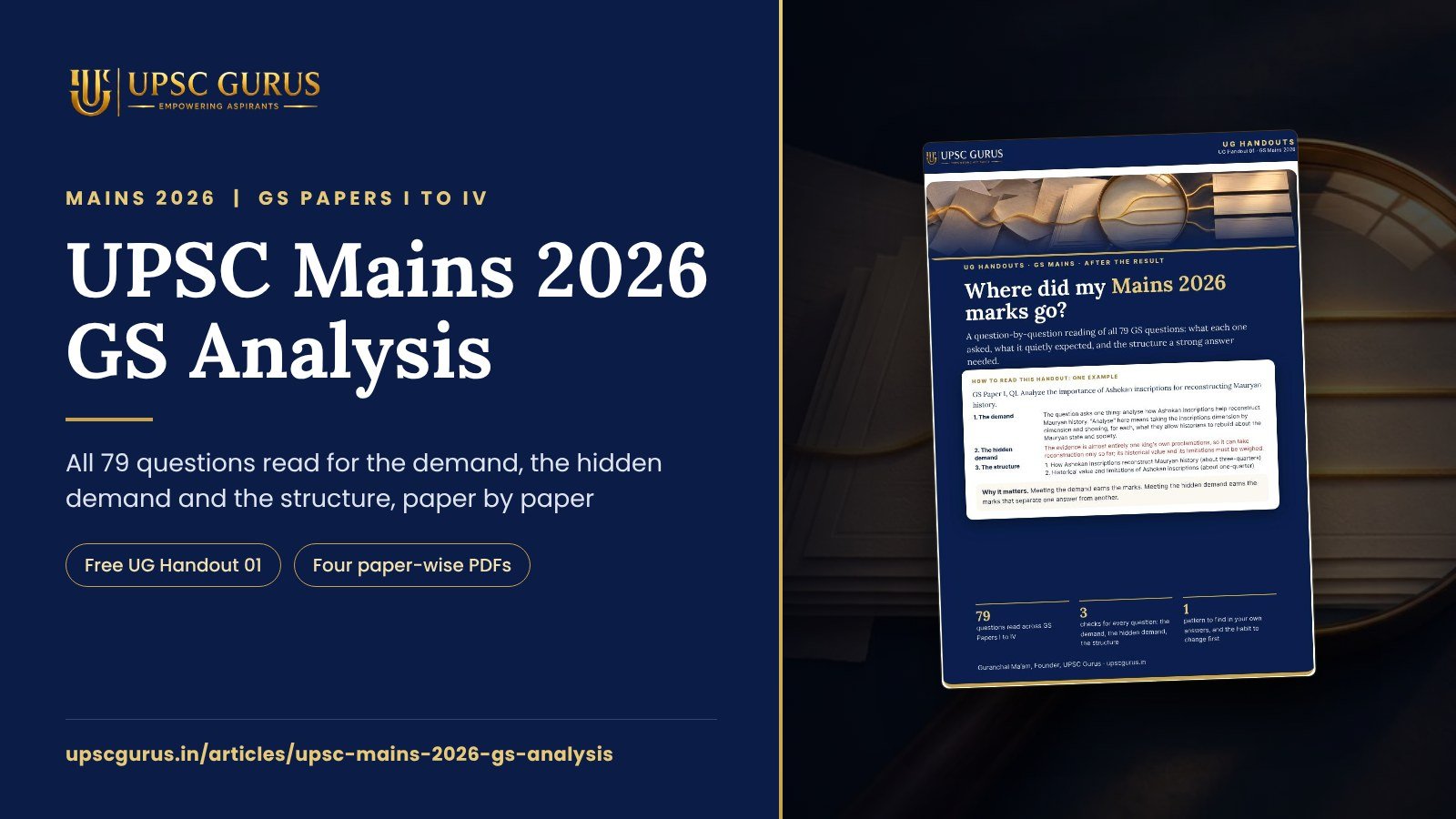
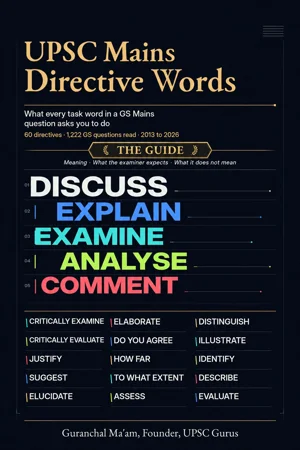
 New this week · Free UG Handout 02UPSC Mains Directive Words: 60 Meanings, Trends and PYQsTwo free PDFs: The Guide and the With PYQs edition.Read and download
Today’s Canvas
- Supreme Court issues notice to ECI on plea against Maharashtra SIR; declines interim relief, lists case for 5 NovemberGS II
- Supreme Court: exclusive women’s bar rooms with washrooms in every district, sub-divisional and taluka court; AG to monitorGS II
- Vigilance Awareness Week 2026 opens with integrity pledge on the theme “Probity for Prosperity”GS IV
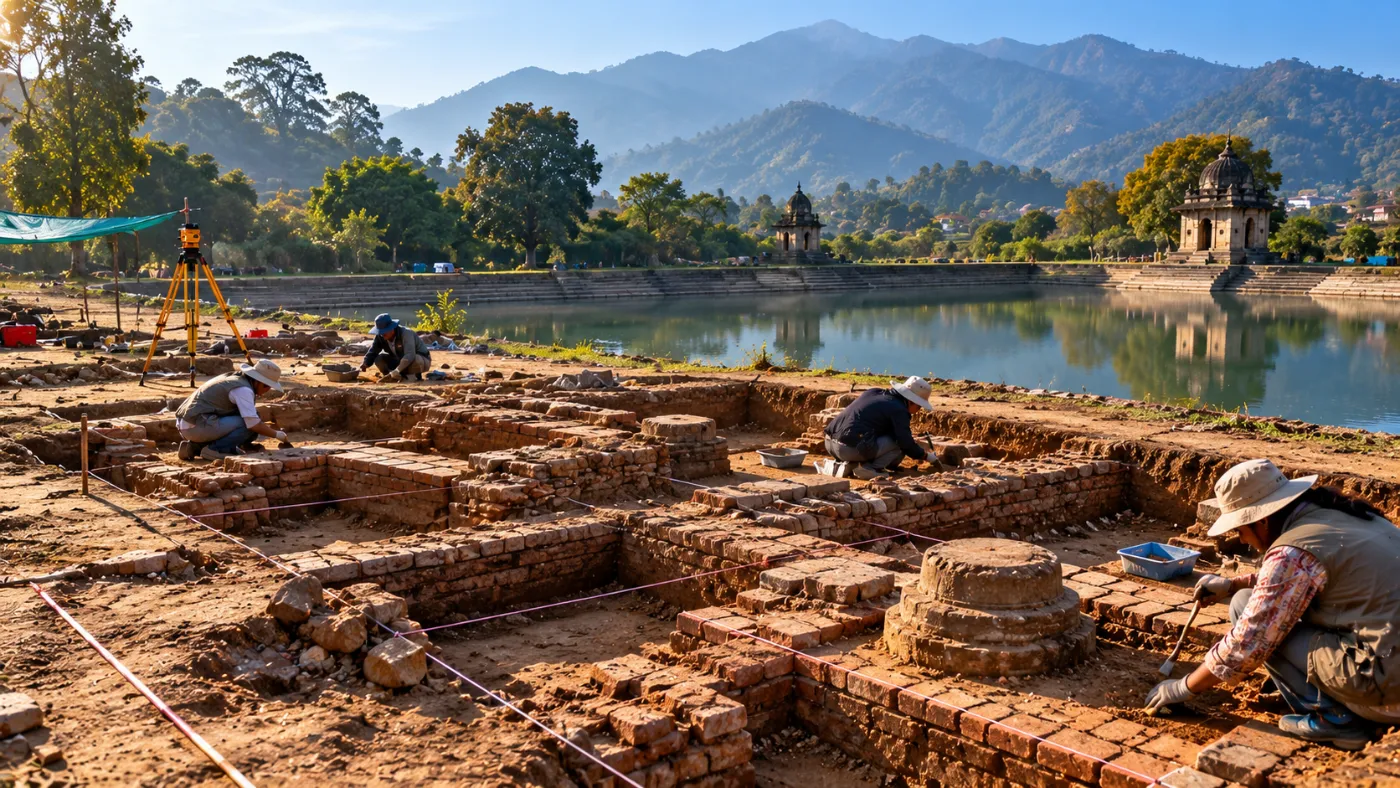
- ASI resumes excavation at Dron Sagar mound in Kashipur, Uttarakhand, to establish the site’s chronologyGS I
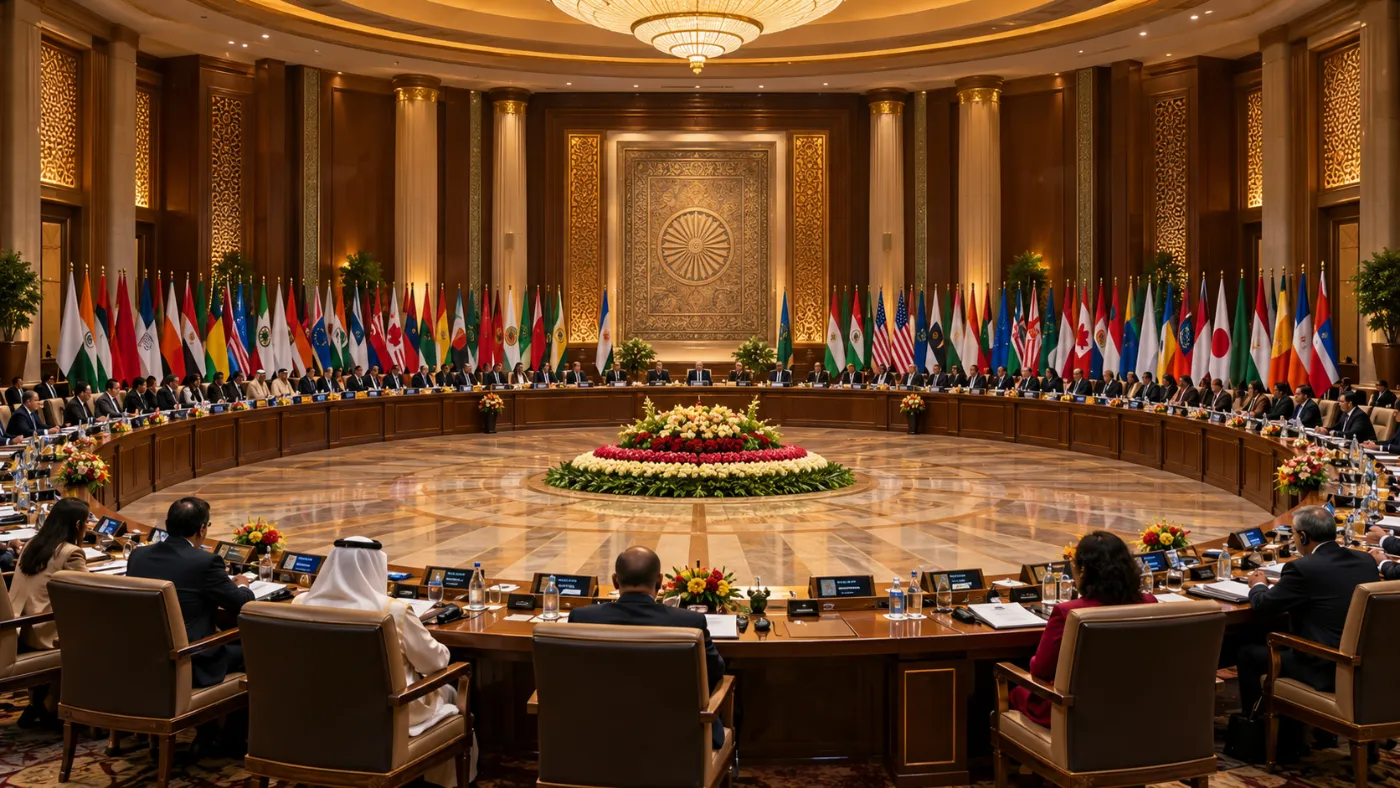
- BRICS Parliamentary Forum opens in Delhi: Om Birla asks legislatures to turn BRICS commitments into resultsGS II
- Birla and Russia’s Duma Chairman Volodin back joint action on terrorism and UNSC reform ahead of 80 years of tiesGS II
- Israel votes on 27 October for its 26th Knesset; final polls show neither bloc near a majorityGS II
- Swavlamban 2026: Navy’s fifth innovation and indigenisation seminar opens in Delhi with Rajnath Singh as chief guestGS III
- PM inaugurates RBI’s second data centre and cybersecurity training institute at Jatni, OdishaGS III
- Sitharaman reaffirms debt target of 50% of GDP by 2030; says RBI curbs sudden rupee swings but does not fix its valueGS III
- Goyal tours Port of Rotterdam; Indian customs and the port work on digitalising cargo processesGS II and III
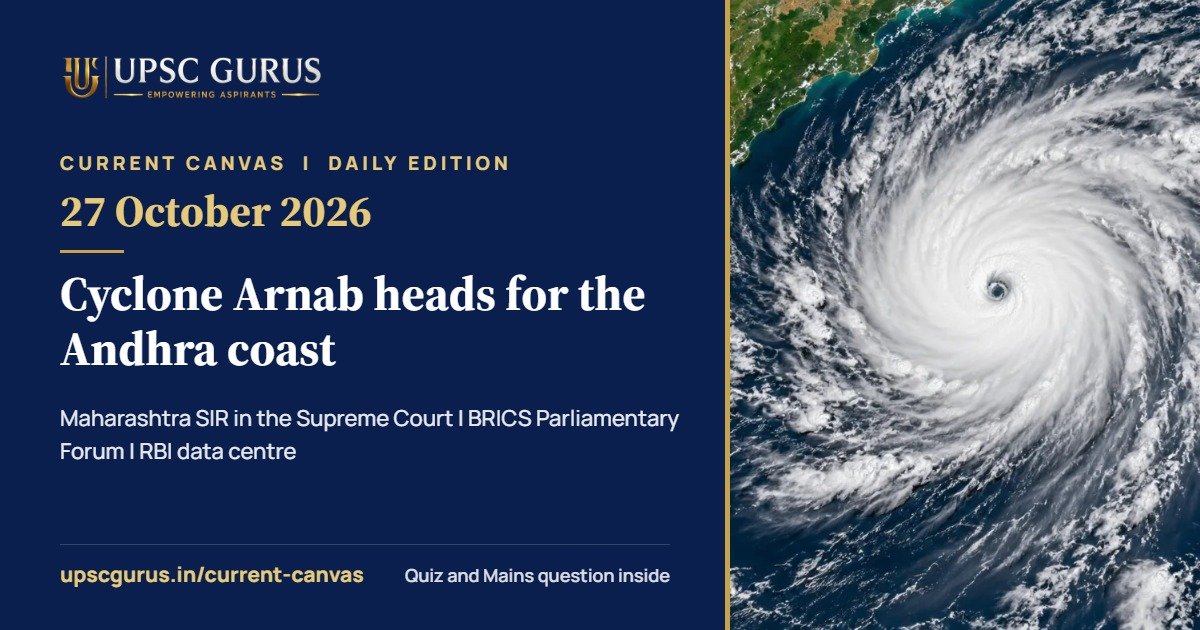
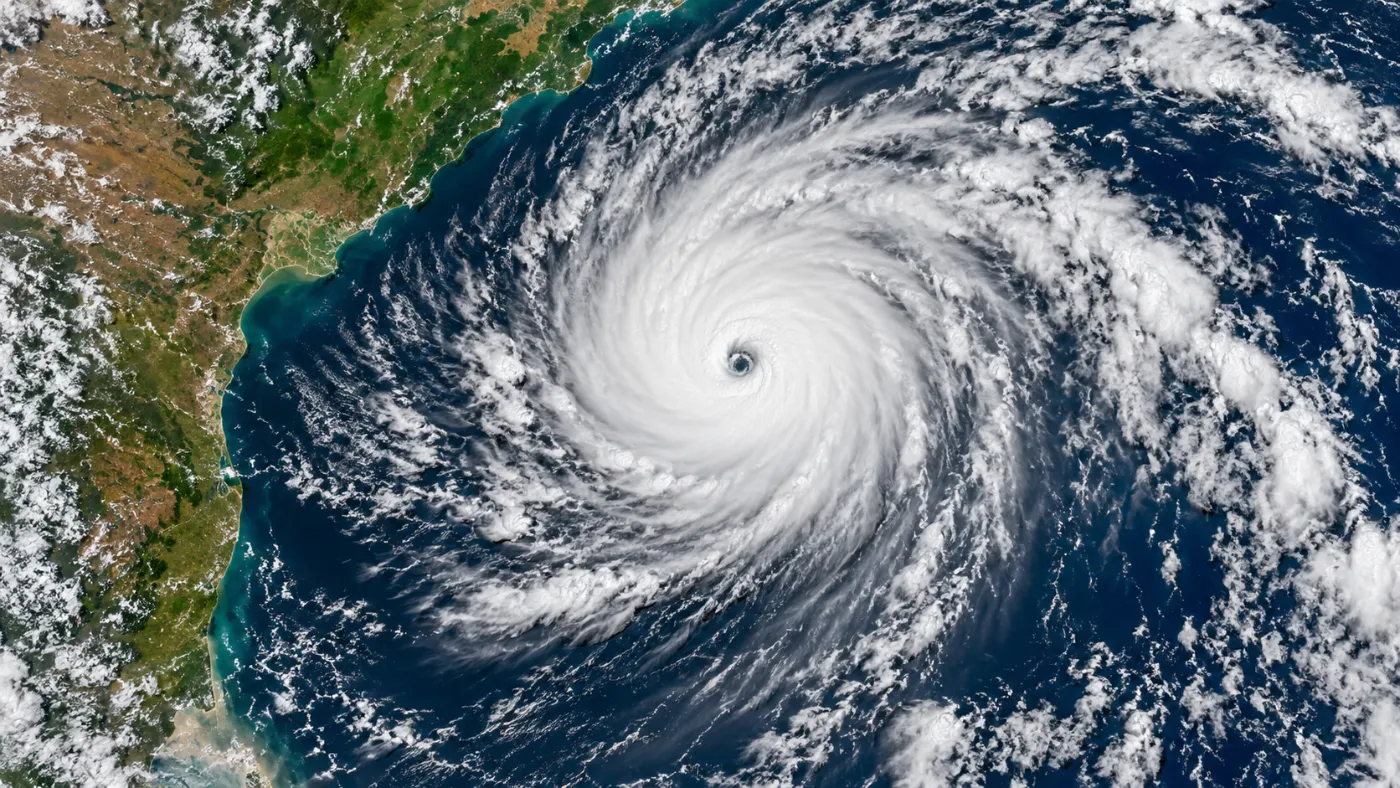
- Cyclone Arnab forms over the Bay of Bengal; likely to cross Andhra coast between Bapatla and Visakhapatnam on 28 OctoberGS III
- COP17 week two: who pays for nature tops the agenda; developed countries seek a wider donor base including India and ChinaGS III
- Overnight rain brings Delhi’s air to moderate on 25 October; experts warn local sources and winter inversion remainGS III
- India to have four functional launch pads by 2029; first uncrewed Gaganyaan test within two months, says ISRO chiefGS III
Polity and governance
Supreme Court issues notice to ECI on plea against Maharashtra SIR; declines interim relief, lists case for 5 November
In short: The Court sought the Election Commission’s response on large deletions from Maharashtra’s draft rolls but passed no interim order before hearing it.
Why in news
On Monday, 26 October 2026, a Bench of Chief Justice Surya Kant and Justices Joymalya Bagchi and V Mohana issued notice to the Centre and the Election Commission of India on a petition challenging the Special Intensive Revision (SIR) of electoral rolls in Maharashtra. The Court declined to pass an interim order on extending the claims-and-objections window, which closed that day, or on halting the final roll due on 16 November, until it hears the Commission; the case is listed for 5 November. The same day, the Bench declined an early hearing on the Delhi SIR, already listed for orders on 28 October.
Background
The petition, filed by Arun Anandagiri and argued by Senior Advocate Arvind Datar, said residents who had temporarily moved out during building redevelopment in Mumbai and Pune were deleted as “not found”. According to the State Chief Electoral Officer, 2,06,88,487 electors (21.14 per cent) of about 9.79 crore were left out of the draft rolls because they could not be traced at their addresses. The petitioner also objected to deleted voters being asked to file Form 6, meant for new electors, fearing prosecution for a false declaration; the Chief Justice responded orally that nobody would be prosecuted, and said the date could still be extended later if needed. In Delhi, the Commission has extended the claims-and-objections period to 30 October, with the final roll due on 4 December.
Key facts for Prelims
- Article 324: superintendence, direction and control of the preparation of electoral rolls and the conduct of elections vests in the Election Commission of India.
- Article 326: elections to the Lok Sabha and State Assemblies are on the basis of adult suffrage; a citizen aged 18 or more on the qualifying date is entitled to be registered.
- Representation of the People Act, 1950: governs preparation and revision of electoral rolls; Section 21 provides for intensive, summary and special revision.
- Form 6: application for inclusion of a name in the electoral roll, used chiefly by first-time electors, under the Registration of Electors Rules, 1960.
- Maharashtra SIR: claims and objections closed on 26 October 2026; final roll due on 16 November 2026; next hearing on 5 November.
Mains analysis and way forward
Mains analysis
- Accurate rolls and inclusive rolls are both goals of revision; a deletion rate above one-fifth of the draft roll calls for verification that does not shift the burden unfairly on to voters.
- Urban mobility, redevelopment and migration make “not found at address” a weak ground on its own; the method of field verification matters as much as the result.
- Judicial review of electoral administration must respect the Commission’s constitutional role while guarding the individual right to vote, which the Court is balancing by hearing the ECI before any interim order.
- A separate, simple restoration route for wrongly deleted electors would avoid misuse of forms designed for first-time voters.
Way forward
- The Commission could publish deletion lists with reasons at booth level and allow restoration through a dedicated, simple procedure.
- Special outreach for redevelopment-affected housing societies and migrants can reduce wrongful exclusion before the final roll.
- Clear, written assurance on the use of Form 6 by previously enrolled electors would remove doubt about prosecution.
Connect the dots: GS II: Election Commission, Representation of the People Act, judicial review, voting rights. GS I: urbanisation and migration.
Sources: ThePrint (PTI): SC notice to Centre, EC on plea challenging SIR in Maharashtra, 26 Oct 2026; The Wire: Supreme Court issues notice to Election Commission on Maharashtra SIR, 26 Oct 2026; LawBeat: Maharashtra SIR, Supreme Court refuses to extend date for filing documents, objections, 26 Oct 2026; Law Chakra: Delhi SIR plea, Supreme Court refuses early hearing, says wait for October 28 orders, 26 Oct 2026
Social justice and ethics
Supreme Court: exclusive women’s bar rooms with washrooms in every district, sub-divisional and taluka court; AG to monitor
In short: Facilities must be provided wherever women advocates practise, whatever their number, with States funding them and the Attorney General coordinating compliance.

Why in news
On 26 October 2026, a Bench led by Chief Justice Surya Kant, hearing Sarika Tyagi v. Union of India, directed that exclusive women’s bar rooms with washrooms and basic amenities be provided wherever women advocates practise in district, sub-divisional and taluka courts, regardless of how many women practise there. States are to allocate funds and land, High Court infrastructure committees are to prioritise the work, and Attorney General R Venkataramani will act as the nodal authority to consolidate progress reports. Only 21 of 69 respondents had filed status reports; the matter is next listed on 2 December.
Background
The public interest petition was filed in June 2026 on the basis of a nationwide survey that found, in most court complexes, either no ladies’ bar room or inadequate facilities, including seating, clean washrooms, changing spaces and nursing rooms. On 19 June 2026 the Court said, prima facie, that basic infrastructure for women advocates has a direct nexus with life and dignity under Article 21. On 17 July 2026 it described access to washrooms as a basic right, called the absence of toilets for women lawyers prima facie discriminatory under Articles 14 and 15, and said lack of funds is no ground for non-compliance. A survey of about 110 women lawyers in over 20 districts of Karnataka, placed before the Court by intervenors, reported that 42 per cent found the available washrooms unusable.
Key facts for Prelims
- Article 21: protection of life and personal liberty, read by courts to include the right to live with dignity.
- Article 15: prohibits discrimination on grounds including sex; Article 15(3) allows special provisions for women.
- Article 19(1)(g): freedom to practise any profession; poor workplace facilities were argued to burden this right for women advocates.
- Attorney General of India: appointed under Article 76; the highest law officer of the Union, here named the nodal authority for compliance.
- Case: Sarika Tyagi v. Union of India, W.P.(C) No. 770 of 2026; next hearing on 2 December 2026.
Mains analysis and way forward
Mains analysis
- Workplace infrastructure is a precondition of equal participation; women’s growing presence at the Bar needs facilities that let them work safely and on equal terms.
- The order shows continuing mandamus at work: the Court sets the standard and monitors compliance through reports rather than a one-time direction.
- District courts are the first point of contact for most litigants; better facilities for advocates also improve the courts’ accessibility for women litigants and staff.
Way forward
- States could ring-fence funds for court amenities in their budgets and link them to High Court infrastructure plans.
- A uniform design standard, as the Attorney General has been asked to work towards, can speed construction and allow audit.
- Periodic public reporting by High Courts on facilities in each court complex would keep progress visible.
Connect the dots: GS II: judiciary, fundamental rights, women’s empowerment. GS I: role of women. GS IV: dignity at the workplace.
Sources: Law Chakra: Women’s bar rooms, Supreme Court orders exclusive facilities with washrooms in district courts, 26 Oct 2026; LiveLaw: No ladies’ bar rooms in most trial courts, Supreme Court says basic facilities for women advocates integral to dignity, 19 Jun 2026; CLPR: Sarika Tyagi v Union of India (case page)
Vigilance Awareness Week 2026 opens with integrity pledge on the theme “Probity for Prosperity”
In short: From 26 October to 1 November, public offices take the integrity pledge and reach out to citizens, linking honest administration with national prosperity.
Why in news
Vigilance Awareness Week 2026 began on Monday, 26 October, and runs until 1 November on the theme “Satyanishtha se Samriddhi: Probity for Prosperity”, set by the Central Vigilance Commission in its circular of 18 September 2026. The week opened with an integrity pledge by public servants in ministries, departments, public sector undertakings and banks. States joined in: Assam urged citizens to take the pledge against bribery, and in Odisha the Chief Minister is to administer the pledge at a State function in Bhubaneswar on 27 October, linked by video to district and block offices.
Background
The week is observed every year in the week that includes 31 October, the birth anniversary of Sardar Vallabhbhai Patel. The Commission has asked organisations to encourage employees and their families to take the e-pledge, hold workshops on preventive vigilance, and organise Awareness Gram Sabhas in rural and semi-urban areas with quizzes, folk performances and puppet shows on integrity. The observance is preceded by a three-month campaign from 17 August to 16 November 2026 on disposal of pending complaints, capacity building, digital initiatives and contract management, with reports due by 30 November. The Central Vigilance Commission was set up in 1964 on the recommendation of the Santhanam Committee and became a statutory body under the CVC Act, 2003.
Key facts for Prelims
- Central Vigilance Commission: set up in 1964 on the Santhanam Committee’s recommendation; statutory status under the Central Vigilance Commission Act, 2003.
- CVC composition: a Central Vigilance Commissioner and up to two Vigilance Commissioners, appointed by the President on the recommendation of a committee of the Prime Minister, the Home Minister and the Leader of the Opposition in the Lok Sabha.
- Vigilance Awareness Week 2026: 26 October to 1 November; theme “Probity for Prosperity” (Satyanishtha se Samriddhi).
- The week coincides with Sardar Vallabhbhai Patel’s birth anniversary on 31 October, also observed as Rashtriya Ekta Diwas.
- Prevention of Corruption Act, 1988, amended in 2018 to make giving a bribe a specific offence.
Mains analysis and way forward
Mains analysis
- Probity and prosperity are linked: corruption raises the cost of public services, distorts contracts and erodes trust, which weakens growth and welfare delivery.
- Preventive vigilance, through simpler procedures, digital processes and transparent contracting, reduces the scope for discretion and is more effective than punishment alone.
- Citizen participation, through Gram Sabhas and complaint channels, turns integrity from an office rule into a shared social value.
- Pledges matter only when matched by institutional follow-through, such as timely disposal of complaints and protection for whistle-blowers.
Way forward
- Publish time-bound data on disposal of vigilance complaints so that the campaign’s outcomes are measurable.
- Expand e-procurement, e-office and online service delivery that reduce face-to-face discretion.
- Build ethics training into induction and mid-career courses for public servants, using case studies of real dilemmas.
Connect the dots: GS IV: probity in governance, integrity, codes of conduct, citizen’s charters. GS II: transparency and accountability, statutory bodies.
Sources: Dainik Jagran English: Vigilance Awareness Week begins across India with focus on integrity, 26 Oct 2026; Sentinel Assam: Assam Government observes Vigilance Awareness Week 2026, 26 Oct 2026; Pragativadi: Odisha Vigilance to observe Awareness Week with CM administering integrity pledge, Oct 2026; StaffNews: CVC Circular No. 05/09/26 on observance of Vigilance Awareness Week 2026, 18 Sep 2026
History and culture
ASI resumes excavation at Dron Sagar mound in Kashipur, Uttarakhand, to establish the site’s chronology
In short: The dig at a 90-acre mound identified with Xuanzang’s Govishana has revealed brick-built structures and a circular feature; work continues until March.
Why in news
The Archaeological Survey of India has resumed excavation at a mound of about 90 acres near Dron Sagar in Kashipur, Uttarakhand, it was reported on 25 October 2026. Mohan Joshi, Superintending Archaeologist of the ASI Dehradun Circle, said the dig aims to gather scientific evidence about remains found earlier, understand cultural activity across periods and establish the site’s chronology. The current phase has revealed brick-built structures and a circular feature and is expected to continue until March.
Background
Historians identify Kashipur with Govishana, described in the travel account of the Chinese pilgrim Xuanzang; Alexander Cunningham identified it with Xuanzang’s “Kiu-pi-shwang-na” and found remains of a large structure at Bhim-Gaja, the highest part of the mound. Earlier excavations in 1939-40, 1965-66 and 1970-71 revealed a temple built in phases from the Gupta to the early medieval period: a raised mud-and-brick platform in the Gupta period, with walls added around the sixth or seventh century. Finds include pottery from the Painted Grey Ware culture to the early medieval period, and antiquities of the Kushan, Gupta and medieval periods. Local tradition links the tank with Guru Dronacharya and the Pandavas; the report notes that such traditions require scientific examination of archaeological evidence.
Key facts for Prelims
- Dron Sagar: a tank and mound at Kashipur, Udham Singh Nagar district, Uttarakhand; excavation by the ASI Dehradun Circle.
- Govishana: ancient kingdom described by Xuanzang, the Chinese Buddhist pilgrim who travelled in India in the seventh century CE, during the reign of Harshavardhana.
- Alexander Cunningham: founder of the Archaeological Survey of India in 1861 and its first Director General; he identified many sites from Xuanzang’s itinerary.
- Painted Grey Ware (PGW): an Iron Age ceramic culture of the Ganga plain and Ghaggar basin, associated with the later Vedic period; B B Lal found PGW at Hastinapur in the 1950s.
- Earlier excavations at the site: 1939-40, 1965-66 and 1970-71, revealing a multi-phase temple of the Gupta to early medieval periods.
Mains analysis and way forward
Mains analysis
- Travellers’ accounts such as Xuanzang’s help locate ancient sites, but identifications need confirmation from stratigraphy and dating.
- Archaeology can test local traditions and epic associations scientifically, without dismissing the cultural value those traditions hold for communities.
- A long occupation sequence, from Painted Grey Ware to the early medieval period, makes the site useful for understanding urban and religious change in the Terai and upper Ganga plain.
Way forward
- Use scientific dating methods and publish excavation reports promptly so that findings enter scholarly and public discussion.
- Involve local communities and the temple in site protection, interpretation and heritage tourism.
- Integrate the site into regional research on the Kushan and Gupta periods in the foothills.
Connect the dots: GS I: ancient Indian history, sources of history (foreign travellers, archaeology), Gupta-period architecture.
Sources: ANI: ASI resumes excavation at Dron Sagar mound in Uttarakhand’s Kashipur to study ancient remains, 25 Oct 2026; Asianet Newsable (ANI): ASI resumes excavation at Dron Sagar mound in Kashipur, 25 Oct 2026
International relations and security
BRICS Parliamentary Forum opens in Delhi: Om Birla asks legislatures to turn BRICS commitments into results
In short: Delegations from 21 countries met at Samvidhan Sadan on 26 October; the PM attended the opening and the chair passes to China on 27 October.
Why in news
The 12th BRICS Parliamentary Forum opened on 26 October in the Central Hall of Samvidhan Sadan, New Delhi, with Lok Sabha Speaker Om Birla in the chair and Prime Minister Narendra Modi attending the inauguration and meeting heads of delegation. Mr Birla urged member and partner countries to carry the joint statement of the September BRICS Summit into legislation, budgets, deliberation and oversight, so that outcomes improve citizens’ lives. ANI reported delegations from 11 member and 10 partner countries.
Background
The two-day forum is held under India’s BRICS chairship in 2026 and is organised around four sessions: Resilience, Innovation, Cooperation and Sustainability. Topics include institutional capacity, legislative oversight of artificial intelligence and digital technologies, and the Sustainable Development Goals. A side meeting of chairpersons of parliamentary committees on international affairs will discuss parliamentary diplomacy and capacity building. Mr Birla noted that BRICS marks 20 years this year and represents nearly half of the world’s population. The forum is set to close on 27 October with a joint statement and the handover of the chair to China, according to ANI.
Key facts for Prelims
- 12th BRICS Parliamentary Forum: 26-27 October 2026, Central Hall, Samvidhan Sadan, New Delhi; chaired by Lok Sabha Speaker Om Birla
- Theme centred on parliaments for people-centric development; four sessions on Resilience, Innovation, Cooperation and Sustainability
- Delegations from 21 countries (11 members and 10 partners, as reported by ANI); Uganda and Cuba are BRICS partner countries
- BRICS marks 20 years in 2026; the grouping represents nearly half of the world’s population
- The forum chair passes to China at the close on 27 October, per ANI
- Rajya Sabha Deputy Chairman Harivansh also addressed the gathering
Mains analysis and way forward
Mains analysis
- Parliamentary diplomacy extends BRICS beyond summits: legislatures can turn summit declarations into laws, budgets and oversight.
- Legislative oversight of AI and digital technologies is an emerging common agenda for the Global South, where regulatory capacity varies widely.
- An expanded BRICS of members and partners brings diverse political systems together, which makes consensus harder but widens the forum’s reach.
- For India, hosting the forum after the leaders’ summit reinforces its image as a bridge between developing countries and a voice for reformed multilateralism.
Way forward
- Set up a simple tracking mechanism so that each parliament reports on how it has followed up the joint statement.
- Build exchanges for young and women parliamentarians, as stressed by the Speaker.
- Use the parliamentary track to share good practice on AI oversight and on balancing development with environmental protection.
Connect the dots: Syllabus link: GS II India and groupings, role of Parliament in foreign policy, Global South cooperation.
Sources: ANI: PM Modi arrives at inauguration of 12th BRICS Parliamentary Forum, welcomes foreign delegations, 26 Oct 2026; IANS via SocialNews.XYZ: 12th BRICS Parliamentary Forum begins in Delhi, LS Speaker highlights shared democratic values, 26 Oct 2026; Revoi: Om Birla inaugurates BRICS Parliamentary Forum, calls for turning dialogue into concrete action, 26 Oct 2026; ANI via webindia123: Delegations from 21 nations arrive in New Delhi, 26 Oct 2026; ANI via LatestLY: Plenary sessions to explore ways for institutions to be more effective, 26 Oct 2026
Birla and Russia’s Duma Chairman Volodin back joint action on terrorism and UNSC reform ahead of 80 years of ties
In short: On the eve of the BRICS forum, India and Russia’s lower-house leaders discussed terrorism, trade barriers, nuclear energy and parliamentary exchanges.
Why in news
On 25 October, Lok Sabha Speaker Om Birla met a Russian delegation led by Vyacheslav Volodin, Chairman of the State Duma, in New Delhi. According to the Lok Sabha Secretariat, both sides stressed closer cooperation at global forums and joint efforts against terrorism, and noted that 2027 marks 80 years of India-Russia diplomatic relations. Mr Birla thanked Russia for supporting India’s bid for permanent membership of a reformed UN Security Council.
Background
Mr Birla called for regular meetings of the India-Russia Inter-Parliamentary Commission and more exchanges of delegations, especially of young and women parliamentarians, and raised cooperation in nuclear energy and industry. Mr Volodin called for joint business ventures and the removal of obstacles to trade and investment. Mr Volodin had earlier visited India in February 2025, when his delegation observed proceedings in both Houses of Parliament. The two countries describe their relationship as a Special and Privileged Strategic Partnership. Mr Birla also met delegations from Cuba, Egypt and Belarus on 25 October.
Key facts for Prelims
- State Duma: lower house of Russia’s Federal Assembly; Chairman Vyacheslav Volodin
- India and Russia mark 80 years of diplomatic relations in 2027
- India-Russia ties are described as a Special and Privileged Strategic Partnership
- India-Russia Inter-Parliamentary Commission: a standing forum for legislative cooperation
- Topics on 25 October: counter-terrorism, UNSC reform, nuclear energy, trade and investment barriers
Mains analysis and way forward
Mains analysis
- Parliamentary channels give continuity to a partnership whose economic side is shaped by sanctions, payment issues and a trade imbalance.
- Russia’s support for India’s permanent UNSC seat remains a consistent diplomatic asset.
- Calls to remove trade and investment obstacles show both sides want to diversify ties beyond defence and energy.
- India balances ties with Russia alongside deepening partnerships with the US and Europe, an expression of strategic autonomy.
Way forward
- Hold the Inter-Parliamentary Commission regularly and link it to trade and connectivity agendas.
- Plan the 80th anniversary in 2027 around people-to-people, education and cultural exchanges.
Connect the dots: Syllabus link: GS II India-Russia relations, UNSC reform, parliamentary diplomacy.
Sources: ThePrint (PTI): India to host 12th BRICS Parliamentary Forum; Birla holds talks with Russian Duma Chair, 25 Oct 2026; ANI via webindia123: Delegations from 21 nations arrive in New Delhi, 26 Oct 2026; The Tribune (ANI): Russian parliamentary delegation calls on Lok Sabha Speaker Om Birla, 4 Feb 2025
Israel votes on 27 October for its 26th Knesset; final polls show neither bloc near a majority
In short: Final polls on 23 October put Eisenkot’s Yashar ahead of Netanyahu’s Likud, but neither camp near 61 of 120 seats.
Why in news
Israelis vote on 27 October to elect the 26th Knesset. The final opinion polls, published on 23 October, put Gadi Eisenkot’s Yashar party ahead: Channel 13 projected Yashar at 22 seats and Prime Minister Benjamin Netanyahu’s Likud at 19, and Channel 12 projected Yashar at 23 and Likud at 21, with Mr Netanyahu’s bloc at about 50 seats in both. That is short of the 61 seats needed to govern; bloc totals depend on which parties are counted.
Background
The Knesset has 120 seats elected by proportional representation, and a party needs 3.25% of the vote to win seats. Arab-led parties are projected at about 14 seats, which could make them important in coalition arithmetic. Smaller lists near the threshold, and the withdrawal of Benny Gantz’s centrist party, add uncertainty. US President Donald Trump has endorsed Mr Netanyahu. The vote comes amid the wider conflict in West Asia, and its outcome will shape Israel’s approach to Iran, Gaza and regional diplomacy.
Key facts for Prelims
- Knesset: Israel’s unicameral parliament of 120 members; 61 needed for a majority
- Electoral threshold: 3.25% of the vote
- The 27 October 2026 vote elects the 26th Knesset
- Yashar: party led by former army chief Gadi Eisenkot; Likud: led by Benjamin Netanyahu
- Proportional representation: seats are shared by party vote share in a single nationwide constituency
Mains analysis and way forward
Mains analysis
- Fragmented results under proportional representation make coalition-building, not the vote itself, the decisive stage.
- Israel’s next government will shape the course of conflict and diplomacy in West Asia, which affects India’s energy security, diaspora and trade routes.
- India’s ties with Israel in defence, technology and agriculture are institutional and have continued across governments in both countries.
- The rising weight of Arab-led parties raises questions of minority representation in Israeli politics.
Way forward
- India should keep engaging whichever coalition emerges while maintaining its balanced West Asia policy, including support for a two-State solution.
- Continue advisories and welfare support for Indian workers in Israel during the transition.
Connect the dots: Syllabus link: GS II India and West Asia, comparative electoral systems, effect of policies of other countries on India’s interests.
Sources: Jerusalem Post: Israel Election 2026, Eisenkot leads Netanyahu but Knesset deadlock looms, 25 Oct 2026; Times of Israel: ToI poll, Eisenkot’s party opens up big lead on Netanyahu’s, but both blocs short of majority, 15 Oct 2026; The New Arab: Israel election, polls forecast stalemate, far-right gains, 20 Oct 2026
Swavlamban 2026: Navy’s fifth innovation and indigenisation seminar opens in Delhi with Rajnath Singh as chief guest
In short: The two-day seminar at Manekshaw Centre links the Navy’s needs with start-ups, MSMEs and academia, focusing on surveillance, counter-drone, AI and quantum technologies.
Why in news
The Indian Navy’s fifth Naval Innovation and Indigenisation Seminar, Swavlamban 2026, is being held at the Manekshaw Centre, New Delhi, on 26 and 27 October, with Defence Minister Rajnath Singh as chief guest at the 26 October plenary. Its theme is Strength and Power through Innovation and Indigenisation. Three documents were scheduled for release: the Swavlamban 5.0 document, a Compendium on Technology Imperatives and the NAUSETU (Naval Unified Systems, Ethernet and Tactical Utilisation) Interface Standards.
Background
Swavlamban began in 2022 and, as Vice Chief of the Naval Staff Vice Admiral Ajay Kochhar said at the 19 October curtain-raiser, has helped connect Navy requirements with Indian industry and academia. The Navy is organising it with the Defence Innovation Organisation and the Society of Indian Defence Manufacturers, with more than 100 stalls expected. Pre-event reports cite Acceptance of Necessity for projects worth over Rs 3,500 crore and contracts worth over Rs 1,900 crore under the Navy’s iDEX-linked work. Exhibition areas include maritime surveillance, counter-UAS, AI, quantum technologies, and nuclear, biological, chemical and damage control.
Key facts for Prelims
- Swavlamban: Indian Navy’s Naval Innovation and Indigenisation Seminar; first held in 2022; 2026 is the fifth edition
- Venue and dates: Manekshaw Centre, New Delhi, 26-27 October 2026
- Theme: Strength and Power through Innovation and Indigenisation
- Documents slated for release: Swavlamban 5.0, Compendium on Technology Imperatives, NAUSETU Interface Standards
- Partners: Defence Innovation Organisation (DIO, which runs iDEX) and Society of Indian Defence Manufacturers (SIDM)
- Acceptance of Necessity (AoN): first approval stage in defence procurement; it is not a signed contract
Mains analysis and way forward
Mains analysis
- Common interface standards such as NAUSETU can let systems from different Indian vendors work together, lowering integration costs.
- The gap between AoN, contract and deployment is the real test of indigenisation; seminars must be judged by systems inducted.
- Start-ups and MSMEs need assured orders and testing facilities, not just prizes, to scale.
- Niche areas such as quantum positioning and counter-drone systems reflect lessons from recent conflicts on cheap, mass-produced threats.
Way forward
- Publish timelines from challenge to induction for each innovation so that progress is visible.
- Expand shared test ranges and certification support for small firms.
- Align naval challenges with the needs of the Army and Air Force where jointness allows common solutions.
Connect the dots: Syllabus link: GS III indigenisation of technology, defence procurement, role of start-ups and MSMEs in security.
Sources: Raksha Anirveda: Swavlamban 2026 to focus on emerging technologies and indigenous defence capabilities, 24 Oct 2026; DD India: Indian Navy to showcase indigenous defence technologies and innovations at Swavlamban 2026, 19 Oct 2026; Indian Masterminds: Swavlamban 2026, how India is building a self-reliant Navy, 26 Oct 2026; Raksha Anirveda: Swavlamban 2026, from innovation to naval capability, 19 Oct 2026; TFIPost: Rajnath Singh to attend Swavlamban 2026, 25 Oct 2026
Economy
PM inaugurates RBI’s second data centre and cybersecurity training institute at Jatni, Odisha
In short: The Rs 169 crore campus will host mission-critical payment systems such as RTGS and NEFT and train professionals in cybersecurity and emerging technologies.

Why in news
Prime Minister Narendra Modi inaugurated the Reserve Bank of India’s Data Centre and Cybersecurity Training Institute at Jatni, near Bhubaneswar, on 25 October 2026. He called it a major step towards a more secure financial system and said the banking system must be protected from cyber threats, describing economic attacks as a form of modern warfare. Finance Minister Nirmala Sitharaman said the campus will house the RBI’s mission-critical systems, including RTGS and NEFT.
Background
The facility, built at a cost of Rs 169 crore on 18.55 acres at Info Valley-II, Jatni, is the RBI’s second data centre after the one in Navi Mumbai. The foundation stone was laid by the then Governor, Shaktikanta Das, on 22 March 2023, and the site was chosen for its geographical stability, away from seismically active zones and high-risk border areas. The training institute, with its own research wing, is meant to build sector-wide capability in cybersecurity, enterprise technology, artificial intelligence and data centres. Speaking at the event, the Finance Minister said UPI now handles over 2,400 crore transactions a month, nearly 80 crore a day, and called a data centre ‘the vault of the digital age’. RBI Governor Sanjay Malhotra and Odisha Chief Minister Mohan Charan Majhi were among those present.
Key facts for Prelims
- The RBI’s Jatni (Khordha district, Odisha) facility is its second data centre; the first is in Navi Mumbai.
- Cost: Rs 169 crore; area: 18.55 acres at Info Valley-II; foundation stone: 22 March 2023.
- RTGS (Real Time Gross Settlement) settles large-value payments individually and in real time; NEFT settles in half-hourly batches; both are owned and operated by the RBI.
- UPI, operated by the National Payments Corporation of India, handles over 2,400 crore transactions a month, according to the Finance Minister (25 October 2026).
- The Union Government granted infrastructure status to data centres in 2022.
- CERT-In is the national nodal agency for cyber incident response under Section 70B of the Information Technology Act, 2000.
Mains analysis and way forward
Mains analysis
- Payment and settlement systems are critical information infrastructure; geographically separate data centres are central to business continuity and systemic stability.
- As digital payments scale, cyber risk becomes a financial stability risk, not only an IT issue; this calls for capacity within regulators and regulated entities alike.
- Describing economic attacks as modern warfare links financial sector resilience with national security and the protection of critical infrastructure.
- A facility in eastern India supports balanced regional development and can anchor a local ecosystem of digital skills and data centres.
Way forward
- Pair physical redundancy with regular disaster recovery drills, independent audits and tested failover between the two sites.
- Use the institute to train staff of smaller banks, cooperative banks and NBFCs, where cyber capacity is often thinnest.
- Keep resilience and data protection moving together, in line with the Digital Personal Data Protection framework.
Connect the dots: Role and functions of the RBI; payment and settlement systems; cyber security and critical information infrastructure; digital public infrastructure.
Sources: PM India: PM inaugurates RBI’s newly established Data Centre and Cybersecurity Training Institute in Bhubaneswar, Odisha, 25 Oct 2026; ThePrint (PTI): PM inaugurates RBI’s Rs 169-cr data centre, Cybersecurity Training Institute in Odisha, 25 Oct 2026; Business Today: UPI leads global real time payments with over 2,400 cr monthly transactions: Nirmala Sitharaman, 26 Oct 2026; Siasat (PTI): PM inaugurates RBI’s Rs 169-cr data, training centre in Odisha, 25 Oct 2026
Sitharaman reaffirms debt target of 50% of GDP by 2030; says RBI curbs sudden rupee swings but does not fix its value
In short: The Finance Minister’s remarks in Tiruchirappalli came as the rupee traded near 95 to the dollar and Brent crude rose above $114 a barrel.
Why in news
Speaking to reporters in Tiruchirappalli on 26 October 2026, Finance Minister Nirmala Sitharaman said the Centre is committed to reducing the fiscal deficit, as evidenced by its annual budgets, and has openly stated its goal of limiting national debt to 50 per cent of GDP by 2030. She said the RBI is taking steps to prevent sudden fluctuations in the rupee but does not determine its value. The same morning, the rupee weakened to 94.98 against the dollar in early trade as Brent crude rose to $114.48 a barrel.
Background
The Union Budget has moved from an annual fiscal deficit target towards debt-to-GDP as the main fiscal anchor, aiming for a Central Government debt ratio of 50 plus or minus one per cent by 2030-31. The Budget 2026-27 put the fiscal deficit at 4.4 per cent of GDP for 2025-26 (revised estimate) and 4.3 per cent for 2026-27, with debt at 56.1 per cent and 55.6 per cent of GDP respectively. The Minister cited the pandemic, geopolitical conflicts and higher crude prices as external sources of inflationary pressure. India follows a market-determined exchange rate, with the RBI intervening to curb excessive volatility rather than to target a level.
Key facts for Prelims
- Fiscal Responsibility and Budget Management (FRBM) Act, 2003 governs the Centre’s fiscal targets.
- Budget 2026-27: fiscal deficit 4.3% of GDP (BE); 2025-26 RE 4.4%; Central Government debt 55.6% of GDP (2026-27 BE).
- Medium-term anchor: Central Government debt-to-GDP of 50 plus or minus 1% by 2030-31.
- Fiscal deficit = total expenditure minus total receipts excluding borrowings.
- Rupee on 26 October 2026: opened at 94.92, weakened to 94.98 per dollar in early trade; Brent crude at $114.48 a barrel.
Mains analysis and way forward
Mains analysis
- A debt anchor gives flexibility in a shock year while committing to a medium-term path; its credibility depends on transparent glide paths.
- High crude prices widen the import bill and current account deficit, pressure the rupee and feed into inflation, testing both fiscal and monetary policy.
- Intervention can smooth rupee volatility, but defending a level drains reserves; a managed float balances stability with market signals.
- Debt reduction also hinges on nominal GDP growth and the quality of spending, especially protecting capital expenditure.
Way forward
- Publish a year-wise debt glide path with clear escape clauses for genuine external shocks.
- Reduce exposure to oil price shocks through energy diversification and strategic reserves.
- Keep communication on exchange rate policy clear to anchor market expectations.
Connect the dots: Fiscal policy and FRBM; government budgeting; exchange rate management; inflation and oil prices.
Sources: ThePrint (PTI): Centre committed to reducing fiscal deficit, as evidenced by annual budgets: Nirmala Sitharaman, 26 Oct 2026; The Tribune: RBI taking steps to prevent sudden rupee fluctuations, but does not determine rupee’s value, says FM Sitharaman, 26 Oct 2026; Daijiworld (PTI): Rupee falls to 94.98 against US dollar, 26 Oct 2026; Deccan Chronicle: Budget focuses on containing fiscal deficit at 4.3 pc in FY27, 1 Feb 2026
Goyal tours Port of Rotterdam; Indian customs and the port work on digitalising cargo processes
In short: On his Netherlands visit, the Commerce Minister pitched Rotterdam as a gateway for Indian goods into Europe and addressed a business forum in The Hague.
Why in news
Commerce and Industry Minister Piyush Goyal toured the Port of Rotterdam, Europe’s largest port, with its CEO Boudewijn Siemons on 25 October 2026. He said Indian customs and the Port of Rotterdam authorities are working on digitalising cargo processes in India to speed up cargo evacuation and the turnaround time of ships. On 26 October he was scheduled to address the India-Netherlands Business Forum in The Hague, with six sectoral roundtables.
Background
Goyal is in the Netherlands from 24 to 27 October 2026 after a leg in Germany, leading a delegation of about 100 Indian businesses and startups across both countries. The Commerce Ministry described Rotterdam as a strategic gateway for Indian goods entering the European market, linked to the India-EU Free Trade Agreement. Goyal said India has doubled its port capacity in the past decade and expects it to double twice more by 2047. The visit builds on PM Modi’s visit in May 2026, when India and the Netherlands upgraded ties to a Strategic Partnership and adopted a Roadmap for 2026-2030 covering semiconductors, water, green shipping and agriculture.
Key facts for Prelims
- Port of Rotterdam is Europe’s largest port; the Netherlands is a major gateway for Indian goods into the European Union.
- India-Netherlands ties were upgraded to a Strategic Partnership in May 2026, with a Roadmap for 2026-2030.
- May 2026 outcomes included a Tata Electronics-ASML MoU for a fab at Dholera, Gujarat, a Green and Digital Sea Corridor, and a letter of intent on the Kalpasar Project in Gujarat.
- Business Forum sectors (26 October): agri-food, high technology, sustainability and renewables, logistics, manufacturing and pharmaceuticals, and services.
- Port turnaround time is a key logistics indicator; digital cargo processes reduce dwell time and transaction costs.
Mains analysis and way forward
Mains analysis
- Digitalising customs and port processes cuts logistics costs, a binding constraint on export competitiveness.
- Port partnerships with European hubs can help Indian exporters use preferential access under trade agreements with the EU.
- The Dutch strengths in water management, agri-food, semiconductor equipment and green shipping complement India’s needs.
- Port-led growth needs hinterland connectivity, coastal shipping and logistics parks, not capacity alone.
Way forward
- Translate port cooperation into measurable targets on dwell time and turnaround.
- Use the 2026-2030 Roadmap to channel Dutch investment into semiconductors, water and green hydrogen corridors.
- Help MSME exporters with standards and certification to use EU market access.
Connect the dots: India-EU relations; ports and maritime infrastructure; logistics efficiency and exports; Sagarmala; semiconductor ecosystem.
Sources: Logistics Insider: Piyush Goyal at Port of Rotterdam: Cargo Digitalisation, 26 Oct 2026; Bhaskar Live: India reaffirms stronger trade and investment ties with the Netherlands, 26 Oct 2026; DD India: Piyush Goyal to visit Germany, Netherlands to boost trade, investment and industrial cooperation, Oct 2026; The Statesman: PM Modi’s Netherlands visit marks strategic reset, May 2026
Environment and disaster management
Cyclone Arnab forms over the Bay of Bengal; likely to cross Andhra coast between Bapatla and Visakhapatnam on 28 October
In short: The Bay of Bengal system became Cyclone Arnab on 26 October; IMD expects a very severe cyclonic storm at landfall, and Andhra Pradesh and Odisha have begun evacuations.
Why in news
IMD National Bulletin No. 8 (5:30 am, 26 October) said the system had intensified into a cyclonic storm, named Arnab, centred near 15.4 degrees N, 88.9 degrees E, about 650 km east-southeast of Visakhapatnam. It is expected to become a severe cyclonic storm by midnight of 26 October and a very severe cyclonic storm on 27 October, and to cross the Andhra Pradesh and Yanam coasts between Bapatla and Visakhapatnam on the morning of 28 October with sustained winds of 115 to 125 km/h, gusting to 140 km/h. Evacuations began in Andhra Pradesh on Monday evening, where authorities have identified about 5.7 lakh vulnerable people.
Background
The name Arnab, meaning “ocean” in Bengali, was contributed by Bangladesh to the list maintained by the WMO/ESCAP Panel on Tropical Cyclones; a system gets a name only on reaching cyclonic storm strength. Andhra Pradesh has kept 10 NDRF and 11 SDRF teams on standby, while Odisha has positioned 17 NDRF teams, 60 ODRAF teams and 225 Fire Services teams and closed schools and colleges in six southern districts on 28 and 29 October. In Telangana, a red alert covers Mulugu, Bhadradri Kothagudem and Khammam for 28 October. Over 4,800 fishing boats have returned to Kakinada and other harbours.
Key facts for Prelims
- IMD scale: cyclonic storm 34 to 47 knots; severe cyclonic storm 48 to 63; very severe cyclonic storm 64 to 89; extremely severe 90 to 119; super cyclonic storm 120 knots and above.
- IMD, New Delhi is the WMO Regional Specialised Meteorological Centre (RSMC) for tropical cyclones over the north Indian Ocean; the 13 member countries of the WMO/ESCAP Panel contribute names.
- Arnab: name contributed by Bangladesh; means “ocean” in Bengali.
- Landfall window: between Bapatla and Visakhapatnam on the Andhra Pradesh and Yanam coasts (Yanam is part of the Union Territory of Puducherry).
- NDRF is constituted under Section 44 of the Disaster Management Act, 2005; ODRAF (Odisha Disaster Rapid Action Force) is Odisha’s state force.
- Districts flagged for isolated extremely heavy rain on 27 and 28 October include Kakinada, Dr B R Ambedkar Konaseema, East and West Godavari, Eluru and Krishna.
Mains analysis and way forward
Mains analysis
- Rapid intensification, from deep depression on the night of 25 October to a forecast very severe storm within about two days, compresses lead time; this is where pre-positioned teams and rehearsed evacuation plans matter most.
- The heaviest damage from Bay of Bengal storms often comes inland through extremely heavy rain and river flooding, as the red alert for interior Telangana districts shows; warnings must reach beyond the coast.
- Power distribution utilities in Andhra Pradesh have set up control rooms and cancelled leave; restoring electricity, water and communication quickly decides how fast relief reaches people.
- Fishers and coastal daily-wage workers lose income during every warning period; preparedness has to include livelihood support, not only safety advisories.
Way forward
- Complete evacuations to cyclone shelters well before landfall and keep shelters stocked with water, food, medicines and power backup.
- Use impact-based, district-level alerts in Telugu, Odia and English, and coordinate reservoir releases with rainfall forecasts to avoid compounding floods.
- Start damage and loss assessment immediately after landfall so that relief and crop insurance claims move quickly.
Connect the dots: Syllabus links: GS I Geography (tropical cyclones, Bay of Bengal, post-monsoon season); GS III Disaster Management (Disaster Management Act, 2005, NDRF, early warning, community preparedness).
Sources: NewsMeter: Cyclone Arnab to cross coast between Bapatla, Vizag on Oct 28 (IMD National Bulletin No. 8), 26 Oct 2026; Outlook India: Cyclone Arnab update, IMD says storm likely to hit Andhra coast between Bapatla and Visakhapatnam, 26 Oct 2026; ANI: Cyclone Arnab expected to make landfall off Andhra Pradesh coast on October 28, 26 Oct 2026
COP17 week two: who pays for nature tops the agenda; developed countries seek a wider donor base including India and China
In short: As biodiversity talks resume in Yerevan, finance, the donor list and harmful subsidies await ministers on 27 and 28 October.
Why in news
Talks at CBD COP17 in Yerevan resumed on Monday, 26 October, with a high-level dialogue on the Global Biodiversity Framework Fund and pledging, ahead of ministerial discussions on 27 and 28 October. The Dhaka Tribune reported on 25 October that the EU and several developed countries want to widen the pool of contributors to include major emerging economies and Gulf states, including China and India, while developing countries say existing donors must first meet their commitments. Saudi Arabia and Qatar oppose broadening the donor pool; the official donor list was last reviewed in 2006.
Background
The Kunming-Montreal Global Biodiversity Framework (2022) aims to mobilise at least $200 billion a year from all sources by 2030, including international flows of at least $20 billion a year by 2025 and $30 billion a year by 2030 to developing countries. It also seeks to cut incentives harmful to biodiversity by at least $500 billion a year by 2030. A draft UN assessment cited by Reuters found countries behind on 22 of the 23 targets. The Armenian presidency is seeking an overarching “Yerevan Pathway” to identify implementation gaps and set priorities for the next two years. The conference is due to close on 30 October.
Key facts for Prelims
- CBD COP17: Yerevan, Armenia, 19 to 30 October 2026; ministerial discussions on 27 and 28 October.
- Global Biodiversity Framework Fund (GBFF): set up under the Global Environment Facility to finance the Kunming-Montreal Framework.
- Framework finance goals: $200 billion a year from all sources by 2030; $20 billion a year international flows by 2025, rising to $30 billion by 2030.
- Harmful incentives: reduce by at least $500 billion a year by 2030 through elimination, phase-out or reform.
- Cali Fund: collects voluntary contributions from companies that use digital sequence information on genetic resources; at least half is meant for indigenous peoples and local communities.
- Common but differentiated responsibilities is a Rio principle (1992) also invoked in biodiversity finance debates.
Mains analysis and way forward
Mains analysis
- The donor-base debate mirrors climate negotiations: developed countries point to the economic weight of emerging economies, while developing countries stress historical responsibility and unmet pledges.
- For India, the issue is to protect the principle of differentiated responsibility while showing leadership through domestic finance and South-South cooperation.
- Reforming harmful subsidies could release more money than new aid, but subsidies for fertiliser, fuel and fishing support livelihoods; reform needs safeguards for farmers, fishers and workers.
- Being off track on 22 of 23 targets shows that the gap is implementation, not ambition; finance that reaches communities directly may matter more than headline pledges.
Way forward
- Deliver on existing pledges first and agree a transparent, rules-based process for any review of the contributor base.
- Phase harmful subsidies with livelihood safeguards and redirect savings to conservation.
- Simplify access to funds so that indigenous peoples and local communities receive money directly.
Connect the dots: Syllabus links: GS III Environment (CBD, Kunming-Montreal Framework, biodiversity finance); GS II International Relations (multilateral negotiations, North-South debates, India’s positions).
Sources: Dhaka Tribune: COP17 faces crunch talks over biodiversity funding, indigenous rights, 25 Oct 2026; ARKA: COP17 in Yerevan to address reform of environmentally harmful subsidies totaling $500 billion annually, 19 Oct 2026
Overnight rain brings Delhi’s air to moderate on 25 October; experts warn local sources and winter inversion remain
In short: A short rain spell washed out particles, but scientists say lasting gains need year-round action on in-city emissions.
Why in news
Safdarjung recorded 5.4 mm of rain in the 24 hours up to 8:30 am on 25 October, and Delhi’s citywide AQI stood at 167 (moderate) at 9 am on Sunday, as reported from CPCB data. Even so, 11 of 54 monitoring stations remained in the poor category, with IIT Delhi at 245 and Alipur at 233. IMD has indicated another light rain spell on 29 and 30 October.
Background
Rain cleans air through wet deposition and strong winds disperse pollutants, but neither cuts emissions. Experts quoted by ETV Bharat pointed to vehicles, diesel generators, waste burning, construction and road dust as persistent in-city sources, and to the wind shift from southwest to northwest after the monsoon, which can bring dust and smoke. As winds weaken and temperatures fall, inversions trap pollutants near the ground.
Key facts for Prelims
- CPCB AQI categories: good 0 to 50; satisfactory 51 to 100; moderate 101 to 200; poor 201 to 300; very poor 301 to 400; severe above 400.
- Temperature inversion: a warm layer above cooler surface air prevents vertical mixing, trapping pollutants.
- Mixing height: the height up to which pollutants disperse; it is lower in winter.
- GRAP (Graded Response Action Plan) is enforced in Delhi-NCR by the Commission for Air Quality Management (CAQM).
- Wet deposition is the removal of particles and gases from the air by rain or snow.
Mains analysis and way forward
Mains analysis
- Weather-driven relief is temporary; the policy aim should be steady cuts in emissions in all seasons, not reacting only when AQI crosses thresholds.
- Local sources such as transport, generators, waste burning and dust are within the city’s control and need consistent enforcement alongside regional action on stubble.
- A spread of readings across 54 stations shows hotspots; ward-level plans can target them better than a single city average.
Way forward
- Run dust and waste-burning controls throughout the year and expand clean public transport.
- Use station-level data to direct enforcement to hotspots before the inversion season peaks.
Connect the dots: Syllabus links: GS I Geography (temperature inversion, winds, western disturbances); GS III Environment (air pollution, CAQM, GRAP, NCAP).
Sources: ETV Bharat: Why October rain cannot override Delhi pollution, 25 Oct 2026
Science and technology
India to have four functional launch pads by 2029; first uncrewed Gaganyaan test within two months, says ISRO chief
In short: ISRO Chairman V Narayanan outlined launch capacity growth, Gaganyaan test plans and the Chandrayaan-5 mission with Japan.

Why in news
Speaking at a university graduation ceremony in Chennai on Saturday, 24 October (reported on 25 and 26 October), ISRO Chairman V Narayanan said India expects four functional launch pads by 2029. He said the first uncrewed Gaganyaan test is planned within two months, to be followed by two more uncrewed missions before astronauts fly. About 8,000 ground experiments have been completed and four astronaut-designates are in specialised training.
Background
Satish Dhawan Space Centre, Sriharikota has two launch pads: the First Launch Pad, built about 30 years ago for PSLV, and the Second Launch Pad, operational for almost 20 years for GSLV and LVM3. The Union Cabinet approved a Third Launch Pad on 16 January 2025 at Rs 3,984.86 crore, to be built in 48 months for Next Generation Launch Vehicles and as a standby for the Second Launch Pad. A 2,000-acre complex for the Small Satellite Launch Vehicle is coming up at Kulasekarapattinam in Thoothukudi district, Tamil Nadu. Narayanan said ISRO will not be privatised, but will work more with private industry through technology transfer.
Key facts for Prelims
- Sriharikota (Andhra Pradesh) hosts the First Launch Pad (PSLV, SSLV) and the Second Launch Pad (GSLV, LVM3).
- Third Launch Pad: Cabinet approval 16 January 2025; Rs 3,984.86 crore; 48 months; for NGLV and semicryogenic LVM3.
- Kulasekarapattinam spaceport: Thoothukudi district, Tamil Nadu; about 2,000 acres; dedicated to SSLV.
- Gaganyaan: India’s human spaceflight programme; the human-rated LVM3 is the launch vehicle; uncrewed flights will test crew escape and life-support systems.
- Chandrayaan-5: joint lunar mission with Japan’s space agency (JAXA), with a 350-kg rover planned to work on the Moon for 100 days.
Mains analysis and way forward
Mains analysis
- More launch pads cut queues and give redundancy, which matters as satellite demand from private firms and constellations grows.
- A southern spaceport at Kulasekarapattinam lets small launch vehicles fly due south over the sea without the dogleg manoeuvre needed from Sriharikota, saving fuel for polar orbits.
- Three uncrewed flights before a crewed mission reflect a safety-first approach in which schedule is secondary to human-rating.
- Keeping ISRO public while expanding private participation follows the Indian Space Policy 2023 model of ISRO focusing on research and handing routine work to industry.
Way forward
- Keep timelines realistic and publish test outcomes to maintain public trust in Gaganyaan.
- Speed up technology transfer and shared range facilities so that startups can use new launch pads.
Connect the dots: Syllabus links: GS III Science and Technology (space technology, Indian achievements, private sector in space, international cooperation).
Sources: Deccan Chronicle: India to have 4 space launch pads by 2029, ISRO, 25 Oct 2026; DT Next: 4 launch pads to be ready by 2029, ISRO chairman, 26 Oct 2026; ISRO: Cabinet approves the establishment of Third Launch Pad, 16 Jan 2025
In brief
- Personality and history: Infantry Day, 27 October: Infantry Day is observed every year on 27 October to mark the landing of the first Indian Army troops at Srinagar on 27 October 1947, the day after the Instrument of Accession was signed. The First Battalion of the Sikh Regiment (1 Sikh), under Lt Col Dewan Ranjit Rai, was flown in by Dakota aircraft from Palam; Lt Col Rai was killed during the operations and was posthumously awarded the Maha Vir Chakra.
- Delhi SIR: Supreme Court to pass orders on 28 October: On 26 October 2026, a Bench of Chief Justice Surya Kant and Justice Joymalya Bagchi declined an early hearing on the Delhi Special Intensive Revision, already listed on 28 October, telling counsel to wait for its orders. The claims-and-objections period in Delhi runs to 30 October and the final roll is due on 4 December.
- Background: Andhra Pradesh urban local body polls now on 1 November: After a Supreme Court order on a YSR Congress Party petition, the Andhra Pradesh State Election Commission issued a fresh notification on 22 October moving polling in 100 urban local bodies (13 municipal corporations and 87 municipalities and nagar panchayats) from 28 October to 1 November, with counting on 3 November. Nominations were reopened in Kadapa, Tirupati, Rajampet and Mydukur, where the Commission found some candidates had been prevented from filing.
- Data centres: ‘the vault of the digital age’: At the RBI event in Odisha on 25 October 2026, Finance Minister Nirmala Sitharaman noted that data centres received infrastructure status in 2022 and that the Union Budget 2026-27 announced a tax holiday for foreign companies providing global cloud services from data centres in India.
- ITI upgradation: In Tiruchirappalli on 26 October 2026, the Finance Minister said 1,000 government ITIs are being upgraded with Rs 60,000 crore, with industry as co-manager.
- SIMBEX 2026 sea phase ends in the Bay of Bengal: The 33rd Singapore-India Maritime Bilateral Exercise, which began at Visakhapatnam on 21 October, had its sea phase scheduled from 24 to 26 October, with anti-submarine, anti-surface and anti-air warfare drills involving RSS Supreme. The series began in 1994 as Exercise Lion King.
- Trump on Hormuz; Iran says its policies stand: In remarks reported on 26 October, US President Donald Trump claimed oil transit through the Strait of Hormuz is now above pre-war levels and that US strikes had heavily damaged Iran’s nuclear capacity; Iran’s Foreign Minister Abbas Araghchi said Iran’s policies remain in place whether or not another war occurs.
- BRICS forum: India-Russia, Cuba, Egypt, Belarus meetings: On 25 October, on the eve of the BRICS Parliamentary Forum, Lok Sabha Speaker Om Birla also held bilateral meetings with parliamentary delegations from Cuba, Egypt and Belarus.
- Telangana red alert: IMD has placed Mulugu, Bhadradri Kothagudem and Khammam districts of Telangana under a red alert for 28 October as Cyclone Arnab approaches, with isolated extremely heavy rain possible (NewsMeter, 26 October).
- Odisha schools shut for two days: Schools and colleges in Ganjam, Gajapati, Rayagada, Koraput and Malkangiri, with Nabarangpur added on 26 October, will stay closed on 28 and 29 October, and the State has begun evacuating people from low-lying and landslide-prone southern districts.
- Chandrayaan-5 rover: ISRO Chairman V Narayanan said on 24 October that Chandrayaan-5, a joint lunar mission with Japan’s space agency, will carry a 350-kg rover designed to work on the Moon for 100 days (Deccan Chronicle, 25 October).
- COP17 pledging day: CBD COP17 in Yerevan resumed on 26 October with a high-level dialogue on the Global Biodiversity Framework Fund and announcements of financial pledges; the conference ends on 30 October (Dhaka Tribune, 25 October).
Prelims practice: 5 questions
Choose an option to see the answer and explanation. Your score appears when all five are answered.
Mains practice
India has sharply reduced loss of life from cyclones, yet losses to livelihoods and infrastructure remain high. Examine the factors behind this success and suggest measures to reduce economic losses from cyclones on the east coast.
Show the answer outline
Introduction (about 30 words)
- Begin with Cyclone Arnab (October 2026): IMD warnings days in advance, evacuation of vulnerable people in Andhra Pradesh and Odisha, and NDRF teams pre-positioned.
Factors behind fewer deaths
- Accurate track and intensity forecasts by IMD, with colour-coded, district-level warnings.
- Large-scale, timely evacuation to multi-purpose cyclone shelters; community volunteers and last-mile alerts.
- Institutions: NDMA, NDRF and State disaster response forces; the Odisha model after the 1999 super cyclone.
- National Cyclone Risk Mitigation Project and the National Guidelines on Management of Cyclones.
Why economic losses remain high
- Exposure of crops, fishing boats, power lines and housing along a densely populated coast.
- Weak building standards and slow restoration of power, telecom and roads.
- Rapid intensification in a warming Bay of Bengal; storm surge and inland flooding.
Measures
- Impact-based forecasting and risk mapping down to the village level.
- Resilient infrastructure: underground cabling in coastal towns, cyclone-resistant housing, mangrove and shelterbelt restoration.
- Risk transfer: crop and parametric insurance, quick relief for fishers and small traders.
- Regular drills, updated State plans, and recovery that builds back better.
Conclusion (about 30 words)
- Saving lives proved that preparation works; the next step is to protect livelihoods, so that a cyclone tests the coast without setting families back by years.
Tip: Credit the institutions with specific examples, then match each cause of economic loss with a precise measure.
Current Canvas is prepared by the UPSC Gurus editorial desk. Every fact is checked against official releases and reliable reporting, with sources listed under each story. Editions are compiled each month into Current Canvas Monthly, a free magazine.
About images: photographs and illustrations in Current Canvas are AI-generated for illustration only. They are not news photographs of the events described.