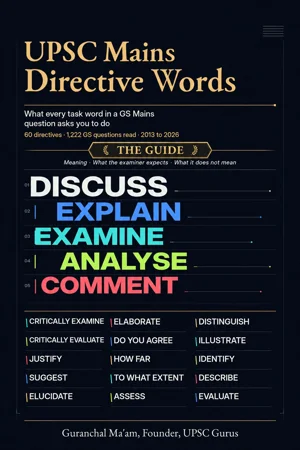
 New this week · Free UG Handout 02UPSC Mains Directive Words: 60 Meanings, Trends and PYQsTwo free PDFs: The Guide and the With PYQs edition.Read and download
Today’s Canvas
Two global yardsticks frame this edition: a fresh Global Multidimensional Poverty Index that tracks India’s long climb out of deprivation, and an Economics Nobel for work on how economies are steadied. At home, the Supreme Court balances rights, order and public sentiment, while a new steel vision and a bumper paddy harvest test planning on the ground. Beyond our borders, an announced energy truce and emergency rule in Pakistan’s Khyber Pakhtunkhwa call for careful reading. And as Navratri lights up the country, culture reminds us what all this effort is finally for.
About 20 minutes to read the key points; Mains analysis opens under each story.
- Global MPI 2026: multidimensional poverty rises for the first time since 2010; India’s incidence 16.4% (2019-21 survey)GS II
- CJI declines Opposition meeting on SIR as sub judice; Supreme Court orders normal Metro, no illegal detentionGS II
- US announces a Russia-Ukraine energy ceasefire; implementation uncertain as attacks are reportedGS II
- Indo-French TRISHNA thermal satellite expected to launch within 12 to 16 months, says ISROGS III
- Pakistan suspends elected PTI government in Khyber Pakhtunkhwa, citing breakdown of constitutional machineryGS II
- Navy commissions INS Mangrol, third Mahe-class anti-submarine shallow water craft, in MumbaiGS III
- Draft National Steel Policy Vision 2047 targets 604 mt capacity and 39% cut in emission intensityGS III
- Bumper paddy arrivals strain procurement and storage in Punjab and HaryanaGS III
- ICMR’s first high-altitude medicine and public health research centre to come up at Keylong, Himachal PradeshGS II
- Sharadiya Navratri begins after Mahalaya: two of its traditions are on UNESCO’s intangible heritage listGS I
- Central team completes drought assessment in Maharashtra; state to follow up with memorandum for central assistanceGS III
- Buxa Tiger Reserve: sit-in continues as villagers seek forest rights after tigress releaseGS III
- Supreme Court Bench, in oral remarks, favours awareness and voluntary restraint over coercive firecracker bans in Delhi-NCRGS IV
- Supreme Court sets up Standing Committee on Judicial Well-Being chaired by Justice K V ViswanathanGS II
- Global MPI 2026: 1.2 billion people in 108 countries are multidimensionally poor; India’s incidence fell from 55.1% to 16.4%.
- Retail inflation rose to 5.54% in September 2026 from 4.82% in August; food inflation was 7.74%.
- Robert E. Hall and Michael Woodford won the 2026 Economics Nobel for microeconomic foundations of macroeconomic stabilisation.
- The US President announced a Russia-Ukraine energy ceasefire; Moscow had not confirmed and terms were not given.
- Pakistan imposed emergency and Governor’s rule in Khyber Pakhtunkhwa on 11 October.
- The Navy commissioned INS Mangrol, its third Mahe-class anti-submarine shallow water craft, in Mumbai.
Reports and economy
Global MPI 2026: multidimensional poverty rises for the first time since 2010; India’s incidence 16.4% (2019-21 survey)
In short: UNDP and OPHI count 1.2 billion multidimensionally poor in 108 countries; India’s incidence fell from 55.1% to 16.4% between 2005-06 and 2019-21.
Why in news
On 12 October 2026, the UNDP Human Development Report Office and the Oxford Poverty and Human Development Initiative (OPHI) released the 2026 Global Multidimensional Poverty Index: Statistical Update. It finds that 1.2 billion of 6.3 billion people (18.9%) in 108 countries live in multidimensional poverty, and that the number of poor has risen for the first time since the index was launched in 2010.
Background
The global MPI measures overlapping deprivations in health, education and living standards at the household level, using 10 indicators. The count of poor people rose from 1,147.8 million in the 2025 tables to 1,198.1 million in 2026; population growth alone added 15.8 million across the 95 countries without new surveys, and Nigeria recorded the largest absolute rise. Sub-Saharan Africa has the highest rate (616 million people, 51.4%), while South Asia has the second-highest number of poor (about 393 million, incidence 19.9%). For India, the MPI value fell from 0.283 in 2005-06 to 0.069 in 2019-21, and incidence from 55.1% to 16.4%, with about 237.8 million people projected as poor for 2024.
Key facts for Prelims
- Global MPI is published by UNDP’s Human Development Report Office and the Oxford Poverty and Human Development Initiative (OPHI); it was launched in 2010.
- It uses 10 indicators in three dimensions: health (2: nutrition, child mortality), education (2: years of schooling, school attendance) and standard of living (6).
- Weights: each health and education indicator 1/6; each living-standard indicator 1/18. A person is poor if deprived in one-third or more of the weighted indicators.
- 2026 update: 108 countries, 6.3 billion people, subnational estimates for 1,360 regions in 100 countries; new surveys from 13 countries.
- Children are 51.5% of the poor (617 million); more than 8 in 10 poor people live in rural areas.
- India: MPI 0.069, incidence 16.4% (2019-21 survey); 33 countries have halved their MPI value in under 15 years.
Mains analysis and way forward
Mains analysis
- The rise in the global count is driven partly by population growth in countries without fresh surveys, showing that headcounts can rise even when incidence is stable; incidence and intensity must be read together.
- India’s fall from 55.1% to 16.4% incidence points to gains in sanitation, cooking fuel, housing, assets and schooling (India’s figures relate to the 2019-21 survey), reinforcing a convergence-based, multi-scheme approach to poverty.
- South Asia’s largest shares of deprivation lie in nutrition, housing and years of schooling, so nutrition remains the most stubborn indicator for the region.
- Data recency matters: India’s figures rest on 2019-21 data, so newer household surveys are needed to reflect post-pandemic change and to target lagging districts.
Way forward
- Prioritise nutrition and learning outcomes, which carry heavy weights and move slowly, through convergence of health, food and education programmes.
- Strengthen the frequency and district-level granularity of household surveys so that national and global MPI estimates stay current.
- Use MPI dashboards with SDG target 1.2 (halving poverty in all its dimensions by 2030) to guide state-level planning.
Connect the dots: Links to poverty measurement, SDG 1, human development, inclusive growth and social sector schemes (GS II and GS III).
Sources: UNDP HDR: 2026 Global Multidimensional Poverty Index, posted 12 Oct 2026; UNDP and OPHI: Global MPI 2026 Statistical Update (full report)

Draft National Steel Policy Vision 2047 targets 604 mt capacity and 39% cut in emission intensity
In short: Steel Ministry’s draft policy aims to nearly triple capacity to 604 mt by 2047 and lift per-capita use from 116 kg to 302 kg.
Why in news
The Ministry of Steel released the draft National Steel Policy Vision 2047 for public consultation late on 10 October 2026. It targets crude steel capacity of 604 million tonnes (mt) by 2047, from about 220 mt now, and a cut in CO2 intensity from 2.54 to about 1.54 tonnes per tonne of crude steel.
Background
India produced about 170 mt of crude steel in FY 2025-26 (ministry estimate), with capacity utilisation of 77%; the draft projects 531 mt output and 505 mt finished steel consumption by 2047, assuming about 7% annual GDP growth and 88% utilisation. Per-capita consumption is to rise from 116 kg to 302 kg. Raw material needs will climb sharply: iron ore from 299 mt to 772 mt and coking coal from 72 mt to 236 mt, while India imports nearly 92% of its coking coal. The draft is open for comments until 30 October 2026; the existing National Steel Policy 2017 runs to 2030-31.
Key facts for Prelims
- Draft National Steel Policy Vision 2047: capacity 604 mt; production 531 mt; export target 45 mt.
- CO2 intensity: 2.54 t per tonne of crude steel now, target about 1.54 t by 2047 (about 39% cut in emission intensity, not total emissions); global average about 1.92 t.
- Steel sector accounts for an estimated 10 to 12% of India’s CO2 emissions.
- Scrap availability to rise from 36 mt (2025-26) to 123 mt by 2047-48; iron ore slurry pipeline capacity from about 18 mtpa to over 299 mtpa.
- Raw materials form 65 to 70% of steelmaking costs; about 92% of coking coal is imported.
- Decarbonisation is phased: efficiency, renewables and scrap first, later green hydrogen-based DRI and CCUS for residual emissions.
Mains analysis and way forward
Mains analysis
- Raw material security is the binding constraint: coking coal needs more than triple, so overseas assets, washeries and alternative routes (DRI, scrap-based EAF) become strategic priorities.
- Growth and decarbonisation must move together; a 39% cut in emission intensity while tripling output requires a staged technology path and green finance, consistent with net zero by 2070.
- Logistics reform such as slurry pipelines can cut cost and emissions.
- Raising utilisation from 77% to 88% depends on domestic demand from infrastructure, housing and manufacturing, and on managing import surges.
Way forward
- Build a raw material strategy combining overseas joint ventures, better coal washing yields and a scrap-collection ecosystem.
- Link capacity addition to green steel standards, green public procurement and support for hydrogen-based DRI pilots.
- Use the consultation to address the needs of secondary and MSME steel producers along with integrated plants.
Connect the dots: Links to industrial policy, infrastructure, mineral resources, energy transition and climate commitments (GS III).
Sources: Ministry of Steel: Draft National Steel Policy Vision 2047; Business Standard: Draft steel policy targets 604 MT capacity by 2047, higher ore need, 11 Oct 2026; ThePrint (Reuters): Steel ministry plans new policy, aims to almost triple capacity to 604 million tons by 2047, 11 Oct 2026
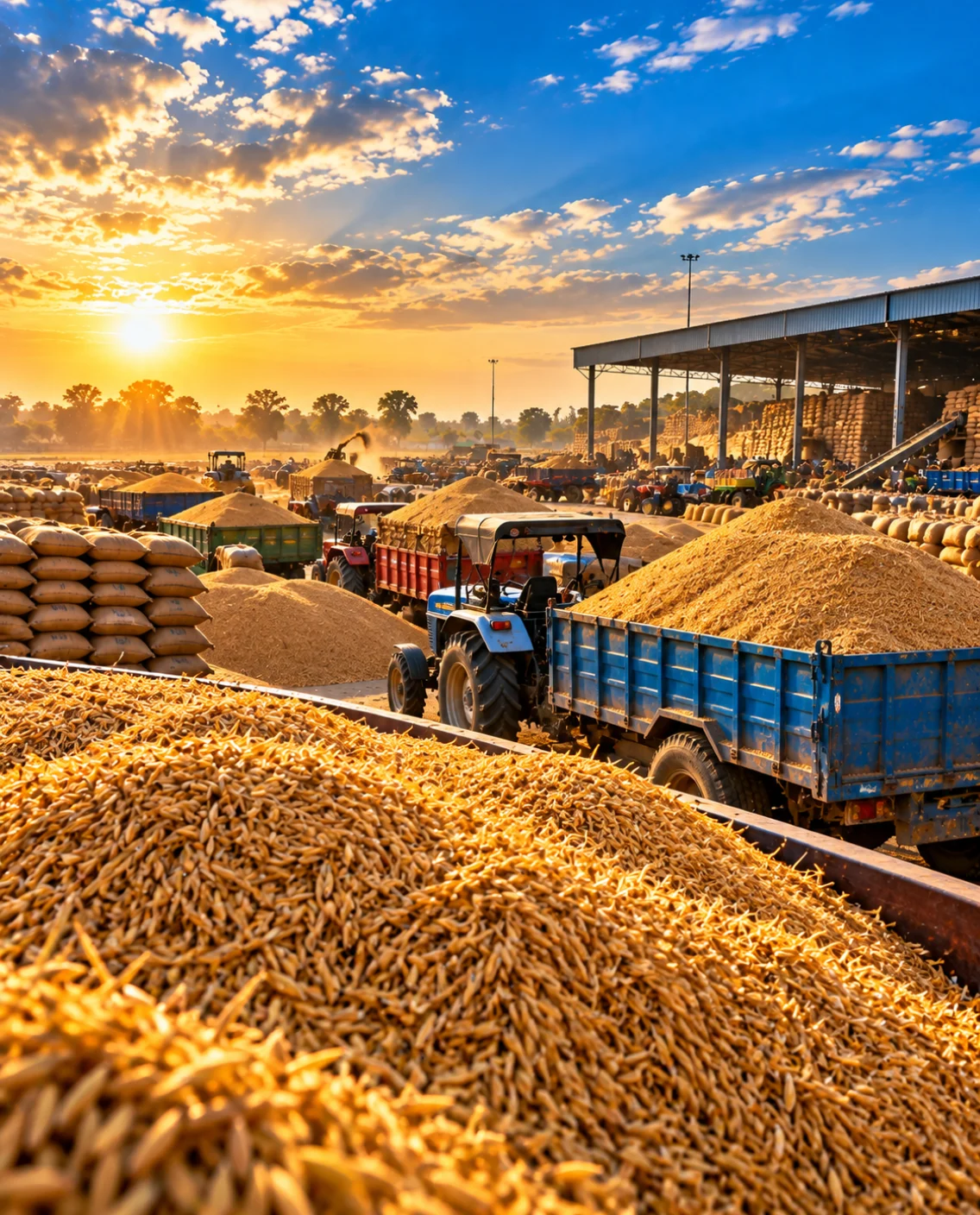
Bumper paddy arrivals strain procurement and storage in Punjab and Haryana
In short: Kharif paddy procurement at MSP of Rs 2,441 per quintal faces mandi congestion and storage pressure as large old stocks remain unlifted.
Why in news
Business Standard reported on 11 October 2026 that a bumper paddy harvest in Punjab and Haryana has led to procurement delays, mandi congestion and storage pressure, with farmers in Haryana reporting waits of three to four days. Punjab has a 2026-27 procurement target of 180 lakh tonnes (18 mt) of paddy against estimated production of about 19 mt.
Background
The Cabinet Committee on Economic Affairs fixed the 2026-27 MSP at Rs 2,441 per quintal for common paddy and Rs 2,461 for Grade A, Rs 72 higher than last year (PIB announcement, 13 May 2026). Punjab began procurement on 1 October with 1,887 notified mandis and a cash credit limit of about Rs 42,786 crore sanctioned by the Centre. Storage is the pressure point: in Punjab, wheat and rice stocks were about 27.64 mt on 31 August 2026 against storage capacity of about 26.84 mt; in Haryana, stocks were about 14.32 mt against capacity of about 13.94 mt. Farmer groups in Haryana report sales below MSP where moisture content is high.
Key facts for Prelims
- MSP 2026-27: common paddy Rs 2,441 per quintal; Grade A Rs 2,461 per quintal (increase of Rs 72).
- MSP is announced by the Centre on the recommendation of the Commission for Agricultural Costs and Prices (CACP) and approved by the CCEA.
- Punjab target 2026-27: 180 lakh tonnes of paddy (about 12.06 mt of rice after milling); 1,887 notified mandis; procurement from 1 October.
- Haryana target: about 5.8 mt of paddy, or about 3.8 mt of rice.
- Cash Credit Limit (CCL): RBI-arranged bank credit that funds state procurement for the central pool before reimbursement by the Centre.
- Asked before: UPSC CSE Prelims 2020 asked which factors or policies were affecting the price of rice in India, such as MSP, government trading, stockpiling and consumer subsidies.
Mains analysis and way forward
Mains analysis
- A storage and lifting bottleneck, not a production shortfall, is the core problem: unlifted old stocks crowd out space for the new crop and slow mandi clearance.
- Delays and moisture deductions can push farm-gate prices below MSP, weakening the price signal that MSP is meant to provide.
- Concentration of open-ended procurement in a few states reinforces the paddy-wheat cycle, with costs for groundwater and stubble management.
- Faster movement of rice to deficit states, open market sales and exports, within food-security needs, can free storage and reduce carrying costs for the central pool.
Way forward
- Plan lifting and rake movement before the season and add modern storage such as silos under the grain storage plan in the cooperative sector.
- Expand on-site drying and moisture testing at mandis and stagger harvesting through better scheduling.
- Continue crop diversification incentives towards pulses, oilseeds and maize in Punjab and Haryana.
Connect the dots: Links to MSP, public distribution and food security, buffer stocks, crop diversification and agricultural marketing (GS III).
Sources: Business Standard: A problem of plenty in Haryana, Punjab as paddy glut sparks farmer distress, 11 Oct 2026; S&P Global: India hikes minimum support price for kharif paddy in MY 2026-27, 13 May 2026; Rozana Spokesman: Punjab ready for paddy procurement from October 1, Centre approves Rs 42,786 crore, 29 Sep 2026
Polity and governance
CJI declines Opposition meeting on SIR as sub judice; Supreme Court orders normal Metro, no illegal detention
In short: The CJI said SIR issues must come on the judicial side; a Sunday bench protected movement, internet and access to justice in Delhi.
Why in news
On 11 October 2026, Chief Justice of India Surya Kant declined a request from Leaders of Opposition Rahul Gandhi and Mallikarjun Kharge to meet him on 12 October over the Special Intensive Revision (SIR) of electoral rolls, saying the issues are already sub judice and the leaders are free to approach the Court on its judicial side. The same day, in a special Sunday hearing, a Bench of Justices Joymalya Bagchi and V Mohana directed that Metro and rail services function normally, that there be no detention save by procedure established by law, and that internet services remain undisturbed.
Background
Opposition parties planned a march to the Supreme Court on 12 October 2026 with a memorandum seeking a halt to the SIR and the resignation of Chief Election Commissioner Gyanesh Kumar. The CJI conveyed that the Court cannot interfere with executive functioning on its administrative side, and that any petition could be heard with similar SIR matters listed on 13 October. The Sunday order (Shailendra Mani Tripathi v. Union of India) also asked authorities to review barricades, remove a Section 163 BNSS notice board near the Court so there is no apprehension about access to justice, and show cause why contempt should not be initiated.
Key facts for Prelims
- Article 324 vests superintendence, direction and control of elections in the Election Commission of India; Article 324(5) provides that the CEC can be removed only in the manner and on the grounds of a Supreme Court judge.
- The Chief Election Commissioner and Other Election Commissioners (Appointment, Conditions of Service and Term of Office) Act, 2023 governs appointment of the CEC and ECs through a selection committee.
- Article 19(1)(b) guarantees the right to assemble peaceably and without arms; Article 19(3) permits reasonable restrictions in the interests of sovereignty and integrity of India or public order.
- Section 163 of the Bharatiya Nagarik Suraksha Sanhita, 2023 replaces Section 144 of the CrPC for urgent orders in cases of nuisance or apprehended danger.
- Sub judice: a matter under judicial consideration; the Supreme Court acts on its judicial side through petitions such as those under Article 32.
Mains analysis and way forward
Mains analysis
- Institutional restraint: by separating its administrative and judicial sides, the Court keeps adjudication of electoral disputes within due process and avoids informal engagement on pending matters.
- Rights and public order: the order permits regulation of Metro services consistent with Articles 19(1)(b) and 19(1)(d), read with Articles 19(3), 19(5) and 21, but not blanket prohibition, applying a proportionality lens to restrictions on movement and communication.
- Access to justice is itself a value the Court protects, as seen in its direction to remove a prohibitory notice board near its premises.
- Electoral integrity rests on public trust in roll revision; transparent claims-and-objections processes and timely adjudication help sustain that trust.
Way forward
- Timely hearing of the listed SIR petitions and the challenges to CEC decisions can settle legal questions on a clear record.
- Police authorities can adopt documented, proportionate crowd-management standards that respect peaceful assembly while keeping public order.
- The Election Commission can widen public disclosure of deletion and addition data and grievance redress during the SIR.
Connect the dots: Links to: Article 324, independence of the ECI, Article 19 and reasonable restrictions, judicial review, separation of powers.
Sources: LiveLaw: CJI Surya Kant declines LoP Rahul Gandhi’s request for meeting over SIR and CEC, 11 October 2026; Bar and Bench: CJI Surya Kant declines meeting with Rahul Gandhi, Mallikarjun Kharge; says approach Court judicially, 11 October 2026; Verdictum: Supreme Court passes interim order for normal operations of Delhi Metro, barricade review, 11 October 2026; The Week: CJI declines INDIA bloc’s proposed discussion ahead of SC march, 11 October 2026; Business Standard: Rahul Gandhi press conference ahead of INDIA bloc march, 12 October 2026
Supreme Court sets up Standing Committee on Judicial Well-Being chaired by Justice K V Viswanathan
In short: A permanent platform will identify stress points and coordinate welfare measures for judicial officers facing heavy caseloads.
Why in news
On 10 October 2026, coinciding with World Mental Health Day, CJI Surya Kant constituted a Standing Committee on Judicial Well-Being chaired by Supreme Court judge Justice K V Viswanathan. The Court said the aim is to move beyond isolated interventions and set up a sustained framework for judicial well-being.
Background
Members include Dr Savita Malhotra (former Dean and Head of Psychiatry, PGIMER Chandigarh), psychologist Rajat Mitra, Advocate-on-Record Mrinal Kanwar and Aarti Singh, Registrar (Judicial), Centre for Research and Planning of the Supreme Court. The committee will identify areas needing institutional intervention, coordinate welfare measures, develop guidance and periodically review initiatives. The Court cited heavy caseloads, long hours, complex decisions, administrative pressure and emotionally sensitive cases, and linked well-being to an effective, independent justice system.
Key facts for Prelims
- Chair: Justice K V Viswanathan; constituted on 10 October 2026 (World Mental Health Day).
- World Mental Health Day is observed on 10 October.
- The Centre for Research and Planning is an in-house research wing of the Supreme Court.
- The Mental Healthcare Act, 2017 recognises a right to access mental healthcare and, through Section 115, presumes severe stress in a person who attempts suicide, who is not to be tried and punished.
Mains analysis and way forward
Mains analysis
- Judicial burnout affects the quality and speed of decisions, so well-being is part of access to justice, not only a welfare issue.
- District judiciary bears the heaviest caseloads and emotionally demanding work such as POCSO and family matters, and needs targeted support.
- An institutional, confidential mechanism reduces stigma compared with ad hoc help.
- Ethics: compassion and emotional intelligence in public institutions begin with care for those who serve in them.
Way forward
- Extend counselling, peer support and workload norms to High Courts and district courts.
- Use data from the Centre for Research and Planning to link case allocation with well-being outcomes.
Connect the dots: Links to: judicial reforms, pendency, Mental Healthcare Act 2017, emotional intelligence (GS IV).
Sources: Supreme Court of India: press release on Standing Committee on Judicial Well-Being, 10 October 2026; Verdictum: Supreme Court constitutes Standing Committee on Judicial Well-Being, 10 October 2026
Supreme Court Bench, in oral remarks, favours awareness and voluntary restraint over coercive firecracker bans in Delhi-NCR
In short: Hearing the NCR air pollution matter, the CJI-led Bench remarked orally that voluntary participation works better than hard-to-enforce total bans.
Why in news
A Bench of CJI Surya Kant and Justices Joymalya Bagchi and V Mohana, hearing the suo motu matter on air pollution in the National Capital Region (reported on 12 October 2026), remarked orally that public awareness and voluntary participation are more effective than total bans; no final order changing existing restrictions was reported. The CJI observed that the Court would not hurt religious sentiments but would create “a welcoming preference”, and noted that restrictive orders are often seen as coercive.
Background
The matter, In Re: Curbing Air Pollution in the National Capital Region (SMW(C) No. 15/2026), is the Court’s current suo motu docket on NCR air pollution, which sits alongside the long-running M.C. Mehta v. Union of India proceedings. In October 2025 the Court had allowed the sale and bursting of NEERI-approved green crackers in Delhi-NCR for Diwali with restricted timings. The Bench suggested publishing material on the harms of firecrackers, an earnest appeal to limit use to certain hours, and market regulation that restricts more harmful crackers. The amicus curiae flagged health risks to children, the elderly and infants and said time limits are poorly enforced; trader bodies pointed to a related matter, Arjun Gopal v. Union of India, before another Bench.
Key facts for Prelims
- Green crackers were developed by CSIR-NEERI (National Environmental Engineering Research Institute, Nagpur).
- Article 25 freedom of religion is subject to public order, morality and health.
- Article 48A (Directive Principle) asks the State to protect and improve the environment; Article 51A(g) makes it a fundamental duty of citizens.
- The Commission for Air Quality Management in NCR and Adjoining Areas (CAQM) is a statutory body under the CAQM Act, 2021.
- M.C. Mehta v. Union of India (1985 writ) is the parent case for many Delhi pollution orders.
Mains analysis and way forward
Mains analysis
- Ethics of nudging: awareness and choice architecture respect autonomy and build ownership, while bans risk resentment and weak compliance.
- Balancing rights: the right to a healthy environment under Article 21 and the freedom of religious practice are reconciled through proportionate, time-bound regulation.
- Enforcement gap: rules that cannot be policed on the ground erode the credibility of law, so design matters as much as intent.
- Moral responsibility is shared: households, traders and local bodies each shape the outcome for vulnerable groups such as children and the elderly.
Way forward
- Pair public campaigns with clear market rules so less harmful products are easy to choose.
- Use community celebrations and fixed time windows to reduce exposure while respecting festivals.
- Publish ward-level air quality data during festival weeks to inform voluntary action.
Connect the dots: Links to: GS IV (persuasion, attitude change, public service values), Article 21 right to clean environment, Article 25, air pollution governance.
International relations
US announces a Russia-Ukraine energy ceasefire; implementation uncertain as attacks are reported
In short: A truce on strikes against energy infrastructure could ease winter hardship in Ukraine and pressure on global fuel markets, if both sides honour it.
Why in news
On 11 October 2026 US President Donald Trump said in a social media post that Russia and Ukraine had agreed to an “energy ceasefire” taking effect immediately, and urged both sides to honour it. No terms were given, and Moscow had not immediately commented. Ukrainian President Volodymyr Zelenskyy welcomed the announcement as good news and said it must now be made a reality. On 12 October Ukraine accused Russia of fresh attacks on its energy infrastructure, so the truce could not be treated as in force.
Background
Russia has repeatedly targeted Ukraine’s power, heating and water systems, which Ukrainian officials describe as “weaponising winter”, while Ukraine has struck Russian oil refineries and diesel facilities. Zelenskyy had said Ukraine was ready to stop refinery strikes if Moscow halted attacks on Ukraine’s energy infrastructure. A day earlier, Trump had blamed Ukrainian strikes for a global diesel shortage, and Washington had announced a deal for Russia to supply millions of tonnes of diesel to the US, which Zelenskyy criticised as helping finance the war. A similar 30-day halt on energy strikes was agreed by Russian President Vladimir Putin in a call with Trump on 18 March 2025, narrower than the full truce sought then.
Key facts for Prelims
- Energy ceasefire: a partial truce limited to strikes on energy infrastructure (power plants, grids, refineries), not a general ceasefire.
- 18 March 2025: Putin agreed to a 30-day halt on strikes on energy infrastructure after a call with Trump.
- Diesel is a middle distillate; refinery outages raise diesel crack spreads and freight costs worldwide.
- Partial truces are often described as confidence-building measures in conflict resolution.
Mains analysis and way forward
Mains analysis
- Partial ceasefires can build trust and protect civilians from loss of heating and water in winter, but without agreed terms and monitoring they are fragile, as the short-lived 2025 halt showed.
- The link between the truce and fuel markets shows how energy has become both a weapon and a bargaining chip, with effects far beyond the battlefield.
- For India, calmer refinery and energy markets would help contain import costs and inflation; it also tests India’s long-standing call for dialogue and diplomacy as the way to end the conflict.
- Great-power deal-making over Ukraine’s head raises questions about the voice of the affected state and the durability of any settlement.
Way forward
- Convert the announcement into written terms with clear definitions of protected facilities and a neutral monitoring mechanism.
- Use the energy truce as a step towards wider humanitarian measures such as prisoner exchanges and safe passage for civilians.
- India can continue supporting humanitarian relief and any credible peace process acceptable to both parties.
Connect the dots: GS II: effect of policies and politics of developed countries on India’s interests; GS III: energy security.
Sources: News On AIR: US President announces an energy ceasefire between Russia and Ukraine with immediate effect, 12 Oct 2026; News On AIR: Trump announces Russia-Ukraine energy ceasefire, urges both sides to honour agreement, 11 Oct 2026; Reuters via Daily Maverick: Putin agrees in Trump call to 30-day ceasefire with Ukraine on energy targets, 18 Mar 2025; Reuters: Ukraine accuses Russia of violating energy ceasefire, 12 October 2026
Pakistan suspends elected PTI government in Khyber Pakhtunkhwa, citing breakdown of constitutional machinery
In short: Emergency rule in Pakistan’s north-western province deepens the government-PTI confrontation in a region bordering Afghanistan.
Why in news
On 11 October 2026 Pakistan’s President Asif Ali Zardari approved emergency and Governor’s rule under Articles 232 and 234 of Pakistan’s Constitution, suspending the elected provincial government of Khyber Pakhtunkhwa (KP), led by Imran Khan’s Pakistan Tehreek-e-Insaf (PTI), on the recommendation of Prime Minister Shehbaz Sharif’s cabinet, citing a “breakdown of constitutional machinery in the province”. The Governor takes over the provincial government’s powers, the federal Parliament exercises those of the provincial assembly, and the Chief Minister and ministers ceased to hold office.
Background
The move follows a protest march towards Islamabad led by PTI supporters and KP Chief Minister Sohail Afridi, demanding Imran Khan’s release and access to medical treatment for him. Khan, 73, has been held at Adiala Jail, Rawalpindi, since 2023 and was removed as Prime Minister in April 2022 by a no-confidence vote. Pakistan’s Constitution allows the President to proclaim an emergency for failure of constitutional machinery in a province under Article 234, when satisfied (for example on a Governor’s report); the proclamation must be laid before a joint sitting of Parliament, lasts two months and can be extended up to six months. KP (formerly NWFP) has seen such rule in 1975, 1994 and from 1999 to 2002.
Key facts for Prelims
- Article 234 (Pakistan): emergency for failure of constitutional machinery in a province; comparable in intent to Article 356 of the Indian Constitution.
- Article 232 (Pakistan): emergency due to war or internal disturbance.
- Khyber Pakhtunkhwa: capital Peshawar; borders Afghanistan; formerly North-West Frontier Province (NWFP).
- Adiala Jail is in Rawalpindi, Punjab province.
- KP/NWFP saw Governor’s rule in 1975 and 1994; the 1999-2002 period fell under military government.
Mains analysis and way forward
Mains analysis
- Suspending an elected provincial government deepens Pakistan’s civil-political polarisation and may weaken federalism and public trust in institutions.
- KP borders Afghanistan and has faced militant violence; administrative disruption there can affect counter-terrorism and border management, which India watches closely for regional security.
- Prolonged internal instability in a neighbour calls for steady vigilance along the Line of Control and the international border, alongside calm and measured diplomacy.
- The comparison with India’s Article 356 and the S.R. Bommai (1994) safeguards is useful for understanding how judicial review and floor tests protect federalism.
Way forward
- India can maintain calm watchfulness, strengthen border and counter-infiltration preparedness and avoid commenting on Pakistan’s internal politics.
- Track developments for spillover into Afghanistan-Pakistan border dynamics and terror financing, working through multilateral forums such as the FATF and UN sanctions committees.
Connect the dots: GS II: India and its neighbourhood; comparison of the Indian constitutional scheme with other countries (Article 356 vs emergency provisions elsewhere).
Sources: Radio Pakistan: President promulgates emergency, Governor’s rule in KP, 11 October 2026; News On AIR: Pakistan suspends Khyber Pakhtunkhwa government led by Imran Khan’s PTI party, 11 Oct 2026; ThePrint: KP’s long history with governor’s rule, 2 Oct 2026
Science, health and technology

Indo-French TRISHNA thermal satellite expected to launch within 12 to 16 months, says ISRO
In short: TRISHNA, built by ISRO and CNES, will map land surface temperature at 57 m to track water stress, crops and urban heat.
Why in news
On 11 October 2026, an ISRO official from the U.R. Rao Satellite Centre said the Indo-French TRISHNA satellite is expected to launch within 12 to 16 months. The mission focuses on water resource management.
Background
TRISHNA (Thermal infraRed Imaging Satellite for High-resolution Natural resource Assessment) is a joint mission of ISRO and the French space agency CNES. CNES provides the four-channel Thermal Infra-Red (TIR) instrument, while ISRO builds the seven-band Visible, Near-Infrared and Short-Wave Infrared (VNIR-SWIR) payload. The satellite will fly in a sun-synchronous orbit at 761 km, crossing the equator at 12:30 pm local time, with a design life of five years. It will image land and coastal areas at 57 m resolution and oceans and polar regions at 1 km.
Key facts for Prelims
- TRISHNA: joint mission of ISRO (India) and CNES (France).
- Payloads: TIR (4 channels, CNES) and VNIR-SWIR (7 bands, ISRO).
- Orbit: sun-synchronous, 761 km, 12:30 pm equator crossing; 5-year design life.
- Resolution: 57 m over land and coasts; 1 km over oceans and polar regions.
- Uses: estimating evapotranspiration, crop water stress, urban heat islands, volcanic and geothermal anomalies, snow-melt and glacier dynamics.
Mains analysis and way forward
Mains analysis
- Thermal infrared data measures land surface temperature and helps estimate evapotranspiration, giving an early signal of crop water stress before visible damage appears.
- High-resolution heat mapping can guide urban heat action plans and heat alerts for cities.
- Open global data sharing strengthens India’s role as a provider of climate public goods and supports SDG and GEOGLAM monitoring.
- The mission deepens the India-France space partnership, building on earlier joint satellites such as Megha-Tropiques and SARAL.
Way forward
- Build ground-level validation networks and agro-advisory pipelines so that data reaches farmers and water managers quickly.
- Integrate TRISHNA outputs with drought monitoring, irrigation planning and city heat action plans.
- Train state remote sensing centres to use thermal products alongside existing optical and radar data.
Connect the dots: Links to GS III space technology, remote sensing applications, water resource management and climate adaptation.
Sources: NewsBytes: India, France partner on TRISHNA satellite launching within 12-16 months, 11 October 2026; ISRO: TRISHNA Mission page; CNES: TRISHNA project page

ICMR’s first high-altitude medicine and public health research centre to come up at Keylong, Himachal Pradesh
In short: ICMR-CHAMP at Keylong will study mountain medicine, climate-sensitive diseases and remote healthcare delivery for Himalayan and border populations.
Why in news
Union Health Minister J.P. Nadda was scheduled to lay the foundation stone of the ICMR Centre for High Altitude Medicine and Public Health Research (ICMR-CHAMP) at Keylong in Lahaul and Spiti district on 12 October 2026. It is described as ICMR’s first dedicated centre for high-altitude medicine and public health research.
Background
The centre is being set up by the Indian Council of Medical Research under the Department of Health Research, Ministry of Health and Family Welfare. Its research areas include high-altitude physiology and acclimatisation, mountain and disaster medicine, climate-sensitive and emerging diseases, maternal and child health, nutrition, mental health and occupational health. It will also test telemedicine, digital health platforms, drone-enabled medical logistics and real-time disease surveillance for remote habitations. Collaborators include the Armed Forces Medical Services, national research institutions and the Himachal Pradesh government.
Key facts for Prelims
- ICMR-CHAMP: Centre for High Altitude Medicine and Public Health Research, Keylong, Lahaul and Spiti district, Himachal Pradesh.
- ICMR functions under the Department of Health Research (Ministry of Health and Family Welfare); the DG of ICMR is also Secretary, DHR (currently Dr Rajiv Bahl).
- The Armed Forces Medical Services (AFMS) is a collaborator, reflecting the needs of personnel posted in high-altitude terrain.
- Planned add-ons at the ceremony: native Himalayan sapling plantation under the Green ICMR Campus Initiative and a commemorative postal special cover.
Mains analysis and way forward
Mains analysis
- High-altitude populations face specific risks such as hypoxia-related illness, harsh winters and long distances to care, which need locally generated evidence rather than plain-area protocols.
- Climate change is altering disease patterns and disaster risks in the Himalaya, making climate-sensitive health research a public health priority.
- Civil-military collaboration can pool expertise in acclimatisation and emergency care for both border communities and soldiers.
- Telemedicine and drone logistics can narrow last-mile gaps, but need reliable connectivity and trained local health workers.
Way forward
- Link the centre’s findings to state health systems and Ayushman Arogya Mandirs in hill districts so research turns into services.
- Build long-term cohorts with tribal and high-altitude communities on the basis of informed consent and community partnership.
- Network with other Himalayan states for shared surveillance and disaster-medicine protocols.
Connect the dots: Links to: health research institutions, tribal health, climate and health, Himalayan geography, civil-military cooperation.
Sources: ANI: JP Nadda to lay foundation stone of ICMR’s first high-altitude medicine research centre in Himachal tomorrow, 11 October 2026; DD India: Health Minister Nadda to lay foundation stone for ICMR’s first high-altitude health research centre in Keylong, October 2026; The Tribune: Nadda to lay stone of medicine research centre at Keylong today, 12 October 2026; Deccan Herald: ICMR to establish high altitude health research centre in Himachal Pradesh, 11 October 2026
Defence

Navy commissions INS Mangrol, third Mahe-class anti-submarine shallow water craft, in Mumbai
In short: INS Mangrol, built by Cochin Shipyard with over 80 per cent indigenous content, strengthens coastal anti-submarine defence on the western seaboard.
Why in news
On 12 October 2026 the Indian Navy commissioned INS Mangrol, the third Anti-Submarine Warfare Shallow Water Craft (ASW-SWC) of its class, at the Naval Dockyard, Mumbai. Vice Admiral Sanjay Vatsayan, Flag Officer Commanding-in-Chief, Western Naval Command, presided. The ship carries more than 80 per cent indigenous content.
Background
The Ministry of Defence signed a Rs 6,311 crore contract with Cochin Shipyard Limited (CSL) on 30 April 2019 for eight Mahe-class ASW shallow water craft, with INS Mahe as the lead ship. INS Mahe, INS Malvan and INS Mangrol were launched together at Kochi on 30 November 2023. CSL delivered Mangrol in August 2026; INS Malvan, delivered on 31 March 2026, was commissioned in July. The ship is named after Mangrol, a fishing harbour town in Junagadh district of Gujarat, and revives the name of a minesweeper that served until 7 April 2004.
Key facts for Prelims
- ASW-SWC: designed to detect and counter submarines and underwater threats in coastal and shallow waters.
- Builder: Cochin Shipyard Limited, Kochi; eight Mahe-class craft contracted in April 2019 (Rs 6,311 crore for the eight-vessel programme).
- Sensors and weapons: Abhay hull-mounted sonar, lightweight torpedoes, indigenous anti-submarine rocket launcher, Mareech Advanced Torpedo Decoy System.
- Mangrol is a fishing harbour town in Junagadh district, Gujarat.
- Commissioning presided over by the FOC-in-C, Western Naval Command (headquartered in Mumbai).
Mains analysis and way forward
Mains analysis
- Shallow littoral waters are where conventional submarines and unmanned underwater vehicles can hide closest to ports, offshore assets and fishing grounds; dedicated ASW craft fill a gap that larger frigates cannot cover economically.
- Over 80 per cent indigenous content shows the depth now reached in domestic shipbuilding supply chains, including sonar and decoy systems, in line with Aatmanirbhar Bharat in defence.
- Navy reports ten ships commissioned in 2026 and eight more due soon, with about 60 per cent of platforms expected to average under ten years old by 2034: a sign of fleet renewal and steady order books for public sector yards.
- Coastal ASW also supports the post-2008 coastal security architecture by protecting harbours and approaches along a coastline with many fishing and trading ports.
Way forward
- Keep delivery schedules for the remaining craft on time and invest in crew training and maintenance for sonar-heavy platforms.
- Integrate the craft with maritime patrol aircraft, helicopters and underwater domain awareness networks for layered coastal defence.
- Continue raising indigenous content in propulsion and electronics through partnerships with MSMEs and start-ups.
Connect the dots: GS III: security challenges in border and coastal areas; indigenisation of technology; defence production and shipbuilding.
Sources: News On AIR: Indian Navy commissions third anti-submarine warfare craft INS Mangrol in Mumbai, 12 Oct 2026; Manorama Yearbook: Cochin Shipyard delivers Mangrol to Navy, 22 Aug 2026; Marine Insight: Indian Navy’s 3 anti-submarine warfare ships launched at Cochin Shipyard, 1 Dec 2023; PIB: commissioning of INS Mangrol
Art and culture

Sharadiya Navratri begins after Mahalaya: two of its traditions are on UNESCO’s intangible heritage list
In short: Navratri (11 to 20 October) brings Durga Puja and Garba, both inscribed on UNESCO’s Representative List of Intangible Cultural Heritage.
Why in news
Mahalaya was observed on 10 October 2026, marking the end of the 16-day Pitru Paksha and the start of Devi Paksha. Sharadiya Navratri began on 11 October with Ghatasthapana and will conclude with Dussehra on 20 October 2026.
Background
Durga Puja in Kolkata was inscribed on UNESCO’s Representative List of the Intangible Cultural Heritage of Humanity in 2021 at the 16th session of the Intergovernmental Committee, held online. UNESCO notes that worship begins on Mahalaya, when eyes are painted onto clay images made from Ganga silt, and ends with immersion on the tenth day. Garba of Gujarat, the devotional circular dance performed during Navaratri, was inscribed in December 2023 at the 18th session in Kasane, Botswana, as India’s 15th element on the list. Both inscriptions fall under the 2003 Convention for the Safeguarding of the Intangible Cultural Heritage.
Key facts for Prelims
- Durga Puja in Kolkata: UNESCO Representative List, 2021 (16th session, online).
- Garba of Gujarat: inscribed 2023 at the 18th session, Kasane, Botswana; India’s 15th ICH element.
- UNESCO Convention for the Safeguarding of the Intangible Cultural Heritage: adopted 2003.
- Mahalaya ends Pitru Paksha (16 days) and begins Devi Paksha; the eye-painting of Durga images (Chokkhu Daan) is linked to it.
- Garba is danced counter-clockwise around a perforated earthen pot holding an oil lamp, or an image of goddess Amba.
Mains analysis and way forward
Mains analysis
- Both festivals show living heritage: UNESCO highlights how Durga Puja collapses divides of class, religion and ethnicity, and how Garba eases socio-economic and gender divisions.
- Durga Puja sustains a large creative economy of clay artisans, pandal designers, drummers and lighting workers.
- UNESCO listing brings visibility but also duties: crowd, traffic and pollution management were part of India’s safeguarding commitments for Durga Puja.
- Commercialisation and plastic or chemical-paint idols can strain rivers; eco-friendly immersion norms are part of sustainable celebration.
Way forward
- Promote natural clay and non-toxic colours, with artificial immersion ponds where rivers are stressed.
- Support artisan clusters through skilling, credit and design protection so that the craft passes to new generations.
- Document and digitise community practices, as envisaged in safeguarding plans under the 2003 Convention.
Connect the dots: Links to GS I Indian culture (festivals, performing arts), UNESCO ICH list from India, and cultural economy.
Sources: NewsBytes: Navratri begins Sunday October 11 with ghatasthapana, ends October 20, 10 October 2026; DD India: PM Modi, Amit Shah extend Mahalaya greetings, 10 October 2026; Organiser: Mahalaya 2026 greetings, 10 October 2026; UNESCO: Durga Puja in Kolkata; UNESCO: Decision 16.COM 8.B.15; UNESCO: Garba of Gujarat; The Tribune: Gujarat’s Garba included in UNESCO list, 6 December 2023
Environment and disaster management
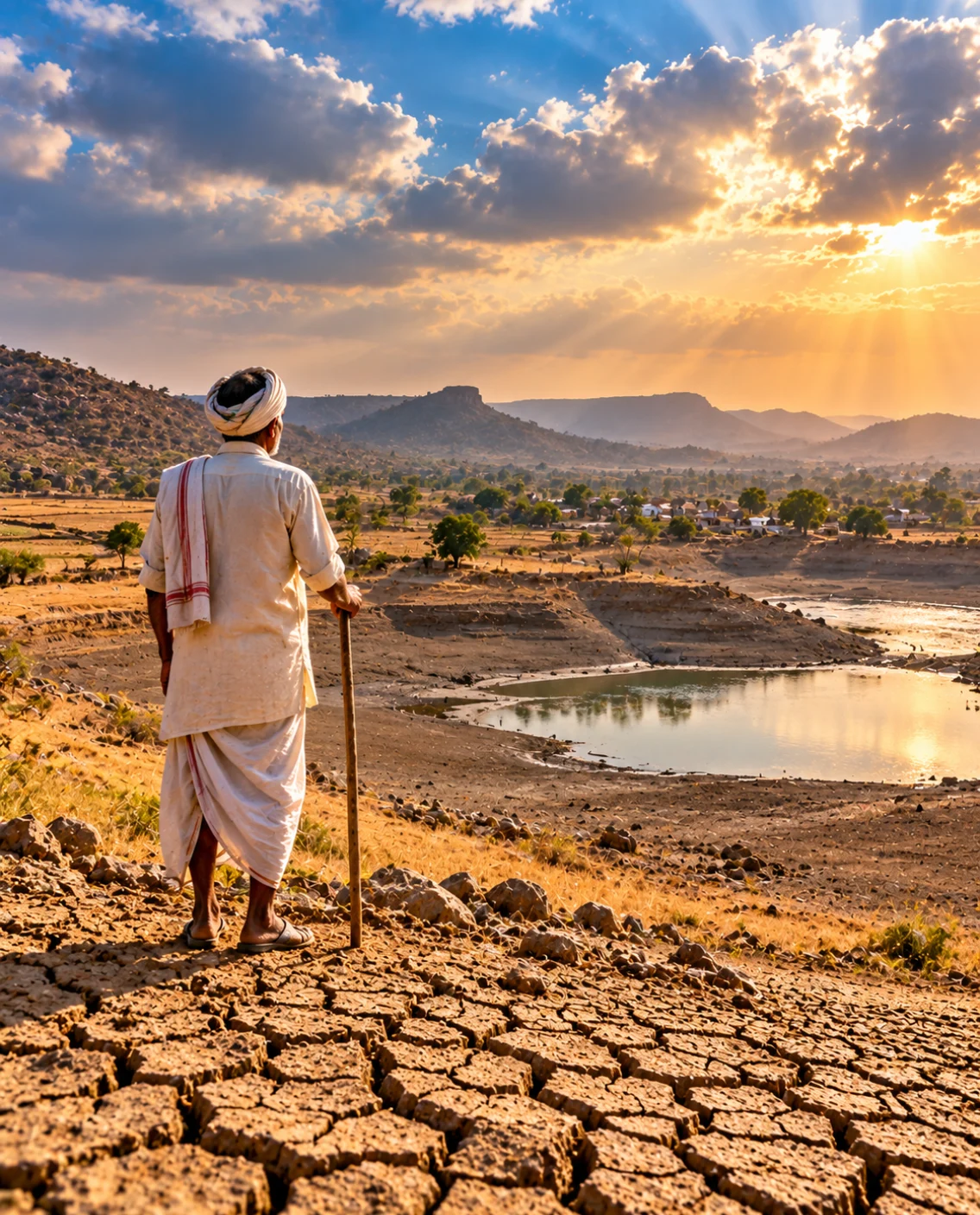
Central team completes drought assessment in Maharashtra; state to follow up with memorandum for central assistance
In short: With 265 of 358 talukas drought-hit, Maharashtra seeks central assistance after an inter-ministerial team toured seven districts.
Why in news
On 11 October 2026, Chief Minister Devendra Fadnavis met the central drought assessment team led by Joint Secretary Muktanand Agrawal in Mumbai after its 8 to 11 October field visit. Three sub-teams inspected fields and water sources in Ahilyanagar, Solapur, Jalna, Beed, Dharashiv, Washim and Yavatmal, and the state is to follow up its initial information with a detailed memorandum.
Background
A state government resolution of 26 September 2026 reported drought conditions in 265 talukas, about 74 per cent of the state’s 358 talukas, an unusually early declaration. Deficient rain at a crucial growth stage hit soybean, with damage also to cotton, tur and sugarcane. The inter-ministerial team drew on about ten departments and institutions, including Finance, NITI Aayog, Jal Shakti, Food and Public Distribution, Animal Husbandry and the Mahalanobis National Crop Forecast Centre, and assesses conditions under the Drought Management Manual, 2020. The state is planning employment, foodgrains, drinking water and fodder for the next six to eight months, and says it plans to reserve water for drinking until August 2027.
Key facts for Prelims
- Drought Management Manual, 2020: framework used by the Centre for drought assessment and declaration.
- National Disaster Response Fund (NDRF): Section 46 of the Disaster Management Act, 2005; State Disaster Response Fund: Section 48.
- Inter-Ministerial Central Team (IMCT): field assessment that precedes NDRF assistance; this team was led by the Department of Agriculture and Farmers Welfare.
- Mahalanobis National Crop Forecast Centre (MNCFC): uses remote sensing for crop forecasting and drought assessment; part of the team.
- Maharashtra: 265 of 358 talukas declared drought-affected (26 September 2026 resolution).
Mains analysis and way forward
Mains analysis
- Drought is a slow-onset disaster: early declaration helps relief start before distress sales of livestock and migration set in.
- Rain-fed Marathwada and Vidarbha districts growing soybean, cotton and tur remain most exposed to dry spells at critical crop stages.
- Relief financing follows a sequence: state funds first, SDRF next, and NDRF top-up after the IMCT report and a high-level committee decision, which can delay payouts.
- Fodder, drinking water and rural employment are the immediate priorities, while water budgeting and crop diversification decide long-term resilience.
Way forward
- Use satellite and soil-moisture indices for faster, objective drought declaration and quicker IMCT visits.
- Link relief with long-term measures: watershed works, micro-irrigation, drought-tolerant varieties and crop insurance coverage.
- Plan for the coming rabi season with contingency crop plans and village-level water budgets.
Connect the dots: Links to GS III disaster management (drought, DM Act 2005, NDRF/SDRF) and GS I geography of rain-shadow regions.
Sources: ThePrint (PTI): Maharashtra govt to submit detailed memorandum for Central drought relief, 11 October 2026; ANI: Fadnavis urges Centre for increased financial aid as drought impacts cotton, soybean, tur, 11 October 2026; AIR News: Central team arrives in Maharashtra to assess drought, 8 October 2026; The Pioneer: Fadnavis seeks special Central assistance, 8 October 2026; Free Press Journal: Centre forms inter-ministerial team, 6 October 2026

Buxa Tiger Reserve: sit-in continues as villagers seek forest rights after tigress release
In short: A tigress from Valmiki has returned tigers to Buxa, but curbs on movement and tourism have sparked protests over forest rights.
Why in news
On 11 October 2026, villagers in the Buxa and Jayanti area of north Bengal continued an indefinite sit-in, after lifting a day-long road blockade on 10 October following talks with officials. They seek implementation of the Forest Rights Act, recognition of their right to live in the area, conversion of forest settlements into revenue villages and public information on forest resources.
Background
A three-year-old tigress from Bihar’s Valmiki Tiger Reserve was released in Buxa on 2 October 2026 as part of efforts to revive its tiger population. Tourism in Buxa and Jayanti was suspended from 30 September to 9 October, with limited access allowed from 10 October; local reports say thousands of tourism-dependent residents are under strain. Buxa, in Alipurduar district, was declared a tiger reserve in 1983 and has several forest villages within it; relocation from core areas under the law has to be voluntary and with consent.
Key facts for Prelims
- Buxa Tiger Reserve: north Bengal (Alipurduar district), declared in 1983.
- Tigress translocated from Valmiki Tiger Reserve (Bihar), released on 2 October 2026.
- Wildlife (Protection) Act, 1972, Section 38V: tiger reserves with core (critical tiger habitat) and buffer areas; relocation needs informed consent and a fair package.
- Forest Rights Act, 2006: Section 4(2) allows modification or resettlement of forest rights in critical wildlife habitats only with statutory safeguards, including free informed consent of the gram sabha; this is distinct from notifying a tiger reserve’s core under the Wildlife (Protection) Act.
- NTCA, a statutory body under the WLPA, approves tiger translocation and reintroduction plans.
Mains analysis and way forward
Mains analysis
- Tiger reintroduction succeeds only with prey base, protection and local support; Buxa shows how livelihood losses can erode that support.
- Voluntary, well-compensated relocation and settled forest rights reduce conflict, while coercive restrictions risk alienating forest dwellers.
- Community-based ecotourism can align conservation with income, if benefit-sharing and clear rules replace ad hoc closures.
- Transparent information on forest resources and decisions builds trust between gram sabhas and forest departments.
Way forward
- Complete FRA claim verification with gram sabha participation before any relocation.
- Design a transition plan for homestays, guides and safari operators, with community-run tourism in the buffer.
- Set up a joint monitoring committee of the forest department, panchayats and residents for the reintroduction phase.
Connect the dots: Links to GS III conservation (Project Tiger, NTCA, WLPA 1972) and GS II rights of forest dwellers (FRA 2006).
Sources: The Statesman: Sit-in protest continues at Buxa, road blockade lifted, 11 October 2026; The Statesman: Villagers, tourism stakeholders launch protest around Buxa after tigress release, 7 October 2026; Millennium Post: Tiger returns to Buxa, but tourism curbs hit locals; Land Conflict Watch: Residents of Buxa Tiger Reserve demand recognition of forest rights
In brief
- Personality in the news: Ram Manohar Lohia: Union ministers and several Chief Ministers paid tribute to Dr Ram Manohar Lohia on his death anniversary on 12 October 2026. Born on 23 March 1910 at Akbarpur (Uttar Pradesh) and died on 12 October 1967, he co-founded the Congress Socialist Party in 1934, addressed the Margao meeting of 18 June 1946 now marked as Goa Revolution Day, and proposed the Saptakranti (Seven Revolutions) for equality.
- Hindu widow’s limited estate becomes absolute: In Sultan Singh (Dead) through LRs v. Financial Commissioner, Govt of NCT of Delhi (2026 INSC 1107, judgment of 9 October 2026), a Bench of Justices S.V.N. Bhatti and N.V. Anjaria held that a Hindu widow’s limited interest held under the Delhi Land Reforms Act, 1954, in her possession and in lieu of a pre-existing right, became absolute ownership under Section 14(1) of the Hindu Succession Act, 1956, calling the provision a corrective to gender inequality.
- September CPI inflation at 5.54%: India’s retail inflation (CPI, base 2024=100) rose to 5.54% in September 2026 from a revised 4.83% in August, according to provisional data released on 12 October; food inflation was 7.74%. The reading is within the RBI’s 2 to 6% tolerance band but above the 4% target.
- Rates to be displayed at clinics and hospitals: On 12 October 2026 the Union Health Secretary asked States and Union Territories to ensure that clinical establishments prominently display the rates charged for services and facilities, as required under the clinical establishments framework; this is a compliance direction, not a new price cap.
- Economics Nobel 2026: The Royal Swedish Academy of Sciences on 12 October 2026 awarded the Sveriges Riksbank Prize in Economic Sciences in Memory of Alfred Nobel to Robert E. Hall of Stanford University and Michael Woodford of Columbia University ‘for microeconomic foundations of macroeconomic stabilisation’. Their research shapes how central banks analyse business cycles, expectations and monetary policy.
- TDB backs AI-discovered drugs: The Technology Development Board (TDB) under the Department of Science and Technology signed an agreement with Bengaluru-based Peptris Technologies, announced on 12 October 2026, to provide Rs 86 crore from the RDI Fund, through optionally convertible debt, for a Rs 172 crore project titled VIGOR. The three-year project aims to move four AI-discovered drug candidates, covering conditions such as neuromuscular disorders, cancer, alopecia and neuropathy, from technology readiness level 4 to 6. These are research candidates, not medicines approved for clinical use.
- NHRC at 33: right to water: The National Human Rights Commission marked its 33rd Foundation Day at Vigyan Bhawan, New Delhi, on 12 October 2026, with a national conference on the right to water. Chief Justice of India Surya Kant noted that the Supreme Court has read the right to pollution-free water and air into Article 21, and remarked that a mere tap is not the same as access to water.
- BRICS games and theatre: Under India’s BRICS Chairship, the Ministry of Youth Affairs and Sports and the Government of Gujarat hosted the BRICS Traditional and Indigenous Demonstration Games at the Veer Savarkar Sports Complex, Ahmedabad, on 12 October 2026, featuring disciplines such as mallakhamb, kalaripayattu, wushu, sambo and capoeira. In New Delhi, the National School of Drama is hosting the BRICS Theatre Festival from 12 to 14 October on the theme ‘Shared Stories, Shared Futures’.
- IMF-World Bank meetings in Bangkok: The 2026 Annual Meetings of the International Monetary Fund and the World Bank Group opened in Bangkok, Thailand, on 12 October 2026 and run until 18 October.
- Katchatheevu remark: Sri Lankan President Anura Kumara Dissanayake said on 11 October 2026 that India had acknowledged before its Supreme Court that Katchatheevu belongs to Sri Lanka, and welcomed the assurance. The reference is to the Attorney General’s submission on 6 October that New Delhi has no plans to reopen the 1974 and 1976 maritime agreements; the remark is the Sri Lankan President’s own characterisation.
- Tankers with Indian crew attacked near Hormuz and Oman: On 11 October 2026 the Marshall Islands-flagged MT Valthera was struck by a projectile in the Strait of Hormuz (all 11 Indian crew safe), and the Nicaragua-flagged MT Petro Dolphin was hit by a drone at Sohar Anchorage, Oman, where two of its 11 Indian crew were reported missing as of 11 October. The MEA condemned the attacks and the Indian Embassy in Muscat is coordinating with Omani authorities.
- Flash flood on the Budhi Gandaki in Nepal’s Gorkha: A flash flood on the Budhi Gandaki river struck Gorkha district, Nepal, early on 11 October 2026, with rescue operations under way and several people reported missing. ICIMOD’s preliminary assessment points to the possible sudden failure of a temporary landslide blockage upstream, a reminder of landslide-dam outburst risk in the Himalaya.
- Disaster Risk Reduction Day: “Resilience Starts at Home”: The International Day for Disaster Risk Reduction is observed on 13 October; UNDRR’s 2026 theme, “Resilience Starts at Home”, focuses on safe housing, household preparedness and early warnings that reach every home, rooted in the Sendai Framework 2015-2030. The day traces to UNGA resolution 44/236 (1989), and resolution 64/200 (2009) fixed 13 October as its date.
Prelims practice: 5 questions
Choose an option to see the answer and explanation. Your score appears when all five are answered.
Mains practice
Tiger conservation and the recognition of forest-dwelling communities’ rights are often presented as competing priorities. Examine the legal and institutional challenges of balancing biodiversity protection with rights under the Forest Rights Act, 2006, and suggest measures for participatory conservation.
Show the answer outline
Introduction (about 30 words)
- India’s tiger landscapes, such as Buxa where villagers protested in October 2026 after a tigress was translocated, are also home to forest-dependent communities; conservation needs both sound habitat management and lawful recognition of rights.
Legal framework
- Wild Life (Protection) Act, 1972, including Section 38V on tiger reserves and critical tiger habitats.
- Forest Rights Act, 2006: individual and community rights, Gram Sabha’s role under Section 6, safeguards for critical wildlife habitats under Section 4(2).
Institutional challenges
- Incomplete or disputed claims and slow settlement of rights.
- Restrictions on mobility, grazing, forest produce and tourism livelihoods.
- Trust deficit, uneven capacity of forest departments and Gram Sabhas, and weak grievance redress.
Conservation requirements
- Habitat connectivity, prey base and scientific monitoring.
- Managing human-wildlife conflict and safeguards for translocation and reintroduction.
- Ecologically responsible tourism.
Way forward
- Complete rights recognition and review pending claims.
- Only informed and genuinely voluntary relocation with fair packages.
- Community-led conservation, benefit-sharing from tourism and joint monitoring.
Conclusion (about 30 words)
- Durable conservation needs legitimacy as well as ecological success; respecting rights and sharing benefits makes communities partners in protecting the tiger.
Tip: Do not treat notification of a tiger reserve’s core as automatic extinguishment of forest rights; distinguish the Wild Life (Protection) Act from the Forest Rights Act.
Current Canvas is prepared by the UPSC Gurus editorial desk. Every fact is checked against official releases and reliable reporting, with sources listed under each story. Editions are compiled each month into Current Canvas Monthly, a free magazine.
About images: photographs and illustrations in Current Canvas are AI-generated for illustration only. They are not news photographs of the events described.