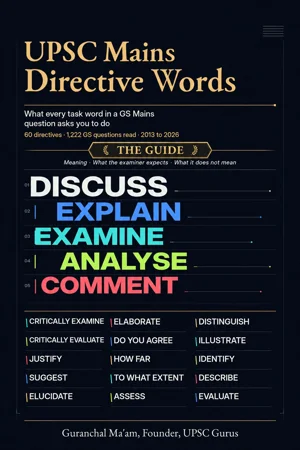
 New this week · Free UG Handout 02UPSC Mains Directive Words: 60 Meanings, Trends and PYQsTwo free PDFs: The Guide and the With PYQs edition.Read and download
Today’s Canvas
- Supreme Court: a rape case cannot be quashed solely on a settlement between survivor and accused; trial to proceedGS II
- NHRC issues advisory on the rights of women prisoners and their children; seeks action taken reports in two monthsGS II
- Tobacco Free Youth Campaign 4.0 launched: 60-day nationwide drive to keep young people away from tobaccoGS II
- India to amend anti-doping law to criminalise supply chains; Sports and Education Ministries sign MoU with UNESCO on clean sport values in classroomsGS IV
- At 13th ADMM-Plus in Cebu, Rajnath Singh backs freedom of navigation and proposes an India-ASEAN Youth BridgeGS II
- After Muizzu’s Pakistan visit, MEA says Maldives ties rest on Neighbourhood First; Pakistan policy ‘unchanged’GS II
- Jaishankar and Austria’s Meinl-Reisinger review April summit outcomes; India-EU FTA and UN cooperation in focusGS II
- INS Sahyadri sails out from Busan for sea phase of second India-Republic of Korea naval exerciseGS III
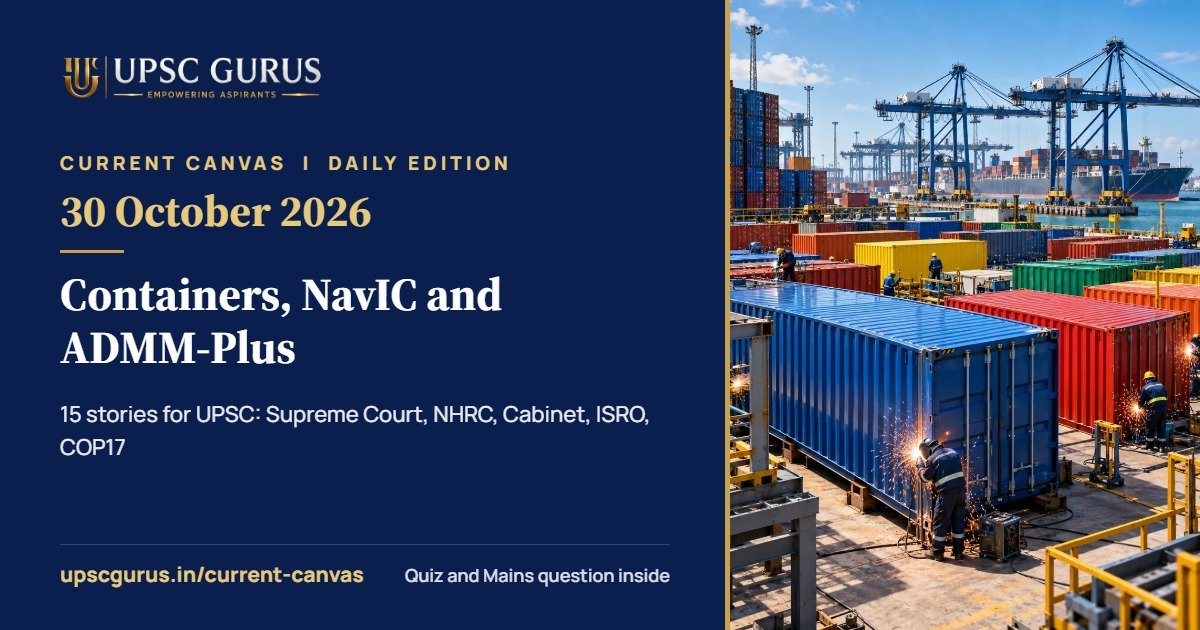
- Cabinet clears Rs 10,000 crore Container Manufacturing Promotion Scheme; aims for tenfold rise in capacity to 7.5 lakh TEUsGS III
- Cabinet raises Dearness Allowance and Dearness Relief by 3 points to 63% from 1 July 2026; cost Rs 10,016 crore a yearGS III
- World Bank Commodity Markets Outlook: commodity prices to rise 23% in 2026, energy up 32%, Brent to average $91GS III
- ISRO to launch NVS-03 on GSLV-F18 on 30 October; NavIC has three serving satellites against four neededGS III
- Ganga Flood Control Board discusses basin-level flood planning and a revised mandate for the GFCCGS I
- After Arnab, Andhra Pradesh seeks central teams to assess damage; paddy on about 70,900 hectares inundatedGS III
- COP17 finance talks deadlock over EU bid to widen donor base; Arab group rejects reclassifying countriesGS III
Polity, social justice and ethics
Supreme Court: a rape case cannot be quashed solely on a settlement between survivor and accused; trial to proceed
In short: Setting aside a Madhya Pradesh High Court order, the Court held that serious, non-compoundable offences cannot be ended by compromise under inherent powers.
Why in news
In a judgment dated 26 October 2026 and uploaded on 28 October, a Bench of Justices J B Pardiwala and K Vinod Chandran, in Gopal Lodhi v. State of Madhya Pradesh, set aside a Madhya Pradesh High Court order that had quashed a rape case on the basis of a compromise between the survivor and the accused. It directed that the trial proceed, granted the accused anticipatory bail with conditions and called for the case records.
Background
The case was registered under Section 64(1) of the Bharatiya Nyaya Sanhita (rape) and other BNS provisions, along with offences under the SC/ST (Prevention of Atrocities) Act, 1989. The High Court had accepted the compromise in an application under Section 528 of the Bharatiya Nagarik Suraksha Sanhita, which preserves the inherent powers of High Courts (earlier Section 482 CrPC). The Bench spoke to the survivor at the District Legal Services Authority office, in the Secretary’s presence; as reported, she said she had been coerced into the settlement and had made her complaint truthfully. The Court said the truth of the allegations must be tested at trial and expressed no opinion on them.
Key facts for Prelims
- Section 528 BNSS: saves the inherent powers of the High Court to prevent abuse of process or secure the ends of justice (corresponds to Section 482 CrPC).
- Section 64(1) BNS: punishment for rape (the provision invoked in this case).
- Gian Singh v. State of Punjab: allowed quashing on settlement in suitable cases but excluded heinous and serious offences such as murder, rape and dacoity, and offences under the Prevention of Corruption Act.
- Narinder Singh v. State of Punjab and Anita Maria Dias v. State of Maharashtra: cautioned against using inherent powers to quash heinous offences.
- Section 320 CrPC lists compoundable offences; the Court said quashing a non-compoundable offence solely on compromise would exceed the inherent jurisdiction and violate this scheme.
- District Legal Services Authorities function under the Legal Services Authorities Act, 1987.
Mains analysis and way forward
Mains analysis
- Rape is treated as an offence against society, not only against an individual; allowing private settlement risks turning criminal justice into a bargain.
- Power imbalances, social pressure and money can produce “consent” to settle; the Court flagged both coerced settlements and the risk of complaints filed in the hope of later payment.
- Inherent powers are meant to prevent abuse of process, not to bypass the legislative choice of which offences are compoundable.
- Hearing the survivor directly, through a legal services institution, is a survivor-centred step that other courts can adopt before accepting any compromise.
Way forward
- High Courts may record the survivor’s statement independently, preferably through legal services authorities, before considering any settlement-based plea.
- Speedy trials, witness protection and victim compensation reduce the pressure on survivors to settle.
- Clear guidance on which offences may never be quashed on compromise would bring consistency across High Courts.
Connect the dots: GS II: judiciary, criminal justice reforms under BNS and BNSS, legal aid; GS I: crimes against women; GS IV: justice and fairness.
Sources: LiveLaw: Rape case can’t be quashed solely on settlement between victim and accused: Supreme Court, 28 Oct 2026; LiveLaw: Supreme Court Daily Round-Up, 28 Oct 2026
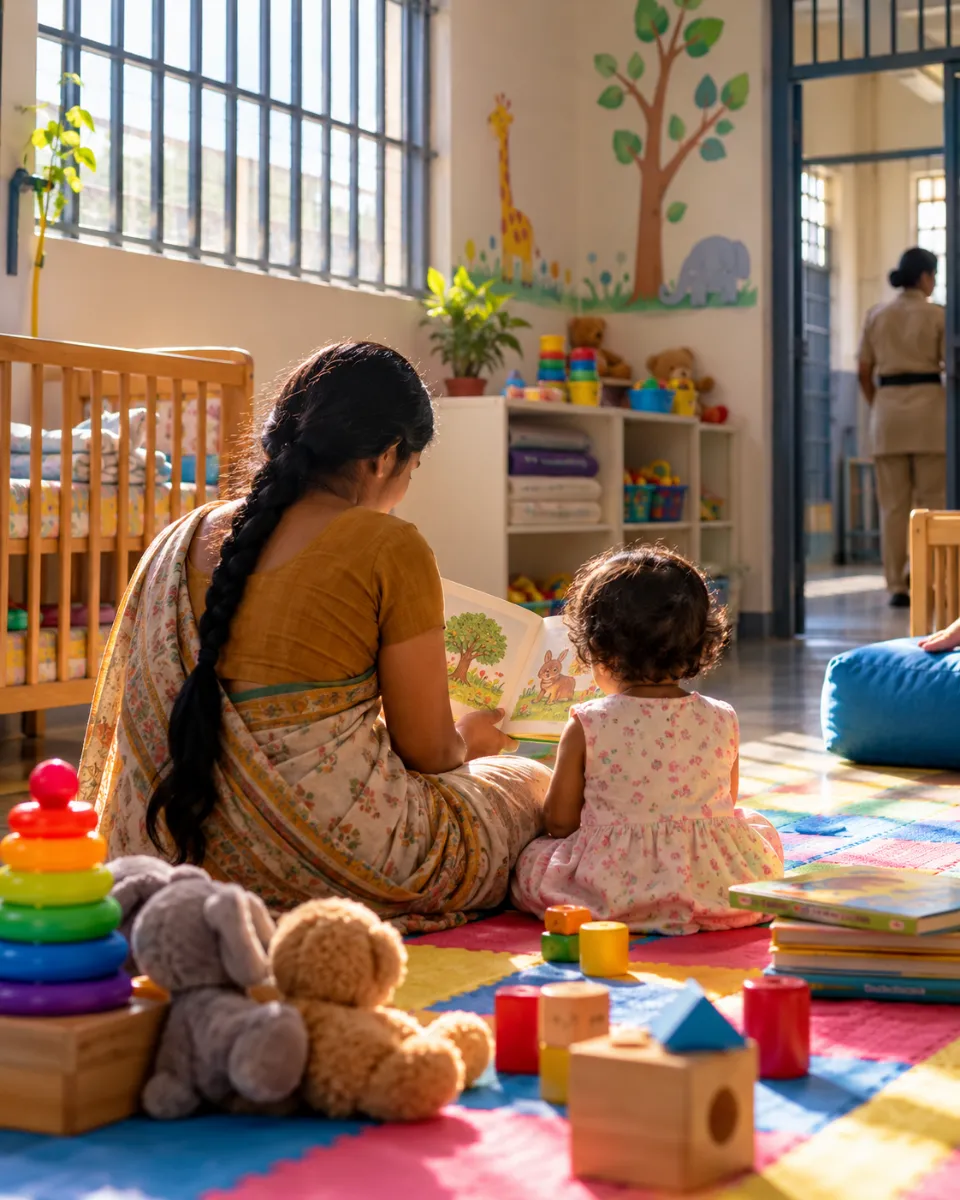
NHRC issues advisory on the rights of women prisoners and their children; seeks action taken reports in two months
In short: The advisory asks Union Ministries, States and police chiefs for gender-responsive prisons, with attention to health, hygiene, legal aid and children living with mothers.
Why in news
On 28 October 2026, the National Human Rights Commission issued an advisory on protecting the human rights of female inmates and their children to nine Union Ministries and to the Chief Secretaries and Directors General of Police of all States and Union Territories. It covers ten broad areas and asks the authorities to implement its recommendations and submit Action Taken Reports within two months.
Background
The advisory calls for humane prison conditions, adequate healthcare for mothers and children, access to justice, preservation of family ties, protection of children’s best interests and rehabilitation. The areas named include admission records, a child database and documentation, medical and mental health care, living conditions, hygiene, and legal aid. In April 2025, the NHRC had taken suo motu cognisance of the difficulties of women inmates and their children, citing overcrowding, poor hygiene and sanitation, inadequate nutrition for pregnant and lactating women and lack of education for children in jails, and sought data from all States and UTs. The Supreme Court’s 2006 guidelines in R D Upadhyay v. State of Andhra Pradesh allow children to stay with their mothers in jail up to the age of six.
Key facts for Prelims
- NHRC: a statutory body under the Protection of Human Rights Act, 1993.
- R D Upadhyay v. State of Andhra Pradesh (judgment of 13 April 2006): children may stay with mothers in prison up to six years; a child in jail is not to be treated as an undertrial or convict; crèche below three years and nursery from three to six.
- Bangkok Rules: United Nations Rules for the Treatment of Women Prisoners and Non-custodial Measures for Women Offenders, recommended by ECOSOC resolution 2010/16 (22 July 2010).
- “Prisons” is a State subject under the Seventh Schedule; the Centre issues model laws and manuals, such as the Model Prisons and Correctional Services Act, 2023.
- The NHRC advisory: 10 broad areas; Action Taken Reports due within two months.
Mains analysis and way forward
Mains analysis
- Prison systems designed largely around male inmates can overlook menstrual hygiene, maternal care and mental health needs.
- Children living with mothers in jail have committed no offence; their nutrition, schooling and early development are a State responsibility.
- Where women are held as undertrials, weak legal aid prolongs detention and keeps families apart.
- Advisories carry moral force but depend on State prison departments for implementation, which makes monitoring through reports and inspections essential.
Way forward
- Build a reliable child database and link children in prisons to ICDS, immunisation and schooling.
- Expand non-custodial options for women offenders, in line with the Bangkok Rules, and strengthen legal aid for undertrials.
- Make periodic NHRC and State Human Rights Commission inspections, with public reporting, part of the follow-up.
Connect the dots: GS II: vulnerable sections, statutory bodies (NHRC), prison reforms; GS I: women and children; GS IV: compassion and dignity in public service.
Sources: News On AIR: NHRC issues advisory on Protection of Human Rights of Female Inmates and their Children, 28 Oct 2026; NHRC: suo motu cognisance of difficulties faced by prisoners including women inmates and their children, 8 Apr 2025; Supreme Court guidelines on children of women prisoners, R D Upadhyay (2006), circulated by MHA; UN ECOSOC resolution 2010/16: Bangkok Rules
Tobacco Free Youth Campaign 4.0 launched: 60-day nationwide drive to keep young people away from tobacco
In short: The fourth edition builds on over 5.8 lakh educational institutions and 73,000 villages declared tobacco-free in the first three rounds.
Why in news
On 28 October 2026, Union Minister of State for Health and Family Welfare Prataprao Jadhav launched the fourth edition of the Tobacco Free Youth Campaign in New Delhi, a 60-day nationwide drive of the Ministry of Health and Family Welfare. It aims to prevent initiation among young people, encourage quitting, strengthen enforcement of tobacco control laws and promote tobacco-free spaces.
Background
Over 5.8 lakh educational institutions and 73,000 villages have been declared tobacco-free under the first three editions, the Ministry said. The first campaign began on 31 May 2023, World No Tobacco Day. The second edition (September 2024) set five priorities: public awareness, compliance with revised Tobacco-Free Educational Institutions (ToFEI) guidelines, stronger enforcement of COTPA, 2003 and the Prohibition of Electronic Cigarettes Act, 2019, tobacco-free villages and social media outreach. Launching that edition, Jadhav had said that around 13 lakh people die of tobacco use in India every year. At the 2026 launch, he called on young people to make the campaign a mass movement.
Key facts for Prelims
- COTPA, 2003 (Cigarettes and Other Tobacco Products Act): bans smoking in public places, sale to minors and sale near educational institutions.
- Prohibition of Electronic Cigarettes Act, 2019 (PECA): bans production, trade, storage and advertisement of e-cigarettes.
- ToFEI guidelines: criteria for an educational institution to be declared tobacco-free.
- Campaign 4.0: 60 days; launched 28 October 2026 by MoS Prataprao Jadhav.
- India is a Party to the WHO Framework Convention on Tobacco Control.
Mains analysis and way forward
Mains analysis
- Most tobacco users start young; prevention among adolescents is the most cost-effective tobacco control investment.
- Declaring institutions and villages tobacco-free works only if enforcement around schools and sale to minors is sustained after the campaign ends.
- Smokeless tobacco, flavoured products and illegal e-cigarettes sold online pose new enforcement challenges.
- Cessation services must expand alongside prevention so that existing users, including young users, get help to quit.
Way forward
- Institutionalise ToFEI compliance through school inspection systems and local bodies, with periodic re-verification.
- Use peer leaders, NSS and NCC volunteers and digital campaigns to reach adolescents where they are.
- Strengthen cessation centres and quitline follow-up, and coordinate enforcement against online sale of banned products.
Connect the dots: GS II: health, government campaigns, issues relating to children and youth; GS III: non-communicable disease burden; GS IV: role of social influence and persuasion.
Sources: News On AIR: Tobacco Free Youth Campaign 4.0 launched to create environment free of menace, 28 Oct 2026; PTI via Siasat: Tobacco claims 13 lakh lives in India every year: Union minister (Campaign 2.0 launch), 24 Sep 2024
India to amend anti-doping law to criminalise supply chains; Sports and Education Ministries sign MoU with UNESCO on clean sport values in classrooms
In short: The Centre plans criminal penalties for coaches, suppliers and networks that push doping, while a UNESCO toolkit takes integrity in sport to schools.
Why in news
Speaking at UNESCO anti-doping meetings in New Delhi this week, Sports Minister Mansukh Mandaviya said India will amend the National Anti-Doping Act in the next session of Parliament to add criminal provisions, including for coaches and supply-chain stakeholders. On 28 October 2026, the Ministry of Youth Affairs and Sports, the Ministry of Education and UNESCO exchanged an MoU to take the Sports Values in Every Classroom Toolkit to schools, with video modules in 13 Indian languages.
Background
The meetings in New Delhi were the third formal meeting of the COP10 Bureau and the fourth formal meeting of the Fund’s Approval Committee for 2026-27 under the UNESCO International Convention against Doping in Sport. The National Anti-Doping Act, 2022, and its 2025 Amendment came into force in July 2026, as reported by News On AIR; the present framework provides only sporting sanctions such as suspension and disqualification. A consultation paper issued in May 2026 proposed criminal provisions aimed at traffickers, suppliers, organised syndicates and support personnel, while athletes who test positive would remain under sporting sanctions and not face prosecution. Reuters reported that India has topped the World Anti-Doping Agency’s list of offenders for three consecutive years, and that the change could support India’s bid to host the 2036 Olympics in Ahmedabad.
Key facts for Prelims
- UNESCO International Convention against Doping in Sport: the global treaty under which the COP10 Bureau and the Fund’s Approval Committee met in New Delhi.
- National Anti-Doping Act, 2022 (amended in 2025): statutory basis for the National Anti-Doping Agency (NADA).
- NADA figures cited: more than 7,000 tests and over 350 awareness sessions reaching about 27,000 participants.
- Consultation draft: imprisonment of up to five years, a fine of up to Rs 2 lakh, or both, proposed for those who administer prohibited substances to athletes; athletes with valid Therapeutic Use Exemptions protected.
- Sports Values in Every Classroom Toolkit: MoU among MYAS, Ministry of Education and UNESCO; video modules in 13 Indian languages.
Mains analysis and way forward
Mains analysis
- Doping is an ethical failure of a whole ecosystem, not only of an athlete: coaches, suppliers and administrators shape incentives and opportunities.
- Targeting supply chains while keeping athletes within the sporting sanctions regime balances deterrence with fairness to young, often uninformed athletes.
- Values education in schools builds integrity before competitive pressure begins; it complements testing, which can only catch violations after the fact.
- Credibility in anti-doping matters for India’s hosting ambitions and for public trust in sporting achievement.
Way forward
- Pair criminal provisions with clear safeguards so that bona fide medical practitioners and athletes acting on advice are not harassed.
- Strengthen intelligence-led testing, regulation of supplement sales and awareness for coaches and parents.
- Track the classroom toolkit’s reach and use it to link sport with ethics education across school boards.
Connect the dots: GS IV: integrity, values education, role of family and schools in inculcating values; GS II: government policies, international conventions.
Sources: News On AIR: India to bring further amendments to National Anti-Doping Act to introduce criminal provisions, 28 Oct 2026; News On AIR: Sports, Education Ministries and UNESCO sign MoU to take clean sport values to every classroom, 28 Oct 2026; Reuters (via The Star): India to criminalise doping supply chains to boost bid to host Olympics, 27 Oct 2026; Republic: Sports Ministry proposes criminal provisions against doping networks, exempts athletes from prosecution, 21 May 2026; Outlook: National Anti-Doping Act proposed amendments, criminalisation of trafficking
International relations and security
At 13th ADMM-Plus in Cebu, Rajnath Singh backs freedom of navigation and proposes an India-ASEAN Youth Bridge
In short: On 29 October, India restated its UNCLOS-based maritime stance, offered counter-terrorism experience and proposed a youth bridge; talks with the US, Japan and Korea came on the sidelines.
Why in news
Defence Minister Rajnath Singh addressed the 13th ASEAN Defence Ministers’ Meeting-Plus (ADMM-Plus) in Cebu, Philippines, on 29 October 2026, held under the theme ‘Navigating Our Future Together’. He said India follows international maritime law, including UNCLOS, and that its stance on freedom of navigation and overflight is not aimed at any country, and he proposed an India-ASEAN defence ‘Youth Bridge’ for people-to-people connectivity, digital innovation and capacity building. On 28 October, on the margins of the meeting, he held bilateral talks with US Secretary of War Pete Hegseth, Japan’s Defence Minister Shinjiro Koizumi and South Korea’s Minister of National Defense Kang Shin-chul.
Background
ADMM-Plus brings together the 11 ASEAN member states and eight dialogue partners: India, China, Australia, Japan, New Zealand, South Korea, Russia and the United States; its inaugural meeting was held in Hanoi on 12 October 2010. Practical cooperation runs through Experts’ Working Groups, and India and Malaysia co-chair the Experts’ Working Group on Counter-Terrorism for the 2024-2027 cycle. The Philippines chairs the forum in 2026. Singh said the youth bridge fits the ‘Youth, Peace and Security’ theme of the meeting’s joint statement, and cited Operation Sindoor as an example of India’s approach to state-sponsored terrorism. He noted that 2026 is the ASEAN-India Year of Maritime Cooperation, that the second ASEAN-India Maritime Exercise has been held, and that the Indian Navy has kept a presence in the Gulf of Aden since 2008. India became an ASEAN dialogue partner in 1992, and the Defence Ministry describes its participation as part of defence diplomacy under the Act East policy.
Key facts for Prelims
- ADMM-Plus: 11 ASEAN members plus eight dialogue partners (India, China, Australia, Japan, New Zealand, South Korea, Russia, United States); first meeting Hanoi, 12 October 2010.
- 13th ADMM-Plus: Cebu, Philippines, 28-29 October 2026; theme ‘Navigating Our Future Together’.
- India and Malaysia co-chair the ADMM-Plus Experts’ Working Group on Counter-Terrorism for 2024-2027.
- 2026 is the ASEAN-India Year of Maritime Cooperation.
- India became an ASEAN dialogue partner in 1992.
- UNCLOS (UN Convention on the Law of the Sea) underpins freedom of navigation and overflight in international waters and airspace.
Mains analysis and way forward
Mains analysis
- ASEAN-led forums such as ADMM-Plus are among the few settings where the US, China, Russia, Japan and India sit at one defence table; India’s support for ASEAN centrality keeps these platforms relevant.
- Stressing that its freedom-of-navigation stance targets no country lets India uphold a rules-based order without framing the region as a contest of blocs.
- Offering operational counter-terrorism experience and co-chairing the working group turn India’s own security record into a regional public good.
- Sideline talks with the US, Japan and South Korea link the multilateral meeting to bilateral goals in defence technology, co-production and maritime security.
Way forward
- Give the Youth Bridge a concrete form, such as exchanges between defence academies, joint training and digital skills programmes, with clear annual milestones.
- Use the Year of Maritime Cooperation to deepen capacity-building with ASEAN navies and coast guards, including maritime domain awareness and humanitarian assistance.
- Keep engagement inclusive and consistent with ASEAN centrality so that partners see India as a steady, non-exclusive security partner.
Connect the dots: Links: Act East policy; ASEAN centrality; UNCLOS and freedom of navigation; South China Sea; defence diplomacy; India as a net security provider.
Sources: IANS: India’s counter-terrorism strategies shaped by cross-border security challenges, says Rajnath Singh, 29 October 2026; The Tribune (ANI): ‘India-ASEAN Youth Bridge’ will foster people-to-people connection, digital innovation, capacity building: Rajnath Singh at ADMM-Plus meet, 29 October 2026; PIB (Ministry of Defence): Raksha Mantri meets US Secretary of War on the sidelines of ADMM-Plus in Philippines, 28 October 2026; PIB (Ministry of Defence): Raksha Mantri and his Japanese counterpart meet on the margins of ADMM-Plus in Philippines, 28 October 2026; Rajnath Singh office: Raksha Mantri and his South Korean counterpart hold bilateral talks on the margins of 13th ADMM-Plus, 28 October 2026; ThePrint: Rajnath to visit Philippines to attend ASEAN Defence Ministers’ Meeting-Plus, 26 October 2026
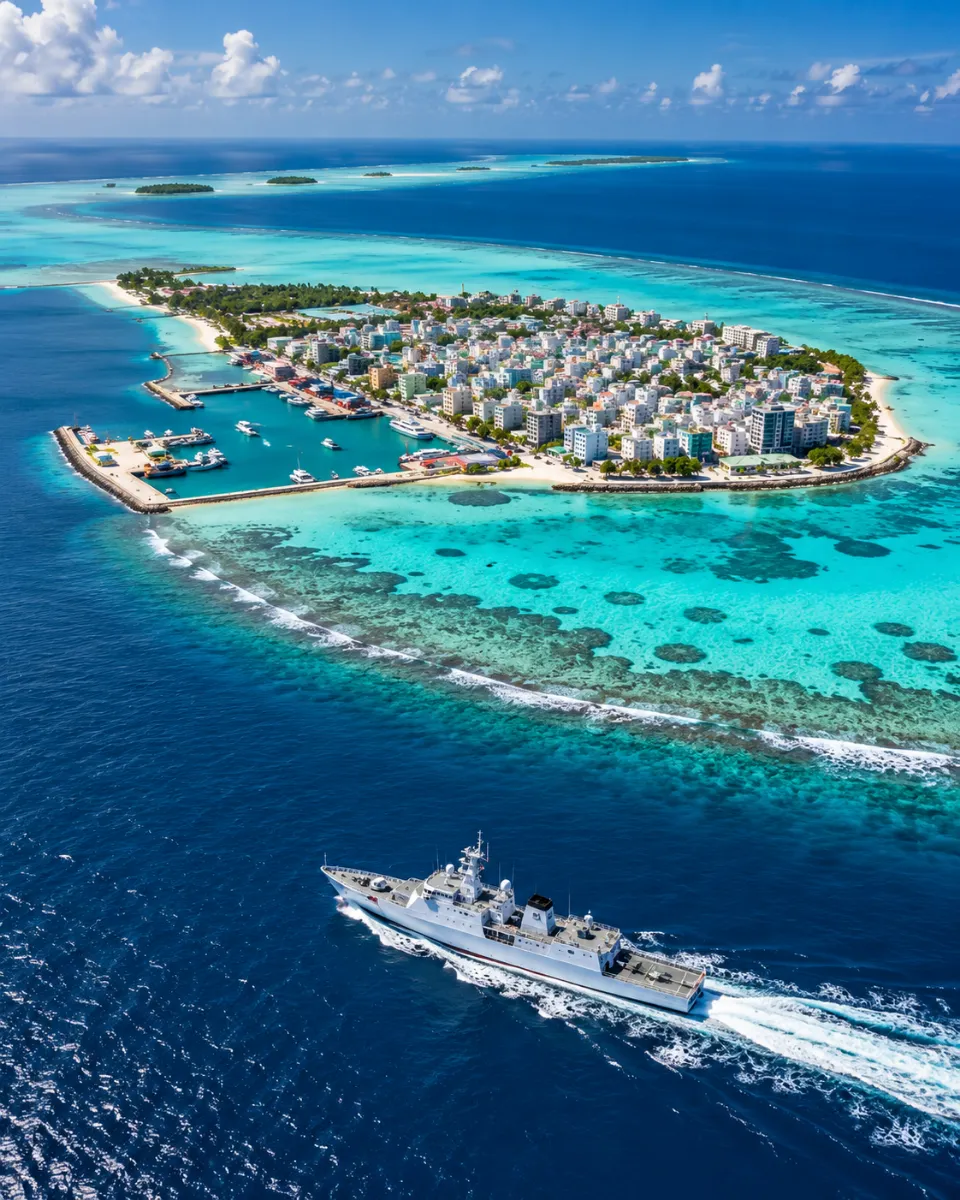
After Muizzu’s Pakistan visit, MEA says Maldives ties rest on Neighbourhood First; Pakistan policy ‘unchanged’
In short: At its 28 October briefing, India called the Maldives an important partner, days after Male and Islamabad signed 20 MoUs and spoke of reviving SAARC.
Why in news
Responding to questions at the bi-weekly briefing on 28 October 2026, MEA spokesperson Randhir Jaiswal said India’s ties with the Maldives are anchored in its Neighbourhood First policy and the SAGAR vision, and that India regards the Maldives as an important partner. The remarks followed Maldivian President Mohamed Muizzu’s state visit to Pakistan from 20 to 22 October, during which about 20 MoUs were signed; on Pakistan, Jaiswal said India’s policy ‘remains unchanged and firmly in place’.
Background
Muizzu’s visit was the first by a Maldivian President to Pakistan in 11 years and marked 60 years of diplomatic relations, established in 1966. The MoUs cover defence ties and maritime security, IT, cybersecurity and AI, health, counter-narcotics, education, fisheries, tourism, air connectivity and the environment, and the two sides aim to raise bilateral trade from about USD 13.9 million to USD 200 million within two years. Muizzu also met Pakistan’s Chief of Defence Forces, Field Marshal Asim Munir, and said the Maldives is ready to help create conditions for the next SAARC summit. SAARC has held no summit since Kathmandu in 2014; the 2016 Islamabad summit did not take place after India and other members stayed away following the Uri attack. Muizzu had made a state visit to India in October 2024.
Key facts for Prelims
- SAARC: founded 1985 in Dhaka; eight members (Afghanistan, Bangladesh, Bhutan, India, Maldives, Nepal, Pakistan, Sri Lanka); secretariat in Kathmandu.
- Last (18th) SAARC summit: Kathmandu, 2014.
- SAGAR: Security and Growth for All in the Region, India’s Indian Ocean outlook announced in 2015.
- Maldives-Pakistan diplomatic relations: established 1966; bilateral trade about USD 13.9 million.
- The Maldives lies astride key sea lanes in the Indian Ocean; capital Male.
Mains analysis and way forward
Mains analysis
- Small states diversify partners to widen their room for manoeuvre; engagement with Pakistan need not be zero-sum for India if India’s own offer stays credible.
- A defence and maritime security MoU with Pakistan adds a new actor to the Maldives’ security landscape, where India has long been the first responder.
- Calls to revive SAARC run into the reality that terrorism and India-Pakistan tensions stalled it; BIMSTEC and the Colombo Security Conclave have absorbed much regional work.
- India’s measured response, stressing partnership rather than rivalry, reflects a mature neighbourhood policy that avoids pushing smaller neighbours into choosing sides.
Way forward
- Keep delivering on development, connectivity and disaster-response projects that ordinary Maldivians see and value.
- Use regular high-level and institutional dialogue to address concerns early, while respecting the Maldives’ sovereign choices.
- Strengthen sub-regional and Indian Ocean frameworks that work, while keeping the door open to SAARC if terrorism-related concerns are addressed.
Connect the dots: Links: Neighbourhood First; SAGAR; SAARC versus BIMSTEC; Indian Ocean security; small-state foreign policy.
Sources: ANI: India closely monitoring Tehran talks involving Pakistan, says MEA, 28 October 2026; Dawn: PM Shehbaz vows to strengthen Maldives ties for ‘all time to come’; 20 MoUs signed, 21 October 2026; The Wire: Maldives President Muizzu visits Pakistan, reiterates call for SAARC’s revival, 22 October 2026; AIR News: Maldives President Mohamed Muizzu arrives in India for five-day state visit, 6 October 2024
Jaishankar and Austria’s Meinl-Reisinger review April summit outcomes; India-EU FTA and UN cooperation in focus
In short: In New Delhi on 28 October, the two ministers reviewed the Enhanced Partnership; Austria joins the UN Security Council from January 2027.
Why in news
External Affairs Minister S Jaishankar held talks at Hyderabad House, New Delhi, on 28 October 2026 with Austria’s Federal Minister for European and International Affairs, Beate Meinl-Reisinger, who is on an official visit to India from 27 October to 2 November. They reviewed progress on agreements reached during Chancellor Christian Stocker’s visit in April; Jaishankar said the two countries could together contribute to international peace and security, and hoped the India-EU FTA, whose negotiations concluded on 27 January 2026, would be signed and enter into force in the coming months.
Background
Chancellor Stocker visited India from 14 to 17 April 2026, building on the Enhanced India-Austria Partnership set out during Prime Minister Modi’s 2024 visit to Vienna. Outcomes included a Letter of Intent on cooperation in military matters, a Joint Working Group on counter-terrorism, a cybersecurity dialogue, a food safety MoU between FSSAI and Austria’s AGES, dual vocational training and a working holiday programme. The 2023 Comprehensive Migration and Mobility Partnership Agreement frames skilled mobility, and Austria plans a pre-check register to match Indian skilled workers with its shortage occupations. Austria was elected in June 2026 to a non-permanent UN Security Council seat for 2027-28, and Jaishankar congratulated it on this. After Delhi, the minister has engagements in Jaipur from 29 October to 2 November.
Key facts for Prelims
- Austria: landlocked central European EU member; capital Vienna; hosts the IAEA, UNIDO and OPEC headquarters.
- Austria, Kyrgyzstan, Portugal, Trinidad and Tobago and Zimbabwe were elected to the UNSC for 1 January 2027 to 31 December 2028.
- India-Austria Comprehensive Migration and Mobility Partnership Agreement: signed 2023.
- India-EU Defence and Security Partnership: signed 27 January 2026.
- Non-permanent UNSC members: 10, elected by the General Assembly for two-year terms.
Mains analysis and way forward
Mains analysis
- Mid-sized EU states such as Austria can be steady advocates for the India-EU FTA during ratification in Europe.
- Austria’s dual vocational model and skill shortages fit India’s demographic profile; regulated mobility can serve both sides.
- A seat on the UNSC in 2027-28 gives Austria a voice on issues India follows closely, from terrorism to UN reform.
- Neutral Austria’s defence and counter-terrorism cooperation shows that security ties with Europe are widening beyond the larger powers.
Way forward
- Turn the April outcomes into time-bound programmes, especially in skills, mobility and technology.
- Coordinate positions on UN reform and counter-terrorism during Austria’s Council term.
- Use the FTA’s investor fast-track mechanism to bring Austrian engineering and green technology firms to India.
Connect the dots: Links: India-EU relations; UNSC composition and reform; migration and mobility agreements; Vienna-based international organisations.
Sources: Asianet Newsable (ANI): India and Austria discuss strategic cooperation and global security, 28 October 2026; Daily Prabhat (ANI): EAM Jaishankar holds bilateral with Austrian counterpart Beate Meinl-Reisinger, 28 October 2026; OrissaPOST: Austria FM to visit India, hold talks with Jaishankar, 26 October 2026; Federal Chancellery of Austria: Joint Statement on the official visit of the Federal Chancellor to India, April 2026; AIR News: Five countries elected non-permanent members of UN Security Council, 4 June 2026
INS Sahyadri sails out from Busan for sea phase of second India-Republic of Korea naval exercise
In short: After a harbour phase from 26 to 29 October, the indigenous frigate began the sea phase with destroyer ROKS Munmu the Great on 29 October.
Why in news
The Indian Navy’s guided missile stealth frigate INS Sahyadri, which reached Busan Naval Harbour on 26 October 2026 for the India-Republic of Korea Navy (IN-RoKN) bilateral exercise, sailed out on 29 October for the sea phase with the Korean destroyer ROKS Munmu the Great, the Indian Embassy in Seoul said. The Defence Ministry said on 28 October that the exercise aims to strengthen maritime cooperation, interoperability and peace and security in the Indo-Pacific.
Background
The harbour phase included cross-deck visits, subject-matter expert exchanges, cross-training, sports fixtures and an onboard reception attended by Ambassador Gourangalal Das. The maiden IN-RoKN exercise was held in October 2025, also at Busan and also with INS Sahyadri, then partnered by ROKS Gyeongnam during the ship’s deployment to the South China Sea and the wider Indo-Pacific. INS Sahyadri, the third Shivalik-class frigate, was built by Mazagon Dock in Mumbai and commissioned on 21 July 2012; it is based at Visakhapatnam with the Eastern Fleet. Regular bilateral exercises with East Asian navies extend the Navy’s presence beyond the Indian Ocean and support India’s Act East policy.
Key facts for Prelims
- IN-RoKN: bilateral exercise between the Indian Navy and the Republic of Korea Navy; first edition October 2025 at Busan.
- INS Sahyadri: Shivalik-class (Project 17) stealth frigate, built by Mazagon Dock Limited, commissioned 2012.
- ROKS Munmu the Great: guided missile destroyer of the Republic of Korea Navy.
- Busan: South Korea’s largest port city, on the south-eastern tip of the Korean peninsula.
- Exercise structure: harbour phase (26 to 29 October 2026) followed by a sea phase from 29 October.
Mains analysis and way forward
Mains analysis
- Naval exercises with South Korea add a capable East Asian partner to India’s Indo-Pacific network beyond the Quad.
- South Korea’s shipbuilding strength opens space for industrial cooperation, including repair and construction, alongside operational ties.
- Deploying an indigenous frigate abroad showcases Indian shipbuilding and supports defence export diplomacy.
- Interoperability built in peacetime helps in humanitarian assistance, disaster relief and protection of sea lanes.
Way forward
- Institutionalise the exercise as an annual event and add complexity over time, such as anti-submarine and air defence serials.
- Link operational ties with shipbuilding and defence industry cooperation.
Connect the dots: Links: Act East policy; Indo-Pacific; naval diplomacy; indigenous warship building (Project 17).
Sources: PIB (Ministry of Defence): INS Sahyadri arrives at Busan, Republic of Korea, for India-RoKN bilateral exercise, 28 October 2026; IANS: INS Sahyadri sails out for sea phase of India-South Korea naval exercise in Busan, 29 October 2026; PIB via GlobalSecurity: INS Sahyadri at Busan for maiden IN-RoKN bilateral exercise, 14 October 2025; Wikipedia: INS Sahyadri (class, builder, commissioning)
Economy
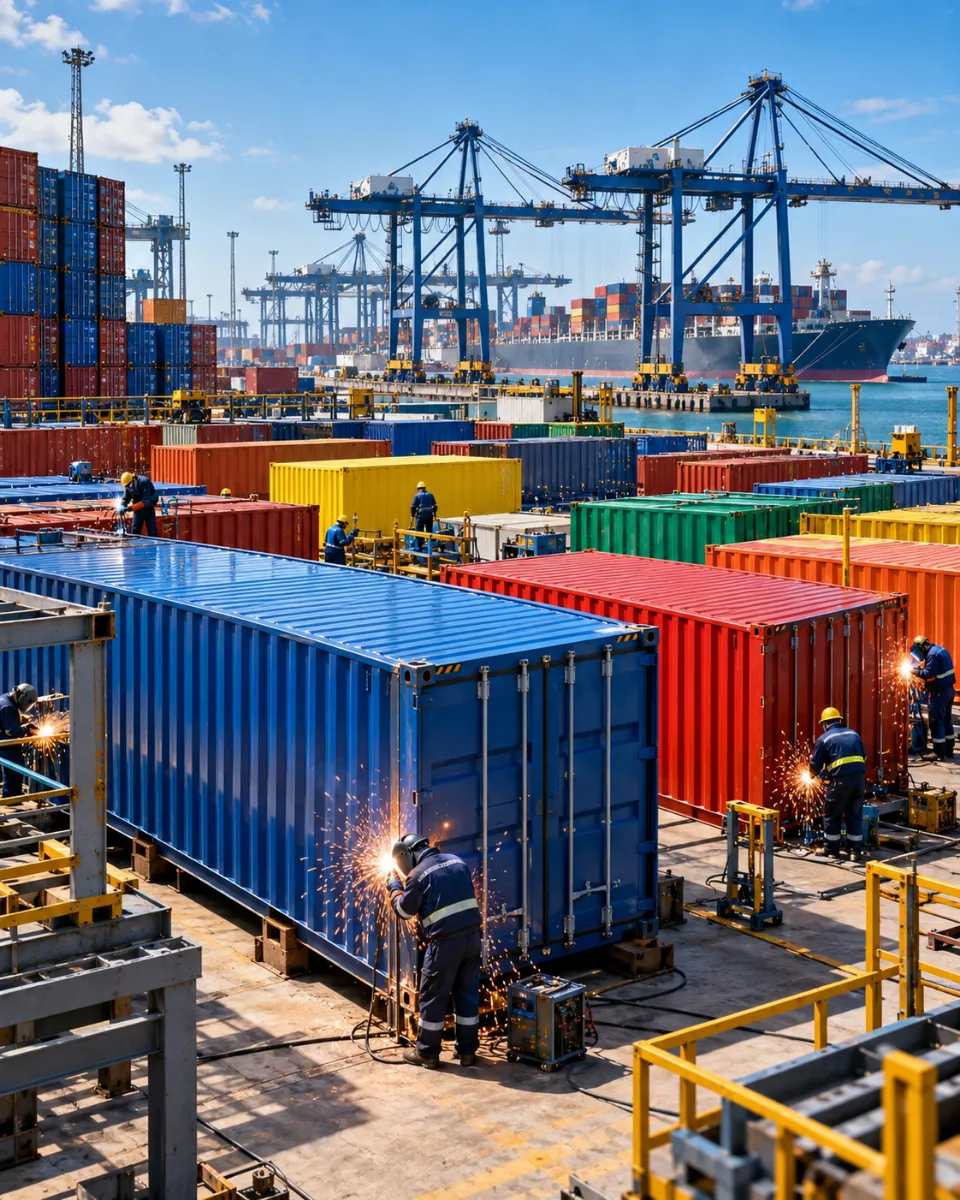
Cabinet clears Rs 10,000 crore Container Manufacturing Promotion Scheme; aims for tenfold rise in capacity to 7.5 lakh TEUs
In short: A 13-year scheme to help Indian factories make shipping containers at globally competitive cost, cutting import dependence and strengthening trade supply chains.
Why in news
On 28 October 2026, the Union Cabinet chaired by Prime Minister Narendra Modi approved the Container Manufacturing Promotion Scheme (CMPS) with an outlay of Rs 10,000 crore for 2027-28 to 2039-40. It seeks to raise India’s annual container manufacturing capacity about tenfold, to 7.5 lakh twenty-foot equivalent units (TEUs).
Background
The scheme was announced in the Union Budget 2026-27. Global shipping lines have sourced containers mostly from China because of its cost advantage; one manufacturer cited about $1,700 per TEU for a Chinese container against about $2,200 to $2,400 from other sources. Indian traders have faced high freight costs since 2023 amid volatile container leasing and buying rates. The bulk of the outlay, Rs 8,891 crore, is operational expenditure assistance per container sold, meant to bridge this cost gap; Rs 859 crore goes to interest subvention, Rs 150 crore to common testing and certification facilities and Rs 100 crore to scheme management, monitoring and capacity building. The government expects about 3,000 direct and over 50,000 indirect jobs, including in ancillary industries such as corner castings, specialised steel, wooden frames and paints.
Key facts for Prelims
- Container Manufacturing Promotion Scheme: outlay Rs 10,000 crore, runs from 2027-28 to 2039-40 (13 years); approved by the Union Cabinet on 28 October 2026.
- Components: operational expenditure assistance Rs 8,891 crore; interest subvention Rs 859 crore (3% a year on eligible term loans); testing and certification Rs 150 crore; administration and monitoring Rs 100 crore.
- Per-container support: Rs 49,500 for a 20-foot and Rs 86,625 for a 40-foot container meeting global shipping standards.
- Eligibility: new units need at least 1 lakh TEUs of annual capacity; expansions must add at least 25,000 TEUs; local content at least 70% until 2031-32, rising to 90% from 2032-33.
- TEU (twenty-foot equivalent unit) is the standard measure of container capacity: one 40-foot container equals two TEUs.
Mains analysis and way forward
Mains analysis
- Containers are the hidden infrastructure of trade: dependence on a single foreign source exposes exporters to freight spikes and shortages, as seen since 2023.
- Output-linked support per container sold, rather than upfront capital subsidy, ties public money to actual production, in the spirit of production-linked incentive schemes.
- Rising local content requirements can build a domestic chain of steel, castings and paints suppliers, adding to manufacturing jobs beyond the container yards.
- The scheme complements port-led growth under Sagarmala and the logistics push under PM Gati Shakti by making a key input of maritime trade at home.
Way forward
- Pair the incentives with quality certification and testing at global standards so that Indian containers are accepted by international shipping lines.
- Locate plants near major ports and steel clusters to cut logistics costs, and review the per-container support periodically as costs fall.
- Track outcomes through public dashboards on capacity added, exports and jobs, so that the long 13-year horizon remains accountable.
Connect the dots: Industrial policy and manufacturing; infrastructure: ports and shipping; logistics and supply chains; Atmanirbhar Bharat.
Sources: Business Standard: Cabinet approves Rs 10,000 crore scheme to boost container manufacturing, 28 Oct 2026; Business Standard: Cabinet clears Rs 10,000 cr scheme to boost domestic container manufacturing, 28 Oct 2026; PSU Watch: Cabinet approves container manufacturing promotion scheme with Rs 10,000-cr outlay, 28 Oct 2026
Cabinet raises Dearness Allowance and Dearness Relief by 3 points to 63% from 1 July 2026; cost Rs 10,016 crore a year
In short: The half-yearly inflation adjustment covers about 48.5 lakh Central Government employees and 68.7 lakh pensioners as prices stay elevated.
Why in news
On 28 October 2026, the Union Cabinet approved an additional instalment of Dearness Allowance (DA) to Central Government employees and Dearness Relief (DR) to pensioners, raising it from 60% to 63% of basic pay and pension with effect from 1 July 2026. The combined cost to the exchequer is Rs 10,016.10 crore a year.
Background
DA and DR are paid to compensate employees and pensioners for the rise in prices. The increase follows the accepted formula based on the recommendations of the 7th Central Pay Commission, which ties DA to the All-India Consumer Price Index for Industrial Workers (CPI-IW) compiled by the Labour Bureau. The decision benefits about 48.54 lakh employees and 68.71 lakh pensioners. On 28 October 2025, the Cabinet approved the Terms of Reference of the 8th Central Pay Commission, which is to make its recommendations within 18 months of its constitution.
Key facts for Prelims
- DA/DR raised from 60% to 63% of basic pay or pension, effective 1 July 2026; approved by the Union Cabinet on 28 October 2026.
- Beneficiaries: about 48.54 lakh Central Government employees and 68.71 lakh pensioners; annual cost Rs 10,016.10 crore.
- DA follows a formula based on the 7th Central Pay Commission’s recommendations and is linked to CPI-IW, compiled by the Labour Bureau under the Ministry of Labour and Employment.
- Pay Commissions are not constitutional bodies; they are set up by the Union Government through a resolution.
- The Terms of Reference of the 8th Central Pay Commission were approved on 28 October 2025; it is to report within 18 months of its constitution.
Mains analysis and way forward
Mains analysis
- Indexation protects the real income of employees and pensioners, but also adds to the government’s committed expenditure at a time of fiscal consolidation.
- Higher DA raises disposable income and may support festive-season consumption, though its overall effect on inflation is small relative to the size of the economy.
- States often follow Central DA revisions for their own employees, so the decision has spillovers on State finances.
- Workers in the informal sector, who lack indexed wages, bear price rises without such protection, highlighting the gap in social security coverage.
Way forward
- Fold the fiscal cost of indexation and the coming 8th Pay Commission into medium-term expenditure planning to keep debt targets credible.
- Keep CPI-IW and other price indices updated with current consumption baskets so that compensation reflects actual cost of living.
- Strengthen minimum wage revision and social security for informal workers, so that protection against inflation is not limited to the formal sector.
Connect the dots: Inflation measurement (CPI-IW); government expenditure and fiscal policy; Pay Commissions; labour and social security.
Sources: PIB, Ministry of Finance: Cabinet approves Dearness Allowance to Central Government employees and Dearness Relief to Pensioners, 28 Oct 2026; The Wire: Eighth Pay Commission Terms of Reference approved by Cabinet, 28 Oct 2025
World Bank Commodity Markets Outlook: commodity prices to rise 23% in 2026, energy up 32%, Brent to average $91
In short: Several shocks at once, from the Middle East conflict to El Nino, are pushing up energy, food, fertiliser and metal prices, with the poorest economies most exposed.
Why in news
On 28 October 2026, the World Bank’s October Commodity Markets Outlook projected that commodity prices will rise 23% in 2026 before easing 7% in 2027. Energy prices are set to jump 32% in 2026, reversing three years of decline, with Brent crude averaging $91 a barrel, up from $69 in 2025.
Background
The report says the Middle East conflict has drawn down oil inventories, grain shipments have been disrupted, and El Nino threatens harvests. Global oil supply is projected to fall 5.2% in 2026 while consumption falls 2.5%. Food prices are expected to rise about 10% in 2026 and about 7% in 2027, a cumulative 18%, while fertiliser prices rise 14% in 2026. Metal prices are projected to rise 25% in 2026, with aluminium, copper and tin at record highs, and precious metals 40%. In an adverse scenario combining higher energy prices, attacks on Black Sea grain trade and a very strong El Nino, food prices would be 12% above the baseline, surpassing 2022 levels.
Key facts for Prelims
- Commodity Markets Outlook is published by the World Bank’s Prospects Group in April and October each year.
- October 2026 projections: overall commodity prices +23% in 2026 and -7% in 2027; energy +32%; metals +25%; precious metals +40%; fertilisers +14%.
- Brent crude: $69 a barrel in 2025, $91 projected for 2026 and $79 for 2027.
- Food prices: about +10% in 2026 and about +7% in 2027; adverse scenario puts them 12% above the baseline.
- The World Bank Group says $50 to 60 billion is available through existing instruments, including $25 billion in pre-arranged financing.
Mains analysis and way forward
Mains analysis
- For an oil-importing economy such as India, a 32% jump in energy prices widens the import bill, presses on the current account and feeds into inflation through fuel and transport costs.
- Costlier fertilisers raise the subsidy burden and, if passed on, farm input costs, linking global energy markets to food security at home.
- Record metal prices raise costs for infrastructure and manufacturing, but also show the strategic value of secure critical mineral and metal supply chains.
- The report’s focus on debt-burdened low-income countries shows how commodity shocks turn into food insecurity and poverty where fiscal buffers are thin.
Way forward
- Build strategic reserves and diversify crude and fertiliser sourcing, including long-term contracts and overseas assets, to soften price spikes.
- Target support to vulnerable households through direct benefit transfer rather than broad price controls that strain public finances.
- Invest in renewable energy, nano and balanced fertiliser use and climate-resilient crops to cut exposure to energy and El Nino shocks.
Connect the dots: Inflation and its drivers; energy security; food security and fertiliser subsidy; external sector and current account; international financial institutions.
Science, geography and environment
ISRO to launch NVS-03 on GSLV-F18 on 30 October; NavIC has three serving satellites against four needed
In short: NVS-03 lifts off from Sriharikota at 11:51 pm on 30 October, adding an L1 signal and an indigenous atomic clock to India’s NavIC system.

Why in news
ISRO said on 28 October that the GSLV-F18 mission will launch the NVS-03 navigation satellite at 11:51 pm IST on 30 October from the Satish Dhawan Space Centre, Sriharikota. NVS-03 is the third of the second-generation NVS satellites meant to ensure continuity of NavIC services; it carries an indigenous atomic clock along with procured clocks and adds L1 band signals to the existing L5 and S band signals.
Background
NavIC (Navigation with Indian Constellation, earlier IRNSS) gives positioning, navigation and timing over the Indian landmass and about 1,500 km beyond India’s boundary, through a Standard Positioning Service and a Restricted Service. According to a government reply in Parliament on 29 July 2026, only three satellites (IRNSS-1B, IRNSS-1I and NVS-01) now provide these services, while four are needed for basic standalone positioning; with three, timing still works. Of the 11 satellites launched so far, some can only broadcast one-way messages, one has been decommissioned and two failed to reach their intended orbits; the atomic clocks on IRNSS-1A failed in 2016. NVS-01, launched on GSLV-F12 on 29 May 2023, was the first to fly an indigenous atomic clock, while NVS-02, launched on GSLV-F15 in January 2025 as ISRO’s 100th launch from Sriharikota, could not be raised to its working orbit. The Space Minister told Parliament in August 2026 that corrective measures had been implemented and tested on the CMS-03 satellite; NVS-04 and NVS-05 are at an advanced stage.
Key facts for Prelims
- NVS series: five second-generation satellites (NVS-01 to NVS-05) planned to augment the NavIC base layer; NVS-03 flies on GSLV-F18 from Sriharikota, Andhra Pradesh.
- NavIC services: Standard Positioning Service (civilian) and Restricted Service (authorised users); coverage: India plus about 1,500 km beyond its boundary.
- Signals: L5 and S bands so far; L1, the band also used by GPS civilian signals, is being added from the NVS series to make NavIC work with more user devices.
- A receiver needs signals from at least four satellites to fix position in three dimensions and correct its own clock error.
- Atomic clocks are the heart of satellite navigation: position is computed from signal travel time, so a clock error of one nanosecond means about 30 cm of range error.
- GSLV Mk II uses an indigenous cryogenic upper stage; NVS-02 (January 2025) was ISRO’s 100th launch from Sriharikota.
Mains analysis and way forward
Mains analysis
- A regional navigation system is strategic infrastructure: it reduces dependence on foreign systems such as GPS for defence, disaster response, shipping and transport, especially in a crisis.
- NavIC’s gaps came from hardware (clock failures, a stranded satellite), showing that sovereign capability needs supply-chain depth in components like atomic clocks and valves, not only launch capacity.
- The L1 signal matters for adoption: phones and consumer chips are built around L1, so NavIC’s civilian reach depends on compatibility as much as on satellite numbers.
- Timing services from NavIC support power grids, telecom networks and banking, so restoring a full constellation has economic as well as strategic value.
Way forward
- Complete the seven-satellite base layer on a published timeline and keep spares ready so that a single failure does not again cut service.
- Push NavIC (with L1) into phones, vehicle trackers and fishing-boat terminals through standards and public procurement, while backing indigenous clock and component makers.
Connect the dots: Syllabus links: GS III Science and Technology (space technology, indigenisation of technology); GS III Security (strategic infrastructure); GS III Disaster Management (navigation and early warning for fishers).
Sources: ThePrint (PTI): ISRO to launch NVS-03 navigation satellite on Oct 30, 28 Oct 2026; Business Standard: Isro to launch NVS-03: What it means for India’s NavIC navigation system, 29 Oct 2026; Deccan Herald: Hitting a century, ISRO launches 100th satellite NVS-02 from Sriharikota, January 2025
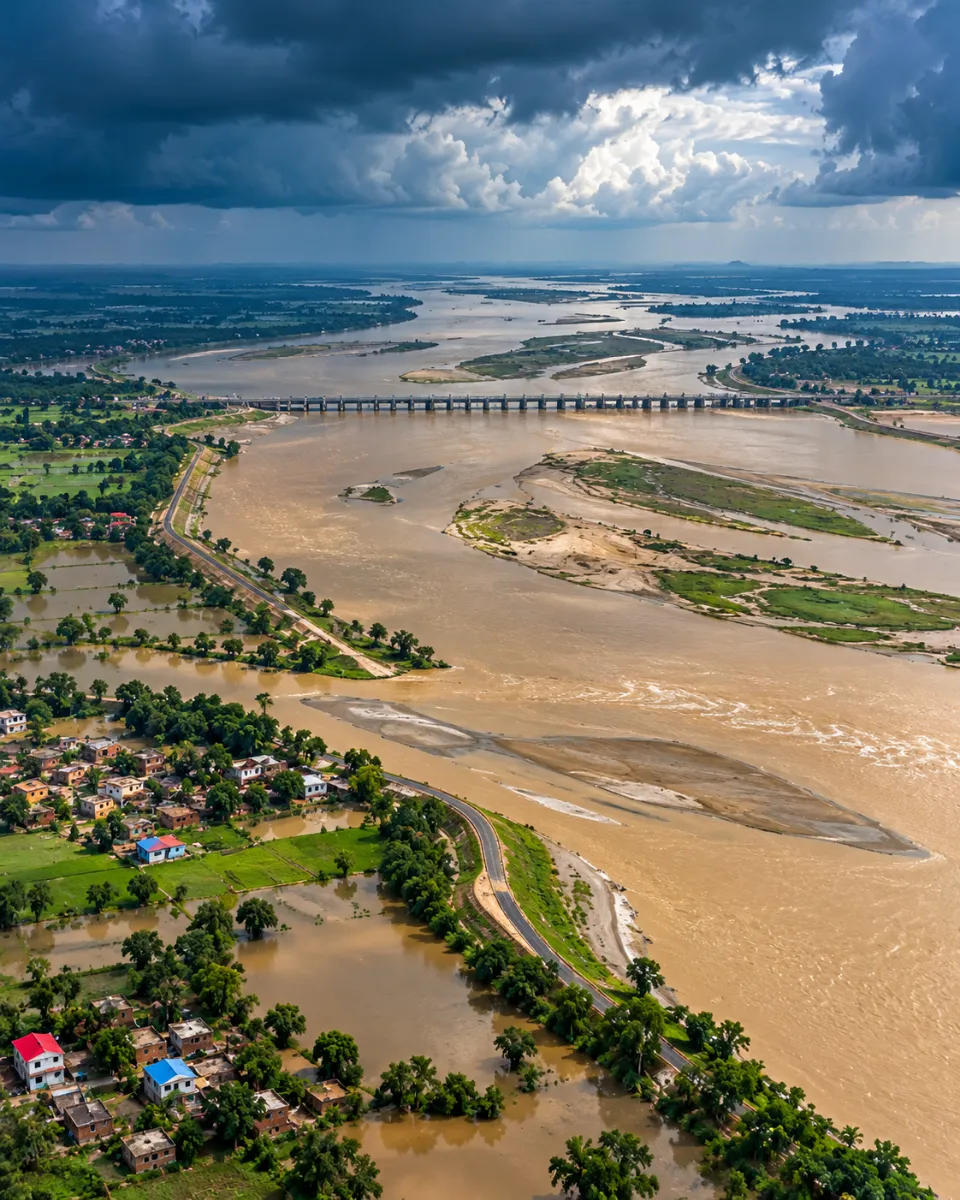
Ganga Flood Control Board discusses basin-level flood planning and a revised mandate for the GFCC
In short: Ganga basin States and the Centre discussed risk-based basin master plans, sediment studies and bridge waterways; an app to map groundwater recharge sites was launched.
Why in news
Union Jal Shakti Minister C R Patil chaired the 19th meeting of the Ganga Flood Control Board at Bharat Mandapam, New Delhi, on 27 October; the Ministry released the outcomes on 29 October. The Board discussed a revised mandate for the Ganga Flood Control Commission (GFCC) covering basin-level flood management planning, appraisal of flood schemes, river morphology and sedimentation studies and a Flood Management Information System, In a related development, the Ministry announced the Punah Bharan mobile app to identify sites for artificial groundwater recharge.
Background
The Board was constituted on 18 April 1972 to coordinate planning for flood, erosion and drainage problems in the Ganga basin; it is chaired by the Union Jal Shakti Minister, with the GFCC Chairman as Member Secretary. The meeting was attended by West Bengal Chief Minister Suvendu Adhikari, Bihar Deputy Chief Minister Vijay Kumar Choudhary, Uttar Pradesh Jal Shakti Minister Swatantra Dev Singh, NITI Aayog Member K V Raju and Union Minister of State Ram Nath Thakur. Other items included risk-based basin master plans, the adequacy of waterways and ventways under bridges, and better detailed project reports. The GFCC has prepared comprehensive flood management plans for 23 river systems of the basin, which States use to frame schemes. Ahead of the meeting, Bihar said it would raise siltation linked to the Farakka barrage and its needs under the India-Bangladesh Ganga Waters Treaty, a 30-year pact signed on 12 December 1996 that shares lean-season flows (1 January to 31 May) at Farakka in 10-day periods and comes up for renewal in December 2026.
Key facts for Prelims
- Ganga Flood Control Board: set up 18 April 1972; chaired by the Union Jal Shakti Minister; the Ganga Flood Control Commission (also 1972) is its technical arm and prepares basin master plans.
- Punah Bharan app: developed by BISAG-N with the National Water Mission; shows potential recharge zones within up to 3 km and village-level zonation maps for artificial recharge structures using rainfall, groundwater level and yield, slope and drainage data.
- National Water Mission is one of the eight missions under the National Action Plan on Climate Change.
- Ganga Waters Treaty (India-Bangladesh): signed 12 December 1996 for 30 years; lean season 1 January to 31 May; flows at Farakka shared in 10-day blocks.
- Farakka barrage is in Murshidabad district of West Bengal, upstream of the point where the Ganga enters Bangladesh as the Padma; its feeder canal diverts water to the Bhagirathi-Hooghly to keep Kolkata port navigable.
- Ventway: the open area under a bridge through which flood water passes; inadequate ventways raise water levels upstream and can turn bridges and embankments into flood traps.
Mains analysis and way forward
Mains analysis
- Floods in the Ganga plains are driven as much by sediment as by water: heavy silt from the Himalaya raises riverbeds, so embankments alone shift the problem downstream; sediment and morphology studies are the right starting point.
- A basin-level, risk-based master plan suits a river shared by many States and two neighbours, since local works in one State change flood levels in another.
- Linking flood management with groundwater recharge turns surplus monsoon water into a resource for the dry season, which matters in a basin that faces both floods and falling water tables.
- Renewal of the Ganga Waters Treaty must balance Bangladesh’s lean-season needs with the claims of upstream States such as Bihar and West Bengal, making federal consultation part of foreign policy.
Way forward
- Give the restructured GFCC a clear mandate, data access and timelines, and update the 23 river-system plans with flood-risk maps and sediment budgets.
- Use the Flood Management Information System to share real-time data with States and with Nepal and Bangladesh, and pair structural works with floodplain zoning and wetland restoration.
Connect the dots: Syllabus links: GS I Geography (Himalayan rivers, floods, sediment, groundwater); GS III Disaster Management (flood management); GS II International Relations (India-Bangladesh water sharing); GS II federalism (inter-State coordination).
Sources: Revoi.in (from PIB): Union Minister of Jal Shakti Shri C R Patil chairs 19th meeting of Ganga Flood Control Board in New Delhi, 29 Oct 2026; The NewsMill (ANI): Union Minister C R Patil chairs 19th Ganga Flood Control Board meeting, 29 Oct 2026; Organiser: Centre launches Punah Bharan app to map groundwater recharge zones, 29 Oct 2026; ETV Bharat: Bihar CM to raise State’s concerns over Farakka barrage at 19th GFCC meeting in Delhi, 16 Oct 2026; Down To Earth: Centre prepared flood management plans for 23 river systems in Ganga basin (Parliament reply), 11 Aug 2023
After Arnab, Andhra Pradesh seeks central teams to assess damage; paddy on about 70,900 hectares inundated
In short: The response has moved from evacuation to assessment: central teams sought, technology-based loss estimates ordered and power to be restored by 30 October.
Why in news
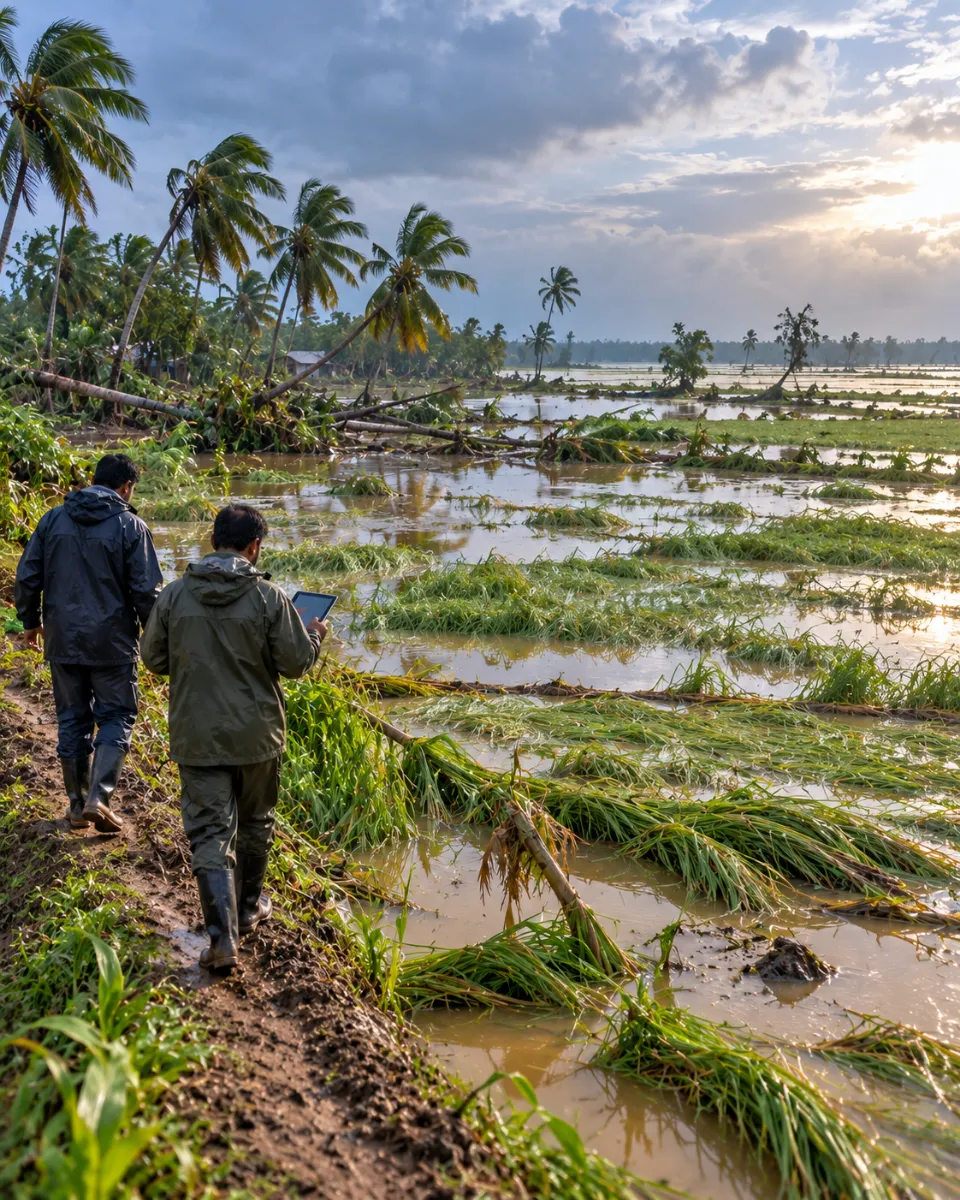
Chief Minister N Chandrababu Naidu wrote to Union Home Minister Amit Shah on 28 October seeking early deployment of central teams to assess damage from Cyclone Arnab and continued central help for relief and restoration. At a teleconference on 29 October he asked officials to use technology to prepare damage estimates quickly, remove fallen trees from roads at once and restore power in all areas by 30 October; he said a government order on compensation had been issued.
Background
Arnab crossed the Andhra Pradesh and Yanam coasts as a very severe cyclonic storm early on 28 October near Narsapur and then weakened over land. Preliminary state figures put paddy inundated on about 70,900 hectares, horticulture damaged on 10,450 hectares and about 180 houses damaged; Konaseema, Kakinada, East Godavari, West Godavari, Anakapalli and Krishna were among the worst-hit districts. Sixteen NDRF and 11 SDRF teams worked across 14 districts and more than 28,000 people were moved to relief centres. By 28 October the NDRF had confirmed three deaths in the State, two from fallen live wires and one from a falling tree (the toll may change as assessments continue), and about 6,000 electric poles were uprooted in Konaseema alone. Naidu asked officials to judge how much submerged crop can be saved and to plan replanting of coconut and other horticultural crops in the Godavari districts, while noting that Rayalaseema, untouched by the cyclone, faces poor farming conditions linked to El Nino.
Key facts for Prelims
- Disaster Management Act, 2005: the National Disaster Response Fund (Section 46) supplements the State Disaster Response Fund when a calamity is of severe nature; central teams assess losses before extra assistance is approved.
- The National Disaster Response Force is constituted under Section 44 of the Act; State forces (SDRF) are raised by States.
- Konaseema, East Godavari and West Godavari lie in the Godavari delta, a low-lying paddy and coconut belt prone to waterlogging after cyclonic rain.
- Rayalaseema (south-western Andhra Pradesh) is a drought-prone, rain-shadow region, showing how one State can face cyclone and drought stress in the same season.
- Yanam, near the landfall zone, is part of the Union Territory of Puducherry.
Mains analysis and way forward
Mains analysis
- Low loss of life shows the value of early warning and pre-emptive evacuation, but electrocution deaths show that the post-landfall phase (live wires, fallen trees) needs the same planning as the storm itself.
- Speedy, technology-based assessment (satellite and drone imagery, geo-tagged field data) shortens the gap between loss and compensation, which matters most for tenant farmers and coconut growers whose recovery takes years.
- Power distribution is the weakest link in coastal resilience: thousands of poles lost in one district can delay water supply, health services and communication for days.
- The contrast between a flooded delta and a dry Rayalaseema argues for district-level climate risk planning rather than one State-wide response.
Way forward
- Link crop loss enumeration to insurance and input-subsidy payouts within fixed timelines, with special attention to perennial crops such as coconut.
- Invest in underground cabling and storm-rated poles in high-risk coastal districts, and in mangrove and shelterbelt plantations that blunt wind and surge.
Connect the dots: Syllabus links: GS III Disaster Management (Disaster Management Act, 2005, NDRF and SDRF, damage assessment, resilient infrastructure); GS I Geography (tropical cyclones, Godavari delta, rain-shadow regions).
Sources: Deccan Chronicle: Naidu seeks central teams to assess Arnab cyclone damage, 28 Oct 2026; Deccan Chronicle: Naidu calls for technology-based quick assessment of Cyclone Arnab damage, 29 Oct 2026; The Pioneer: Cyclone Arnab weakens over land; three dead in Andhra, crops hit on 70,900 hectares, 28 Oct 2026
COP17 finance talks deadlock over EU bid to widen donor base; Arab group rejects reclassifying countries
In short: With COP17 closing on 30 October, who pays for nature is unresolved, though 14 decisions and over $1.8 billion in commitments are secured.
Why in news
As the Convention on Biological Diversity’s COP17 in Yerevan, Armenia, entered its last days, talks on biodiversity finance were deadlocked on 28 October over a European Union proposal to expand the list of donor countries so that emerging economies such as China and Gulf states could contribute to collective goals. The Arab group said it rejects any attempt to expand the donor list or reclassify countries’ development status, while Ireland, holding the EU presidency, said EU States would keep their position.
Background
Developed countries have most likely missed the Kunming-Montreal Global Biodiversity Framework’s interim goal of $20 billion a year for nature by 2025, according to the UN progress report; the framework seeks $30 billion in international public finance by 2030 and $200 billion a year from all sources. Separately, Target 18 seeks to reform harmful incentives by at least $500 billion a year; it is the least-progressed target, and the UN estimates that about $30 goes into activities that destroy nature for every $1 spent on conservation. By 28 October, COP17 had adopted 14 decisions (on invasive alien species, biosafety, gender and education) and secured more than $1.8 billion in financial commitments; nearly 90% of Parties have set national targets. The conference, the first Global Review of collective progress under the framework, is due to end on 30 October with a proposed “Yerevan Pathway” of measurable priorities; the presidency hoped to adopt the review text separately from the finance talks.
Key facts for Prelims
- CBD Article 20: developed country Parties provide new and additional financial resources to help developing country Parties meet implementation costs.
- Kunming-Montreal GBF (COP15, December 2022): 23 targets for 2030; Target 19 on mobilising $200 billion a year; Target 18 on cutting harmful incentives by at least $500 billion a year.
- COP17: Yerevan, Armenia; President Hambardzum Matevosyan, Armenia’s Environment Minister; Executive Secretary of the CBD: Astrid Schomaker.
- Kunming Biodiversity Fund: initiated by China (400 million yuan); approved nine projects worth about $4.5 million for developing countries.
- Cali Fund: set up at COP16 (Cali, Colombia) for benefit-sharing from digital sequence information; guideline contribution of 1% of profits or 0.1% of revenue by users.
Mains analysis and way forward
Mains analysis
- The donor-base dispute mirrors climate talks: the 1990s division of developed and developing countries no longer reflects economic weight, but redrawing it reopens the principle of common but differentiated responsibilities.
- For India, which has asked for predictable finance and technology from developed countries, a wider donor base could bring new expectations; India’s case rests on per capita income and historical responsibility.
- Public money alone cannot close the gap: reforming harmful subsidies in agriculture, fisheries and fossil fuels is the largest lever, yet it is the least advanced target.
- Separating the Global Review from finance may secure a text, but targets without money risk repeating the missed Aichi Targets of 2011-2020.
Way forward
- Agree a predictable roadmap for the $20 billion and $30 billion commitments while opening voluntary South-South channels that do not change obligations under Article 20.
- Make subsidy reform measurable through national reporting, and make Cali Fund contributions by large users of genetic data more binding.
Connect the dots: Syllabus links: GS III Environment (CBD, Kunming-Montreal GBF, biodiversity finance, access and benefit-sharing); GS II International Relations (global negotiations, North-South divide).
Sources: Climate Home News: Stalemate on finance at COP17 nature talks exposes need for new sources, 28 Oct 2026; Xinhua: World Insights: COP17 nears conclusion as negotiators make progress but face hurdles, 28 Oct 2026
In brief
- Personality and history: Homi J Bhabha, born 30 October 1909: Homi Jehangir Bhabha, the principal architect of India’s nuclear energy programme, was born in Bombay on 30 October 1909; he founded the Tata Institute of Fundamental Research in 1945 with support from J R D Tata and became chairman of the Atomic Energy Commission in 1948. He presided over the 1955 UN Conference on the Peaceful Uses of Atomic Energy and died in an air crash on Mont Blanc on 24 January 1966, after which the Atomic Energy Establishment, Trombay, was renamed the Bhabha Atomic Research Centre.
- Curtain-raiser: Rashtriya Ekta Diwas, 31 October: The Rashtriya Ekta Diwas parade at Ekta Nagar, Gujarat, on Sardar Vallabhbhai Patel’s birth anniversary will be held in the evening for the first time, with about 5,000 artists presenting over 50 art forms and 15 tableaux marking 150 years of Vande Mataram, DeshGujarat reported on 21 October. Celebrations open on 30 October with a National School of Drama production based on Bankim Chandra Chattopadhyay’s Anandamath.
- Supreme Court: grounds of arrest: On 28 October 2026, a Bench of Justices M M Sundresh and Prasanna B Varale (State of Rajasthan v. Jhabra Ram) set aside bail granted in an Official Secrets Act case, holding that there was substantial compliance with Article 22(1) and Section 47 BNSS. A procedural defect in communicating grounds of arrest does not by itself justify bail unless it causes demonstrable prejudice, and the grounds need not always be in writing, the Court said.
- Supreme Court on “digital arrest” frauds: Hearing a matter on 28 October 2026, Chief Justice Surya Kant orally described “digital arrest” frauds targeting senior citizens as prima facie “digital dacoity” and called for strong action against such cyber crimes.
- CBI withdraws West Bengal post-poll violence petitions: On 28 October 2026, the CBI, through the Solicitor General, withdrew before the Supreme Court its petitions seeking transfer of 2021 West Bengal post-poll violence cases, citing changed circumstances.
- Cancer medicines: revised MRPs for 543 brands: On 28 October 2026, the National Pharmaceutical Pricing Authority released revised MRPs for 543 brands of anti-cancer medicines, effective 9 November 2026, following the trade margin rationalisation of 137 non-scheduled anti-cancer drugs announced on 17 October; the list will be updated as more manufacturers submit revised prices (PIB).
- Khelo India Sports Goods Manufacturing Scheme: The Union Cabinet on 28 October 2026 approved the Khelo India Sports Goods Manufacturing Scheme with an outlay of Rs 1,856.67 crore for 2026-27 to 2033-34, including four integrated sports goods manufacturing zones of over 300 acres each, anchor investment and turnover-linked support, and help with international certification (PIB).
- DPDP Act: Centre open to talks with media: Union IT Minister Ashwini Vaishnaw said on 28 October 2026 that there is no intention to affect journalistic freedom under the Digital Personal Data Protection Act, 2023, and invited editors to discuss their concerns; a day earlier the Supreme Court issued notice on the Digital News Publishers Association’s challenge to provisions of the Act and its rules, with the next hearing on 17 November (PTI via Assam Tribune; Business Standard).
- Background: what is a TEU?: The twenty-foot equivalent unit (TEU) measures container capacity: a standard 20-foot container is one TEU and a 40-foot container is two; the Container Manufacturing Promotion Scheme approved on 28 October 2026 aims for 7.5 lakh TEUs of annual capacity in India.
- Background: Pay Commissions: Central Pay Commissions are set up by the Union Government, not under the Constitution, to recommend pay, allowances and pensions; the Terms of Reference of the 8th Central Pay Commission were approved on 28 October 2025, and it is to report within 18 months of its constitution.
- US Federal Reserve holds rates: On 28 October 2026 (late night in India), the US Federal Open Market Committee kept the federal funds target range at 3.75% to 4% in a 10 to 2 vote; two members preferred a quarter-point increase. US rate decisions influence capital flows to emerging markets such as India.
- Hormuz: three more tankers hit mines: Iran’s Revolutionary Guards said on 29 October 2026 that three tankers exploded and caught fire after hitting sea mines while using what Iran calls an unauthorised route south of the Strait of Hormuz in the previous 24 hours; UKMTO separately reported a ship on fire about 9 nautical miles north of Khasab, Oman (Reuters/AFP via Arab News).
- Iran targets a shipping firm: Iran’s new strait authority said on 27 October 2026 that vessels of South Korea’s Sinokor would face ‘legal action’ from 1 November for crossing violations; the Korea Shipowners’ Association said on 28 October that the ships concerned are not owned by Sinokor (Reuters via Arab News).
- India and Mexico launch trade pact talks: On 28 October 2026, India and Mexico signed the Terms of Reference to begin negotiations on a Preferential Trade Agreement covering goods market access, rules of origin, customs, SPS, TBT, trade remedies and dispute settlement; Commerce Secretary Rajesh Agrawal led the Indian side.
- US-Russia-Ukraine talks proposed: Russian presidential aide Yuri Ushakov said on 28 October 2026 that trilateral US-Russia-Ukraine talks are planned in Abu Dhabi after 4 November; no date has been confirmed and the venue could change. The MEA said on 28 October that India is working with both Kyiv and Moscow to bring home Indians recruited into the war.
- Cali Fund: little corporate money so far: A Zero Carbon Analytics estimate cited on 28 October says the 15 largest pharmaceutical companies could have paid $756 million to the Cali Fund in 2025 under its guideline of 1% of profits or 0.1% of revenue; in two years the fund has received only a little over $10,000 in corporate contributions (Climate Home News, 28 October).
- COP17 pledges for nature: By 28 October, nine philanthropic organisations had pledged $500 million through 2030 for species recovery at COP17, and the Global Biodiversity Framework Fund had secured over $60 million in new pledges (Xinhua, 28 October).
- Arnab disrupts travel: At least 91 trains were cancelled across eastern and southern India and 38 flights to and from Visakhapatnam were called off as Cyclone Arnab came ashore on 28 October; IMD forecast heavy rain over parts of West Bengal until 31 October (The Pioneer, 28 October).
Prelims practice: 5 questions
Choose an option to see the answer and explanation. Your score appears when all five are answered.
Mains practice
Containers are the hidden infrastructure of trade. Examine how the Container Manufacturing Promotion Scheme can reduce India’s import dependence in maritime logistics, and the challenges it may face.
Show the answer outline
Introduction (about 30 words)
- Begin with the Cabinet’s approval on 28 October 2026 of a Rs 10,000 crore scheme up to 2039-40, aiming for a tenfold rise in capacity to 7.5 lakh TEUs a year.
Why containers matter
- Global shipping lines source containers mostly from China because of a cost advantage (about $1,700 per TEU against $2,200 to $2,400 elsewhere).
- Volatile container leasing and buying rates since 2023 have raised freight costs for Indian traders.
- A domestic supply supports port-led growth under Sagarmala and logistics under PM Gati Shakti.
How the scheme helps
- Output-linked support per container sold (Rs 49,500 for a 20-foot unit) bridges the cost gap and ties money to production.
- Interest subvention and common testing and certification facilities lower entry barriers.
- Local content rising from 70% to 90% builds supply chains in steel, corner castings, wooden floors and paints, with about 3,000 direct and over 50,000 indirect jobs.
Challenges
- Matching global scale and price; acceptance by international shipping lines and lessors.
- Supply of specialised steel, quality certification and a long 13-year horizon that needs steady monitoring.
Way forward
- Cluster plants near ports and steel hubs; certify to global standards; publish outcomes on capacity, exports and jobs.
Conclusion (about 30 words)
- Making a key input of maritime trade at home can turn freight shocks into an opportunity, if quality and scale keep pace with the subsidy.
Tip: Use the TEU figures and the cost gap with Chinese containers, and link the scheme to Sagarmala and PM Gati Shakti.
Current Canvas is prepared by the UPSC Gurus editorial desk. Every fact is checked against official releases and reliable reporting, with sources listed under each story. Editions are compiled each month into Current Canvas Monthly, a free magazine.
About images: photographs and illustrations in Current Canvas are AI-generated for illustration only. They are not news photographs of the events described.