 New this week · Free UG Handout 02UPSC Mains Directive Words: 60 Meanings, Trends and PYQsTwo free PDFs: The Guide and the With PYQs edition.Read and download
Today’s Canvas
- Supreme Court: rising acid attacks show the policy has failed; asks Centre to revisit curbs on retail sale of acidGS II
- Allahabad High Court issues statewide directions to stop child marriages being registered; says Aadhaar cannot prove ageGS II
- Why are most medicines outside price control? Supreme Court questions Centre, reserves orderGS II
- Supreme Court to frame constitutional guiding principles on compulsory rural service by medical graduatesGS II
- Israel’s 26th Knesset vote: with over 85% counted, no bloc has 61 seats; Herzog urges an open mind in coalition talksGS II
- Modi and Liechtenstein’s Hereditary Prince Alois discuss a tax treaty; trade, technology and talent in focusGS II
- Local ceasefire takes effect in Russian-occupied Oleshky to let aid in; strikes continue elsewhere in UkraineGS II
- Garuda Shakti 11th edition: India-Indonesia special forces exercise opens at Banyuwangi, runs till 6 NovemberGS III
- Jio Platforms lists at Rs 1,358, a 21.36% premium; market value of about Rs 12.5 lakh crore on debutGS III
- Goyal: India open to Chinese supplies but will act on unfair pricing; sees exports to China and ASEAN risingGS III
- Reuters poll: India’s growth to ease to 7.1% in 2026-27 as high oil prices keep inflation above targetGS III
- DPIIT launches sixth National Startup Awards with 12 new sectors and a new award for student innovatorsGS III
- Cyclone Arnab crosses the Andhra coast southwest of Yanam; three deaths reported as over 1.8 lakh people were evacuatedGS III
- At COP17 in Yerevan, India backs the Cali Fund and seeks predictable finance and technology from developed countriesGS III
- Lancet Countdown 2026: climate change behind 68% of heat deaths since 2016; heat cost $1.07 trillion in lost income in 2025GS III
Social justice and health
Supreme Court: rising acid attacks show the policy has failed; asks Centre to revisit curbs on retail sale of acid
In short: Guidelines alone are not enough, the Court said, asking the Union to study NCRB data and consider a tightly controlled sale model.

Why in news
On 27 October 2026, a Bench of Chief Justice Surya Kant and Justices Joymalya Bagchi and V Mohana, hearing Shaheen Malik v. Union of India, said acid attacks continue despite the Union’s guidelines restricting retail sale of acid, and that if incidents are rising, the policy has failed. It asked the Union to examine National Crime Records Bureau data on acid attacks over the years and revisit its policy, and asked the Union and NALSA to review a proposed Standard Operating Procedure submitted by an NGO, after consulting survivors.
Background
In Laxmi v. Union of India (July 2013), the Supreme Court asked States and Union Territories to frame rules regulating the sale of acids under the Poisons Act, 1919: sale only to adults with photo identity proof, a sales register, declaration of stock with confiscation and a fine of up to Rs 50,000 for undeclared stock, and at least Rs 3 lakh compensation to each survivor, Rs 1 lakh of it within 15 days. On 31 August 2026, the Court asked the Centre to consider whether retail sale should be banned outright or allowed only under strict safeguards. On 27 October, the Bench asked why retail sale is needed where substitutes exist; the CJI suggested a controlled-sale model like that under the NDPS Act, and Justice Bagchi proposed identifying the purposes for which open sale was allowed and restricting sale to uses where acid is indispensable. The Additional Solicitor General said guidelines had been revised and recirculated but implementation remained a problem.
Key facts for Prelims
- Shaheen Malik v. Union of India (W.P.(C) No. 1112/2025): the pending Supreme Court case on acid attack survivors.
- Laxmi v. Union of India (2013): Supreme Court directions on regulating acid sale and minimum compensation of Rs 3 lakh to survivors.
- Poisons Act, 1919: the law under which rules regulating the sale of acids and corrosive substances are framed.
- NALSA (National Legal Services Authority): constituted under the Legal Services Authorities Act, 1987; asked to review the proposed SOP.
- Survivors with internal injuries from forced ingestion of acid are covered in the “persons with disability” category, and disability assessment guidelines are being revised, the Union told the Court.
Mains analysis and way forward
Mains analysis
- Federal division of work: the Union issues guidelines, but sale is policed by States and districts; the Court stressed that the Union cannot treat guidelines as the end of its responsibility.
- Regulation that relies on registers and identity checks at thousands of retail points is hard to enforce; restricting sale by end use addresses supply more directly.
- Survivors need long-term medical care, disability certification and livelihood support; one-time compensation often falls short.
- Data-led review using NCRB figures can show which States and supply channels need the most attention.
Way forward
- Map legitimate uses of acid, identify safer substitutes and limit retail sale to indispensable uses under licences.
- Hold enforcement officers accountable through periodic audits of acid sellers and public reporting by States.
- Finalise disability criteria and a survivor-centred SOP with time limits for compensation, treatment and rehabilitation.
Connect the dots: GS II: welfare of vulnerable sections, role of NALSA, Centre-State relations; GS I: crimes against women; GS IV: accountability in public administration.
Sources: LiveLaw: Rise in acid attacks indicates policy failure; Supreme Court asks Union to revisit, consider regulation of acid sale, 27 Oct 2026; Bar and Bench: Acid attacks: Supreme Court calls for complete ban or restricted retail sale of acid, 31 Aug 2026; Moneylife: Supreme Court directs States to frame rules to regulate acid sale (2013)
Allahabad High Court issues statewide directions to stop child marriages being registered; says Aadhaar cannot prove age
In short: Marriage registration must meaningfully verify age, the Court said, ordering a document hierarchy, portal checks and bi-monthly inspections across Uttar Pradesh.
Why in news
In Deepak Pal v. State of U.P., reported on 27 October 2026, Justice Tej Pratap Tiwari of the Allahabad High Court set aside a marriage registration made on the basis of an unverified transfer certificate and an Aadhaar card, holding that “an Aadhaar card cannot prove age”. He issued twelve statewide directions so that no marriage is registered unless the groom is 21 and the bride 18 on the date of application, and listed the matter for compliance on 27 November 2026.
Background
The Court said compulsory registration of marriages is a safeguard against child marriage, not merely record-keeping, and drew on Seema v. Ashwani Kumar, in which the Supreme Court had called for compulsory registration. It found that Uttar Pradesh’s instructions did not rank age documents, and directed the State to prescribe a hierarchy, with the birth certificate from the competent authority and the matriculation or equivalent record taken first; a mere transfer certificate does not fall within the documents listed in Section 94(2)(i) of the Juvenile Justice Act. Doubtful cases must be referred to the Child Marriage Prohibition Officer and the District Magistrate, the online portal must record the source of each date of birth and block unverified applications, and District Legal Services Authority secretaries must inspect registration offices every two months. The directions apply until the Uttar Pradesh Marriage Registration Rules, 2017 are amended.
Key facts for Prelims
- Prohibition of Child Marriage Act, 2006: marriageable age is 21 for men and 18 for women; it provides for Child Marriage Prohibition Officers.
- Seema v. Ashwani Kumar (2006): Supreme Court ruling calling for compulsory registration of marriages.
- Juvenile Justice (Care and Protection of Children) Act, 2015, Section 94: sets the order of documents for determining age.
- Uttar Pradesh Marriage Registration Rules, 2017: govern marriage registration in the State.
- District Legal Services Authorities: constituted under the Legal Services Authorities Act, 1987; to inspect registration offices every two months.
Mains analysis and way forward
Mains analysis
- Registration can be a powerful preventive tool only if the age check is real; a paper process that accepts any document can legitimise child marriage.
- Clear document hierarchies reduce discretion and corruption at the counter while protecting genuine applicants.
- Technology helps when the portal records the source of each date of birth and flags conflicts, but officers must still verify with issuing authorities.
- Judicial monitoring through DLSAs and District Judges brings accountability but cannot replace sustained administrative effort and social change.
Way forward
- Amend the 2017 Rules to build in the document hierarchy, escalation and reasons for accepting a date of birth.
- Link registration portals with birth registration and school board databases for automatic verification.
- Pair enforcement with community awareness, girls’ education and support for families at risk.
Connect the dots: GS II: protection of vulnerable sections, children, role of the judiciary; GS I: social empowerment and issues relating to women.
Why are most medicines outside price control? Supreme Court questions Centre, reserves order
In short: Citing steep gaps between MRPs and purchase prices, the Court asked why the Centre does not control prices across the whole range of medicines.

Why in news
On 27 October 2026, a Bench of Justices Vikram Nath and Sandeep Mehta, hearing Kishan Chand Jain v. Ethics and Medical Registration Board, asked the Centre why most medicines remain outside the stricter regime of the Drugs (Prices Control) Order, 2013 (DPCO) and reserved its order, allowing written submissions within two weeks. Justice Mehta cited a chemotherapy injection bought by a dealer for Rs 11,000 but billed by a hospital at Rs 1.3 lakh, and remarked that the National Pharmaceutical Pricing Authority (NPPA) appeared weak.
Background
Under the DPCO, scheduled medicines carry ceiling prices, while manufacturers set the MRPs of non-scheduled medicines, subject to a cap on annual increases. The Centre said there is no legal bar to wider control, but it follows a calibrated approach under the National Pharmaceutical Pricing Policy, 2012, balancing affordability with innovation, competition and jobs, and intervenes in extraordinary cases under Paragraph 19 of the DPCO, as with caps on 106 diabetes and cardiac formulations in 2014, coronary stents and knee implants in 2017 and trade margins on 42 anti-cancer medicines in 2019. Scheduled medicines account for 35% of the market by volume and 18% by value, the Centre said; the petitioner said non-scheduled medicines make up about 83% by value. In September 2026, the same Bench had called a tenfold gap between the retailer price (Rs 2,700) and MRP (Rs 27,000) of a cancer drug “broad daylight dacoity”.
Key facts for Prelims
- Drugs (Prices Control) Order, 2013: issued under the Essential Commodities Act, 1955; fixes ceiling prices of scheduled formulations.
- NPPA: the National Pharmaceutical Pricing Authority, set up in 1997, fixes and monitors drug prices under the DPCO.
- Paragraph 19 of the DPCO: allows the government to fix prices of any drug in extraordinary circumstances in public interest.
- Trade margin rationalisation: the recent cap limits margins on selected non-scheduled anti-cancer medicines to 30% of MRP.
- Scheduled medicines: 35% of the market by volume and 18% by value, the Centre told the Court.
Mains analysis and way forward
Mains analysis
- A high MRP with a deep discount to retailers and hospitals means patients, who have little bargaining power or information, pay the most.
- Price control must balance affordability against supply, quality and investment in new medicines; excessive control can cause shortages.
- Public schemes that reimburse hospitals at MRP may end up paying inflated prices with taxpayer money.
- Out-of-pocket spending on medicines is a major driver of household health costs, linking pricing policy to the right to health under Article 21.
Way forward
- Extend trade margin caps in stages to high-value non-scheduled medicines, especially in cancer, cardiac and critical care.
- Strengthen the NPPA with staff, data and real-time monitoring of price to retailer against MRP.
- Expand Jan Aushadhi outlets and hospital pharmacy transparency so patients can compare prices.
Connect the dots: GS II: health, government policies and interventions, regulatory bodies; GS III: inclusive growth and the pharmaceutical sector.
Sources: LiveLaw: Why most medicines kept out of price control regime? Supreme Court questions Centre, reserves order, 27 Oct 2026; The Week: Rs 2,700 cancer medicine sold for Rs 27,000: Supreme Court questions 10-fold price gap, 22 Sep 2026
Supreme Court to frame constitutional guiding principles on compulsory rural service by medical graduates
In short: Calling it a policy deficit, the Court said it would set guiding principles, not a mandate, for rural service by doctors nationwide.
Why in news
On 27 October 2026, a Bench of Justices P S Narasimha and Alok Aradhe, hearing Ashish Redu v. Government of Karnataka, said it was inclined to lay down guiding principles, based on constitutional values, on compulsory rural service by medical students across the country. Justice Narasimha said the right to health is a fundamental right and the obligation of the State, and that the formulations would be made by the States in consultation with the Commission; the Court asked the Union whether it intends to frame a policy and whom it would consult.
Background
The petitioners challenge the Karnataka Compulsory Service Training by Candidates Completed Medical Courses Act, 2012, its 2015 Rules and a 28 July 2023 notification extending one year of compulsory public rural service to candidates on private seats in private and deemed universities. Completing the service is needed for a no-objection certificate and permanent registration with the Karnataka Medical Council; the petitioners argue that students paying much higher fees form a separate class under Article 14. The Union said health is a State subject, many States have service bonds, a committee had recommended uniform adoption, and it preferred a consultative process. In an earlier case on super-speciality aspirants, the Court had upheld compulsory service bonds but urged a uniform policy.
Key facts for Prelims
- Public health and sanitation, hospitals and dispensaries: Entry 6 of the State List (Seventh Schedule).
- Article 47 (Directive Principle): duty of the State to raise the level of nutrition and the standard of living and to improve public health.
- Right to health: read into the right to life under Article 21 by the Supreme Court.
- Karnataka Compulsory Service Training by Candidates Completed Medical Courses Act, 2012: one year of rural service for MBBS, PG and super-speciality graduates.
- Amicus curiae in the case: Senior Advocate Raju Ramachandran.
Mains analysis and way forward
Mains analysis
- Rural India faces shortages of doctors and specialists, and compulsory service is one way States try to staff primary and community health centres.
- Bonds raise questions of fairness, especially for students who pay full private fees, and of the quality of service by unwilling doctors.
- A uniform national framework could reduce the patchwork of State rules, but health being a State subject calls for cooperative federalism.
- Incentives such as rural allowances, housing, PG seat weightage and safe workplaces often work better than compulsion alone.
Way forward
- Frame national guiding principles through consultation among the Union, States and the National Medical Commission.
- Combine service obligations with incentives, mentoring and career benefits to make rural postings attractive.
- Invest in rural health infrastructure so that doctors posted there can actually practise.
Connect the dots: GS II: health, Centre-State relations, DPSP and fundamental rights; GS IV: public service values and duty to society.
International relations and security
Israel’s 26th Knesset vote: with over 85% counted, no bloc has 61 seats; Herzog urges an open mind in coalition talks
In short: Counts on 28 October put Netanyahu’s bloc at 53 seats, the Eisenkot-led bloc at 48 and Arab parties at 19; turnout was about 77.7%, the highest since 1999.

Why in news
Israelis voted on 27 October 2026 to elect the 26th Knesset. With over 85% of votes counted by the evening of 28 October, Prime Minister Benjamin Netanyahu’s bloc was projected at 53 seats, the bloc led by Gadi Eisenkot’s Yashar! at 48 and Arab parties at 19, so no side had the 61 seats needed for a majority in the 120-member house. President Isaac Herzog called on parties to approach coalition talks with an open mind.
Background
Exit polls on the night of 27 October had suggested a narrow edge for the Eisenkot-led bloc; early counts moved the balance towards Netanyahu’s camp, and later counts narrowed it again, with Likud the single largest party at about 27 seats. Turnout was reported at about 77.7%, the highest since 1999. Between 600,000 and 650,000 double-envelope ballots of soldiers, diplomats, hospital patients and displaced voters are counted separately, roughly 15 seats’ worth, so the tally can still shift, particularly for parties near the 3.25% threshold. The final tally is expected by Friday and official results on 4 November.
Key facts for Prelims
- The Knesset is Israel’s unicameral legislature of 120 members, elected by nationwide proportional representation from party lists.
- Electoral threshold: 3.25% of valid votes; parties below it win no seats.
- After the results, the President (Isaac Herzog) consults party leaders and nominates the member most likely to form a government.
- The nominee has up to 42 days to build a coalition; meanwhile the outgoing government continues in a caretaker role.
- No single party has ever won a Knesset majority on its own.
Mains analysis and way forward
Mains analysis
- A fragmented result will make coalition-building, not the vote, the real contest; small and Arab parties gain bargaining power.
- A high turnout during a regional conflict shows strong civic engagement, but also deep polarisation over security, judicial reform and the war.
- For India, continuity matters most: defence, agriculture, water technology and the IMEC corridor link ties across governments in Israel.
- Delay in forming a government could slow Israel’s decisions on Gaza, Iran and regional normalisation, which affect energy routes and the Indian diaspora in the Gulf.
Way forward
- India can keep its engagement institutional, through existing defence, trade and innovation mechanisms, whoever forms the government.
- Continued support for a negotiated two-state solution and humanitarian access remains consistent with India’s stated position.
Connect the dots: Links: proportional representation versus first-past-the-post; coalition politics; India-Israel relations; West Asia and IMEC.
Sources: The Times of Israel: With over 85% of votes counted, pro-Netanyahu bloc gets 53 seats, Eisenkot-led bloc at 48 and Arab parties have 19, 28 October 2026; Ynet News: Israel election results, live count, 28 October 2026; Ynet News: Revised exit polls and counting update, 27-28 October 2026; Al Jazeera: Five key takeaways from Israel’s parliamentary elections, 28 October 2026
Modi and Liechtenstein’s Hereditary Prince Alois discuss a tax treaty; trade, technology and talent in focus
In short: Talks in New Delhi on 27 October took up a Double Taxation Avoidance Agreement proposal and investment under the India-EFTA trade pact.
Why in news
Prime Minister Narendra Modi held talks in New Delhi on 27 October 2026 with Hereditary Prince Alois, Acting Head of State of Liechtenstein, who is on a four-day visit from 25 to 28 October. Secretary (West) Sibi George told the media that the two sides discussed a proposal for a Double Taxation Avoidance Agreement (DTAA), which Liechtenstein sees as an enabling framework for its companies to invest in India.
Background
Liechtenstein is a member of the European Free Trade Association (EFTA), whose India-EFTA Trade and Economic Partnership Agreement (TEPA) was signed in March 2024 after nearly 16 years of talks and came into force in October 2025. The EFTA states have set a goal of USD 100 billion of investment in India over 15 years. Cumulative FDI from Liechtenstein stands at about USD 110 million, and firms such as Hilti operate in India. This is the Prince’s second visit in 2026, after the AI Impact Summit in February; he was accompanied by a business delegation, and President Droupadi Murmu was to host a banquet in his honour.
Key facts for Prelims
- EFTA members: Iceland, Liechtenstein, Norway and Switzerland; none is in the European Union.
- India-EFTA TEPA: signed March 2024, in force October 2025; first Indian FTA with a binding investment commitment of USD 100 billion over 15 years.
- Liechtenstein is a doubly landlocked principality between Switzerland and Austria; capital Vaduz.
- A DTAA prevents the same income from being taxed in two countries and sets rules for allocating taxing rights between them.
- Talks covered three areas: trade, technology and talent, plus skill development and vocational education.
Mains analysis and way forward
Mains analysis
- Small, high-income European states can bring niche capital and precision engineering; tax certainty is a low-cost way to unlock it.
- The visit shows TEPA’s investment chapter being turned into country-level engagement with each EFTA member.
- Vocational and skills cooperation fits India’s demographic needs and the dual-system training models of Alpine economies.
- Any new DTAA must balance investor certainty with safeguards against treaty shopping and base erosion.
Way forward
- Conclude the DTAA with anti-abuse provisions consistent with the multilateral instrument on BEPS.
- Use the TEPA desk and investment facilitation mechanisms to track pledges from each EFTA state.
Connect the dots: Links: India-EFTA TEPA; FDI policy; double taxation and BEPS; India-Europe relations.
Sources: News On AIR: India and Liechtenstein discuss proposal for Double Taxation Avoidance Agreement: MEA, 27 October 2026; News On AIR: PM Modi to hold bilateral talks with Liechtenstein’s Prince Alois, 24 October 2026; ThePrint (PTI): Liechtenstein’s Prince Alois to undertake 4-day India visit, 24 October 2026
Local ceasefire takes effect in Russian-occupied Oleshky to let aid in; strikes continue elsewhere in Ukraine
In short: A US-brokered truce on the Kherson axis from 27 October allows food, medicine and evacuation for a town cut off since the 2023 dam collapse.
Why in news
A localised ceasefire between Russia and Ukraine came into effect in the early hours of 27 October 2026 around Oleshky, a Russian-occupied town in Ukraine’s Kherson region, to allow humanitarian deliveries. The deal was reached on 23 October by Ukrainian, Russian and US negotiators, with the White House crediting First Lady Melania Trump; it is to last several days.
Background
Oleshky lies on the left bank of the Dnipro, which separates the two forces in the south; it had about 24,000 residents before the war and was captured on the first day of the full-scale invasion in February 2022. It was flooded in June 2023 after the Kakhovka Dam collapsed, and now has no electricity, heating or running water. The plan provides food, medicine and hygiene supplies, and transport for civilians who wish to leave. Russian missile strikes continued elsewhere, including Kyiv, on the same day; the Kremlin said it had no reports of violations of the local truce.
Key facts for Prelims
- Oleshky: town in Kherson region, southern Ukraine, on the left (east) bank of the Dnipro river.
- Kakhovka Dam on the Dnipro collapsed in June 2023, flooding downstream towns.
- Ukraine’s ombudsman Dmytro Lubinets and Russia’s ombudswoman Yana Lantratova were part of the arrangement.
- Humanitarian access and protection of civilians are obligations under the Geneva Conventions of 1949 and their Additional Protocols.
Mains analysis and way forward
Mains analysis
- Local humanitarian pauses can save lives and build small steps of trust even when a full ceasefire is out of reach.
- Their fragility, with strikes elsewhere on the same day, shows the limits of piecemeal arrangements without a wider settlement.
- Third-party facilitation by major powers has become central to Russia-Ukraine humanitarian deals, alongside prisoner exchanges.
- India’s stated position of dialogue and diplomacy and its humanitarian aid to Ukraine align with such de-escalation steps.
Way forward
- Neutral monitoring by the ICRC or UN agencies could make such pauses verifiable and repeatable.
- Humanitarian corridors can be linked to wider talks on energy infrastructure, prisoners and nuclear safety.
Connect the dots: Links: international humanitarian law; Russia-Ukraine conflict; India’s strategic autonomy; dams and water as conflict issues.
Sources: News On AIR: Local ceasefire comes into effect in Russian-occupied Ukrainian city of Oleshky for humanitarian mission, 27 October 2026; AP via KTTC: White House announces Melania Trump secured ceasefire in Russian-occupied Ukrainian city, 23 October 2026
Garuda Shakti 11th edition: India-Indonesia special forces exercise opens at Banyuwangi, runs till 6 November
In short: Paratroopers of the Parachute Regiment (Special Forces) train with Indonesian special forces in jungle warfare, air assault and joint validation drills.
Why in news
The 11th edition of Exercise Garuda Shakti, the India-Indonesia joint special forces exercise, began at Banyuwangi, Indonesia, on 27 October 2026 and will run until 6 November. The Indian Army contingent from the Parachute Regiment (Special Forces), which left on 25 October, trains with the Indonesian Special Forces to improve mutual understanding and interoperability.
Background
The training covers jungle warfare, obstacle crossing, combat marksmanship, mountaineering, air assault and combat-hardening, with an exchange of practices on weapons and equipment, ending in a validation exercise on realistic scenarios. The 10th edition was held at the Special Forces Training School, Bakloh, Himachal Pradesh, from 3 to 12 December 2025. The exercise follows Prime Minister Modi’s state visit to Indonesia from 6 to 8 July 2026, when the Indian Coast Guard and Indonesia’s Bakamla renewed a maritime safety and security MoU; ICGS Shaunak visited Jakarta from 17 to 19 October.
Key facts for Prelims
- Garuda Shakti: India-Indonesia Army special forces exercise; 11th edition at Banyuwangi (East Java), 27 October to 6 November 2026.
- Indian contingent: Parachute Regiment (Special Forces).
- 10th edition: Bakloh, Himachal Pradesh, December 2025.
- Other India-Indonesia defence engagements: Samudra Shakti (navies) and the India-Indonesia Coordinated Patrol (CORPAT).
- Indonesia is India’s maritime neighbour; Indira Point in the Andaman and Nicobar Islands lies close to Sumatra across the Six Degree Channel.
Mains analysis and way forward
Mains analysis
- Special forces exercises build trust at the tactical level and shared procedures for counter-terrorism and crisis response.
- Jungle and archipelagic terrain training adds value for India’s island territories and the Northeast.
- Indonesia is central to India’s Act East policy and maritime security near the Malacca Strait, a key choke point for trade.
- Regular alternating editions show defence ties moving from goodwill visits to steady institutional cooperation.
Way forward
- Expand to tri-service and coast guard scenarios such as humanitarian assistance and disaster relief in the Indian Ocean.
- Pair exercises with defence industrial cooperation and training seats at each other’s institutions.
Connect the dots: Links: Act East policy; Indo-Pacific; maritime choke points; defence diplomacy and joint exercises.
Sources: IANS: India-Indonesia Special Forces exercise Garuda Shakti begins in Banyuwangi, 27 October 2026; PIB (Ministry of Defence): India-Indonesia joint special forces exercise Garuda Shakti, 11th edition, October 2026; Social News XYZ (IANS): Garuda Shakti begins; ICGS Shaunak and Bakamla MoU, 27 October 2026; The Week (PTI): India-Indonesia exercise Garuda Shakti begins in Himachal, 4 December 2025
Economy
Jio Platforms lists at Rs 1,358, a 21.36% premium; market value of about Rs 12.5 lakh crore on debut
In short: India’s largest IPO lists at a strong premium, making Jio Platforms the country’s second-most valuable listed company after its parent, Reliance Industries.

Why in news
On 28 October 2026, shares of Jio Platforms opened at Rs 1,358 on both the BSE and the NSE, 21.36 per cent above the issue price of Rs 1,119. In early trade the company’s market capitalisation was about Rs 12.5 lakh crore, second only to Reliance Industries, which holds 66.4 per cent of Jio Platforms.
Background
The Rs 30,213 crore issue, the largest initial public offering in India, was entirely a fresh issue of 27 crore shares priced at the top of the Rs 1,065 to Rs 1,119 band. It was open from 21 to 23 October and was subscribed 22.19 times overall: 70.55 times in the qualified institutional buyer portion and 2.72 times in the retail portion. Before the issue opened, about Rs 8,110 crore was raised from 212 anchor investors on 19 October. Total demand across the public issue and the anchor book exceeded Rs 7.4 lakh crore, from about 1.39 crore applications. The listing came on the third working day after the issue closed, in line with SEBI’s T+3 listing timeline.
Key facts for Prelims
- Jio Platforms is the telecom and digital services subsidiary of Reliance Industries, which holds 66.4% of it.
- Issue price Rs 1,119; listing price Rs 1,358 on BSE and NSE (premium 21.36%); issue size Rs 30,213 crore, all fresh issue.
- Fresh issue: new shares are created and the money goes to the company; offer for sale: existing shareholders sell and the money goes to them.
- Anchor investors are qualified institutional buyers who are allotted shares a day before the issue opens.
- SEBI has made listing within three working days of issue closure (T+3) mandatory for public issues since 1 December 2023.
Mains analysis and way forward
Mains analysis
- Very large IPOs deepen the domestic market and let household savings flow into equity, but heavy oversubscription also shows how scarce large, quality issues have been.
- The gap between 70.55 times QIB demand and 2.72 times retail demand shows that institutional money now drives price discovery in big issues.
- Listing a digital infrastructure company improves disclosure and price discovery for a sector that is central to the Digital India agenda.
- Strong listings during heavy foreign portfolio outflows point to the growing role of domestic institutions and mutual funds in stabilising the market.
Way forward
- SEBI should keep watch on post-listing volatility and grey-market activity in large issues to protect small investors.
- Investor education should stress that listing gains are not a reliable guide to long-term returns.
- Fresh-issue money should be tracked through the monitoring agency reports that SEBI rules require for the stated objects of the issue.
Connect the dots: Capital markets and SEBI; primary and secondary markets; mobilisation of resources; digital infrastructure.
Sources: The Tribune: Jio Platforms shares list at Rs 1,358 on BSE, NSE, 21.36% above issue price, 28 Oct 2026; Onmanorama: Jio Platforms shares list at 21% premium, become India’s second-most valuable firm, 28 Oct 2026
Goyal: India open to Chinese supplies but will act on unfair pricing; sees exports to China and ASEAN rising
In short: China is India’s largest trading partner in the first half of 2026-27, but India imports about seven times what it sells there.
Why in news
Speaking to reporters in The Hague on 27 October 2026, Commerce and Industry Minister Piyush Goyal said India is willing to source from Chinese suppliers to meet its growing import needs, but will act through established legal procedures if it finds unfair pricing. He said he expects India to become a major exporter to China and the ASEAN region in the coming years, and that India will work to address the impact of China’s new export controls on key machinery, including tunnel boring machines.
Background
Commerce Ministry data show India-China trade rose about 29 per cent to $91.76 billion in April to September 2026, making China India’s largest trading partner in the first half of 2026-27, ahead of the United States ($83.14 billion). India’s exports to China rose to $11.41 billion from $8.38 billion, while imports rose to $80.34 billion from $62.86 billion, widening the deficit to $68.93 billion. China’s licensing requirement for exports of tunnel boring machines, effective 18 November 2026, has raised concern for India’s metro, rail and hydropower tunnelling projects. Goyal said India supports free and fair trade, and wants wider market access for its goods and services on a reciprocal basis.
Key facts for Prelims
- April to September 2026 (H1 2026-27): India-China trade $91.76 billion (up about 29%); India-US trade $83.14 billion.
- India’s exports to China $11.41 billion; imports $80.34 billion; deficit $68.93 billion in H1 2026-27.
- Trade remedies in India: anti-dumping and countervailing duty investigations are conducted by the Directorate General of Trade Remedies (DGTR) under the Commerce Ministry; duties are imposed by the Finance Ministry.
- Anti-dumping duty addresses goods sold below normal value; countervailing duty offsets foreign subsidies; both are allowed under WTO agreements.
- ASEAN has 11 members after Timor-Leste joined in October 2025; the ASEAN-India Trade in Goods Agreement (AITIGA) is under review.
Mains analysis and way forward
Mains analysis
- Imports of intermediate goods, electronics and machinery from China feed Indian manufacturing, so cutting them abruptly can hurt exporters and projects.
- A large and widening deficit reflects narrow export access in China and India’s weak base in components and capital goods.
- Export controls on machinery such as tunnel boring machines show how supply-chain dependence can delay infrastructure.
- Trade remedies give legal protection against unfair pricing, but frequent use invites retaliation and raises input costs for users.
Way forward
- Pair openness to Chinese inputs with steady investment in domestic capital goods, components and PLI-linked supply chains.
- Seek concrete market access in China for pharmaceuticals, agricultural goods and IT services to narrow the deficit.
- Diversify sourcing of critical machinery through partners such as the EU, Japan and South Korea.
Connect the dots: India-China relations; balance of trade; WTO and trade remedies; supply-chain resilience; ASEAN.
Sources: News On AIR: India set to become major exporter to China and ASEAN: Piyush Goyal, 27 Oct 2026; HDFC Sky (PTI): China largest trading partner of India in first half of FY27: Govt data, 16 Oct 2026
Reuters poll: India’s growth to ease to 7.1% in 2026-27 as high oil prices keep inflation above target
In short: Economists expect growth to hover around 7 per cent, with energy-driven inflation above 6 per cent and two more RBI rate hikes likely.
Why in news
A Reuters poll of economists conducted from 19 to 26 October and published on 28 October 2026 put India’s median growth forecast for 2026-27 at 7.1 per cent, down from 7.7 per cent in 2025-26, and 7.0 per cent for 2027-28. Inflation is forecast to average 6.1 per cent this quarter and to stay above the RBI’s 4 per cent target at least until the end of 2027.
Background
The war in West Asia has had a limited direct effect on India’s growth but has raised inflation through energy costs, with crude oil futures around $116 a barrel, about 60 per cent above pre-war levels. Private investment grew nearly 12 per cent in the June quarter, but forecasters say this will be hard to sustain if oil stays high. On 7 October 2026 the RBI raised the repo rate by 25 basis points to 5.50 per cent, moved its stance to calibrated tightening and kept its 2026-27 growth projection at 7.1 per cent; the poll expects two more hikes, taking the rate to 6.0 per cent by end-March. Economists also flagged weak job creation for young people and India missing out on the AI investment wave seen elsewhere in Asia.
Key facts for Prelims
- Reuters poll (28 Oct 2026): median growth 7.1% in 2026-27 and 7.0% in 2027-28; 2025-26 at 7.7%.
- RBI repo rate: 5.50% after a 25 bps hike on 7 October 2026; stance: calibrated tightening.
- The RBI’s inflation target is 4% CPI inflation with a tolerance band of 2% to 6%, set by the Centre under Section 45ZA of the RBI Act, 1934.
- The Monetary Policy Committee has six members, three from the RBI and three external members appointed by the Centre; the Governor has a casting vote.
- Official GDP estimates are released by the National Statistics Office under MoSPI.
Mains analysis and way forward
Mains analysis
- Imported energy inflation is a supply shock; raising rates can anchor expectations but cannot lower oil prices and may slow investment.
- Inflation above the 6 per cent upper band for a long period would test the credibility of flexible inflation targeting.
- Fiscal space is squeezed as subsidies are cut while fuel costs rise, raising questions about protecting vulnerable households.
- Growth that does not create enough jobs for young people limits the demographic dividend.
Way forward
- Use targeted transfers rather than broad subsidies to cushion poor households from energy prices.
- Diversify crude sourcing and speed up renewable and storage capacity to reduce oil sensitivity.
- Support labour-intensive manufacturing and services to turn growth into jobs.
Connect the dots: Growth and inflation; monetary policy framework; oil price shocks; employment.
Sources: Business Standard (Reuters): India’s growth seen losing momentum after strong start to fiscal year: Poll, 28 Oct 2026; ETV Bharat: RBI MPC announces repo rate hike of 25 bps, GDP projection at 7.1% for FY27, 7 Oct 2026
DPIIT launches sixth National Startup Awards with 12 new sectors and a new award for student innovators
In short: In Startup India’s tenth year, the awards widen to 20 sectors, including defence, space-tech and semiconductors, with Rs 25 lakh per winner.
Why in news
On 27 October 2026, the Department for Promotion of Industry and Internal Trade (DPIIT) under the Ministry of Commerce and Industry launched the sixth edition of the National Startup Awards (NSA 6.0). It has 20 sectoral categories, 12 of them new, and three special categories, including a new Student Innovator and Aspiring Entrepreneur award. Applications are open on the Startup India portal until 20 November 2026.
Background
Startup India was launched in January 2016, and the National Startup Awards began in 2019. The new sectoral categories include biomanufacturing, defence and security, electronics and semiconductors, the ocean and blue economy, space-tech and drones, telecom and digital infrastructure, rural economy and traditional industries, and sports. Special categories recognise women-led startups and startups from the North-Eastern Region. Each winning startup in the 20 sectoral categories and in the women-led and North-East categories receives Rs 25 lakh, while the student award carries a total pool of Rs 25 lakh across four sub-categories. Startups are judged on innovation, scalability, sustainability and socio-economic impact, and DPIIT plans outreach to Tier-2 and Tier-3 cities.
Key facts for Prelims
- The National Startup Awards are run by DPIIT, Ministry of Commerce and Industry, under the Startup India initiative (launched January 2016).
- NSA 6.0: 20 sectoral categories (12 new) and three special categories: women-led startups, North-East startups, and Student Innovator or Aspiring Entrepreneur (new).
- Prize: Rs 25 lakh per winner in sectoral, women-led and North-East categories; Rs 25 lakh pool for the student award.
- Applications: 27 October to 20 November 2026, through startupindia.gov.in.
- National Startup Day is observed on 16 January, the date Startup India was launched in 2016.
Mains analysis and way forward
Mains analysis
- Adding defence, space, semiconductors and the blue economy aligns startup recognition with strategic sectors and import substitution goals.
- A student category pushes entrepreneurship into schools and colleges, linking with the innovation goals of the National Education Policy 2020.
- Special categories for women-led and North-East startups address regional and gender gaps in access to capital and markets.
- Awards can signal quality to investors, but most startups still struggle with early-stage finance, public procurement access and compliance costs.
Way forward
- Link winners to the Fund of Funds for Startups, public procurement through GeM and mentoring by sector ministries.
- Track award winners over several years to judge whether recognition leads to growth and jobs.
- Keep the Tier-2 and Tier-3 outreach strong so that recognition is not concentrated in a few metro hubs.
Connect the dots: Startups and innovation; industrial policy; Make in India; women’s entrepreneurship; North-East development.
Sources: India Education Diary: DPIIT launches 6th edition of National Startup Awards, 27 Oct 2026; Orissa Diary: DPIIT launches 6th edition of National Startup Awards, 27 Oct 2026
Environment and disaster management
Cyclone Arnab crosses the Andhra coast southwest of Yanam; three deaths reported as over 1.8 lakh people were evacuated
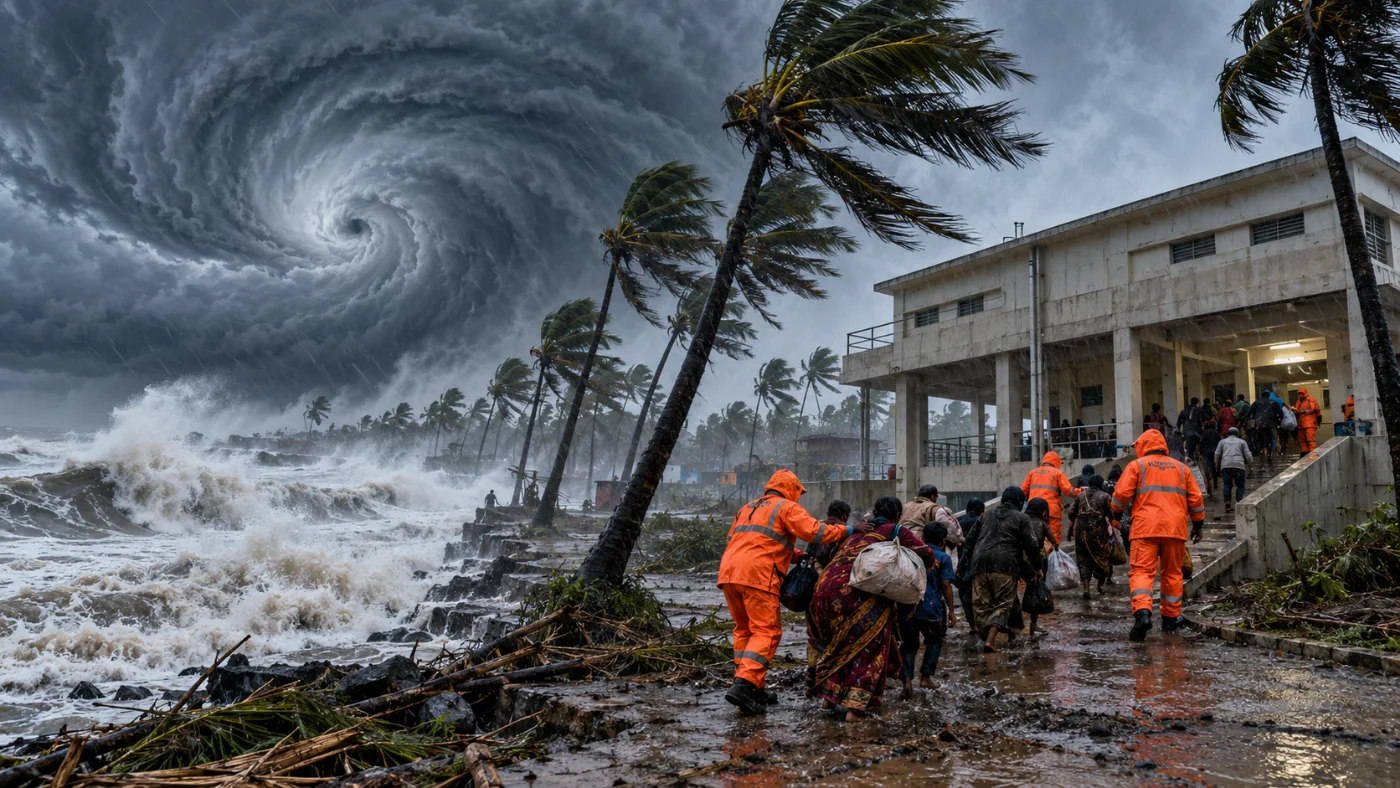
In short: Arnab crossed the coast as a very severe cyclonic storm on 28 October, felling trees and power lines; NDRF reported three deaths in Andhra Pradesh, and restoration and crop damage now come first.
Why in news
Cyclone Arnab, a very severe cyclonic storm, crossed the Andhra Pradesh and Yanam coasts on the morning of 28 October. IMD placed the landfall point at 16.45 degrees N, 81.90 degrees E, about 20 km east-northeast of Narsapur, 40 km southwest of Yanam and 60 km southwest of Kakinada, and said the system had moved fully over land and was weakening. By the evening, NDRF reported three deaths in Andhra Pradesh, two of them from contact with fallen live wires, in Visakhapatnam and Anakapalli districts. More than 1.8 lakh people had been evacuated across Andhra Pradesh and Odisha.
Background
During landfall, IMD gave the storm a core intensity of 125 to 135 km/h, gusting to 150 km/h, and warned of a storm surge of 1.5 to 2.5 metres above the astronomical tide, peaking near Kakinada and Yanam. Several places in Anakapalli and Visakhapatnam districts received over 200 mm of rain between 8:30 am on 27 October and 3 am on 28 October. In Kakinada district a few hundred trees and fewer than 100 electric poles were uprooted and the Uppada coastal road was washed away; fallen trees blocked roads in Visakhapatnam. Chief Minister N Chandrababu Naidu reviewed the work of 32,000 personnel and asked officials to prepare preliminary crop damage estimates, drain water from farmland and prevent breaches in tanks and canals. IMD has kept a red-category warning for heavy to extremely heavy rain in six southern Odisha districts, including Gajapati, Ganjam and Koraput, until 29 October.
Key facts for Prelims
- IMD scale: a very severe cyclonic storm has sustained winds of 64 to 89 knots (118 to 165 km/h); a severe cyclonic storm 48 to 63 knots.
- Landfall is the moment the centre (eye) of a cyclone crosses the coast; the process can last several hours.
- Storm surge is an abnormal rise of sea level above the astronomical tide, driven by cyclonic winds and low pressure; it is usually the deadliest hazard of a cyclone.
- Yanam is an enclave of the Union Territory of Puducherry within Andhra Pradesh, near the Godavari delta; Narsapur lies in West Godavari district.
- IMD, New Delhi is the WMO Regional Specialised Meteorological Centre for tropical cyclones over the north Indian Ocean and names storms from a list contributed by member countries.
Mains analysis and way forward
Mains analysis
- A low death toll from a very severe cyclone reflects a mature system of early warning, pre-emptive evacuation and shelters on India’s east coast, a shift from the high death tolls of 1977 and 1999; deaths from live wires show that power safety after landfall needs equal attention.
- Damage was driven more by wind than by rain in Kakinada, while interior districts such as Anakapalli and Alluri Sitharama Raju saw heavy rain, so recovery must plan for both power restoration and floods.
- Losses of roads, power lines and standing crops fall hardest on farmers, fishers and daily-wage workers, which makes quick damage assessment and insurance settlement central to relief.
- The Uppada coastal road washout points to long-term coastal erosion, a reminder that shoreline protection and setback rules matter as much as emergency response.
Way forward
- Complete enumeration of crop and house damage quickly and link it to State Disaster Response Fund norms and crop insurance claims.
- Invest in underground cabling and stronger poles in high-risk coastal districts, and in mangrove shelterbelts that blunt surge and wind.
Connect the dots: Syllabus links: GS I Geography (tropical cyclones, storm surge, Godavari delta coast); GS III Disaster Management (Disaster Management Act, 2005, NDRF and SDRF, early warning and evacuation, resilient infrastructure).
Sources: The Watchers: Cyclone Arnab leaves 3 dead after landfall in Andhra Pradesh, 28 Oct 2026; The Hans India: Arnab completes landfall, 28 Oct 2026; ETV Bharat: Cyclone Arnab live updates, landfall in Andhra Pradesh, 28 Oct 2026
At COP17 in Yerevan, India backs the Cali Fund and seeks predictable finance and technology from developed countries
In short: Delivering India’s national statement on 27 October, Bhupender Yadav set out India’s record and asked that biodiversity targets be backed by finance and technology transfer.
Why in news
Environment Minister Bhupender Yadav delivered India’s national statement at the high-level segment of the 17th Conference of the Parties (COP17) to the Convention on Biological Diversity in Yerevan, Armenia, on 27 October. He called for implementing the Kunming-Montreal Global Biodiversity Framework in line with national priorities and laws, supported by adequate and predictable finance, capacity building and technology transfer from developed countries. He backed benefit-sharing from digital sequence information through a multilateral mechanism including the Cali Fund.
Background
The high-level segment opened on 27 October with panels on biodiversity policy and finance, with about 150 high-level participants from Parties; national statements continue on 28 October. A “Yerevan Call for Action”, meant to give countries a roadmap for further work, is under negotiation as part of a draft decision, and Armenia announced a biodiversity technology hub on 27 October. Earlier, on 16 October, a Leaders for Nature summit adopted the Yerevan Declaration on moving from political commitments to measurable action, and framed this COP’s first global review of progress as a chance to close gaps before 2030. In his statement, Yadav said India’s updated National Biodiversity Strategy and Action Plan has 23 national targets and 142 indicators, and cited 1,134 protected areas, 103 Ramsar sites, 57 biodiversity heritage sites and 18 biosphere reserves, 13 of them in UNESCO’s Man and the Biosphere network.
Key facts for Prelims
- Kunming-Montreal Global Biodiversity Framework: adopted at CBD COP15 (December 2022); 23 targets for 2030, including protecting 30% of land and sea (30×30).
- Cali Fund: set up at COP16 in Cali, Colombia (2024) to share benefits from the use of digital sequence information (DSI) on genetic resources.
- India’s updated NBSAP has 23 national targets and 142 indicators, aligned with the 23 global targets.
- MISHTI (Mangrove Initiative for Shoreline Habitats and Tangible Incomes) and Amrit Dharohar (for Ramsar sites) were announced in 2023.
- India implements the CBD through the Biological Diversity Act, 2002; the National Biodiversity Authority is in Chennai, with State Biodiversity Boards and local Biodiversity Management Committees.
Mains analysis and way forward
Mains analysis
- India’s insistence on “national priorities and legislation” reflects the principle that global targets such as 30×30 must respect rights of forest-dwelling and local communities.
- Support for a multilateral DSI mechanism protects biodiversity-rich countries whose genetic data are used freely by companies abroad.
- The call for predictable finance and technology transfer links biodiversity talks to the climate debate on common but differentiated responsibilities, at a time when donors want a wider donor base.
- Decentralised access and benefit sharing through village-level committees can turn conservation into income, but only if Biodiversity Management Committees are funded and active.
Way forward
- Back national targets with district-level data and regular reporting so that India’s progress shows clearly in the global review.
- Use the Cali Fund and domestic benefit-sharing to reward communities that hold traditional knowledge.
Connect the dots: Syllabus links: GS III Environment (CBD, Kunming-Montreal framework, protected areas, Ramsar sites, biosphere reserves, Biological Diversity Act, 2002); GS II International Relations (environmental diplomacy, North-South finance).
Sources: The Hans India: India reaffirms commitment to conserving biodiversity at Convention on Biological Diversity, 27 Oct 2026; Armenpress: COP17 high-level segment focuses on biodiversity policy and financing, 27 Oct 2026; COP17 Yerevan: Yerevan Declaration on Taking Action for Nature adopted in Yerevan, 17 Oct 2026
Lancet Countdown 2026: climate change behind 68% of heat deaths since 2016; heat cost $1.07 trillion in lost income in 2025
In short: The tenth Lancet Countdown finds many climate-linked health harms grew faster in 2016-2025, with South-East Asia losing 3.9% of GDP to heat.
Why in news
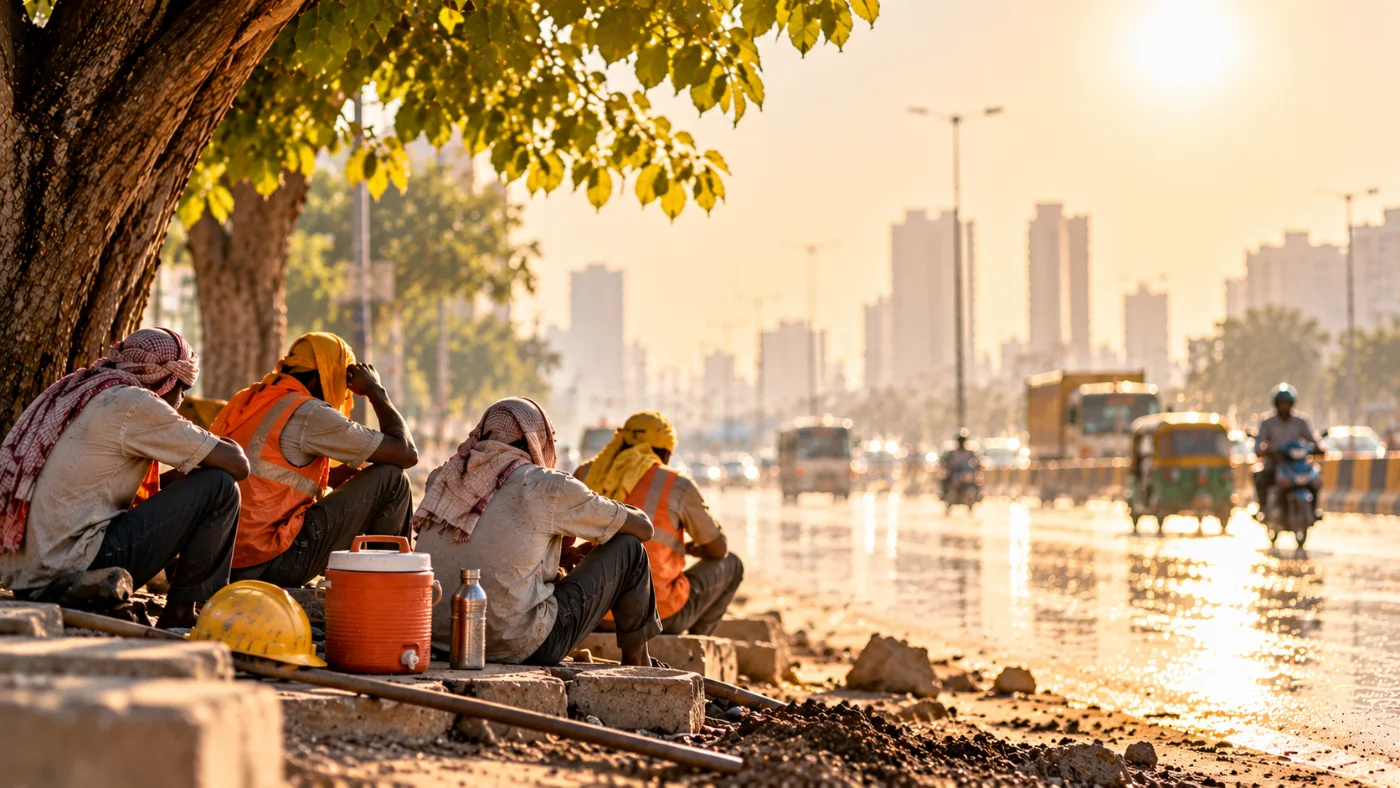
The 2026 report of the Lancet Countdown on Health and Climate Change, published on 27 October, estimates an average of 540,800 heat-related deaths a year in 2016-2023, of which 68% (369,900) are attributed to climate change, up from 55% in 2006-2015. Heat-related deaths reached a record of about 710,000 in 2023, with 71.5% driven by climate change. Lost labour from heat cost an estimated US$1.07 trillion in potential income in 2025.
Background
The report, the tenth in the series, is led by University College London and produced with the World Health Organization; it tracks 54 indicators and draws on 146 researchers. It finds that 51.8% of global land had at least a month of extreme drought in 2025 and that very extreme rainfall now covers about 17.2% of land each year, against 14.8% in 2006-2015. Heat-related income losses equal 3.9% of GDP in South-East Asia, compared with 0.2% in Europe, with agriculture and construction bearing most of the loss. On the positive side, clean energy investment reached a record US$2.1 trillion in 2025 and cleaner air prevented an estimated 323,000 deaths a year in at least 77 countries, though fossil fuels still supply over 80% of the world’s energy.
Key facts for Prelims
- Lancet Countdown: annual report published in The Lancet; led by University College London with WHO; 2026 edition is the tenth, with 54 indicators.
- Heat-related deaths attributed to climate change: 68% in 2016-2023, up from 55% in 2006-2015.
- Only 56 of 194 WHO member states have a national plan to adapt health services to climate change (14 in 2015).
- Ten countries spent more on fossil fuel subsidies in 2024 than on their health systems.
- Fossil-fuel air pollution is estimated to kill about 2.73 million people a year.
Mains analysis and way forward
Mains analysis
- Heat is now a leading climate killer, yet it is less visible than floods or cyclones; this calls for heat action plans with the same status as disaster plans.
- Losses concentrated in agriculture and construction hit outdoor and informal workers, making work-hour rules, shade, water and social protection a labour issue as much as a health issue.
- The gap between rising clean energy investment and plans by large oil and gas firms to produce far more than a 1.5 degree pathway allows shows that the transition remains uneven.
- Research money and adaptation finance still flow mostly to rich countries, while the burden falls on South-East Asia and Africa.
Way forward
- Strengthen city and district heat action plans, early warnings and hospital preparedness, and track heat deaths properly.
- Redirect fossil fuel subsidies towards health systems and clean energy, with support for workers who lose income on hot days.
Connect the dots: Syllabus links: GS III Environment (climate change impacts, heatwaves, air pollution); GS II Health (climate-resilient health systems, WHO); GS I Geography (drought, extreme rainfall).
Sources: News-Medical: Climate change intensifies global health risks, Lancet Countdown report warns, 27 Oct 2026; ABC News: Climate change is a global health emergency and the harms are accelerating, Lancet report warns, 27 Oct 2026
In brief
- Personality and history: the Republic of Turkey, proclaimed 29 October 1923: On 29 October 1923, the Grand National Assembly declared Turkey a republic and elected Mustafa Kemal (later Ataturk) its first President. The caliphate was abolished on 3 March 1924, removing the institution that India’s Khilafat movement had sought to defend.
- ECI orders transfer of officers in five poll-bound States: On 27 October 2026, the Election Commission directed Goa, Manipur, Punjab, Uttar Pradesh and Uttarakhand, which go to the polls in 2027, to transfer officers connected with elections who are posted in their home districts or have served three years or more in the same district. The cut-off date for counting tenure is 31 March 2027 for four States and 31 May 2027 for Uttar Pradesh.
- Supreme Court notice on six-stanza Vande Mataram orders: On 27 October 2026, the Supreme Court issued notice to the Centre on petitions challenging Home Ministry orders of 28 January and 9 July 2026 prescribing a six-stanza version of Vande Mataram for specified occasions. The petitioners seek a declaration that only the first two stanzas, accepted by the Congress Working Committee in 1937, form the national song.
- Background: fresh issue and offer for sale: In a fresh issue a company creates new shares and keeps the money, as in the Rs 30,213 crore Jio Platforms IPO that listed on 28 October 2026; in an offer for sale, existing shareholders sell their shares and receive the proceeds.
- Navy training squadron in Colombo: The Indian Navy’s First Training Squadron, including INS Tir and INS Sujata, has reached Colombo, Sri Lanka, the Defence Ministry announced on 27 October 2026, after earlier port calls at Port Victoria, Seychelles (12 to 15 October) and the Maldives.
- Sullage barge for the Navy: On 26 October 2026, the first sullage barge (Yard 142) for the Indian Navy was launched at Suryadipta Projects, Thane, and construction began on Yards 144 and 148, the Defence Ministry said.
- Industrial output grows 6.7% in September: The Index of Industrial Production grew 6.7% in September 2026, down from a revised 7.8% in August, MoSPI data released on 28 October show. Manufacturing grew 7.6% and electricity 11.2%, while mining contracted 6.2%; intermediate goods (12.2%) and capital goods (10.4%) led the use-based categories. The index uses the revised base year 2022-23 (Business Today, 28 October).
- Cabinet: Rs 7,395 crore for self-reliant panchayats: The Union Cabinet on 28 October approved a Rs 7,395 crore scheme to make over 2.5 lakh gram panchayats financially empowered and self-reliant, through training of elected representatives, better use of Finance Commission grants, more own-source revenue and a digital framework. It also approved a 3% rise in dearness allowance and relief, taking it to 63% from 1 July, and a Rs 10,000 crore scheme to boost domestic container manufacturing (Business Standard, 28 October).
- Supreme Court questions Form 6 for deleted Delhi voters: Hearing a plea on the Delhi SIR on 28 October, a bench led by Chief Justice Surya Kant asked the Election Commission why people deleted from the draft roll were being asked to file Form 6, which is meant for first-time voters, when they were on the 2026 rolls. The Commission said it would examine the concerns and consider extending the deadline; the matter will be taken up after two weeks (LiveLaw, 28 October).
- Delhi air turns poor: Delhi’s AQI rose to 228 (poor) at 7 am on 28 October from 167 a day earlier; 33 of 59 monitoring stations crossed 200, and Vivek Vihar (316) and Jahangirpuri (305) were in the very poor range. GRAP Stage I has been in force across Delhi-NCR since 21 October (Business Standard, 28 October).
- Arnab rain over Odisha: IMD has warned of heavy to extremely heavy rain in Gajapati, Ganjam, Rayagada, Koraput, Nabarangpur and Malkangiri districts of Odisha until 29 October, with gusty winds of 60 to 80 km/h, as the remnant of Cyclone Arnab moves inland (ETV Bharat, 28 October).
- ESTIC 2026: results in three years: Inaugurating ESTIC 2026 at Bharat Mandapam on 27 October, Prime Minister Narendra Modi asked scientists and innovators to deliver measurable, scalable technology outcomes within three years and to take research from laboratories to real-world problems (Awaz The Voice, 28 October).
Prelims practice: 5 questions
Choose an option to see the answer and explanation. Your score appears when all five are answered.
Mains practice
Most medicines sold in India lie outside direct price control. Examine the case for widening drug price regulation while keeping supply, quality and innovation secure.
Show the answer outline
Introduction (about 30 words)
- Begin with the Supreme Court’s question to the Centre on 27 October 2026: why most medicines remain outside the Drugs (Prices Control) Order, 2013.
The present framework
- DPCO 2013 fixes ceiling prices for scheduled medicines; manufacturers set MRPs of non-scheduled medicines, with a cap on annual increases.
- The Centre says scheduled medicines are 35% of the market by volume but only 18% by value.
- Paragraph 19 allows price fixing in extraordinary cases, as with stents, knee implants and trade margins on anti-cancer medicines.
Case for widening regulation
- Wide gaps between the price to retailer and the MRP mean patients, with little bargaining power, pay the most.
- Out-of-pocket spending on medicines drives household health costs and links pricing to the right to health under Article 21.
- Public schemes that reimburse at MRP pay inflated prices with public money.
Concerns to balance
- Excessive control can cause shortages, lower quality or withdrawal of products.
- Investment in research and new medicines needs reasonable returns.
Way forward
- Extend trade margin caps in stages to high-value non-scheduled medicines.
- Strengthen the NPPA with data and real-time price monitoring; expand Jan Aushadhi and hospital price transparency.
Conclusion (about 30 words)
- Affordable medicines and a healthy industry are not opposites; calibrated, transparent regulation can serve both.
Tip: Use the scheduled versus non-scheduled distinction and the market-share figures, and balance affordability with supply and innovation.
Current Canvas is prepared by the UPSC Gurus editorial desk. Every fact is checked against official releases and reliable reporting, with sources listed under each story. Editions are compiled each month into Current Canvas Monthly, a free magazine.
About images: photographs and illustrations in Current Canvas are AI-generated for illustration only. They are not news photographs of the events described.