 New this week · Free UG Handout 02UPSC Mains Directive Words: 60 Meanings, Trends and PYQsTwo free PDFs: The Guide and the With PYQs edition.Read and download
Today’s Canvas
- Baratang mud volcanoes, Andaman volcanoes and Sirpur added to India’s UNESCO Tentative ListGS I
- UNEP Emissions Gap Report 2026: chance of holding warming below 1.5 C with no overshoot is goneGS III
- IMD alerts: heavy to very heavy rain for Tamil Nadu, Puducherry and Karaikal as new Bay of Bengal system formsGS I
- Core sector growth rises to 7.9% in September 2026, up from 5.9% in August, led by iron ore, electricity and coalGS III
- RBI MPC minutes: all six members backed the 25 bps hike to 5.50%; Governor says rate cuts are off the table for nowGS III
- Jio Platforms IPO opens: Rs 30,213 crore fresh issue, India’s largest, subscribed in full on day oneGS III
- Supreme Court tells ED not to extend its hand beyond statutory limits in Kerala CMRL-Exalogic case; stays probe for a weekGS II
- At UNGA committees, India seeks safer diplomatic missions and objects to selective use of human rightsGS II
- India repeats offer to place no-first-use in a multilateral legal agreement; flags AI in nuclear command systemsGS III
- Jitendra Singh: India’s nuclear programme is for peaceful purposes; nuclear power to meet AI and data centre demandGS III
- BARC scientists report a method to recover about 90% of lithium from seawaterGS III
- World Iodine Deficiency Disorders Prevention Day, 21 October: where India stands on iodised saltGS II
- Baratang’s mud volcanoes, the Andaman Subduction Volcanoes and Sirpur in Chhattisgarh are now on India’s UNESCO Tentative List.
- UNEP’s Emissions Gap Report 2026 says the chance of holding warming below 1.5 C without overshoot is gone.
- IMD issued alerts for heavy to very heavy rain over Tamil Nadu, Puducherry and Karaikal on 21 October.
- The Index of Core Industries grew 7.9% in September 2026, up from 5.9% in August.
- RBI MPC minutes show all six members backed the 25 bps repo rate hike to 5.50%.
- At the UN First Committee, India repeated its offer to place no-first-use in a multilateral legal agreement.
- BARC scientists report a laboratory method that recovers about 90% of lithium from seawater.
- 21 October is Global Iodine Deficiency Disorders Prevention Day; NFHS-5 found 94.3% of households using salt containing iodine.
Art, culture and geography
Baratang mud volcanoes, Andaman volcanoes and Sirpur added to India’s UNESCO Tentative List
In short: Three Indian properties, two natural and one cultural, enter the Tentative List, the first formal step towards World Heritage nomination.

Why in news
Reports of 21 October 2026, citing a press release of the Permanent Delegation of India to UNESCO, say three sites are now on India’s Tentative List (UNESCO records their submission date as 28 September 2026): the Karst-Mud-Volcano Complex of Baratang and the Andaman Subduction Volcanoes (both in Andaman and Nicobar Islands), and the Sirpur Cultural and Archaeological Landscape (Chhattisgarh). The listing is a preliminary step; it is not World Heritage status.
Background
A property must be on a country’s Tentative List before it can be formally nominated; the final decision on inscription rests with the World Heritage Committee of 21 elected States Parties. The Baratang mud volcanoes, locally called Jalki, release cool mud, water and gases such as methane, and erupted in 2025 after about 20 years of dormancy; the site lies within the Baratang Reserve Forest and the Jarawa Tribal Reserve. The Andaman Subduction Volcanoes are Barren Island, home to India’s only confirmed active volcano, and Narcondam, both part of the Burma-Andaman-Java volcanic arc. Sirpur, historically Shripura, lies on the Mahanadi in Mahasamund district and combines Hindu, Buddhist and Jain remains, including the 7th-century brick Lakshmana Temple dedicated to Vishnu.
Key facts for Prelims
- Tentative List: an inventory of properties a State Party considers suitable for nomination; inclusion is a precondition for nomination, not a guarantee of inscription.
- World Heritage Convention: adopted by UNESCO in 1972; the World Heritage Committee has 21 elected States Parties.
- Barren Island: caldera about 2 km wide; India’s only confirmed active volcano; the Geological Survey of India declared it a geoheritage site in 2025 (as reported).
- Narcondam: no summit crater, only three hummocks; an Important Bird Area and a Key Biodiversity Area (as reported).
- Baratang mud volcanoes (Jalki): cold mud, water and gases such as methane and hydrogen sulphide; located in Middle Andaman, within the Jarawa Tribal Reserve.
- Sirpur: on the Mahanadi, Mahasamund district, about 78 km from Raipur; Lakshmana Temple, 7th century CE, brick, Vishnu.
Mains analysis and way forward
Mains analysis
- Natural and cultural heritage need different management models: Baratang and Narcondam raise questions of tribal rights and fragile ecology, while Sirpur raises questions of living communities (about 1,500 people are reported to live within the site).
- Tentative listing builds a pipeline of nominations; the quality of the dossier, a management plan and community consultation largely decide success at the Committee.
- World Heritage branding can raise tourism, so carrying-capacity limits, especially in the Jarawa Tribal Reserve, must be settled before promotion.
Way forward
- Prepare nomination dossiers with scientific baselines, boundary clarity and buffer zones, involving the Geological Survey of India, the Archaeological Survey of India and the State governments.
- Build community participation into site management, including Gond and Baiga communities near Sirpur and the protections applicable to the Jarawa Reserve.
Connect the dots: Syllabus: Indian heritage and architecture (GS I); distribution of volcanoes, plate tectonics and island geomorphology (GS I Geography); conservation and tribal welfare (GS III, GS II).
Sources: Time Out India: UNESCO Tentative List 2026, 3 new Indian sites added, 21 Oct 2026; Open Magazine: UNESCO adds Andaman volcanoes and Sirpur to India’s Tentative List, 21 Oct 2026; Free Press Journal: Three sites enter UNESCO’s Tentative List, 21 Oct 2026; Dainik Jagran (English): UNESCO Tentative List adds 3 Indian sites, 21 Oct 2026
Environment and disaster management
UNEP Emissions Gap Report 2026: chance of holding warming below 1.5 C with no overshoot is gone
In short: UNEP says a 1.5 C overshoot is now unavoidable; deep cuts of 18% by 2030 could still bring warming back down by 2100.

Why in news
The United Nations Environment Programme released its Emissions Gap Report 2026 on 21 October, ahead of the COP31 climate talks. It says the chance of holding warming below 1.5 C with no or limited overshoot has closed, and that the task now is to keep the overshoot short and return to 1.5 C by 2100. The lowest-overshoot pathway needs global greenhouse gas emissions to fall 18% by 2030, 45% by 2035 and 69% by 2040, relative to 2025.
Background
The Emissions Gap Report is UNEP’s annual assessment of the distance between climate pledges and the cuts needed to meet the Paris Agreement temperature goal. This is its 17th edition and is titled “The Point of Return”. Global greenhouse gas emissions in 2025 were about 58.4 Gt CO2e, only 0.1 Gt lower than in 2024, and the dip came from lower land-use emissions while fossil CO2 kept rising. G20 members (excluding the African Union) account for 76% of global emissions. The United States, the second-largest emitter, has withdrawn from the Paris Agreement, which is one reason the current-policy estimate has risen.
Key facts for Prelims
- Emissions Gap Report: published annually by UNEP; 2026 edition is the 17th.
- Projected peak warming: about 2.8 C under current policies, about 2.6 C if updated national pledges are fully implemented, about 2.1 C if pledges plus net-zero commitments are met.
- Lowest-overshoot pathway: peak of 1.7 to 1.8 C, then return to 1.5 C or below by 2100; cuts of 18% (2030), 45% (2035), 69% (2040) from 2025 levels.
- Every five years of CO2 emissions at current levels adds roughly 0.1 C to peak warming.
- Paris Agreement goal: well below 2 C, pursuing 1.5 C; Nationally Determined Contributions (NDCs) are the pledges measured by the report.
Mains analysis and way forward
Mains analysis
- A first for the series: the report speaks of overshoot as unavoidable, shifting the debate from avoiding 1.5 C to limiting how long and how high the world exceeds it.
- Overshoot depends on carbon dioxide removal technologies that are not yet proven at the required scale, so reliance on them carries delivery and equity risks.
- Near-term levers named include tripling renewable electricity capacity by 2035 and phasing out coal by 2040, which bear directly on developing countries’ energy transitions and finance needs.
- For India, a low per-capita emitter, the report sharpens the case for climate finance, technology transfer and the principle of common but differentiated responsibilities in COP31 negotiations.
Way forward
- Strengthen the next round of NDCs with sectoral milestones for 2035 and an end-date for unabated coal where feasible.
- Scale methane cuts and renewables as near-term measures, backed by predictable international climate finance.
- Invest early in monitoring and governance for carbon removal so that it complements, rather than delays, emission reductions.
Connect the dots: GS III: climate change, Paris Agreement, NDCs, UNFCCC COPs; international environmental reports.
Sources: Egypt Independent (CNN): As climate summit approaches, UN reports existing 1.5C warming limit is no longer achievable, 21 Oct 2026; Down To Earth: Emissions Gap Report 2026, Point of no return for the 1.5 C warming threshold, 21 Oct 2026; Free Press Journal: UN sounds climate alarm, calls for 18% cut in global carbon emissions by 2030, 21 Oct 2026
IMD alerts: heavy to very heavy rain for Tamil Nadu, Puducherry and Karaikal as new Bay of Bengal system forms
In short: An orange alert covers Tamil Nadu on 21 October; a cyclonic circulation near the coast is expected to form a low-pressure area.

Why in news
The India Meteorological Department (IMD) issued an orange alert for 21 October for heavy to very heavy rainfall of 115.6 to 204.4 mm at isolated places over Tamil Nadu, Puducherry and Karaikal, with a yellow alert for Kerala, Andhra Pradesh and south interior Karnataka. As reported on 21 October, a cyclonic circulation over the southwest Bay of Bengal near Tamil Nadu is expected to form a low-pressure area within 12 hours. A separate low-pressure system over the southwest Arabian Sea is moving towards the Somali coast.
Background
The northeast monsoon season is under way over the south peninsula, and it is Tamil Nadu’s principal rainy season, bringing about 48% of its annual rainfall. IMD uses colour-coded warnings: yellow means be aware, orange means be prepared, and red means take action. Advisories issued with this alert ask farmers to ensure field drainage and protect harvested crops, and residents to avoid open fields, isolated trees and electricity poles during thunderstorms. Fishermen have been advised to follow official warnings for the Arabian Sea.
Key facts for Prelims
- IMD colour codes: green (no action), yellow (watch), orange (alert), red (warning).
- Heavy rainfall: 64.5 to 115.5 mm in 24 hours; very heavy: 115.6 to 204.4 mm.
- Northeast (retreating) monsoon: October to December; principal rainy season for Tamil Nadu (about 48% of annual rainfall); also important for coastal Andhra Pradesh.
- Low-pressure area to depression to cyclone: stages of a tropical system; cyclone classification follows wind speed.
- IMD is the nodal agency and also the Regional Specialised Meteorological Centre for tropical cyclones over the north Indian Ocean.
Mains analysis and way forward
Mains analysis
- Impact-based, colour-coded warnings turn forecasts into local action, but their value depends on last-mile communication in cities such as Chennai that face urban flooding.
- The post-monsoon season brings both heavy rain and cyclone risk to the east coast, requiring preparedness of drainage, relief and fisher-warning systems.
- Seasonal outlooks and day-to-day bulletins need to be read together, since short spells of intense rain can occur within a normal season.
Way forward
- Link IMD alerts to State disaster management action plans, with clear triggers for drainage clearance and advisories.
- Strengthen fishermen’s communication through coastal radio and mobile alerts during sea-state warnings.
Connect the dots: GS I: monsoon and cyclones; GS III: disaster management, NDMA guidelines, early warning.
Sources: Down To Earth: Daily weather tracker, heavy rain alert for Tamil Nadu (summarising the IMD update), 21 Oct 2026; Down To Earth: Daily weather tracker, heavy rain alert for southern India (IMD update), 20 Oct 2026; The Week: Will rains continue this week? IMD alert for Chennai and 23 Tamil Nadu districts, 19 Oct 2026
Economy
Core sector growth rises to 7.9% in September 2026, up from 5.9% in August, led by iron ore, electricity and coal
In short: Core industries output grew 7.9% in September 2026, with iron ore, power and coal leading; fertilisers, natural gas and crude oil contracted.

Why in news
The Ministry of Commerce and Industry released the provisional Index of Core Industries for September 2026 on 21 October 2026. Output grew 7.9% year on year, against 5.9% in August (revised up from a provisional 4.8%) and 3.1% in September 2025. Cumulative growth for April to September 2026 is 5.1%, compared with 2.5% a year earlier.
Background
The index tracks the output of the core industries that feed directly into the Index of Industrial Production (IIP), and it is now compiled with base year 2022-23. In September 2026, iron ore grew 18.4%, electricity 11.4%, coal 10.7%, refinery products 10.3%, cement 9.8% and steel 4.9%. Fertiliser output fell 11.7%, natural gas 4.6% and crude oil 1.4%. Over April to September, fertiliser output is down 7.6% and natural gas 4.4%. Earlier reporting in 2026 linked lower urea output to disruption of LNG flows through the Strait of Hormuz.
Key facts for Prelims
- Core industries index base year is now 2022-23; the data is released by the Ministry of Commerce and Industry (Office of the Economic Adviser, DPIIT), usually around the 20th of each month
- The index covers industries such as coal, crude oil, natural gas, refinery products, fertilisers, steel, cement, electricity and, in the new series, iron ore
- Provisional September 2026 growth: 7.9%; August revised to 5.9%; April to September cumulative: 5.1%
- The core index feeds into the Index of Industrial Production (IIP), compiled by the National Statistics Office (MoSPI)
- Next release (October 2026 data): 20 November 2026
Mains analysis and way forward
Mains analysis
- A broad-based pickup in iron ore, steel, cement and electricity points to continuing infrastructure and construction demand, with power demand also reflecting weather and industrial activity.
- Contraction in fertilisers, natural gas and crude oil shows that import-dependent and gas-dependent segments remain exposed to external supply shocks in West Asia, which matters for kharif and rabi input availability.
- Core indices are production indicators, not demand indicators; they should be read with IIP, GST collections and PMI data before drawing conclusions about the broader economy.
Way forward
- Diversify gas and LNG sources and strengthen domestic fertiliser feedstock options to reduce supply shocks.
- Continue public capital expenditure on roads, railways and power so that upstream sectors such as steel, cement and coal sustain momentum.
- Track revisions, as the August figure moved by over one percentage point on revision, and treat provisional numbers with caution.
Connect the dots: GS III: Indian economy, industrial growth, infrastructure, energy; inclusive growth; measurement of growth through IIP and core indices.
Sources: Tribune (ANI): India’s core sector growth accelerates to 7.9% in September from 5.9% in August, 21 Oct 2026; Business Today: India’s core sector growth accelerates to 7.9% in September; refinery output jumps 10.3%, 21 Oct 2026; PIB (Commerce and Industry): Provisional Index of Core Industries for September 2026 (base 2022-23), 21 Oct 2026; Outlook Business: India urea plants at half capacity as West Asia tensions choke gas supplies, 22 Mar 2026
RBI MPC minutes: all six members backed the 25 bps hike to 5.50%; Governor says rate cuts are off the table for now
In short: Minutes of the 5 to 7 October MPC meeting show a unanimous hike to 5.50%, a shift to calibrated tightening and a data-dependent path ahead.
Why in news
The RBI released the minutes of the Monetary Policy Committee meeting of 5 to 7 October 2026 on 21 October 2026. All six members voted for the 25 basis point increase in the repo rate to 5.50%, and the stance changed to calibrated tightening, with two members preferring to keep a neutral stance. Governor Sanjay Malhotra said the duration and extent of the hiking cycle depend on actual growth and inflation developments and outlook.
Background
The Governor pointed to increasing signs of generalisation of inflation: 37% of commodities in the CPI basket had inflation above 4% in August, up from 20% in March. Core inflation rose from 3.9% in July to 4.2% in August. The RBI projects headline CPI at 6.0% in Q3 and 5.7% in Q4 of 2026-27, and real GDP growth at 7.1% for 2026-27, up from 6.7%. The October increase came after a gap of nearly four years. The next MPC meeting is scheduled for 2 to 4 December 2026.
Key facts for Prelims
- MPC has six members and decides the policy repo rate by majority; the Governor has a casting vote only in the event of a tie
- Repo rate is now 5.50% after a 25 bps increase; stance changed to calibrated tightening
- The inflation target is 4% CPI with a tolerance band of 2% to 6%
- Diffusion index: 37% of CPI items had inflation above 4% in August 2026 (20% in March)
- MPC minutes are published on the RBI website about two weeks after the meeting; next meeting 2 to 4 December 2026
Mains analysis and way forward
Mains analysis
- Generalised inflation, with more items crossing 4%, signals that price pressures are spreading beyond food and fuel, which strengthens the case for tightening even with growth projected at 7.1%.
- The dissent on stance, not on the rate, shows the committee agreed on the direction but differed on the signalling, a distinction that matters for forward guidance and market expectations.
- Higher policy rates support the rupee and inflation expectations but raise borrowing costs for households, MSMEs and government, so the balance between price stability and growth remains finely judged.
Way forward
- Maintain data-dependent communication, with clear explanation of what would prompt a pause or a further hike.
- Coordinate with supply-side measures on food, fuel and logistics, since monetary policy alone cannot address supply shocks from the Gulf.
- Monitor transmission of the hike to lending and deposit rates, especially for small borrowers.
Connect the dots: GS III: monetary policy, inflation, RBI and MPC (Section 45ZB, RBI Act 1934), flexible inflation targeting, growth-inflation trade-off.
Sources: Tribune (ANI): Rate cuts off the table for now, further hikes depend on inflation outlook: RBI Governor, 21 Oct 2026; ThePrint (PTI): Extent of rate hike cycle to depend on growth-inflation outlook: RBI Guv, 21 Oct 2026; Deccan Herald: RBI MPC meeting 2026, repo rate hiked by 25 basis points to 5.5%, 7 Oct 2026
Jio Platforms IPO opens: Rs 30,213 crore fresh issue, India’s largest, subscribed in full on day one
In short: Jio Platforms opened its record Rs 30,213 crore fresh issue on 21 October at Rs 1,065 to Rs 1,119 a share; bidding closes on 23 October.
Why in news
The public issue of Jio Platforms opened for subscription on Wednesday, 21 October 2026 and closes on Friday, 23 October; listing is expected on 28 October. The price band is Rs 1,065 to Rs 1,119 per share for up to 27 crore equity shares, or about Rs 30,213 crore at the upper end, which would make it India’s largest IPO, ahead of Hyundai Motor India (Rs 27,858.75 crore, 2024) and LIC (Rs 20,557.23 crore). Business Standard reported the issue as fully subscribed on the first day.
Background
The offer is entirely a fresh issue with no offer for sale, so proceeds go to the company; the draft prospectus indicated that a major part, about Rs 27,500 crore, would repay borrowings of its subsidiary Reliance Jio Infocomm. The draft red herring prospectus was filed with SEBI in June and SEBI issued its final observations on 28 August. The minimum bid is 12 shares (Rs 13,428 at the cap price), with up to Rs 500 crore reserved for eligible employees at a discount of Rs 54 a share and up to Rs 2,500 crore for eligible Reliance shareholders.
Key facts for Prelims
- A fresh issue raises money for the company; an offer for sale (OFS) transfers shares between existing holders and the company receives nothing
- SEBI regulates IPOs; the draft red herring prospectus (DRHP) is filed with SEBI and SEBI issues observations before the final offer document (RHP)
- Anchor bidding for Jio took place on 19 October; the public issue opened on 21 October
- Price band Rs 1,065 to Rs 1,119; lot size 12 shares; expected listing 28 October 2026
- Previous largest IPOs: Hyundai Motor India (2024) and LIC (2022)
Mains analysis and way forward
Mains analysis
- A record IPO shows depth in domestic capital markets and growing retail and institutional participation, offering large companies an alternative to debt.
- Using proceeds to repay subsidiary debt strengthens the balance sheet, but investors will weigh valuation, telecom tariff outlook and capital expenditure needs.
- Very large issues test market absorption and liquidity; regulators must ensure disclosure quality and investor protection, especially for first-time retail applicants.
Way forward
- Strengthen investor education so that retail participants understand valuation, risk and allotment mechanics.
- Maintain SEBI’s disclosure and surveillance standards for large, complex listings.
- Encourage deepening of long-term domestic institutional capital to reduce dependence on volatile foreign flows.
Connect the dots: GS III: capital markets, SEBI, primary market, financial inclusion; telecom and digital infrastructure.
Sources: ThePrint (PTI): Jio Platforms sets IPO price band at Rs 1,065-1,119, targets to raise record Rs 30,213 cr; Free Press Journal: Jio Platforms IPO likely to open October 21; Rs 27,500 crore debt repayment planned; Business Standard: Stock Market Live, 21 Oct 2026 (Jio Platforms IPO fully subscribed)
Polity and governance
Supreme Court tells ED not to extend its hand beyond statutory limits in Kerala CMRL-Exalogic case; stays probe for a week
In short: A vacation bench says the ED’s duty ends with informing the State of a suspected corruption offence; the State agency must then act under law.
Why in news
On 21 October 2026 a Supreme Court bench of Justices Joymalya Bagchi and V Mohana set aside a Kerala High Court division bench refusal to hear an appeal in the CMRL-Exalogic matter and directed that the appeal be heard. It granted interim protection against investigation for seven days; the FIR stands but cannot be investigated in that period. Justice Bagchi told the ED’s counsel, “Don’t extend your hand beyond your statutory limits.” The order does not decide whether the allegations are true.
Background
The case concerns payments by Cochin Minerals and Rutile Ltd to Exalogic Solutions, owned by Veena T, daughter of former Kerala Chief Minister Pinarayi Vijayan; the ED alleges Rs 2.78 crore was paid under the guise of IT consultancy. The ED shared information with Kerala police under Section 66(2) of the Prevention of Money Laundering Act, 2002. On 9 October a Kerala High Court single judge ordered an FIR and set aside the State’s Special Investigation Team; on 15 October the division bench declined to entertain the challenge. The Supreme Court said the High Court had acted in haste, and that its observations were limited to the appellants’ standing to appeal.
Key facts for Prelims
- PMLA Section 66(2): enables the ED to share information with other agencies where it finds a possible offence under another law.
- Prevention of Corruption Act, 1988, Section 17A: prior approval is needed before enquiry or inquiry into decisions taken by a public servant in discharge of official functions; the Bench said the agency’s prerogative is not completely shut out.
- PMLA proceedings can continue on money-laundering and hawala transactions; a person need not be named an accused in the scheduled offence (as reported).
- Money laundering is a standalone offence under the PMLA, linked to a scheduled (predicate) offence.
- Interim protection: the FIR remains registered; only further investigation is stayed for seven days.
Mains analysis and way forward
Mains analysis
- The ruling restates the division of roles: the ED handles laundering, while predicate corruption offences belong to the competent State or central agency, under its own safeguards.
- Section 17A balances protection of honest decision making by public servants against the need to investigate corruption; its application before an FIR is an unsettled question.
- Hearing affected persons before directing an FIR raises principles of natural justice and the limits of writ jurisdiction in criminal investigation.
Way forward
- Clear protocols between the ED and State agencies on sharing information and deciding on FIRs would reduce litigation and delay.
- Courts and agencies should ensure that investigations into allegations, which remain unproven, proceed through the legally prescribed steps and at a measured pace.
Connect the dots: Syllabus: Separation of powers and functions of the judiciary (GS II); PMLA and anti-corruption laws (GS II, GS III); Centre-State relations in law enforcement (GS II).
Sources: Free Press Journal: Supreme Court tells ED not to overstep its powers in Kerala CMRL-Exalogic case, 21 Oct 2026; Telangana Today: Supreme Court stays probe against Pinarayi Vijayan in CMRL case for a week, 21 Oct 2026; LiveLaw: Pinarayi Vijayan moves Supreme Court against Kerala HC direction for FIR, Oct 2026
International relations and security
At UNGA committees, India seeks safer diplomatic missions and objects to selective use of human rights
In short: India told two UN General Assembly committees that diplomatic missions must be protected and that human rights should not be used as a political tool.
Why in news
On 21 October 2026, Lok Sabha MP Sanjay Dina Patil delivered India’s national statement at the Sixth Committee of the 81st UN General Assembly session on the protection, security and safety of diplomatic and consular missions. He called such protection essential to international relations and linked it to sovereign equality, peace and security. The same day, MEA Deputy Secretary Barkha Tamrakar told the Third Committee that India opposes the use of human rights as a political tool to target countries on unverified allegations.
Background
The Sixth Committee is the General Assembly’s forum for legal questions, while the Third Committee deals with social, humanitarian and human rights matters. States’ duties to guard mission premises and protect diplomats flow from the Vienna Conventions on diplomatic relations (1961) and consular relations (1963). Mr Patil listed vandalism, threats, harassment, assaults, hostile drone overflights, arson and online release of diplomats’ personal information as concerns, without naming any case. He called for accountability through effective investigation and prosecution, wider adherence to the conventions and greater international cooperation. In the Third Committee, Ms Tamrakar said India is willing to clarify properly documented cases through established channels and urged engagement based on dialogue, cooperation, non-selectivity and transparency. She pointed to Article 21, habeas corpus writs, the National and State Human Rights Commissions, the Right to Information Act, and independent media and civil society as domestic safeguards.
Key facts for Prelims
- Sixth Committee of the UN General Assembly: legal matters; Third Committee: social, humanitarian and cultural matters including human rights.
- Vienna Convention on Diplomatic Relations, 1961, and Vienna Convention on Consular Relations, 1963: the legal basis for protecting missions and diplomats.
- Article 21 of the Constitution: protection of life and personal liberty; habeas corpus is a writ available under Articles 32 and 226.
- National Human Rights Commission: statutory body under the Protection of Human Rights Act, 1993; State Human Rights Commissions exist at State level.
- The 81st session of the UN General Assembly is under way in New York; India’s statements were national statements delivered by a parliamentarian and an MEA official.
Mains analysis and way forward
Mains analysis
- Discuss why the inviolability of diplomatic premises and personnel is regarded as the bedrock of orderly international relations, and how hostile drone overflights and online doxxing test the older conventions.
- Examine the argument that human rights scrutiny can be selective, and how a State can answer concerns credibly without diluting universal norms.
- Assess how the work of the National and State Human Rights Commissions, courts and the Right to Information Act supports India’s case at international human rights forums.
Way forward
- Strengthen shared practice on investigation, prosecution and information-sharing when missions are threatened, building on the Vienna Conventions.
- Pair firm positions at the UN with transparent, timely responses to documented cases and constructive engagement with human rights mechanisms.
Connect the dots: GS II: India and the UN system; international conventions; human rights institutions. Link with Article 21, NHRC and the Protection of Human Rights Act, 1993.
Sources: AIR News: Protection of diplomatic and consular missions is essential, says MP Sanjay Dina Patil at UNGA 81st Session, 21 Oct 2026; AIR News: Deputy Secretary in MEA Barkha Tamrakar delivers India’s national statement at UNGA Third Committee, 21 Oct 2026
India repeats offer to place no-first-use in a multilateral legal agreement; flags AI in nuclear command systems
In short: At the UN First Committee, India reiterated its no-first-use offer and said decisions on nuclear weapon use must remain under human control.

Why in news
Congress MP Manish Tewari, speaking for India at the UN General Assembly’s First Committee in New York, reiterated India’s offer to convert its No First Use commitment, and its pledge not to use nuclear weapons against non-nuclear-weapon states, into a multilateral legal agreement (AIR report of 20 October 2026). He said India supports universal, non-discriminatory and verifiable nuclear disarmament and raised concerns about integrating artificial intelligence into nuclear command and control systems.
Background
The First Committee handles disarmament and international security within the General Assembly. In the statement, India reaffirmed credible minimum deterrence, no first use, non-use against non-nuclear-weapon states and its voluntary moratorium on nuclear testing. India also repeated proposals to reduce nuclear risk, including de-alerting of nuclear weapons and an international convention prohibiting the use or threat of use of nuclear weapons. Mr Tewari stressed that decisions on the use of nuclear weapons must remain under human control. India’s published nuclear doctrine of 2003 is the source of the no-first-use and credible minimum deterrence policy.
Key facts for Prelims
- First Committee of the UN General Assembly: disarmament and international security.
- No First Use (2003 doctrine): India will not be the first to use nuclear weapons, but retains the option of nuclear retaliation in the event of a major biological or chemical attack; the pledge of non-use against non-nuclear-weapon states is a separate commitment.
- Credible minimum deterrence: the stated basis of India’s nuclear posture.
- De-alerting: reducing the readiness of nuclear forces to lower the risk of accidental or unauthorised use.
- India has maintained a voluntary moratorium on nuclear testing; it is not a party to the NPT or the CTBT.
Mains analysis and way forward
Mains analysis
- Evaluate the value of a legally binding multilateral no-first-use agreement for global nuclear stability, and the hurdles posed by nuclear-weapon states’ differing doctrines.
- Discuss the risks of embedding artificial intelligence in nuclear command, control and early warning, and why human control is stressed.
- Analyse how India reconciles credible minimum deterrence with its advocacy of universal, verifiable and non-discriminatory disarmament.
Way forward
- Push for confidence-building measures such as de-alerting and risk-reduction dialogues alongside legal proposals.
- Build early international norms on AI in strategic systems, with human control over nuclear use decisions as a baseline.
Connect the dots: GS II and III: nuclear doctrine, disarmament regimes (NPT, CTBT), emerging technologies and strategic stability.
Science and technology
Jitendra Singh: India’s nuclear programme is for peaceful purposes; nuclear power to meet AI and data centre demand
In short: The Union Minister links 100 GW of nuclear capacity by 2047 and Net Zero by 2070 to round-the-clock power for AI infrastructure.
Why in news
Dr Jitendra Singh, Union Minister of State for Atomic Energy, said on 20 October that India’s nuclear programme is dedicated to peaceful purposes and national development, not warfare. Speaking to IANS on the sidelines of the Bloomberg Economy Forum 2026, he said nuclear energy will become more important for future power needs, including those of AI and data centres. He cited the goals of 100 GW of nuclear capacity by 2047 and Net Zero emissions by 2070.
Background
AI infrastructure and data centres need dependable, continuous electricity, which is why nuclear power, a source of firm clean electricity, is being discussed alongside renewables. In December 2025 the Minister said nuclear capacity had roughly doubled from about 4.4 GW in 2014 to nearly 8.7 GW. In June 2026 he said the Government would open advanced areas, including the nuclear sector, to private players through the SHANTI Act. He also invoked Homi Bhabha, the architect of India’s nuclear programme, and said AI should be treated as a tool across sectors, with regulation and integrity guiding its use.
Key facts for Prelims
- Nuclear capacity target: 100 GW by 2047; Net Zero target: 2070.
- Nuclear capacity: about 4.4 GW (2014) to nearly 8.7 GW (December 2025, as stated by the Minister).
- SHANTI Act: enables private participation in the nuclear sector (Government statement, June 2026).
- Homi Bhabha: regarded as the architect of India’s nuclear programme.
- Firm power: a source that supplies electricity continuously, unlike intermittent solar and wind.
Mains analysis and way forward
Mains analysis
- Data centres and AI workloads need round-the-clock supply, making firm clean power central to the AI and climate agendas together.
- Opening the nuclear sector to private players can raise investment but needs a robust regulator, safety culture and clear liability rules.
- India’s declaratory peaceful-use position supports its credibility in civil nuclear cooperation and the Nuclear Suppliers Group debate.
- Challenges include long gestation, cost, fuel supply and waste management, which must be set against grid-scale renewables and storage.
Way forward
- Pair nuclear additions with renewables and storage so that data centre growth does not raise fossil dependence.
- Build independent regulatory capacity and transparent public communication as private participation expands.
Connect the dots: GS III: energy security, nuclear energy, AI infrastructure; GS II: international nuclear regime.
Sources: StratNews Global: India Targets Nuclear Power for AI and Data Centre Growth, 21 Oct 2026; The Hawk (IANS): India’s nuclear plan dedicated to peaceful purposes, 20-21 Oct 2026; News On AIR: SHANTI Act to open nuclear sector to private players, 11 Jun 2026; News On AIR: SHANTI Bill as biggest science reform, 28 Dec 2025
BARC scientists report a method to recover about 90% of lithium from seawater
In short: A solvent extraction process from BARC’s Hyderabad centre recovers nearly 90% of lithium from natural seawater at laboratory scale.
Why in news
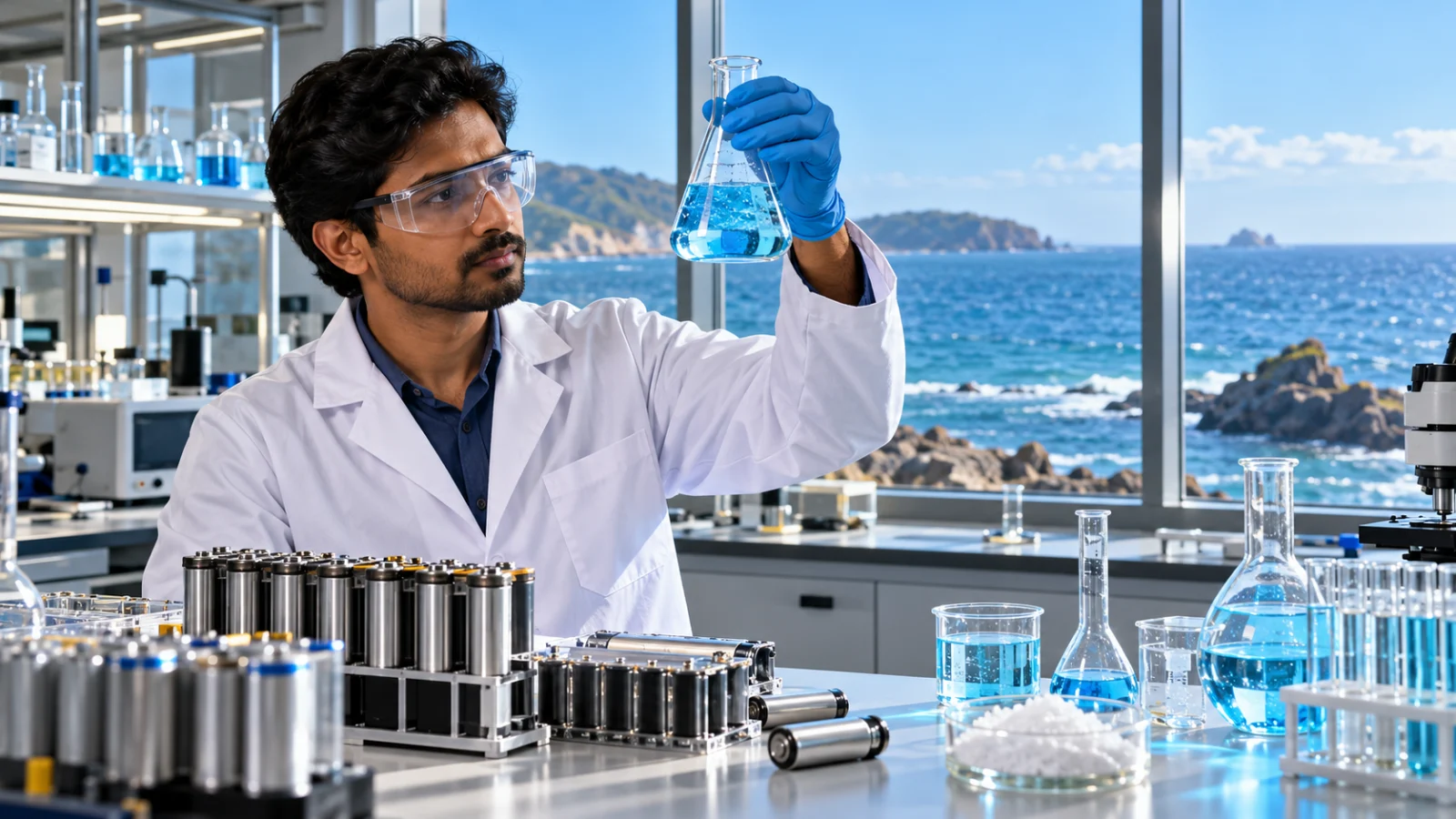
Scientists at the Bhabha Atomic Research Centre (BARC), Hyderabad, have reported a selective extraction system that recovers nearly 90% of lithium from natural seawater. The paper appeared online in the journal Talanta in September 2026 and was reported by Down To Earth on 20 October. The work is at the research stage; its energy use, cost and ecological effects are yet to be assessed.
Background
Seawater holds lithium at only about 0.17 mg per litre, with a magnesium-to-lithium ratio above 6,000, which makes recovery difficult. The BARC process first raises pH with sodium hydroxide and sodium carbonate to remove over 99% of interfering elements such as magnesium and calcium. Lithium is then pulled into an organic solvent (dibenzoyl methane in MIBK) and stripped with dilute nitric acid, and the solvent is reused. Recovery stayed near 90% over five cycles, though about 10% of the solvent was lost per cycle. India depends on imports for lithium raw materials, so alternative sources matter for electric mobility and storage.
Key facts for Prelims
- Lithium: a critical mineral for lithium-ion batteries used in EVs and grid storage.
- BARC: Department of Atomic Energy research centre, Trombay; the work came from its centre in Hyderabad.
- Method: solvent extraction after chemical pre-treatment; recovery about 90% over five cycles.
- Seawater lithium concentration: about 0.17 mg per litre.
- India depends on imports for its lithium raw materials; domestic cell manufacturing is at an early stage.
Mains analysis and way forward
Mains analysis
- Seawater is a vast but dilute resource; the real test is whether processing can be energy-efficient and affordable at scale.
- Domestic recovery routes would reduce import dependence and supply-chain risk in the clean energy transition.
- Marine ecosystem effects and brine and chemical waste handling must be examined before any scale-up.
Way forward
- Move from laboratory results to pilot trials with life-cycle, energy and cost assessments.
- Align this work with the National Critical Mineral Mission and recycling of battery waste.
Connect the dots: GS III: critical minerals, energy storage, S&T achievements by DAE institutions.
Sources: Down To Earth: Indian scientists develop new way to extract lithium from seawater, 20 Oct 2026
Health
World Iodine Deficiency Disorders Prevention Day, 21 October: where India stands on iodised salt
In short: NFHS-5 shows 94.3% of households use salt containing iodine, but a 2018-19 survey found only 76.3% of salt adequately iodised.
Why in news
Global Iodine Deficiency Disorders Prevention Day is observed every year on 21 October. India’s National Iodine Deficiency Disorders Control Programme (NIDDCP) aims to bring IDD prevalence below 5% and ensure all households use adequately iodised salt (15 ppm). The day is a prompt to review a programme built on a simple, low-cost intervention.
Background
India began the National Goitre Control Programme in 1962; in 1984 it decided to iodise all edible salt, with phased rollout from 1986, and in 1992 the programme was renamed NIDDCP. The National Family Health Survey 2020-21 found 94.3% of households using salt containing iodine (by rapid test kit), while an India Iodine Survey of 2018-19 (Nutrition International with AIIMS New Delhi) had found 76.3% on its own method. The Health Ministry reports that for April to December 2024, 93.3% of salt samples tested were adequately iodised by the volumetric method. The 2018-19 survey also found that crystal and crushed salt were less often adequately iodised than refined salt, and that only 55% of respondents had heard of iodised salt.
Key facts for Prelims
- NIDDCP: renamed from the National Goitre Control Programme in 1992; goal is IDD prevalence below 5% and 100% household use of adequately iodised salt.
- Adequately iodised salt: at least 15 ppm iodine at the household level, as defined in the programme.
- NFHS-5 (2019-21): 94.3% of households use salt containing iodine (rapid test kits); this does not measure the 15 ppm adequacy level.
- Iodine deficiency can cause goitre, cretinism, stillbirths and impaired learning; pregnancy and early childhood are the critical periods.
- Salt quality is monitored by the Salt Commissioner at production and by State Health Directorates at distribution and consumer levels.
Mains analysis and way forward
Mains analysis
- Salt iodisation is among the most cost-effective public health measures, but different surveys use different methods, so comparisons must be made with care.
- Remaining gaps lie in salt type (crystal and crushed salt), packaging, awareness and local salt production, which need targeted monitoring.
- Iodine deficiency is part of the wider hidden hunger agenda, linked to maternal health, school learning and productivity.
Way forward
- Strengthen salt testing at retail and household levels, including test kits at anganwadi and school level.
- Continue district resurveys every five years and publish results, with awareness drives that explain iodine in plain language.
Connect the dots: Syllabus: Health and nutrition programmes (GS II); human development and malnutrition indicators (GS II); government interventions for vulnerable sections.
Sources: Directorate General of Health Services: NIDDCP; Vikaspedia: World Iodine Deficiency Day; BioVoice News: India Iodine Survey 2018-19, 76.3% of households consume adequately iodised salt
In brief
- Personality in the news: Ashfaqulla Khan: Born on 22 October 1900 in Shahjahanpur, Uttar Pradesh, Ashfaqulla Khan co-founded the Hindustan Republican Association in 1924 and was linked to the Kakori train action of 9 August 1925. He was arrested in July 1926 and hanged at Faizabad Jail on 19 December 1927.
- India and New Zealand customs sign MoC on certificate of origin data: The Central Board of Indirect Taxes and Customs and the New Zealand Customs Service signed a Memorandum of Cooperation on 19 October 2026, announced on 20 October, on exchanging and verifying electronic certificate of origin data to facilitate bilateral trade under the India-New Zealand FTA (PIB, Ministry of Finance).
- Sensex and Nifty fall for a second session: On 21 October 2026 the Sensex fell 143 points (0.19%) to 73,710 and the Nifty fell 78 points to 22,811, while the Nifty Midcap 100 fell 1.6% and the Smallcap 100 2.4% (News On AIR).
- UK expands military support for Saudi Arabia: On 20 October 2026, the United Kingdom announced that RAF Typhoon jets will fly defensive air patrols over Saudi Arabia against Houthi missile and drone attacks, without striking Houthi targets; the aerial refuelling mission was extended by 90 days (AIR News).
- GSAT-7B: Army’s first dedicated satellite: Media reports of 19 October 2026 say ISRO is expected to launch GSAT-7B, the Army’s first dedicated communication satellite, by mid-2028, after a delay from the earlier November 2027 target (The Week, citing officials).
- Army and ITBP coordination conference at Chushul: The Indian Army and the Indo-Tibetan Border Police held a coordination conference at Chushul in eastern Ladakh on border management and issues of mutual interest, according to reports of 21 October 2026.
- Supreme Court on wetlands: four months for ground-truthing: In an order dated 12 October 2026 (reported on 21 October), the Supreme Court gave States four months to complete ground-truthing under the Wetlands (Conservation and Management) Rules, 2017, covering other waterbodies and wetlands below 2.25 hectares, with affidavits on status due in four weeks. It noted that the Rule 7(1)(a) documents, due within a year of the Rules, remain incomplete nine years on.
- Himalayan Yak Herders’ Network to launch on 23 October: The first regional network of yak-herding communities of Bhutan, India and Nepal will launch at Bhutan’s ninth Royal Highland Festival, with ICIMOD support. Rangelands cover over 60% of the Hindu Kush Himalaya and support an estimated 25 to 30 million people, according to the organisers.
Prelims practice: 5 questions
Choose an option to see the answer and explanation. Your score appears when all five are answered.
Mains practice
The UNEP Emissions Gap Report 2026 says limiting warming to 1.5 C without overshoot is no longer possible. Discuss what this means for developing countries such as India and suggest a balanced path for climate action.
Show the answer outline
Introduction (about 30 words)
- The Emissions Gap Report 2026, released on 21 October, finds that the 1.5 C goal can now be met only after an overshoot, with deep cuts needed by 2030 and 2035.
What it means for developing countries
- Greater exposure to heat, floods and sea-level rise during an overshoot period; higher adaptation costs.
- Pressure for faster emission cuts while development and energy needs are still growing.
- Equity concerns: historical emissions, carbon space and the principle of common but differentiated responsibilities.
- Need for climate finance and technology transfer, which remain short of commitments.
A balanced path for India
- Scale renewables, storage and nuclear power; improve energy efficiency in industry and buildings.
- Invest in adaptation: early warning, resilient agriculture and urban planning.
- Use carbon markets and green finance; push for predictable international finance in climate negotiations.
Conclusion (about 30 words)
- A just transition that protects growth and the vulnerable, backed by international cooperation, can keep India’s climate action both ambitious and fair.
Tip: Begin with the report’s headline finding, link it to equity and finance, and end with India’s own mix of mitigation and adaptation.
Current Canvas is prepared by the UPSC Gurus editorial desk. Every fact is checked against official releases and reliable reporting, with sources listed under each story. Editions are compiled each month into Current Canvas Monthly, a free magazine.
About images: photographs and illustrations in Current Canvas are AI-generated for illustration only. They are not news photographs of the events described.