 New this week · Free UG Handout 02UPSC Mains Directive Words: 60 Meanings, Trends and PYQsTwo free PDFs: The Guide and the With PYQs edition.Read and download
Today’s Canvas
Today’s edition opens with a strong month for exports, as merchandise exports rose 23% in September and the goods trade deficit narrowed, and with the Cabinet’s decision to continue the National Social Assistance Programme to 2030-31 with a wider disability pension. The Cabinet also cleared the sale of a majority stake in IDBI Bank, India and the United States moved a step closer to the first phase of a trade deal, and the Supreme Court issued notice on the Special Intensive Revision of electoral rolls. Beyond our shores, the Union Government approved India’s accession to the Southern Indian Ocean Fisheries Agreement and Indonesia records its most fire hotspots in a decade.
About 35 minutes to read the key points; Mains analysis opens under each story.
- Merchandise exports jump 23% to $44.40 billion in September 2026; goods trade deficit narrows year on year to $30.21 billionGS III
- Cabinet continues National Social Assistance Programme to 2030-31 as PM Samajik Sahayata Yojana, eases disability pensionGS II
- Cabinet clears sale of 60.72% of IDBI Bank to Canada’s Fairfax for Rs 52,878 crore; Centre and LIC keep 34%GS III
- India-US trade deal: first phase finalised and in legal drafting, says Commerce Secretary AgrawalGS II
- Supreme Court issues notice to ECI and all three Commissioners on INDIA bloc petition against Special Intensive RevisionGS II
- Union Government approves India’s accession to the Southern Indian Ocean Fisheries Agreement as a Contracting PartyGS III
- IEA Oil Market Report: world oil demand to fall 2.6 mb/d in 2026 as Gulf conflict keeps crude above $100 and diesel at recordsGS III
- Supreme Court quashes UP Police notice to X seeking three months of a journalist’s digital data, calls it overkillGS II
- Indian Navy completes first command of Combined Task Force 154; command handed over in Manama on 14 OctoberGS III
- NITI Aayog’s Frontier Tech Hub releases Data Centre Evaluation Framework for states to assess proposalsGS III
- Supreme Court to examine whether Delhi Police applied its mind in denotifying Jantar Mantar; seeks Section 163 BNSS ordersGS II
- Shah cites 8,526 Maoist surrenders, says Bastar security camps will progressively become public service centresGS III
- Indonesia records most fire hotspots in a decade as Super El Nino dries Sumatra and KalimantanGS I
- IEA report Powering Artificial Intelligence sets out six principles for plugging data centres into power gridsGS III
- Chromium over 1,000 times the drinking water limit in Nashik groundwater; 109 residents report skin ailmentsGS III
- Carney-Modi call confirms December visit to Canada as nearly 300 Canadian trade delegates tour IndiaGS II
- Merchandise exports rose 23.04% to $44.40 billion in September 2026; the goods trade deficit narrowed to $30.21 billion.
- The Cabinet continued NSAP to 2030-31 with an outlay of Rs 53,428 crore and lowered the disability pension threshold from 80% to 40%.
- The Cabinet approved the sale of 60.72% of IDBI Bank to Fairfax for Rs 52,878 crore; the Centre and LIC keep 34%.
- The Commerce Secretary said the first phase of the India-US trade deal has been finalised and is in legal drafting.
- The Supreme Court issued notice to the Election Commission on a petition against the Special Intensive Revision.
- The Union Government approved India’s accession to the Southern Indian Ocean Fisheries Agreement; India remains a cooperating non-Contracting Party until accession takes effect.
Economy and reports

Merchandise exports jump 23% to $44.40 billion in September 2026; goods trade deficit narrows year on year to $30.21 billion
In short: September exports rose 23.04% year on year; combined goods and services deficit narrowed to $13.30 billion.
Why in news
Data released by the Ministry of Commerce and Industry on 15 October 2026 showed merchandise exports of $44.40 billion in September 2026, up 23.04 per cent from $36.08 billion a year earlier, while merchandise imports rose to $74.61 billion from $69.08 billion. The goods trade deficit narrowed year on year to $30.21 billion from about $33 billion in September 2025, though it widened month on month from $26.86 billion in August 2026. Including estimated services, total exports were $80.75 billion (up 10.99 per cent) and total imports $94.05 billion, leaving a combined deficit of $13.30 billion against $14.17 billion a year earlier.
Background
The ministry said export growth was driven by electronic goods, petroleum products, engineering goods, chemicals and agricultural products. Overall exports (goods and services) in July to September 2026 are estimated at $242.6 billion, described as the highest ever for a second quarter, compared with $233.6 billion in April to June; overall export growth accelerated to 15.84 per cent in the second quarter from 11.84 per cent in the first. For April to September 2026, merchandise exports were $259.89 billion, up 18.51 per cent, and imports $437.53 billion, up 16.31 per cent. Commerce Secretary Rajesh Agrawal said at the briefing that merchandise shipments were driving strong export growth and that the second quarter had outperformed the first. The numbers come against a backdrop of high crude and diesel prices after disruptions in the Gulf, which inflate the import bill in value terms.
Key facts for Prelims
- September 2026 merchandise exports $44.40 billion (+23.04% YoY); imports $74.61 billion; goods deficit $30.21 billion (September 2025: about $33 billion; August 2026: $26.86 billion).
- Overall exports (goods plus services) $80.75 billion and imports $94.05 billion in September 2026; combined deficit $13.30 billion.
- April to September 2026: merchandise exports $259.89 billion (+18.51%), imports $437.53 billion (+16.31%).
- Overall exports in Q2 2026-27 estimated at $242.6 billion, the highest for any second quarter; Q1 was $233.6 billion.
- Monthly trade data is released by the Department of Commerce, Ministry of Commerce and Industry; services figures for the latest month are estimates later revised using RBI data.
- Lead export drivers named: electronics, petroleum products, engineering goods, chemicals, agricultural products.
Mains analysis and way forward
Mains analysis
- A narrowing deficit despite higher energy prices points to the growing weight of electronics and engineering exports in India’s basket, consistent with production-linked incentive outcomes.
- Services exports continue to cushion the goods deficit: the combined deficit of $13.30 billion is less than half the merchandise gap.
- Import growth of 16 per cent in the first half reflects both volume demand and price effects from costly crude; value-based data can overstate real import dependence.
- Export diversification across markets and products remains the structural task, especially given tariff uncertainty in major markets.
Way forward
- Sustain logistics and credit support for exporters, including trade-finance access for MSMEs affected by West Asia shipping disruptions.
- Deepen free trade agreement utilisation and market diversification to reduce exposure to any single destination.
- Track the petroleum import bill separately so that policy responds to volume trends rather than price swings.
Connect the dots: Links to balance of payments, current account deficit, export promotion schemes, Foreign Trade Policy 2023 and India’s services trade.
Sources: ANI: India’s merchandise exports jump 23% to USD 44.4 billion in September, trade deficit narrows, 15 Oct 2026; Business Today: India exports rise to $44.4 billion in September; trade deficit narrows to $30.21 billion, 15 Oct 2026; ThePrint (PTI): India’s exports rise 26.12 pc in August; trade deficit narrows to USD 26.86 bn, 15 Sep 2026
Cabinet clears sale of 60.72% of IDBI Bank to Canada’s Fairfax for Rs 52,878 crore; Centre and LIC keep 34%
In short: Strategic sale of a controlling stake in IDBI Bank: Fairfax to buy 60.72% at Rs 81 a share, subject to RBI clearance.
Why in news
On 14 October 2026 the Union Cabinet approved the strategic restructuring of IDBI Bank Ltd, with the Cabinet Committee on Economic Affairs clearing Fairfax Financial Holdings (through a Canadian subsidiary) as the strategic buyer of a 60.72 per cent controlling stake for Rs 52,878 crore. The Government of India will sell 30.48 per cent and Life Insurance Corporation of India 30.24 per cent; after the sale the Centre keeps 15 per cent and LIC 19 per cent, a combined 34 per cent. Fairfax bid Rs 81 a share, above the independently assessed average fair value of Rs 75.99.
Background
IDBI Bank was placed under the Reserve Bank of India’s Prompt Corrective Action framework in May 2017 because of weak capital and high bad loans, and the restrictions were lifted only in March 2021. The bank has since turned around: gross non-performing assets fell from 31.78 per cent in September 2018 to 2.32 per cent in March 2026, net NPAs from 17.30 per cent to 0.15 per cent, and net profit in 2025-26 was Rs 9,513 crore. An earlier bidding round in 2025-26 failed because initial offers were below the reserve price of Rs 94.42 a share, after which the government invited revised offers. The Cabinet has also authorised the Centre to sell its remaining 15 per cent through the open market, while LIC will manage its residual 19 per cent under its own procedures and regulatory requirements. Union Minister Ashwini Vaishnaw said: “The Government of India and LIC will jointly retain a 34% stake in the restructured entity.” The buyer must now submit its credentials to the RBI and present a roadmap for meeting regulatory conditions before the deal closes; IDBI Bank shares fell on 15 October since the offer price was below the prevailing market price.
Key facts for Prelims
- Buyer: Fairfax Financial Holdings (Canada), via a Canadian subsidiary; stake 60.72%; consideration Rs 52,878 crore; price Rs 81 a share against fair value of Rs 75.99.
- Sellers: Government of India 30.48% and LIC 30.24%; post-sale holdings 15% (Centre) and 19% (LIC), together 34%.
- Approving body: Cabinet Committee on Economic Affairs (CCEA), 14 October 2026; RBI fit-and-proper assessment of the buyer still required.
- IDBI Bank was under RBI Prompt Corrective Action from May 2017 to March 2021; gross NPA 2.32% and net NPA 0.15% in March 2026; FY26 net profit Rs 9,513 crore.
- Earlier 2025-26 round failed as bids fell below the reserve price of Rs 94.42 a share.
- Government describes the deal as expected to be the largest foreign direct investment in India’s financial services sector.
Mains analysis and way forward
Mains analysis
- Strategic sale versus minority disinvestment: transfer of management control brings private capital and governance, but a 34 per cent residual public holding keeps the state a significant shareholder with aligned incentives.
- Price discovery in public asset sales: the reserve price logic of 2025-26 and the revised-offer route show the trade-off between maximising receipts and completing a transaction when market conditions change.
- Prudential safeguards: the RBI’s fit-and-proper test, ownership and voting-rights norms and the roadmap for regulatory compliance are the real gate for a foreign-controlled Indian bank.
- Fiscal angle: disinvestment receipts support the deficit target, but the sale of a turned-around bank also raises the question of timing and value for the exchequer.
Way forward
- Complete regulatory due diligence transparently and publish the compliance roadmap milestones so that depositors and markets have clarity.
- Ensure continuity of priority-sector and MSME lending commitments and employee protections through shareholder agreements.
- Use the experience to build a standard template for future strategic sales of public financial institutions.
Connect the dots: Links to disinvestment policy, Prompt Corrective Action framework, bank ownership norms of the RBI, FDI in financial services and public sector bank reforms.
Sources: The Tribune (ANI): LIC to reduce IDBI Bank stake to 19% as Cabinet clears Rs 52,878 crore with Canada’s Fairfax deal, 14 Oct 2026; ANI: LIC to reduce IDBI Bank stake to 19% as Cabinet clears Rs 52,878 crore with Canada’s Fairfax deal, 14 Oct 2026; APAC News Network: IDBI Bank shares tumble over 7% as Govt announces Fairfax deal, 15 Oct 2026; PIB: Government approves strategic restructuring of IDBI Bank Ltd., Cabinet, 14 Oct 2026 (listing)
IEA Oil Market Report: world oil demand to fall 2.6 mb/d in 2026 as Gulf conflict keeps crude above $100 and diesel at records
In short: IEA sees 2026 demand at 102.4 mb/d, supply down 5.8 mb/d, stocks 509 mb below pre-war levels; Hormuz flows recovering.
Why in news
The International Energy Agency released its Oil Market Report for October 2026 on 14 October. It forecasts world oil demand falling by 2.6 million barrels a day (mb/d) in 2026 to 102.4 mb/d, with diesel accounting for a quarter of the decline, and only a partial recovery of about 2 mb/d in 2027. Global supply rose 2.5 mb/d month on month to 102.3 mb/d in September as Gulf producers restored output, but the agency calls the recovery fragile because of renewed attacks in the Gulf.
Background
Average supply in 2026 is projected to fall 5.8 mb/d to 100.7 mb/d before rising 7.7 mb/d in 2027; second-half 2026 supply of 101.4 mb/d compares with 96.4 mb/d in the second quarter, when flows through the Strait of Hormuz were disrupted. Gulf crude exports rose 4.4 mb/d to 13.9 mb/d in September, above 75 per cent of pre-war levels, with Hormuz flows at 10.9 mb/d and bypass exports through Saudi Arabia’s East-West pipeline at 5.6 mb/d; Middle East refined product and LPG shipments remain below half of pre-war levels. Prices stay elevated: North Sea Dated crude averaged $116.89 a barrel in September and was around $134 when the report was written, Brent futures were near $107, and diesel benchmarks hit records above $200 a barrel in Singapore and around $220 in Europe and the US. Global observed stocks fell 10 million barrels in September and stand 509 million barrels below end-February pre-war levels. The report notes that gasoil output was cut in the second quarter in China, India and Korea because of lost Hormuz crude; oil balances remain in deficit through 2026, with a surplus possible in 2027 only if the conflict does not drag on.
Key facts for Prelims
- IEA: 2026 world oil demand forecast 102.4 mb/d, down 2.6 mb/d year on year; 2027 recovery of about 2 mb/d still leaves demand 620 kb/d below 2025.
- Global supply 102.3 mb/d in September 2026 (+2.5 mb/d m-o-m); OPEC+ gains 2.1 mb/d led by Saudi Arabia; 2026 average supply 100.7 mb/d.
- Gulf crude exports 13.9 mb/d in September (over 75% of pre-war); Hormuz flows 10.9 mb/d; East-West pipeline bypass 5.6 mb/d.
- North Sea Dated $116.89 a barrel average in September; diesel above $200 a barrel in Singapore; global stocks 509 million barrels below end-February levels.
- The IEA is an autonomous agency within the OECD framework, Paris; India has been an Association country since 2017.
- Refinery runs at a seasonal low of 81.3 mb/d in October 2026, expected at 84.6 mb/d by year-end.
Mains analysis and way forward
Mains analysis
- For India, which imports most of its crude and relies heavily on Gulf supply through Hormuz, record diesel cracks feed directly into freight, farm and wholesale inflation, which the September WPI already reflects.
- The demand destruction of 2.6 mb/d shows how supply shocks are absorbed partly by lower consumption; energy efficiency and fuel switching become macro stabilisers.
- Strategic petroleum reserves, diversified sourcing (US, Russia, Africa, Latin America) and bypass routes are now central to energy security rather than optional.
- Current account and rupee pressure from a costlier import bill constrains monetary policy space, linking energy geopolitics to the RBI’s calibrated tightening.
Way forward
- Expand strategic reserve capacity and commercial storage, and formalise emergency sharing arrangements with IEA members.
- Accelerate electrification of transport and freight rail to reduce structural diesel dependence.
- Hedge and diversify long-term crude and LNG contracts to limit exposure to a single chokepoint.
Connect the dots: Links to energy security, Strait of Hormuz, OPEC+, strategic petroleum reserves, imported inflation and current account deficit.
Sources: IEA: Oil Market Report – October 2026, 14 Oct 2026; IEA: Reports listing 2026 (publication dates)
IEA report Powering Artificial Intelligence sets out six principles for plugging data centres into power grids
In short: Prepared for the G7, the 14 October IEA report maps 134 data-centre policies and warns of long grid-connection queues and water stress.
Why in news
On 14 October 2026 the International Energy Agency published Powering Artificial Intelligence: Strategies for integrating data centres into electricity systems, prepared at the request of France’s G7 Presidency. It surveys policy, regulation and corporate strategy across 34 jurisdictions covering about 90 per cent of global data-centre capacity and proposes six principles for integrating these large loads securely into grids.
Background
The report counts 134 data-centre-related policies worldwide, nearly 40 per cent announced or implemented in the past 12 months, as governments respond to hyperscaler capital expenditure of more than $700 billion in 2026. Corporate power purchase agreements for data centres reached 45 terawatt-hours in the first half of 2026, up nearly 20 per cent, with close to 70 per cent in the United States. In jurisdictions such as Texas, Virginia, Finland and the UK, connection queues hold cumulative capacity larger than today’s peak demand, and slow permitting adds to delays. The IEA estimates that flexible, non-firm connections could unlock 750 to 900 gigawatts of additional grid hosting capacity globally, and notes that AI-optimised compute can cost $20 to 30 billion per gigawatt a year to rent, about 100 times the cost of equivalent battery capacity, which makes curtailment expensive for operators. Emissions from data-centre electricity use, now about 150 million tonnes of CO2, could rise to around 350 million tonnes by 2035, about 1.5 per cent of energy-related emissions, and nearly 40 per cent of identified AI data-centre capacity sits in areas of high or extremely high water stress.
Key facts for Prelims
- Publisher: International Energy Agency, 14 October 2026; requested by the French G7 Presidency; covers 34 jurisdictions and about 90% of global data-centre capacity.
- 134 data-centre policies tracked globally; nearly 40% adopted in the last 12 months.
- Data-centre PPAs: 45 TWh in H1 2026 (up nearly 20%), about 70% in the United States; hyperscaler capex above $700 billion in 2026.
- Non-firm (flexible) grid connections could add 750 to 900 GW of hosting capacity worldwide.
- Data-centre emissions: about 150 Mt CO2 now, around 350 Mt by 2035 (about 1.5% of energy-related emissions); nearly 40% of AI capacity in high water-stress areas.
- Six principles: transparency on location and demand, predictable connection processes, energy and water efficiency, fair cost allocation through tariffs, flexibility frameworks, and dialogue among stakeholders.
Mains analysis and way forward
Mains analysis
- India’s data-centre build-out under the IndiaAI Mission and state data-centre policies will test grid planning: large point loads need transparent connection queues and fair cost allocation to avoid cross-subsidy by ordinary consumers.
- Water stress is a binding constraint: siting rules and efficiency standards must be built into approvals, not added later.
- Flexibility is the cheapest capacity: non-firm connections and demand response can host new loads without over-building generation.
- Governance of digital infrastructure now sits at the intersection of energy, climate and industrial policy, calling for coordination among CEA, state regulators, MeitY and discoms.
Way forward
- Publish a national data-centre load forecast and connection pipeline with the Central Electricity Authority to guide transmission planning.
- Make water-use and power-use efficiency disclosure a condition of incentives, and prefer sites with surplus renewable supply.
- Create tariff categories for large flexible loads that reward grid support services.
Connect the dots: Links to electricity grid integration, Electricity Act 2003 and tariff design, IndiaAI Mission, water stress, energy transition and G7 processes.
Sources: IEA: Powering Artificial Intelligence, executive summary, 14 Oct 2026; IEA: Powering Artificial Intelligence, report page, 14 Oct 2026
Polity and governance
Supreme Court issues notice to ECI and all three Commissioners on INDIA bloc petition against Special Intensive Revision
In short: CJI-led bench seeks ECI response on plea to suspend SIR, audit deletions and publish booth-wise lists; one petitioner to explain conduct.
Why in news
On 15 October 2026 a bench of Chief Justice Surya Kant and Justice Joymalya Bagchi issued notice to the Election Commission of India, Chief Election Commissioner Gyanesh Kumar and Election Commissioners Sukhbir Singh Sandhu and Vivek Joshi on a writ petition filed by Leader of the Opposition Rahul Gandhi and other INDIA bloc leaders against the Special Intensive Revision (SIR) of electoral rolls. Notice was also issued on separate pleas by AIMIM chief Asaduddin Owaisi and Congress leader Digvijaya Singh, and the CJI said the Court would ask one of the petitioners to explain his conduct. The petitions are expected to be taken up with the other pending SIR matters, tentatively listed for Tuesday.
Background
The petition seeks production of the complete file on the ECI’s decision of 24 June 2025 to launch the SIR and asks the Court to test whether SIR decisions complied with Article 324, Section 18 of the 2023 Act on the Chief Election Commissioner and Election Commissioners, and the T.N. Seshan judgment on collective functioning of the Commission. It asks that SIR decisions be taken collectively and minuted while the case is pending, that online Form 6 conform to the Registration of Electors Rules, 1960, and that a committee headed by a retired Supreme Court judge audit deletions, electoral-roll database access and EVM processes. It also seeks booth-wise publication of deleted voters with reasons and age and gender break-up, a restoration mechanism, no deletion without notice and hearing, inclusion applications in Punjab and other poll-bound States until the last date, and suspension of the SIR across all States. The petition was filed on 12 October after Opposition leaders marched towards the Supreme Court; the Registry was closing, so lawyers filed it, and the leaders’ later visit to the Registry caused a crowd on the premises. The CJI had earlier declined a request by Mr Gandhi for a meeting on SIR, saying the issues were pending judicially.
Key facts for Prelims
- Article 324: superintendence, direction and control of elections and preparation of electoral rolls vest in the ECI.
- Form 6 under the Registration of Electors Rules, 1960: application for inclusion of a name in the electoral roll.
- Election Commission: CEC Gyanesh Kumar, ECs Sukhbir Singh Sandhu and Vivek Joshi; ECI decision to launch SIR dated 24 June 2025.
- T.N. Seshan case (1995): Supreme Court upheld the multi-member Commission and collective decision-making.
- Bench: CJI Surya Kant and Justice Joymalya Bagchi; case Rahul Gandhi v Election Commission of India, W.P.(C) 1351/2026.
Mains analysis and way forward
Mains analysis
- The petition shifts the SIR debate from political contestation to a judicial test of process: whether the Commission decided collectively, recorded reasons and followed the 1960 Rules.
- Courts face a balance between protecting the right to be on the rolls and preserving the Commission’s constitutional autonomy under Article 324; a suspension across States would be an exceptional intervention.
- Transparency measures such as booth-wise deletion lists with reasons could strengthen public trust without the Court micromanaging the revision.
- The episode of leaders marching to the Court and the CJI’s remark on conduct underline that access to justice runs through the Registry, not public demonstration.
Way forward
- ECI could publish deletion data and reasons proactively, with a simple time-bound restoration route, to address grievances before they reach court.
- A clear, minuted record of Commission decisions would meet the demand for collective functioning and reduce litigation.
- All stakeholders can treat the pending hearing as the forum for the dispute, keeping protests peaceful and lawful.
Connect the dots: Election Commission (Art 324 to 329) | Representation of the People Act 1950 and Rules 1960 | Judicial review of electoral process
Sources: LiveLaw: One Petitioner Has To Explain His Conduct: Supreme Court Issues Notice On INDIA Bloc Leaders’ Petition Against ECI Over SIR, 15 October 2026; Bar and Bench: Supreme Court hears Rahul Gandhi petition against SIR and Delhi protest cases: live updates, 15 October 2026
Supreme Court quashes UP Police notice to X seeking three months of a journalist’s digital data, calls it overkill
In short: Court bars pre-incident data demands; post-FIR data only if other means to trace the accused fail; CJI open to guidelines.
Why in news
On 14 October 2026 a bench of Chief Justice Surya Kant and Justice Joymalya Bagchi quashed a notice issued by Uttar Pradesh Police to the platform X seeking about three months of digital data of investigative journalist Abhishek Upadhyay, including login and logout IP addresses, email ID, IMEI number and registration logs. Justice Bagchi described the demand as overkill. The Court held that no confidential or personal information can be sought for the period before the alleged incident, and that even after an FIR such information cannot be sought unless alternative measures to trace or arrest the accused prove inadequate.
Background
Mr Upadhyay, who had reported on alleged misappropriation of donations at the Shri Ram Janmabhoomi temple, faces an FIR at Indirapuram police station in Ghaziabad over an alleged road-rage incident near Shipra Mall, including allegations of hitting a motorcyclist, threatening the complainant and making casteist remarks. He denies the allegations and says the case was staged in retaliation for his reporting. The Court had granted him interim protection from coercive action on 25 August. The Ghaziabad Police Commissioner said the notice to X was meant to trace and arrest him, which the Court found inconsistent with the notice’s contents. The Court directed that any information obtained through the notice or otherwise cannot be used against him, made the interim protection absolute subject to his cooperation with the investigation, ordered release of his seized vehicle within two days, and left him free to challenge the FIR before the competent High Court. The CJI said guidelines on collection of personal and digital data during investigations could be considered in an appropriate petition.
Key facts for Prelims
- Bench: CJI Surya Kant and Justice Joymalya Bagchi; order dated 14 October 2026.
- Right to privacy is a fundamental right under Article 21 (Puttaswamy, 2017); proportionality test applies to State intrusion.
- Data sought from X: login and logout IP addresses, email ID, IMEI number, registration logs for about three months before the incident.
- Court’s rule: no personal data for the pre-incident period; post-FIR data only when alternative measures to trace or arrest are inadequate.
- Interim protection from coercive action (granted 25 August) made absolute, subject to cooperation with investigation.
Mains analysis and way forward
Mains analysis
- The order applies the proportionality principle to routine investigative requests to intermediaries, treating bulk digital data as an intrusion that needs justification, not a default.
- By barring use of any information already obtained, the Court adds a practical deterrent against fishing expeditions in investigations.
- The case sits at the intersection of privacy and press freedom: the Court decided it on privacy and necessity, leaving the FIR’s merits to the High Court.
- The absence of statutory guidelines for seeking digital data from platforms leaves scope for inconsistent practice across States; the CJI’s remark signals judicial willingness to fill the gap if approached.
Way forward
- A uniform, time-bound protocol for police requests to intermediaries, with recorded reasons and judicial or senior-officer oversight, would give both investigators and citizens certainty.
- Intermediaries can publish transparency reports on government data requests, as a check against disproportionate demands.
- Training for investigating officers on the necessity and proportionality standards after Puttaswamy.
Connect the dots: Article 21 and right to privacy | Proportionality doctrine | Criminal procedure and digital evidence | Freedom of the press (Art 19(1)(a))
Supreme Court to examine whether Delhi Police applied its mind in denotifying Jantar Mantar; seeks Section 163 BNSS orders
In short: Court issues notice on Jantar Mantar plea, directs production of prohibitory orders and preservation of CCTV footage from Delhi protests.
Why in news
On 15 October 2026, hearing a batch of petitions arising from the Delhi protests of 10 and 11 October over the Special Intensive Revision and the demand for the Chief Election Commissioner’s resignation, the Supreme Court (CJI Surya Kant and Justice Joymalya Bagchi) issued notice on a plea challenging the denotification of Jantar Mantar as a protest site and said it would examine whether Delhi Police had applied its mind. The Court directed the police to produce the prohibitory orders issued under Section 163 of the Bharatiya Nagarik Suraksha Sanhita (BNSS) ahead of the 10 October protests and asked Delhi Police and paramilitary forces to preserve CCTV footage. It also ordered no coercive action in an SC/ST Act case against a woman journalist who had accused a Delhi ACP of sexual harassment.
Background
On 11 October 2026 a bench of Justices Joymalya Bagchi and V. Mohana had directed authorities to immediately lift the Section 163 BNSS restrictions around the Supreme Court so that there was no apprehension about access to justice, allowed movement across the capital in accordance with law and ordered that there be no illegal detention of peaceful, unarmed assemblies. The same day Delhi Police Commissioner Anurag Kumar issued a standing order denotifying Jantar Mantar and designating Ramlila Maidan, Burari Ground and CBD Ground as venues for protests, with a revised SOP to follow; the police announced the change on 12 October and told the Delhi High Court on 13 October that the decision followed a Supreme Court order of 9 October in Uday Bhanu Chib v Union of India. A plea in the Supreme Court questions the rationale for the restrictions and the suitability of the alternative sites, noting that the Court had earlier recognised Jantar Mantar as a designated protest site. In the hearing, Solicitor General Tushar Mehta clarified that the apology in the Union and Delhi authorities’ affidavits was the response the law requires when a contempt notice is issued, and the Delhi Metro Rail Corporation filed an affidavit attributing reduced ridership to the protests.
Key facts for Prelims
- Section 163 BNSS: power of a magistrate to issue orders in urgent cases of nuisance or apprehended danger (successor to Section 144 CrPC).
- Delhi Police standing order of 11 October 2026: Jantar Mantar denotified; Ramlila Maidan, Burari Ground and CBD Ground designated.
- Article 19(1)(a) and 19(1)(b): freedom of speech and expression and of peaceful assembly, subject to reasonable restrictions under 19(2) and 19(3).
- 11 October 2026 order (Justices Bagchi and V. Mohana): lift Section 163 curbs around the Supreme Court; no illegal detention of peaceful unarmed assemblies.
- Delhi High Court bench hearing the parallel plea: Acting Chief Justice Nitin Wasudeo Sambre and Justice Sanjay Sharma.
Mains analysis and way forward
Mains analysis
- The question the Court has framed, whether the police applied its mind, is the classic standard of administrative law review: a decision affecting fundamental freedoms must show reasons and consideration of relevant factors.
- Designated protest sites reconcile the right to assemble with public order; relocating protests to peripheral grounds can make the right effective in form but weak in substance.
- Preservation of CCTV footage and production of prohibitory orders show courts using evidentiary safeguards to test police action rather than relying on affidavits alone.
- Parallel proceedings before the High Court and the Supreme Court on the same denotification raise questions of judicial economy and consistency.
Way forward
- A transparent, reasoned notification process for protest sites, with public consultation and accessibility criteria, would reduce litigation.
- Section 163 orders should be narrowly drawn in time and area, published promptly and reviewed, consistent with the Court’s 11 October directions.
- Independent, time-bound inquiry mechanisms for alleged excesses during protests would build trust on both sides.
Connect the dots: Fundamental rights (Art 19) and reasonable restrictions | Police powers and BNSS | Administrative law: application of mind | Contempt jurisdiction
Sources: LiveLaw: Breaking News Alerts, 15 October 2026; Devdiscourse (PTI): SC directs lifting of Sec 163 BNSS curbs around apex court, orders no illegal detention of peaceful protesters, 11 October 2026; Bar and Bench: Decision to de-notify Jantar Mantar as protest site taken after Supreme Court order: Delhi police to High Court, 13 October 2026; Onmanorama: Jantar Mantar denotified as protest site; Delhi HC to hear plea tomorrow, 12 October 2026; Deccan Chronicle (PTI): Plea in Supreme Court challenges restrictions on protests at Jantar Mantar, 13 October 2026
International relations

India-US trade deal: first phase finalised and in legal drafting, says Commerce Secretary Agrawal
In short: Commerce Secretary says the first tranche of the India-US trade agreement is settled and being legally drafted; Rubio visits India from 17 October.
Why in news
On 15 October 2026 Commerce Secretary Rajesh Agrawal told a media briefing on trade data in New Delhi that the first phase of the trade deal with the United States has been finalised and is undergoing legal drafting. He said talks are moving in the right direction, that India wants preferential market access and greater tariff stability, and that both sides hope to sign as soon as possible. Reuters has also reported that US Secretary of State Marco Rubio will visit India and Uzbekistan from 17 to 22 October to discuss energy, investment and wider economic ties.
Background
India and the US have been negotiating a Bilateral Trade Agreement in tranches. A framework announced on 7 February 2026 saw the US agree to cut tariffs on Indian goods from 50 per cent to 18 per cent and drop a 25 per cent levy linked to India’s Russian oil purchases; the US Supreme Court later struck down the underlying tariffs, and on 24 February Washington imposed a temporary 10 per cent surcharge on all countries under Section 122 of the Trade Act of 1974, which carries a 150-day statutory limit; it lapsed on 24 July 2026 and was replaced by Section 301 duties, set at 10 per cent for India. Commerce Minister Piyush Goyal and US Trade Representative Jamieson Greer held talks in Delhi on 23 June 2026 to close pending issues on the first phase. India has offered to cut or remove tariffs on US industrial goods and some farm products such as tree nuts, fruit, soybean oil, wine and spirits, and has indicated purchases of about USD 500 billion of US energy, aircraft, precious metals, technology and coking coal over five years. In 2025-26 India exported USD 87.3 billion to the US and imported USD 52.9 billion, a surplus of USD 34.4 billion. Ties have also been strained by President Trump’s repeated claim of brokering an India-Pakistan ceasefire and a US strike on a ship off Oman that killed three Indian seafarers.
Key facts for Prelims
- Rajesh Agrawal is Commerce Secretary; India’s chief negotiator for the Bilateral Trade Agreement is Darpan Jain, Additional Secretary, Department of Commerce, and the US chief negotiator is Brendan Lynch. The deal is being concluded in phases or tranches.
- The February 2026 framework proposed cutting US tariffs on Indian goods from 50 per cent to 18 per cent.
- Section 122 of the US Trade Act of 1974 allows a temporary import surcharge of up to 15 per cent for at most 150 days; the 10 per cent surcharge of 24 February 2026 lapsed on 24 July and was replaced by Section 301 duties (10 per cent for India).
- India-US goods trade 2025-26: exports USD 87.3 billion, imports USD 52.9 billion, surplus USD 34.4 billion.
- Marco Rubio, US Secretary of State, is due in India and Uzbekistan from 17 to 22 October 2026; his previous India visit was in May 2026.
- Global Trade Research Initiative (GTRI) is a New Delhi-based trade think tank headed by Ajay Srivastava.
Mains analysis and way forward
Mains analysis
- Tariff stability matters as much as tariff cuts: Indian exporters of textiles, gems, pharmaceuticals and engineering goods plan on multi-year contracts, so a legally binding text reduces policy risk.
- The deal links trade to strategic bargaining; energy purchases, Russian oil and defence cooperation are negotiated alongside market access, which tests India’s strategic autonomy.
- A phased agreement lets India protect sensitive agriculture and dairy while front-loading industrial tariff cuts, but it also leaves contested issues for later rounds.
- Legal drafting after a political framework is where agreements often slip; rules of origin, dispute settlement and review clauses decide the real value of the pact.
Way forward
- Publish the first-phase text and an impact assessment so exporters, farmers and states can prepare.
- Pair tariff access with non-tariff work: mutual recognition of standards, visa predictability and services commitments.
- Keep diversifying through the UK, EFTA, EU and Gulf agreements so that no single partner can use tariffs as leverage.
Connect the dots: GS II: India and its bilateral relations, effect of developed countries’ policies on India’s interests; GS III: external trade, balance of payments.
Sources: Reuters via Investing.com: India says first phase of US trade deal finalised, 15 Oct 2026; ETV Bharat: Goyal, Greer begin talks in Delhi on Phase-1 of bilateral agreement, 23 Jun 2026; News On AIR: India and US to resume trade negotiations on first phase of BTA, 20 Apr 2026; The Week: US tariff surcharge on India expires today, new Section 301 duties, 24 Jul 2026
Carney-Modi call confirms December visit to Canada as nearly 300 Canadian trade delegates tour India
In short: Leaders commit to concluding CEPA at the earliest and doubling two-way trade to C$70 billion by 2030; Canada aims to finish talks by end-2026.
Why in news
Canada’s Prime Minister’s Office said in a readout of 13 October 2026 that Prime Minister Mark Carney and Prime Minister Narendra Modi had spoken, committed to concluding the Comprehensive Economic Partnership Agreement (CEPA) at the earliest opportunity with the goal of doubling two-way trade by 2030, and agreed to stay in close contact ahead of Modi’s visit to Canada in December. In an interview reported by IANS on 14 October, India’s High Commissioner to Canada Dinesh Patnaik described the visit as “almost confirmed” and forecast that CEPA could be finalised within a year of launch. Canada’s International Trade Minister Maninder Sidhu is leading a Team Canada trade mission of nearly 300 delegates to Mumbai and Bengaluru from 12 to 17 October, which Ottawa calls its largest delegation to India in over 30 years, and Foreign Minister Anita Anand called on Modi in New Delhi this week.
Background
Ties collapsed in 2023 after then Prime Minister Justin Trudeau alleged a possible link between Indian agents and the killing of Hardeep Singh Nijjar, which India rejected. The relationship was rebuilt under Carney: the two prime ministers agreed to launch CEPA negotiations on 23 November 2025 on the margins of the G20 summit in Johannesburg, and the Terms of Reference were signed in New Delhi on 2 March 2026 by Commerce Minister Piyush Goyal and Minister Sidhu in the presence of both leaders. Canada’s stated objective is to conclude CEPA by the end of 2026 and to double two-way trade to C$70 billion (Canadian dollars) a year by 2030, from about C$30.4 billion in goods and services in 2025; the fifth negotiating round was held in Ottawa from 5 to 9 October. India seeks a zero-tariff regime, noting that its textiles, leather, chemicals and pharmaceuticals face Canadian tariffs that some competitors do not, and wants more Canadian crude, LNG, LPG and agri-food; India already buys Canadian uranium. Non-tariff issues under discussion include sanitary and phytosanitary rules, rules of origin and customs documentation. Patnaik said External Affairs Minister S Jaishankar and Canadian Foreign Minister Anita Anand have met more than 12 times in the past year.
Key facts for Prelims
- Dinesh Patnaik is India’s High Commissioner to Canada; Mark Carney is Canada’s Prime Minister; Maninder Sidhu is Canada’s Minister of International Trade.
- India-Canada CEPA: launch agreed on 23 November 2025 at the G20 summit in Johannesburg; Terms of Reference signed on 2 March 2026 in New Delhi; Canada aims to conclude by end-2026.
- Target: double two-way trade to C$70 billion (Canadian dollars) a year by 2030, from about C$30.4 billion in 2025.
- Team Canada trade mission, 12-17 October 2026: nearly 300 delegates led by Minister Maninder Sidhu, Mumbai and Bengaluru, largest Canadian delegation to India in over 30 years.
- India already buys Canadian uranium and is seeking more crude, LNG, LPG and agri-food imports from Canada.
Mains analysis and way forward
Mains analysis
- The reset shows that economic complementarity, especially energy and critical minerals, can pull a relationship back after a diplomatic rupture.
- Concluding CEPA by end-2026 would be unusually fast; speed depends on trust, as the envoy noted, and on how far Canada moves on tariffs for labour-intensive Indian exports.
- Diaspora politics remains the structural fault line; security cooperation on extremism must advance alongside trade for the reset to hold.
- Canada’s push to diversify from the US market and India’s search for reliable energy suppliers create a window that both sides have an incentive to use.
Way forward
- Front-load an early-harvest list (energy, agri-food, education services) while the full CEPA is negotiated.
- Set up a joint mechanism on security concerns so that trade progress is insulated from political shocks.
- Build state-province links (Ontario, Alberta with Maharashtra, Karnataka) to broaden the relationship beyond Ottawa and New Delhi.
Connect the dots: GS II: India and its bilateral relations, Indian diaspora, effect of developed countries’ policies; GS III: energy security.
Sources: Prime Minister of Canada: Prime Minister Carney speaks with Prime Minister of India Narendra Modi, readout, 13 Oct 2026 (via Cantech Letter newswire); News On AIR: India and Canada launch negotiations for CEPA, 2 Mar 2026; BNN Bloomberg (Canadian Press): Trade minister leading 300-member mission to India this week, 12 Oct 2026; ThePrint: Canadian minister to lead 300-member trade mission to India this month, Oct 2026; IANS via idrw.org: PM Modi’s Canada visit by year-end almost confirmed, says envoy, 14 Oct 2026
Security
Indian Navy completes first command of Combined Task Force 154; command handed over in Manama on 14 October
In short: Eight-month tenure delivered over 7,800 training hours to personnel from 39 countries and closed with SPAR 2026, a 25-nation counter-piracy exchange.
Why in news
The Indian Navy relinquished command of Combined Task Force 154 (CTF 154) at a ceremony in Manama, Bahrain, on 14 October 2026, the Ministry of Defence said, ending its first command of a Combined Maritime Forces (CMF) task force, which began on 11 February 2026 under Commodore Milind M Mokashi. During the tenure CTF 154 ran 20 Staff Enhancement Training engagements, two multinational exercises (Operation Compass Rose 26-1 and Operation Southern Readiness 26-2) and delivered over 7,800 training hours to personnel from 39 countries. Its final major engagement was the inaugural Subject Matter Expert Exchange on Piracy and Armed Robbery (SPAR 2026) on 5 and 6 October in Manama, with 135 participants from 25 countries and 19 organisations.
Background
CMF is a 47-nation naval partnership headquartered in Bahrain alongside US Naval Forces Central Command, covering about 3.2 million square miles of international waters through five task forces, CTF 150 to CTF 154, which run maritime security operations in waters including the Gulf of Aden, the Red Sea and the Arabian Gulf. CTF 154 was created in May 2023 as the training task force; it lets partner nations take part without contributing ships or aircraft and trains in five areas: maritime awareness, maritime law, interdiction, rescue and assistance, and leadership development. On 11 February 2026 Commodore Mokashi, Shaurya Chakra, took over from Italian Navy Commodore Andrea Bielli at a ceremony presided over by Vice Admiral Curt Renshaw, with India’s Deputy Chief of Naval Staff Vice Admiral Tarun Sobti present; it was the first time the Indian Navy had led a CMF task force. Operation Southern Readiness 26-2 was hosted at the Southern Naval Command, Kochi, from 20 to 23 July 2026; CTF 154 also held its first engagement with the International Tribunal for the Law of the Sea. The Ministry of Defence said the tenure reinforced the Indian Navy’s role as a preferred security and training partner in the region.
Key facts for Prelims
- Combined Maritime Forces: 47 nations, headquartered in Manama, Bahrain; five task forces, CTF 150 to CTF 154.
- CTF 154, set up in May 2023, is the CMF training and capacity-building task force; India led it from 11 February 2026, its first command of any CMF task force.
- SPAR 2026 (Subject Matter Expert Exchange on Piracy and Armed Robbery): 5-6 October 2026, 135 participants from 25 countries and 19 organisations.
- Commodore Milind M Mokashi, Shaurya Chakra, commanded CTF 154 from 11 February to 14 October 2026; he succeeded Italian Navy Commodore Andrea Bielli.
- Tenure figures (Ministry of Defence): 20 Staff Enhancement Training engagements, two multinational exercises, over 7,800 training hours, personnel from 39 countries.
- CMF task forces operate in the Gulf of Aden, the Red Sea and the Arabian Gulf; CTF 151 representatives shared counter-piracy operational perspectives at SPAR 2026.
Mains analysis and way forward
Mains analysis
- Leading a CMF task force signals India’s shift from net security provider in the Indian Ocean to a shaper of multinational training standards west of India.
- Training-focused task forces build interoperability cheaply: smaller littoral states join without ships, which widens the coalition against piracy and smuggling.
- Piracy, armed robbery and drone or missile threats to shipping now overlap; the exchange’s focus on uncrewed systems and space-based surveillance shows the changing threat picture.
- Legal follow-through remains the weak link: evidence standards and prosecution capacity decide whether interdictions at sea lead to convictions.
Way forward
- Institutionalise the training material and exercises India developed so the next command inherits a working curriculum.
- Use the CMF experience to strengthen the Indian Ocean Naval Symposium and IFC-IOR information-sharing.
- Pair naval training with legal capacity-building in partner states so piracy cases can be prosecuted regionally.
Connect the dots: GS III: security challenges in border and maritime areas, role of external agencies; GS II: India and multilateral groupings.
Sources: Combined Maritime Forces: CTF 154 brings counter-piracy partners together for inaugural SPAR 2026, 14 Oct 2026; Combined Maritime Forces: India assumes command of CTF 154, 11 Feb 2026; News On AIR: Indian Navy assumes command of multinational CTF 154 task force, 12 Feb 2026; ThePrint (PTI): Tenure of Indian Navy’s command of CTF 154 reinforced its role as preferred security partner, says MoD, 14 Oct 2026; The Week: What has the Indian Navy achieved during its command of CTF 154, 14 Oct 2026
Shah cites 8,526 Maoist surrenders, says Bastar security camps will progressively become public service centres
In short: Addressing a disability-assistance camp in Dantewada, the Home Minister set out the post-conflict development plan for Bastar.
Why in news
On 15 October 2026 Union Home Minister Amit Shah addressed the second phase of a Divyang Seva Camp in Dantewada, Chhattisgarh, virtually from New Delhi. He said about 8,526 Naxalites have surrendered so far and that the security camps set up during the campaign will progressively be converted into service and development centres offering healthcare, education, employment and welfare access. The camp, part of the Seva Sankalp Abhiyan, distributes wheelchairs, tricycles, hearing aids, artificial limbs and calipers; an earlier camp in Jagdalpur from 5 to 7 October reached more than 3,600 persons with disabilities, including over 1,570 from Bastar.
Background
The Centre had set a target of a Naxal-free India by 31 March 2026, and Bastar was declared Naxal-free on 31 March. According to the Ministry of Home Affairs (19 May 2026), nearly 200 security camps were set up in Bastar during the operations and 70 are being converted in the first phase into Veer Shaheed Gundadhur Seva Deras, offering banking, Aadhaar registration, ration distribution, healthcare, education and digital access at village level; the first, at Netanar near Jagdalpur, was inaugurated by Shah on 18 May 2026 and is named after the Netanar tribal leader who led the 1910 rebellion against the British. Shah also cited rehabilitation figures for Bastar: bank accounts for about 7,500 people, jobs for 455, land for 129, about 6,700 new ration cards, 372 new road projects and Aadhaar enrolment for 48,526 people, alongside the Bastar Olympics, Bastar Pandum and the Niyad Nellanar scheme for remote villages.
Key facts for Prelims
- Seva Sankalp Abhiyan marks 25 years of Narendra Modi in public office; the Divyang Seva Camps in Jagdalpur (5-7 October) and Dantewada (15 October) are part of it.
- Bastar division, Chhattisgarh, was declared Naxal-free on 31 March 2026; MHA: nearly 200 security camps in Bastar, 70 being converted in the first phase into Veer Shaheed Gundadhur Seva Deras; the first opened at Netanar near Jagdalpur on 18 May 2026.
- Niyad Nellanar is a Chhattisgarh scheme for taking welfare schemes to remote villages in Bastar; the Home Minister cited it with the Bastar Olympics and Bastar Pandum on 15 October.
- Bastar Pandum is a tribal cultural festival; the Bastar Olympics is a sports outreach programme in the former conflict zone.
- Partners named for the assistance camp: Bhagwan Mahavir Viklang Sahayata Samiti and the Bharatiya Jain Sanghatana.
Mains analysis and way forward
Mains analysis
- Converting camps into service centres is the “hold and build” stage of counter-insurgency: the state stays present but changes its face from security to services.
- Surrender-and-rehabilitation needs durable livelihoods; bank accounts, land allocation and skill training decide whether cadres stay in the mainstream.
- Disability support has a direct link to the conflict, as landmine and IED injuries left many villagers and security personnel disabled.
- Risks remain: residual armed groups across state borders, land and forest-rights grievances and the danger of over-securitised governance.
Way forward
- Hand the converted centres to panchayats and SHGs over time so the civilian administration, not the camp, becomes the visible state.
- Track outcomes, not inputs: school enrolment, maternal health and disability pension coverage in former conflict blocks.
- Keep a transparent grievance mechanism for surrendered cadres and affected villagers to prevent relapse.
Connect the dots: GS III: linkages between development and spread of extremism, role of state and non-state actors; GS II: welfare schemes for vulnerable sections.
Sources: Daily Excelsior (PTI): End of Naxalism doesn’t erase five decades of suffering it caused, Amit Shah, 15 Oct 2026; TenNews (IANS): HM Shah hails aid for Naxal-affected Divyangs in Chhattisgarh under Seva Sankalp Abhiyan, 15 Oct 2026; PIB/MHA: Union Home Minister’s press conference in Jagdalpur, 19 May 2026 (nearly 200 camps, 70 to be converted); ThePrint: Inside the Bastar CRPF camp that is now a Seva Dera, 2026
Science and technology
NITI Aayog’s Frontier Tech Hub releases Data Centre Evaluation Framework for states to assess proposals
In short: A decision-support tool, not a new regulation, to help states weigh data centre investment proposals and plan power and other infrastructure.
Why in news
On 14 October 2026, NITI Aayog’s Frontier Tech Hub released the Data Centre Evaluation Framework in New Delhi, developed in consultation with the Ministry of Power and the Ministry of Electronics and Information Technology. The framework is meant to give state governments a structured way to review data centre investment proposals, identify the infrastructure they will need and promote sustainable growth of such projects; NITI Aayog described it as a practical decision-support tool that states can adapt to their own priorities, not an additional layer of regulation.
Background
NITI Aayog CEO Anurag Jain said data centres and computing infrastructure are central to India’s future growth and a large opportunity for the country, while Member Prof Abhay Karandikar said the framework identifies the issues states should weigh when evaluating proposals. The Frontier Tech Hub was set up within NITI Aayog to anticipate major technology shifts in areas such as AI, quantum and biotechnology and to assess India’s readiness to use them for inclusive growth, supply-chain resilience and national security; it works with states and departments and has published roadmaps on semiconductors, quantum, bioeconomy and AI. At a Hub workshop in May 2025, NITI Aayog had noted that India generates nearly 20 per cent of the world’s data but hosts only about 3 per cent of global data centre capacity, and had framed state readiness around six pillars: land, power, network, compute, talent and enabling policies. Data centres are energy and water intensive, so siting, grid access and cooling choices shape both their viability and their environmental footprint.
Key facts for Prelims
- Data Centre Evaluation Framework: released 14 October 2026 by NITI Aayog’s Frontier Tech Hub, in consultation with the Ministry of Power and MeitY.
- It is a decision-support tool for state governments to review data centre investment proposals; it does not create a new regulatory layer.
- NITI Frontier Tech Hub: mandate covers frontier technologies such as AI, quantum and biotechnology, state partnerships and the Frontier Tech Repository of use cases.
- May 2025 NITI workshop: India generates nearly 20 per cent of global data but holds about 3 per cent of global data centre capacity; six readiness pillars: land, power, network, compute, talent, policy.
- NITI Aayog was constituted on 1 January 2015, replacing the Planning Commission, as the Union Government’s policy think tank; its CEO is Anurag Jain.
Mains analysis and way forward
Mains analysis
- Compute capacity is becoming a strategic resource; a common evaluation framework can help states compete on ecosystem quality rather than only on land and tax incentives.
- Data centres raise sustainability questions on electricity demand, water use for cooling and renewable energy sourcing, which the framework asks states to weigh early.
- Predictable, structured appraisal reduces project delays and aligns state incentives with national goals on digital sovereignty and AI infrastructure.
- Balanced regional spread of data centres, beyond a few metros, depends on grid strength, fibre connectivity and skilled manpower in other states.
Way forward
- States could pair the framework with clear timelines for power connections and land approvals so that appraisal translates into faster execution.
- Encourage renewable-powered and water-efficient designs through differentiated incentives rather than blanket subsidies.
- Publish aggregate data on capacity, energy use and water use so that growth of the sector can be tracked transparently.
Connect the dots: Links to: GS III digital infrastructure, AI and emerging technologies, energy; GS II cooperative federalism and the role of NITI Aayog.
Sources: News On AIR: NITI Aayog’s Frontier Tech Hub releases Framework for sustainable data centers growth, 15 October 2026; NITI Aayog: Frontier Tech Hub (mandate and publications); Greater Kashmir (IANS): India needs reliable, scalable AI infrastructure, NITI Aayog, 8 May 2025
Social justice
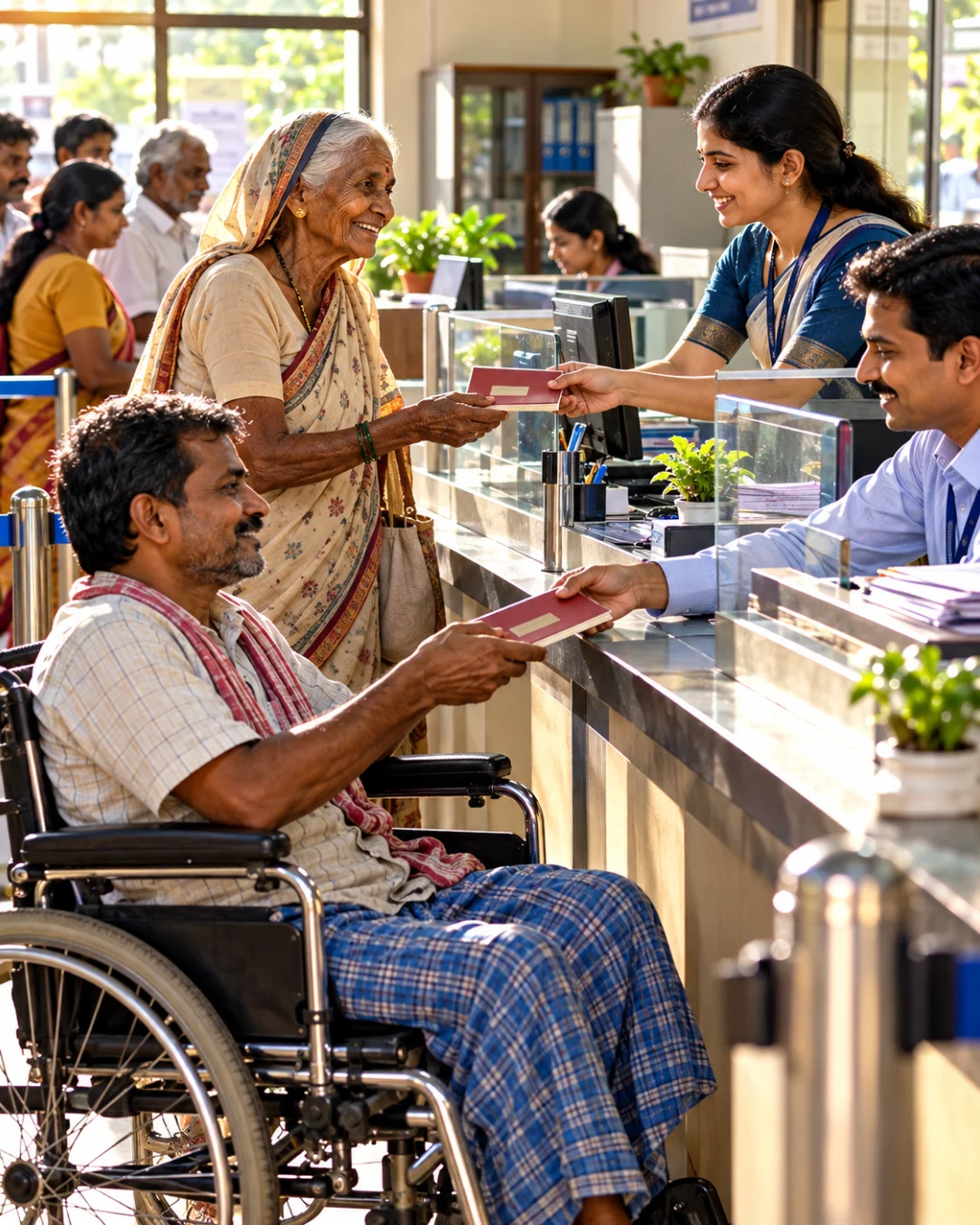
Cabinet continues National Social Assistance Programme to 2030-31 as PM Samajik Sahayata Yojana, eases disability pension
In short: Rs 53,428 crore outlay for five years; disability pension now open from birth at 40 per cent benchmark disability.
Why in news
On 14 October 2026 the Union Cabinet approved the Department of Rural Development proposal to continue the National Social Assistance Programme (NSAP) for five years, from 2026-27 to 2030-31, with a total outlay of Rs 53,428 crore. The programme and its sub-schemes are being renamed, the disability pension rules are being relaxed, and the old-age, widow and family benefit components continue in their existing form. About 3.20 crore beneficiaries across all 36 States and Union Territories are covered.
Background
NSAP was launched on 15 August 1995 to give effect to the Centre’s responsibility under Article 41 of the Constitution, which directs the State to provide public assistance in old age, sickness and disablement within its economic capacity. It is a 100 per cent centrally assisted programme so that a uniform floor of social security is available across the country. NSAP becomes the Pradhan Mantri Samajik Sahayata Yojana; the old-age pension (IGNOAPS) becomes the Pradhan Mantri Vridhavastha Pension Yojana, the widow pension (IGNWPS) the Pradhan Mantri Vidhawa Pension Yojana, the disability pension (IGNDPS) the Pradhan Mantri Divyangjan Pension Yojana and the National Family Benefit Scheme the Pradhan Mantri Parivar Labh Yojana. For the disability pension, the benchmark disability criterion falls from 80 per cent to 40 per cent and the minimum age condition is removed so that eligibility begins from birth; central assistance is Rs 375 a month for ages 0 to 79 and Rs 625 for those aged 80 and above. The changes align the scheme with the Rights of Persons with Disabilities Act, 2016, which uses 40 per cent benchmark disability and requires disability-related assistance to be at least 25 per cent higher than that under comparable schemes. Revised guidelines are to be issued and implemented within three months.
Key facts for Prelims
- NSAP: launched 15 August 1995; 100 per cent central assistance; administered by the Department of Rural Development.
- Constitutional anchor: Article 41 (Directive Principle on public assistance in old age, sickness and disablement).
- New names: PM Samajik Sahayata Yojana (umbrella); PM Vridhavastha, PM Vidhawa, PM Divyangjan Pension Yojanas; PM Parivar Labh Yojana.
- Disability pension: benchmark disability lowered from 80 per cent to 40 per cent; eligible from birth; Rs 375 (0 to 79 years) and Rs 625 (80 plus) per month.
- Outlay Rs 53,428 crore for 2026-27 to 2030-31; about 3.20 crore beneficiaries in 36 States and UTs.
- Rights of Persons with Disabilities Act, 2016 defines benchmark disability as 40 per cent or more.
Mains analysis and way forward
Mains analysis
- Lowering the disability threshold to 40 per cent brings a large group of persons with disabilities, including children, within a cash transfer net for the first time; this operationalises the RPwD Act rather than leaving it as a statutory promise.
- Central pension amounts remain modest; the effective benefit depends on State top-ups, which vary widely, raising questions of horizontal equity in a centrally funded scheme.
- Renaming sub-schemes raises the debate on scheme branding versus continuity of entitlements; for beneficiaries, portability of records and uninterrupted payments matter more than nomenclature.
- Social pensions are among the most direct instruments against old-age and disability poverty, complementing in-kind entitlements such as food security and health cover.
Way forward
- Use the three-month guideline window to update beneficiary databases with UDID (Unique Disability ID) linkage so that newly eligible persons are enrolled proactively.
- Consider indexing central pension amounts to inflation and encouraging States to converge their top-ups.
- Publish disaggregated beneficiary data (age, gender, disability type) to track whether the expanded eligibility reaches those intended.
Connect the dots: Directive Principles (Art 41) | Social security and welfare schemes | RPwD Act 2016 | Centrally sponsored schemes
Sources: PIB: Cabinet approves continuation of the National Social Assistance Programme for five years from 2026-27 to 2030-31, 14 October 2026; News on AIR: Cabinet approves continuation of National Social Assistance Programme for five years, 14 October 2026
Geography and environment

Union Government approves India’s accession to the Southern Indian Ocean Fisheries Agreement as a Contracting Party
In short: Once accession takes effect, Indian-flagged vessels can fish lawfully for squid, toothfish and alfonsino on the high seas and India gains a vote in SIOFA.
Why in news
On 14 October 2026, the Union Government approved India’s accession to the Southern Indian Ocean Fisheries Agreement (SIOFA) as a Contracting Party. India has been a cooperating non-Contracting Party since 2022, a status SIOFA still lists; the formal accession process is yet to be completed. According to the Ministry of Fisheries, Animal Husbandry and Dairying, once accession takes effect the move will allow Indian-flagged vessels and enterprises to conduct authorised fishing of squid, toothfish, alfonsino and other non-migratory stocks within SIOFA’s area, and to take part in scientific assessments, sustainable harvesting rules and action against illegal, unreported and unregulated (IUU) fishing.
Background
SIOFA was signed in Rome on 7 July 2006 and entered into force on 21 June 2012; its secretariat is at Le Port on Reunion. It governs fisheries on the high seas between eastern Africa and Western Australia, covering fish, molluscs, crustaceans and other sedentary species but excluding highly migratory species and sedentary species under coastal-state jurisdiction; major managed fisheries include orange roughy, alfonsino and toothfish. Contracting Parties include Australia, China, the Cook Islands, the European Union, France (for its Indian Ocean territories), Japan, South Korea, Mauritius, Seychelles and Thailand. The official statement noted that the high seas make up about 65 per cent of the global ocean and that high-seas catch is dominated by China (21 per cent), Taiwan (13 per cent), Japan (11 per cent), South Korea (11 per cent) and Spain (8 per cent), while Indian vessels largely operate within 60 to 80 nautical miles of the coast inside the Exclusive Economic Zone. The statement also linked the accession to coastal security through the High Seas Boarding and Inspection scheme adopted under SIOFA.
Key facts for Prelims
- SIOFA: signed Rome, 7 July 2006; in force 21 June 2012; secretariat at Le Port, Reunion (France).
- Area: high seas of the southern Indian Ocean between eastern Africa and Western Australia; adjacent to the CCAMLR (south), SPRFMO (east) and SEAFO (west) convention areas.
- Species: fish, molluscs, crustaceans and other sedentary species; highly migratory species (such as tuna) are excluded and are handled by other bodies.
- India: cooperating non-Contracting Party since 2022; the Union Government approved accession as a Contracting Party on 14 October 2026; accession is not yet complete.
- High seas are about 65 per cent of the global ocean; under UNCLOS the EEZ extends to 200 nautical miles from the baseline.
- Target species named: squid, toothfish, alfonsino.
Mains analysis and way forward
Mains analysis
- Once accession takes effect, membership gives India a vote in setting catch limits and conservation measures, turning it from a rule-taker into a rule-maker in southern Indian Ocean fisheries.
- Deep-sea and high-seas fishing can diversify livelihoods away from overfished coastal waters, but needs capable vessels, cold chains and trained crews.
- Participation in compliance and boarding schemes strengthens maritime domain awareness and India’s stance against IUU fishing in the wider Indian Ocean Region.
- Sustainability safeguards matter: toothfish and orange roughy are slow-growing stocks where overfishing has historically caused collapses.
Way forward
- Build a transparent licensing and monitoring system for Indian high-seas vessels, including vessel tracking and catch documentation.
- Invest in fisheries science capacity so India contributes stock assessments rather than relying only on others’ data.
- Align the accession with the Pradhan Mantri Matsya Sampada Yojana’s deep-sea fishing components and with coastal community interests.
Connect the dots: Links to: GS I oceanography and ocean resources; GS II international agreements; GS III blue economy, fisheries and maritime security.
Sources: Punjab Kesari (IANS): Govt approves India’s accession to SIOFA to boost presence in High Seas fisheries, 14 October 2026; Southern Indian Ocean Fisheries Agreement: official site
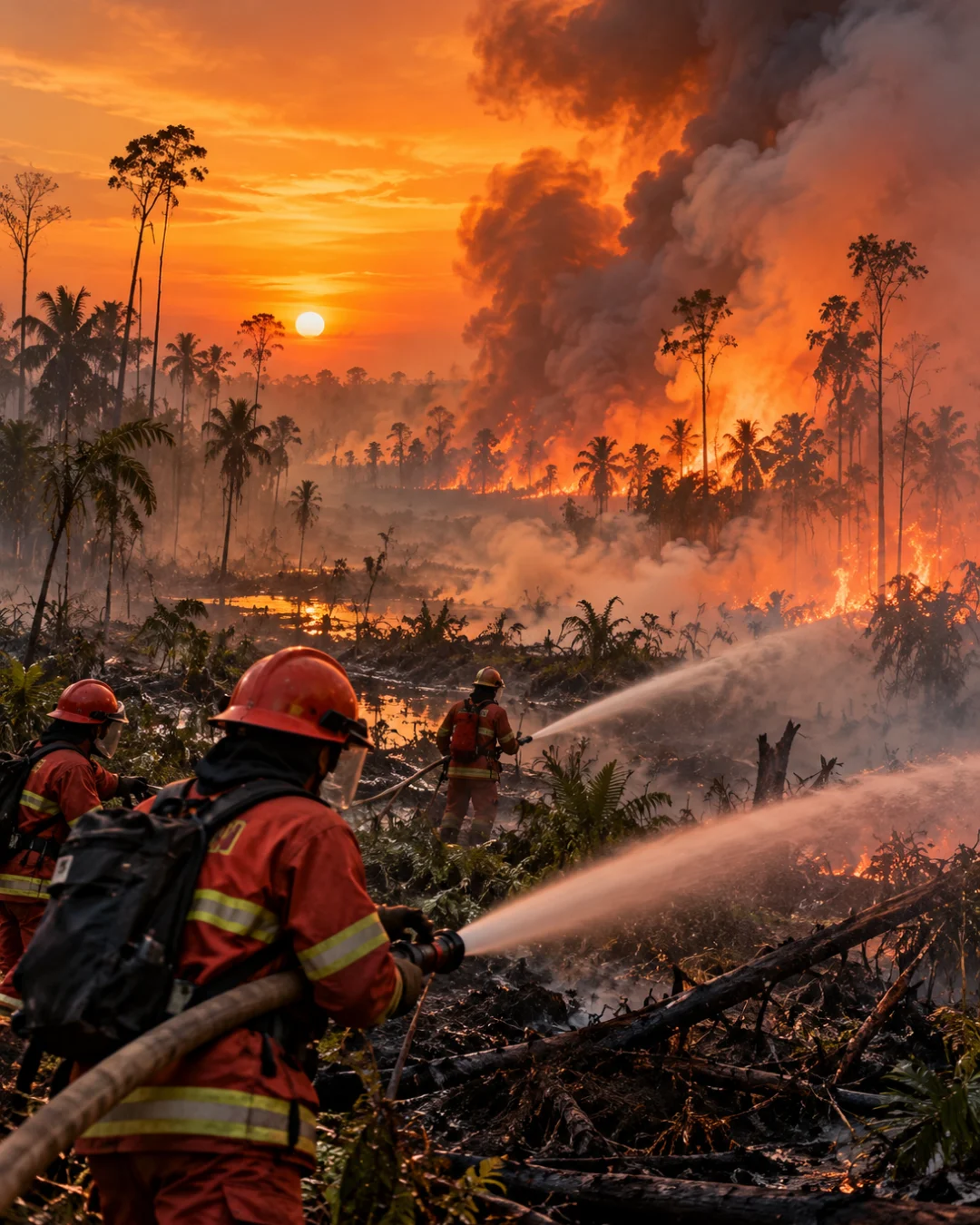
Indonesia records most fire hotspots in a decade as Super El Nino dries Sumatra and Kalimantan
In short: Over 1.06 million satellite hotspot detections by 14 October 2026, with haze reaching Malaysia and Singapore, as El Nino delays Indonesia’s rains.
Why in news
Indonesia is experiencing its most intense forest and land fire season in a decade by hotspot count, Down To Earth reported on 14 October 2026. The independent tracker Nusantara Atlas recorded 1,061,746 satellite hotspot detections as of 14 October, more than the 885,037 recorded in 2019, the previous worst year in its comparison; hotspots are thermal anomalies detected by satellite, not counts of distinct fires. Burned area tells a different story so far: about 895,657 hectares had burned by August 2026, against 2,631,469 hectares in the whole of 2019. Smoke has reached residential areas in Indonesia and in neighbouring Malaysia and Singapore, worsening air quality.
Background
The fires are being driven by dry conditions linked to a Super El Nino in the equatorial Pacific, combined with slash-and-burn land clearing, which is banned in Indonesia but hard to enforce. Indonesia’s Meteorology, Climatology and Geophysics Agency (BMKG) had warned on 22 September that a very strong El Nino would prolong dry conditions into October, with hotspot counts highest in Central Kalimantan (5,283 as of 21 September), followed by South Sumatra (1,485) and West Kalimantan (1,357); it expects the 2026-27 rainy season to start later than the long-term average over more than 60 per cent of the country’s land area, often in November or December, and to be shorter than usual. During El Nino, warmer sea surface in the central and eastern Pacific weakens the Walker circulation, suppressing convection and rainfall over Indonesia and often weakening the Indian monsoon. Aerosol maps show smoke spreading towards the Indian Ocean, though it is not clear whether it will cross the Bay of Bengal to India.
Key facts for Prelims
- Nusantara Atlas: 1,061,746 satellite hotspot detections as of 14 October 2026 versus 885,037 in 2019 (hotspots are not distinct fires); area burned by August 2026 about 895,657 hectares against 2,631,469 hectares in all of 2019.
- El Nino: anomalous warming of the central and eastern equatorial Pacific; weakens the Walker circulation, reducing rainfall over Indonesia and Australia and tending to weaken the Indian monsoon.
- BMKG is Indonesia’s Meteorology, Climatology and Geophysics Agency.
- Fire-prone regions: Sumatra and Kalimantan (Indonesian Borneo), with extensive tropical peatlands.
- Transboundary haze affects Malaysia and Singapore; ASEAN has an Agreement on Transboundary Haze Pollution (2002).
- Slash-and-burn land clearing is banned in Indonesia but enforcement is weak.
Mains analysis and way forward
Mains analysis
- Transboundary haze shows how land-use practices in one country become a regional public health and diplomatic issue.
- El Nino years amplify fire risk; early-warning forecasts from agencies such as BMKG allow pre-positioning of firefighting and health resources.
- Peat fires release large stores of carbon, so Indonesian fire seasons have a disproportionate effect on global emissions.
- For India, El Nino forecasts matter for monsoon planning, reservoir management and kharif sowing, and the episode is a reminder of forest-fire preparedness in central Indian and Himalayan states.
Way forward
- Strengthen regional cooperation on haze through ASEAN mechanisms and shared satellite monitoring.
- Address the economic drivers of land clearing through traceable supply chains for palm oil and pulp.
- Restore degraded peatlands and maintain water tables so that fires do not burn deep and long.
Connect the dots: Links to: GS I climatology (ENSO, Walker circulation, monsoon), Southeast Asian geography; GS III disaster management and climate change.
Sources: Down To Earth: Indonesia faces worst wildfire season in a decade as Super El Nino fuels fires, 14 October 2026; Bernama: Indonesia forecasts forest fire risk into early October as El Nino keeps rainfall low, 22 September 2026
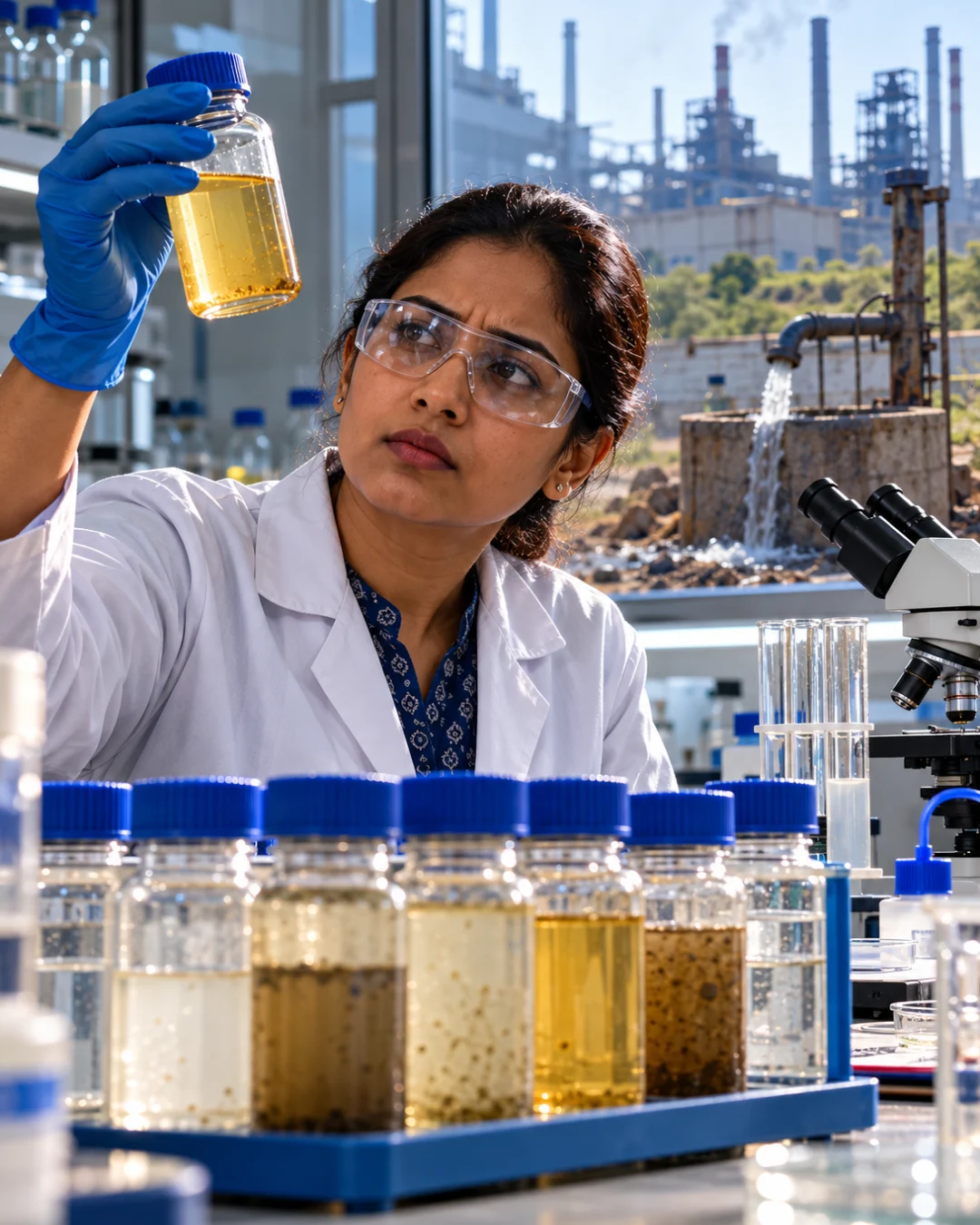
Chromium over 1,000 times the drinking water limit in Nashik groundwater; 109 residents report skin ailments
In short: Groundwater near Nashik’s Ambad industrial area shows chromium far above the BIS limit; 17 electroplating units ordered shut and borewells closed.
Why in news
Down To Earth reported on 14 October 2026 that groundwater in Dattanagar, in Nashik’s Ambad industrial area in Maharashtra, is heavily contaminated with chromium. An independent laboratory analysis commissioned by the South Asia Network on Dams, Rivers and People (SANDRP) found hexavalent chromium at 50.3 mg per litre and total chromium at 50.5 mg per litre, more than 1,000 times the Bureau of Indian Standards limit of 0.05 mg per litre for total chromium in drinking water. The Maharashtra Pollution Control Board’s own samples of 8 October 2026 showed about 45 mg per litre, roughly 900 times the limit.
Background
About 25,000 people live in Dattanagar and officials are investigating contamination along a stretch of about 500 metres. The Nashik Municipal Corporation screened 248 people and diagnosed 109 with skin conditions or allergies; residents reported rashes, blisters and ulcers, with SANDRP describing some lesions as “chrome holes”. The MPCB ordered 17 electroplating units closed, authorities shut eight of 17 borewells that showed visibly yellow water, groundwater use has been banned and tankers are supplying water; blood and urine tests for chromium and other contaminants are scheduled for 17 October. Hexavalent chromium is a toxic industrial pollutant classified by the International Agency for Research on Cancer as carcinogenic to humans; the exact source unit has not yet been confirmed and officials say a direct causal link between the water and each diagnosed condition is still to be established.
Key facts for Prelims
- BIS drinking water standard (IS 10500): total chromium limit 0.05 mg per litre.
- Reported levels: 50.3 mg per litre hexavalent chromium (SANDRP lab); about 45 mg per litre (MPCB, 8 October 2026).
- Hexavalent chromium (Cr VI) is classified by IARC as carcinogenic to humans; electroplating, tanning and chemical industries are common sources.
- Maharashtra Pollution Control Board functions under the Water (Prevention and Control of Pollution) Act, 1974 and the Air Act, 1981.
- The Central Ground Water Authority is constituted under the Environment (Protection) Act, 1986 to regulate groundwater.
- Location: Dattanagar, Ambad industrial area, Nashik, Maharashtra.
Mains analysis and way forward
Mains analysis
- The episode shows the gap between consent conditions for polluting units and actual monitoring of effluent and groundwater.
- Groundwater pollution is slow to detect and slower to remediate, so citizen science and independent testing play a vital early-warning role.
- Environmental health surveillance in industrial clusters must link pollution boards, municipal health systems and medical colleges.
- The polluter-pays principle, recognised by the Supreme Court, requires identification of the source and funding of remediation and compensation.
Way forward
- Complete source attribution and begin groundwater remediation, with periodic public disclosure of test results.
- Mandate zero-liquid-discharge and effluent monitoring for electroplating clusters, with surprise sampling.
- Set up health registries for affected residents so long-term outcomes can be tracked and compensated.
Connect the dots: Links to: GS III environmental pollution and degradation, groundwater; GS II health and regulatory governance; GS IV corporate responsibility.
In brief
- Personality in the news: Hema Malini: Hema Malini, born on 16 October 1948 at Ammankudi in present-day Tamil Nadu, turns 78 on 16 October 2026. A trained Bharatanatyam dancer who also learnt Kuchipudi and Mohiniattam, she won the Filmfare Best Actress award for Seeta Aur Geeta (1972), received the Padma Shri in 2000 and became the first woman chairperson of the National Film Development Corporation the same year; she was a nominated member of the Rajya Sabha (2003-2009) and has represented Mathura in the Lok Sabha since 2014.
- NMC advisory on digital signatures for medical records: The National Medical Commission’s Ethics and Medical Registration Board issued a public notice dated 13 October 2026 advising all registered medical practitioners on the use of digital and electronic signatures for remote review and authentication of medical records, in line with the Information Technology Act, 2000, following a recommendation of the High-Level Committee on Non-Financial Regulatory Reforms.
- 19 National Law Universities to research pendency in 100 districts: On 14 October 2026 Union Law Minister Arjun Ram Meghwal chaired a virtual meeting with the vice-chancellors of 19 National Law Universities from 16 States, under which the Ministry of Law and Justice has engaged the NLUs to study the causes of delay in the 100 judicial districts with the highest pendency, which together account for more than half of all pending district court cases; the universities will use pro bono clubs, researchers and students to profile cases and propose district-specific strategies such as identifying infructuous cases, mediation, plea bargaining and summary trials.
- PM dedicates Ladakh projects worth about Rs 3,350 crore: On 15 October 2026 Prime Minister Narendra Modi inaugurated and dedicated projects in Ladakh including a new passenger terminal at Kushok Bakula Rimpochee Airport, Leh, the 298-km Nimmu-Padum-Darcha road, the 9 MW Hanu small hydroelectric project, the 66 kV Dah-Hanu-Khaltsi transmission line and India’s first Petroglyph Conservation Park at Sindhu Ghat; 40 water bodies in 40 villages were developed under Project Him Sarovar.
- Supreme Court to hear Asaram’s appeal in November: On 14 October 2026 the Supreme Court said it would hear in November the challenge by Asaram to his conviction and life sentence in the 2013 Jodhpur rape case, after a bail-related plea was dismissed as withdrawn.
- No coercive action against woman journalist in SC/ST case: On 15 October 2026 the Supreme Court ordered that no coercive action be taken in a case under the SC/ST Act against a woman journalist who had accused a Delhi ACP of sexual harassment during the Delhi protests; the Court continues to hear contempt petitions on the deputation of IPS officers and pleas on the constitutional validity of the Central Armed Police Forces.
- India-Brunei Joint Trade Committee: India and Brunei Darussalam reviewed bilateral trade at the Third Joint Trade Committee Meeting, the Ministry of Commerce and Industry said on 14 October 2026.
- Agrivision national convention: Union Agriculture Minister Shivraj Singh Chouhan participated in the 10th National Convention of Agrivision in New Delhi, the Ministry of Agriculture and Farmers Welfare said on 14 October 2026.
- Mahila Kisan Diwas 2026: The Ministry of Agriculture and Farmers Welfare said on 14 October 2026 that Mahila Kisan Diwas 2026, recognising women farmers, would be celebrated at the national level on 15 October 2026.
- Record second-quarter exports: Overall exports of goods and services in July to September 2026 are estimated at $242.6 billion, the highest for any second quarter, with growth of 15.84 per cent, the Commerce Ministry said on 15 October 2026.
- Rubio to visit India and Uzbekistan from 17 October: Reuters has reported that US Secretary of State Marco Rubio will travel to India and Uzbekistan from 17 to 22 October 2026, meeting government and business leaders on energy cooperation, commercial investment and broader economic ties. It is his second India visit this year after the May 2026 trip.
- Defence Secretary in Cyprus: training offer to Cypriot Navy: During an official visit to Cyprus on 12 and 13 October 2026, reported by the Ministry of Defence on 14 October, Defence Secretary Rajesh Kumar Singh met Cypriot Naval Commander Commodore Nicolaos Luca at Mari Naval Base and offered training, capacity-building and technical assistance for maritime security. He also met the UNFICYP Force Commander on India’s peacekeeping contribution before travelling on to Greece.
- Army receives 450 Nagastra-1R loitering munitions in one batch: Solar Defence and Aerospace, a Solar Industries subsidiary, announced on 13 October 2026 that it had completed delivery of 450 Nagastra-1R loitering munitions to the Indian Army in a single lot under emergency procurement, which it described as the largest such supply to the Army. The short-range kamikaze drone has an abort-and-recovery option.
- KAUMARACON 2026 on Ayurvedic child care: The third International Conference on Kaumarabhritya, the Ayurvedic branch of child care, opened in New Delhi on 15 October 2026 under the All India Institute of Ayurveda, with experts from more than a dozen countries and over 200 research papers. Vice President C P Radhakrishnan said Ayurveda must be strengthened through evidence-based research and responsible integration with modern healthcare, and launched an AYUSH Start-up portal, the AIIA-iCAINE website and the AyuDIVA, Vamana and Panchakarma Assessment apps; the conference ends on 17 October, AIIA’s 10th foundation day.
- DRDO to lead semiconductor session at ESTIC-2026: At a curtain-raiser in Bengaluru on 13 October 2026, DRDO announced it will lead a thematic session on Semiconductors and Next-Gen Chips at the Emerging Science, Technology and Innovation Conclave (ESTIC-2026), to be held at Bharat Mandapam, New Delhi, from 27 to 29 October by 12 ministries and departments under the guidance of the Principal Scientific Adviser. DRDO will also showcase quantum technology prototypes, high-power pulse laser diodes and scramjet engine technology.
- World Food Day, 16 October: World Food Day on 16 October 2026 marks the anniversary of the founding of the Food and Agriculture Organization (1945) and is observed in nearly 150 countries; FAO’s 2026 theme is “Innovate today. Nourish tomorrow.”, stressing innovation combined with traditional knowledge for access to healthy, safe and nutritious diets.
Prelims practice: 5 questions
Choose an option to see the answer and explanation. Your score appears when all five are answered.
Mains practice
Social assistance pensions are among the most direct ways in which the State gives effect to Article 41 of the Constitution. In the light of the decision to continue and revise the National Social Assistance Programme, examine its significance and limitations, and suggest reforms.
Show the answer outline
Introduction (about 30 words)
- On 14 October 2026 the Cabinet continued NSAP to 2030-31 (Rs 53,428 crore) as the PM Samajik Sahayata Yojana, covering about 3.20 crore beneficiaries.
Constitutional and policy basis
- Article 41 directs the State to provide public assistance in old age, sickness and disablement, within its economic capacity.
- NSAP (1995) is 100 per cent centrally assisted, giving a uniform national floor of social security.
Significance
- Direct cash support to the elderly, widows, persons with disabilities and bereaved poor households.
- Lowering the disability threshold from 80 to 40 per cent and removing the age bar aligns the scheme with the RPwD Act, 2016.
- Complements in-kind entitlements such as food security and health cover.
Limitations
- Central pension amounts are modest; actual benefits depend on State top-ups, which vary widely.
- Exclusion and delays arising from outdated beneficiary lists and documentation gaps.
- Renaming does not by itself improve coverage or adequacy.
Reforms
- Link enrolment to UDID and other databases to enrol newly eligible persons proactively.
- Index central assistance to inflation and encourage convergence of State top-ups.
- Publish disaggregated beneficiary data and conduct social audits.
Conclusion (about 30 words)
- A dignified, adequate and reliably paid social pension turns Article 41 from a directive into a lived entitlement for the most vulnerable.
Tip: Anchor the answer in Article 41 and the RPwD Act, 2016, use the 14 October Cabinet decision as the current example, and balance significance with limitations before suggesting reforms.
Current Canvas is prepared by the UPSC Gurus editorial desk. Every fact is checked against official releases and reliable reporting, with sources listed under each story. Editions are compiled each month into Current Canvas Monthly, a free magazine.
About images: photographs and illustrations in Current Canvas are AI-generated for illustration only. They are not news photographs of the events described.