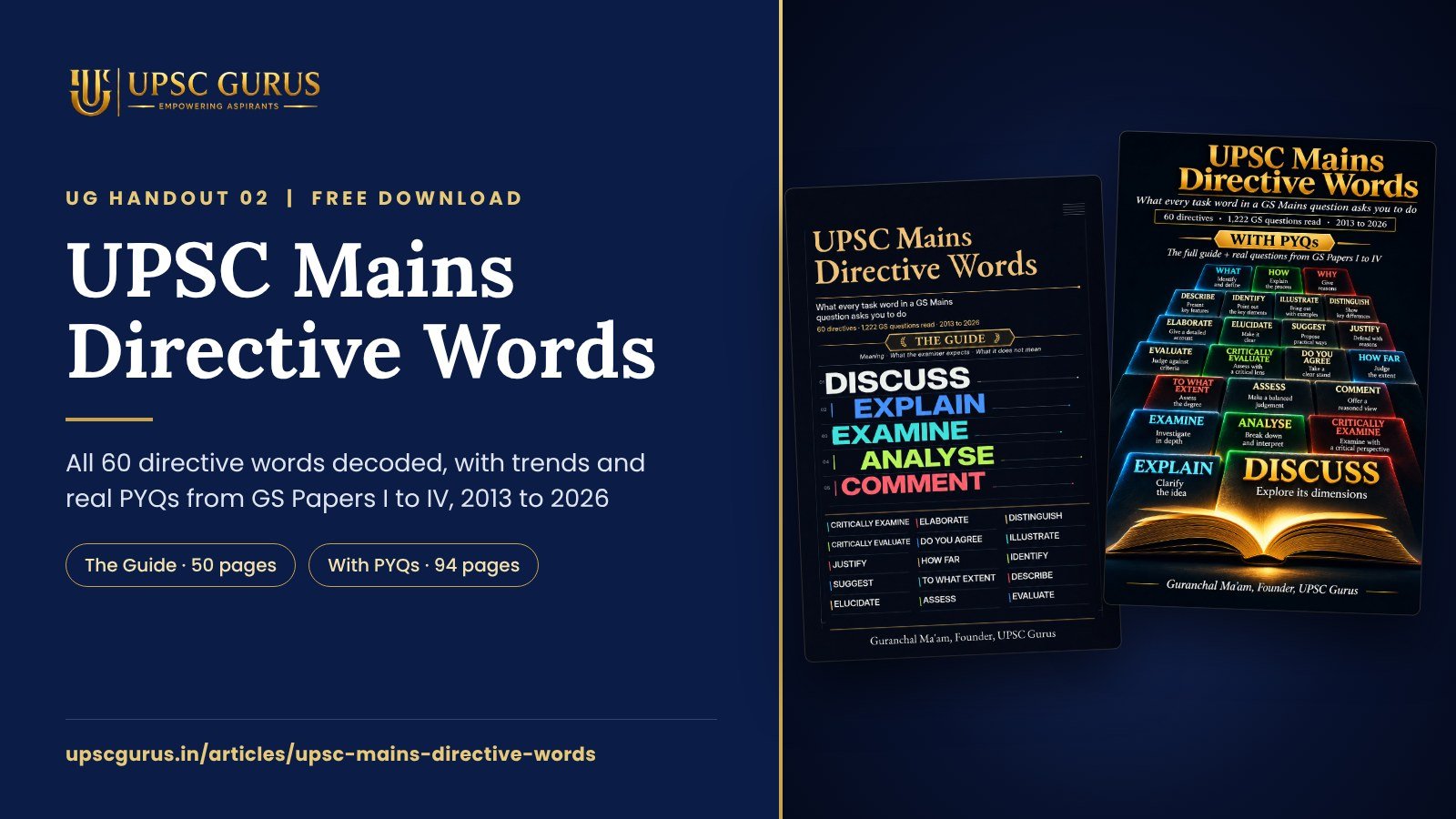
 New this week · Free UG Handout 02UPSC Mains Directive Words: 60 Meanings, Trends and PYQsTwo free PDFs: The Guide and the With PYQs edition.Read and download
Today’s Canvas
- Cyclone Murasu aftermath: crops on 52,459 hectares hit across 15 Andhra districts; at least two deadGS III
- Navy frees pirate-held fishing vessel Azini off Somalia: all 20 crew safe after a 48-hour operationGS III
- Tiger Triumph 2026 opens in Visakhapatnam as a tabletop exercise; NDRF joins the India-US HADR drill for the first timeGS III
- Speaker opens PAC chairpersons’ conference: committees must use data analytics to clear reports pending for yearsGS II
- Supreme Court: rescued bonded labourers must get immediate assistance within seven days of release certificateGS II
- Supreme Court issues notice on plea against facial recognition surveillance at protest sitesGS II
- Caste discrimination in prisons: Supreme Court gives 23 States and UTs a last chance to report complianceGS II
- Expert committee proposes replacing NEET-PG percentile cut-offs with a rank-based system; Supreme Court informedGS II
- Weeks before the Ganga Water Treaty expires on 12 December, India says the Joint Rivers Commission is the mechanism for talksGS II
- India and Israel the only two votes against a Pakistan-Belarus UN draft on regional conventional arms controlGS II
- India sets a $1 trillion export goal for 2026-27 after a 14% rise to $480 billion in April-SeptemberGS III
- Centre aims to double the share of coastal shipping and waterways in freight movement from 6% to 12% by 2047GS III
- Pune Metro projects worth about Rs 21,800 crore launched; Hinjawadi-Shivajinagar PPP line opensGS III
- Global wildlife trade involves at least 107,356 species, more than twice earlier estimates, finds studyGS III
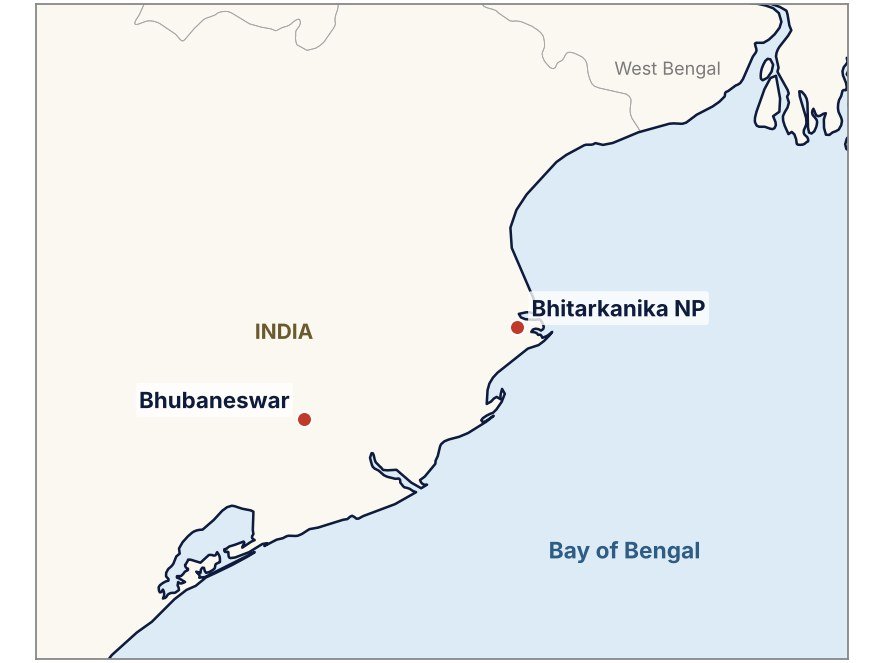
- Fifth crocodile death in 27 days at Bhitarkanika raises concern over illegal fishing netsGS III
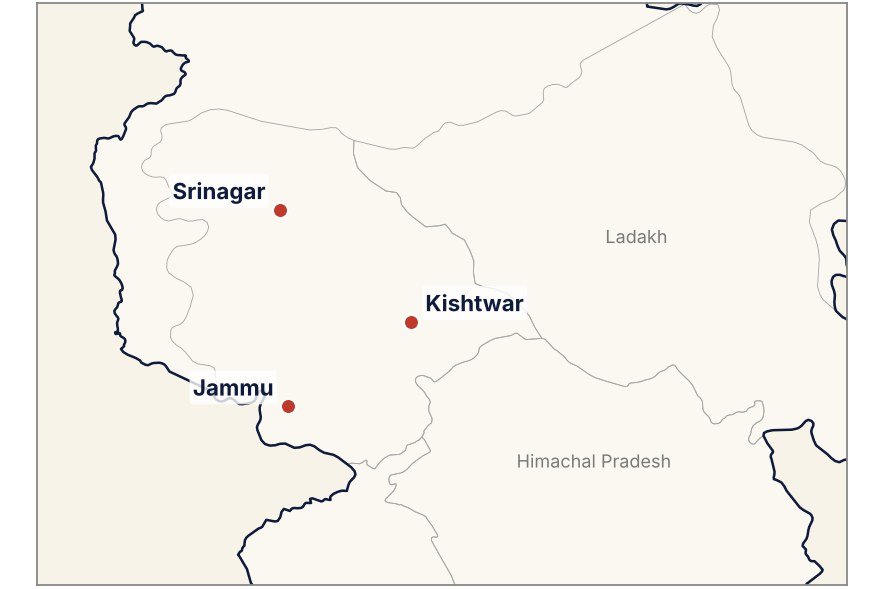
- Seismological observatory opens at Kishtwar, J&K’s fourth, as weather radar and station network expandsGS III
Disaster management and security
Cyclone Murasu aftermath: crops on 52,459 hectares hit across 15 Andhra districts; at least two dead
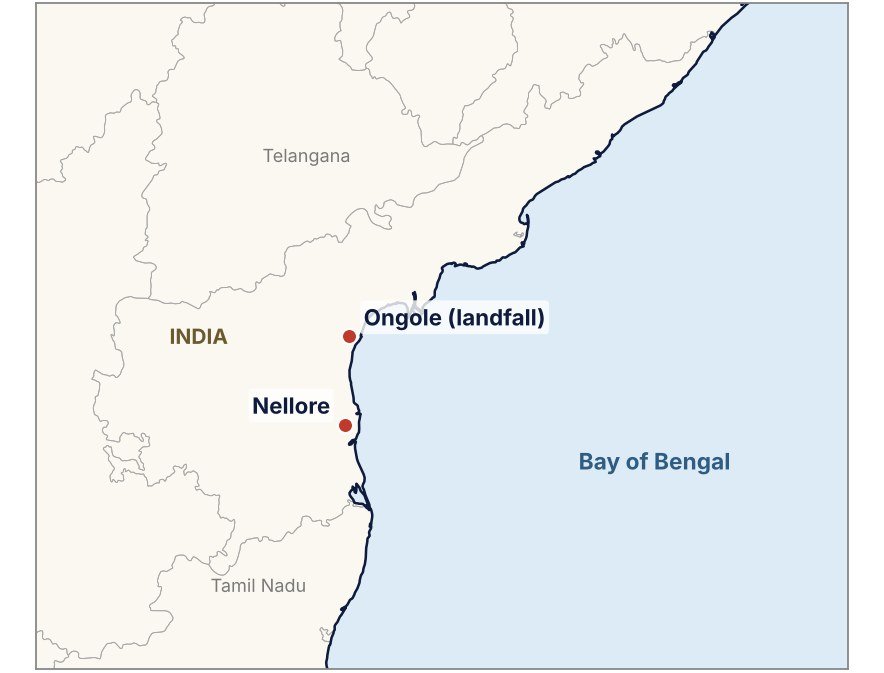
In short: Murasu crossed the coast near Ongole on 3 November; early losses are put at Rs 344 crore as 12,230 people stay in shelters.
Why in news
Severe Cyclonic Storm Murasu crossed the south Andhra Pradesh coast near Ongole between 3.30 am and 5.30 am on 3 November 2026, with winds of 100 to 110 kmph gusting to 120 kmph. By the evening the Andhra Pradesh State Disaster Management Authority reported at least two deaths, standing crops damaged on 52,459 hectares in 15 districts and a preliminary loss of at least Rs 344 crore. It was the second cyclone to hit the State within a week, after Arnab on 28 October.
Concept: How IMD grades a cyclonic disturbance
The India Meteorological Department grades a system by its maximum sustained wind speed. A depression has winds of 31 to 49 kmph and a deep depression 50 to 61 kmph; from 62 to 88 kmph it is a cyclonic storm, and from 89 to 117 kmph a severe cyclonic storm, the grade Murasu held at landfall. Higher grades are very severe (118 to 167 kmph), extremely severe (168 to 221 kmph) and super cyclonic storm (222 kmph and above). Wind speed broadly reflects the pressure difference between the low-pressure centre and its surroundings, which is why a deepening low intensifies the storm. Once over land a cyclone loses its supply of warm, moist ocean air and weakens step by step down this ladder, as Murasu was forecast to do within a day of landfall.
Key facts for Prelims
- Worst-hit districts for crops: Krishna, Bapatla and Nandyala; Prakasam and Bapatla took the heaviest damage to the power network.
- Bapatla recorded 22 cm of rain in the 24 hours to 8.30 am on 3 November, the highest reported; Narasapur received 20 cm.
- Field response: 11 NDRF and 13 SDRF teams, 185 fire service teams and 725 medical teams; 171 relief camps ran on 3 November.
- Precaution for mothers: 3,066 pregnant women and 1,008 nursing mothers were shifted to hospitals before the storm.
Mains analysis and way forward
Mains analysis
- Back-to-back cyclones within a week compound losses: soils, tanks and embankments already saturated by Arnab have little capacity left, so the same rainfall causes more flooding.
- Zero or near-zero deaths in large cyclones now reflect strong early warning and evacuation, but livelihood losses (crops, boats, livestock, power) remain high and are harder to compensate.
- Shifting pregnant women and nursing mothers to hospitals in advance shows how disaster plans are becoming people-centred rather than only infrastructure-centred.
- Damage to 2,750 power poles shows that power restoration is now the critical path for recovery of water supply, health services and communication.
Way forward
- Speed up damage enumeration so that input subsidy reaches farmers before the rabi sowing window closes.
- Invest in cyclone-resilient distribution networks (underground cabling in coastal towns) and in the upkeep of the 814 minor irrigation tanks under watch.
- Use the twin Arnab-Murasu experience to update district disaster management plans for multi-hazard, back-to-back events.
Connect the dots: Links to GS I (cyclones, Indian climate) and GS III (disaster management, DM Act 2005, early warning systems).
Sources: Daily Excelsior (PTI): Cyclonic storm makes landfall in Andhra, two killed, damages crops, power lines, 3 Nov 2026; Down To Earth: Cyclone Murasu: Second severe cyclonic storm in a week leaves a trail of destruction along Andhra Pradesh coast, 3 Nov 2026; The Hans India: Cyclone Murasu batters Prakasam, leaves trail of destruction, 4 Nov 2026; Deccan Herald: Explained: How IMD categorises cyclones
Navy frees pirate-held fishing vessel Azini off Somalia: all 20 crew safe after a 48-hour operation
In short: INS Kolkata, a P-8I, a Sea Guardian drone and MARCOS airdropped from an IAF C-17 recovered a hijacked vessel without casualties.
Why in news
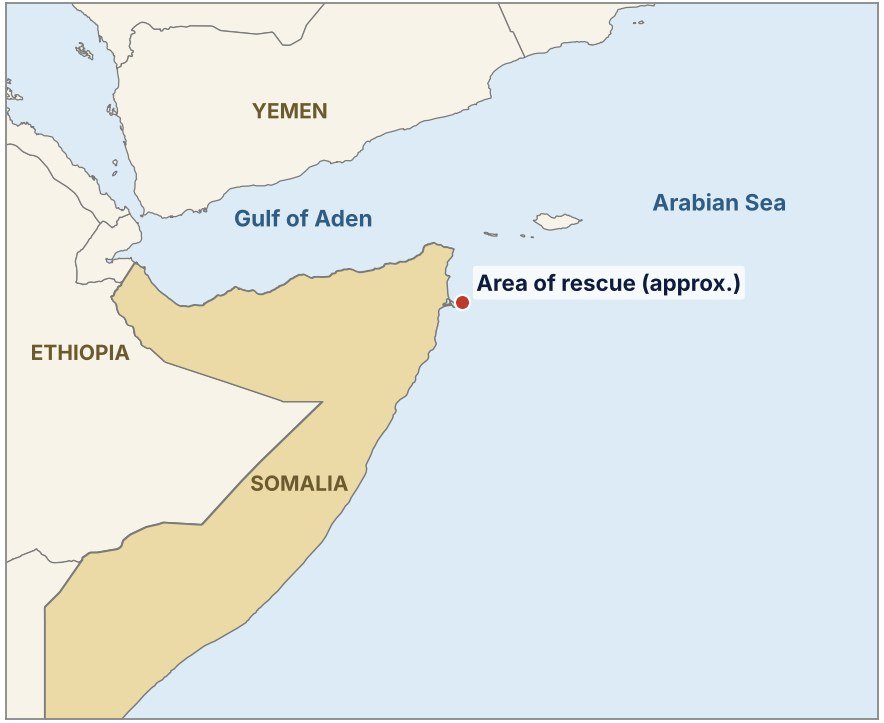
The Indian Navy said on 3 November 2026 that it had freed the fishing vessel Azini, hijacked in October off the north-eastern coast of Somalia, on the evening of 2 November; all 20 crew were rescued unhurt. INS Kolkata, backed by a P-8I maritime reconnaissance aircraft and a Sea Guardian drone, tracked and boxed in the vessel with non-kinetic measures before Marine Commandos (MARCOS), airdropped from an IAF C-17, secured it. The Navy said the vessel could have been used as a “mother ship” for further attacks on merchant shipping.
Concept: India’s anti-piracy law: the Maritime Anti-Piracy Act, 2022
India enacted its first dedicated anti-piracy law, the Maritime Anti-Piracy Act, 2022 (Act No. 3 of 2023), in force from 22 February 2023. It applies to the high seas, defined to include the Exclusive Economic Zone (EEZ) of India and of other States and all waters beyond any State’s jurisdiction. Piracy includes illegal acts of violence, detention or depredation committed for private ends by the crew or passengers of a private ship, directed on the high seas against another ship or persons or property aboard it, along with knowingly operating a pirate ship, inciting or facilitating such acts, and acts treated as piracy under international law. Piracy is punishable with imprisonment that may extend to life, or a fine, or both; where the offender causes death or attempts to cause death, the punishment is death or life imprisonment. Cases are tried by Designated Courts (Courts of Session notified after consulting the High Court Chief Justice), whose jurisdiction depends on the Indian port where the accused is disembarked.
Key facts for Prelims
- A “mother ship” is a captured vessel that pirates use as a floating base to launch skiff attacks far from the coast.
- Under the 2022 Act, attempting, aiding or conspiring in piracy carries up to 10 years; participating in, organising or directing piracy carries up to 14 years.
- Designated Courts can try an accused apprehended by Indian authorities regardless of nationality, and are to hold trials day to day where practicable.
- The Navy described its role as “First Responder and Preferred Security Partner in the Indian Ocean Region”.
Mains analysis and way forward
Mains analysis
- The operation shows integrated, tri-service maritime power: naval surface ship, long-range maritime patrol aircraft, unmanned surveillance and strategic airlift working to one plan.
- Non-kinetic containment before boarding protected the crew, showing that calibrated force and patience are as important as firepower.
- Persistent maritime domain awareness (P-8I and remotely piloted aircraft) is what turns a vast ocean search into a precise interdiction.
- Repeated action near the Gulf of Aden strengthens India’s credibility as a net security provider and builds goodwill with countries whose seafarers are rescued.
Way forward
- Use the 2022 Act to prosecute captured pirates, so that rescues are followed by legal accountability.
- Share real-time information with regional partners and information fusion centres to deny pirates the use of mother ships.
Connect the dots: Links to GS III: security challenges in border and maritime areas, role of armed forces; GS II: India as a net security provider in the Indian Ocean.
Sources: ThePrint: Indian Navy rescues fishing vessel hijacked off Somalian coast in dramatic 48-hour operation, 3 Nov 2026; India Code: The Maritime Anti-Piracy Act, 2022 (Act No. 3 of 2023)
Tiger Triumph 2026 opens in Visakhapatnam as a tabletop exercise; NDRF joins the India-US HADR drill for the first time
In short: The fifth India-US tri-service disaster relief exercise focuses on joint planning across domains, with India’s NDRF taking part for the first time.
Why in news
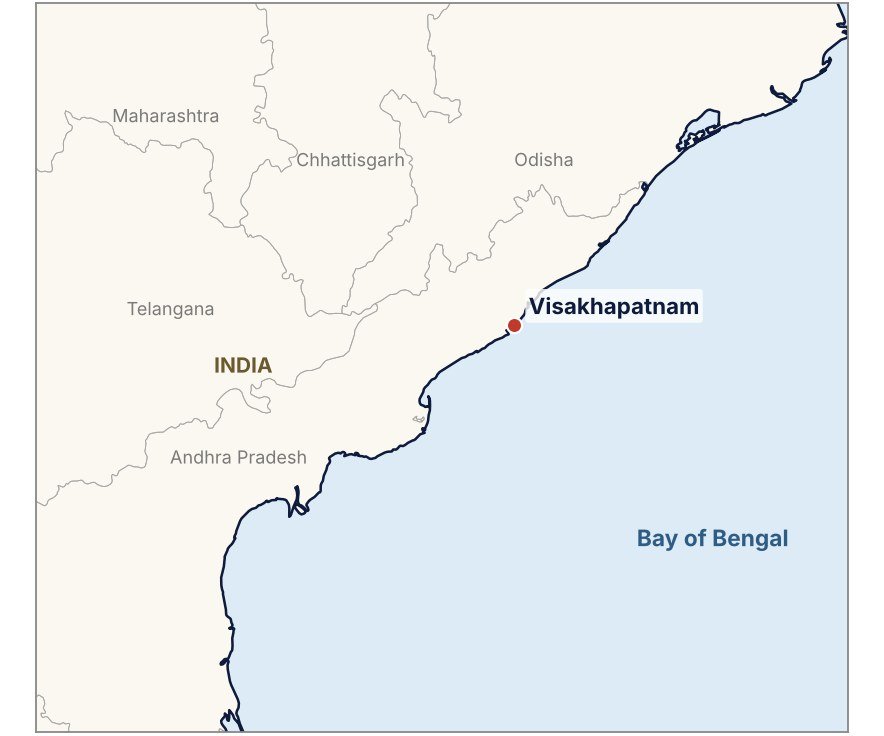
The fifth edition of Tiger Triumph, the India-US bilateral tri-service Humanitarian Assistance and Disaster Relief (HADR) exercise, opened at the Maritime Warfare Centre, Visakhapatnam, on 2 November 2026, as reported on 3 November. This year it is a tabletop exercise focused on joint planning, coordination and interoperability for large-scale HADR, and on Combined Joint All-Domain Operations. Personnel of the National Disaster Response Force (NDRF) are taking part for the first time.
Concept: HADR and the tabletop exercise as tools of defence diplomacy
Humanitarian Assistance and Disaster Relief (HADR) is the use of military capabilities such as ships, aircraft, medical teams and engineers to support civil authorities after a disaster. Militaries train for it together because large disasters often need several countries to work in the same space at once. A tabletop exercise (TTX) is a discussion-based drill: commanders and specialists walk through a scenario on maps and simulations, testing plans, command links and decision-making without deploying troops, which makes it cheaper and well suited to planning across many domains. “All-domain” operations combine land, sea, air, space and cyber capabilities under joint plans. HADR exercises also build trust between partners at low political cost, which is why they are a common first step in defence cooperation.
Key facts for Prelims
- The opening was presided over by Rear Admiral Vishal Bishnoi, Flag Officer Commanding Eastern Fleet, and Rear Admiral Joaquin J. Martinez de Pinillos, Vice Commander, US Pacific Fleet.
- Indian participants include Navy maritime specialists, Army ground forces, Air Force units and Special Forces from all three Services.
- The US side includes specialists from its Air Force, Army, Marine Corps and Navy, and in space, cyber, medical and explosive ordnance disposal.
Mains analysis and way forward
Mains analysis
- Bringing the NDRF in links the military and civilian disaster response chains, which is where coordination usually breaks down in real emergencies.
- A tabletop format puts planning and command-and-control at the centre, which matters more than troop numbers in multi-agency relief.
- Space and cyber specialists in an HADR exercise reflect how satellite imagery and secure communications now shape relief operations.
Way forward
- Carry lessons from the tabletop phase into field and sea drills with civil agencies and coastal States.
- Extend similar HADR planning with other Indian Ocean partners so India can lead coalition relief in the region.
Connect the dots: Links to GS III: disaster management and role of armed forces; GS II: India-US strategic partnership.
Sources: Life of Soldiers: Opening Ceremony of Exercise Tiger Triumph 2026, 3 Nov 2026
Polity, governance and social justice
Speaker opens PAC chairpersons’ conference: committees must use data analytics to clear reports pending for years
In short: Om Birla praised the convention of an Opposition chair for the Public Accounts Committee and asked PACs to use technology to track audit findings.
Why in news
Opening a two-day conference of Public Accounts Committee chairpersons from 25 States, hosted by the Kerala Legislative Assembly in Thiruvananthapuram, Lok Sabha Speaker Om Birla said on 3 November 2026 that PACs ensure public money is spent efficiently and for the right purposes. He noted that some PAC reports remain pending for 15 to 20 years and urged the use of data analytics and artificial intelligence to analyse expenditure and track audit observations. Kerala’s Chief Minister said a legislature cannot exclude a tabled CAG report from PAC scrutiny.
Concept: The Public Accounts Committee and the CAG
The Public Accounts Committee examines the accounts of the Government of India and the reports of the Comptroller and Auditor General (CAG), which are laid before Parliament under Article 151. It has 22 members, 15 from the Lok Sabha and 7 from the Rajya Sabha, elected each year by proportional representation through the single transferable vote; a Minister cannot be a member. By convention since 1967, its chairperson is from the Opposition. The PAC is a post-mortem body: it examines spending after it has occurred, and its recommendations are advisory, though the government reports action taken on them.
Key facts for Prelims
- The PAC was first set up in 1921 under the Government of India Act, 1919.
- The CAG is appointed under Article 148 and is often called the friend, philosopher and guide of the PAC.
- The Estimates Committee and the Committee on Public Undertakings are the other two financial committees.
Mains analysis and way forward
Mains analysis
- Long pendency of reports weakens accountability; findings lose relevance when acted on years later.
- Technology can help match audit observations with action-taken notes, but needs adequate secretariat capacity.
- Selective scrutiny of CAG reports risks politicising a constitutional audit.
Way forward
- Time limits for action-taken notes and follow-up hearings.
- Shared digital tracking of CAG paras across Parliament and State legislatures.
Connect the dots: Links: GS II Parliament and State legislatures, constitutional bodies (CAG).
Sources: The Hindu: PACs ensure efficient use of public money: Om Birla, 4 Nov 2026
Supreme Court: rescued bonded labourers must get immediate assistance within seven days of release certificate
In short: Release without prompt rehabilitation does not meet the Constitution; the Court sets timelines for Centre, States and districts on bonded labour.
Why in news
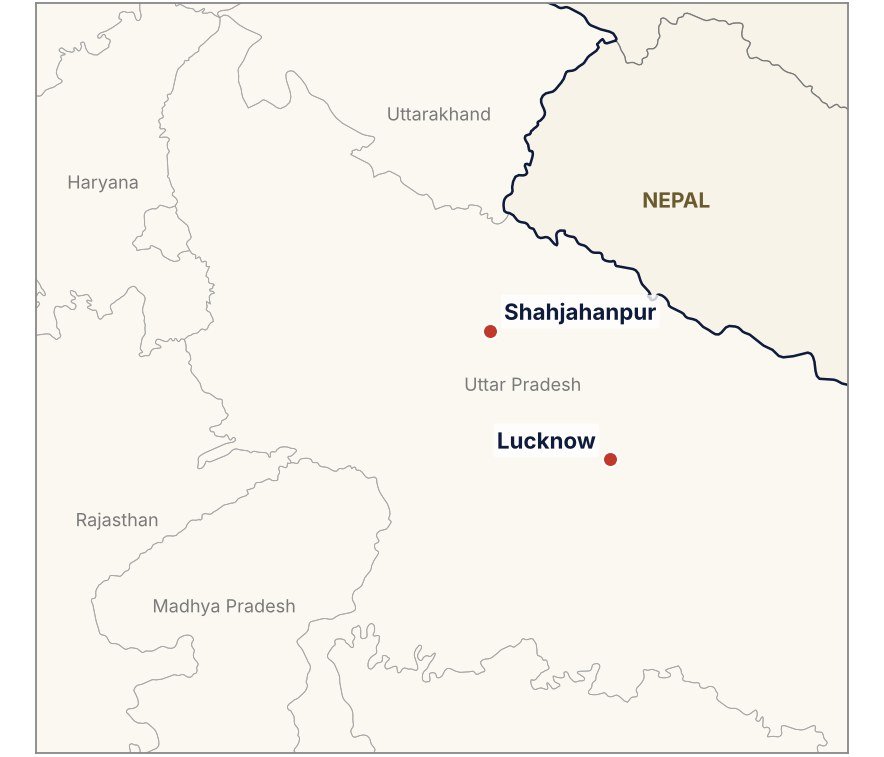
In Surendra Manjhi v. Union of India, reported on 3 November 2026, a bench of Justices Vikram Nath and Aparesh Kumar Singh held that rescued bonded labourers must ordinarily receive immediate financial assistance within seven days of the release certificate, since delay can amount to denial of rehabilitation. The case arose from 42 labourers from Bihar released from a brick kiln in Shahjahanpur, Uttar Pradesh, in February 2019; according to the petitioners, 17 of them had not received immediate financial assistance; the Court directed Uttar Pradesh and Bihar to jointly verify their payment status within one month.
Concept: Bonded labour: the constitutional and legal framework
Article 23 prohibits traffic in human beings, begar and other forms of forced labour, and the Bonded Labour System (Abolition) Act, 1976 extinguishes bonded debts and makes bonded labour a punishable offence. The Act places enforcement on the District Magistrate, assisted by Vigilance Committees at the district and sub-divisional levels. In Bandhua Mukti Morcha v. Union of India, the Supreme Court read Article 21 to include a life of dignity and treated rehabilitation as part of release. The Central Sector Scheme for Rehabilitation of Bonded Labourer, revamped in 2021 and effective from 27 January 2022, gives Rs 1 lakh, Rs 2 lakh or Rs 3 lakh depending on the category and degree of exploitation, plus immediate assistance of up to Rs 30,000 from a district fund with a permanent corpus of at least Rs 10 lakh.
Key facts for Prelims
- Bonded Labour System (Abolition) Act was enacted in 1976; Article 23 is a fundamental right enforceable against private persons too.
- NAVJIVAN Portal: the Court directed the Centre to make it work effectively for monitoring rescue and rehabilitation.
- Complaints are to be verified ordinarily within 24 hours and release certificates issued ordinarily within 24 hours of determination.
- Districts must designate a grievance officer; grievances are to be resolved ordinarily within 30 days.
Mains analysis and way forward
Mains analysis
- The Court framed identification, release and rehabilitation as one continuing constitutional duty under Articles 21 and 23, not three separate administrative acts.
- Inter-State migration creates a responsibility gap: the rescuing State and the home State can each wait on the other; the Court ruled that disputes over who pays cannot delay payment.
- Withholding assistance until prosecution concludes punishes the victim; delinking relief from criminal proceedings is a victim-centred shift.
- The judgment notes the problem is implementation, not absence of law, which points to district capacity, funds and Vigilance Committees that exist on paper.
Way forward
- A uniform release certificate format recognised by all States and a working inter-State nodal mechanism, as directed, can make entitlements portable.
- Linking released labourers to livelihood schemes and reviewing each case for at least a year reduces the risk of re-bondage.
- Higher immediate assistance and interim subsistence support, which the Centre must decide on within three months, can close the gap between rescue and relief.
Connect the dots: GS II: Fundamental Rights (Articles 21, 23), welfare of vulnerable sections; GS III: inclusive growth and informal labour; GS IV: dignity and compassion in administration.
Sources: LiveLaw: Bonded labourers must get rehabilitation assistance within 7 days of release certificate, Supreme Court, 3 Nov 2026; Ministry of Labour and Employment (PIB): Central Sector Scheme for Rehabilitation of Bonded Labourer-2021, 28 Jul 2025
Supreme Court issues notice on plea against facial recognition surveillance at protest sites
In short: A plea against AI facial recognition at Jantar Mantar asks what privacy a citizen can expect in a public place.
Why in news
On 3 November 2026, a bench of Chief Justice of India Surya Kant, Justice Joymalya Bagchi and Justice V Mohana issued notice on a plea by the Software Freedom Law Centre against facial recognition and surveillance at protest sites, including Delhi Police vans said to scan live CCTV feeds with AI. The Centre argued that CCTV serves a legitimate state interest; the bench distinguished between identifying a face and the later use of the data collected.
Concept: Privacy as a fundamental right and the proportionality test
In K.S. Puttaswamy v. Union of India (2017), a nine-judge bench held that privacy is a fundamental right protected mainly under Article 21. Any intrusion must pass a test of legality (a law must authorise it), a legitimate aim, and proportionality (the least intrusive means suited to that aim), with procedural safeguards against abuse. Earlier, in PUCL v. Union of India (1997), the Court laid down safeguards for telephone interception. Peaceful protest is protected by Article 19(1)(a), freedom of speech and expression, and Article 19(1)(b), peaceful assembly without arms. Speech is subject to reasonable restrictions under Article 19(2); assembly under Article 19(3), in the interests of the sovereignty and integrity of India or public order.
Key facts for Prelims
- The Criminal Procedure (Identification) Act, 2022 replaced the Identification of Prisoners Act, 1920 and added iris and retina scans, palm prints and biological samples to permissible measurements.
- Under the 2022 Act, records are to be kept in digital form for 75 years, with records ordinarily destroyed after legal remedies are exhausted where a person not previously convicted of an offence punishable with imprisonment is released without trial, discharged or acquitted, unless a court or Magistrate directs otherwise for recorded reasons.
- A similar petition by Rajya Sabha MP A.A. Rahim is also before the Court, in which it had sought the Centre’s response.
Mains analysis and way forward
Mains analysis
- Facial recognition can convert a one-time sighting into a searchable record that may be retained for long periods, which is why the use and retention of data, not the camera itself, is the core privacy question.
- Surveillance of protesters can chill free speech and assembly even without any arrest, so the harm extends beyond Article 21 to Article 19.
- Error rates and the absence of a dedicated statute governing police use of facial recognition raise the legality limb of the Puttaswamy test.
- Legitimate uses such as crowd safety and crime detection exist, so the answer lies in calibrated rules rather than a blanket ban or blanket permission.
Way forward
- A clear legal framework on when facial recognition may be used, by whom, for how long data is retained and with what independent oversight.
- Purpose limitation, audit trails and disclosure of the technology used, so that safety cameras do not become tools to profile dissent.
- Periodic accuracy testing and a grievance route for people wrongly flagged.
Connect the dots: GS II: Fundamental Rights (Articles 19 and 21), police reforms, data protection; GS III: emerging technology and internal security; GS IV: surveillance and ethics.
Sources: LiveLaw: What is reasonable expectation of privacy in public place? Supreme Court to consider plea against facial surveillance at protests, 3 Nov 2026; PRS Legislative Research: Bill summary, The Criminal Procedure (Identification) Bill, 2022
Caste discrimination in prisons: Supreme Court gives 23 States and UTs a last chance to report compliance
In short: States must report on deleting caste columns and other reforms by 13 January 2027 or Chief Secretaries may be summoned.
Why in news
On 3 November 2026, in the suo motu case In Re: Discrimination Inside Prisons in India, a bench of Justices J.B. Pardiwala and Manmohan gave 23 States and Union Territories a final opportunity to send information sought by the Union Home Ministry. If they do not respond by 13 January 2027, their Chief Secretaries or Principal Secretaries may be directed to appear in person.
Concept: Sukanya Shantha and prisons as a State subject
Prisons are a State subject (Entry 4, State List), so jail manuals are framed by States, while the Centre issues model frameworks such as the Model Prison Manual, 2016 and the Model Prisons and Correctional Services Act, 2023. In Sukanya Shantha v. Union of India (3 October 2024), the Supreme Court struck down provisions in State prison manuals that assigned work such as cleaning by caste, holding that they violated Articles 14, 15, 17, 21 and 23. It directed removal of the caste column from prison registers and revision of manuals, and registered a suo motu case to monitor compliance. Boards of Visitors are independent bodies meant to inspect prisons and hear inmates.
Key facts for Prelims
- Information sought includes how caste data reaches the NCRB, deletion of caste columns, outsourcing of cleaning work and compliance with the Arnesh Kumar arrest guidelines.
- In July 2026 the Court directed district-wise Boards of Visitors headed by the Principal District Judge within four weeks; the amicus said no State or UT had fully complied.
- Senior Advocate S. Muralidhar is amicus curiae; the Union is to file one composite status report.
Mains analysis and way forward
Mains analysis
- Caste-based allocation of jail labour shows how Article 17 can be breached by rules framed long before the Constitution and never revised.
- Federal division of the subject makes the Centre dependent on States for compliance, so judicial monitoring fills an accountability gap.
- Independent inspection through Boards of Visitors is the main safeguard for people whose voice rarely leaves the prison wall.
Way forward
- States can adopt the 2023 model Act with clear anti-discrimination rules and publish compliance status.
- Mechanised and paid sanitation work, open to all inmates by choice, ends caste-coded labour.
- Functioning Boards of Visitors with fixed inspection cycles and public reports.
Connect the dots: GS II: Fundamental Rights (Articles 14, 15, 17), Centre-State relations, prison reforms; GS I: caste in Indian society; GS IV: dignity of the incarcerated.
Expert committee proposes replacing NEET-PG percentile cut-offs with a rank-based system; Supreme Court informed
In short: After zero and negative-mark qualifying cut-offs drew a challenge, a committee proposes rank-based qualification for NEET-PG and NEET SS.
Why in news
On 3 November 2026, the Union Government told a bench of Justices P.S. Narasimha and Alok Aradhe that an expert committee has proposed replacing the percentile-based qualifying threshold for NEET-PG and NEET SS with a rank-based merit system. NBEMS proposed the change and the National Medical Commission approved it in principle; a draft regulation will follow stakeholder comments.
Concept: Percentile versus rank, and who regulates medical education
A percentile shows the share of candidates who scored below a given candidate, so a percentile cut-off can fall to very low or even negative raw marks when it is reduced. A rank-based system instead fills seats in order of merit position, treating the exam as a ranking tool for limited seats. The National Medical Commission, set up under the National Medical Commission Act, 2019, regulates medical education and replaced the Medical Council of India. The National Board of Examinations in Medical Sciences (NBEMS) conducts NEET-PG, while counselling for central seats is run by the Medical Counselling Committee (MCC).
Key facts for Prelims
- A 13 January 2026 NBEMS notice cut third-round qualifying cut-offs: General/EWS from the 50th to the 7th percentile, and SC/ST/OBC from the 40th to the 0th percentile (minus 40 marks).
- The petition (Harisharan Devgan v. Union of India) argues the cut is arbitrary under Articles 14 and 21 and affects patient safety.
- Proposed MCC counselling reforms introduce ‘Freeze’ (physical reporting at the allotted institution) and ‘Float’ (online acceptance of the allotted seat), with payment only once at final admission.
Mains analysis and way forward
Mains analysis
- The case sets two public goods against each other: minimum standards for specialists and the waste of costly PG seats that remain vacant.
- The Union argues that the MBBS degree already certifies competence and NEET-PG only allocates scarce seats; critics reply that specialist training needs its own floor.
- The committee cautioned that candidates with grossly inadequate or negative performance should not qualify, signalling that a rank system still needs a quality floor.
- Seat blocking and long gaps between counselling rounds are the operational roots of vacant seats; KYC or biometric checks are being studied.
Way forward
- Pair the rank-based system with a transparent minimum score so integrity and seat utilisation are both protected.
- Fixed annual timelines for college approvals, the exam and counselling, as proposed, reduce last-minute cut-off changes.
- Expand quality PG seats in under-served States, which addresses vacancies at the source.
Connect the dots: GS II: health and education, regulatory bodies (NMC, NBEMS), Articles 14 and 21; GS III: human resource development.
International relations
Weeks before the Ganga Water Treaty expires on 12 December, India says the Joint Rivers Commission is the mechanism for talks
In short: No update yet on renewing the 1996 Farakka water-sharing treaty; India has invited Bangladesh PM Tarique Rahman to visit New Delhi.
Why in news
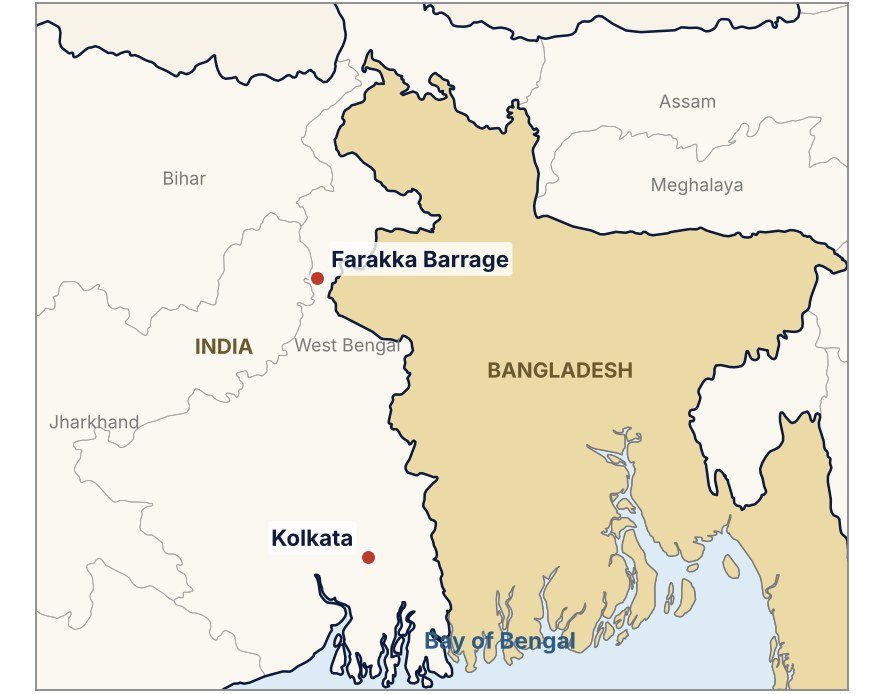
At the External Affairs Ministry briefing on 3 November 2026, spokesperson Randhir Jaiswal said India and Bangladesh have a structured mechanism, the Joint Rivers Commission, for all cross-boundary rivers including the Ganga, but that there was no update on renewing the Ganga Water Treaty, which expires on 12 December 2026. India has invited Bangladesh Prime Minister Tarique Rahman to visit New Delhi; no dates have been fixed.
Concept: The Ganga Water Treaty and Farakka
India built the Farakka Barrage on the Ganga in West Bengal to divert water into the Bhagirathi-Hooghly and keep Kolkata port navigable; Bangladesh argued this cut its dry-season flow. After interim agreements, the two countries signed a 30-year treaty in December 1996 to share the Ganga’s waters at Farakka in the lean season, 1 January to 31 May, measured in ten-day periods. The sharing formula depends on the flow reaching Farakka, with a guaranteed minimum for each side in critical periods, and a provision for joint review if flows fall sharply. The Joint Rivers Commission, set up in 1972, is the standing bilateral body for the rivers the two countries share.
Key facts for Prelims
- The treaty was signed in New Delhi on 12 December 1996, by Prime Ministers H.D. Deve Gowda and Sheikh Hasina.
- India and Bangladesh share 54 rivers; the Teesta water-sharing agreement remains unsigned.
- The Farakka Barrage was commissioned in 1975.
Mains analysis and way forward
Mains analysis
- Renewal is a test of India’s neighbourhood policy with a new government in Dhaka.
- Climate change and upstream use make lean-season flows less predictable; a renewed treaty may need data sharing and a stronger review clause.
- West Bengal’s role matters, as the Teesta experience shows: water is a State subject in practice, though treaties are the Union’s.
Way forward
- Begin technical talks early through the Joint Rivers Commission, with joint flow measurement.
- Consider a basin-level approach linking the Ganga with other shared rivers and with the States concerned.
Connect the dots: Links: GS II India and its neighbourhood; GS I rivers of India; GS III water resources.
Sources: The Hindu: ‘Structured mechanism’ in place to deal with Ganga Water Treaty: India, 4 Nov 2026
India and Israel the only two votes against a Pakistan-Belarus UN draft on regional conventional arms control
In short: At the UN First Committee, India held that conventional arms control is a global issue, not one to be settled region by region.
Why in news
In a vote reported on 3 November 2026, the UN General Assembly First Committee adopted the Pakistan and Belarus sponsored draft “General and complete disarmament: Conventional arms control at the regional and subregional levels” by 180 votes to 2, with no abstentions. India and Israel cast the only votes against. India also voted against a separate paragraph that took note of proposals made in the context of South Asia.
Concept: The UN disarmament machinery: First Committee and Disarmament Commission
The UN handles disarmament through a layered system. The General Assembly First Committee (Disarmament and International Security) debates and votes on draft resolutions every autumn, which then go to the full Assembly; these resolutions are recommendations, not binding law. The UN Disarmament Commission (UNDC) is a deliberative body of all member States: first created in January 1952 under the Security Council, it was re-established in 1978 by the first Special Session on Disarmament (SSOD-I) as a subsidiary organ of the General Assembly. It meets for three weeks each spring and works by consensus, producing principles and guidelines rather than treaties. Multilateral treaty negotiations take place in a separate forum, set up in 1979 as the Committee on Disarmament after the 1978 Special Session and renamed the Conference on Disarmament in 1984.
Key facts for Prelims
- India’s explanation of vote was delivered by Anmol Sher Bedi, First Secretary at India’s Permanent Mission to the UN.
- India cited three earlier consensus outcomes of the UN Disarmament Commission: regional disarmament (1993), conventional arms control (1999) and confidence-building measures for conventional weapons (2017).
- The UNDC reached no substantive outcome between 1999 and 2017; in 2023 it adopted recommendations on transparency and confidence-building in outer space.
- The draft says militarily significant States carry a “special responsibility” to promote regional arms control arrangements and seeks agreements at “the lowest possible level of armaments”.
Mains analysis and way forward
Mains analysis
- India’s security horizon is not only South Asian: its threat assessment includes an extra-regional neighbour and the Indian Ocean, so a ‘regional balance’ framed around one neighbour does not fit its strategic reality.
- Regional framing in South Asia tends to create a hyphenated India-Pakistan equation, which India has consistently resisted in multilateral forums.
- A 180 to 2 vote shows the diplomatic cost of principled positions in numbers-driven forums; India relies on the logic of its argument and on consistency over decades rather than on vote counts.
- The request to the UNDC to draft new principles duplicates consensus texts already adopted, which strains a body that has struggled for consensus.
Way forward
- Keep explaining India’s position through global instruments it supports, such as transparency and confidence-building measures for conventional weapons.
- Back practical, non-discriminatory confidence-building measures with neighbours bilaterally, without accepting region-only arms ceilings.
Connect the dots: Links to GS II: UN and its specialised bodies, India and its neighbourhood, India’s position on disarmament and arms control.
Sources: India TV News: India, Israel vote against Pakistan-Belarus UN resolution on regional conventional arms control, 3 Nov 2026; ANI: India, Israel vote against Pakistan-backed UN arms control resolution, 3 Nov 2026; UN Office for Disarmament Affairs: Disarmament Commission (institution page)
Economy and infrastructure
India sets a $1 trillion export goal for 2026-27 after a 14% rise to $480 billion in April-September
In short: Exports grew 14% to $480 billion in the first half; reaching $1 trillion this year needs about $520 billion more by March 2027.
Why in news
Speaking at Kirori Mal College, New Delhi, on 3 November 2026, Commerce and Industry Minister Piyush Goyal said India is aiming for $1 trillion in exports in the current financial year. Total exports rose 14% to $480 billion in April-September 2026, so about $520 billion more is needed in the second half.
Concept: Where exports sit in the economy
Exports enter national income through net exports (exports minus imports), one of the four components of aggregate demand along with consumption, investment and government spending. In the balance of payments, merchandise exports and imports make up the trade balance, while services exports such as IT and business services are recorded under invisibles; together with transfers and income they form the current account. A strong services surplus has helped India offset a large merchandise trade deficit. A rising export base also supports the rupee, adds to foreign exchange earnings and creates jobs in labour-intensive sectors.
Key facts for Prelims
- India’s total exports in 2025-26 were a record $863 billion; a $1 trillion target implies growth of about 16% in 2026-27.
- The minister said a “safer” target of $900 billion (about 4% growth) was set aside for a more ambitious one.
- Total exports include both merchandise and services; the H1 figure of $480 billion is the combined total.
Mains analysis and way forward
Mains analysis
- Sustaining double-digit export growth amid uncertain global trade depends on diversifying markets and products, not only on a few sectors.
- Trade agreements matter only when exporters use them: awareness of rules of origin and compliance support for MSMEs decide utilisation.
- Services exports give resilience, but merchandise exports, especially labour-intensive goods, are needed for mass employment.
- Logistics costs, quality standards and access to trade finance remain the main constraints for smaller exporters.
Way forward
- Combine trade agreements with domestic reforms in logistics, standards and credit so that exporters can use the market access gained.
- Track both value and diversification: more destinations and more products reduce exposure to shocks in any one market.
Connect the dots: GS III: external sector, balance of payments, trade policy, FTAs; links to logistics and manufacturing competitiveness.
Centre aims to double the share of coastal shipping and waterways in freight movement from 6% to 12% by 2047
In short: Water transport carries 6% of India’s freight; the Ports Ministry wants 12% by 2047 through coastal cargo incentives, cruise growth and new waterways.
Why in news
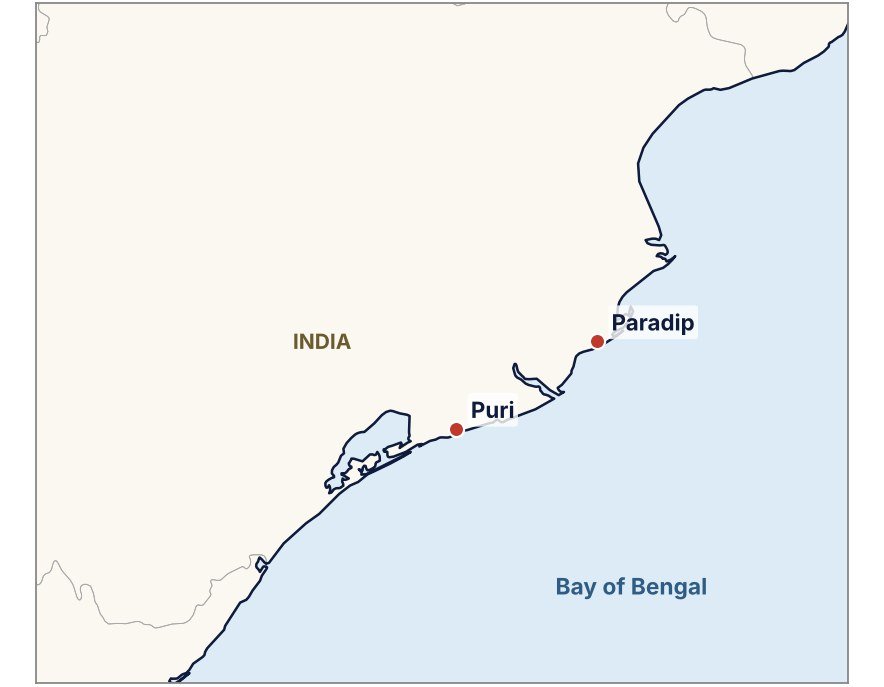
At a Consultative Committee meeting of the Ministry of Ports, Shipping and Waterways in Puri, Odisha, on 3 November 2026, Union Minister Sarbananda Sonowal set out a plan to raise the share of coastal shipping and inland waterways in India’s freight movement from 6% to 12% by 2047. The meeting also discussed a Rs 1,500 crore international cruise terminal at Puri, to be built by the Paradip Port Authority with the Odisha government.
Concept: Modal shift: why moving freight to water matters
Modal share is the proportion of total freight carried by each mode: road, rail, pipeline, air and water. India moves most of its freight by road, which is flexible but costs more per tonne-kilometre and emits more carbon than rail or water. Waterways suit bulk, low-value, non-urgent cargo such as coal, iron ore, cement and petroleum products, and they ease congestion on highways and rail lines. Coastal shipping means moving cargo between two Indian ports along the coast; when a country reserves such domestic sea trade for its own vessels, the practice is called cabotage. The limits of a modal shift are first-mile and last-mile links: cargo has to reach the port or jetty by road or rail, so water transport works best as part of a multimodal chain.
Key facts for Prelims
- Coastal cargo handling rose from 74 million tonnes to 177 million tonnes over the past 12 years, about 140% growth (Business Standard, 4 Nov 2026).
- Coastal Cargo Promotion Scheme: announced in the Union Budget 2026-27; incentives for cargo owners, coastal vessel operators and multimodal transport operators.
- Cruise Bharat Mission (launched September 2024) targets 10 lakh sea cruise passengers a year and 4 lakh jobs by March 2029; ocean cruise passengers were 4,62,661 in 2025-26.
- National Waterway 5 in Odisha (estimated above Rs 13,000 crore) is meant to link the industrial and mining centres of Talcher and Kalinganagar with east coast ports.
- River cruises: 20 circuits on 16 National Waterways are operational, with 51 more identified for phased development.
Mains analysis and way forward
Mains analysis
- A modal shift to water lowers logistics costs for bulk commodities and supports the competitiveness of Indian manufacturing and exports.
- Coastal shipping is a low-carbon option: the coastal cargo scheme and Cruise Bharat Mission together are projected to save 16 million tonnes of carbon dioxide emissions.
- Doubling the share needs more than ships: dedicated coastal berths, rail and road links to ports, and simpler procedures for domestic cargo.
- Coastal states such as Odisha gain jobs and tourism from cruise terminals, but these must respect coastal regulation zones and fragile ecosystems.
Way forward
- Integrate coastal and waterway projects with PM GatiShakti planning so that first-mile and last-mile links are built alongside berths.
- Use assured cargo, such as bulk movements by public sector units, to give operators a stable base while private demand builds.
Connect the dots: GS III: Infrastructure (ports, waterways), logistics costs, Sagarmala, sustainable transport; GS I: distribution of industries and minerals in Odisha.
Sources: Business Standard: Centre targets 12% coastal freight share by 2047, says Minister Sonowal, 4 Nov 2026; ANI: Sarbananda Sonowal targets doubling coastal and waterway freight share to 12% by 2047, 3 Nov 2026
Pune Metro projects worth about Rs 21,800 crore launched; Hinjawadi-Shivajinagar PPP line opens
In short: PM opens Pune’s Hinjawadi-Shivajinagar metro, a PPP corridor to the city’s IT hub, among projects worth about Rs 21,800 crore.
Why in news
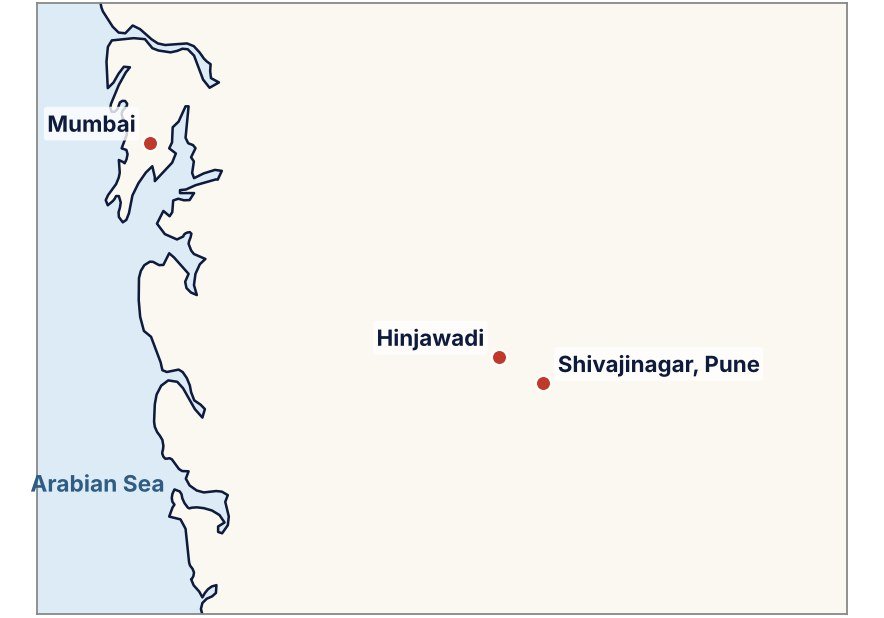
On 3 November 2026, Prime Minister Narendra Modi, by video conference, inaugurated and laid the foundation stone of Pune Metro projects worth about Rs 21,800 crore. They include the inauguration of the Hinjawadi-Shivajinagar line (Line 3) on 3 November, with commercial passenger services from 4 November at 17 of its 23 stations, an elevated corridor of about 23 km with 23 stations, developed by the Pune Metropolitan Region Development Authority (PMRDA) as a public-private partnership.
Concept: How metro rail projects are financed: Metro Rail Policy 2017
The Metro Rail Policy, 2017 lets States seek central support for a metro in one of three ways: a public-private partnership (PPP) with central viability gap funding, a grant from the Centre of 10% of project cost, or a 50:50 equity-sharing joint venture between the Centre and the State. The policy makes a PPP component, at least for some services, a condition for central assistance. It also asks cities to prepare a Comprehensive Mobility Plan, to set up an Urban Metropolitan Transport Authority, and to compare alternatives such as bus rapid transit before choosing a metro. In a full PPP line, the private partner builds, finances and operates the corridor under a concession, which allocates construction, financing and ridership risks between public and private partners under the concession agreement.
Key facts for Prelims
- Line 3 connects the Rajiv Gandhi Infotech Park at Hinjawadi with Shivajinagar, Pune’s commercial and administrative centre.
- Implementing authority for Line 3: PMRDA, not Maha Metro, which runs Pune’s other metro lines.
- Viability gap funding (VGF): a one-time capital grant that makes an economically justified but financially unviable PPP project bankable.
Mains analysis and way forward
Mains analysis
- PPP metros can speed delivery and reduce fiscal load, but ridership risk and fare setting need clear contracts to avoid disputes later.
- A line serving an IT hub shows how transit can follow employment clusters and ease peak-hour road congestion.
- Metros succeed only with last-mile links: feeder buses, walkable station areas and parking near stations.
- Transit-oriented development and value capture financing can help repay metro costs from the rise in nearby land values.
Way forward
- Integrate fares and ticketing across metro lines run by different agencies so that riders see one network.
- Publish ridership and performance data so that the PPP model can be judged and improved for other cities.
Connect the dots: GS III: infrastructure, PPP models, urban transport; GS II: urban governance and planning.
Sources: Akashvani News (newsonair): PM Modi lauds India’s achievement as fastest poverty reducer; launches projects worth 21,800 cr for Pune Metro, 3 Nov 2026; Construction World: Hinjewadi Metro to begin services on November 3, 2026; Free Press Journal: Pune Metro Line 3 likely to launch on Nov 3, 27 Oct 2026
Environment, science and technology
Global wildlife trade involves at least 107,356 species, more than twice earlier estimates, finds study
In short: A Science Advances study finds trade databases miss most traded species, leaving over 98% outside some forms of international monitoring.
Why in news
A study in the journal Science Advances, reported on 3 November 2026, finds that at least 107,356 non-domesticated species of wild animals, plants and fungi are used or traded worldwide. This is more than double the roughly 50,000 species counted in the 2022 IPBES assessment. The authors warn that existing biodiversity indicators cover only a small fraction of traded species.
Concept: CITES and its three Appendices
The Convention on International Trade in Endangered Species of Wild Fauna and Flora (CITES) was signed in Washington in 1973 and came into force in 1975; India has been a Party since 1976. It regulates trade through permits under three Appendices. Appendix I covers species threatened with extinction, where commercial trade is generally prohibited; Appendix II covers species not necessarily threatened now but whose trade must be controlled to keep it compatible with their survival; Appendix III lists species protected by one Party that asks others to help control trade. CITES regulates only international trade in listed species, which is why a species can be heavily traded yet escape global oversight if it is not listed.
Key facts for Prelims
- Animals: 47,685 species recorded in trade, including up to 31,306 vertebrates, about 42% of all described vertebrates.
- Plants: at least 49,723 species in trade; 26,842 are used medicinally and 13,418 for timber and other materials.
- The US Law Enforcement Management Information System (LEMIS) alone recorded 27.5% of traded animal species.
- Indicators under the Kunming-Montreal Global Biodiversity Framework cover only about 6 to 11% of traded vertebrates.
Mains analysis and way forward
Mains analysis
- Invertebrates, fungi, reptiles and amphibians are the most under-recorded groups, so the species most at risk from unseen trade are the least studied.
- Online marketplaces and social media have widened the exotic pet trade, a demand that customs systems built for bulk cargo find hard to track.
- Unmonitored trade carries risks beyond extinction: zoonotic disease spread and the release of invasive species.
Way forward
- Adopt electronic permits such as eCITES and use machine reading of shipping documents to flag mismatches and laundering.
- Standardise customs declarations with species-level reporting, including species not listed under CITES.
- For India, strengthen data sharing between customs, the Wildlife Crime Control Bureau and State forest departments.
Connect the dots: Links to GS III (biodiversity conservation, international environmental conventions, wildlife crime).
Fifth crocodile death in 27 days at Bhitarkanika raises concern over illegal fishing nets
In short: A female saltwater crocodile was found dead on 3 November; a herpetologist suspects illegal fishing nets may be contributing; the exact causes await post-mortem findings.
Why in news
A dead female saltwater crocodile was found in the Hansua river near Badakota village on 3 November 2026, the fifth such death in and around Bhitarkanika National Park in Odisha’s Kendrapara district since 6 October. Tissue samples from earlier carcasses have been sent to the Centre for Wildlife Health at OUAT, Bhubaneswar. A herpetologist has linked the deaths to illegal fishing with prohibited nets, in which crocodiles can drown if they cannot surface.
Concept: India’s three crocodilians and the 1975 conservation programme
India has three crocodilian species: the saltwater or estuarine crocodile of mangrove creeks, the mugger of freshwater lakes and rivers, and the gharial of fast-flowing rivers. On the IUCN Red List the gharial is Critically Endangered, the mugger Vulnerable and the saltwater crocodile Least Concern. Odisha is the only State where all three occur in the wild. A crocodile conservation programme began in 1975 with the Union Environment Ministry and UNDP, combining captive rearing, release and habitat protection; it revived saltwater and mugger populations but has been far less successful for the gharial.
Key facts for Prelims
- Bhitarkanika saltwater crocodiles: an estimated 95 in 1975; 1,858 in the January 2026 census, up from 1,826 a year earlier.
- Bhitarkanika Mangroves, which include the National Park, are a Ramsar site (designated 19 August 2002); the census also covers the adjoining Gahirmatha Wildlife Sanctuary.
- Unnatural crocodile deaths here: 22 in six years and 44 in 14 years.
Mains analysis and way forward
Mains analysis
- Success brings new conflict: a larger crocodile population in creeks shared with fishing communities raises both net entanglement and human-crocodile encounters.
- Bans on fishing gear fail without enforcement and without alternative livelihoods for families who depend on the creeks.
- Systematic post-mortems and public reporting of causes are essential to move from suspicion to evidence-based action.
Way forward
- Step up patrolling against prohibited nets, with community monitoring and compensation for gear surrendered.
- Map high-risk creeks where deaths cluster and regulate fishing there seasonally.
Connect the dots: Links to GS III (protected areas, species conservation, wetlands) and GS I (coastal and estuarine geography of Odisha).
Sources: Down To Earth: Five crocodile deaths in 27 days raise alarm over illegal fishing in Bhitarkanika, 3 Nov 2026; The Hans India: Bhitarkanika now home to 1,858 estuarine crocodiles, 22 Jan 2026
Seismological observatory opens at Kishtwar, J&K’s fourth, as weather radar and station network expands
In short: Kishtwar now streams real-time quake data to the National Centre for Seismology; four more Doppler radars in J&K are due in 2027.
Why in news
Union Minister Dr Jitendra Singh inaugurated a Seismological Observatory at Kishtwar in Jammu and Kashmir on 3 November 2026. Its digital instruments send real-time data to the 24×7 Earthquake Monitoring Centre of the National Centre for Seismology in New Delhi. It is the fourth such observatory in Jammu and Kashmir after Jammu, Srinagar and Udhampur.
Concept: How earthquakes and mountain weather are monitored
A seismological observatory houses seismometers that record ground vibrations; when several stations record the same tremor, arrival times of seismic waves at several stations fix the location and focal depth; magnitude is estimated separately from wave amplitudes. The National Centre for Seismology under the Ministry of Earth Sciences runs India’s national network and its round-the-clock monitoring centre. Weather in steep terrain is tracked by a different set of tools: a Doppler Weather Radar sends out microwave pulses: the strength of the echo (reflectivity) estimates rain intensity, and the Doppler frequency shift gives the radial velocity of raindrops, revealing wind movement inside a storm; automatic weather stations and rain gauges add ground truth. Together they support short-term rainfall monitoring, nowcasting and flash-flood warnings in the Himalaya, though precise prediction of highly localised cloudbursts remains difficult.
Key facts for Prelims
- Doppler Weather Radars in the region: none in 2014; four now at Banihal, Jot, Jammu and Srinagar; four more planned for 2027 at Doda, Kishtwar, Anantnag and Baramulla.
- Automatic weather stations in the five districts of the Udhampur constituency have risen from three to 12; rain gauge stations from nine to 15.
- The region also has a High-Altitude Cloud Physics Laboratory at Patnitop and a Regional Meteorological Centre in Jammu.
- The added installations followed the Chasoti cloudburst in Kishtwar the previous year.
Mains analysis and way forward
Mains analysis
- Dense instrument networks matter most in the Himalaya, where valleys a few kilometres apart can see very different weather and where a single radar cannot see behind ridges.
- Real-time seismic data improves rapid assessment after a quake and helps refine hazard maps used for building codes and land-use planning.
- Panchayat-level forecasts show the shift from data collection to last-mile delivery, which is where early warning usually fails.
Way forward
- Link radar, rain gauge and seismic feeds to district emergency operation centres with clear alert thresholds and public messaging.
- Pair new instruments with trained local staff and maintenance budgets so that stations do not go silent in winter.
- Integrate cloudburst and landslide nowcasts with tourism and pilgrimage route management in the hills.
Connect the dots: Links to GS III (science and technology, disaster management) and GS I (earthquakes, Himalayan geography).
In brief
- Indian seafarer killed in drone strike off Oman: An Indian national was killed when a drone of unidentified origin struck the Indian vessel MSV Al Jusufi off Oman on 3 November; 13 Indians were rescued by Omani naval personnel. The External Affairs Ministry said 23 Indian seafarers have been killed since the West Asia conflict began in February, and called for free navigation through the Strait of Hormuz (The Hindu, 4 Nov 2026).
- Delhi drops NGO from new State Board for Wildlife: The Delhi government said late on 2 November that Wildlife SOS would be removed from the State Board for Wildlife, constituted by a notification dated 23 October 2026, published in the Delhi Gazette on 27 October, under Section 6 of the Wild Life (Protection) Act, 1972, after an activist objected in view of a leopard poaching probe (Down To Earth, 3 Nov 2026).
- Odisha counts Arnab’s crop losses as Murasu passes by: Cyclone Murasu largely spared Odisha on 3 November, but farmers in Ganjam, Gajapati and Kandhamal are still recovering from Arnab’s floods of 28 October; an eight-member central team led by a Union Home Ministry Joint Secretary is assessing the damage and the State has ordered crop loss surveys (Down To Earth, 3 Nov 2026).
- Prakasam after landfall: mothers moved to safety: In Prakasam district, where Murasu came ashore, 2,100 people were sheltered at 52 relief centres; 121 of 135 women near their due dates were shifted to hospitals and 14 babies were born during the cyclone period (The Hans India, 4 Nov 2026).
- Jantar Mantar not a protest site, Delhi Police tells Supreme Court: In a response reported on 3 November 2026, the Delhi Police Commissioner told the Supreme Court that Jantar Mantar is a public road, citing over 1,300 protests a year against a capacity of about 1,500 people, and named Ramlila Maidan, CBD Ground and Burari Ground as alternative protest sites.
- Waqf Amendment Act hearing widened: On 3 November 2026, a Supreme Court bench of Justices M.M. Sundresh and Prasanna B. Varale allowed intervenors in the Waqf (Amendment) Act, 2025 challenge to file their own writ petitions within two weeks, set 31 December 2026 to complete pleadings and listed the case in the second week of January 2027.
- Foreign Secretary to Nepal: The Ministry of External Affairs said on 2 November 2026 that Foreign Secretary Vikram Misri will visit Nepal on 4 and 5 November to prepare for Prime Minister Balendra Shah’s first bilateral visit to India, likely in the second half of November. Trade, hydropower, infrastructure, air connectivity and help with reconstruction after floods on the Bhote Koshi river are expected on the agenda.
- India and the International Solar Alliance: At the Bharat Renewable Energy Summit and Expo in New Delhi on 3 November 2026, New and Renewable Energy Minister Pralhad Joshi said India has been elected President of the International Solar Alliance for a third consecutive term. He added that about 30 lakh farmers have been empowered through solar power and agricultural photovoltaics (Akashvani News, 3 Nov 2026).
- Puri to get an international cruise terminal: A Rs 1,500 crore international cruise terminal at Puri, Odisha, will be developed by the Paradip Port Authority with the State government, the Ports Ministry’s Consultative Committee was told on 3 November 2026 (Business Standard, 4 Nov 2026).
- Defence exports at Rs 38,424 crore: Defence Minister Rajnath Singh said on 3 November 2026 at the Delhi Defence Dialogue that India’s defence exports reached Rs 38,424 crore in 2025-26, up from about Rs 686 crore in 2013-14 (Akashvani News, 3 Nov 2026).
- Personality in the news: Balendra Shah: Nepal’s Prime Minister, born in 1990 and trained as a structural engineer, was a hip-hop artist before winning the 2022 Kathmandu mayoral election. He resigned as mayor to contest the 5 March 2026 polls, won Jhapa-5 against former Prime Minister K P Sharma Oli, and was sworn in on 27 March 2026 as leader of the Rastriya Swatantra Party, which won nearly a two-thirds majority in the 275-member House.
Prelims practice: 5 questions
Choose an option to see the answer and explanation. Your score appears when all five are answered.
Mains practice
India’s maritime interests now extend from anti-piracy operations off Somalia to cyclone response on its own coast. Discuss how the Navy’s expanding role as a first responder in the Indian Ocean serves both national security and humanitarian goals, and the challenges it faces.
Show the answer outline
Introduction (about 30 words)
- Open with the Navy’s recovery of the hijacked fishing vessel Azini off Somalia with all 20 crew safe, reported on 3 November 2026, the same week Cyclone Murasu struck the Andhra coast.
Security role
- Anti-piracy deployments in the Gulf of Aden since 2008; the Maritime Anti-Piracy Act, 2022 gives Indian courts jurisdiction over piracy on the high seas.
- Joint operations: P-8I patrol aircraft, drones and MARCOS, with IAF support, show integrated, tri-service reach.
Humanitarian role
- Humanitarian assistance and disaster relief at home and abroad; exercises such as Tiger Triumph with the United States now include the NDRF.
- SAGAR and MAHASAGAR vision: India as a preferred security partner and first responder in the region.
Challenges
- Stretched assets across a vast ocean; legal and jurisdictional limits on prosecuting pirates; coordination between Navy, Coast Guard, NDRF and States; climate-driven rise in extreme cyclones.
Way forward
- Information Fusion Centre (Indian Ocean Region) for shared awareness; more joint exercises; investment in ships, aircraft and drones; clear standard procedures for civil-military disaster response.
Conclusion (about 30 words)
- A navy that protects sea lanes and rescues people in distress earns trust in the region; capability and credibility together make India a net security provider.
Tip: Use two examples from this edition, the Azini rescue and Tiger Triumph 2026, to show the security and humanitarian roles side by side.
Current Canvas is prepared by the UPSC Gurus editorial desk. Every fact is checked against official releases and reliable reporting, with sources listed under each story. Editions are compiled each month into Current Canvas Monthly, a free magazine.
About images: photographs and illustrations in Current Canvas are AI-generated for illustration only. They are not news photographs of the events described.