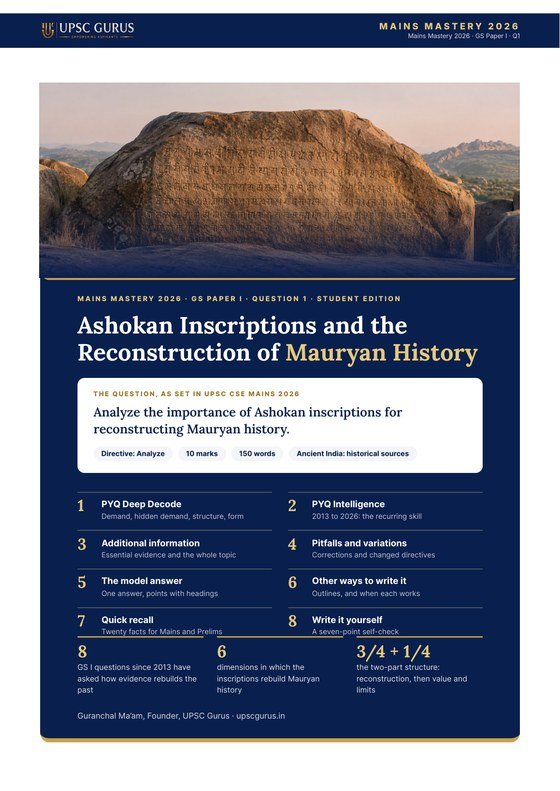
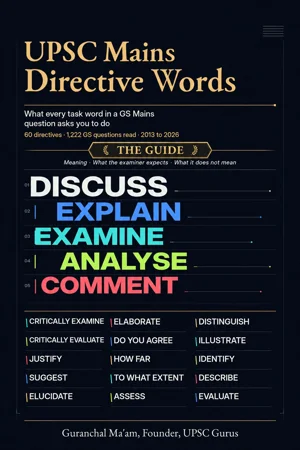
 New this week · Free UG Handout 02UPSC Mains Directive Words: 60 Meanings, Trends and PYQsTwo free PDFs: The Guide and the With PYQs edition.Read and download
Today’s Canvas
- States suggest board-mark weightage and multiple NEET attempts to examination-reform panelGS II
- Supreme Court to hear Election Commission’s objections to 48 interrogatories on electoral-roll revisionGS II
- Bilkis Bano announces intention to challenge Supreme Court’s suspension of two convicts’ sentencesGS II
- Delhi approves annual health insurance cover of up to Rs 10 lakh for eligible transgender beneficiariesGS II
- Economists differ over possible equity capital gains tax reduction during pre-Budget consultationsGS III
- New York surveillance-pricing bill highlights data-driven pricing risks for Indian consumersGS III
- India proposes four climate-cooperation priorities with small island developing states at COP31GS III
- GIFT City becomes India’s first MCR2030 Resilience HubGS III
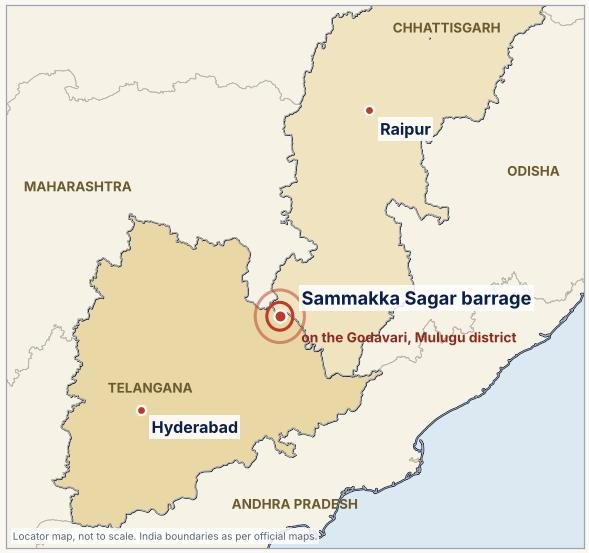
- Telangana seeks Chhattisgarh clearance for full storage at Sammakka Sagar barrageGS III
- Quad leaders announce maritime surveillance and business initiatives at Manila summitGS II
- India announces seafarers’ safety and cybercrime cooperation proposals at East Asia SummitGS II
- Armed forces discuss technical and performance criteria for extended-service AgniveersGS III
- Voyager 1 scheduled to reach one light-day from Earth on 18 NovemberGS III
- IIT Gandhinagar develops pH-responsive hydrogel beads for controlled crop micronutrient deliveryGS III
Polity, governance and social justice
States suggest board-mark weightage and multiple NEET attempts to examination-reform panel
In short: States have suggested changes to NEET-UG, including board-mark weightage and multiple attempts, but no new admission rule has been approved.
Why in news
On 17 November 2026, The Indian Express reported that several states had suggested giving weightage to Class 12 board examination marks in NEET-UG admissions. The suggestions were made during consultations with a six-member task force headed by Nandan Nilekani. Other proposals include multiple attempts annually, computer-based testing and better geographical access to examination centres. Officials indicated that the Ministry of Health would decide the final examination format. The panel, originally expected to report in October, has received an extension until January 2027.
Concept: Common Entrance Examinations and Equality of Opportunity
Section 14 of the National Medical Commission Act, 2019 provides for a common and uniform National Eligibility-cum-Entrance Test for undergraduate medical admissions. The National Testing Agency conducts NEET-UG. A common test offers a standard basis for comparing applicants, but students may have unequal access to school resources, digital infrastructure and examination facilities. Giving weightage to board marks raises a separate challenge because different school boards follow different evaluation systems. Computer-based testing changes how the examination is delivered, whereas board-mark weightage changes how admission merit is calculated.
Key facts for Prelims
- NEET stands for National Eligibility-cum-Entrance Test.
- Section 14 of the National Medical Commission Act, 2019 provides for NEET.
- The National Testing Agency conducts NEET-UG.
- Board-mark weightage, multiple attempts and computer-based testing are proposals, not approved changes.
Mains analysis and way forward
Mains analysis
- A common entrance test can simplify admission procedures and establish comparable standards.
- Dependence on one examination may disadvantage students with unequal access to preparation resources.
- Board-mark weightage may reward sustained school performance but creates comparability problems across boards.
- Multiple attempts and computer-based examinations require reliable infrastructure, accessibility and fair scheduling.
Way forward
- Publish the evidence and reasoning behind proposed reforms.
- Assess the effects on students from different states, boards and socioeconomic backgrounds.
- Ensure adequate testing infrastructure and accessible examination centres before introducing operational changes.
Connect the dots: Education governance, equal opportunity, cooperative federalism, digital access and social justice.
Sources: The Indian Express, “States to Nandan Nilekani task force: Give weightage to Class 12 board exam scores in NEET”, 17 November 2026. Official verification: National Testing Agency, Medical Exam.
Supreme Court to hear Election Commission’s objections to 48 interrogatories on electoral-roll revision
In short: The Supreme Court will examine objections before deciding whether the Election Commission must answer written questions about electoral-roll revision.
Why in news
On 17 November 2026, the Supreme Court considered an application filed by Leader of the Opposition Rahul Gandhi and others seeking sworn responses to 48 interrogatories concerning the Special Intensive Revision of electoral rolls. The applicants, through counsel, sought additional information about the decision-making process. The Election Commission, through its counsel, raised procedural objections. A three-judge bench headed by Chief Justice Surya Kant said both sides would be heard before directions were issued. The hearing was adjourned to 9 December 2026.
Concept: Article 324 and Electoral-Roll Accountability
Article 324 of the Constitution vests the superintendence, direction and control of electoral-roll preparation and specified elections in the Election Commission of India. The Representation of the People Act, 1950 and associated rules provide the statutory framework for preparing and revising electoral rolls. These processes must ensure that eligible voters are included and corrections follow lawful procedures. Judicial review allows courts to examine the legality of administrative action. Interrogatories are written questions seeking sworn answers during litigation. A request for interrogatories is a procedural step, not evidence that an institution has acted unlawfully.
Key facts for Prelims
- Article 324 establishes the Election Commission’s constitutional responsibilities.
- The Representation of the People Act, 1950 contains provisions concerning electoral rolls.
- SIR stands for Special Intensive Revision.
- Interrogatories are written questions seeking sworn responses in legal proceedings.
Mains analysis and way forward
Mains analysis
- Accurate electoral rolls are necessary for meaningful electoral participation.
- Incorrect exclusions can affect eligible citizens’ ability to vote.
- Institutional independence and accountability are complementary constitutional requirements.
- Courts must consider both procedural safeguards and the legal basis for seeking official records.
Way forward
- Make electoral-roll revision procedures transparent and accessible.
- Provide effective mechanisms for correcting errors and challenging exclusions.
- Maintain reliable records of administrative decisions and their legal authorisation.
Connect the dots: Article 324, electoral participation, administrative accountability, judicial review and constitutional governance.
Sources: The Indian Express, “Rahul Gandhi’s plea to put questions to ECI: Supreme Court to hear objections”, 18 November 2026. Official verification: Constitution of India, Article 324.
Bilkis Bano announces intention to challenge Supreme Court’s suspension of two convicts’ sentences
In short: Bilkis Bano has questioned the suspension of two convicts’ life sentences and announced her intention to challenge the order.

Why in news
On 17 November 2026, Bilkis Bano expressed concern over a Supreme Court order dated 28 October suspending the life sentences of two of the 11 persons convicted in the case arising from the 2002 Gujarat riots. The Court had noted that the appellants had spent more than 17 years in custody, that one had a severe disability, and that legal and factual issues remained for consideration in their appeals. Bano said she had not been informed or heard. Her legal team indicated that it intended to seek recall of the order.
Concept: Suspension of Sentence, Bail and Acquittal
A conviction is a judicial finding of criminal guilt, while a sentence determines the punishment imposed. During an appeal, a competent court may suspend the execution of a sentence and grant bail under applicable criminal procedure. Suspension does not automatically set aside the conviction or amount to an acquittal. An appellate court may later uphold, modify or reverse the conviction. Such decisions involve the applicable statutory conditions and circumstances of the case. Article 21 protects life and personal liberty, while the justice system must also address procedural fairness and victims’ lawful interests.
Key facts for Prelims
- Article 21 protects life and personal liberty.
- Suspension of sentence does not automatically remove a criminal conviction.
- Bail and acquittal have different legal consequences.
- The Supreme Court order discussed in the report is dated 28 October 2026.
Mains analysis and way forward
Mains analysis
- Appellate courts need discretion to address the circumstances of individual cases.
- Reasoned judicial decisions permit scrutiny of the principles applied.
- Victim participation, information and access to legal remedies are important components of procedural justice.
- Public confidence depends on consistent application of legal safeguards to all parties.
Way forward
- Ensure that orders clearly explain the relevant legal and factual considerations.
- Strengthen lawful victim-notification and participation mechanisms.
- Protect appellate rights while maintaining procedural fairness and consistency.
Connect the dots: Article 21, criminal appeals, gender justice, victims’ rights and judicial accountability.
Delhi approves annual health insurance cover of up to Rs 10 lakh for eligible transgender beneficiaries
In short: Delhi has approved a Centre-State arrangement providing eligible transgender beneficiaries annual health cover of up to Rs 10 lakh per family.
Why in news
On 17 November 2026, the Delhi government approved the inclusion of eligible transgender beneficiaries in an arrangement under Ayushman Bharat PM-JAY. Officials announced cover of up to Rs 10 lakh annually per eligible family, comprising Rs 5 lakh under the central scheme and an additional Rs 5 lakh from Delhi. The government estimated 5,656 potential beneficiaries, using the 4,213 transgender persons recorded in the 2011 Census as a starting point. Officials said applicants would require a valid identity certificate. Delhi’s estimated additional annual expenditure is Rs 1.19 crore.
Concept: Transgender Rights, Identity Certification and Healthcare
The Transgender Persons (Protection of Rights) Act, 2019, as amended in 2026, provides the current statutory framework for specified protections and welfare measures. Section 15 concerns healthcare access, treatment and insurance coverage. The 2026 amendment changed the statutory definition of transgender person and introduced a medical-board recommendation into the identity-certification process. These changes took effect on 25 May 2026. Healthcare access therefore involves both financial protection and eligibility documentation. Insurance can reduce treatment costs, but its effectiveness depends on enrolment, available hospital services, appropriate care and non-discriminatory implementation.
Key facts for Prelims
- The principal Transgender Persons (Protection of Rights) Act was enacted in 2019.
- The Amendment Act, 2026 came into force on 25 May 2026.
- Section 15 concerns healthcare facilities and related measures.
- Delhi’s approved cover combines Rs 5 lakh under PM-JAY with Rs 5 lakh additional cover from Delhi.
Mains analysis and way forward
Mains analysis
- Health insurance can reduce financial barriers to hospital treatment.
- Identity-certification requirements may affect access to welfare schemes.
- The updated statutory framework raises important questions concerning eligibility and administrative inclusion.
- Successful implementation depends on enrolment, accessible hospitals and non-discriminatory treatment.
Way forward
- Communicate eligibility and certification requirements clearly and accurately.
- Ensure accessible enrolment and appropriate healthcare services.
- Monitor actual coverage, hospital access and claims rather than relying only on estimated beneficiary numbers.
Connect the dots: Social justice, statutory rights, identity documentation, public health financing and administrative inclusion.
Sources: The Indian Express, “Delhi government approves Rs 10 lakh annual health cover for transgender community”, 17 November 2026. Official verification: India Code, Transgender Persons (Protection of Rights) Act, 2019, as amended in 2026. Official verification: Gazette of India, Transgender Persons (Protection of Rights) Amendment Act, 2026.
Economy
Economists differ over possible equity capital gains tax reduction during pre-Budget consultations
In short: Economists expressed differing views on reducing equity long-term capital gains tax, but no government decision was announced.
Why in news
The Finance Ministry began its pre-Budget consultations on 16 November 2026. At the first meeting, chaired by Finance Minister Nirmala Sitharaman, economists debated whether the long-term capital gains tax on equities should be reduced. According to The Indian Express report published on 17 November, some participants opposed additional concessions, while others supported relief. No consensus emerged. The report cited the prevailing tax rate of 12.5% and stronger recent foreign portfolio inflows. Government officials heard the suggestions but announced no tax-policy decision.
Concept: Long-Term Capital Gains Tax and Investment
A capital gain arises when a capital asset is transferred at a gain. Its classification as short-term or long-term depends on the asset and statutory holding period. Under Section 112A of the Income-tax Act, qualifying long-term capital gains from specified equity shares, equity-oriented mutual funds and business trusts exceeding the aggregate annual threshold of Rs 1.25 lakh are generally taxed at 12.5%, subject to applicable conditions. Investors also consider economic growth, exchange rates, valuations and regulatory stability. Policymakers must balance investment incentives against revenue needs and fairness in taxation.
Key facts for Prelims
- LTCG stands for Long-Term Capital Gains.
- Section 112A provides special taxation rules for specified long-term equity-related gains.
- The relevant rate is 12.5%, subject to statutory conditions and the Rs 1.25 lakh aggregate threshold.
- Pre-Budget consultations collect recommendations; they do not themselves change tax law.
Mains analysis and way forward
Mains analysis
- Lower capital gains taxation may improve investors’ after-tax returns.
- Tax relief can reduce government revenue and must be evaluated against fiscal priorities.
- Foreign portfolio flows respond to exchange rates, global conditions and domestic fundamentals.
- Predictable taxation can be more valuable than frequent changes in tax rates.
Way forward
- Evaluate proposed changes using revenue and investment evidence.
- Consider the distributional consequences of capital gains tax concessions.
- Maintain consistency, transparency and fiscal prudence in tax policy.
Connect the dots: Fiscal policy, capital markets, foreign investment, tax equity and resource mobilisation.
Sources: The Indian Express, “At Finance Ministry’s 1st pre-Budget meet, economists debate LTCG tax”, 17 November 2026. Official verification: Income Tax Department, Capital Gains guidance.
New York surveillance-pricing bill highlights data-driven pricing risks for Indian consumers
In short: New York City Council has passed a bill targeting personal-data-based pricing, raising questions relevant to India’s digital economy.

Why in news
On 12 November 2026, the New York City Council voted 44-5 in favour of legislation intended to restrict surveillance pricing. The Indian Express explained the proposal on 17 November. Surveillance pricing uses personal information, including browsing history and purchasing behaviour, to influence prices shown to individuals. In India, the Central Consumer Protection Authority sought explanations from ride-hailing platforms in January 2025 following allegations of differential fares. The platforms denied the allegations. The reported New York council vote should not be treated as proof that the prohibition has taken effect.
Concept: Dynamic Pricing, Surveillance Pricing and Information Asymmetry
Dynamic pricing adjusts prices according to market conditions such as demand, supply, capacity or time. Surveillance pricing uses data about an individual consumer to estimate willingness to pay and influence the price offered. These approaches can overlap, but they are not identical. Information asymmetry arises when one party has important information unavailable to another. In digital markets, consumers may not know why their prices differ. India’s Consumer Protection Act, 2019 addresses unfair and misleading practices, while the Digital Personal Data Protection Act, 2023 provides a separate framework for digital personal data processing.
Key facts for Prelims
- The New York City Council voted 44-5 on 12 November 2026.
- The measure was reported as a bill passed by the council, not an already implemented prohibition.
- The Central Consumer Protection Authority is established under the Consumer Protection Act, 2019.
- Dynamic pricing and surveillance pricing are different pricing concepts.
Mains analysis and way forward
Mains analysis
- Undisclosed personalised pricing may prevent consumers from making informed comparisons.
- Consumer data can enable unfair differentiation if used without adequate safeguards.
- Dynamic pricing based on market conditions can serve legitimate commercial purposes.
- Indian regulatory intervention requires evidence of specific unlawful or unfair practices.
Way forward
- Strengthen transparency concerning the use of personal information in pricing.
- Develop evidence-based methods for assessing algorithmic pricing practices.
- Coordinate consumer-protection and data-protection enforcement where their legal responsibilities overlap.
Connect the dots: Digital economy, consumer rights, algorithmic governance, information asymmetry and data protection.
Sources: The Indian Express, “What is surveillance pricing, and why does New York want to ban it?”, 17 November 2026. Official verification: India Code, Digital Personal Data Protection Act, 2023.
Environment, disaster management and infrastructure
India proposes four climate-cooperation priorities with small island developing states at COP31
In short: India has identified four priority areas for technical cooperation with small island countries facing increasing climate risks.

Why in news
At COP31 in Antalya, Türkiye, on 17 November 2026, Environment Minister Bhupender Yadav addressed a ministerial event on cooperation between India and Small Island Developing States. The event was organised by the Ministry of Environment, Forest and Climate Change and The Energy and Resources Institute, in partnership with the International Solar Alliance. India identified four priorities: coastal risk assessment, ecosystem-based adaptation, island-specific technology partnerships, and institutional capacity-building. These are proposed cooperation priorities, not evidence of newly completed projects or binding financing commitments.
Concept: Small Island Developing States and Climate Adaptation
Small Island Developing States face serious risks from sea-level rise, coastal erosion, stronger storms, ocean warming and damage to marine ecosystems. Climate adaptation involves adjusting human and natural systems to reduce harm from climate change. Mitigation addresses greenhouse gas emissions and removals. Coastal adaptation can combine scientific monitoring, early warning systems, resilient infrastructure and ecosystem protection. Mangroves, seagrasses, wetlands and coral reefs provide important ecological services. India can share experience in disaster preparedness and coastal management while learning from island communities’ traditional knowledge and locally adapted practices.
Key facts for Prelims
- COP31 is the 31st Conference of the Parties to the UN Framework Convention on Climate Change.
- COP31 is being held in Antalya, Türkiye.
- SIDS stands for Small Island Developing States.
- Infrastructure for Resilient Island States is an initiative associated with the Coalition for Disaster Resilient Infrastructure.
Mains analysis and way forward
Mains analysis
- SIDS face substantial climate risks despite relatively small contributions to global emissions.
- Coastal resilience connects environmental protection with housing, livelihoods and infrastructure.
- Ecosystem-based adaptation may provide multiple benefits for disaster-risk reduction and biodiversity.
- International cooperation is most effective when driven by the priorities of participating countries.
Way forward
- Develop country-led pilot projects with clear adaptation outcomes.
- Integrate scientific assessments with local ecological knowledge.
- Improve access to technology, institutional support and suitable climate finance.
Connect the dots: Climate justice, disaster management, coastal ecosystems, blue economy and international environmental cooperation.
Sources: The Indian Express, “COP31: India seeks to strengthen climate engagement with small island nations”, 18 November 2026. Official verification: Ministry of Environment, Forest and Climate Change, PIB release, 17 November 2026.
GIFT City becomes India’s first MCR2030 Resilience Hub
In short: UNDRR recognition identifies GIFT City as a platform for sharing urban disaster-resilience practices with other cities.

Why in news
A statement issued on 17 November 2026 announced that Gujarat International Finance Tec-City, in Gandhinagar, had been recognised as India’s first Making Cities Resilient 2030 Resilience Hub by the United Nations Office for Disaster Risk Reduction. The development was reported on 18 November. The designation positions GIFT City to support knowledge-sharing, capacity-building and cooperation on urban disaster resilience. Recognition is not a declaration that the city faces no disaster risk. It also does not automatically establish an entitlement to a new UN financial grant.
Concept: MCR2030 and the Sendai Framework
Making Cities Resilient 2030 supports local governments in understanding and managing disaster risks. Resilience Hubs are recognised local authorities with relevant experience that undertake to mentor other municipalities, share practical knowledge and strengthen city-to-city cooperation. UNDRR guidelines provide for recognition lasting three years, subject to renewal based on performance. The initiative aligns with the Sendai Framework for Disaster Risk Reduction 2015-2030. Its four priorities are understanding risk, strengthening disaster-risk governance, investing in resilience, and improving preparedness for effective response and recovery, including building back better.
Key facts for Prelims
- UNDRR stands for United Nations Office for Disaster Risk Reduction.
- MCR2030 stands for Making Cities Resilient 2030.
- GIFT City is located in Gandhinagar, Gujarat.
- The Sendai Framework for Disaster Risk Reduction covers 2015-2030.
Mains analysis and way forward
Mains analysis
- Urban resilience requires reliable infrastructure, effective institutions and prepared communities.
- Critical business districts depend on continuity of electricity, water, transport and communications.
- City-to-city learning can spread tested disaster-management practices.
- Recognition must be supported by continued assessment and implementation.
Way forward
- Document and share GIFT City’s practical resilience systems.
- Integrate disaster and climate risks into urban land-use and infrastructure planning.
- Evaluate preparedness through drills, institutional coordination and service-continuity indicators.
Connect the dots: Disaster risk reduction, urban planning, climate adaptation, resilient infrastructure and local governance.
Sources: The Indian Express, “GIFT City recognised as India’s first MCR2030 ‘Resilience Hub’ by UN body”, 18 November 2026. Official verification: UNDRR, MCR2030 Resilience Hub Guidelines.
Telangana seeks Chhattisgarh clearance for full storage at Sammakka Sagar barrage
In short: Telangana seeks permission to operate Sammakka Sagar at full capacity while Chhattisgarh assesses potential land submergence.
Why in news
Telangana Chief Minister A Revanth Reddy met Chhattisgarh Chief Minister Vishnu Deo Sai on 17 November 2026 to discuss a pending no-objection certificate for the Sammakka Sagar project on the Godavari River. The project is located at Tupakulagudem in Telangana’s Mulugu district and was completed in 2021-22. Full storage could partially submerge agricultural land in five villages of Bijapur district, Chhattisgarh. IIT Kharagpur has completed one backwater-impact survey, while two additional surveys remain pending. Both states agreed to continue discussions.
Concept: Inter-State Rivers, Backwater Effects and Cooperative Federalism
Entry 17 of the State List covers water, subject to Entry 56 of the Union List concerning regulation and development of inter-state rivers and river valleys. Article 262 enables Parliament to legislate on adjudication of disputes relating to inter-state river waters. A barrage raises upstream water levels, potentially producing backwater effects beyond the state containing the structure. Scientific assessment must consider hydrology, land submergence, forest impacts and affected communities. Not every disagreement over project permissions automatically becomes a formal dispute under Article 262. Negotiation and technical cooperation are important mechanisms for resolving project-related concerns.
Key facts for Prelims
- Sammakka Sagar is a project on the Godavari River.
- The barrage is situated at Tupakulagudem in Mulugu district, Telangana.
- The potentially affected villages are in Bijapur district, Chhattisgarh.
- Article 262 concerns disputes relating to waters of inter-state rivers or river valleys.
Mains analysis and way forward
Mains analysis
- Water infrastructure can support irrigation and regional economic development.
- Reservoir and backwater impacts can extend across state boundaries.
- Independent scientific surveys help establish the extent of possible submergence.
- Compensation and rehabilitation arrangements are important for protecting affected communities.
Way forward
- Complete the remaining surveys before decisions on full-capacity operation.
- Ensure transparent assessment of agricultural, forest and settlement impacts.
- Agree on operating conditions and compensation using verified evidence.
Connect the dots: Cooperative federalism, water security, environmental assessment, infrastructure and rehabilitation.
Sources: The Indian Express, “A river project, a pending clearance, and a meeting between two CMs”, 18 November 2026. Official verification: Constitution of India, Article 262 and Seventh Schedule.
International relations and security
Quad leaders announce maritime surveillance and business initiatives at Manila summit
In short: Quad leaders announced maritime surveillance and business initiatives while reaffirming cooperation on artificial intelligence, cybersecurity and connectivity.

Why in news
Leaders of India, the United States, Japan and Australia met in Manila on 17 November 2026. Their joint statement announced the Indo-Pacific Maritime Surveillance Collaboration and a Quad-context maritime patrol aircraft exercise planned for 2027. The first Quad Business Leaders’ Forum is planned for early 2027, with The Indian Express identifying Mumbai as its venue. The leaders reaffirmed an accelerator previously announced by their Foreign Ministers in Atlanta and announced enhanced cybersecurity cooperation. The new announcements should be distinguished from existing initiatives and activities scheduled for later implementation.
Concept: Quad and Plurilateral Cooperation
The Quadrilateral Security Dialogue brings together India, Australia, Japan and the United States. It emerged in 2007 and was revived in 2017. The Quad is a flexible diplomatic partnership, not a treaty-based collective-defence alliance. Plurilateralism involves a limited group of countries cooperating on shared priorities. Quad activities address maritime awareness, technological cooperation, secure connectivity and regional resilience. For India, such arrangements can strengthen practical capabilities while preserving independent foreign-policy choices. Cooperation can complement engagement through ASEAN-led forums and other regional organisations rather than replace them.
Key facts for Prelims
- Quad members are India, Australia, Japan and the United States.
- The leaders met in Manila on 17 November 2026.
- P-8 and P-3C maritime patrol aircraft are scheduled for a Quad-context exercise in 2027.
- The accelerator reaffirmed at Manila had previously been announced by Quad Foreign Ministers in Atlanta.
Mains analysis and way forward
Mains analysis
- Maritime-domain awareness improves understanding of activity across strategic ocean areas.
- Secure cables and communications infrastructure support regional economic resilience.
- Cooperation on trusted technology and cybersecurity can reduce vulnerabilities.
- India’s participation must balance practical security cooperation with strategic autonomy.
Way forward
- Convert announced initiatives into clearly defined joint activities.
- Prioritise maritime information-sharing, technology access and infrastructure resilience.
- Maintain close engagement with ASEAN and other Indo-Pacific partners.
Connect the dots: Maritime security, critical technologies, connectivity, strategic autonomy and economic resilience.
Sources: The Indian Express, “Quad unveils security, business, AI plans; Trump says ‘phone, office open’”, 18 November 2026 print edition. Official verification: Quad Leaders’ Summit Joint Press Release, 17 November 2026.
India announces seafarers’ safety and cybercrime cooperation proposals at East Asia Summit
In short: India announced a seafarers’ safety initiative and proposed cooperation on cybercrime, maritime heritage and academic exchanges.

Why in news
At the 21st East Asia Summit in Manila on 17 November 2026, Prime Minister Narendra Modi announced a Seafarers’ Safety Initiative involving joint training and emergency-response cooperation. India’s official outcome list also identified a proposed East Asia Summit cybercrime conference at the National Forensic Science University, a maritime heritage festival at Lothal and a university conclave at Nalanda. Separately, the 23rd ASEAN-India Summit produced proposals concerning maritime cooperation, cyber forensics and other areas. These are summit announcements and proposals, not completed programmes.
Concept: East Asia Summit and ASEAN Centrality
The East Asia Summit is an ASEAN-led, leaders-level forum launched in 2005 to discuss strategic, political and economic questions. It now comprises 19 participating countries: 11 ASEAN members and eight dialogue partners. Timor-Leste joined ASEAN as its 11th member in October 2025. The eight other participants are India, Australia, China, Japan, New Zealand, Russia, South Korea and the United States. ASEAN centrality refers to ASEAN’s role in convening and coordinating regional cooperation. Maritime safety includes protection of seafarers, navigation safety, emergency preparedness and coordinated responses to accidents.
Key facts for Prelims
- The East Asia Summit was established in 2005.
- ASEAN has 11 members following Timor-Leste’s admission in October 2025.
- The East Asia Summit has 19 participating countries.
- Lothal is an important Harappan site in Gujarat associated with maritime activity.
Mains analysis and way forward
Mains analysis
- Safe maritime transport supports regional trade and economic security.
- Joint training and emergency response require cooperation between maritime authorities.
- Online fraud and cybercrime create transnational enforcement challenges.
- Heritage and academic exchanges can strengthen long-term regional relationships.
Way forward
- Establish practical mechanisms for maritime emergency cooperation.
- Develop the proposed cybercrime conference around training and institutional capacity.
- Ensure announced heritage and academic exchanges have sustained follow-up.
Connect the dots: ASEAN centrality, maritime safety, cybercrime, cultural diplomacy and regional institutions.
Sources: The Indian Express, “East Asia meet: PM Narendra Modi announces safety initiative for seafarers, flags cyber fraud”, 18 November 2026. Official verification: Prime Minister’s Office, “List of Outcomes: Visit of Prime Minister to Manila, Philippines”, 17 November 2026. Official verification: ASEAN, East Asia Summit participating countries.
Armed forces discuss technical and performance criteria for extended-service Agniveers
In short: Defence authorities are discussing criteria for regular enrolment after the revised six-year Agniveer engagement pathway.
Why in news
On 18 November 2026, The Indian Express reported discussions over selection criteria for Agniveers seeking regular service after an additional two-year engagement. The Union Cabinet approved the revised pathway on 4 November 2026. Under the first stage, 25% of Agniveers are offered regular employment on merit after four years. The remaining 75% are offered another two years if willing. Following the extension, regular enrolment is subject to willingness and selection criteria. The Integrated Defence Staff confirmed that detailed eligibility criteria remain under deliberation.
Concept: Agnipath and Military Human-Resource Management
Agnipath is a recruitment framework for personnel below officer rank in the armed forces. It combines an initial four-year engagement with a revised pathway for continued service. Personnel management must balance military readiness, physical fitness, technical competence, organisational needs and welfare. Modern defence systems increasingly require proficiency with advanced equipment and technology. Selection criteria must therefore be linked to operational requirements and applied consistently. Importantly, an opportunity to seek regular enrolment after six years is not the same as guaranteed absorption without conditions.
Key facts for Prelims
- The revised Agnipath pathway received Cabinet approval on 4 November 2026.
- The first stage provides for regular selection of 25% on merit after four years.
- The remaining 75% are offered a two-year extension, subject to willingness.
- Regular enrolment after six years remains conditional on willingness and meeting selection criteria.
Mains analysis and way forward
Mains analysis
- Longer engagement can improve retention of trained military personnel.
- Technological proficiency is increasingly important for defence preparedness.
- Transparent and objective selection systems support fairness and organisational efficiency.
- Service conditions and career transitions remain important personnel-policy considerations.
Way forward
- Finalise clear, role-appropriate and measurable selection criteria.
- Align training with technological and operational requirements.
- Communicate service conditions, benefits and transition arrangements transparently.
Connect the dots: Defence modernisation, human-resource policy, technological readiness and personnel welfare.
Sources: The Indian Express, “Revamped Agnipath scheme: On talks table, multi-skilling, tech proficiency for 6-year Agniveers”, 18 November 2026. Official verification: Ministry of Defence, “Cabinet creates a pathway for all Agniveers to be absorbed in Defence Forces”, 4 November 2026.
Science and technology
Voyager 1 scheduled to reach one light-day from Earth on 18 November
In short: NASA expects Voyager 1 to become the first human-made object approximately one light-day from Earth later today.

Why in news
NASA has calculated that Voyager 1 will reach a distance of one light-day from Earth on 18 November 2026 at 5:16:07 a.m. Eastern Standard Time, equivalent to 3:46:07 p.m. Indian Standard Time. The distance is approximately 25.902 billion kilometres. At the time of this morning’s edition, the milestone remains scheduled for later today. Voyager 1 was launched on 5 September 1977 and crossed the heliopause in August 2012, entering interstellar space. Its continued operation demonstrates the challenges and achievements of long-duration spacecraft missions.
Concept: Light-Day, Heliosphere and Interstellar Space
A light-day is a unit of distance equal to the distance light travels in a vacuum over 24 hours. It is not the time taken by Voyager 1 to travel that distance. The heliosphere is the region influenced by the solar wind and associated magnetic fields. Its outer boundary is the heliopause. Beyond it lies interstellar space, the region between stars. Intergalactic space refers to the region between galaxies and must not be confused with interstellar space. NASA’s Deep Space Network supports communication with distant spacecraft through powerful ground-based radio antennas.
Key facts for Prelims
- Voyager 1 was launched on 5 September 1977.
- Voyager 2 was launched on 20 August 1977.
- Voyager 1 crossed the heliopause in 2012; Voyager 2 crossed it in 2018.
- One light-day equals approximately 25.902 billion kilometres.
Mains analysis and way forward
Mains analysis
- Long-duration missions continue to generate scientific value beyond their initial objectives.
- Deep-space communication requires sensitive receivers and precise tracking.
- Limited power and ageing instruments affect mission-management decisions.
- Voyager’s observations contribute to knowledge of the outer solar system and interstellar environment.
Way forward
- Preserve technical lessons from long-duration space missions.
- Improve deep-space communication and autonomous spacecraft capabilities.
- Support continued scientific analysis of verified mission data.
Connect the dots: Space exploration, electromagnetic communication, mission engineering and scientific research infrastructure.
Sources: The Indian Express, “After half a century in space, one light-day milestone in sight: What makes Voyager 1’s journey a feat of humankind”, 18 November 2026. Official verification: NASA, “Voyager 1: What Is a Light-Day?”. Official verification: NASA, “Where Are Voyager 1 and 2 Now?”.
IIT Gandhinagar develops pH-responsive hydrogel beads for controlled crop micronutrient delivery
In short: Researchers have developed biodegradable beads that respond to soil acidity and release micronutrients, with field-level agricultural benefits yet to be established.

Why in news
On 17 November 2026, The Indian Express reported research by IIT Gandhinagar scientists on pH-responsive hydrogel beads for delivering plant micronutrients. The study appeared in ACS Omega in October 2026. The beads, approximately 3.2-3.7 millimetres in diameter, use kappa-carrageenan and trans-ferulic acid. During 14-day release experiments, they released 68% of their iron and 66% of their zinc at pH 4, compared with 28% and 27% at pH 9. Experimental plant-growth results were encouraging, but field-level crop-yield improvements have not been demonstrated.
Concept: Rhizosphere and Controlled Nutrient Release
The rhizosphere is the zone of soil influenced by plant roots and associated microorganisms. Its chemical environment affects nutrient availability and uptake. Hydrogels are water-retaining polymer networks that can hold and gradually release substances. In pH-responsive systems, acidity influences the material’s swelling, breakdown and nutrient-release behaviour. Iron, zinc, copper and manganese are essential plant micronutrients. Controlled delivery may improve nutrient availability where conventional application is inefficient. However, laboratory results and growth experiments in model plants cannot automatically establish benefits for crops under variable field conditions.
Key facts for Prelims
- The rhizosphere is the soil zone influenced by plant roots.
- Kappa-carrageenan is a gelling polysaccharide obtained from red seaweed.
- Iron, zinc, copper and manganese are plant micronutrients.
- Lower pH indicates greater acidity; higher pH indicates greater alkalinity.
Mains analysis and way forward
Mains analysis
- Controlled nutrient delivery may improve efficiency in nutrient-limited soils.
- Materials developed for medical applications can be adapted for agricultural use.
- Laboratory observations do not necessarily predict performance across different soil and crop conditions.
- Affordability, biodegradation and long-term soil effects require further examination.
Way forward
- Conduct field trials across representative crops and soil conditions.
- Measure nutrient uptake, crop yield, cost and environmental effects.
- Evaluate soil-microbe impacts and scalability before commercial deployment.
Connect the dots: Agricultural productivity, biotechnology, soil health, materials science and sustainable nutrient management.
Sources: The Indian Express, “How a cancer therapy technique can improve farm yield”, 17 November 2026. Research verification: ACS Omega, “Engineering pH-Responsive trans-Ferulic Acid/kappa-Carrageenan Beads for On-Demand Micronutrient Delivery in Plants”, 26 October 2026.
In brief
- Delhi air pollution: The Commission for Air Quality Management revoked GRAP Stage III on 17 November 2026 after air quality improved. GRAP Stages I and II continue. The decision does not mean Delhi’s air pollution problem has been resolved. Source
- Punjab paddy procurement: Agriculture Department crop-cutting experiments indicated approximately 181 lakh metric tonnes of non-Basmati production, while reported mandi arrivals reached 189.75 lakh metric tonnes by 16 November. State authorities are examining possible explanations, including revisions to provisional acreage estimates. The discrepancy alone does not establish wrongdoing. Source
- Air pollution governance: An expert analysis published on 18 November argues that India’s pollution challenge requires sustained institutional and administrative measures alongside technology. Major emission sources include transport, industry, household fuels, construction and waste burning. Weather affects pollutant dispersion and accumulation. Source
- Himalayan aviation safety: Following a helicopter crash near Joshimath on 30 October 2026 that killed six persons, aviation authorities are reportedly considering an age limit for helicopters operating in mountainous terrain. No specific age limit has been finalised. Source
- Urban renewable energy: The New Delhi Municipal Council approved proposals including a rooftop solar project with a projected cost of Rs 54 crore over 25 years, Rs 106 crore for drain desilting and more than 40 smart public toilets. Its rooftop solar plan includes RESCO and capital-expenditure models. Source
- Indian classical music: A stage production titled “Enchantment”, scheduled in Delhi for 21 November, explores the life of sitar maestro Pandit Ravi Shankar. For GS I, revise Hindustani classical music, the sitar, the guru-shishya tradition and India’s cultural exchanges with the world. Source
Prelims practice: 5 questions
Choose an option to see the answer and explanation. Your score appears when all five are answered.
Mains practice
GS II | International Relations | The Quad and the Indo-Pacific “The Quad is evolving from a platform for strategic dialogue into a mechanism for practical cooperation in the Indo-Pacific.” Examine this statement in the light of recent initiatives on maritime security, critical technologies and economic resilience. How can India use this partnership while preserving its strategic autonomy?
Show the answer outline
INTRODUCTION
The Quad brings together India, Australia, Japan and the United States to address shared Indo-Pacific challenges. The November 2026 Manila summit announced practical initiatives concerning maritime surveillance, business cooperation and cybersecurity, while reaffirming technological partnerships.
FROM DIALOGUE TO PRACTICAL COOPERATION
- The Indo-Pacific Maritime Surveillance Collaboration aims to improve maritime information-sharing and awareness.
- A maritime patrol aircraft exercise involving Quad countries is planned for 2027.
- Cooperation on connectivity and disaster resilience can provide practical regional benefits.
ECONOMIC AND TECHNOLOGICAL DIMENSIONS
- The proposed Quad Business Leaders’ Forum can strengthen private-sector cooperation.
- The previously announced technology accelerator may support trusted AI access and deployment.
- Secure undersea cables and related connectivity infrastructure contribute to economic resilience.
- Diversified supply chains can reduce vulnerabilities involving strategically important materials.
CHALLENGES AND LIMITATIONS
- Quad members have different national interests and economic relationships.
- Technology initiatives may face financing, access and implementation constraints.
- Regional cooperation must respect ASEAN centrality and the priorities of smaller Indo-Pacific countries.
INDIA’S APPROACH
- Prioritise maritime security, trusted technology and resilient infrastructure.
- Strengthen domestic technological and industrial capabilities.
- Maintain engagement through ASEAN-led and other regional institutions.
- Preserve independent decision-making in foreign and security policy.
CONCLUSION
The Quad can strengthen India’s maritime awareness, technological capabilities and economic resilience without becoming a formal defence alliance. Its value will depend on implementation, regional inclusiveness and India’s ability to combine international cooperation with strategic autonomy.
TIP: Structure the answer around security, economy and technology. Distinguish announced commitments from completed outcomes. Explain why the Quad’s flexible structure supports cooperation without requiring India to surrender independent foreign-policy choices.
Your next step, whichever stage you are at.
Open Library · All programmes · WhatsApp +91 81220 02172
Current Canvas is prepared by the UPSC Gurus editorial desk. Every fact is checked against official releases and reliable reporting, with sources listed under each story. Editions are compiled each month into Current Canvas Monthly, a free magazine.
About images: photographs and illustrations in Current Canvas are AI-generated for illustration only. They are not news photographs of the events described.
Your first Mentor’s Desk call is free
One free conversation per aspirant about where you are in your preparation, with an honest suggestion of the right next step.
Know more and bookHave a question? Get in touch
For questions about a programme, its fees, batch dates, payment or access. Message us on WhatsApp and our team will reply. Asking a question is not a booking, and you can ask as often as you need.
Get in touch on WhatsApp