UPSC Gurus PYQ Deep Decode
Every question of UPSC Mains 2026 General Studies Papers I to IV, explored one by one: what the question asks, its implied dimensions, how to plan the answer, related PYQs from 2013 to 2026, and a suggested model answer. All 79 questions. Free to read. Written by Guranchal Ma’am.
How to use this library
These decodes are designed for active practice. Take one question at a time and give yourself time to understand, write, compare and improve.
- Read the question firstOpen a question and read it before you scroll. Identify the directive word, and decide what the question asks and what your answer should cover.
- Understand the decodeRead section 1, PYQ Deep Decode: the demand, the implied dimensions and the suggested structure. Compare them with your own reading.
- Write before you read the answerWrite your answer by hand within the word limit: about 7 minutes for a 10-mark question, 11 for a 15-mark one. Then read the model answer and the other ways to write it.
- Send it for feedbackYour first answer receives a free written evaluation. Upload it from the bottom of any decode page and use the feedback in your next answer.
PYQ Deep Decode and PYQ Intelligence
Every question brings together two complementary parts of the UPSC Gurus method, also used in our books and the Sociology School: one helps you understand the question and build your answer, the other connects it to your wider preparation.
PYQ Deep Decode
- The demand: what the directive word and the keywords require
- The hidden demand: the dimensions the question implies without stating them
- The structure: introduction, body and conclusion, part by part
- Pitfalls, variations and other ways to write it
- A suggested model answer within the word limit
PYQ Intelligence
- Related UPSC questions from 2013 to 2026
- Recurring themes and the new dimensions in the 2026 question
- Additional knowledge relevant to future answers
- Quick recall and links to Prelims preparation
- A free, downloadable PDF of the complete decode, after a one-time sign-up
Write your first answer. Get written feedback, free.
Choose any question in this library, write your answer by hand, and upload it from the bottom of that decode page. Your first answer receives a free written evaluation by the UPSC Gurus method: how it met the question’s demand and implied dimensions, its structure, content and presentation, and what to work on next.
- One free evaluation per aspirant, on any PYQ Deep Decode question.
- Want to talk it through afterwards? Use your free Mentor’s Desk call.
- Want a full paper evaluated? See Mains Mastery.
GS Paper I 2026
Indian heritage and culture, history, geography of the world and society · 20 questions decoded
Write the full paper under the clock in Mains Replay
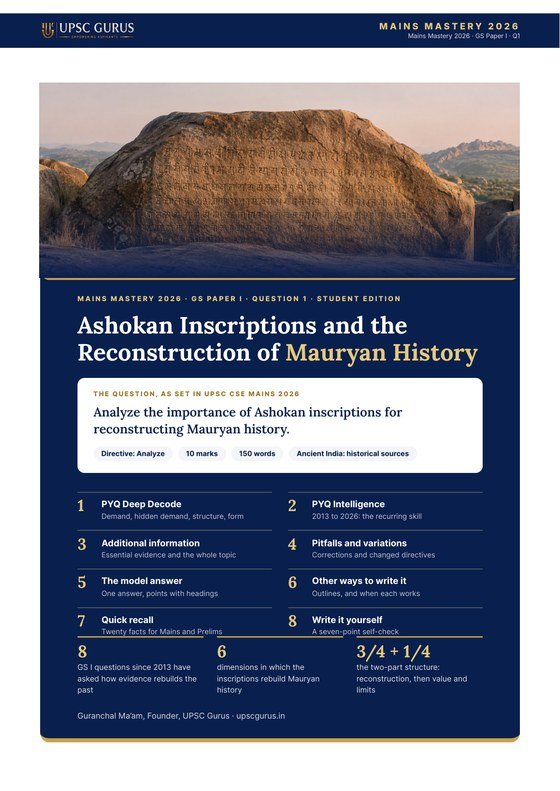
- Q1Ashokan Inscriptions and Mauryan HistoryAnalyze the importance of Ashokan inscriptions for reconstructing Mauryan history.
- Q2Macaulay's Minute: Administration and EducationDiscuss the impact of Macaulay's Minute on colonial administration and education in India.
- Q3The Gandhian Movements and the Masses They MobilisedThe significance of the Gandhian movements lay in the masses they mobilized. Elucidate.
- Q4The Fujiwhara Effect and Tropical CyclonesWhat is the Fujiwhara effect? Explain its impact on the movement and intensity of tropical cyclones.
- Q5Tundra Regions: Fragile Yet Economically Important"Tundra regions are ecologically fragile but economically important." Examine this statement critically.
- Q6Aeolian Processes, Desertification and Land DegradationDiscuss the role of aeolian processes in desertification and land degradation.
- Q7Water in South Asia: Asset and Conflict"Water resources are both an asset and a source of conflict in South Asia." Examine this statement giving examples.
- Q8Unity in Diversity: Bonds and Fault LinesUnity in diversity remains the defining feature of Indian society despite the challenges from communalism and regionalism. Comment.
- Q9Understanding Disability and the Need for Inclusive PolicyHow do you understand disability? Substantiate the need for inclusive policy framework in India in this regard.
- Q10Digital Technology and Social EmpowermentDo you think digital technology promotes social empowerment? Explain with examples.
- Q11Vijayanagara Architecture: Tradition and InnovationVijayanagara architecture exemplifies the amalgamation of past traditions with contemporary practices. Elucidate with examples.
- Q12Linguistic Reorganisation: Pressure from BelowLinguistic reorganization of Indian States was driven by popular pressure from below. Comment.
- Q13Planned Economy and Regional ImbalanceThe model of planned economy was adopted in India to address the regional imbalances left behind by colonial rule. Comment.
- Q14Local Winds: Loo, Chinook and FoehnCompare the Loo, Chinook and Foehn winds with respect to their regions of prevalence, their nature and climatic impacts.
- Q15Satellites, Climate-Smart Agriculture and Food SecurityAnalyze the role of satellite-based technologies in achieving climate-smart agriculture and food security in India.
- Q16Global Trade's Shift from the Atlantic to the Indo-Pacific"The centre of global trade is gradually shifting from the Atlantic region to the Indo-Pacific region." Examine this statement.
- Q17Human-Induced Land Use and Geographical ConsequencesAnalyze the major drivers of human-induced land-use changes in India and their geographical consequences.
- Q18Urban India: Is Caste Disappearing?Is caste disappearing in urban India? Illustrate your answer with examples.
- Q19Demographic Transition in Contemporary IndiaCritically examine the challenges of demographic transition in contemporary India.
- Q20Globalisation and the Indian Youth ExperienceEvaluate the impact of globalization on Indian youths with reference to social, political, economic and cultural spheres.
GS Paper II 2026
Governance, Constitution, polity, social justice and international relations · 20 questions decoded
Write the full paper under the clock in Mains Replay
- Q1Self-Identity, Privacy and the 2026 Transgender AmendmentRight to privacy relating to self-identity is very dear to every human being and well protected under Article 21 of the Constitution. In this…
- Q2Women's Reservation: From Panchayats to Parliament"Women as a class neither belong to a minority group nor are they regarded as forming a backward class." In the light of this statement, discuss the…
- Q3The Lok Sabha Speaker: Neutrality and the Anti-Defection LawExamine whether the constitutional office of the Lok Sabha Speaker has become vulnerable to partisan politics under the current anti-defection…
- Q4The Right to Vote and the Electoral RollIs the right to vote a fundamental right? Discuss the position of the Election Commission of India while undertaking the revision of electoral rolls.…
- Q5The NCSC, the NCST and Substantive EqualityDo constitutional bodies like the National Commission for Scheduled Castes (NCSC) and the National Commission for Scheduled Tribes (NCST) possess…
- Q6Tribal Development Policy and Equity-Based GovernanceDoes India's tribal development policy reflect the aspirations for a socially grounded and equity-based governance? Justify your answer.
- Q7Malnutrition as a Test of Equity and GovernanceMalnutrition in India is not merely a public health concern; it is also a challenge of social equity, human development and effective welfare…
- Q8The Generalist Civil Services in Contemporary GovernanceAnalyse the advantages and limitations of the generalist structure of the Indian Civil Services in contemporary governance.
- Q9IPMDA: Bridging SAGAR and the Quad"IPMDA (Indo-Pacific Partnership for Maritime Domain Awareness) bridges the gap between India's SAGAR (Security and Growth for All in the Region)…
- Q10BRICS and the Global South Counterweight"BRICS acts as a powerful counterweight in global governance, actively amplifying the voice and influence of the Global South." Explain the role of…
- Q11The Governor in India's Federal PolityDiscuss the position of the Governor in the federal polity of India. What is the nature of his power while giving assent to a bill passed by the…
- Q12Judicial Legislation and the Right to Die with DignityWhat is meant by judicial legislation? In this context, discuss the verdicts of the apex court allowing "passive euthanasia" and a "living will".
- Q13Diversity, Asymmetry and Federal TrustHow far has the Indian federal framework been successful in accommodating regional and cultural diversities? Highlight the role of asymmetric…
- Q14Separation of Powers: India and the USAExamine how the separation of powers is practised in India compared to the rigid presidential model of the United States of America. In this context,…
- Q15Pressure Groups, Corporate Power and Pluralistic DemocracyTo what extent do pressure groups, social movements and corporate lobbies deepen pluralistic democracy in India by representing excluded interests?…
- Q16Transparency, Accountability and Stakeholder Trust"Transparency and accountability in governance are not about controlling corruption but about creating the trust of stakeholders in the policy…
- Q17Rights-Based Welfare and the Delivery GapCan the constitutional mandate of rights-based welfare be effectively realised in the context of non-integrated governance and minimal public…
- Q18Education as Welfare or Strategic InvestmentShould education be treated primarily as a welfare obligation of the state or as a strategic investment for building a globally competitive,…
- Q19India's Global Diaspora: Culture to Strategic Leverage"India's global diaspora acts as a living bridge, as a critical economic factor and knowledge network in transforming cultural heritage into…
- Q20China's BRI and India's South Asian Strategy"China's Belt and Road Initiative (BRI) has transformed South Asia from a regional space into a theatre of great power competition." Analyse the…
GS Paper III 2026
Technology, economic development, biodiversity, environment, security and disaster management · 20 questions decoded
Write the full paper under the clock in Mains Replay
- Q1The Digital Rupee: Meaning, Working and ProgressWhat do you mean by Digital Rupee? In this context, explain the working and progress of India's Central Bank Digital Currency (CBDC).
- Q2Financial Inclusion and the RBI's FI-IndexExamine the view that financial inclusion is an integral part of social and economic inclusion in a country like India. Also throw light on the…
- Q3Technology Missions and Food SecurityDescribe the various Technology Missions initiated in Indian agriculture and examine their role in food security.
- Q4Agri-Marketing and E-CommerceExplain the factors responsible for inefficiency of agri-produce marketing. How e-commerce helps to reduce inefficiency of agri-produce marketing?…
- Q5Biotechnology for Perishable CropsExplain by giving two examples, how biotechnology has helped the Indian farmers in processing their perishable crops.
- Q6Fast Breeders, Criticality and a Clean Energy FutureDistinguish between a Fast Breeder Reactor (FBR) and a thermal nuclear reactor. In the context of first indigenously developed prototype FBR at…
- Q7Infrastructure and Disaster Risk in Fragile LandscapesDiscuss how the contradiction between 'rapid infrastructure development' and 'disaster-risk reduction' in ecologically-sensitive areas of India can…
- Q8Global Biodiversity Goals and India's CommitmentsDiscuss the aim and goals of Kunming-Montreal global biodiversity framework. Mention India's commitments and initiatives to achieve the goals and…
- Q9Fake News, Internal Security and IT Rules AmendmentsExplain how fake news and disinformation pose threat to Internal Security and Public Order in Indian context? In this regard, discuss salient…
- Q10Ladakh: Development, Civic Action and the Sixth ScheduleLadakh is strategically located between China and Pakistan. As a measure to win hearts and minds of locals, discuss the Border Area Development…
- Q11India's Energy Security: Growth and SustainabilityExplain the key challenges for India's energy security. What measures do you suggest for ensuring energy security along with economic growth and…
- Q12Indian Startups: Innovation, Jobs and SustainabilityHow are startups in India promoting entrepreneurship, innovation and employment? Discuss the global and domestic challenges in their working and…
- Q13From Food Scarcity to Surplus: Diversifying Indian AgricultureHow Indian agriculture has been transformed from food scarcity to food surplus level? Explain the various government policies implemented for…
- Q14Agricultural Subsidies and the WTO Agreement on AgricultureDiscuss the different types of subsidies and supports provided by the Government of India to agricultural sector. Examine the related issues…
- Q15Mission Drishti and the OptoSAR BreakthroughMention salient features of 'Mission Drishti'. Discuss the imaging techniques used in the satellite launched on 3rd May 2026. Why it is being…
- Q16Agentic Artificial Intelligence: Autonomy and AccountabilityWhat is agentic Artificial Intelligence (AI)? Explain its working. Describe its applications with suitable examples. Discuss the advantages, risks…
- Q17Solid Waste Management: Delhi and IndoreWhat are the challenges to solid waste management in India? Discuss the governmental policy framework on solid waste management. Discuss the…
- Q18Community Participation as the Cornerstone of Disaster Management"Community participation is the cornerstone of effective disaster management". Analyse this statement with suitable examples from India. Also discuss…
- Q19Jammu and Kashmir: Integration after Article 370Separatist movements have been one of the major factors contributing to militancy and instability in Jammu & Kashmir (J & K). Bring out actions taken…
- Q20Counterfeit Currency, Money Laundering and FATF ComplianceDiscuss counterfeit currency and money laundering as major sources of terror funding in India. State the actions being taken at International level…
GS Paper IV 2026
Ethics, integrity and aptitude · 19 questions decoded
Write the full paper under the clock in Mains Replay
- Q1(a)An AI-Written Ph.D. Evaluation: Accountability and IntegrityOwing to paucity of time, a university professor generates a Ph.D. evaluation report using Artificial Intelligence and submits it with some…
- Q1(b)A Forest Community and a Business Project: The District Officer's DilemmasA business house is working on a project that could displace a forest community from their habitat. As the administrative officer of that district,…
- Q2(a)An Untested Remedy for an Endangered Tribe: Medical and Administrative EthicsAn endangered tribe has developed a severe skeletal deformity. A university research has identified a mineral supplement as a possible remedy, though…
- Q2(b)National Security and Human RightsDiscuss how national security can be balanced with concerns of human rights.
- Q3(a)Civil Disobedience and the Grammar of AnarchyDr. B. R. Ambedkar had cautioned that employing civil disobedience within a constitutional democracy equates to endorsing 'anarchy'. How should…
- Q3(b)Gandhi's Trusteeship and Fair GovernanceIn what ways can an Indian Administrative Officer apply Gandhi's notion of 'trusteeship' to ensure fairness in governance?
- Q3(c)Just Intent and Fair MeansShakespeare in Henry IV says, "The arms are fair when the intent of bearing them is just". What ethical implications does this have in governance?
- Q4(a)Paternalism and BeneficenceCiting the serious adverse effects of long-term medication, a doctor convinces the family of a female patient for surgery. This led the patient to…
- Q4(b)Efficiency, Effectiveness and ProductivityEfficiency is doing things right, while effectiveness is doing the right thing. How do you strike a balance between the two to enhance productivity?
- Q5(a)Rules, Remote Schools and a Child's Right to LearnUsually schools, working in remote areas, do not fully comply with government regulations. However, if the rules are enforced strictly, it would lead…
- Q5(b)Ethics and Strategic Interest in International RelationsIn international relations, ethical considerations are often subjugated to the strategic interests of nation-states. Discuss this from an ethical…
- Q6(a)Empathy, Rules and a Transfer Stopped on RequestOn the request of his Personal Assistant (PA), the District Magistrate (DM) stops the transfer of a schoolteacher who takes private tuition for his…
- Q6(b)Helping Those Who Suffer: Duty, Not CharitySome moral philosophers argue that spending some of your resources—without significantly affecting your financial stability—to help other people who…
- Q7Consent, Care and a Decision Made for HerCase study: Lata, a mother of two children, was admitted to a hospital for acute abdominal pain.
- Q8Predictive Policing and the Bias in the DataCase study: Ravi is a senior police officer with vast experience in riot control and cyber-policing.
- Q9Seema's CLU Dilemma: Integrity without ParalysisCase study: Seema is a senior bureaucrat with a reputation of honesty and professional efficiency.
- Q10Biometric Gatekeeping: Probity and the Right to FoodCase study: Vikas is a government officer with over a decade of service in public administration.
- Q11Rajapuram: Ethical Leadership and Non-Partisan AdministrationCase study: Rajapuram is a border district.
- Q12The Ethics of Defence ExportsCase study: Ajit has been recently promoted as the Head of the Department of Weapon Sales (DWS) in the Ministry of Defence Production (MDP).
Your first Mentor’s Desk call is free
One free conversation per aspirant about where you are in your preparation, with an honest suggestion of the right next step.
Know more and bookHave a question? Get in touch
For questions about a programme, its fees, batch dates, payment or access. Message us on WhatsApp and our team will reply. Asking a question is not a booking, and you can ask as often as you need.
Get in touch on WhatsApp