

Ashokan Inscriptions and Mauryan History
PYQ Deep Decode
Read the question the way the examiner set it: the demand, the hidden demand, the structure that follows from both, and how the answer should be presented, opened and closed.
1.1 The demand
This is a question of historical source evaluation, not a request for a narrative of Ashoka’s life or achievements. It asks you to explain the historical knowledge recoverable from his inscriptions and to assess the limits of that knowledge. Each word below narrows the task.
| Word in the question | What it asks you to do | What goes wrong if you miss it |
|---|---|---|
| Analyze | Separate the distinct kinds of evidence the inscriptions offer, explain the inference each one supports, and reach a reasoned judgement on their combined value. | The answer becomes a list of edicts with no judgement on their worth. |
| importance | Show the gain to historical knowledge: for every inscription you name, say what we know because it exists. | You name inscriptions but never say why a historian needs them. |
| Ashokan inscriptions | Draw on the range of the corpus (rock, pillar and cave inscriptions, and the Greek and Aramaic texts), selecting the evidence that matters rather than cataloguing it. | The answer is confined to Kalinga and dhamma and neglects the wider evidence. |
| for reconstructing | Treat the inscriptions as evidence from which history is inferred, the way a historian works: from what is written to what can reasonably be concluded. | You repeat the king’s statements as if they were a finished history. |
| Mauryan history | Speak of the Mauryan state and society, not Ashoka’s biography; and notice that the evidence comes almost entirely from one reign. | The answer turns into a life of Ashoka. |
1.2 The hidden demand
The question says Mauryan history, but almost every inscription belongs to one king, in his own voice. Most answers praise the edicts. The stronger answer identifies a central methodological difficulty: inscriptions are contemporary, datable and placed in the landscape, which makes them invaluable, yet they record the ruler’s declarations more directly than the conduct of his officials or the experience of his subjects, and they are largely silent on Chandragupta, Bindusara and the later Mauryas. The hidden demand is therefore a judgement on their historical value and their limits, and it earns its own part in the structure.
Each point should connect evidence to an inference and, where needed, qualify it. The qualification is where the hidden demand is met.
| Evidence: what survives | Inference: what historians rebuild | Qualification: what stays uncertain |
|---|---|---|
| Rock Edict III directs yuktas, rajukas and pradesikas to tour every five years for dhamma instruction and other business. | Named grades of officials, a claimed machinery of territorial supervision, and moral instruction built into government. | An order to tour is not proof that every official toured, or that control was equally firm everywhere. |
| Rummindei pillar: in his 20th regnal year Ashoka exempts Lumbini from bali and fixes its share at one-eighth. | A royal visit to the Buddha’s birthplace and a specific fiscal concession: sacred-site patronage tied to royal fiscal authority. | One village’s concession, not the Mauryan tax rate. |
1.3 The structure
The question has one demand (how the inscriptions reconstruct Mauryan history) and one hidden demand (their value and limits). So the answer has two parts, in that order, with the bulk going to the first. The three-quarters to one-quarter balance is a teaching guide, not a UPSC rule: the quality of evidence and inference decides the final allocation.
Subheadings inside this one part, each carrying a named inscription and what it reveals. Six well-chosen subheadings suit 150 words; let the quality of explanation, not a fixed quota, decide the final number.
| Identity and chronology | Maski links Devanampiya with the name Asoka; Rock Edict XIII places Kalinga eight years after his consecration and names five Hellenistic kings, giving external synchronisms (the identity of Alexander is debated). |
| Extent | The spread of edicts from Kandahar to Karnataka, with Kharosthi, Greek and Aramaic texts, shows royal communication across linguistic regions. |
| Administration and justice | Rock Edict III (touring officials), Rock Edict VI (reports at any hour), Pillar Edict IV (rajukas’ judicial powers). |
| Statecraft after Kalinga | Rock Edict XIII (remorse, dhamma-vijaya); Separate Edicts at Dhauli and Jaugada on fair treatment. |
| Economy and welfare | Rummindei (bali exempted, one-eighth share); Rock Edict II (medical treatment, herbs, wells, roadside trees). |
| Religion and pluralism | Rock Edict XII (restraint between sects); Barabar caves for the Ajivikas; Bairat for his own Buddhism. |
Value: contemporary royal evidence, often datable by regnal year and originally situated in identifiable landscapes, preserving the ruler’s declared policies. Some pillars were later relocated, so their present locations cannot always be treated as original findspots. Limits: predominantly one royal voice; uneven evidence of implementation; findspots that do not trace borders; little on the other Mauryan rulers. This part, and the conclusion after it, is where you name what completes the picture: the Arthashastra, Megasthenes’ fragments, Buddhist and Jaina traditions, and archaeology.
1.4 How to present it
The form of an answer is chosen by the question, not by habit. This question asks for several distinct kinds of evidence, each followed by what it lets historians rebuild. That is best carried by points under short headings: each heading names a dimension of Mauryan history, and each point pairs a named inscription with its inference.
| Form | Fit here | Reason |
|---|---|---|
| Points with headings | Best | Six dimensions, each with an inscription and an inference, read in one glance; the examiner sees “Analyze” line by line. |
| Table | Possible | Separates the record from the inference neatly, but ruling it costs time and the cells leave little room to qualify a point. |
| Diagram or flowchart | Weak | There is no process or sequence to show; boxes and arrows spend words a 150-word answer cannot spare. |
1.5 The introduction and the conclusion
Keep this decode with you. Download the complete decode of this question as a free, print-ready PDF. A one-time sign-up opens every free download on the site.
Download the free PDFPYQ Intelligence 2013 to 2026
The question’s context in 2026, its place in the line of source-evaluation questions UPSC has set since 2013, and what to prepare next.
2.1 Why the subject was topical in 2026
Three heritage developments of 2025 and 2026 give the question contemporary context. Their relevance differs: the Ashokan Edict nomination is direct, Sarnath substantial, Piprahwa comparative. UPSC never states why it sets a question, so treat these as context, not cause.
| When | What happened | Why it matters for this question |
|---|---|---|
| 25 July 2026 | Ancient Buddhist Site of Sarnath inscribed on the UNESCO World Heritage List at the 48th session of the World Heritage Committee (Busan); India’s 45th World Heritage property. | Sarnath preserves an Ashokan pillar bearing the Schism Edict; the original Lion Capital, in the Sarnath museum, is the model for India’s State Emblem. One site, four kinds of evidence: inscription, architecture, art and religious history. |
| 11 February 2025 | India placed the Serial nomination for Ashokan Edict sites along the Mauryan Routes on UNESCO’s Tentative List: 34 site entries across several states and Delhi. | It frames the edicts as a network along routes, which is exactly the question of reach and communication. A Tentative List entry is not a World Heritage inscription. |
| 30 July 2025 and 3 January 2026 | India announced the return of the Piprahwa relics after intervening in a proposed auction; the exposition “The Light and the Lotus: Relics of the Awakened One” opened in New Delhi. | Comparative context only: relic deposits are archaeological evidence of Buddhist commemoration, while edicts are written royal communications. Different sources answer different questions. |
2.2 The skill UPSC keeps testing
These GS Paper I questions from 2013 to 2026 share one concern, interpreting historical evidence, at different levels: what a source records, what historians can infer from it, how representative it is, and where it falls silent.
| Year | The question, as UPSC set it | What it asked of you | What changed in 2026 |
|---|---|---|---|
| 2013, GS I, Q1 10 marks | Though not very useful from the point of view of a connected political history of South India, the Sangam literature portrays the social and economic conditions of its time with remarkable vividness. Comment. | Separate what a source does well (social life) from what it does badly (political chronology). | The same split, applied to inscriptions: strong on policy and administration, thin on everyday life. |
| 2013, GS I, Q2(a) 5 marks | Discuss the ‘Tandava’ dance as recorded in early Indian inscriptions. | Use inscriptions as evidence for religious and artistic practice. | The most direct precedent: read what an inscription reveals, not just what it says. |
| 2015, GS I, Q2 12.5 marks | Mesolithic rock cut architecture of India not only reflects the cultural life of the times but also a fine aesthetic sense comparable to modern painting. Critically evaluate this comment. | Read prehistoric material remains for cultural life, and judge an aesthetic claim. | Separate what is observed from what is interpreted, as with the edicts. |
| 2018, GS I, Q2 10 marks | Assess the importance of the accounts of the Chinese and Arab travellers in the reconstruction of the history of India. | Value of outsiders’ accounts, with their limits of perspective. | Almost the same wording. The outsider’s eye is replaced by the ruler’s own voice. |
| 2020, GS I, Q1 10 marks | The rock-cut architecture represents one of the most important sources of our knowledge of early Indian art and history. Discuss. | What material remains reveal about art, patronage and religion. | From stone carved into space to stone carved with words. Barabar combines both: rock-cut caves with Ashokan inscriptions recording patronage of the Ajivikas. |
| 2020, GS I, Q12 15 marks | Persian literary sources of medieval India reflect the spirit of the age. Comment. | Whether court writing reflects its age or only its patrons. | The same problem of the royal point of view, now in edicts rather than chronicles. |
| 2022, GS I, Q1 10 marks | How will you explain that medieval Indian temple sculptures represent the social life of those days? | Rebuild social life from artistic remains. | Sculpture shows social representation; edicts show official declarations. Both are situated evidence. |
For further practice: 2016 GS I Q1 (12.5 marks), “Early Buddhist Stupa-art, while depicting folk motifs and narratives successfully expounds Buddhist ideals. Elucidate.” and 2017 GS I Q1 (10 marks), “How do you justify the view that the level of excellence of the Gupta numismatic art is not at all noticeable in later times?”
- What survives? Name the source and where it comes from.
- What does it establish? The concrete facts.
- Whose view is it? Author, audience, purpose.
- What can it not establish? Its silences.
- What tests it? An independent source.
2.3 What to prepare next
Other evidence for the Mauryas
| Arthashastra | Statecraft, revenue, officials; a composite, normative text of debated date. |
| Megasthenes’ Indica | Pataliputra and Chandragupta’s court; survives only in later quotations. |
| Buddhist, Jaina, Puranic traditions | Royal memory, religious history, succession; later texts, to be read for genre and purpose. |
| Archaeology and coins | Pataliputra’s timber palisade and pillared hall; punch-marked coins; NBPW. |
Later inscriptions on the same template
| Hathigumpha | Kharavela of Kalinga: campaigns, public works, a damaged royal record. |
| Junagadh | Rudradaman I’s Sanskrit record: the Sudarshana lake built under Chandragupta by Pushyagupta, its channels developed under Ashoka by the Yavana Tushaspha, and repaired under Rudradaman. |
| Allahabad Pillar | Samudragupta’s prashasti on an Ashokan pillar: one monument, many layers. |
| Aihole | Pulakeshin II, by Ravikirti: dynastic claims in courtly verse. |
Additional information
Everything needed to answer this question well. Tier 1 holds the evidence the demand needs; Tier 2 places it within the wider corpus, its discovery, its interpretation and the scholarly debates.
| Inscription | What it records | What historians reconstruct | Caution |
|---|---|---|---|
| Identity of the king | |||
| Maski Minor Rock Edict (found 1915) | Discovered by C. Beadon; the personal name Asoka with the epithet Devanampiya. | Compared with the edicts of Devanampiya Piyadasi, decisive inscriptional confirmation that he is Ashoka. | Confirmed an identification first made through the Sri Lankan chronicles. Gujarra and Nittur also carry the name. |
| Chronology | |||
| Rock Edict XIII | Kalinga conquered eight years after consecration; names five Hellenistic kings, generally identified as Antiochus II, Ptolemy II, Antigonus Gonatas, Magas and Alexander (the last debated). | The named rulers supply external synchronisms that place Ashoka’s reign in a wider chronology, subject to identifying each king. | Years are counted from consecration, not accession. |
| Regnal dates across the corpus | Rock Edict III (12th year), Nigali Sagar (14th; a later visit, its year partly reconstructed), Rummindei (20th), Pillar Edicts I to VI (26th) and VII (27th). | An internal sequence of the reign’s policies. | Regnal years give relative order; BCE dates need external synchronisms. |
| Political geography and reach | |||
| Distribution of edicts | From Kandahar and Shahbazgarhi to Girnar, Kalsi, Dhauli, Erragudi and Maski. | The reach of royal communication across the subcontinent. | Findspots are points, not borders. |
| Rock Edict II | Neighbours: Cholas, Pandyas, Satiyaputras, Keralaputras, Tamraparni, and Antiochus. | Neighbouring polities, and the line between the declared sphere of authority and regions beyond it. | These were neighbours, not provinces. |
| Administration and justice | |||
| Rock Edict III | Yuktas, rajukas, pradesikas on tour every five years. | Named grades of officials and territorial supervision. | Exact ranks and duties remain debated. |
| Rock Edict V | Creation of dhamma-mahamattas in his 13th year. | Specialised officials for dhamma, religious communities and specified social groups. | An appointment, not a measure of its effect. |
| Rock Edict VI | Reports to reach the king at any time and place. | An ideal of constant royal oversight; a parisa (council). | A proclaimed standard, not observed practice. |
| Pillar Edict IV | Rajukas given powers of reward and punishment; uniformity in justice; a three-day respite for the condemned. | Judicial duties delegated to rajukas, and the royal ideal of uniform law and punishment. | Not evidence that sentencing was in fact uniform. |
| Statecraft after Kalinga | |||
| Rock Edict XIII | 150,000 deported, 100,000 killed; remorse; dhamma-vijaya preferred to conquest. | A declared shift towards dhamma-vijaya, while coercive authority remained with the king. | The king’s own figures. He still warns forest peoples of his power to punish. |
| Separate Edicts at Dhauli and Jaugada | Orders to officials at Tosali and Samapa against wrongful imprisonment; reassurance to frontier peoples. | How the king instructed officials to govern conquered Kalinga; not proof of implementation. | Here Rock Edicts XI to XIII are omitted. Never cite Dhauli for the casualty figures. |
| Economy and welfare | |||
| Rummindei pillar, Lumbini | Village made free of bali and its share fixed at one-eighth (athabhagiya). | Categories of revenue and their use as royal patronage. | A local concession, not an empire-wide rate. |
| Rock Edict II; Pillar Edict VII | Medical treatment for people and animals, medicinal herbs, wells, roadside trees; Pillar VII adds rest houses and watering places. | Royal welfare policy, whose actual reach must be tested independently. | Rock Edict II does not mention hospitals or rest houses. |
| Religion and pluralism | |||
| Rock Edict XII | Restraint in praising one’s own sect and condemning others. | A royal programme of restraint and mutual respect among sects. | An ideal; it does not prove the absence of conflict. |
| Bairat (Bhabru); Barabar | Reverence for Buddha, Dhamma and Sangha, and seven passages recommended for study (their identification with surviving texts is debated); Sudama and Visvakarma explicitly dedicated to the Ajivikas; Karna Chaupar’s damaged inscription records a cave given for rainy-season shelter but does not explicitly name the Ajivikas as its recipients. | Ashoka’s personal Buddhism alongside patronage beyond it. | The Nagarjuni caves are Dasharatha’s, not Ashoka’s. |
| Language, script and audience | |||
| Scripts | Prakrit in Brahmi; Kharosthi at Shahbazgarhi and Mansehra; Greek and Aramaic at Kandahar. | Communication adapted to different regional languages and scripts. | Engraved texts do not prove wide literacy; some edicts prescribe periodic public recitation. |
| Kandahar bilingual (found 1958) | Ashoka’s dhamma rendered as Greek eusebeia, alongside Aramaic. | A Greek- and Aramaic-using audience in the north-west, of unknown size. | Free renderings, not word-for-word translations. |
| Frontiers and the Hellenistic world | |||
| Rock Edict XIII; Rock Edict II | Antiochus, Ptolemy, Antigonus, Magas, Alexander named as reached by dhamma; Antiochus’s lands named for medical provision. | The court’s knowledge of the Hellenistic world and its claim to moral influence beyond the empire. | A claim of influence, not Mauryan sovereignty over those kingdoms. |
The corpus at a glance
The fourteen Major Rock Edicts and seven Pillar Edicts are conventional textual series. Their regional versions and fragmentary copies must be distinguished from the number of sites. Count texts, copies and sites separately, and never give a single total.
| Type | Where | What it is best used for |
|---|---|---|
| Major Rock Edicts I to XIV | Full or near-full sets at Girnar, Kalsi, Shahbazgarhi, Mansehra, Erragudi; variant sets at Dhauli, Jaugada; fragments at Sopara (VIII, IX) and Sannati | Statecraft, dhamma, administration, welfare, Kalinga, neighbours |
| Separate (Kalinga) Edicts | Dhauli, Jaugada | Governing a conquered province; frontier peoples |
| Minor Rock Edicts | Maski, Gujarra, Nittur, Brahmagiri, Rupnath, Sasaram, Ahraura, Bahapur (Delhi) and others; the Bhabru (Bairat) Buddhist edict is separate | His Buddhist commitment; his name; the spread of the message |
| Pillar Edicts I to VII | Delhi-Topra, Delhi-Meerut, Lauriya-Araraj, Lauriya-Nandangarh, Rampurva, Allahabad-Kosam; VII only at Delhi-Topra | Mature dhamma, justice, officials, public works |
| Minor Pillar Inscriptions | Rummindei, Nigali Sagar, Sarnath, Sanchi, Allahabad-Kosam | Pilgrimage, a fiscal concession, Sangha discipline, the Queen’s gift |
| Cave dedications | Barabar Hills, Bihar | Patronage of the Ajivikas |
| Greek and Aramaic texts | Kandahar, Laghman, Taxila | A multilingual north-west |
Where the inscriptions were found
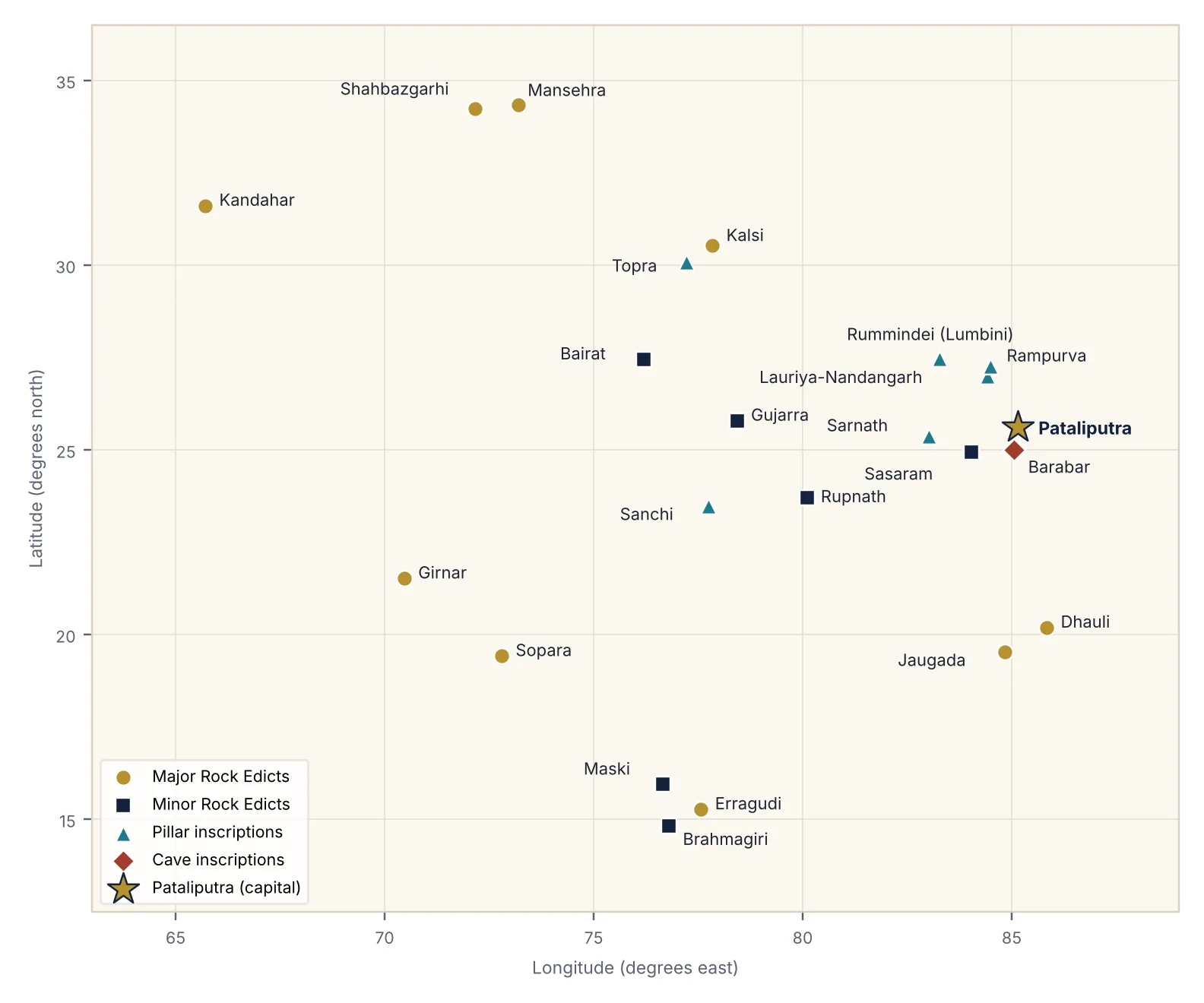
Selected findspots plotted by latitude and longitude; modern borders are deliberately not drawn. The spread shows the reach of royal communication from Kandahar to Karnataka, not the frontiers of the empire.
The fourteen Major Rock Edicts
| I | No animal sacrifice; slaughter for the royal kitchen cut down |
| II | Medical treatment for people and animals; herbs, wells, trees; neighbours |
| III | Officials on tour every five years |
| IV | The sound of the drum replaced by the sound of dhamma |
| V | Dhamma-mahamattas appointed |
| VI | Reports to reach the king at any hour |
| VII | All sects may live everywhere |
| VIII | Pleasure tours replaced by dhamma-yatras; visit to Sambodhi |
| IX | Empty ceremonies against the ceremony of dhamma |
| X | Fame and glory worth little without dhamma |
| XI | The gift of dhamma (dhamma-dana) |
| XII | Restraint and respect between sects |
| XIII | Kalinga, remorse, dhamma-vijaya, five Hellenistic kings |
| XIV | Why the edicts vary, repeat or are abridged |
The seven Pillar Edicts
| I | Officials must lead by dhamma (26th year) |
| II | What dhamma is: kindness, generosity, truth, purity |
| III | Self-examination; anger, cruelty, pride as sins |
| IV | Rajukas, uniform justice, three-day respite |
| V | Protected animals; days without killing |
| VI | Welfare and regard for all sects |
| VII | The fullest statement: officials, public works, rest houses, and persuasion as stronger than regulation (27th year) |
Minor pillar inscriptions
| Rummindei | Buddha’s birthplace; bali exempted, one-eighth share (20th year) |
| Nigali Sagar | Stupa of Buddha Konakamana enlarged (14th year); a later royal visit and pillar, the damaged year usually read as the 20th |
| Schism Edict | Sarnath, Sanchi, Allahabad-Kosam: monks who divide the Sangha to be expelled |
| Queen’s Edict | Allahabad-Kosam: gifts of Karuvaki, mother of Tivara |
How the inscriptions were read: a timeline
The limits, in full
- One royal voice: official priorities, not subjects’ views.
- Prescriptive language: what should happen, not what did.
- Implementation unknown: intention is not outcome.
- Findspots are not borders: some pillars were moved, and some slabs reused in later buildings.
- One reign: near silence on Chandragupta, Bindusara and the later Mauryas.
- Little on economic life: Rummindei aside, nothing on production, prices, wages, trade or agrarian relations.
- Words need interpreting: damaged texts, regional variants, terms like dhamma with no exact modern match.
What completes the picture
Triangulation in practice: Rock Edict III records official inspections; the Arthashastra offers a separately composed, normative model of administration; archaeology shows material infrastructure. They can be compared, but they do not independently prove the same practice everywhere. The later Junagadh inscription adds named Mauryan officials and hydraulic works.
| Arthashastra | Administrative categories to read the edicts’ officials against; not a manual of Ashoka’s government. |
| Megasthenes | An outsider’s view of Pataliputra; survives through Strabo, Arrian and Diodorus. |
| Buddhist and Jaina texts | Memory of Ashoka and Chandragupta; written later, with a religious aim. |
| Archaeology | Timber palisade at Bulandibagh; a Mauryan pillared structure at Kumrahar, its function debated; NBPW, punch-marked coins, polished stone. |
Two debates worth knowing
Bairat and Rummindei show personal Buddhist devotion. The civic ethic of the Rock Edicts, addressed to all sects, reads as a policy to hold a diverse empire together. Romila Thapar stressed dhamma as a social and political programme. The balanced reading: conviction shaped the policy, and the policy reached beyond the conviction.
Named officials, tours and reports suggest a strong centre. Romila Thapar’s distinction of metropolitan, core and peripheral areas, and Gerard Fussman’s study of central power and the regions, suggest that control varied by region, which the spread of edicts alone cannot settle. The balanced reading: a powerful centre, unevenly felt.
Pitfalls and variations
The mistakes that cost marks here, the claims never to make, and how the answer changes when the question changes.
4.1 Six pitfalls, each with its correction
4.2 Never write these
- “There are exactly 33 Ashokan inscriptions.” Counts depend on texts, copies and sites.
- “The Cholas and Pandyas were Mauryan provinces.” Rock Edict II names them as neighbours.
- “Lumbini was made completely tax-free.” Bali was remitted; a one-eighth share remained.
- “One-eighth was the Mauryan land revenue rate.” It was one village’s concession.
- “Ashoka gave the Nagarjuni caves to the Ajivikas.” Those are Dasharatha’s; Ashoka’s are at Barabar.
- “Dhamma was simply Buddhism.” His faith and his public ethic must be distinguished.
- “The inscriptions give a complete history of the Mauryas.” They cover one reign, in one voice.
4.3 If the question changes
| If it asks | The structure becomes | What must change |
|---|---|---|
| Critically examine the importance of Ashokan inscriptions… | 1. What they reconstruct (about three-fifths); 2. How far they can be trusted (about two-fifths) | The limits become an argument with evidence, not a closing line; end with a firm verdict. |
| Discuss the importance of Ashokan inscriptions… | 1. Their contribution, dimension by dimension (about four-fifths); 2. Qualification (about one-fifth) | More room to explain each dimension; still end with a view. |
| “Ashokan inscriptions are the foundation of Mauryan history.” Comment. | 1. Where the claim holds (about three-quarters); 2. Where it fails (about one-quarter) | Take a position on the statement and keep it throughout. |
| The same question for 15 marks, 250 words | 1. How the inscriptions reconstruct Mauryan history (about three-quarters), with political, administrative, economic, religious and cultural subheadings inside it; 2. Historical value and limitations (about one-quarter) | Develop each inference, add one worked example of corroboration, and separate personal Buddhism from public dhamma. More words should mean more analysis, not more edict numbers. |
The model answer
One answer, written in 150 words, in the form this question calls for: points under headings. The introduction covers the whole question; the conclusion settles its demand.
Contemporary, sometimes regnally dated, Ashokan inscriptions illuminate Mauryan political, administrative and religious history, though chiefly in one ruler’s voice.
1. How the inscriptions reconstruct Mauryan history
- Identity and chronology: Maski links Devanampiya with Asoka; Rock Edict XIII dates Kalinga eight years after consecration.
- Extent: edicts from Kandahar to Karnataka mark royal communication’s reach.
- Administration: Rock Edict III implies official inspections; Pillar Edict IV gives rajukas judicial powers.
- Statecraft: Rock Edict XIII records remorse and dhamma-vijaya, yet retains coercive authority.
- Welfare and revenue: Rock Edict II proclaims medical treatment; Rummindei fixes Lumbini’s share at one-eighth.
- Religion: Rock Edict XII urges sectarian respect; Barabar shows Ajivika patronage.
2. Historical value and limitations
Often in situ, they preserve royal priorities, not uniform compliance, precise borders, ordinary people’s voices or the wider dynasty.
Read with archaeology and literary traditions, they remain indispensable for Ashoka’s reign, yet cannot by themselves reconstruct the wider Mauryan polity and society.
Other ways to write it
The model answer above remains the answer. These outlines show how a different, equally valid answer could be built, and when each choice works.
| Approach | How it is built | When it works |
|---|---|---|
| Open with the decipherment | Introduction: Prinsep’s decipherment of Brahmi in 1837 made the proclamations of Devanampiya Piyadasi readable, and Maski in 1915 confirmed that he was Ashoka; then the same two parts. | When you want the opening to show at once why inscriptions changed Mauryan history. |
| Open with the nature of the source | Introduction: inscriptions as contemporary royal communication carved in stone, valuable for their date and place, limited by their single voice; then the same two parts. | When the limits are the sharper point you wish to carry through the answer. |
| Table for Part 1 | Three columns: inscription, what it records, what historians infer; six rows; Part 2 in prose below. | When you can rule a table quickly and neatly, and the rows stay short. |
| Grouped by state and society | Part 1 under two headings only: the state (identity, chronology, reach, administration, statecraft) and society (welfare, revenue, religion). | For a 15-mark version, where each heading has room for three or four developed points. |
Quick recall and Prelims crossover
Twenty verified facts for rapid revision and Prelims.
| 1 | James Prinsep deciphered Brahmi in 1837. | 11 | Rock Edict XIII: 150,000 deported, 100,000 killed (the king’s figures). |
| 2 | Maski (Raichur, Karnataka), found in 1915, first to name Asoka. | 12 | Dhauli and Jaugada omit Rock Edicts XI to XIII; two Separate Edicts instead. |
| 3 | Gujarra (Datia, Madhya Pradesh) and Nittur also give his name. | 13 | Pillar Edict IV: rajukas, uniform justice, three-day respite. |
| 4 | Kharosthi at Shahbazgarhi and Mansehra; Brahmi in most Indian edicts; Greek and Aramaic at Kandahar. | 14 | Pillar Edict VII is found only on the Delhi-Topra pillar. |
| 5 | Kandahar Greek-Aramaic bilingual, found at Chehel Zina in 1958. | 15 | Rummindei: 20th year; bali exempted, one-eighth share. |
| 6 | Rock Edict II: medical treatment for people and animals; herbs, wells, roadside trees. | 16 | Nigali Sagar: Buddha Konakamana’s stupa enlarged in the 14th year. |
| 7 | Rock Edict III: yuktas, rajukas, pradesikas on five-yearly tours. | 17 | Schism Edict: Sarnath, Sanchi, Allahabad-Kosam. |
| 8 | Rock Edict V: dhamma-mahamattas, in the 13th year. | 18 | Queen’s Edict: Karuvaki, mother of Tivara. |
| 9 | Rock Edict VIII: dhamma-yatra to Sambodhi (Bodh Gaya). | 19 | Barabar caves: Ashoka to the Ajivikas; Nagarjuni: Dasharatha. |
| 10 | Rock Edict XII: restraint and respect between sects. | 20 | Bairat (Bhabru): faith in the Buddha, Dhamma, Sangha; seven texts named. |
Write it yourself
Write the answer in 150 words without looking back, then check it against each line below.
| Check | Yes / No | |
|---|---|---|
| 1 | Does the introduction place the inscriptions as a source and signal both parts: what they reconstruct and their limits? | |
| 2 | Does Part 1 take about three-quarters of the body, under short headings? | |
| 3 | Does every point name an inscription and say what it lets historians reconstruct? | |
| 4 | Does the answer speak of Mauryan history, not Ashoka’s biography? | |
| 5 | Does Part 2 weigh value and limits, the hidden demand, in about a quarter of the body? | |
| 6 | Does the conclusion give a verdict on their importance, at about the length of the introduction? | |
| 7 | Is it within 150 words, with no claim from section 4.2? |
Write your first answer. Get written feedback, free.
Reading a decode helps you understand the question. Writing your own answer helps you put that understanding into practice. Write this answer and send it to us: your first answer receives a free written evaluation by the UPSC Gurus method.
- Write the answer by hand on A4 sheets, within about 150 words, before you look at the model answer.
- Go through the self-check in section 8 above, then photograph every page clearly (or scan it as one PDF).
- Upload it below. Your written feedback comes to your email: how your answer met the question’s demand and implied dimensions, its structure, content and presentation, and what to work on next.
Explore personalised support
Write any actual UPSC Mains GS paper from 2017 to 2026. Receive written evaluation of every answer by email, followed by a personal feedback session.
Get my paper evaluatedUnderstand where your preparation stands through a structured diagnosis, a written roadmap and one follow-up session. The full counselling fee is adjusted against any UPSC Gurus programme you join within 30 days. This is a fee adjustment, not a refund.
Book counsellingSources
- E. Hultzsch, Inscriptions of Asoka, Corpus Inscriptionum Indicarum, Vol. I (1925); D. C. Sircar, Inscriptions of Asoka.
- Romila Thapar, Asoka and the Decline of the Mauryas (3rd edition, 2012); Upinder Singh, A History of Ancient and Early Medieval India; Harry Falk, Asokan Sites and Artefacts (2006); Patrick Olivelle, Ashoka: Portrait of a Philosopher King (Yale University Press, 2024).
- S. Dhammika, The Edicts of King Asoka (English rendering): accesstoinsight.org/lib/authors/dhammika/wheel386.html
- UNESCO Tentative List, Serial nomination for Ashokan Edict sites along the Mauryan Routes (11 February 2025): whc.unesco.org/en/tentativelists/6803
- Sarnath inscribed on the World Heritage List, 25 July 2026: PIB backgrounder, 26 August 2026; Piprahwa relics: Ministry of Culture, 30 July 2025; Prime Minister’s Office, 3 January 2026.
- UPSC Civil Services (Main), GS Paper I: 2013 Q1 (Sangam literature) and Q2(a) (Tandava in inscriptions), 2015 Q2 (Mesolithic rock art), 2016 Q1 (stupa art), 2017 Q1 (Gupta numismatic art), 2018 Q2 (Chinese and Arab travellers), 2020 Q1 (rock-cut architecture) and Q12 (Persian literary sources), 2022 Q1 (temple sculptures), 2026 Q1. Official question papers.
Your first Mentor’s Desk call is free
One free conversation per aspirant about where you are in your preparation, with an honest suggestion of the right next step.
Know more and bookHave a question? Get in touch
For questions about a programme, its fees, batch dates, payment or access. Message us on WhatsApp and our team will reply. Asking a question is not a booking, and you can ask as often as you need.
Get in touch on WhatsApp