 New this week · Free UG Handout 02UPSC Mains Directive Words: 60 Meanings, Trends and PYQsTwo free PDFs: The Guide and the With PYQs edition.Read and download
Today’s Canvas
- Karnataka seeks Supreme Court permission to use earlier electoral rolls for Bengaluru civic electionsGS II
- Uttar Pradesh approves ordinance proposal to extend gram panchayat administrators’ tenureGS II
- Centre seeks early Supreme Court hearing on uniform builder-buyer agreementsGS II
- Purana Qila exhibition brings archaeological evidence of Delhi’s past to SCO delegatesGS I
- Domestic airline schedules show year-on-year decline in November-December flightsGS III
- Italy outlines trade and investment priorities ahead of joint economic engagement with IndiaGS III
- Mekedatu reservoir proposal renews Karnataka-Tamil Nadu dispute over Cauvery watersGS II
- ICMR surveillance finds substantial antibiotic resistance in secondary-care hospitalsGS II
- IMD revises Cyclone Akvan forecast as Andhra Pradesh and Odisha prepare for heavy rainGS III
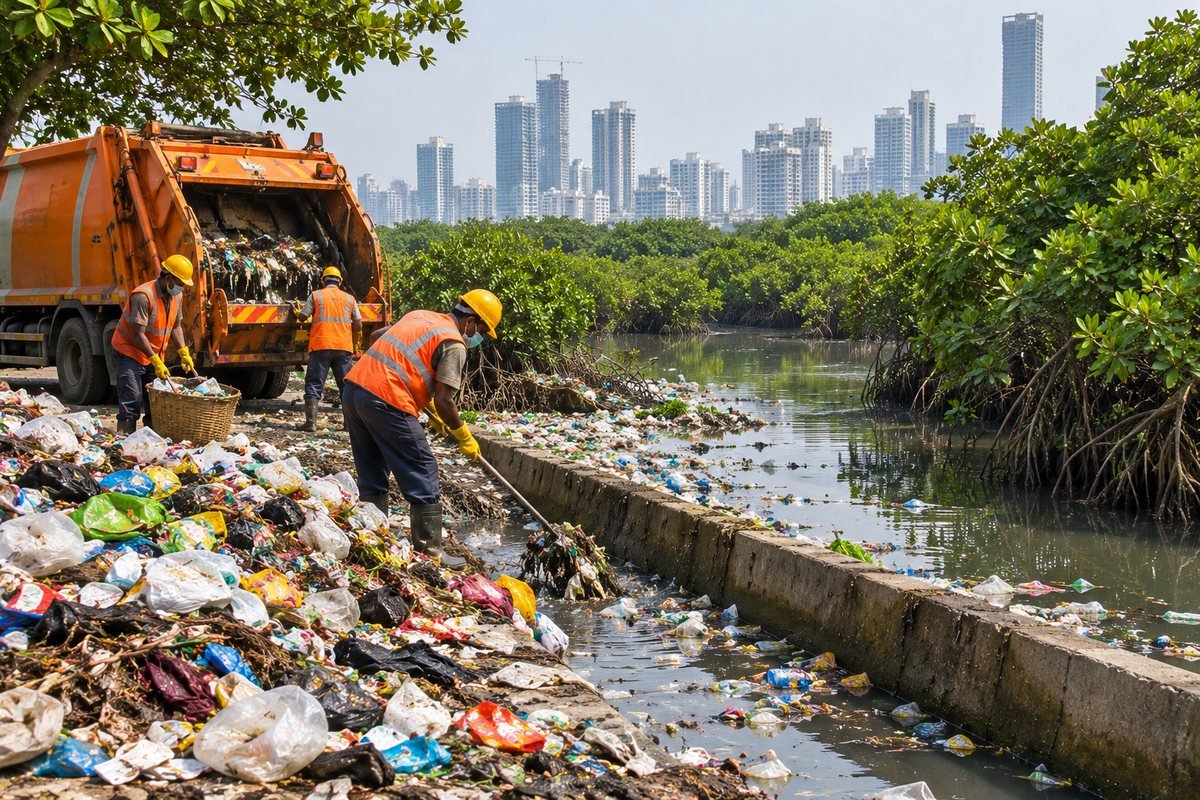
- Bombay High Court questions Mumbai’s waste management and persistent plastic pollutionGS III
- India links transboundary water cooperation to wider bilateral relations at COP31GS II
- India and Japan prepare for fourth foreign and defence ministers’ dialogue in TokyoGS II
- India signs Rs 1,976.40-crore agreement to upgrade naval Barak air-defence systemsGS III
- Sarvam AI’s new inference platform raises questions about India’s technological sovereigntyGS III
Polity, governance, heritage and culture
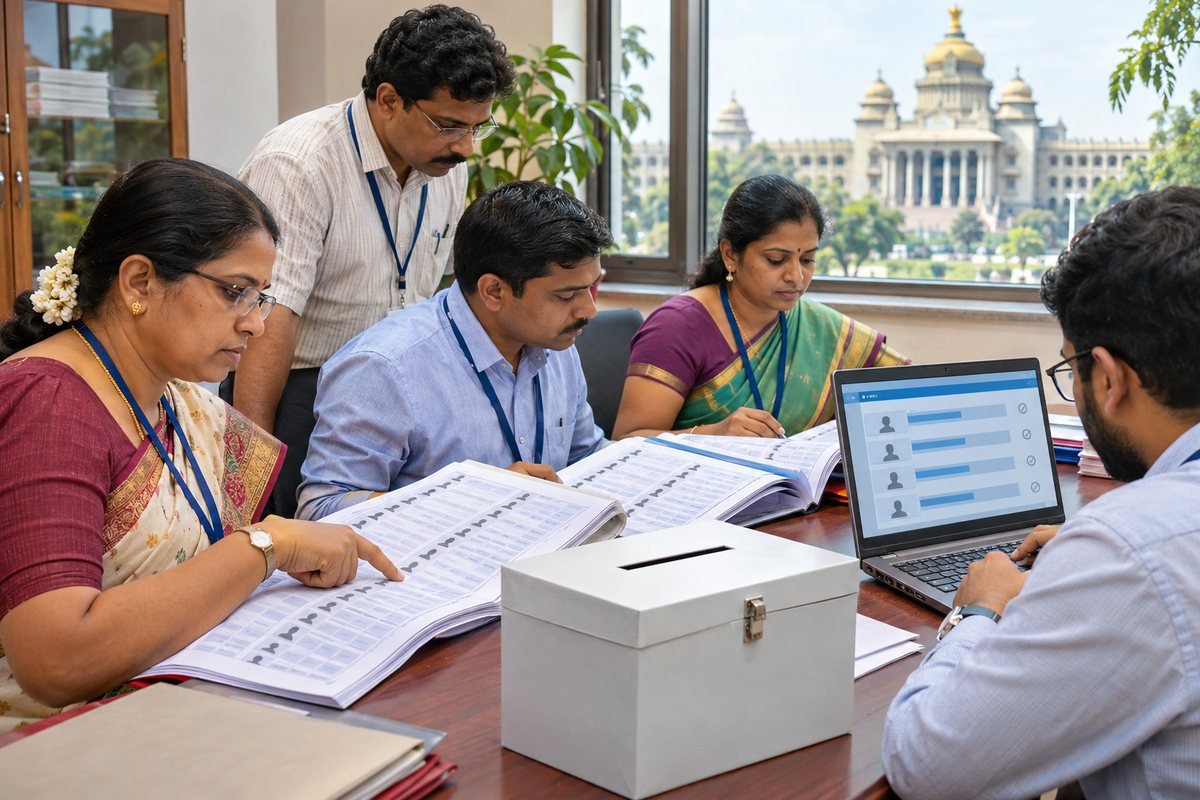
Karnataka seeks Supreme Court permission to use earlier electoral rolls for Bengaluru civic elections
In short: Karnataka and its State Election Commission have asked the Supreme Court to permit Bengaluru civic elections using electoral rolls prepared before the Special Intensive Revision.
Why in news
The Karnataka government and State Election Commission approached the Supreme Court seeking permission to use ward-wise rolls published on 18 April 2026 for elections to five municipal corporations under the Greater Bengaluru Authority. These rolls listed 88,95,361 voters. The ECI’s post-SIR rolls published on 27 October listed 59,08,151 voters across 28 Assembly constituencies in Bengaluru district, including rural areas. The different geographical coverage complicates direct comparison. The SEC also sought time until 31 January 2027 to complete elections.
Concept: State Election Commissions and Electoral Rolls
Article 243ZA gives State Election Commissions the authority to supervise, direct and control municipal elections. Article 243K provides the corresponding framework for panchayat elections. In contrast, Article 324 gives the Election Commission of India authority over elections to Parliament, State Legislatures and the offices of President and Vice-President. State laws may provide for municipal rolls to be prepared using Assembly electoral data. However, the authority responsible for preparing the underlying electoral database is distinct from the constitutional authority supervising municipal elections. Accurate rolls and accessible correction procedures are essential safeguards against wrongful exclusion.
Key facts for Prelims
- Article 243ZA governs the conduct of municipal elections.
- Article 243K concerns State Election Commissions and panchayat elections.
- Article 324 concerns the Election Commission of India.
- Bengaluru’s proposed civic elections involve five municipal corporations under the Greater Bengaluru Authority.
Mains analysis and way forward
Mains analysis
- Electoral-roll accuracy is essential for meaningful participation in local democracy.
- Using datasets with different geographical boundaries can produce misleading comparisons.
- Delays in sharing authenticated electoral data can affect election schedules and administrative readiness.
- Repeated postponement of local elections weakens representative urban governance.
Way forward
- Reconcile the electoral databases using consistent geographical boundaries and transparent methods.
- Ensure accessible correction procedures for eligible voters.
- Provide the SEC with authenticated data while protecting timely elections.
Connect the dots: Constitutional bodies | Electoral reforms | Urban local governance | Democratic participation
Uttar Pradesh approves ordinance proposal to extend gram panchayat administrators’ tenure
In short: Uttar Pradesh has proposed continuing the present panchayat administrators while elections remain pending and a backward-classes commission completes its work.
Why in news
On 18 November 2026, the Uttar Pradesh Cabinet approved the proposed Uttar Pradesh Panchayati Raj (Amendment) Ordinance, 2026. The elected gram panchayats’ terms ended on 26 May 2026, after which outgoing gram pradhans were appointed administrators for routine functions. Their existing administrative tenure was due to expire on 26 November. The proposal would permit another six months or continuation until the dedicated backward-classes commission submits its report. An Allahabad High Court order of 14 October had directed elections within three months under the existing reservation arrangements.
Concept: Constitutional Tenure of Panchayats
Article 243E provides that an elected panchayat ordinarily continues for five years from its first meeting and no longer. Elections should be completed before the expiry of its term. Article 243K establishes the State Election Commission’s authority over panchayat elections. Article 243D deals with reservation of seats and chairperson offices. Article 213 empowers Governors to promulgate ordinances when constitutional conditions are satisfied. Importantly, continuing administrative arrangements after an elected body’s term ends is not equivalent to extending its constitutional tenure. Such arrangements must comply with applicable legislation and judicial directions.
Key facts for Prelims
- Article 243E provides for the five-year tenure of panchayats.
- Article 243D concerns reservation in panchayats.
- Article 243K governs State Election Commissions in relation to panchayat elections.
- Article 213 concerns the Governor’s ordinance-making power.
Mains analysis and way forward
Mains analysis
- Administrative continuity is needed to maintain essential village-level services.
- Prolonged absence of elected representatives reduces democratic accountability.
- Reservation policy requires legally sound procedures and reliable empirical evidence.
- Administrative arrangements cannot be assumed to override constitutional requirements for elections.
Way forward
- Complete elections according to constitutional provisions and applicable court directions.
- Finish the backward-classes commission’s work through a transparent and time-bound process.
- Limit interim administrators to functions permitted by law and subject them to appropriate oversight.
Connect the dots: Democratic decentralisation | Social justice | Reservation | Constitutional accountability
Centre seeks early Supreme Court hearing on uniform builder-buyer agreements
In short: The Centre has requested an early hearing of a pending petition concerning uniform agreements and protection against potentially unfair real-estate contract terms.

Why in news
On 17 November 2026, the Union Ministry of Housing and Urban Affairs sought an early Supreme Court hearing of a petition filed in 2020 concerning builder-buyer and agent-buyer agreements. The case was last heard on 20 December 2024. The ministry pointed to differences among agreement-for-sale rules notified by states and Union Territories. Separately, the Forum for People’s Collective Efforts proposed giving the agreement for sale stronger statutory backing through an amendment to RERA. The petition remains pending, and the reported development does not establish a new nationwide agreement.
Concept: RERA and Agreements for Sale
The Real Estate (Regulation and Development) Act, 2016, regulates covered real-estate projects and seeks transparency, accountability and consumer protection. Section 13 provides that a promoter cannot accept more than 10 per cent of the cost of an apartment, plot or building as an advance or application fee without first entering into a written agreement for sale and registering it as required. Such agreements specify important contractual obligations, including payment and delivery arrangements. State rules influence the detailed format. Uniform minimum safeguards may improve consumer protection, but proposals to amend legislation must be distinguished from existing statutory requirements.
Key facts for Prelims
- RERA was enacted in 2016.
- Section 13 concerns agreements for sale and restrictions on advance payments.
- The statutory advance-payment threshold under Section 13 is 10 per cent.
- The Supreme Court petition concerning uniform agreements was filed in 2020.
Mains analysis and way forward
Mains analysis
- Standard contractual safeguards can reduce the bargaining imbalance between promoters and individual homebuyers.
- Differences in state-level agreements may create inconsistent consumer protection.
- Clear contractual obligations improve predictability and reduce disputes.
- Regulation must also provide effective enforcement and timely remedies.
Way forward
- Consider mandatory minimum clauses after consultation with states, consumers and developers.
- Strengthen transparency concerning payment schedules, delivery timelines and remedies.
- Improve enforcement of existing RERA provisions before relying exclusively on new amendments.
Connect the dots: Consumer rights | Housing governance | Regulation | Cooperative federalism
Sources: The Indian Express, “Buying a flat? Centre moves SC over ‘one-sided’ builder-buyer agreements”, updated 19 November 2026. Official reference: Real Estate (Regulation and Development) Act, 2016, India Code.
Purana Qila exhibition brings archaeological evidence of Delhi’s past to SCO delegates
In short: A special exhibition will display inscriptions, pottery and excavation evidence to illustrate the long history of settlement in Delhi.

Why in news
The Indian Express reported on 19 November 2026 that a curated exhibition called Astitva would be inaugurated at Purana Qila in New Delhi on 20 November for the SCO Civilisational Dialogue Forum. It will display a Sanskrit inscription dated 1328, recovered from a stepwell in the former village of Sarban near present-day Raisina Road. The inscription refers to Indraprastha. Painted Grey Ware pottery and a 10-metre by 10-metre live excavation site are also part of the exhibition, highlighting different periods of Delhi’s history.
Concept: Archaeological Methods and Historical Evidence
Archaeology investigates human history through material remains such as pottery, tools, inscriptions, coins and buildings. Stratigraphy examines the sequence of archaeological layers, helping establish their relative chronology. Epigraphy is the study of inscriptions, which may provide information about historical rulers, languages, religious practices and place names. Painted Grey Ware is associated with the early Iron Age in parts of northern India. Archaeological finds must be interpreted in context. An inscription mentioning a traditional place name establishes evidence of that name’s historical use, but does not independently verify every event associated with a literary account.
Key facts for Prelims
- Purana Qila is situated in New Delhi.
- The Archaeological Survey of India investigates and protects important archaeological heritage.
- Painted Grey Ware is associated with the early Iron Age in northern India.
- Epigraphy refers to the study of inscriptions.
Mains analysis and way forward
Mains analysis
- Excavations can reveal the multiple phases of settlement at an urban site.
- Pottery and inscriptions provide different types of historical evidence.
- Public exhibitions make archaeological research more accessible.
- Cultural diplomacy can encourage international engagement with India’s heritage.
Way forward
- Preserve excavation records and associated material systematically.
- Explain the dating and interpretation of archaeological evidence clearly.
- Distinguish verified archaeological findings from literary associations and hypotheses.
Connect the dots: Ancient Indian history | Archaeological methods | Urban heritage | Cultural diplomacy
Economy
Domestic airline schedules show year-on-year decline in November-December flights
In short: Scheduled domestic flights are projected to decline, but a smaller fall in seat capacity shows why flight counts alone cannot measure aviation supply.

Why in news
According to an Indian Express report published on 19 November 2026, aviation analytics firm Cirium’s schedule data showed 195,774 domestic flights planned by Indian airlines for November and December 2026. This was 7,154 fewer flights than the corresponding period in 2025, a decline of 3.5 per cent. Scheduled seat capacity was projected to fall by only 0.5 per cent. The report discussed higher fuel costs, rupee depreciation and expensive tickets as pressures on the industry. Actual flight operations may differ from published schedules.
Concept: Aviation Capacity, Costs and Demand
Airline operating costs include aviation turbine fuel, aircraft leasing, maintenance, airport charges and personnel expenses. Some important expenses are denominated in foreign currency, making exchange-rate movements relevant to profitability. Flight frequency measures the number of scheduled services, while seat capacity measures the seats made available. Available seat-kilometres measure capacity adjusted for distance. Passenger load factor indicates the share of available seats occupied by passengers. Airlines may reduce frequency while using larger aircraft, meaning that flights and seats decline by different proportions. These indicators should be examined separately when assessing aviation performance.
Key facts for Prelims
- Scheduled domestic flights for November-December 2026: 195,774.
- Year-on-year reduction in scheduled flights: 7,154 or 3.5 per cent.
- Year-on-year reduction in scheduled seat capacity: 0.5 per cent.
- Available seat-kilometres measure seat capacity multiplied by distance.
Mains analysis and way forward
Mains analysis
- Rising fuel costs and currency depreciation may weaken airline profitability.
- Fewer departures can reduce travel flexibility even if total seat capacity remains relatively stable.
- High fares can affect demand, but published schedules alone cannot establish the cause of a decline.
- Airline financial sustainability matters for long-term regional connectivity.
Way forward
- Improve airport efficiency and reduce avoidable operational costs.
- Support competitive and commercially sustainable services on underserved routes.
- Monitor actual flights, passenger traffic, load factors and fares alongside published schedules.
Connect the dots: Infrastructure | Exchange rates | Competition | Regional connectivity
Italy outlines trade and investment priorities ahead of joint economic engagement with India
In short: Italy’s foreign minister has described plans to strengthen economic cooperation and pursue a bilateral trade target of EUR 20 billion by 2029.

Why in news
In an opinion article published on 18 November 2026, Italian Deputy Prime Minister and Foreign Minister Antonio Tajani discussed plans to strengthen India-Italy economic cooperation. He referred to the 23rd Joint Commission for Economic Cooperation and the fourth India-Italy Business Forum in two years. Tajani said the two governments had established a bilateral trade target of EUR 20 billion by 2029. He also identified investment, industrial collaboration, technology and small enterprises as priorities. These are stated policy objectives rather than confirmed future economic outcomes.
Concept: International Trade and Global Value Chains
International trade allows countries to specialise in goods and services where they possess productive strengths. Global value chains divide production processes across countries, creating opportunities for component manufacturing, design, assembly and services. Trade agreements can reduce tariffs and address selected regulatory barriers. Foreign direct investment may bring capital, technology, management practices and access to markets, although these benefits depend on domestic conditions. Rules of origin determine whether goods qualify for preferential treatment under trade agreements. For India, industrial cooperation can support export diversification and domestic value addition when accompanied by adequate skills, infrastructure and competitive enterprises.
Key facts for Prelims
- The stated India-Italy bilateral trade target is EUR 20 billion by 2029.
- Italy is a member of the European Union.
- The Joint Commission for Economic Cooperation provides a bilateral institutional platform.
- Rules of origin determine whether products qualify for preferential treatment under trade agreements.
Mains analysis and way forward
Mains analysis
- Industrial cooperation can connect Indian companies with European manufacturing networks.
- Investment partnerships may support technological upgrading and export diversification.
- Smaller enterprises need finance, skills and market information to benefit from international opportunities.
- Announced trade targets must be evaluated against actual investment and trade outcomes.
Way forward
- Focus on practical manufacturing, research and technology partnerships.
- Improve export competitiveness through logistics, skills and regulatory predictability.
- Monitor realised trade, investment, employment and domestic value addition.
Connect the dots: Foreign trade | Manufacturing | MSMEs | India-EU relations
Federalism, environment, health and disaster management
Mekedatu reservoir proposal renews Karnataka-Tamil Nadu dispute over Cauvery waters
In short: Karnataka’s proposed reservoir has renewed disagreement over drinking-water requirements, downstream releases and the existing Cauvery water-sharing framework.
Why in news
An Indian Express explainer published on 18 November 2026 examined renewed demands for approval of Karnataka’s Mekedatu reservoir proposal. Former Prime Minister H D Deve Gowda sought clearance of the detailed project report from the Central Water Commission. The proposed reservoir has a reported storage capacity of 48 thousand million cubic feet and an estimated project cost of Rs 6,000 crore. Karnataka presents drinking-water supply to Bengaluru and hydropower generation as important objectives. Tamil Nadu maintains that upstream storage could affect scheduled releases, particularly during water-deficit periods.
Concept: Inter-State River Disputes and the Cauvery Framework
Article 262 permits Parliament to legislate concerning inter-state river-water disputes. Parliament enacted the Inter-State River Water Disputes Act, 1956, to provide a framework for adjudication. In the Cauvery dispute, the tribunal’s award was modified by the Supreme Court on 16 February 2018. Karnataka’s allocation became 284.75 TMC and Tamil Nadu’s 404.25 TMC, while Kerala and Puducherry retained allocations of 30 TMC and 7 TMC respectively. Water governance also involves scheduled releases and monitoring. Annual allocations and the timing of downstream deliveries are distinct but connected matters.

Key facts for Prelims
- Article 262 addresses inter-state river-water disputes.
- The Cauvery basin includes Karnataka, Tamil Nadu, Kerala and Puducherry.
- Mekedatu is a proposed reservoir site in Karnataka on the Cauvery.
- The Supreme Court modified the Cauvery allocation framework on 16 February 2018.
Mains analysis and way forward
Mains analysis
- Karnataka’s stated drinking-water objectives must be considered alongside existing legal obligations.
- Tamil Nadu’s concerns relate to downstream water availability and the timing of releases.
- Storage and water-sharing arrangements require basin-wide hydrological assessment.
- Disputes demonstrate the difficulty of reconciling development needs through cooperative federal institutions.
Way forward
- Appraise the proposal against the applicable Cauvery allocation and regulatory framework.
- Use transparent hydrological data and credible environmental-impact assessments.
- Strengthen cooperation through existing inter-state institutions and monitored release arrangements.
Connect the dots: Federalism | Water security | Environmental governance | Urban development
ICMR surveillance finds substantial antibiotic resistance in secondary-care hospitals
In short: ICMR findings show that resistance to important antibiotics is affecting smaller hospitals, highlighting the need for improved diagnosis and responsible prescribing.

Why in news
An Indian Express report published on 18 November 2026 examined the Indian Council of Medical Research’s Antimicrobial Resistance Surveillance and Research Network Annual Report 2025. The report described resistance among bacteria including E. coli and Klebsiella pneumoniae. For the first time, it included data from 34 secondary-care hospitals. ICMR scientist Dr Kamini Walia explained that resistance to third-generation cephalosporins was high even at these facilities, while carbapenem resistance remained more concentrated in larger specialist hospitals. She emphasised diagnostics, infection prevention and locally informed prescribing.
Concept: Antimicrobial Resistance and Antibiotic Stewardship
Antimicrobial resistance occurs when microorganisms develop the ability to survive treatment with medicines previously effective against them. Antibiotic resistance specifically concerns bacteria. Antibiotics do not treat viral illnesses. Unnecessary use, inappropriate treatment and poor infection prevention can contribute to the spread of resistant organisms. Antibiotic stewardship promotes the selection of appropriate medicines, doses and treatment durations. An antibiogram summarises local laboratory findings on bacterial susceptibility to antibiotics, helping guide prescribing. The One Health approach recognises connections between human health, animal health and environmental conditions, including antimicrobial use beyond human medicine.
Key facts for Prelims
- AMRSN is the Antimicrobial Resistance Surveillance and Research Network.
- The 2025 report included 34 secondary-care hospitals for the first time.
- E. coli and Klebsiella pneumoniae are bacteria.
- Carbapenems and cephalosporins are different classes of antibiotics.
Mains analysis and way forward
Mains analysis
- Resistant infections can increase treatment costs, hospital stays and the risk of poor outcomes.
- Secondary-care surveillance helps identify problems beyond major referral hospitals.
- Local resistance patterns are important because the effectiveness of antibiotics varies across facilities.
- Weak infection prevention and poor diagnostic access complicate rational antibiotic use.
Way forward
- Expand microbiology laboratories and hospital-level resistance surveillance.
- Establish infection-control and antimicrobial-stewardship committees.
- Improve prescribing practices using diagnostics and local antibiograms.
Connect the dots: Public health | One Health | Medical research | Health-system strengthening
IMD revises Cyclone Akvan forecast as Andhra Pradesh and Odisha prepare for heavy rain
In short: The latest available official IMD bulletin forecasts Cyclone Akvan weakening before coastal crossing, while authorities continue preparedness across the eastern coast.
Why in news
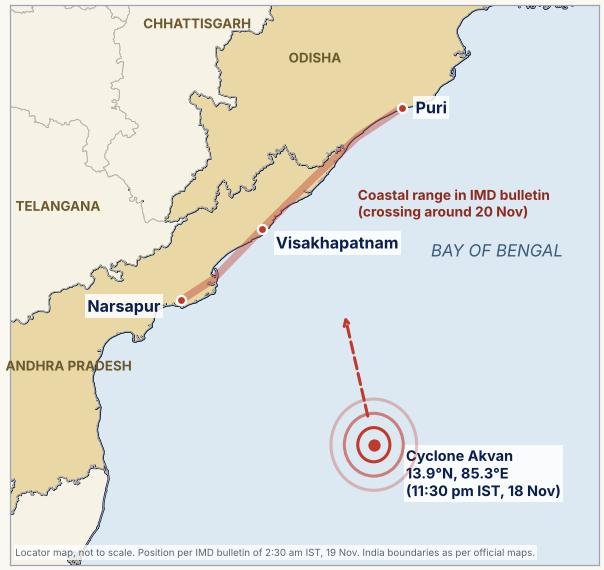
The IMD bulletin issued at 2:30 AM IST on 19 November 2026 placed severe cyclonic storm Akvan at 13.9°N, 85.3°E at 11:30 PM on 18 November. It forecast a northward movement and weakening before coastal crossing around 20 November, with winds of 80-90 kmph, gusting to 100 kmph. The bulletin described a broad coastal range between Narsapur and Puri, although the precise crossing location remained uncertain. Odisha had placed 14 districts on alert and mobilised disaster-response teams, according to its 18 November preparedness report.
Concept: Tropical Cyclone Forecasting and Disaster Preparedness
Tropical cyclones are intense low-pressure systems that develop over warm ocean waters under favourable atmospheric conditions. They may produce strong winds, heavy rainfall, rough seas and storm surges. The IMD classifies cyclonic systems by maximum sustained surface wind speed. A severe cyclonic storm is a stronger category than a cyclonic storm. The intensity observed at sea may differ from the intensity forecast at landfall. Forecast tracks include uncertainty because atmospheric steering conditions can change. Effective disaster preparedness combines scientific monitoring, timely warnings, evacuation planning, cyclone shelters and coordination among local administrations and emergency-response agencies.
Key facts for Prelims
- Akvan was classified as a severe cyclonic storm at the time of the cited observation.
- The cited IMD bulletin was issued at 2:30 AM IST on 19 November 2026.
- The bulletin forecast coastal-crossing winds of 80-90 kmph, gusting to 100 kmph.
- The India Meteorological Department provides official cyclone forecasts and warnings for India.
Mains analysis and way forward
Mains analysis
- Changes in forecast tracks demonstrate the importance of continuous monitoring rather than relying on an earlier prediction.
- Evacuations should cover vulnerable areas within the forecast-risk zone.
- Kutcha housing, low-lying settlements and landslide-prone locations face different forms of exposure.
- Coordination across states and districts is essential when the potential impact area crosses administrative boundaries.
Way forward
- Base operational decisions on the newest IMD district-level warnings.
- Prioritise evacuation, shelter access and communication for vulnerable communities.
- Prepare for restoration of electricity, roads, healthcare and other essential services.
Connect the dots: Physical geography | Disaster risk reduction | Climate resilience | Administrative coordination
Sources: The Indian Express, “Cyclone Akvan shifts track, puts North Andhra-South Odisha on alert”, updated 18 November 2026. Official verification: India Meteorological Department, Cyclone Akvan bulletin, issued 19 November 2026 at 2:30 AM IST.
Bombay High Court questions Mumbai’s waste management and persistent plastic pollution
In short: The Bombay High Court raised concerns about persistent garbage and plastic pollution, highlighting the need for consistent municipal waste services.
Why in news
On 18 November 2026, the Bombay High Court made oral observations concerning municipal cleanliness while hearing a petition related to waste disposal at the Kanjurmarg landfill in Mumbai. A bench of Justices Girish S Kulkarni and Neela K Gokhale questioned why cleanliness standards improved for visiting guests but were not maintained consistently for residents. The court also raised concerns about plastic waste and asked why stronger restrictions could not be considered. These observations were not equivalent to a final judicial order imposing a complete plastic ban.
Concept: Solid Waste Management Rules, 2026
The Solid Waste Management Rules, 2026, notified under the Environment (Protection) Act, 1986, came into force on 1 April 2026, replacing the Solid Waste Management Rules, 2016. They require four-stream segregation at source: wet waste, dry waste, sanitary waste and special-care waste. The framework strengthens responsibilities for bulk waste generators, processing facilities, local authorities and monitoring agencies. It also provides for environmental compensation in specified cases of non-compliance. Plastic waste remains subject to the Plastic Waste Management Rules, 2016, as amended. The two regulatory frameworks address related but distinct responsibilities.
Key facts for Prelims
- The Solid Waste Management Rules, 2026, came into force on 1 April 2026.
- Mandatory segregation covers wet, dry, sanitary and special-care waste.
- The rules were notified under the Environment (Protection) Act, 1986.
- The Plastic Waste Management Rules, 2016, as amended, separately regulate plastic waste.
Mains analysis and way forward
Mains analysis
- Persistent waste accumulation reflects implementation gaps in everyday municipal services.
- Segregation improves recycling, biological processing and safe handling of special waste.
- Poor waste management creates environmental and public-health risks.
- Effective regulation requires accountability across households, businesses, local bodies and processing facilities.
Way forward
- Enforce four-stream segregation and strengthen local collection systems.
- Improve processing, recycling and monitoring of disposal facilities.
- Provide public reporting on waste-management performance and compliance.
Connect the dots: Urban governance | Circular economy | Environmental regulation | Public health
Sources: The Indian Express, “Have permanent show for citizens, not temporary show for guests: Bombay High Court to BMC”, updated 19 November 2026. Official verification: Ministry of Environment, Forest and Climate Change, PIB, “New Solid Waste Management Rules Notified; To Come into Force from April 1, 2026”, 28 January 2026.
International relations and security
India links transboundary water cooperation to wider bilateral relations at COP31
In short: India’s environment minister argued that transboundary water cooperation must consider changing conditions and wider relations between countries.

Why in news
Environment Minister Bhupender Yadav delivered India’s national statement at COP31 in Antalya, Türkiye, on 18 November 2026. He argued that transboundary water cooperation should account for climatic, demographic and technological changes and the broader relationship between countries. The Indian Express interpreted the remarks as referring to India’s decision to place the Indus Waters Treaty in abeyance. Yadav did not explicitly name the treaty. Pakistan’s Prime Minister Shehbaz Sharif had separately called for water-sharing agreements to be honoured. The two governments’ legal and diplomatic positions remain contested.
Concept: The Indus Waters Treaty
The Indus Waters Treaty was signed between India and Pakistan in 1960 following negotiations involving the World Bank. It broadly allocates the eastern rivers, Ravi, Beas and Sutlej, to India and the western rivers, Indus, Jhelum and Chenab, primarily to Pakistan, subject to specified permitted uses. The treaty provides for the Permanent Indus Commission and procedures for handling questions and disputes. India announced in 2025 that it was placing the treaty in abeyance. Pakistan disputes India’s position. The legal implications remain contested and should not be treated as conclusively settled by unilateral political statements.
Key facts for Prelims
- The Indus Waters Treaty was signed in 1960.
- Eastern rivers: Ravi, Beas and Sutlej.
- Western rivers: Indus, Jhelum and Chenab.
- The Permanent Indus Commission is provided for under the treaty.
Mains analysis and way forward
Mains analysis
- Transboundary rivers connect national water security with international obligations.
- India has linked its treaty position to security concerns and changing circumstances.
- Pakistan emphasises the protection of downstream rights and continuation of treaty obligations.
- Climate variability and growing water demand complicate long-term river governance.
Way forward
- Encourage credible hydrological monitoring and technically informed engagement where feasible.
- Distinguish competing diplomatic claims from the treaty’s text and formal legal findings.
- Address emerging climate and water-management challenges through appropriate institutional mechanisms.
Connect the dots: International law | Water diplomacy | Climate adaptation | National security
India and Japan prepare for fourth foreign and defence ministers’ dialogue in Tokyo
In short: India and Japan are scheduled to review bilateral security and strategic cooperation through their fourth ministerial 2+2 dialogue.

Why in news
India and Japan scheduled their fourth Foreign and Defence Ministers’ Meeting for 19 November 2026 in Tokyo. India’s External Affairs Minister S Jaishankar and Defence Minister Rajnath Singh were to participate with Japanese Foreign Minister Toshimitsu Motegi and Defence Minister Shinjiro Koizumi. Japan’s Ministry of Foreign Affairs confirmed the meeting in a release dated 17 November. It also announced the 19th Japan-India Foreign Ministers’ Strategic Dialogue for the same day. The agenda included security, economic security and cooperation for a free and open Indo-Pacific. Meeting outcomes were not established by the advance announcement.
Concept: The 2+2 Ministerial Dialogue
A 2+2 dialogue brings together foreign and defence ministers from two countries to coordinate diplomatic and security priorities. Discussions may cover military cooperation, maritime security, defence technology, strategic assessments and regional developments. The mechanism helps connect defence planning with broader foreign-policy objectives. India and Japan share interests in secure maritime routes, economic connectivity and regional stability. Japan is also a member of the Quad, but a bilateral 2+2 meeting is institutionally distinct from Quad engagements. The significance of a dialogue depends on the decisions implemented and the continuity of cooperation, not merely the number of meetings held.
Key facts for Prelims
- A ministerial 2+2 involves foreign and defence ministers from two countries.
- The fourth India-Japan 2+2 was scheduled for 19 November 2026.
- The meeting venue is Tokyo.
- The 19th Japan-India Foreign Ministers’ Strategic Dialogue was also scheduled for 19 November.
Mains analysis and way forward
Mains analysis
- India-Japan strategic engagement supports cooperation in the Indo-Pacific.
- Maritime security is important for commercial shipping and economic stability.
- Defence technology and industrial partnerships may strengthen long-term capabilities.
- Institutionalised dialogue can improve coordination on regional and international challenges.
Way forward
- Convert agreed priorities into measurable bilateral projects.
- Strengthen maritime and technological cooperation.
- Maintain regular diplomatic coordination while respecting each country’s strategic interests.
Connect the dots: Indo-Pacific | Defence diplomacy | Maritime security | Economic security
Sources: The Indian Express, “National interest priority but helping partners deepens trust: Jaishankar in Tokyo”, updated 19 November 2026. Official verification: Ministry of Foreign Affairs of Japan, “The Fourth Japan-India Foreign and Defence Ministers’ Meeting (‘2+2′) and the Nineteenth Japan-India Foreign Ministers’ Strategic Dialogue”, 17 November 2026.
India signs Rs 1,976.40-crore agreement to upgrade naval Barak air-defence systems
In short: The Ministry of Defence has contracted Israel Aerospace Industries to modernise existing Barak Point Defence Missile Systems aboard Indian Navy ships.

Why in news
On 18 November 2026, the Ministry of Defence signed a contract worth Rs 1,976.40 crore with Israel Aerospace Industries. The agreement covers upgradation and obsolescence management of Barak Point Defence Missile Systems installed on Indian Navy ships. According to the official PIB release, it was signed in New Delhi in the presence of Defence Secretary Rajesh Kumar Singh under the Other Capital Procurement Procedure. The planned work includes hardware and software upgrades intended to enhance naval air-defence capability. It is not a contract for developing an entirely new missile system.
Concept: Naval Air Defence and Obsolescence Management
Naval air-defence systems protect warships against aerial threats. Their effectiveness depends on sensors, tracking equipment, command-and-control systems and weapons working together. A surface-to-air missile is launched from a surface platform to intercept a target in the air. Point-defence systems focus on protecting particular platforms or nearby areas. Obsolescence management addresses ageing hardware, discontinued components and outdated software. Modernising existing systems can improve capability and extend operational life without requiring the replacement of an entire ship. Defence procurement therefore includes both new acquisitions and substantial upgrades to equipment already in service.
Key facts for Prelims
- Barak Point Defence is a naval surface-to-air missile system.
- The contracted company is Israel Aerospace Industries.
- The contract value is Rs 1,976.40 crore.
- The agreement includes hardware and software upgrades under Other Capital Procurement Procedure.
Mains analysis and way forward
Mains analysis
- Modernising existing weapons can improve operational readiness.
- Upgrades may be more economical than premature replacement of an entire platform.
- Dependence on external suppliers creates maintenance and supply-chain considerations.
- Defence procurement must consider lifecycle costs, compatibility and long-term support.
Way forward
- Complete integration and operational testing according to specified requirements.
- Strengthen domestic maintenance and repair capabilities.
- Plan future technological upgrades and component replacement systematically.
Connect the dots: Maritime defence | Technology management | Defence procurement | Strategic partnerships
Sources: The Indian Express, “Government inks deal with Israel to upgrade Barak missile system”, 19 November 2026. Official verification: Ministry of Defence, Press Information Bureau, 18 November 2026.
Science and technology
Sarvam AI’s new inference platform raises questions about India’s technological sovereignty
In short: Sarvam AI’s platform offers access to Indian and foreign-developed models, highlighting the distinction between domestic computing infrastructure and indigenous AI development.

Why in news
An Indian Express explainer published on 18 November 2026 examined Sarvam AI’s Token Factory platform, announced on 16 November. The platform provides developers and enterprises access to several AI models through computing infrastructure located in India. The available models include offerings developed by DeepSeek, Moonshot AI, Z.ai and Alibaba, along with Google’s Gemma models and Sarvam’s own models. The launch has prompted discussion about India’s AI ambitions and the meaning of technological sovereignty. The presence of foreign models is not, by itself, evidence of a security breach.
Concept: AI Training, Inference and Technological Sovereignty
Training an AI model involves adjusting its parameters using data and computing resources. Inference is the process of running a trained model to produce outputs. An inference platform allows applications to access models without maintaining all the underlying computing infrastructure. Open-weight models make their parameters available under specified conditions, but they are not necessarily fully open-source systems. AI sovereignty has several dimensions: computing infrastructure, data governance, model development, intellectual property, security and operational control. A foreign-developed model may be hosted domestically, but domestic hosting does not establish domestic ownership of its underlying technology.
Key facts for Prelims
- AI inference refers to generating outputs using an already trained model.
- APIs allow applications to access external services and models.
- Open-weight models are not necessarily fully open-source software.
- Sarvam’s Token Factory provides access to Indian and foreign-developed AI models.
Mains analysis and way forward
Mains analysis
- Domestic computing infrastructure may support local service availability and data governance.
- Foreign-developed models can help businesses adopt AI before domestic alternatives mature.
- Dependence on external technology may create commercial and strategic vulnerabilities.
- AI sovereignty requires more than simply locating servers within national territory.
Way forward
- Support indigenous model training, research and specialised datasets.
- Establish robust evaluation, cybersecurity and accountability requirements.
- Encourage responsible technological collaboration alongside domestic capability development.
Connect the dots: Digital sovereignty | Innovation policy | Cybersecurity | Industrial development
In brief
- Air pollution needs more than short-term technological fixes: An expert analysis published on 18 November argues that controlling air pollution requires sustained action on emissions, institutional coordination and everyday implementation, not only temporary technological measures. Source
- United States tightens advanced AI chip access rules: The US Commerce Department’s Bureau of Industry and Security introduced additional authorisation requirements affecting certain advanced American chips supplied to overseas data centres serving significant computing demand from countries of concern. Source
- Java security vulnerability prompts urgent patching advice: A newly reported vulnerability known as Java4Shell prompted security warnings. The Indian Computer Emergency Response Team advised users of affected Oracle Java SE and Oracle GraalVM products to apply available security updates. Source
- Prehistoric elephant fossil found in Narmada Valley: A fossilised jaw approximately 75 cm long was discovered near Patai Ghat in Madhya Pradesh’s Raisen district. Researchers consider Palaeoloxodon a possible identification, but species determination and age require further scientific study. Source
- Delhi approves Rs 5-crore support for vehicle emission testing: The Delhi government approved a Rs 5-crore programme on 17 November to modernise authorised Pollution Under Control testing centres, including surveillance and infrastructure improvements. Implementation remains a separate administrative task. Source
- Pakistan selects minister for SCO cultural forum in Delhi: Pakistan nominated Climate Change and Environmental Coordination Minister Musadik Masood Malik for the SCO Civilisational Dialogue Forum scheduled in New Delhi from 20 to 22 November 2026. The nomination does not establish that bilateral water-treaty talks will take place. Source
Prelims practice: 5 questions
Choose an option to see the answer and explanation. Your score appears when all five are answered.
Mains practice
GS II | Federalism | Inter-State River Water Disputes Inter-state river-water disputes in India are not merely questions of water allocation but also of cooperative federalism, ecological sustainability and institutional trust. Discuss with reference to the Cauvery dispute.
Show the answer outline
INTRODUCTION
Inter-state rivers are shared natural resources that support agriculture, drinking water, industry and ecosystems. Their governance requires cooperation among states with different geographical positions, development needs and legally recognised water entitlements.
CONSTITUTIONAL AND INSTITUTIONAL FRAMEWORK
- Article 262 provides the constitutional basis for parliamentary legislation concerning inter-state river-water disputes.
- The Inter-State River Water Disputes Act, 1956, establishes a statutory framework for adjudication.
- The Cauvery dispute has been shaped by the tribunal’s award and the Supreme Court’s judgment of 16 February 2018.
- The Cauvery Water Management Authority and Cauvery Water Regulation Committee have roles in implementing and monitoring the relevant water-sharing arrangements.
WHY WATER DISPUTES PERSIST
- Upper and lower riparian states may have different concerns about storage, withdrawals and scheduled releases.
- Water demand increases with urbanisation, irrigation requirements and economic development.
- Rainfall variability and periods of deficient inflow create uncertainty in available water.
- Political disagreement and mistrust over hydrological information can complicate implementation.
THE CAUVERY AND MEKEDATU EXAMPLE
- Karnataka describes Mekedatu as a project intended to address Bengaluru’s drinking-water requirements and generate hydropower.
- Tamil Nadu argues that the proposed upstream storage could affect the timing and reliability of downstream deliveries.
- The project must be assessed against the existing legal allocation framework and applicable regulatory requirements.
- Environmental impacts and the rights of affected communities must also be examined.
REFORMS REQUIRED
- Maintain transparent, jointly accessible hydrological information.
- Strengthen basin-wide planning that includes drinking-water security, irrigation and ecological needs.
- Improve monitoring and implementation of legally required water releases.
- Encourage demand management, water-use efficiency and sustained cooperation among basin states.
CONCLUSION
Effective river governance requires more than an annual allocation of water. Cooperative federalism depends on legally credible arrangements, reliable data, ecological safeguards and institutions capable of building trust among states.
TIP
Organise the answer into three dimensions: constitutional and legal arrangements, competing developmental and ecological demands, and institutional solutions. Use Mekedatu to illustrate the wider governance problem without treating either state’s claims as independently established facts.
Your next step, whichever stage you are at.
Open Library · All programmes · WhatsApp +91 81220 02172
Current Canvas is prepared by the UPSC Gurus editorial desk. Every fact is checked against official releases and reliable reporting, with sources listed under each story. Editions are compiled each month into Current Canvas Monthly, a free magazine.
About images: photographs and illustrations in Current Canvas are AI-generated for illustration only. They are not news photographs of the events described.
Your first Mentor’s Desk call is free
One free conversation per aspirant about where you are in your preparation, with an honest suggestion of the right next step.
Know more and bookHave a question? Get in touch
For questions about a programme, its fees, batch dates, payment or access. Message us on WhatsApp and our team will reply. Asking a question is not a booking, and you can ask as often as you need.
Get in touch on WhatsApp