 New this week · Free UG Handout 02UPSC Mains Directive Words: 60 Meanings, Trends and PYQsTwo free PDFs: The Guide and the With PYQs edition.Read and download
Today’s Canvas
- Election Commission extends Model Code of Conduct curbs to retired officials re-employed by StatesGS II
- Supreme Court tells Uttar Pradesh to ensure undertrials granted bail are actually releasedGS II
- Ladakh announces hill council elections as demands for constitutional safeguards continueGS II
- Supreme Court closes a 30-year-old sales-tax surcharge reference, relies on earlier precedentGS II
- Oxford returns the remains of 39 Naga ancestors after more than a centuryGS I
- Further mega dams in the Dibang basin face opposition as Arunachal’s hydropower push growsGS III
- Supreme Court panel recommends phasing out unsustainable river sand mining within three yearsGS III
- Starlink debate: balancing satellite connectivity with strategic autonomyGS III
- NMDC reportedly explores lithium investments with Russia’s RosatomGS III
- DGTR opens a suo motu anti-dumping probe into aluminium importsGS III
- Tea industry backs a proposal for a minimum sustainable priceGS III
- India and the U.S. vow joint action against synthetic drugs and precursor chemicalsGS II
- Gulf states approve a joint military command headquarters in KuwaitGS II
Polity and governance
Election Commission extends Model Code of Conduct curbs to retired officials re-employed by States
In short: The Election Commission has directed retired officials engaged by governments to follow the same election-period neutrality restrictions as serving government employees.

Why in news
On 9 November 2026, the Election Commission of India (ECI) extended election-period conduct restrictions to retired government officials re-employed or engaged by State governments. The directions were communicated to Goa, Manipur, Punjab, Uttar Pradesh and Uttarakhand, where Assembly elections are expected in 2027. Such individuals must maintain political neutrality and cannot summon election-related officers for official meetings in constituencies where elections have been announced. The decision addresses a regulatory gap concerning retired officials appointed to government-funded bodies or advisory positions.
Concept: What is the Model Code of Conduct?
The Model Code of Conduct (MCC) is a set of guidelines governing political parties, candidates and governments during elections. Developed through political consensus, it has no independent statutory backing. The ECI enforces it using its constitutional authority under Article 324 and its powers under election laws. The MCC becomes operational when the election schedule is announced and continues until the election process ends. It restricts misuse of official machinery, public funds and government positions for electoral advantage. However, conduct that separately violates election laws can attract statutory penalties.
Key facts for Prelims
- Article 324: Superintendence, direction and control of elections are vested in the ECI.
- MCC: A non-statutory code that operates from the announcement of the election schedule until completion of the election process.
- Transfers and postings: Officers directly or indirectly connected with election work cannot be transferred or posted during the MCC period without prior ECI approval.
- Scope: The MCC also covers government-funded organisations, corporations, commissions and their employees.
Mains analysis and way forward
Mains analysis
- Level playing field: The MCC seeks to prevent ruling parties from gaining unfair electoral advantages through government resources.
- Regulatory gap: Re-employment and contractual appointments may allow individuals outside ordinary service rules to exercise official influence.
- Statutory debate: Giving the MCC legal status could strengthen enforceability and penalties, but ordinary court proceedings might delay swift election-related decisions.
- Institutional independence: Effective MCC enforcement depends on impartial election administration, transparent decisions and consistent treatment of political parties.
Way forward
- Establish clear neutrality and conflict-of-interest conditions for retired officials holding government assignments.
- Publish transparent ECI directions, with prompt and reasoned action against violations.
- Examine selective statutory recognition of serious electoral misconduct without undermining the MCC’s flexibility.
Connect the dots: Article 324 + free and fair elections + civil service neutrality + institutional accountability.
Sources: The Hindu, “ECI extends Model Code restrictions to retired govt. officials engaged by States”, 10 November 2026. The Indian Express, “Model code of conduct also applies to officials engaged after retirement: EC”, 10 November 2026. ECI, Model Code of Conduct and official FAQs. https://www.eci.gov.in/faq/5/16.
Supreme Court tells Uttar Pradesh to ensure undertrials granted bail are actually released
In short: The Supreme Court has held that granting bail is insufficient unless States help eligible prisoners satisfy release conditions.

Why in news
In an order dated 4 November 2026, the Supreme Court examined 264 undertrial prisoners in 20 Uttar Pradesh districts who had received bail but remained in custody. The State reported that 158 had been released, leaving 106 awaiting release. The Court directed Uttar Pradesh to work with District Legal Services Authorities and extend the review to all 75 districts. It clarified that legal-aid assistance must also be available to eligible prisoners who have privately engaged lawyers.
Concept: Undertrial detention and Section 479 of the BNSS
An undertrial prisoner is an accused person detained while investigation or trial remains pending. Article 21 protects personal liberty and requires fair, lawful procedures. Section 479 of the Bharatiya Nagarik Suraksha Sanhita, 2023, provides for release on bail after detention for half the maximum prescribed imprisonment for an eligible offence. First-time offenders generally qualify for release on bond after one-third of that period. The provision excludes offences punishable with death or life imprisonment and contains restrictions concerning multiple pending offences or cases. It addresses excessive detention, while separate bail procedures govern release after a court grants bail.
Key facts for Prelims
- Article 21: Protection of life and personal liberty.
- BNSS Section 479: Half of the maximum imprisonment period for eligible undertrials; one-third for first-time offenders, subject to statutory conditions.
- 2023 Supreme Court SOP: If a prisoner remains in custody seven days after bail, the jail superintendent must inform the DLSA; an automated e-Prisons alert was also proposed.
- Bail conditions: Under the Supreme Court’s 2023 directions, if bail bonds are not furnished within one month, the court may itself consider relaxing or modifying the bail conditions.
- NALSA: Established under the Legal Services Authorities Act, 1987, to facilitate legal aid and access to justice.
Mains analysis and way forward
Mains analysis
- Poverty and liberty: Bail can become ineffective when an accused cannot arrange sureties, bonds or necessary documentation.
- Prison overcrowding: NCRB’s Prison Statistics India 2024 recorded 5,11,542 prisoners against a capacity of 4,53,769, an occupancy rate of 112.7%.
- Undertrial population: Undertrials constituted 72.6% of India’s prison population at the end of 2024, highlighting the importance of timely trials and effective bail procedures.
- Procedural inequality: People with limited legal knowledge or financial resources face greater difficulties securing timely release.
- Institutional accountability: Courts grant bail, but prison officials, State authorities and legal services institutions must ensure orders are implemented.
Way forward
- Create time-bound digital monitoring of every bail order, linked to prison and District Legal Services Authority records.
- Review unaffordable surety conditions and use personal bonds wherever legally appropriate.
- Strengthen Undertrial Review Committees, legal-aid outreach and regular publication of prison statistics.
Connect the dots: Article 21 + access to justice + poverty + prison overcrowding + technology-enabled administration.
Sources: The Hindu, “Onus on Uttar Pradesh to ensure undertrials allowed bail are released, says Supreme Court”, 11 November 2026. Supreme Court, In Re: Policy Strategy for Grant of Bail, order dated 4 November 2026. India Code, Bharatiya Nagarik Suraksha Sanhita, 2023, Section 479. Supreme Court, order dated 31 January 2023 on monitoring prisoners granted bail. National Crime Records Bureau, Prison Statistics India 2024, latest published edition.
Ladakh announces hill council elections as demands for constitutional safeguards continue
In short: Ladakh’s proposed eight elected hill councils have not resolved civil society demands for statehood and stronger constitutional protection.

Why in news
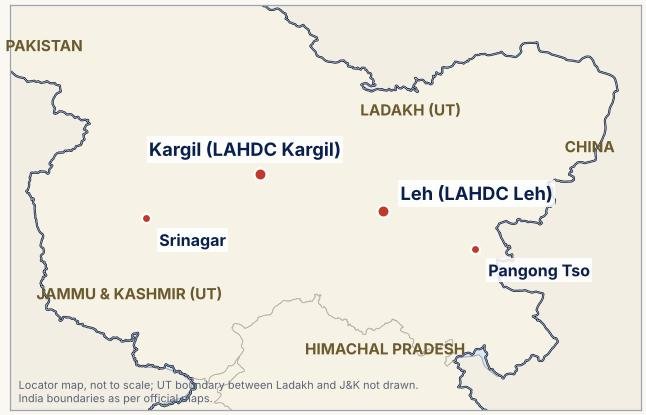
On 10 November 2026, Ladakh’s administration announced elections to eight Ladakh Autonomous Hill Development Councils (LAHDCs) for 4 December. Following the creation of six additional districts, the proposed arrangement replaces the previous two-council structure with eight councils covering 100 constituencies. About 1.87 lakh electors are expected to participate. The Leh Apex Body and Kargil Democratic Alliance remain concerned about constitutional safeguards, local representation and the electoral process. Groups in Kargil also objected to holding elections during winter.
Concept: Ladakh’s constitutional and administrative status
Ladakh became a Union Territory without a legislature on 31 October 2019 under the Jammu and Kashmir Reorganisation Act, 2019. Its elected hill development councils are institutions of local self-governance established through specific regional legislation. They are not equivalent to the autonomous district councils constituted under the Constitution’s Sixth Schedule. The Sixth Schedule, linked to Articles 244(2) and 275(1), provides special arrangements for tribal areas in Assam, Meghalaya, Tripura and Mizoram. Demands for its extension to Ladakh concern stronger legislative, administrative and resource-related autonomy beyond ordinary decentralisation.
Key facts for Prelims
- Ladakh: A Union Territory without its own Legislative Assembly.
- LAHDC: Ladakh Autonomous Hill Development Council, an institution distinct from Sixth Schedule autonomous district councils.
- Sixth Schedule: Applies to designated tribal areas of Assam, Meghalaya, Tripura and Mizoram.
- Election schedule: Polling on 4 December 2026; nomination deadline 17 November; election process to conclude by 8 December.
Mains analysis and way forward
Mains analysis
- Democratic participation: Elected hill councils provide local representation and a mechanism for decentralised planning.
- Constitutional gap: Ordinary council legislation does not necessarily deliver the legislative and resource-related safeguards sought under the Sixth Schedule.
- Cultural and ecological concerns: Ladakh’s communities seek protection of land, local employment, cultural identity and fragile Himalayan ecosystems.
- Representation debate: Expansion from two councils to eight raises questions about devolution of powers, fiscal capacity and effective coordination.
Way forward
- Resume structured dialogue among the Union government, Leh Apex Body, Kargil Democratic Alliance and elected representatives.
- Clearly specify the financial and administrative powers of the new councils.
- Examine constitutional safeguards through an inclusive process while ensuring accessible and credible elections.
Connect the dots: Federalism + Union Territory administration + Sixth Schedule + tribal rights + decentralised governance.
Sources: The Hindu, “Schedule for eight Ladakh hill council elections announced; polling on December 4”, 10 November 2026. The Indian Express, “In first polls since creation of 6 new districts, Ladakh to elect hill councils on December 4”, 10 November 2026. Administration of Union Territory of Ladakh, Chief Secretary’s election announcement, 10 November 2026.
Supreme Court closes a 30-year-old sales-tax surcharge reference, relies on earlier precedent
In short: The Supreme Court reaffirmed that a surcharge calculated on sales tax can remain an additional sales tax, while closing an outdated constitutional reference.

Why in news
On 4 November 2026, a seven-judge Constitution Bench of the Supreme Court disposed of a nearly three-decade-old reference concerning State surcharges on sales tax. The reference arose from Odisha and Punjab sales-tax laws and arguments that a surcharge calculated on tax payable amounted to an unconstitutional tax on tax. The Court reaffirmed the principle established in S. Kodar (1974) and held that the broader reference had become infructuous, particularly after constitutional changes associated with GST. Certain individual disputes were left for separate adjudication.
Concept: Surcharge, legislative competence and GST
A surcharge is an additional levy imposed over a tax. Its constitutional character depends on the subject being taxed, not merely the mathematical method used to calculate the amount. Before GST, Entry 54 of the State List broadly empowered States to tax the sale or purchase of goods, subject to constitutional limitations. The Constitution (101st Amendment) Act, 2016, introduced the GST framework and narrowed Entry 54. Article 366(12A) defines GST as a tax on the supply of goods or services or both, excluding alcoholic liquor for human consumption. Article 246A separately provides concurrent GST law-making powers.
Key facts for Prelims
- Entry 54, List II: Now covers sales taxes on petroleum crude, high-speed diesel, motor spirit, natural gas, aviation turbine fuel and alcoholic liquor for human consumption.
- Article 366(12A): Constitutional definition of GST.
- S. Kodar (1974): Held that additional sales tax calculated with reference to sales tax payable retains the character of sales tax.
- Pending questions: The Supreme Court left certain issues under Punjab’s sales-tax and social-security legislation for separate adjudication by the appropriate Benches.
- Judgment: A seven-judge Bench disposed of the reference on 4 November 2026, finding no surviving conflict requiring reconsideration.
Mains analysis and way forward
Mains analysis
- Substance over calculation: A surcharge is not automatically a separate tax merely because it is calculated as a percentage of another levy.
- Legislative competence: Courts examine the actual subject of taxation and its constitutional entry.
- Fiscal federalism: GST altered the balance between independent State taxation and coordinated Union-State tax powers.
- Judicial consistency: The Court relied on existing precedent rather than reopening a constitutional question whose practical context had substantially changed.
Way forward
- Draft tax laws with clearly defined taxable subjects, charging provisions and calculation mechanisms.
- Resolve pending disputes under older tax laws without confusing pre-GST and post-GST powers.
- Strengthen cooperative fiscal decision-making through the GST Council while respecting constitutional State powers.
Connect the dots: Seventh Schedule + Articles 246A and 366(12A) + GST Council + fiscal federalism + judicial precedent.
Sources: The Indian Express, “Can states levy a tax on sales tax? The 30-year-old legal question SC has now settled, explained”, 10 November 2026. Supreme Court Observer, “State’s Power to Impose Tax on Annual Turnover”, judgment summary, November 2026. Reserve Bank of India, analysis of the Constitution (101st Amendment) Act and GST.
Society and culture
Oxford returns the remains of 39 Naga ancestors after more than a century
In short: The return of 39 Naga ancestors’ remains raises important questions about cultural ownership, colonial collections and community-led restitution.

Why in news
On 9 November 2026, Oxford University’s Pitt Rivers Museum formally transferred custodianship of 39 Naga ancestral human remains to Naga representatives through the Forum for Naga Reconciliation and Naga tribal organisations. The transfer followed a community-led process initiated in 2020. Oxford’s governing council had approved the repatriation on 13 July 2026. The remains, held in Oxford for decades after their removal during the colonial period, began their journey home following the handover.
Concept: Repatriation and the 1970 UNESCO Convention
Repatriation means returning human remains, sacred objects or cultural property to their communities or places of origin. During colonial rule, museums and collectors acquired many objects and human remains through unequal relationships, sometimes without meaningful consent. The UNESCO Convention of 1970 establishes a framework to prevent illicit import, export and transfer of cultural property and facilitate cooperation over restitution. However, the Convention does not automatically require the return of every colonial-era collection. Human-remains repatriation also involves provenance research, ethical commitments, institutional agreements and the wishes of descendant communities.
Key facts for Prelims
- Pitt Rivers Museum: An anthropology and archaeology museum at the University of Oxford, United Kingdom.
- 39 ancestral remains: Repatriation authorised by Oxford University in July 2026; formal handover on 9 November 2026.
- UNESCO 1970 Convention: Adopted on 14 November 1970 and entered into force on 24 April 1972.
- India deposited its instrument of ratification of the Convention on 24 January 1977.
Mains analysis and way forward
Mains analysis
- Historical justice: Repatriation acknowledges that colonial collection practices could involve coercion, unequal power and disregard for community beliefs.
- Cultural continuity: Ancestral remains can hold spiritual, historical and social significance that cannot be reduced to their scientific or display value.
- Community agency: Descendant communities must help determine identification, return, burial, memorialisation and future access.
- Museum ethics: Institutions must balance legitimate research with dignity, consent, transparency and respect for the communities concerned.
Way forward
- Establish transparent inventories and provenance records of human remains and disputed cultural collections.
- Support community-led discussions on respectful return, conservation and memorialisation.
- Develop international museum partnerships based on consent, equitable research access and cultural dignity.
Connect the dots: Colonial history + tribal cultures + UNESCO conventions + museum ethics + restorative justice.
Sources: The Hindu, “Oxford University returns remains of 39 Naga people after more than a century”, 11 November 2026. Pitt Rivers Museum, “A Path Home”, including the July and November 2026 repatriation record. UNESCO, Convention on the Means of Prohibiting and Preventing the Illicit Import, Export and Transfer of Ownership of Cultural Property.
Environment and geography
Further mega dams in the Dibang basin face opposition as Arunachal’s hydropower push grows
In short: Resistance to major dams highlights the challenge of balancing India’s hydropower ambitions with indigenous rights, river ecology and disaster preparedness.

Why in news
In November 2026, opposition intensified around hydropower development in Arunachal Pradesh’s Dibang and Siang valleys. On 9 November, a rally in Roing raised concerns about the 2,880 MW Dibang Multipurpose Project and expressed solidarity with those opposing the proposed 11,200 MW Siang Upper Multipurpose Project. Downstream communities in Assam and Arunachal Pradesh also demanded stronger flood safeguards and recognition as project-affected families. Separately, the Dibang basin contains the proposed 3,097 MW Etalin and 680 MW Attunli projects.
Concept: Hydropower and the Brahmaputra river system
The Yarlung Tsangpo flows through Tibet before entering Arunachal Pradesh as the Siang. It joins the Dibang and Lohit river systems in Assam to form the Brahmaputra. The region has considerable hydropower potential because of steep gradients and high river flows. However, it is also seismically active and ecologically sensitive. Large dams can generate electricity, moderate some floods and provide strategic water-storage capacity. They can also submerge settlements, disrupt sediment transport, affect fisheries and expose downstream populations to risks if their design or operation is inadequate.
Key facts for Prelims
- Dibang Multipurpose Project: A 2,880 MW NHPC project in Lower Dibang Valley, Arunachal Pradesh, designed for electricity generation and flood moderation.
- Etalin Hydroelectric Project: A proposed 3,097 MW NHPC project in the Dibang basin, associated with the Dri and Tangon rivers.
- Attunli Hydroelectric Project: A 680 MW SJVN project on the Talo or Tangon River in the Dibang sub-basin.
- Siang Upper Multipurpose Project: A proposed project of approximately 11,200 MW on the Siang River, distinct from the Dibang projects.
Mains analysis and way forward
Mains analysis
- Strategic dimension: China’s hydropower development near the Great Bend of the Yarlung Tsangpo, including the Medog project, has increased Indian attention to upstream water infrastructure and downstream risks.
- Environmental concerns: Large dams may alter sediment movement, aquatic habitats and river flows. Multiple projects require cumulative basin-level assessment.
- Indigenous rights: Idu Mishmi communities in the Dibang region and Adi communities in the Siang region have cultural and livelihood connections to their landscapes. Their concerns must not be treated as identical.
- Disaster vulnerability: High seismic exposure, intense rainfall and landslide-prone terrain demand robust dam safety and emergency planning.
Way forward
- Conduct independent cumulative environmental assessments, including seismic risk and climate-adjusted flood estimates.
- Ensure meaningful local consultation, transparent rehabilitation and recognition of eligible downstream-affected families.
- Strengthen dam-safety audits, early-warning systems and India-China hydrological data cooperation.
Connect the dots: Himalayan river systems + renewable energy + disaster management + indigenous rights + India-China relations.
Sources: The Hindu, “Opposition builds over third mega dam project on Dibang River”, 11 November 2026. The Hindu, “Siang dam and a threatened homeland in Arunachal Pradesh”, November 2026. The Times of India, “NHPC go back: Dibang Valley rallies behind Siang anti-dam protesters”, 9 November 2026. https://sjvn.nic.in/en/attunli-hep. NHPC, Etalin HEP agreement disclosure, 16 June 2026.
Supreme Court panel recommends phasing out unsustainable river sand mining within three years
In short: A Supreme Court-appointed committee has proposed reducing harmful river sand extraction while developing reservoir sediment and manufactured sand as alternatives.

Why in news
The Supreme Court-appointed Central Empowered Committee (CEC), in Report No. 36 of 2026 filed on 2 November, recommended a three-year roadmap to phase out unsustainable sand extraction from active river channels. The recommendations arose from proceedings concerning illegal mining in the National Chambal Sanctuary. The CEC also proposed a national reservoir-desilting framework, followed by a structured ten-year cycle for suitable reservoirs. The report emphasised alternative sand supplies, digital monitoring and environmental safeguards rather than an immediate blanket prohibition.
Concept: Sustainable sand mining and river ecology
River sand is a minor mineral under Section 3(e) of the Mines and Minerals (Development and Regulation) Act, 1957. States regulate minor-mineral concessions under Section 15. The Sustainable Sand Mining Management Guidelines, 2016, promote scientific assessment and environmentally responsible extraction. The Enforcement and Monitoring Guidelines, 2020, strengthen district surveys, replenishment studies and monitoring. Excessive extraction alters riverbed levels, destabilises banks, damages aquatic habitats and may affect groundwater recharge. Reservoir desilting can recover some construction material and restore storage capacity, but not all accumulated sediment is suitable or safe to remove.
Key facts for Prelims
- MMDR Act, 1957: Sand is classified as a minor mineral; States regulate its mineral concessions.
- MoEFCC guidelines: Sustainable Sand Mining Management Guidelines, 2016, and Enforcement and Monitoring Guidelines, 2020.
- District Survey Report: A key document identifying potential mining locations and environmental constraints.
- CEC finding: Across 439 assessed reservoirs, average gross storage loss from sedimentation was reported at 19.24%, based on Ministry of Jal Shakti data.
Mains analysis and way forward
Mains analysis
- Ecological damage: Excessive mining changes channel morphology, accelerates bank erosion and destroys riverine habitats.
- Construction demand: Abrupt supply restrictions without alternatives can encourage illegal extraction and increase construction costs.
- Reservoir management: Selective desilting may restore storage and supply usable material, but sediment quality and ecological impacts vary.
- Governance failure: Weak monitoring, illegal transport and inadequate extraction data obstruct sustainable resource management.
Way forward
- Implement scientifically determined extraction limits and river-wise replenishment studies.
- Develop BIS-compliant manufactured sand, suitable reservoir sediment and recycled construction waste as substitutes.
- Introduce QR-based transit permits, digital mineral tracking and independently audited desilting programmes.
Connect the dots: River geomorphology + environmental regulation + sustainable construction + groundwater + State resource powers.
Sources: The Indian Express, “Supreme Court panel: Phase out ‘unsustainable’ river sand mining in 3 years, desilt dams”, 11 November 2026. MoEFCC, Sand Mining Guidelines, 2016 and 2020. PIB, “Guidelines for Sand Mining”, official explanation of MMDR provisions.
Economy, science and technology
Starlink debate: balancing satellite connectivity with strategic autonomy
In short: A newspaper commentary argues that India should strengthen satellite broadband without compromising regulatory control, national security or strategic autonomy.

Why in news
An 11 November 2026 commentary in The Hindu argues that strategic autonomy should guide India’s approach to Starlink and other foreign satellite internet operators. India has already provided satellite communication authorisations to several operators, including Starlink, but commercial deployment requires compliance with additional spectrum and security requirements. The Telecommunications Act, 2023, permits administrative spectrum assignment for specified satellite services. The debate concerns how India can expand broadband coverage while retaining effective oversight of networks, user information and critical communications infrastructure.
Concept: Satellite broadband and regulatory authorisation
Satellite broadband delivers internet connectivity through satellites rather than relying exclusively on terrestrial fibre or mobile towers. Low Earth Orbit constellations use satellites closer to Earth, helping reduce communication latency compared with traditional geostationary systems. In India, telecommunications service authorisation falls under the Department of Telecommunications (DoT), while IN-SPACe authorises relevant space activities and satellite systems. Under the Telecommunications Act, 2023, specified satellite-based services are eligible for administrative spectrum assignment. This does not mean free or automatic spectrum access. Operators must separately satisfy applicable frequency assignment, gateway, lawful-interception and security conditions.
Key facts for Prelims
- Telecommunications Act, 2023: Its First Schedule includes specified satellite services eligible for administrative spectrum assignment.
- IN-SPACe: Indian National Space Promotion and Authorisation Centre, the space-sector authorisation body.
- GMPCS: Global Mobile Personal Communication by Satellite, a category of satellite communication services.
- TRAI, November 2026: Recommended a separate Satellite Communication Network Provider authorisation for supplying network services to eligible operators, not directly to users. This remains a recommendation.
- Ground gateways: Indian licensing conditions require authorised gateway infrastructure and compliance with stipulated routing and security requirements.
Mains analysis and way forward
Mains analysis
- Digital inclusion: Satellite broadband can connect remote Himalayan, island, border and rural areas where terrestrial networks are difficult to establish.
- Strategic autonomy: Dependence on a foreign-operated satellite constellation can create concerns about service continuity, governance and access during geopolitical crises.
- Security and privacy: Lawful interception, network monitoring, applicable data-protection obligations and cybersecurity compliance require enforceable safeguards.
- Market competition: Regulation must protect national interests without creating arbitrary barriers or favouring particular operators.
Way forward
- Apply transparent, technology-neutral authorisation and spectrum-allocation rules to all eligible operators.
- Ensure enforceable security, lawful-interception, incident-reporting and applicable data-handling requirements.
- Promote domestic satellite technology, interoperable communications infrastructure and resilient alternatives.
Connect the dots: Space technology + Digital India + strategic autonomy + cyber sovereignty + competition policy.
Sources: The Hindu, opinion article, “Strategic autonomy must guide India’s Starlink policy”, 11 November 2026. India Code, Telecommunications Act, 2023, First Schedule. Department of Telecommunications, GMPCS authorisation requirements.
NMDC reportedly explores lithium investments with Russia’s Rosatom
In short: Reported exploratory discussions involving NMDC and Russian lithium projects highlight India’s efforts to diversify critical-mineral supplies.

Why in news
On 10 November 2026, Reuters reported, citing three sources, that India’s State-owned miner NMDC had held preliminary discussions with Russia’s Rosatom and explored possible investments in Russian lithium mining and processing. The sources said NMDC officials had visited Russia in October. Rosatom, however, stated that it was not currently engaged in talks with NMDC, while NMDC did not respond to the report. No investment agreement was confirmed. The development comes amid India’s efforts to secure lithium for batteries, electric vehicles and domestic mineral-processing industries.
Concept: Critical minerals and the National Critical Mineral Mission
Critical minerals are economically important resources whose supply could face significant disruption. Lithium is essential for many rechargeable batteries used in electric vehicles and energy-storage systems. India’s vulnerability includes limited domestic production and dependence on imported materials, processed chemicals and battery components. On 29 January 2025, the Union Cabinet approved the National Critical Mineral Mission (NCMM). It covers exploration, mining, processing, recycling and overseas asset acquisition. The approved framework provides for government expenditure of Rs 16,300 crore and expected investment of Rs 18,000 crore by public sector enterprises and other stakeholders over seven years.
Key facts for Prelims
- NMDC Limited: A public sector mining company under the Ministry of Steel.
- Rosatom: Russia’s State atomic energy corporation, associated with nuclear and other strategic technologies.
- NCMM: Approved on 29 January 2025, covering FY 2024-25 to FY 2030-31.
- KABIL: Khanij Bidesh India Limited, a joint venture of NALCO, Hindustan Copper and Mineral Exploration & Consultancy Limited, established to secure overseas critical minerals.
Mains analysis and way forward
Mains analysis
- Supply-chain diversification: Overseas mineral investments can reduce excessive reliance on a limited number of supplier countries.
- Value addition: Access to mineral deposits is insufficient without refining, chemical processing and battery-manufacturing capabilities.
- Geopolitical risk: Overseas partnerships require assessment of sanctions exposure, investment restrictions and logistics.
- Environmental responsibility: Lithium extraction can create water-use, waste-management and ecosystem concerns requiring due diligence.
Way forward
- Diversify sourcing through multiple countries and long-term supply partnerships.
- Strengthen domestic mineral exploration, processing, battery recycling and research.
- Subject overseas acquisitions to commercial, environmental and sanctions-related risk assessment.
Connect the dots: Critical minerals + electric mobility + energy transition + industrial policy + economic diplomacy.
Sources: The Hindu, “NMDC said to be in talks with Russia’s Rosatom over lithium investments”, 11 November 2026. Reuters, “India’s NMDC in talks with Russia’s Rosatom over lithium investments, sources say”, 10 November 2026. PIB, National Critical Mineral Mission approval, 29 January 2025. PIB, KABIL established to secure critical mineral supplies, 1 August 2019.
DGTR opens a suo motu anti-dumping probe into aluminium imports
In short: India’s trade-remedy authority has independently initiated an investigation into specified aluminium imports, without making a final finding of dumping.

Why in news
On 9 November 2026, the Directorate General of Trade Remedies (DGTR) initiated a suo motu anti-dumping investigation into aluminium extrusion profiles, structures and related articles originating in or exported from China, Malaysia, Vietnam and Thailand. The official notification identifies four countries, including Thailand. Representations from the Aluminium Extrusion Manufacturers Association of India, reportedly representing 228 manufacturers, raised concerns about dumped imports and injury to domestic producers. The investigation will determine whether dumping, material injury and a causal relationship are established.
Concept: Anti-dumping duty and the injury margin
Dumping occurs when an exported product is sold at a price below its normal value, determined according to applicable trade-remedy rules. Under Section 9A of the Customs Tariff Act, 1975, India may impose anti-dumping duties following a legally compliant investigation. DGTR examines dumping, material injury to domestic industry and causation. The dumping margin measures the difference between normal value and export price. The injury margin measures the difference between the non-injurious domestic price and the landed value of imports, under the applicable rules. India’s lesser-duty approach aims to remove injury without imposing an unnecessarily higher duty.
Key facts for Prelims
- DGTR: Directorate General of Trade Remedies, under the Department of Commerce, Ministry of Commerce and Industry.
- Legal basis: Section 9A, Customs Tariff Act, 1975, and the Anti-Dumping Rules, 1995.
- Institutional roles: DGTR investigates dumping and recommends trade-remedy duties; the Department of Revenue, Ministry of Finance, decides whether to impose them.
- Suo motu power: Rule 5(4) permits initiation without a domestic-industry application when sufficient supporting evidence exists.
- Countries investigated: China, Malaysia, Vietnam and Thailand. The investigation does not itself establish dumping or impose duty.
Mains analysis and way forward
Mains analysis
- Domestic industry: Trade remedies can protect producers facing proven injury from unfairly priced imports.
- Procedural safeguards: Anti-dumping duties require evidence and due process, not merely an increase in imports or low prices.
- Fragmented industries: Smaller manufacturers may lack the resources to prepare complex applications, making suo motu action relevant.
- Consumer and industrial interests: Duties can raise input costs for downstream manufacturers and must be assessed carefully.
Way forward
- Conduct transparent investigations with opportunities for exporters, importers and domestic producers to respond.
- Base recommendations on verified dumping margins, material injury and causation.
- Combine lawful trade remedies with productivity improvement, quality upgrading and industrial competitiveness.
Connect the dots: WTO rules + Customs Tariff Act + trade remedies + MSME competitiveness + industrial policy.
Sources: The Hindu, “DGTR suo motu initiates probe into dumping of aluminium products from China, Malaysia, Vietnam”, 10 November 2026. DGTR, official initiation notification, Case 6/67/2026-DGTR, 9 November 2026. WTO, Agreement on Implementation of Article VI of GATT 1994. India Code, Customs Tariff Act, 1975.
Tea industry backs a proposal for a minimum sustainable price
In short: A Tea Board committee’s pricing proposal seeks to protect producer viability amid rising costs and fluctuating tea-market returns.

Why in news
On 10 November 2026, five major tea industry associations urged the Union government to adopt a Tea Board committee’s proposal for a minimum sustainable price for tea. The ten-member committee, formed in July 2026, recommended a benchmark reflecting wage movements and changes in the Consumer Price Index, with periodic reviews. Industry representatives say a stronger price framework could help narrow the gap between production costs and realised prices. The proposal has been submitted for government consideration; it is not an implemented statutory minimum price.
Concept: Tea marketing and the Price Sharing Formula
Tea is a plantation crop regulated under the Tea Act, 1953. The Tea Board, established on 1 April 1954, supports development, regulation, research, quality and marketing. Tea reaches markets through auctions and private sales. Small tea growers commonly sell green leaves to bought-leaf factories, while estates may process their own produce. The existing Price Sharing Formula (PSF) seeks to distribute the realised value of made tea fairly between growers and manufacturers. District green-leaf prices are linked to auction-price benchmarks. A proposed minimum sustainable price for made tea is distinct from both the PSF and conventional government procurement at minimum support prices.
Key facts for Prelims
- Tea Board of India: A statutory body under the Tea Act, 1953, functioning under the Ministry of Commerce and Industry.
- Small tea growers: Accounted for 54.55% of India’s tea production in 2024-25, according to the Tea Board’s annual report.
- Price Sharing Formula: A mechanism for sharing tea-sale realisation between green-leaf growers and manufacturers.
- Auction system: Tea is sold through organised auctions and private transactions; auction prices help inform district-level green-leaf price determination.
Mains analysis and way forward
Mains analysis
- Producer viability: Wage increases, input costs and uncertain market realisation can affect investment in plantations and processing.
- Small-grower vulnerability: Growers selling green leaves may have weaker bargaining power and limited storage or processing capacity.
- Price intervention: A cost-sensitive benchmark could support producers, but poorly designed price controls may distort markets or affect competitiveness.
- Sector sustainability: Price reforms must also consider labour welfare, productivity, quality and demand.
Way forward
- Evaluate the proposed price framework using transparent cost, wage, inflation and market data.
- Strengthen implementation of the Price Sharing Formula and improve growers’ access to price information.
- Promote farmer producer organisations, quality improvement, value addition and diversification of export markets.
Connect the dots: Plantation agriculture + statutory commodity boards + price discovery + labour welfare + agricultural value chains.
Sources: The Hindu, “Producers welcome proposal for minimum sustainable price for tea”, 11 November 2026. Business Standard, “Tea industry bodies welcome Tea Board panel proposal for sustainable price”, 10 November 2026. Tea Board India, Annual Report 2024-25. Tea Board, official document on objectives and statutory functions. Tea Board, Tea (Marketing) Control Order, 2003, updated to 2024.
International relations and security
India and the U.S. vow joint action against synthetic drugs and precursor chemicals
In short: India and the United States have agreed to strengthen intelligence sharing, precursor control and coordinated enforcement against evolving drug-trafficking networks.

Why in news
The second India-U.S. Drug Policy Executive Working Group meeting was held in New Delhi on 2 and 3 November 2026. A joint statement published on 9 November reaffirmed bilateral cooperation against illicit drug trafficking. The meeting was led by Narcotics Control Bureau Director General Anurag Garg and U.S. Office of National Drug Control Policy Acting Deputy Director Debbie Seguin. Discussions covered synthetic drugs, chemical precursors, pharmaceutical supply-chain integrity, intelligence sharing, financial investigations and drug-demand reduction. Both sides also reviewed operational initiatives and opportunities for further cooperation.
Concept: Synthetic drugs, precursor chemicals and international drug control
Synthetic drugs are manufactured through chemical processes rather than obtained directly from naturally occurring plant material. Some synthetic opioids, including illicitly manufactured fentanyl, can be extremely potent and present serious overdose risks. Precursor chemicals are substances used in manufacturing drugs and may also have legitimate industrial or pharmaceutical applications. India’s Narcotic Drugs and Psychotropic Substances Act, 1985, governs controlled narcotic drugs and psychotropic substances, while precursor control operates through applicable legal provisions and notifications. International cooperation is guided by the UN drug conventions of 1961, 1971 and 1988.
Key facts for Prelims
- NDPS Act, 1985: Principal Indian legislation governing narcotic drugs and psychotropic substances.
- NCB: Narcotics Control Bureau, a central coordinating and enforcement agency under the Ministry of Home Affairs.
- Three major UN drug conventions: 1961 Single Convention on Narcotic Drugs; 1971 Convention on Psychotropic Substances; 1988 Convention against Illicit Traffic in Narcotic Drugs and Psychotropic Substances.
- Drug Policy Executive Working Group: The second India-U.S. meeting took place on 2 and 3 November 2026.
Mains analysis and way forward
Mains analysis
- Transnational networks: Drug trafficking increasingly involves interconnected suppliers, chemical manufacturers, logistics channels and financial intermediaries.
- Dual-use precursors: Legitimate chemical trade must continue while preventing diversion into illicit drug manufacturing.
- Public-health dimension: Prevention, treatment and rehabilitation are essential alongside seizures and criminal prosecution.
- International coordination: Shared intelligence and financial investigations can disrupt trafficking networks across borders.
Way forward
- Improve real-time intelligence exchange, precursor monitoring and financial investigation capabilities.
- Strengthen pharmaceutical supply-chain traceability and voluntary industry compliance mechanisms.
- Integrate enforcement with evidence-based prevention, treatment and rehabilitation programmes.
Connect the dots: NDPS Act + transnational organised crime + India-U.S. relations + public health + international conventions.
Sources: The Hindu, “India, U.S. vow to jointly act against emerging drug threats”, 10 November 2026. The White House, “India and United States Reaffirm Commitment to Strengthen Bilateral Counter-Narcotics Cooperation”, 9 November 2026. United Nations, international drug control conventions. India Code, Narcotic Drugs and Psychotropic Substances Act, 1985.
Gulf states approve a joint military command headquarters in Kuwait
In short: The six GCC countries have approved an additional command facility in Kuwait to strengthen joint defence coordination amid regional insecurity.

Why in news
On 10 November 2026, defence ministers of the Gulf Cooperation Council approved an advanced headquarters for the bloc’s Unified Military Command in Kuwait and the allocation of appropriate forces to it. GCC Secretary-General Jasem Mohamed Albudaiwi announced the decision following the 23rd Joint Defense Council meeting in Manama, Bahrain. The announcement comes amid regional security concerns following the war involving Iran, Israel and the United States, which began on 28 February 2026. Operational details of the new facility were not announced.
Concept: GCC and collective Gulf security
The Gulf Cooperation Council was established on 25 May 1981 to strengthen coordination and integration among Bahrain, Kuwait, Oman, Qatar, Saudi Arabia and the United Arab Emirates. Its cooperation extends across economic, political and security matters. The Peninsula Shield Force emerged as a collective military arrangement in the 1980s, while the GCC established its Unified Military Command in 2013. These mechanisms aim to improve coordination among national armed forces. The proposed advanced headquarters in Kuwait adds a forward command facility; it should not be confused with the establishment of the original Unified Military Command.

Key facts for Prelims
- GCC: Established on 25 May 1981; six member States.
- Members: Bahrain, Kuwait, Oman, Qatar, Saudi Arabia and the UAE.
- Peninsula Shield Force: GCC collective military force established in the early 1980s, operational from 1984.
- Unified Military Command: Established in 2013; the newly approved advanced command facility is in Kuwait.
Mains analysis and way forward
Mains analysis
- Regional security: Collective defence coordination may improve preparedness against missile, drone and maritime threats.
- Strategic limitations: GCC members have differing foreign-policy priorities and external security partnerships, potentially complicating joint operations.
- India’s energy security: Disruption in Gulf oil and gas production or maritime transport can affect Indian import costs and energy availability.
- Diaspora and trade: The safety of Indian workers, remittances, shipping links and investment relationships gives India a direct interest in regional stability.
Way forward
- Support diplomatic de-escalation and peaceful resolution of regional disputes.
- Deepen energy-supply diversification, strategic reserves and maritime security cooperation.
- Advance India-GCC economic engagement, including the FTA negotiations formally launched in February 2026, while maintaining balanced regional relationships.
Connect the dots: Regional organisations + West Asian geopolitics + energy security + Indian diaspora + economic diplomacy.
Sources: The Hindu, “Gulf Arab states approve military command headquarters in Kuwait, GCC chief says”, 11 November 2026. Reuters, “Gulf Arab states approve military command headquarters in Kuwait”, 10 November 2026. GCC Secretariat, official announcement following Joint Defense Council meeting, 10 November 2026. GCC Secretariat, charter and membership. PIB, formal launch of India-GCC FTA negotiations, 24 February 2026.
In brief
- Drones barred near Amur falcon roosts: Assam has prohibited unauthorised drone operations near seasonal Amur falcon congregation sites to prevent disturbance. Prelims: The Amur falcon (Falco amurensis) is a long-distance migratory raptor. Umrangso in Assam and the Doyang reservoir near Pangti in Nagaland are important stopover locations. Source
- Coal gasification: NTPC bids: On 10 November 2026, the Ministry of Coal announced that Round 2 of the ₹37,500 crore surface coal/lignite gasification scheme received two applications, both from NTPC, proposing urea, methanol and dimethyl ether production. Round 3 opened on the same day. Source
- Kadambini Ganguly: Kadambini Ganguly (1861-1923) and Chandramukhi Basu were among British India’s first female graduates in 1883. Ganguly received the Graduate of Bengal Medical College qualification in 1886, rather than an MB degree, and became a pioneering practitioner of Western medicine. Source
- Sheikh Hasina and travel documents: On 10 November 2026, India’s Ministry of External Affairs stated that international travel requires appropriate documentation, following questions about former Bangladesh Prime Minister Sheikh Hasina’s passport. India described the extradition issue as a legal matter, without confirming any travel arrangement. Source
- Hormuz LNG traffic recovers: Vessel-tracking data reported by S&P Global Energy showed 31 laden LNG tankers exiting the Strait of Hormuz in October 2026, compared with 23 in September, the highest monthly tally since the Iran war began in February. Prelims: The strait connects the Persian Gulf with the Gulf of Oman. Source
Prelims practice: 5 questions
Choose an option to see the answer and explanation. Your score appears when all five are answered.
Mains practice
GS II | Criminal justice, bail and personal liberty “The constitutional promise of personal liberty remains incomplete when undertrial prisoners continue in custody despite being granted bail.” Examine the legal, financial and administrative barriers to implementing bail orders in India. Suggest reforms to ensure that bail results in timely release.
Show the answer outline
INTRODUCTION
Article 21 protects personal liberty and demands fair legal procedures. However, granting bail and securing actual release are different stages of justice. The Supreme Court’s November 2026 directions to Uttar Pradesh demonstrate this implementation gap.
LEGAL AND CONSTITUTIONAL FRAMEWORK
- Article 21 protects life and personal liberty, while Article 39A promotes equal justice and free legal aid.
- Section 479 of the BNSS provides detention-period-based release safeguards for eligible undertrials, subject to statutory exceptions.
- Courts can review disproportionate bail conditions. Legal services authorities facilitate access to legal assistance.
BARRIERS TO EFFECTIVE RELEASE
- Financial: Poor accused persons may struggle to furnish sureties, bonds or required documentation.
- Administrative: Delays in communicating bail orders, verifying sureties and coordinating prison releases prolong custody.
- Legal: Complex conditions, inadequate representation and delayed applications for modification obstruct release.
- Institutional: Fragmented responsibility between courts, prisons, police and legal services authorities weakens accountability.
JUDICIAL GUIDANCE AND INSTITUTIONAL RESPONSIBILITY
- The Supreme Court’s 2023 SOP requires jail authorities to notify the DLSA after seven days; automated e-Prisons alerts were proposed.
- In November 2026, the Court directed Uttar Pradesh to review unreleased undertrials across all 75 districts.
- District Legal Services Authorities can assist eligible prisoners irrespective of whether private counsel has been engaged.
WAY FORWARD
- Integrate digital bail orders, prison records and legal-aid monitoring.
- Review unaffordable surety requirements and permit suitable personal bonds.
- Strengthen Undertrial Review Committees, time-bound compliance and periodic public reporting.
CONCLUSION
Bail must become an enforceable guarantee of liberty rather than a merely formal judicial order. Effective coordination, affordable conditions and institutional accountability are essential for substantive justice.
TIP: Distinguish eligibility for bail under Section 479 from implementation of an already granted bail order. Both affect personal liberty, but address different legal problems.
The DAF-II window is open.
DAF-II opens today, 11 November. Every line you fill in today is a question the Board may ask you in a few weeks, so fill it with care and prepare from it. Read the six free Interview Edge books (336 pages), practise from your own DAF in Interview Edge Studio, and apply for Interview Edge: a one-to-one profile session with Guranchal Ma’am and a mock interview with a panel of seasoned officers and academicians. Complimentary and application-based.
Six free books · Interview Edge Studio · DAF-II checklist · WhatsApp +91 81220 02172
Current Canvas is prepared by the UPSC Gurus editorial desk. Every fact is checked against official releases and reliable reporting, with sources listed under each story. Editions are compiled each month into Current Canvas Monthly, a free magazine.
About images: photographs and illustrations in Current Canvas are AI-generated for illustration only. They are not news photographs of the events described.
Your first Mentor’s Desk call is free
One free conversation per aspirant about where you are in your preparation, with an honest suggestion of the right next step.
Know more and bookHave a question? Get in touch
For questions about a programme, its fees, batch dates, payment or access. Message us on WhatsApp and our team will reply. Asking a question is not a booking, and you can ask as often as you need.
Get in touch on WhatsApp