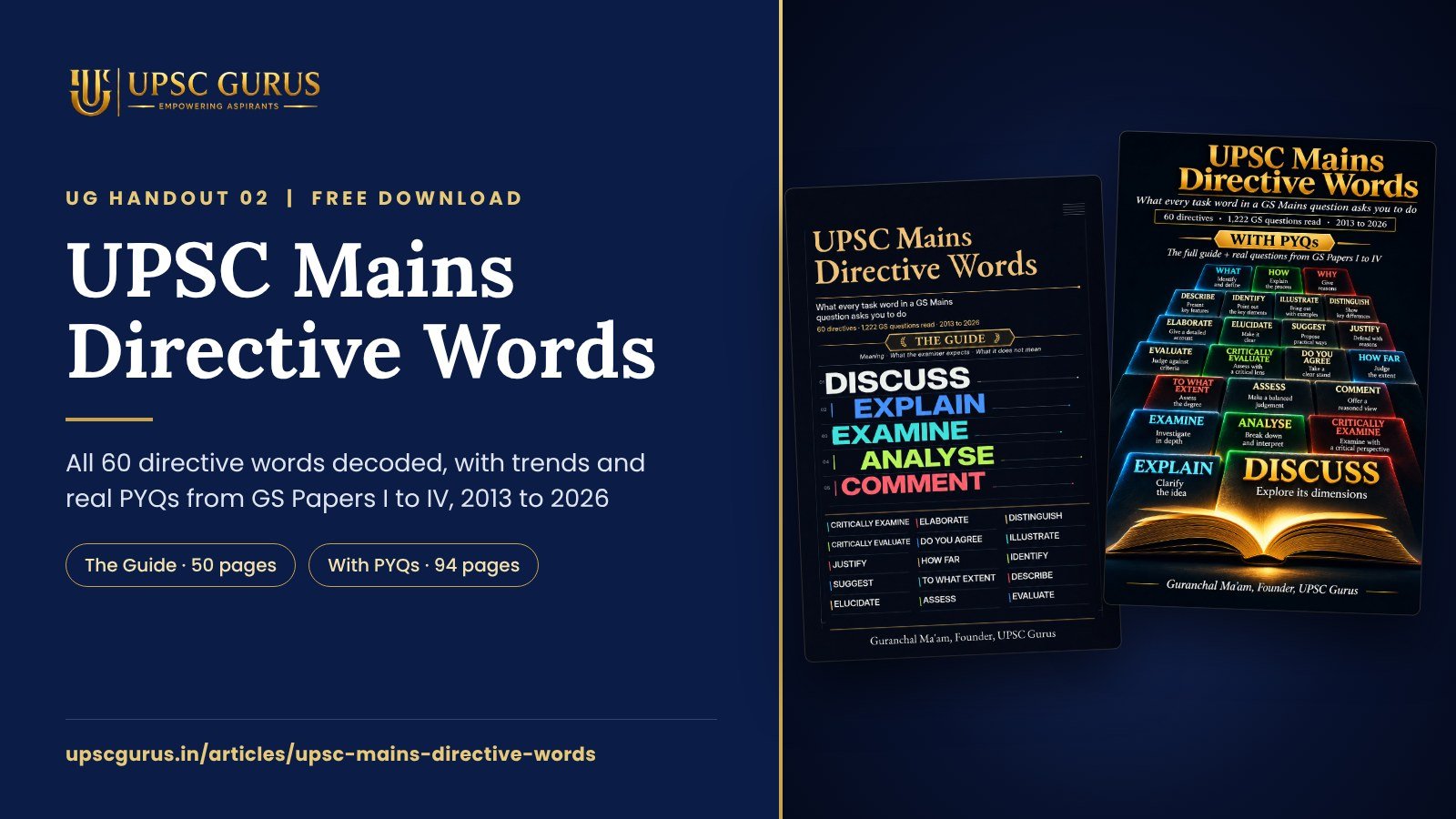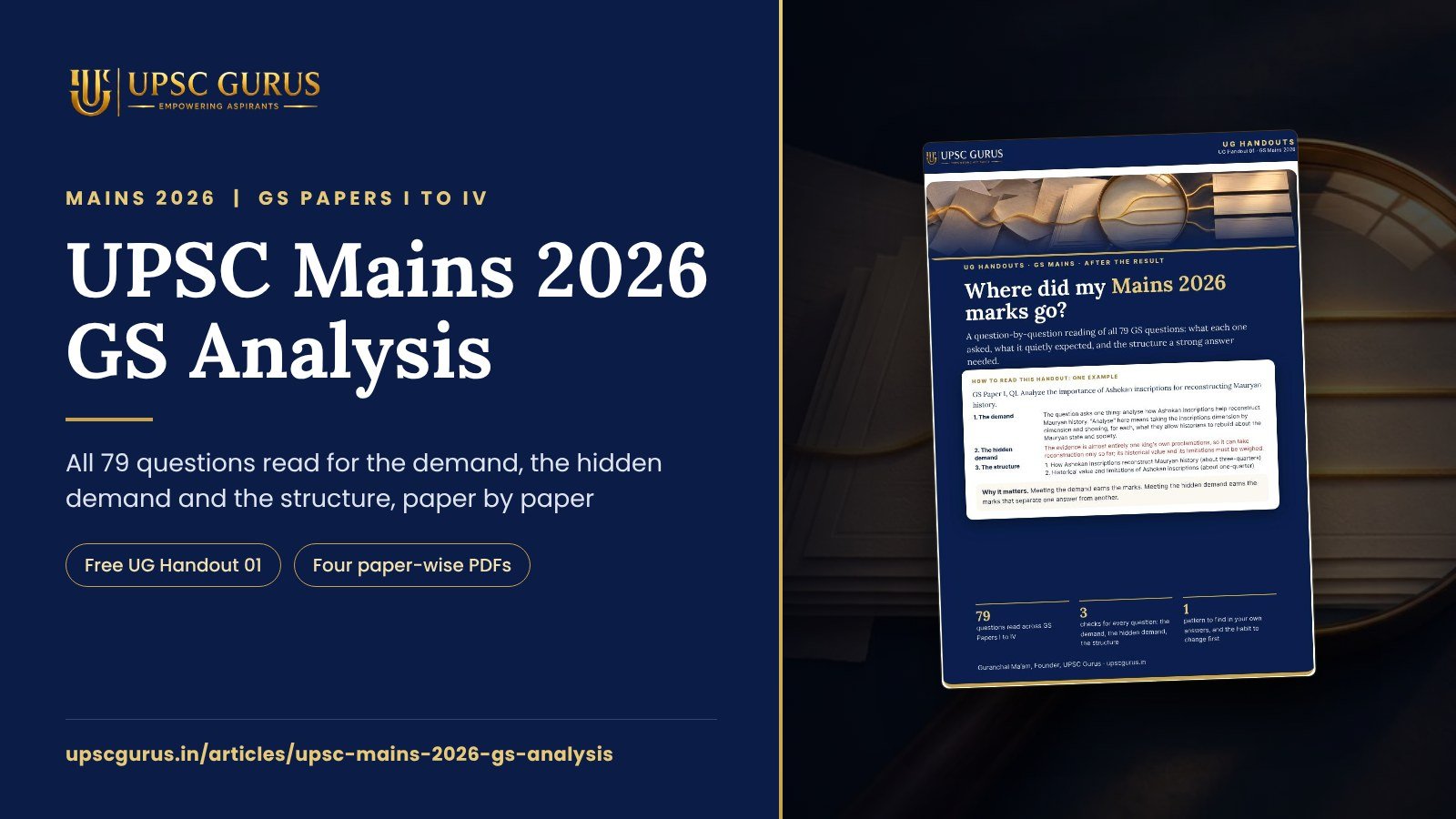
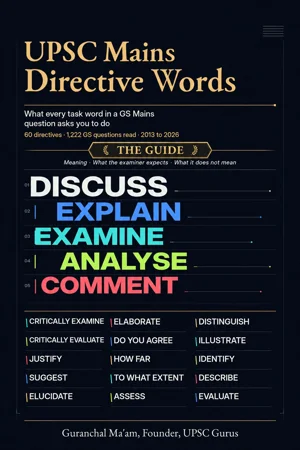
 New this week · Free UG Handout 02UPSC Mains Directive Words: 60 Meanings, Trends and PYQsTwo free PDFs: The Guide and the With PYQs edition.Read and download
Today’s Canvas
This edition opens in Atlanta, where the Quad turned its attention to economic security, from critical minerals to safe sea lanes. At home, a second cyclone in a fortnight is heading for the Andhra coast, GST receipts have risen sharply and States get an early share of taxes. We also look at a patent decision that may widen access to TB medicines, the start of the Nashik Kumbh, lessons from the loss of a young cheetah, and the quiet ethics of organ donation.
Sources for this edition include The Hindu, The Indian Express, PIB, the Ministry of External Affairs and official releases.
About 18 minutes to read the key points; Mains analysis opens under each story.
- Quad Foreign Ministers in Atlanta put economic security first: critical minerals, trusted AI and safe sea lanesGS II
- Cyclone Murasu forms over the Bay of Bengal, days after Arnab; landfall expected on the Andhra Pradesh coast on 3 NovemberGS I and GS III
- Glacial lake outburst at Shintaphu Lake in Bhutan prompts flood alerts along the Sankosh in Assam and West BengalGS I and GS III
- GST collections rise 23% to Rs 2.31 lakh crore in October; Centre releases an extra Rs 1,09,019 crore of tax devolution to StatesGS III
- CAQM team reviews paddy straw management in Punjab as Delhi records its cleanest October in eight years, average AQI 166GS III
- Speaker to open national conference of Public Accounts Committee chairpersons in Thiruvananthapuram on 3 NovemberGS II
- Patent Office refuses application for the TB combination BPaL, which may widen generic supply of a shorter drug-resistant TB regimenGS II and GS III
- EPFO marks 74 years with a Rs 32 lakh crore corpus; social protection coverage has risen from 19% in 2015 to 68.4%GS II
- Simhastha period of the Nashik-Trimbakeshwar Kumbh begins with flag hoisting; President Murmu attends the DhwajarohanGS I
- Kuno director explains limits of satellite collars after a young cheetah dies of pellet wounds; six forest officials suspendedGS III
- TRAI proposes rules for responsible AI in telecom networks: board-approved policies, risk tiers and mandatory reporting of serious incidentsGS III
- Vice-President opens National Organ Transplant Games, calls organ donation a “Mahadaan”GS IV and GS II
- Quad ministers back open supply chains, trusted AI and freedom of navigation in Hormuz and the Red Sea.
- Cyclone Murasu formed on 1 November; landfall expected on the Andhra coast on 3 November.
- October GST up 23% to Rs 2.31 lakh crore; States receive an extra Rs 1,09,019 crore.
- Patent Office rejects BPaL patent, easing generic supply of a shorter drug-resistant TB regimen.
- Nashik-Trimbakeshwar Simhastha begins; main bathing days in August and September 2027.
- Delhi’s October AQI averaged 166, the best in eight years, as CAQM checks straw management in Punjab.
International relations

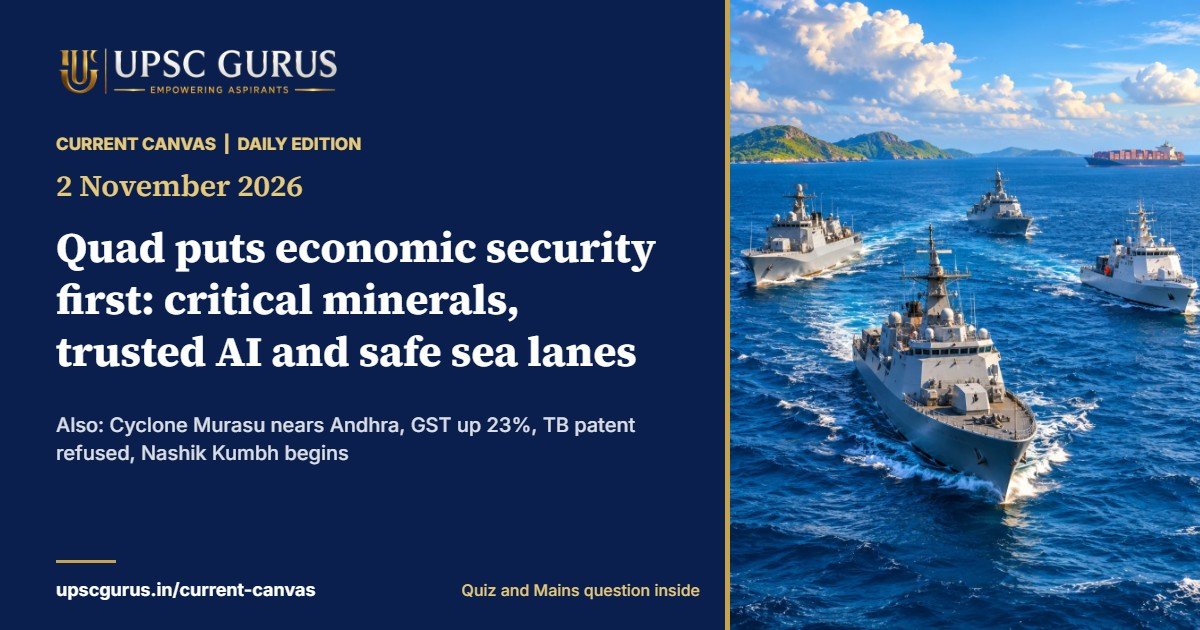
Quad Foreign Ministers in Atlanta put economic security first: critical minerals, trusted AI and safe sea lanes
In short: On 31 October the Quad ministers backed open supply chains, planned over $85 million for trusted AI, and urged free navigation through Hormuz and the Red Sea.
Why in news
The US Secretary of State and the Foreign Ministers of Australia, India and Japan met in Atlanta, Georgia, on 31 October 2026, on the sidelines of the G20 Foreign Ministers’ Meeting. Their joint press release, issued by the Ministry of External Affairs, voices grave concern over economic coercion, including arbitrary export restrictions, and over non-market practices that create overcapacity in critical industries. The ministers called for protecting navigational rights in the Strait of Hormuz, the Red Sea and the Bab el-Mandeb Strait in accordance with UNCLOS.
Background
The Quad (Quadrilateral Security Dialogue) of Australia, India, Japan and the United States began as a tsunami core group in 2004 and was revived in 2017; leaders have met since 2021. Its agenda has widened from maritime security to health, climate, technology, infrastructure and now economic security. The Atlanta statement builds on the Quad Critical Minerals Initiative Framework announced in May 2026, when the Foreign Ministers met in New Delhi. It also recognised India’s role as first responder after Nepal’s flash floods of 26 August 2026.
Key facts for Prelims
- Atlanta: the ministers expressed their intent to provide over $85 million of technical and financial assistance for trusted AI across the Indo-Pacific, including through the Quad AI Accelerator.
- Critical minerals: the US will provide $10 million for facilities in India and ASEAN countries that recover critical minerals from waste.
- The second Quad-at-Sea Ship Observer mission sailed from Chennai to Perth (25 September to 7 October 2026) aboard an Indian Coast Guard Offshore Patrol Vessel.
- Upcoming: first Quad Business Leaders’ Forum; Quad export credit agencies meet in Tokyo on 18 November; first exercise under the Indo-Pacific Maritime Surveillance Collaboration at Sea Dragon 2027.
- Australia, Japan and the US will send observers to India’s Annual Joint HADR Exercise (AJHE-26) in November.
Mains analysis and way forward
Mains analysis
- Economic security is now the Quad’s organising idea: supply-chain resilience in minerals, semiconductors and AI hardware responds to the use of trade as a lever.
- For India, the agenda fits its own goals in electronics, critical minerals and digital public infrastructure, and brings partners for recycling and processing capacity.
- Maritime language on Hormuz and the Red Sea reflects India’s exposure: most of its crude imports and a large share of its trade pass through these chokepoints.
- The grouping still avoids a formal security alliance; its value lies in delivering public goods (HADR, maritime domain awareness, cyber and scam networks) to smaller Indo-Pacific states.
Way forward
- Convert announcements into projects with timelines, especially in critical-mineral recycling and undersea cables.
- Keep ASEAN centrality and Pacific island priorities at the core so the Quad is seen as a provider, not a bloc.
- Use the Quad alongside bilateral trade and technology talks with each partner rather than as a substitute for them.
Connect the dots: Links to GS II groupings (Quad, IPEF, IPOI), maritime security and UNCLOS, and GS III critical minerals and semiconductor supply chains.
Disaster management and geography

Cyclone Murasu forms over the Bay of Bengal, days after Arnab; landfall expected on the Andhra Pradesh coast on 3 November
In short: A deep depression became Cyclonic Storm Murasu on 1 November; IMD expects it to cross the Andhra coast between Nellore and Narsapur on 3 November.
Why in news
The deep depression over the southwest and adjoining westcentral Bay of Bengal intensified into Cyclonic Storm Murasu at 11:30 am IST on 1 November 2026, the India Meteorological Department (IMD) said. IMD expects it to intensify further and cross the Andhra Pradesh coast between Nellore and Narsapur by the morning of 3 November, with wind speeds of 100 to 110 kmph gusting to 120 kmph. Odisha has declared a high alert in its southern districts and ordered evacuation from low-lying and hilly areas, with rain expected from 2 November.
Background
Murasu follows Cyclone Arnab, which crossed the Andhra coast southwest of Yanam in the last week of October and whose remnants brought heavy rain and landslides to Odisha. The post-monsoon months of October to December are the main cyclone season in the Bay of Bengal, where warm sea surface temperatures and a deep layer of warm water (high ocean heat content) favour intensification. Murasu, meaning a war drum in Tamil, is a name contributed by India to the list adopted in 2020 by the 13 member countries of the WMO/ESCAP Panel on Tropical Cyclones.
Key facts for Prelims
- IMD is the Regional Specialised Meteorological Centre (RSMC), New Delhi, which names cyclones over the north Indian Ocean.
- IMD scale: Cyclonic Storm 62 to 88 kmph; Severe Cyclonic Storm 89 to 117 kmph; Very Severe 118 to 166 kmph; Extremely Severe 167 to 221 kmph; Super Cyclonic Storm 222 kmph and above.
- The 2020 list has 169 names, 13 from each of the 13 Panel members; names are not reused.
- Other names contributed by India include Gati, Tej, Aag, Vyom, Jhar and Neer.
- The National Disaster Management Authority (NDMA) is chaired by the Prime Minister under the Disaster Management Act, 2005.
- Asked before: 2020 Mains GS III asked about recent disaster management measures that depart from the earlier reactive approach.
Mains analysis and way forward
Mains analysis
- Back-to-back cyclones stretch relief systems: soils are already saturated and embankments weakened, so even a moderate storm can cause floods and landslides.
- Early warning and evacuation have cut cyclone deaths sharply on the east coast; the challenge has shifted to protecting crops, fishing livelihoods and power networks.
- Rapid intensification over a warmer Bay of Bengal makes forecasts of strength harder, which calls for better ocean observation.
Way forward
- Pre-position NDRF and SDRF teams and restore power and communications quickly after landfall.
- Expand cyclone shelters, mangrove belts and crop insurance coverage in the Andhra and Odisha coastal districts.
- Invest in ocean buoys and high-resolution models to track rapid intensification.
Connect the dots: Links to GS I tropical cyclones and climatology, and GS III disaster management (Sendai Framework, NDMA guidelines on cyclones).
Sources: The Hindu: Cyclone Murasu forms over Bay of Bengal, southern Odisha on high alert, 1 November 2026

Glacial lake outburst at Shintaphu Lake in Bhutan prompts flood alerts along the Sankosh in Assam and West Bengal
In short: A GLOF in Bhutan’s Gasa district sent alerts downstream along the Sankosh; waters were reported receding by 30 October.
Why in news
A glacial lake outburst flood (GLOF) was reported at Shintaphu Lake in Bhutan’s Gasa district, triggering flood alerts in districts of Assam and West Bengal along the Sankosh river, The Indian Express reported on 30 October 2026. Kokrajhar and Dhubri in Assam and Cooch Behar in West Bengal were on alert. The Kokrajhar district commissioner said the water was receding and no inundation was expected in vulnerable areas.
Background
A glacial lake forms in front of, on or beneath a melting glacier, often held back by a loose moraine dam of ice, sand and boulders. When such a dam fails, perhaps after an avalanche, landslide or heavy rain, millions of cubic metres of water can be released within hours. Glacier retreat across the Hindu Kush Himalaya has created many new lakes. The October 2023 outburst of South Lhonak Lake in Sikkim, which destroyed the Teesta III dam, killed 55 people.
Key facts for Prelims
- The Sankosh rises in northern Bhutan and flows south into India along the Assam-West Bengal border; it is part of the Brahmaputra river system.
- Gasa is Bhutan’s northernmost district, on the border with the Tibet region.
- The NDMA issued Guidelines on Management of Glacial Lake Outburst Floods in 2020.
- Early warning methods include satellite monitoring of lake area, automatic weather and water-level stations, and controlled lowering of lake levels by siphoning or pumping.
Mains analysis and way forward
Mains analysis
- GLOFs are transboundary: water from Bhutan, Nepal or Tibet reaches Indian districts, so data sharing is as important as local preparedness.
- Hydropower and road building in high valleys raise exposure; projects need GLOF risk in their design.
- Community-based warning, with sirens and trained volunteers, has saved lives where forecasts alone could not.
Way forward
- Create a joint India-Bhutan inventory and monitoring system for high-risk lakes.
- Install early warning stations on the most dangerous lakes and test evacuation drills downstream.
- Factor GLOF scenarios into safety reviews of dams in the eastern Himalaya.
Connect the dots: Links to GS I glaciers and Himalayan geomorphology, GS III disaster management, and India-Bhutan cooperation.
Sources: The Indian Express: Bhutan GLOF explained: what are glacial lake outburst floods, 30 October 2026
Economy and agriculture
GST collections rise 23% to Rs 2.31 lakh crore in October; Centre releases an extra Rs 1,09,019 crore of tax devolution to States
In short: October GST receipts jumped on strong domestic and import collections, while the Centre front-loaded an additional devolution instalment to help States spend before the festivals.
Why in news
Gross GST collections rose 23% year on year to over Rs 2.31 lakh crore in October 2026, according to data released on 1 November. Domestic collections grew 16% to over Rs 1.59 lakh crore and GST on imports climbed 42% to Rs 72,246 crore; net collections after refunds rose 26% to over Rs 2.03 lakh crore. A day earlier, on 31 October, the Finance Ministry released an additional instalment of tax devolution of Rs 1,09,019 crore to the States, over and above the regular monthly release.
Background
GST, introduced on 1 July 2017 through the 101st Constitutional Amendment, subsumed most indirect taxes of the Centre and States. Its revenue is split into Central GST, State GST and Integrated GST (on inter-State supplies and imports, later apportioned). Separately, the Centre shares 41% of the divisible pool of central taxes with States, paid in 14 instalments a year. The 31 October release is the second additional instalment this financial year, meant to help States speed up capital spending and welfare outlays in the festive season.
Key facts for Prelims
- October 2026 break-up: CGST Rs 42,935 crore, SGST Rs 51,340 crore and IGST over Rs 1.37 lakh crore; refunds Rs 27,934 crore (up 6.5%).
- April-October 2026: gross GST Rs 14.77 lakh crore (up 13.2%); net Rs 12.69 lakh crore (up 13%).
- Article 279A: GST Council, chaired by the Union Finance Minister, with State Finance Ministers as members.
- Article 270 provides for distribution of central taxes between the Union and the States; Article 280 provides for the Finance Commission.
- Divisible pool excludes cesses and surcharges, which the Centre keeps in full.
Mains analysis and way forward
Mains analysis
- Strong import GST signals firm demand for inputs and consumer goods, but a 42% jump also reflects higher import values, so it should be read with trade data.
- Front-loaded devolution eases State cash flow and supports capital spending, a key driver of growth when private investment is cautious.
- States depend heavily on GST and devolution after losing independent taxing powers; predictability of these flows is central to cooperative federalism.
- The rising share of cesses and surcharges outside the divisible pool remains a point of friction between the Centre and States.
Way forward
- Publish a calendar for additional instalments so States can plan capital projects.
- Keep refund timelines short so exporters’ working capital is not locked up.
- Use the GST Council to review rates and compliance with State consent.
Connect the dots: Links to GS III mobilisation of resources and GS II fiscal federalism (Articles 270, 279A, 280; Finance Commission).
Sources: The Hindu: GST mop-up grows 23% to over Rs 2.31 lakh cr. in October, 1 November 2026; PIB, Ministry of Finance: Union Government releases tax devolution of Rs 1,09,019 crore to State Governments, 31 October 2026

CAQM team reviews paddy straw management in Punjab as Delhi records its cleanest October in eight years, average AQI 166
In short: As paddy harvest peaks, CAQM checked in-situ and ex-situ straw use in three Punjab districts; Delhi’s October average AQI fell to 166 from 223.
Why in news
A team of the Commission for Air Quality Management in NCR and Adjoining Areas (CAQM) reviewed paddy straw management and stubble-fire control with officials of Sangrur, Patiala and Malerkotla districts in Punjab on 31 October 2026. It visited a paper and duplex board unit in Malerkotla whose 20 TPH boiler will use about 17,000 tonnes of paddy straw a year, and saw a super seeder at work. The same day CAQM said Delhi’s average AQI for October 2026 was 166, the lowest for the month since at least 2018.
Background
After the kharif paddy harvest, farmers in Punjab and Haryana have a short window to sow wheat, which drives burning of straw. Management takes two forms: in-situ (mixing straw into the soil with machines such as the Happy Seeder or super seeder, or bio-decomposers) and ex-situ (using straw as fuel in boilers, power plants and biomass pellets). Calm winds and low temperatures in October and November trap smoke and urban emissions over the Indo-Gangetic plain, so farm fires add to an existing pollution load.
Key facts for Prelims
- CAQM is a statutory body under the Commission for Air Quality Management in National Capital Region and Adjoining Areas Act, 2021.
- Delhi, January to October 2026: 220 days in the “Good to Moderate” range (AQI below 200), against 200 in 2025.
- Average PM2.5 in Delhi from 1 January to 29 October 2026: 69 micrograms per cubic metre, against 72 in 2025.
- The Graded Response Action Plan (GRAP) has four stages, triggered by AQI levels.
- AQI categories: Good 0-50, Satisfactory 51-100, Moderate 101-200, Poor 201-300, Very Poor 301-400, Severe above 400.
- Asked before: 2020 Mains GS III asked what made the rice-wheat system a success and how it has become a bane.
Mains analysis and way forward
Mains analysis
- Better October numbers are welcome, but weather plays a large role; one good month does not show that sources have been controlled.
- Ex-situ demand from industry gives straw a price, which is a more durable answer than penalties alone.
- Crop diversification away from water-intensive paddy in Punjab would address both groundwater depletion and residue burning.
Way forward
- Guarantee year-round buyers for straw through boiler and biomass co-firing mandates.
- Make machines available through custom hiring centres in time for small farmers.
- Keep year-round action on vehicles, dust and industry, which dominate urban pollution.
Connect the dots: Links to GS III agriculture (crop residue, cropping patterns) and environmental pollution (NCAP, GRAP).
Sources: PIB, Ministry of Environment: CAQM team reviews paddy straw management in Sangrur, Patiala and Malerkotla, 31 October 2026; PIB, Ministry of Environment: Delhi records lowest average AQI for October in the last eight years at 166, 31 October 2026
Polity and governance
Speaker to open national conference of Public Accounts Committee chairpersons in Thiruvananthapuram on 3 November
In short: Chairpersons of PACs of Parliament and the States meet on 3 and 4 November to discuss audit, accountability and the evolving role of the PAC.
Why in news
Lok Sabha Speaker Om Birla will inaugurate the Conference of Chairpersons of Public Accounts Committees of Parliament and State and Union Territory Legislatures at Thiruvananthapuram, Keralam, on 3 November 2026, the Lok Sabha Secretariat said on 1 November. The two-day conference has the theme “Audit, Accountability and Good Governance: The Evolving Role of the PAC”. K. C. Venugopal, Chairperson of the PAC of Parliament, will deliver the welcome address.
Background
The Public Accounts Committee is the oldest financial committee of Parliament: it was first set up in 1921 under the Government of India Act, 1919. It examines the appropriation accounts of the Union and the reports of the Comptroller and Auditor General (CAG), checking whether money was spent as Parliament intended and with economy. Since 1967 its chairperson has, by convention, been from the Opposition. Each State legislature has its own PAC that examines the State audit reports.
Key facts for Prelims
- Members: up to 22 (15 from the Lok Sabha and 7 from the Rajya Sabha), elected every year by proportional representation through the single transferable vote.
- A Minister cannot be a member of the PAC.
- The chairperson is appointed by the Speaker from among the members.
- CAG reports are laid before Parliament under Article 151 and are then examined by the PAC.
- The other financial committees are the Estimates Committee (30 members, all Lok Sabha) and the Committee on Public Undertakings (22 members).
Mains analysis and way forward
Mains analysis
- The PAC is a key link in the accountability chain: CAG audits, the PAC examines, and the government must report action taken.
- Its limits are well known: it works after expenditure has happened (post-mortem), its recommendations are advisory, and delays in action-taken notes weaken it.
- State PACs vary widely in how often they meet and how many audit paragraphs they clear, leaving backlogs of unexamined reports.
- Sharing practices across legislatures, such as time-bound follow-up and digital tracking of recommendations, can raise the overall standard.
Way forward
- Set time limits for action-taken replies and publish a tracker of PAC recommendations.
- Strengthen research support to committees so members can engage with complex audits.
- Encourage regular joint sittings of State PACs with the State Accountants General.
Connect the dots: Links to GS II parliamentary committees, CAG (Articles 148 to 151) and accountability in governance.
Health and social justice

Patent Office refuses application for the TB combination BPaL, which may widen generic supply of a shorter drug-resistant TB regimen
In short: India’s Patent Office has refused a patent for the bedaquiline-pretomanid-linezolid combination; experts say this removes one barrier to wider access to the six-month regimen.
Why in news
The Indian Patent Office has rejected an application filed by the US-based Global Alliance for TB Drug Development (TB Alliance) for the combination of bedaquiline, pretomanid and linezolid, known as BPaL, The Indian Express reported on 31 October 2026. The decision followed two pre-grant oppositions filed in 2020 by patient groups and civil society organisations. The refusal means this application cannot be used to claim exclusive rights over the combination in India; experts expect more competition, though access will also depend on testing, procurement and supply.
Background
BPaL is a six-month, all-oral regimen recommended by the WHO for eligible patients with drug-resistant TB; BPaLM adds moxifloxacin. BPaLM has recorded a treatment success rate of 89%, against 52 to 75% for standard regimens, and more than 15,000 patients have started it under India’s national TB programme. India has the world’s largest TB burden, close to a quarter of all cases, with an incidence of 187 cases per 100,000 people in 2024. India’s patent law allows anyone to oppose an application before it is granted.
Key facts for Prelims
- Section 3(d) of the Patents Act, 1970 bars patents on new forms of known substances unless they show enhanced efficacy; it was upheld in Novartis v Union of India (2013).
- Pre-grant opposition is provided under Section 25(1) of the Patents Act.
- Compulsory licensing (Section 84) and the TRIPS flexibilities affirmed by the Doha Declaration (2001) allow countries to protect public health.
- BPaL: bedaquiline (B), pretomanid (Pa), linezolid (L); BPaLM adds moxifloxacin (M).
- India’s national programme is the National TB Elimination Programme, aiming at elimination ahead of the SDG target of 2030.
Mains analysis and way forward
Mains analysis
- The decision shows how India’s patent safeguards balance innovation with access, a policy that has made India a major supplier of affordable medicines.
- Price is only one barrier: diagnosis of drug resistance, drug-susceptibility testing and follow-up for side effects decide whether patients benefit.
- Product-development partnerships like TB Alliance rely on public and philanthropic money, raising questions about who should own the results.
Way forward
- Scale up rapid molecular testing so every eligible patient is identified for BPaL or BPaLM.
- Support quality-assured generic production and pooled procurement for low-income countries.
- Keep strong pharmacovigilance for linezolid-related side effects.
Connect the dots: Links to GS II health and GS III IPR (Patents Act, TRIPS), and to the TB Mukt Bharat goal.
Sources: The Indian Express: Why India’s rejection of a TB drug patent matters for patients, 31 October 2026
EPFO marks 74 years with a Rs 32 lakh crore corpus; social protection coverage has risen from 19% in 2015 to 68.4%
In short: At EPFO’s 74th Foundation Day, the government highlighted wider coverage, a higher wage ceiling and faster claim settlement.
Why in news
The Employees’ Provident Fund Organisation (EPFO) celebrated its 74th Foundation Day in New Delhi on 1 November 2026, with Labour Minister Mansukh Mandaviya noting a corpus of Rs 32 lakh crore built from contributions of more than 8 crore members. A government note released on 31 October said India’s social protection coverage rose from 19% in 2015 to 68.4% in 2026, bringing more than one billion people under some form of social protection. The raising of EPFO’s mandatory wage ceiling from Rs 15,000 to Rs 25,000 is expected to cover over 51 lakh more employees.
Background
EPFO is a statutory body under the Ministry of Labour and Employment that administers the Employees’ Provident Funds and Miscellaneous Provisions Act, 1952, through three schemes: provident fund, pension and deposit-linked insurance. Contributing members rose from 3.49 crore in 2014-15 to about 7.98 crore by 16 September 2026, and pensioners from 51.04 lakh to about 82 lakh. Claims settled in a year went from 1.30 crore in 2014-15 to 6.42 crore in the year to October 2026. For unorganised workers, e-Shram, PM Shram Yogi Maan-dhan and the new Code on Social Security, 2020 extend the net.
Key facts for Prelims
- EPFO is governed by a tripartite Central Board of Trustees, chaired by the Union Labour Minister.
- About 7.68 lakh establishments were contributing to EPFO as of September 2026.
- The 68.4% figure is the share of the population covered by at least one social protection benefit, as cited by the government.
- The Code on Social Security, 2020 merges nine earlier laws, including the EPF Act and the ESI Act.
- Article 41 (Directive Principles) asks the State to provide public assistance in old age, sickness and disablement.
Mains analysis and way forward
Mains analysis
- Coverage numbers are rising, but adequacy is the next question: many schemes pay small amounts, and pensions under EPS remain modest.
- Formalisation is the main route to protection, yet most of India’s workforce is informal, self-employed or in gig work.
- Faster, digital claim settlement builds trust in contributory schemes, which in turn encourages participation.
Way forward
- Make benefits portable across jobs and States, linked to a single worker identity.
- Review pension adequacy and indexation for EPS pensioners.
- Bring gig and platform workers into contributory schemes with clear aggregator shares.
Connect the dots: Links to GS II welfare schemes for vulnerable sections and GS III employment and labour reforms.
Sources: PIB, Ministry of Labour and Employment: EPFO’s 74-year journey built on trust, 1 November 2026; PIB, Ministry of Labour and Employment: India’s Social Security Coverage, 31 October 2026
Art and culture

Simhastha period of the Nashik-Trimbakeshwar Kumbh begins with flag hoisting; President Murmu attends the Dhwajarohan
In short: The Nashik-Trimbakeshwar Simhastha began on 31 October with flag hoisting; the main bathing days fall in August and September 2027.
Why in news
President Droupadi Murmu attended the Dhwaj Stambh Pujan, Dhwaja Pujan and Dhwajarohan ceremony of the Simhastha Maha Kumbh at Nashik on 31 October 2026, marking the formal start of the Simhastha period. Flags are hoisted at Ramkund in Nashik and Kushavarta Tirtha in Trimbakeshwar. The Kumbh Mela Authority expects about 12 crore visits over the festival, with the main Amrut Snans in August and September 2027 and the period closing in July 2028.
Background
The Kumbh Mela is held at four places: Prayagraj (Ganga, Yamuna and the Sangam), Haridwar (Ganga), Ujjain (Shipra) and Nashik-Trimbakeshwar (Godavari). Its timing follows the positions of Jupiter and the Sun; the Nashik and Ujjain gatherings are called Simhastha because they fall when Jupiter is in Leo (Simha). The Nashik-Trimbakeshwar Kumbh comes once in 12 years; the last was in 2015-16. In her address the President called the Kumbh a living proof of India’s cultural unity and urged high standards of cleanliness and waste management.
Key facts for Prelims
- UNESCO inscribed the Kumbh Mela on the Representative List of the Intangible Cultural Heritage of Humanity in 2017.
- Trimbakeshwar, near the source of the Godavari, is one of the 12 Jyotirlingas.
- The legend links the four sites to drops of amrit that fell during the Samudra Manthan.
- The Godavari rises at Brahmagiri near Trimbakeshwar in the Western Ghats and flows east into the Bay of Bengal.
Mains analysis and way forward
Mains analysis
- The Kumbh is an example of living heritage: a tradition kept alive by community practice rather than monuments.
- Crowd management is the main governance test: safe bathing ghats, transport, health services and clear information for pilgrims.
- River health matters for a festival built around a sacred bath; sewage treatment along the Godavari is as important as temporary facilities.
Way forward
- Use real-time crowd monitoring and staggered bathing slots to prevent stampedes.
- Treat the Kumbh as a chance to leave lasting sanitation and river-cleaning assets for Nashik.
- Document local crafts, music and food traditions linked to the Simhastha.
Connect the dots: Links to GS I Indian culture and intangible heritage, and GS II crowd and disaster management (NDMA guidelines on mass gatherings).
Sources: PIB, President’s Secretariat: President graces the Dhwajarohan ceremony of Simhastha Maha Kumbh at Nashik, 31 October 2026; The Indian Express: Nashik Kumbh begins October 31: what makes it different, 30 October 2026
Environment
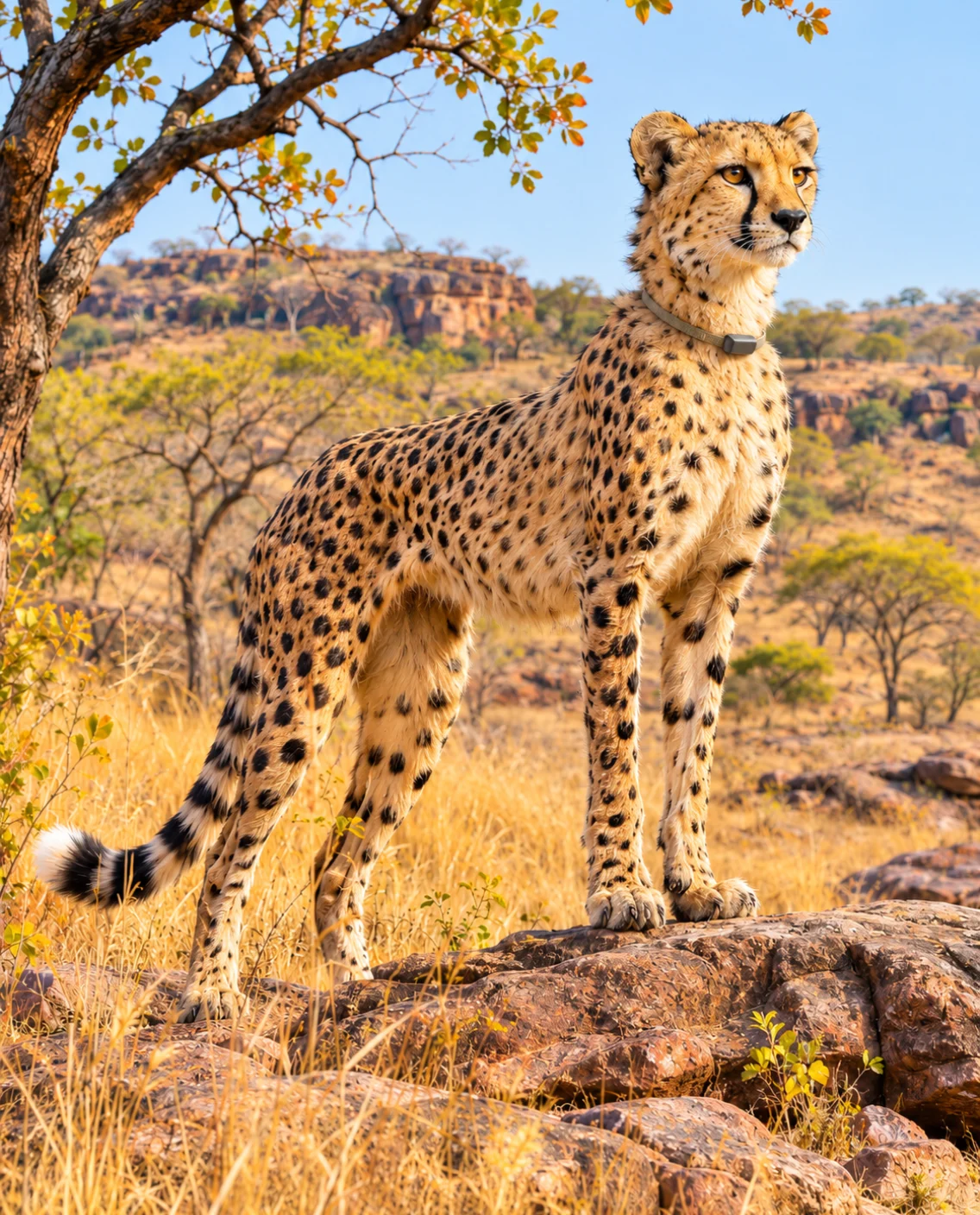
Kuno director explains limits of satellite collars after a young cheetah dies of pellet wounds; six forest officials suspended
In short: The death of KNG22, a 19-month-old cheetah found with firearm pellets, has put the monitoring of free-ranging cheetahs under scrutiny.
Why in news
Kuno National Park Director Uttam Kumar Sharma has said satellite collars cannot give continuous live tracking, The Indian Express reported on 1 November 2026, after the death of KNG22, a 19-month-old male cheetah born to the South African female Nirva. He was found seriously injured outside the national park on 25 October and died during treatment in Jabalpur on 27 October; five firearm pellets were recovered. The Madhya Pradesh government has suspended six forest officials, and two persons have been arrested under the Arms Act.
Background
Project Cheetah brought eight cheetahs from Namibia to Kuno in September 2022 and 12 from South Africa in February 2023, the world’s first intercontinental translocation of a large carnivore. As cheetahs and cubs range outside the park, conflict with people and poaching become real risks. At Kuno, about 15 cheetahs are tracked with satellite collars and VHF radio receivers; collars send a location every six hours to save battery, so one missed fix can stretch the gap to 12 hours or more.
Key facts for Prelims
- The cheetah (Acinonyx jubatus) is listed as Vulnerable on the IUCN Red List; the Asiatic cheetah was declared extinct in India in 1952.
- Kuno National Park is in the Sheopur district of Madhya Pradesh; Gandhi Sagar Wildlife Sanctuary is the second site for cheetahs.
- Project Cheetah is implemented by the National Tiger Conservation Authority (NTCA) with the State Forest Department.
- The cheetah is in Schedule I of the Wild Life (Protection) Act, 1972.
Mains analysis and way forward
Mains analysis
- Collars are tools, not guarantees: protection outside the park depends on patrolling, community intelligence and quick response teams.
- Landscape-level planning is needed as cheetahs disperse beyond Kuno into farmland and other forest divisions.
- Accountability after a loss should look at systemic gaps such as staffing and corridors, not only at individual lapses.
Way forward
- Increase collar transmission frequency for dispersing animals where battery life allows.
- Involve villages around Kuno through compensation, awareness and local monitors.
- Publish an annual review of survival, deaths and lessons learnt.
Connect the dots: Links to GS III conservation and species reintroduction, and to the Wild Life (Protection) Act and NTCA.
Sources: The Indian Express: Why can’t satellite collars live-track cheetahs? Kuno director explains, 1 November 2026; The Hindu: Two held over death of cheetah, 30 October 2026
Science and technology
TRAI proposes rules for responsible AI in telecom networks: board-approved policies, risk tiers and mandatory reporting of serious incidents
In short: TRAI’s draft makes telecom operators accountable for every AI system they deploy, whether built in-house or bought, with human oversight and incident reporting.
Why in news
The Telecom Regulatory Authority of India (TRAI) on 30 October 2026 released draft “Guidelines on Responsible Use of AI in Telecommunication Networks and Provision of Telecommunication Services” for stakeholder comments. Operators would have to adopt board-approved AI policies, set up governance and safety committees, classify AI systems by risk and report serious AI-related incidents to the regulator. Entities would be accountable for outcomes of AI systems irrespective of whether they are developed internally or procured from third parties.
Background
Telecom operators already use AI for network optimisation, fraud and spam detection, customer service and billing. Errors in such systems can cause outages, wrongful blocking of numbers or biased decisions affecting millions of users. India has so far preferred sector-specific guidance over a single AI law, alongside the Digital Personal Data Protection Act, 2023 and the IndiaAI Mission. TRAI’s draft is one of the first detailed AI risk frameworks proposed by an Indian sectoral regulator.
Key facts for Prelims
- TRAI is a statutory body set up under the TRAI Act, 1997.
- Proposed risk tiers for AI systems: high, medium and low, based on importance to network operations, financial outcomes and impact on consumers.
- Proposed incident severity classes: critical, high, moderate and low, with critical and high incidents to be reported.
- All AI systems are to have human oversight under a predefined mechanism.
- The Telecommunications Act, 2023 replaced the Indian Telegraph Act, 1885.
Mains analysis and way forward
Mains analysis
- A risk-based approach focuses compliance effort where harm is greatest, similar in spirit to global frameworks.
- Board-level ownership makes AI a governance issue, not just an IT issue.
- Smaller operators and vendors may find compliance costly; clear templates and proportionate rules will matter.
- Incident reporting creates data that the regulator can use to spot systemic risks across networks.
Way forward
- Align definitions with the IndiaAI governance guidelines so firms do not face conflicting rules.
- Publish anonymised summaries of reported incidents to build shared learning.
- Provide a phased timeline for compliance.
Connect the dots: Links to GS III awareness in IT and AI, and GS II regulatory bodies and data protection.
Ethics
Vice-President opens National Organ Transplant Games, calls organ donation a “Mahadaan”
In short: The Games celebrate transplant recipients and donor families; the ethical case for organ donation rests on altruism, consent and fair allocation.
Why in news
Vice-President C. P. Radhakrishnan inaugurated the National Organ Transplant Games 2026 at Talkatora Stadium, New Delhi, on 1 November 2026, organised with the National Organ and Tissue Transplant Organisation (NOTTO), Sir Ganga Ram Hospital and the Renal Care Foundation. He noted that one deceased donor can save up to eight lives and urged people to dispel myths and share their wishes with their families. A gathering of 570 transplant recipients and donors performed Tadasana together in a record attempt.
Background
Organ donation in India is governed by the Transplantation of Human Organs and Tissues Act (THOTA), 1994, which recognised brain-stem death and banned commercial dealing in organs. India follows an opt-in system: donation rests on the person’s own authorisation given in life or, failing that, on consent from the person lawfully in possession of the body, usually the family. NOTTO, under the Union Health Ministry, maintains the national registry and coordinates allocation with regional and State bodies. The Vice-President recalled the sage Dadhichi, who in legend gave his bones for the common good, as an Indian symbol of giving.
Key facts for Prelims
- THOTA, 1994 (amended 2011) covers both organs and tissues and sets up Authorisation Committees for living donation by non-relatives.
- NOTTO is located in New Delhi; ROTTOs and SOTTOs work at regional and State levels.
- The Games also honoured Indian medal winners from the World Transplant Games 2025 held in Dresden, Germany.
Mains analysis and way forward
Mains analysis
- Altruism: donation is a gift without expectation of return, the purest form of compassion in public life.
- Autonomy and consent: respecting a person’s wishes, and the family’s role at a time of grief, are central ethical tests.
- Justice: allocation must be transparent and based on medical need, not wealth or influence, to keep public trust.
- Integrity: strict enforcement against organ trade protects the poor from exploitation.
Way forward
- Train hospital counsellors to talk to grieving families with sensitivity and honesty.
- Make it simple to register a pledge and record it on digital health IDs.
- Publish allocation data to show fairness across States and income groups.
Connect the dots: Links to GS IV values (compassion, empathy, altruism) and GS II health governance.
In brief
- Personality in the news: Manisha, world wrestling champion: Indian wrestler Manisha won the women’s 59 kg title at the Senior World Wrestling Championships in Astana, Kazakhstan, on 30 October 2026, coming back from 0-6 to beat Abigail Nette of the USA 8-6. United World Wrestling called it India’s first-ever women’s world title.
- New head of the Geological Survey: Dinesh Vitthalrao Ganvir took charge on 1 November 2026 as the 55th Director General of the Geological Survey of India (GSI), set up in 1851 and now an attached office of the Ministry of Mines.
- UN mission in Somalia ends: The UN Transitional Assistance Mission in Somalia (UNTMIS) ended operations on 31 October 2026 after a two-year transition under Security Council resolutions 2753 (2024) and 2809 (2025), at the request of Somalia’s federal government; its functions pass to Somali institutions and UN agencies.
- Commonwealth summit opens: The 28th Commonwealth Heads of Government Meeting is being held in St John’s, Antigua and Barbuda, from 1 to 4 November 2026, on the theme “Accelerating Partnerships and Investment for a Prosperous Commonwealth”. The Commonwealth has 56 members.
- Pakistan and Afghanistan: In a statement on the night of 31 October, Pakistan’s Ministry of Information and Broadcasting called terrorism a “red line” and accused the Taliban government of failing to act against militants on Afghan soil, after the Taliban spokesperson blamed Islamabad for the tensions.
- Taiwan and China at sea: Taiwan’s Coast Guard said on 31 October that two Chinese coast guard ships on a patrol off its east coast were trying to assert jurisdiction by radioing vessels, and that it had sent ships to monitor them; China also sent a coast guard ship near the Taiwan-controlled Pratas Islands.
- Ebola in DR Congo: Deaths in the Ebola outbreak in the Democratic Republic of Congo passed 5,000, government data showed on 30 October 2026, with more than 10,000 infected since May; it is caused by the Bundibugyo species, for which there is no approved vaccine or treatment, and eight of Congo’s 26 provinces are affected (Reuters).
- INS Trishul in Greece: Indian Naval Ship Trishul called at Souda Bay, Crete, on 31 October 2026 during its Mediterranean deployment, for professional exchanges with the Hellenic Navy and a visit to the NATO Maritime Interdiction Operational Training Centre.
- Water ingress on INS Kesari: Water entered compartments of INS Kesari while berthed at the Naval Dockyard, Visakhapatnam, on 31 October 2026; no injuries were reported and the Navy will hold an inquiry.
- Home Minister’s medal for excellence: The Kendriya Grihmantri Dakshata Padak was awarded to 490 police, security, intelligence and forensic personnel for 2026. Instituted by an MHA notification of 1 February 2024, it is announced every year on 31 October, Sardar Patel’s birth anniversary.
- A private tokamak test bed: Bengaluru start-up Pranos Fusion has built PRAGYA, a small tokamak to test plasma control and superconducting magnets, as a step towards a larger machine, PRANIK, whose design it hopes to firm up in 2027, The Hindu reported on 31 October.
- More POCSO courts in Tamil Nadu: Tamil Nadu ordered 26 special courts under the POCSO Act, 2012 and four under the NDPS Act, 1985 to speed up trials, the State government said on 1 November 2026.
- Helicopter crash near Joshimath: Six people died when a helicopter returning from Badrinath to Dehradun crashed near Chai village, Joshimath, on 30 October 2026; Army, ITBP, NDRF and SDRF teams recovered the bodies over difficult terrain.
- Minister of State to Spain: Minister of State for External Affairs Pabitra Margherita will visit Spain from 3 to 5 November 2026, the MEA said.
Prelims practice: 5 questions
Choose an option to see the answer and explanation. Your score appears when all five are answered.
Mains practice
The Quad has steadily moved from maritime security towards economic security and technology. Examine the significance of this shift for India and the limits of the grouping as an instrument of its foreign policy.
Show the answer outline
Introduction (about 30 words)
- Quad of Australia, India, Japan and the US; revived in 2017, leaders’ summits since 2021.
- Atlanta meeting of 31 October 2026 centred on economic security, critical minerals, AI and sea lanes.
Significance of the shift for India
- Supply-chain resilience in critical minerals and semiconductors supports Indian manufacturing goals.
- Trusted AI and digital connectivity projects align with India’s digital public infrastructure.
- Maritime focus on Hormuz and the Red Sea protects India’s energy and trade routes.
- Public goods such as HADR and maritime domain awareness raise India’s standing as a first responder.
Limits of the Quad
- Not a security alliance; no binding commitments or common funding.
- Differences among members on trade, tariffs and Russia.
- Risk of being seen in the region as an anti-China bloc; ASEAN sensitivities.
- Delivery gap between announcements and projects.
Way forward
- Project pipelines with timelines; co-financing with the private sector.
- Keep ASEAN centrality and Pacific priorities central.
- Use Quad alongside bilateral partnerships, IPOI and BIMSTEC.
Conclusion (about 30 words)
- The Quad is most useful to India as a flexible platform for capacity and standards, complementing strategic autonomy rather than replacing it.
Tip: Quote two concrete Atlanta outcomes, such as the $10 million critical-minerals recycling support and the Sea Dragon 2027 surveillance exercise, to make the answer specific.
Current Canvas is prepared by the UPSC Gurus editorial desk. Every fact is checked against official releases and reliable reporting, with sources listed under each story. Editions are compiled each month into The Canvas magazine.
About images: photographs and illustrations in Current Canvas are AI-generated for illustration only. They are not news photographs of the events described.