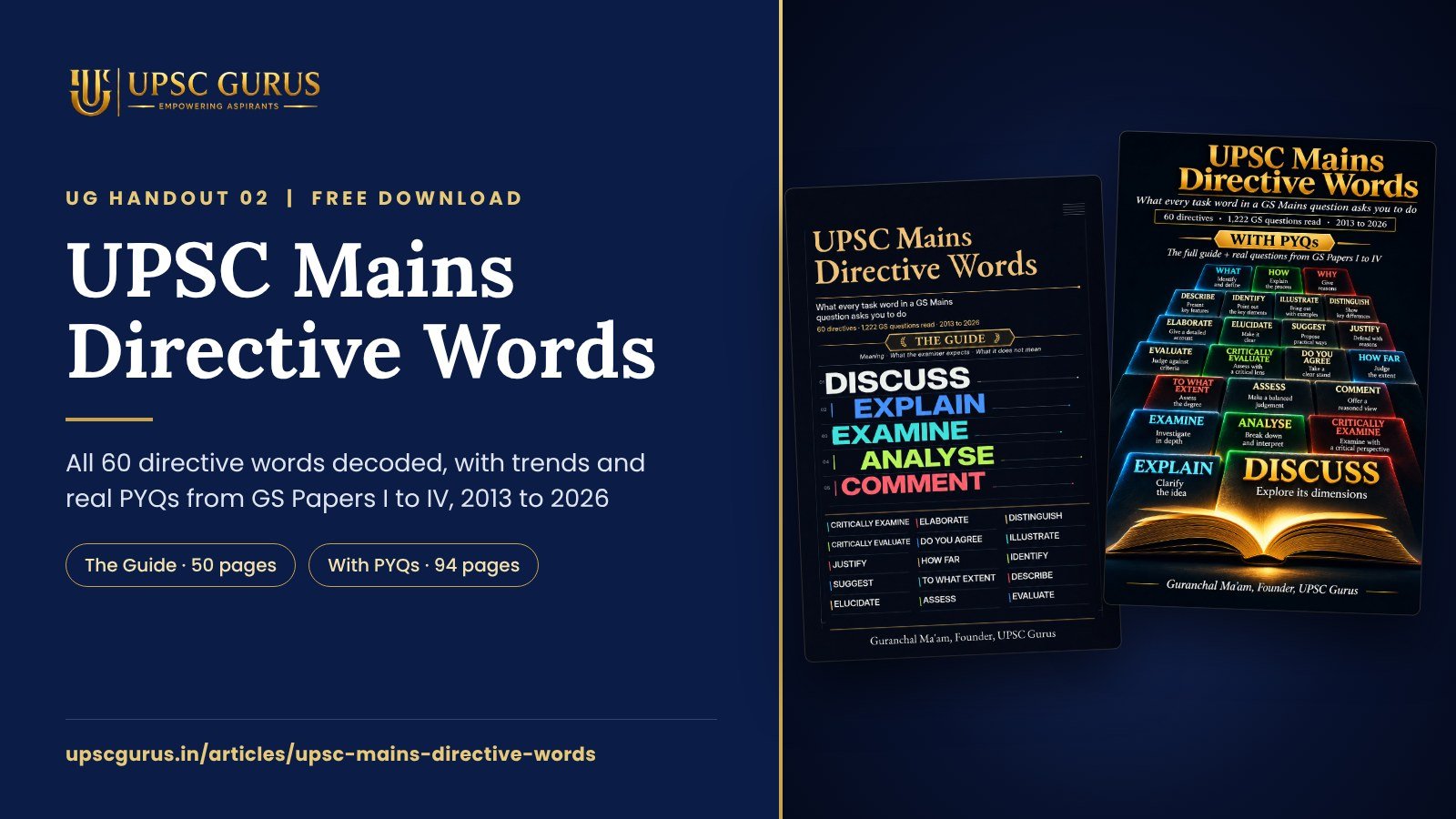
 New this week · Free UG Handout 02UPSC Mains Directive Words: 60 Meanings, Trends and PYQsTwo free PDFs: The Guide and the With PYQs edition.Read and download
Today’s Canvas
This edition opens with the dates for India’s first Census since 2011 and a new board for gig workers, two steps that will shape welfare for years. Abroad, a Russian veto left a UN mission in limbo, while Bay of Bengal partners trained together at sea. We also mark 70 years of the reorganisation of States, follow the Buddha’s relics to Arunachal Pradesh, and meet a new amphibian found in a village backyard.
About 17 minutes to read the key points; Mains analysis opens under each story.
- Census 2027: house-to-house population count from 25 January to 28 February 2027; 40 questions, several asked for the first timeGS II
- Centre notifies National Social Security Board for unorganised, gig and platform workers under the Code on Social SecurityGS II, GS III
- UN Security Council fails to renew Western Sahara mission: Russia vetoes US draft, rival Russian text falls short; MINURSO mandate due to lapse on 31 OctoberGS II
- Inaugural BIMSTEC Maritime Security Exercise brings seven Bay of Bengal partners together from 30 October to 3 NovemberGS II, GS III
- 70 years of the States Reorganisation Act: how 1 November 1956 redrew India’s internal mapGS I, GS II
- Piprahwa relics of the Buddha travel to Arunachal Pradesh: public exposition at Tawang, Bomdila and Namsai from 1 to 20 NovemberGS I
- Centre sets up High Level Committee on Banking for Viksit Bharat under former CVC Suresh N. Patel; report due in six monthsGS III
- Fiscal deficit at 42.1% of full-year target in April-September; capital spending at Rs 6.55 lakh croreGS III
- 24th PM-KISAN instalment: about Rs 18,690 crore reaches 9.34 crore farmers; total payouts cross Rs 4.64 lakh croreGS III
- MeitY launches DEPA for AI Training handbook: a framework for controlled, purpose-bound AI training on data held by institutionsGS III
- Species in news: Gegeneophis chandgadi, a new legless amphibian found in a village backyard in KolhapurGS III
- After Cyclone Arnab’s rain, landslide buries hilltop village on Ganjam-Kandhamal border; 12 missing as 170 rescuers searchGS III
- DRI seizes 50 kg of methamphetamine in Mizoram and Assam and busts a synthetic drug laboratory in Uttar PradeshGS III
- Supreme Court upholds disproportionate assets conviction of a former sub-registrar: once disproportion is shown, the burden shifts to the officialGS IV
- Census 2027: house visits from 25 January to 28 February; 40 questions, 13 new.
- A National Social Security Board for gig and platform workers has been notified.
- A Russian veto leaves the UN mission in Western Sahara without a renewal.
- BIMSTEC holds its first maritime security exercise.
- Fiscal deficit reaches 42.1% of the annual target by September.
- Gegeneophis chandgadi: a new caecilian from Kolhapur.
Polity and governance

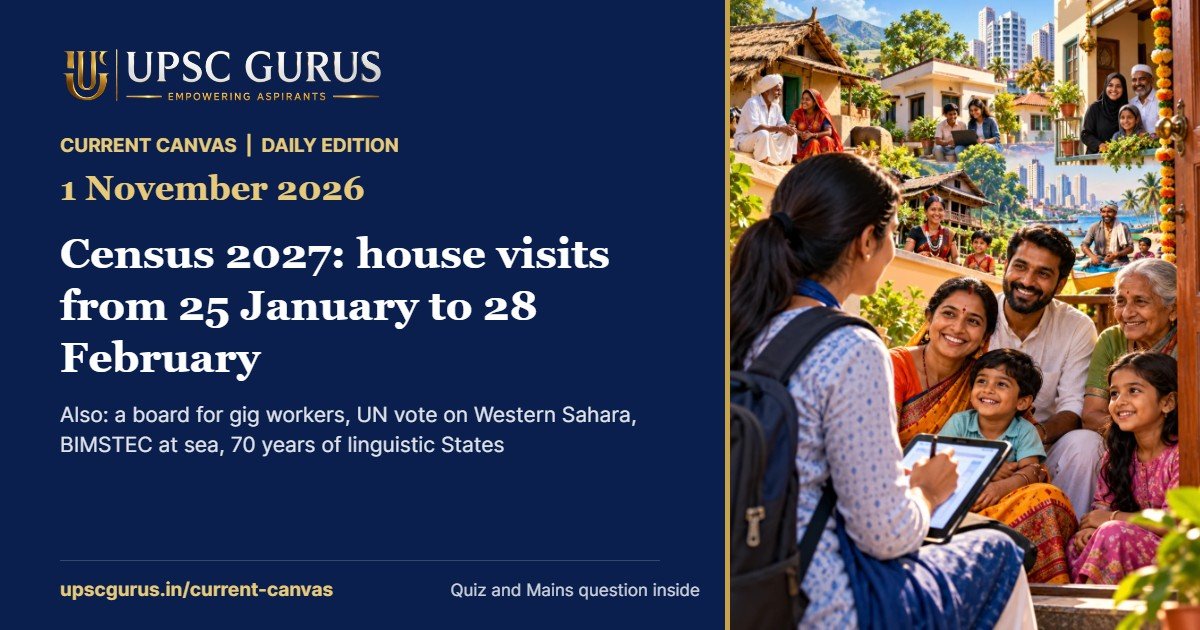
Census 2027: house-to-house population count from 25 January to 28 February 2027; 40 questions, several asked for the first time
In short: The second phase of Census 2027 now has dates: self-enumeration from 10 January, house visits from 25 January to 28 February 2027.
Why in news
The Union Home Ministry has notified the schedule for Population Enumeration, the second and final phase of Census 2027, The Hindu reported on 30 October 2026. The self-enumeration portal opens on 10 January 2027 and enumerators will visit homes from 25 January to 28 February 2027. The four poll-bound States of Uttar Pradesh, Uttarakhand, Goa and Punjab go first: their portal opens on 16 November 2026 and house visits begin on 1 December. Separate schedules also apply to snow-bound areas.
Background
Census 2027 is India’s 16th Census and the first since 2011, as the 2021 round was postponed. It is being held in two phases: Houselisting and Housing Census, which ran from April to September 2026, and Population Enumeration. Enumerators will ask 40 questions; The Hindu counts 13 of them as new, including caste (beyond the SC and ST categories), the place and date of birth of both parents, digital literacy and the number of bank accounts. Trainers expect each household interview to take 20 to 25 minutes, far longer than the houselisting visit.
Key facts for Prelims
- Census is in the Union List (Entry 69, Seventh Schedule) and is conducted under the Census Act, 1948 by the Registrar General and Census Commissioner, Ministry of Home Affairs.
- Reference date: 00:00 hours of 1 March 2027 for most of the country; earlier dates apply to snow-bound non-synchronous areas and to the four States enumerated ahead of the rest.
- Caste of all communities is being recorded for the first time since the 1931 Census.
- Section 15 of the Census Act keeps individual Census records confidential; they cannot be used as evidence in court.
- This is the first Census with a digital self-enumeration option.
Mains analysis and way forward
Mains analysis
- Data foundation: Census tables drive fund devolution, scheme targeting and urban planning; a 16-year gap since 2011 has left many policies running on old numbers.
- Political stakes: Articles 82 and 170 freeze seat readjustment until the first Census after 2026, so this count is expected to shape delimitation and, through it, the operation of women’s reservation under the 106th Amendment.
- Caste data can sharpen welfare design, but categorisation of thousands of sub-castes and self-reported entries will test data quality.
- New questions on Aadhaar, passport and voter ID numbers raise questions of purpose limitation and data security, even with Section 15 protection.
Way forward
- Publish clear guidance on which identity numbers are optional and how they will be stored and protected.
- Invest in enumerator training and supervision so that longer interviews do not reduce accuracy, and release provisional tables quickly.
Connect the dots: GS II: Census Act 1948, Articles 82 and 170, delimitation, 106th Amendment; GS I: population and social structure.
Sources: The Hindu: Census 2027, door-to-door enumeration to start on January 25, 30 October 2026; The Hindu Explained: new questions in Census 2027 and enumerator training, 31 October 2026
Centre notifies National Social Security Board for unorganised, gig and platform workers under the Code on Social Security
In short: A statutory board now exists to design and monitor welfare schemes for gig and platform workers alongside traditional unorganised workers.
Why in news
The Ministry of Labour and Employment notified the constitution of the National Social Security Board for Unorganised Workers and for Gig and Platform Workers on 30 October 2026, in the two configurations provided under the Code (Sections 6 and 114). The Boards are chaired by the Union Labour Minister and includes Central and State officials, aggregator companies, employers, civil society, workers’ unions and gig and platform associations. They must meet at least three times a year.
Background
The Code on Social Security, 2020, one of the four labour codes in force since 21 November 2025, is the first central law to define gig workers and platform workers. It allows the Centre to frame schemes for them on life and disability cover, health, maternity and old-age protection, financed partly by contributions from aggregators. The Board recommends such schemes, advises the Centre, monitors schemes, reviews record-keeping by States and reviews spending from the social security fund. App-based delivery, ride-hailing and home services have made gig work a large and growing part of urban employment.
Key facts for Prelims
- Gig worker (Code on Social Security, 2020): a person who earns from work outside a traditional employer-employee relationship.
- Aggregator contribution under the Code: 1 to 2% of annual turnover, capped at 5% of the amount paid to gig and platform workers.
- Board chair: Union Minister for Labour and Employment; it meets at least thrice a year.
- “Social security and social insurance” and “welfare of labour” are in the Concurrent List (Entries 23 and 24).
- e-Shram is the national database of unorganised workers, with an Aadhaar-seeded registration.
Mains analysis and way forward
Mains analysis
- A shift in welfare architecture: social protection is being linked to work done through platforms rather than to a fixed employer.
- Implementation questions remain on how contributions are collected across multiple platforms and how benefits move with workers between apps and States.
- Tripartite membership gives workers a voice, but representation of women and part-time gig workers will matter for credibility.
- As a Concurrent subject, outcomes depend on States framing matching schemes and boards.
Way forward
- Notify the first schemes quickly, with portable benefits tied to a single worker ID.
- Require platforms to share anonymised data on earnings and hours so that schemes can be costed and monitored.
Connect the dots: GS II: DPSP Articles 41 and 43, Concurrent List; GS III: labour codes, informal economy.
International relations
UN Security Council fails to renew Western Sahara mission: Russia vetoes US draft, rival Russian text falls short; MINURSO mandate due to lapse on 31 October
In short: A Russian veto and a failed rival draft left the 35-year-old UN mission for Western Sahara without a renewal, showing how divisions can stall even routine mandate extensions.
Why in news
On 30 October 2026 the UN Security Council rejected two drafts on the UN Mission for the Referendum in Western Sahara (MINURSO). A US draft received 11 votes in favour and 3 abstentions but was vetoed by Russia; a Russian draft to extend the mandate to 31 October 2027 got only 3 votes in favour (China, Somalia and Russia), well short of the nine needed, with the United States voting against and 11 abstentions. The mission’s mandate was set to expire on 31 October 2026.
Background
MINURSO was set up by Security Council resolution 690 of 1991, under settlement proposals accepted in 1988 by Morocco and the Polisario Front. It was meant to prepare a referendum in which the people of Western Sahara would choose between independence and integration with Morocco, but the vote has never been held. Morocco’s 2007 Autonomy Proposal envisages self-government under Moroccan sovereignty. The US argued the mission had not delivered its original purpose in 35 years; Russia said the US text would impose a one-sided solution.
Key facts for Prelims
- MINURSO: established by UNSC resolution 690 (1991).
- Parties: Morocco and the Frente POLISARIO; many Sahrawi refugees live in camps around Tindouf, Algeria.
- Under Article 27(3) of the UN Charter, a substantive resolution needs nine affirmative votes and no negative vote by a permanent member.
- Morocco presented its Autonomy Proposal in 2007.
Mains analysis and way forward
Mains analysis
- The episode shows how great-power rivalry can paralyse even long-running peacekeeping mandates.
- It sets self-determination against territorial integrity, two principles that India also weighs carefully in its own diplomacy.
- For troop-contributing countries such as India, abrupt mission endings raise questions of safety, planning and accountability.
- It strengthens the case for Security Council reform and for limiting the use of the veto, a position India has repeatedly put forward.
Way forward
- Keep the political process alive through the UN Secretary-General’s envoy, and ensure any drawdown is orderly.
- Use the episode to build support for review of mandates and of veto use in the Council.
Connect the dots: GS II: UN Charter, peacekeeping, UNSC reform; GS I: geography of north-west Africa.

Inaugural BIMSTEC Maritime Security Exercise brings seven Bay of Bengal partners together from 30 October to 3 November
In short: BIMSTEC has moved from summit statements to its first joint maritime security exercise, with the Bay of Bengal as the shared stage.
Why in news
The first BIMSTEC Maritime Security Exercise is being held from 30 October to 3 November 2026 with Bangladesh, Bhutan, India, Myanmar, Nepal, Sri Lanka and Thailand, the Defence Ministry said on 31 October. It aims to improve interoperability, maritime domain awareness, coordination and sharing of best practices, and highlights the role of the Andaman and Nicobar Command.
Background
BIMSTEC, the Bay of Bengal Initiative for Multi-Sectoral Technical and Economic Cooperation, was formed in 1997 through the Bangkok Declaration and has its secretariat in Dhaka. The exercise builds on the 6th BIMSTEC Summit, held under the theme “BIMSTEC: Prosperous, Resilient and Open”. The Bay of Bengal carries trade and energy flows between South and South-East Asia and faces threats such as trafficking, illegal fishing and natural disasters.
Key facts for Prelims
- BIMSTEC members: Bangladesh, Bhutan, India, Myanmar, Nepal, Sri Lanka, Thailand; formed 1997 (Bangkok Declaration); secretariat in Dhaka.
- Exercise motto: “Shared Seas, Shared Security and Shared Prosperity”.
- Andaman and Nicobar Command: India’s first integrated tri-service command.
- Two members, Nepal and Bhutan, are landlocked.
Mains analysis and way forward
Mains analysis
- The exercise gives BIMSTEC a practical security dimension at a time when SAARC remains largely inactive.
- Shared maritime domain awareness helps against drug trafficking from the Golden Triangle and illegal, unreported and unregulated fishing.
- It supports India’s Neighbourhood First and Act East policies and its role as a first responder in disasters.
Way forward
- Make the exercise regular and link it to an information-sharing arrangement for the Bay of Bengal.
- Add humanitarian assistance and disaster relief drills that involve the landlocked members.
Connect the dots: GS II: regional groupings, Act East; GS III: maritime security, coastal security.
Sources: PIB (Ministry of Defence): Inaugural BIMSTEC Maritime Security Exercise, 31 October 2026
History, art and culture
70 years of the States Reorganisation Act: how 1 November 1956 redrew India’s internal map
In short: On 1 November 1956 India moved from a four-tier system of States to 14 States and six Union Territories, largely along linguistic lines.
Why in news
1 November 2026 marks 70 years since the States Reorganisation Act, 1956 and the Constitution (Seventh Amendment) Act came into force. Several States, including Kerala, Mysore (renamed Karnataka in 1973), Madhya Pradesh and Andhra Pradesh, trace their present form to that day, while Haryana (1966) and Chhattisgarh (2000) were also formed on 1 November.
Background
At independence, States were grouped as Part A, B, C and D. The Dhar Commission and the JVP Committee (Nehru, Patel and Pattabhi Sitaramayya) in 1948 were cautious about language as the basis for States. After Potti Sriramulu died in December 1952 following a fast, Andhra State was created on 1 October 1953. The States Reorganisation Commission, headed by Fazl Ali with H.N. Kunzru and K.M. Panikkar, reported in 1955, and its recommendations led to the 1956 reorganisation.
Key facts for Prelims
- States Reorganisation Commission (1953): Fazl Ali (chair), H.N. Kunzru, K.M. Panikkar.
- The 1956 Act created 14 States and 6 Union Territories; the Seventh Amendment ended the Part A, B, C and D classification.
- Andhra State (1 October 1953) was the first State formed on a linguistic basis.
- Article 3 lets Parliament form new States and alter boundaries by simple majority, on the President’s recommendation after referring the Bill to the State legislature concerned.
- Haryana was carved out of Punjab on 1 November 1966 under the Punjab Reorganisation Act, 1966.
- Asked before: 2016 Mains GS I asked whether the formation of linguistic States strengthened the cause of Indian unity.
Mains analysis and way forward
Mains analysis
- Linguistic States strengthened democracy by bringing administration closer to people’s language, contrary to early fears of fragmentation.
- The SRC itself warned against language as the sole criterion and stressed unity, administrative and financial viability.
- Later reorganisations (1960, 1966, 2000, 2014) moved towards development and identity as reasons, showing Article 3’s flexibility.
- Inter-State disputes over boundaries and river waters remain a legacy to be managed through cooperative federalism.
Way forward
- Use zonal councils, created by the same 1956 Act, more actively to resolve boundary and resource disputes.
- Any future reorganisation should rest on transparent criteria and wide consultation.
Connect the dots: GS I: post-independence consolidation; GS II: Article 3, federalism, zonal councils.
Sources: NCERT, Politics in India since Independence (Class XII), Chapter 1: Challenges of Nation Building

Piprahwa relics of the Buddha travel to Arunachal Pradesh: public exposition at Tawang, Bomdila and Namsai from 1 to 20 November
In short: The sacred Piprahwa relics are on public view in three Buddhist centres of Arunachal Pradesh, with an exhibition on their discovery and return.
Why in news
The Ministry of Culture, with the Arunachal Pradesh government, the International Buddhist Confederation and the National Museum, is holding an exposition of the Holy Relics of the Buddha in Arunachal Pradesh from 31 October to 21 November 2026. After an inaugural ceremony at Tawang Monastery on 31 October, public darshan is scheduled at Tawang (1 to 7 November), Bomdila (8 to 13 November) and Namsai (14 to 20 November), before the relics return to the National Museum on 21 November. An international conference on “Buddhism: Dissemination in the Himalayan Region and Beyond” will bring together delegates from India and six other countries.
Background
Piprahwa, in present-day Siddharthnagar district of Uttar Pradesh, is associated with ancient Kapilavastu and the Shakya clan of the Buddha. William Claxton Peppe excavated a stupa there in 1898; later, the Archaeological Survey of India excavated the site between 1971 and 1977 under K.M. Srivastava and found two more caskets holding 22 bone relics. Twenty of these are kept at the National Museum, New Delhi, and two at the Indian Museum, Kolkata; an exhibition on the discovery and repatriation of the Piprahwa heritage accompanies the exposition. The opening coincides with Lhabab Duchen, a festival in Tibetan Buddhism.
Key facts for Prelims
- Piprahwa: Siddharthnagar district, Uttar Pradesh; stupa excavated by W.C. Peppe in 1898 and by the ASI in 1971-77.
- Tawang Monastery is also known as Gaden Namgyal Lhatse.
- Lhabab Duchen marks the Buddha’s descent from the heaven of the thirty-three gods in Tibetan Buddhist tradition.
- International Buddhist Confederation (IBC): a New Delhi-based body supported by the Ministry of Culture.
Mains analysis and way forward
Mains analysis
- Relic expositions are a tool of cultural diplomacy and soft power, building links with Buddhist communities in Asia.
- Holding the exposition in Arunachal Pradesh highlights the State’s living Himalayan Buddhist traditions and supports cultural tourism.
- The emphasis on repatriation reflects a growing effort to bring back India’s antiquities and to curb illicit trade.
Way forward
- Pair expositions with conservation, digitisation and scholarly publication of the relics.
- Link Buddhist circuit tourism to local livelihoods in the host regions.
Connect the dots: GS I: Buddhism, art and architecture; GS II: cultural diplomacy; GS III: tourism.
Economy and agriculture
Centre sets up High Level Committee on Banking for Viksit Bharat under former CVC Suresh N. Patel; report due in six months
In short: A four-member panel will review how India’s banks are regulated and run, and propose reforms to make them globally competitive by 2047.
Why in news
The Government of India constituted the High Level Committee on Banking for Viksit Bharat on 30 October 2026, as announced in the Budget for 2026-27. It is chaired by former Central Vigilance Commissioner Suresh N. Patel, with RBI Deputy Governor Shirish Chandra Murmu, former Indian Bank MD and CEO Padmaja Chunduru and former RBI Deputy Governor N.S. Vishwanathan as members; its tenure is six months.
Background
The committee will review banking practices and prudential norms against global best practice and suggest a roadmap for globally competitive banks. It will also review regulatory and legal frameworks, including those for Regional Rural Banks and cooperative banks, and recommend structural, institutional, regulatory and legislative reforms. Earlier landmark reviews include the Narasimham Committees of 1991 and 1998 and the P.J. Nayak Committee of 2014 on bank boards.
Key facts for Prelims
- Chair: Suresh N. Patel (former Central Vigilance Commissioner); Member Secretary: Joint Secretary (Banking), Department of Financial Services.
- Tenure: six months.
- Scope includes Regional Rural Banks and cooperative banks.
- Narasimham Committee I (1991) and II (1998) shaped the first wave of banking reforms.
Mains analysis and way forward
Mains analysis
- A developed economy needs a deeper banking system: India’s bank credit relative to GDP remains well below that of major economies.
- Dual regulation of cooperative banks and governance of public sector banks are long-standing reform areas.
- Reforms must balance scale and global competitiveness with financial inclusion and stability.
Way forward
- Prioritise governance and board autonomy in public sector banks alongside consolidation.
- Align any legislative changes with the RBI’s regulatory independence and depositor protection.
Connect the dots: GS III: banking sector reforms, RBI, financial inclusion.
Fiscal deficit at 42.1% of full-year target in April-September; capital spending at Rs 6.55 lakh crore
In short: Halfway through 2026-27, the Centre has used 42.1% of its deficit target while raising capital spending over last year.
Why in news
Monthly accounts released on 30 October 2026 show the Centre received Rs 18,35,422 crore (50.3% of the Budget Estimate) and spent Rs 25,49,835 crore (47.7%) up to September 2026. The fiscal deficit for April-September stood at Rs 7,14,413 crore (about Rs 7.14 lakh crore), 42.1% of the full-year target, against about Rs 5.7 lakh crore a year earlier.
Background
The 2026-27 fiscal deficit target is 4.3% of GDP, or about Rs 16.96 lakh crore. Of total spending, Rs 18,95,288 crore was on revenue account and Rs 6,54,547 crore on capital account. Interest payments of Rs 6,46,010 crore took about a third of revenue spending, and major subsidies were Rs 2,22,905 crore. The Centre transferred Rs 6,99,409 crore to States as their share of taxes, Rs 67,658 crore more than last year.
Key facts for Prelims
- Fiscal deficit = total expenditure minus (revenue receipts + non-debt capital receipts).
- Monthly accounts are compiled by the Controller General of Accounts (CGA), Ministry of Finance.
- Tax devolution to States follows Finance Commission recommendations under Article 270.
- The FRBM Act, 2003 is the legal framework for fiscal targets.
Mains analysis and way forward
Mains analysis
- Rising capital spending supports growth and crowds in private investment, but high interest costs limit fiscal space.
- The half-year deficit is higher than last year, but interim figures reflect the timing of receipts and spending and are not a reliable guide to the full-year outcome.
- Larger devolution helps States but leaves the Centre dependent on non-tax revenue such as RBI dividends.
Way forward
- Protect capital spending while improving the quality of revenue expenditure.
- Use the second half to strengthen tax buoyancy and asset monetisation to meet the 4.3% target.
Connect the dots: GS III: fiscal policy, FRBM, government budgeting; GS II: fiscal federalism.
Sources: PIB (Ministry of Finance): Monthly review of accounts of Government of India up to September 2026, 30 October 2026; Reuters: India’s April-September fiscal deficit at 42.1% of 2026/27 target, 30 October 2026
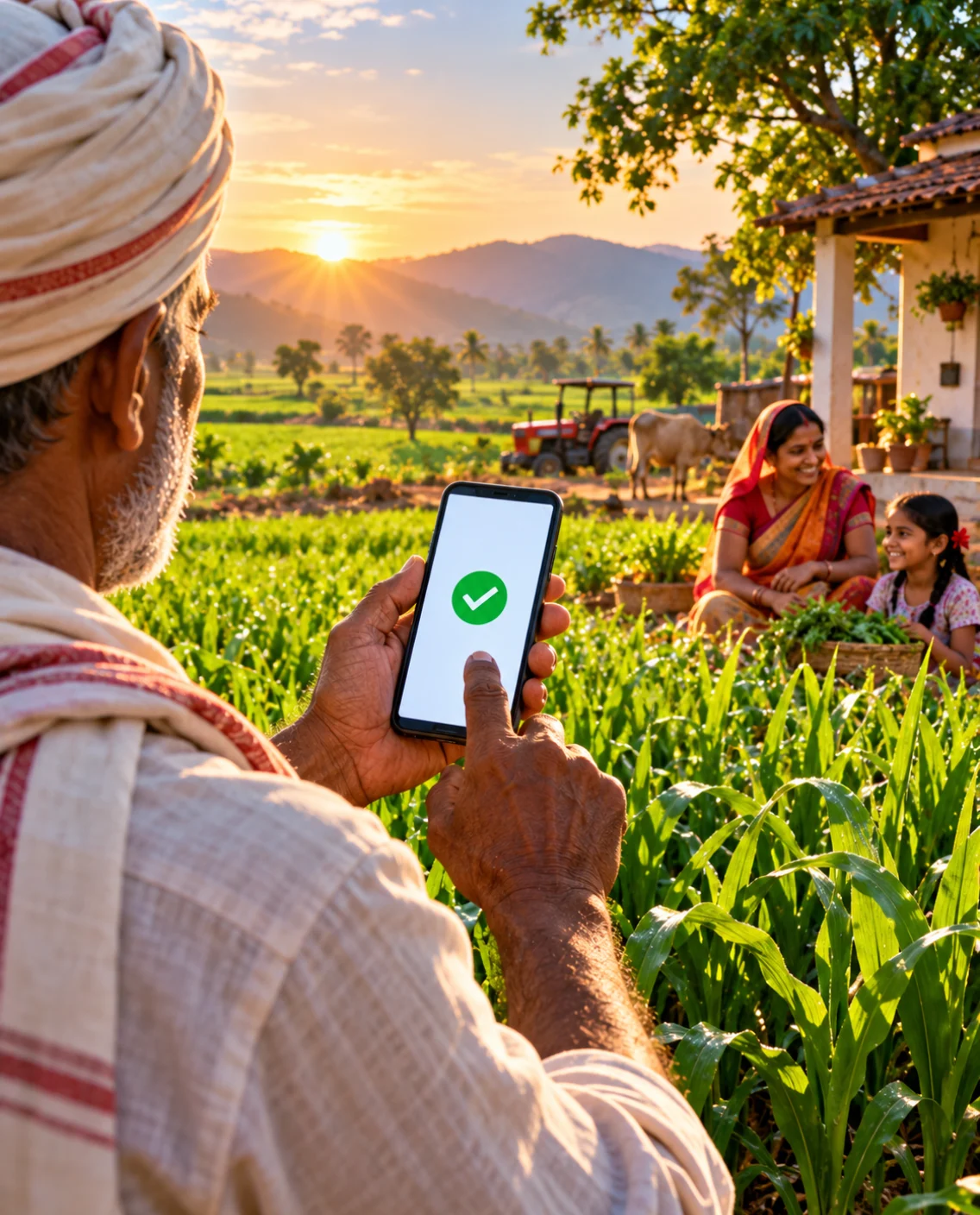
24th PM-KISAN instalment: about Rs 18,690 crore reaches 9.34 crore farmers; total payouts cross Rs 4.64 lakh crore
In short: The 24th instalment of PM-KISAN was released on 30 October, taking cumulative income support to farmers beyond Rs 4.64 lakh crore.
Why in news
The Prime Minister released the 24th instalment of the Pradhan Mantri Kisan Samman Nidhi (PM-KISAN) at Banaskantha, Gujarat, on 30 October 2026, transferring about Rs 18,690 crore to more than 9.34 crore farmers through Direct Benefit Transfer. Cumulative disbursements have now crossed Rs 4.64 lakh crore.
Background
PM-KISAN was launched on 24 February 2019 and is fully funded by the Centre. Each eligible landholding farmer family receives Rs 6,000 a year in three equal instalments of Rs 2,000 into Aadhaar-seeded bank accounts. In July 2026 the Union Cabinet approved continuing the scheme from 2026-27 to 2030-31 with an outlay of Rs 3.15 lakh crore. e-KYC and digital verification are used to check eligibility.
Key facts for Prelims
- Launched: 24 February 2019; benefit Rs 6,000 a year in three instalments of Rs 2,000.
- Eligibility is for landholding farmer families; income-tax payers and some other categories are excluded.
- Scheme continued for 2026-27 to 2030-31 with an outlay of Rs 3.15 lakh crore.
- 24th instalment: about Rs 18,690 crore to 9.34 crore farmers on 30 October 2026.
Mains analysis and way forward
Mains analysis
- Direct income support is simple and leak-resistant, but it is not linked to crop choice, risk or productivity.
- Tenant farmers and landless agricultural workers, who bear much of farm risk, remain outside the scheme.
- The fixed Rs 6,000 has lost real value since 2019; its role is best seen as a floor alongside MSP, insurance and credit.
Way forward
- Use digitised land records and State tenancy data to bring genuine cultivators into the net.
- Converge PM-KISAN with Kisan Credit Cards and crop insurance for a fuller income safety net.
Connect the dots: GS III: farm incomes, agricultural subsidies, DBT; GS II: welfare schemes.
Sources: PIB Backgrounder: 24th Instalment of PM-KISAN, 30 October 2026
Science and technology
MeitY launches DEPA for AI Training handbook: a framework for controlled, purpose-bound AI training on data held by institutions
In short: DEPA Training aims to let institutions contribute data to AI training under purpose-bound, traceable permissions while keeping control of that data.
Why in news
The Ministry of Electronics and Information Technology launched the Handbook on Data Empowerment and Protection Architecture (DEPA) for AI Training in Bengaluru on 31 October 2026. It sets out a techno-legal framework for purpose-bound data collaboration in AI training that lets institutions keep control of their data, developed with support from the iSPIRT Foundation.
Background
Access to large, diverse and high-quality data is central to building AI models, but privacy, confidentiality, intellectual property and institutional control often limit sharing. DEPA Training combines contractual permissions, controlled computing environments and privacy-enhancing safeguards, and records data provenance so that the origin, permissions and use of data can be traced. As the Principal Scientific Adviser put it at the launch, the model travels to the data rather than the data travelling to the model. The approach extends the DEPA consent architecture already used for financial data sharing.
Key facts for Prelims
- DEPA: Data Empowerment and Protection Architecture; DEPA Training handbook launched by MeitY on 31 October 2026.
- Key features: purpose-bound permissions, controlled compute environments, privacy-enhancing technologies, data provenance.
- The Digital Personal Data Protection Act, 2023 is India’s personal data protection law.
- Account Aggregators, regulated by the RBI, use DEPA-style consent for sharing financial data.
Mains analysis and way forward
Mains analysis
- Trusted data sharing can unlock Indian-language and sector-specific datasets for domestic AI, a gap in global models.
- Keeping data with its owner supports data sovereignty and reduces privacy risk.
- Success depends on interoperable standards, audits of the controlled environments and clarity on liability.
Way forward
- Pilot DEPA Training in health, agriculture and Indian languages with clear audit trails.
- Align the framework with DPDP Act rules so that consent and purpose limitation are enforceable.
Connect the dots: GS III: AI, digital public infrastructure, data governance; GS II: right to privacy.
Sources: PIB (MeitY): MeitY launches DEPA for AI Training Handbook, 31 October 2026
Environment and disaster management

Species in news: Gegeneophis chandgadi, a new legless amphibian found in a village backyard in Kolhapur
In short: A new burrowing caecilian from the northern Western Ghats shows that undocumented species can live in farms and villages, not only in forests.
Why in news
Gegeneophis chandgadi, a new caecilian from Buzawade village in Chandgad taluka of Kolhapur district, Maharashtra, was announced by the Environment Ministry on 12 September 2026 and was back in the news on 29 October. It was described by a multi-institutional team including the Zoological Survey of India. It was found in August 2025 beneath wooden piles, decaying logs and leaf litter, and is named after the Chandgadi dialect of Marathi.
Background
Caecilians are limbless, soil-dwelling amphibians often mistaken for earthworms or blind snakes, which is why conventional surveys miss them. India has documented 41 caecilian species among its 458 amphibian species, including 12 of the genus Gegeneophis, 11 of which are endemic to the Western Ghats. Genetic analysis suggests four more lineages in the region may be new to science.
Key facts for Prelims
- Gegeneophis chandgadi: family Grandisoniidae; adults 105 to 185 mm long; 132 to 135 primary rings (annuli); no tail.
- Location: Buzawade village, Chandgad taluka, Kolhapur district, Maharashtra (northern Western Ghats).
- Recommended IUCN status: Data Deficient, until more is known about its range and numbers.
- Caecilians belong to the amphibian order Gymnophiona.
Mains analysis and way forward
Mains analysis
- Discoveries in human-modified landscapes show that conservation must extend beyond protected areas.
- Soil biodiversity is poorly surveyed though it supports soil health and farming.
- Heavy pesticide use and loss of organic matter threaten such species, linking conservation with sustainable agriculture.
Way forward
- Fund long-term soil and amphibian surveys, including citizen science, in the Western Ghats.
- Encourage low-chemical farming and retention of leaf litter and organic matter in village landscapes.
Connect the dots: GS III: biodiversity, Western Ghats, IUCN categories; GS I: physical geography of the Western Ghats.
Sources: PIB (MoEFCC): New subterranean amphibian species discovered in Western Ghats, 12 September 2026; The Indian Express: Why is the Western Ghats amphibian discovery significant?, 29 October 2026

After Cyclone Arnab’s rain, landslide buries hilltop village on Ganjam-Kandhamal border; 12 missing as 170 rescuers search
In short: Cyclone remnants triggered at least 10 landslides in southern Odisha, a reminder that cyclone risk extends far inland into the hills.
Why in news
Odisha launched a search for 12 people missing after a rain-triggered landslide struck Gidipabali village, in Ganjam’s Bhanjanagar block on the border with Kandhamal district, on 30 October 2026, The Hindu reported on 31 October. Of 26 residents, 13 escaped and one of the missing was traced; 170 personnel of the NDRF, Odisha Disaster Rapid Action Force and Special Operation Group are involved. Three people died in a separate landslide in Kandhamal on 30 October.
Background
The landslide was among 10 such incidents during heavy rain from the remnants of Cyclone Arnab, which crossed the Andhra coast on 28 October. Southern Odisha’s Eastern Ghats terrain has steep slopes and weathered soil that lose strength when saturated. The Geological Survey of India is the nodal agency for landslide studies, and the NDMA has issued national guidelines for landslide management.
Key facts for Prelims
- Geological Survey of India: nodal agency for landslide hazard studies.
- Landslide Atlas of India was prepared by ISRO’s National Remote Sensing Centre.
- Odisha set up the Odisha State Disaster Management Authority after the 1999 super cyclone, one of the first such bodies in India.
- Gidipabali village: Baibali panchayat, Bhanjanagar block, Ganjam district.
Mains analysis and way forward
Mains analysis
- Cyclone impacts are usually planned for the coast, but inland rainfall can trigger landslides and flash floods in hill districts.
- Hilltop tribal hamlets are small, remote and often outside early-warning coverage.
- Deforestation, road cutting and shifting land use on slopes increase susceptibility.
Way forward
- Extend rainfall-threshold based landslide warnings to the Eastern Ghats districts and relocate the most exposed hamlets with consent.
- Include landslide drills and community volunteers in cyclone preparedness for interior districts.
Connect the dots: GS III: disaster management, Sendai Framework, cyclones; GS I: Eastern Ghats geography.
Security
DRI seizes 50 kg of methamphetamine in Mizoram and Assam and busts a synthetic drug laboratory in Uttar Pradesh
In short: Two DRI operations show both faces of the drug threat: cross-border methamphetamine from Myanmar and home-grown synthetic drug labs.
Why in news
The Directorate of Revenue Intelligence said on 30 October 2026 that it had seized 50 kg of methamphetamine (30 kg of tablets and 20 kg of crystal meth) in two operations in Mizoram and Assam, with help from the Assam Rifles, and arrested four people. Separately, a DRI team with the Uttar Pradesh ATS raided a clandestine laboratory in a village in Jalaun district on 29 October, seizing about 1,100 kg of drugs and precursor chemicals and arresting two people.
Background
In Mizoram, a vehicle intercepted on the Aizawl-Champhai road on 29 October carried 30 kg of tablets hidden in a specially built cavity inside an office table, part of consignments moving from Zokhawthar towards Aizawl and Silchar. The Jalaun search found about 184 kg of semi-prepared drugs and 582 kg of precursor chemicals, followed by about 15.4 kg of finished methaqualone at the accused’s homes. Methamphetamine from the Golden Triangle region is a major concern along the India-Myanmar border.
Key facts for Prelims
- DRI is the apex anti-smuggling agency under the Central Board of Indirect Taxes and Customs (CBIC).
- Cases are registered under the Narcotic Drugs and Psychotropic Substances (NDPS) Act, 1985.
- Golden Triangle: the border region of Myanmar, Laos and Thailand.
- Zokhawthar, in Champhai district of Mizoram, lies on the India-Myanmar border.
Mains analysis and way forward
Mains analysis
- Instability in Myanmar has made the north-east border a major entry route for synthetic drugs.
- Domestic labs using diverted precursor chemicals show the need to regulate the chemical supply chain.
- Drug money can fund insurgent and criminal networks, linking narcotics to internal security.
Way forward
- Tighten tracking of precursor chemicals and share intelligence among DRI, NCB, State police and border forces.
- Pair enforcement with treatment and prevention for young people in border States.
Connect the dots: GS III: border management, organised crime and terrorism; GS II: India-Myanmar relations.
Sources: PIB (Ministry of Finance): DRI seizes 50 kg methamphetamine in North-East, 30 October 2026; PIB (Ministry of Finance): DRI busts clandestine synthetic drug laboratory in Uttar Pradesh, 30 October 2026
Ethics
Supreme Court upholds disproportionate assets conviction of a former sub-registrar: once disproportion is shown, the burden shifts to the official
In short: A public servant must account for wealth beyond known income; the case also shows how long probity cases can take to conclude.
Why in news
The Supreme Court upheld the conviction of a former sub-registrar from Kerala under the Prevention of Corruption Act, 1988 for possessing assets disproportionate to his known sources of income, LiveLaw reported on 30 October 2026. A Bench of Justices Sanjay Kumar and Sanjeev Sachdeva held that once the prosecution establishes the disproportion, the burden rests on the accused to show the assets came from lawful sources.
Background
The official was found to hold disproportionate assets of Rs 5,25,129, or 51.88% of his family’s income during the 1993-2001 check period. The case was registered in 2001; the trial court convicted him in 2009, and the High Court in 2025 upheld the conviction but reduced the sentence to one year, citing delay and his age. The Supreme Court dismissed his appeal and gave him two weeks to surrender.
Key facts for Prelims
- The offence of possessing disproportionate assets was in Section 13(1)(e) of the PC Act; after the 2018 amendment it is covered by Section 13(1)(b).
- The “check period” is the span over which income, expenditure and assets are compared.
- The Central Vigilance Commission supervises vigilance administration and oversees CBI investigations under the PC Act; State vigilance bureaus investigate cases in the States.
Mains analysis and way forward
Mains analysis
- Integrity is more than avoiding bribes: public servants are expected to be able to explain their wealth.
- The reverse burden is a deliberate legislative choice, justified because the facts lie within the official’s knowledge.
- A 25-year journey from FIR to final verdict weakens deterrence; delay is itself an ethical and governance failure.
- Annual asset declarations and lifestyle audits can prevent wrongdoing earlier.
Way forward
- Fast-track trials under the PC Act and digitise asset declarations for automated scrutiny.
- Build an organisational culture where integrity is recognised, not only where misconduct is punished.
Connect the dots: GS IV: probity, accountability, Nolan principles; GS II: anti-corruption institutions.
In brief
- Personality in the news: Air Chief Marshal Ashutosh Dixit: He took charge as the 29th Chief of the Air Staff on 31 October 2026, succeeding Air Chief Marshal A.P. Singh. An NDA alumnus commissioned into the fighter stream on 6 December 1986, he is an experimental test pilot and qualified flying instructor who worked on the Tejas initial and final operational clearances.
- G20 foreign ministers in Atlanta: At the meeting on 30 October, External Affairs Minister S. Jaishankar criticised disruption of energy supplies through sanctions and chokepoints and said India had proposed a G20 Critical Minerals Circularity Initiative. The meeting was set to end on 31 October with a chair’s statement instead of a joint communique.
- US, Japan and South Korea on North Korea: Meeting in Atlanta on 30 October, the three foreign ministers reaffirmed their commitment to the complete denuclearisation of North Korea and full implementation of UN Security Council resolutions.
- COP17 closes in Yerevan: Nearly 200 nations adopted decisions in overtime on 30 and 31 October at the UN biodiversity summit to get the Kunming-Montreal 2030 targets back on track; observers called the text on harmful subsidies weak.
- Green hydrogen offtake: Indian companies have signed 23 offtake contracts for about 5.56 lakh tonnes a year of green hydrogen equivalent, over 70% for export, about 11% of the National Green Hydrogen Mission target of 5 million tonnes a year by 2030 (MNRE, 29 October).
- Chola bronzes found in Nagapattinam: Tamil Nadu’s archaeology department unearthed bronze idols of Nataraja (Ananda Tandava, 110 cm) and Sivagami (Tribhanga, 82 cm), dated to about the 12th century, during excavations reported on 30 October.
- Delhi-NCR air quality: The Environment Minister reviewed CAQM’s PAVAN command centre, which integrates over 30 data streams and 111 monitoring stations (30 October). In an October 30 letter, the CPCB asked NCR regulators to close units that have not ordered pollution-control devices within five days of notice.
- Cotton duty exemption extended: The customs duty exemption on cotton imports, due to end on 31 October, was extended to 31 December 2026 to ease raw material supply for textile mills (Notification 35/2026-Customs, 30 October).
- Fuel export duties revised: From 31 October, export duty on petrol was cut to nil and the levy on diesel and ATF exports raised by Rs 3 and 50 paise a litre respectively, for the next fortnightly period; domestic excise rates are unchanged.
- Index of Services Production: MoSPI’s trial ISP for August 2026 (base 2024-25) showed retail trade up 19.9% year on year and air transport down 9.6% (29 October).
- Ayushman Vay Vandana at two: The cover for all citizens aged 70 and above recorded 23.46 lakh hospital admissions worth Rs 5,668.80 crore by 20 October 2026; cataract surgery was the most common treatment.
- BharatNet in Tamil Nadu: Digital Bharat Nidhi signed an agreement with Tamil Nadu and TANFINET on 30 October under the Amended BharatNet Programme, with subsidy support for over 5 lakh rural home fibre connections and on-demand connectivity to 4,767 villages.
- SEBI on FPI KYC: SEBI issued a circular on 30 October rationalising how often the KYC records of foreign portfolio investors must be reviewed.
- Supreme Court on judicial discipline: On 30 October the Court set aside an Appellate Tribunal for Electricity review order that departed from a binding Supreme Court ruling, stressing that Article 141 makes its decisions binding on all courts and tribunals.
Prelims practice: 5 questions
Choose an option to see the answer and explanation. Your score appears when all five are answered.
Mains practice
The notification of a National Social Security Board for gig and platform workers marks a shift in India’s welfare architecture. Discuss the challenges in extending social security to gig and platform workers and suggest measures to make it effective.
Show the answer outline
Introduction (about 30 words)
- Board notified on 30 October 2026 under the Code on Social Security, 2020, the first central law to define gig and platform workers.
Why this is a shift
- Protection linked to work through platforms, not a single employer.
- Aggregator contribution of 1 to 2% of turnover, capped at 5% of payouts.
- Tripartite board with workers’ associations.
Challenges
- Ambiguous employment status and multi-apping across platforms.
- Collection and portability of contributions across States.
- Low registration and awareness; exclusion of women and part-time workers.
- Social security is a Concurrent subject, so outcomes depend on States.
Measures
- Portable benefits tied to one worker ID linked to e-Shram.
- Data-sharing duties for platforms; grievance redressal.
- Quick notification of schemes on accident, health and old-age cover.
Conclusion (about 30 words)
- Translating the Board into working schemes will test whether India’s labour codes can match the realities of the platform economy.
Tip: Use the Board’s composition and the aggregator contribution formula as concrete examples in any answer on labour reforms.
Current Canvas is prepared by the UPSC Gurus editorial desk. Every fact is checked against official releases and reliable reporting, with sources listed under each story. Editions are compiled each month into The Canvas magazine.
About images: photographs and illustrations in Current Canvas are AI-generated for illustration only. They are not news photographs of the events described.