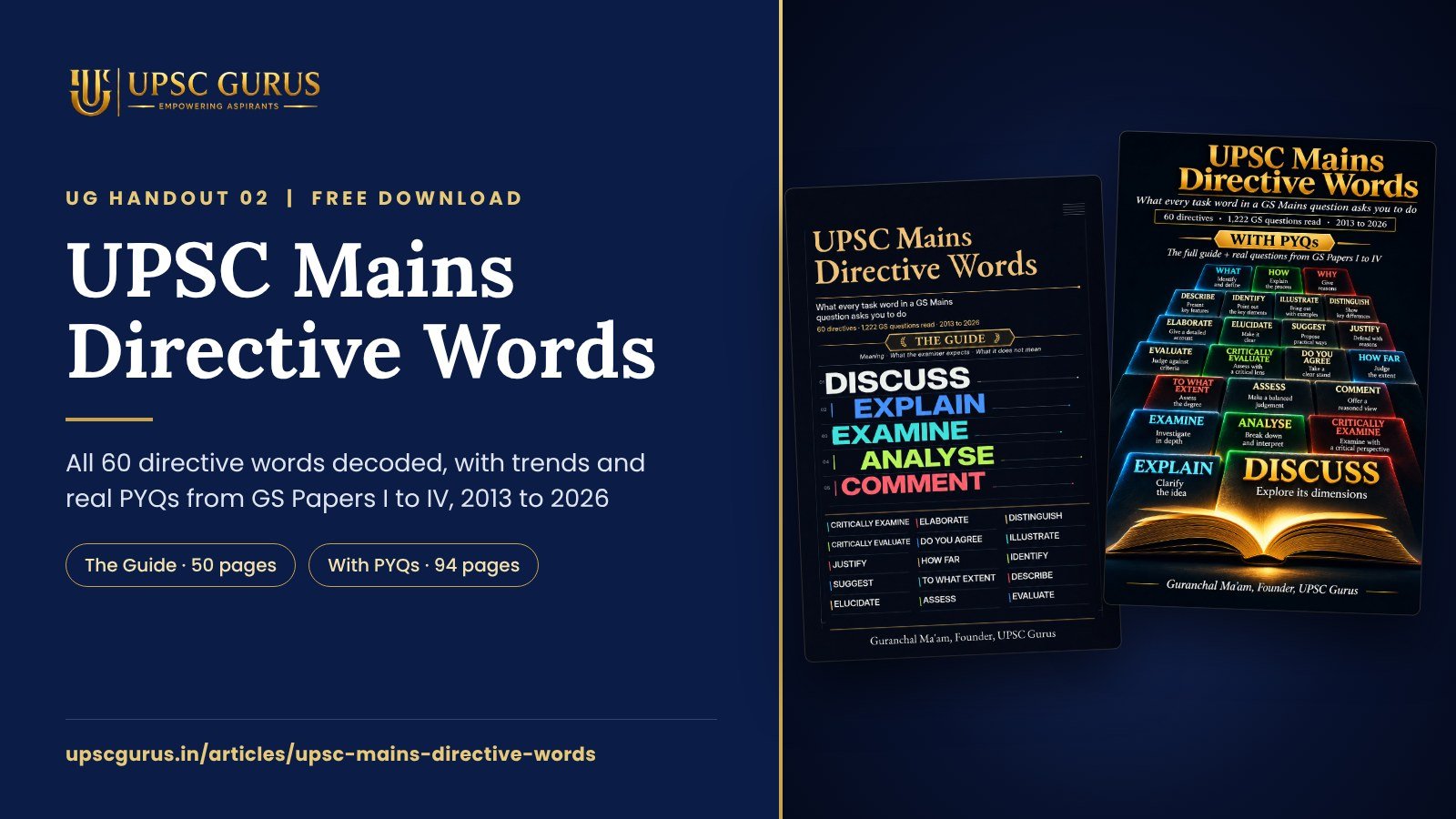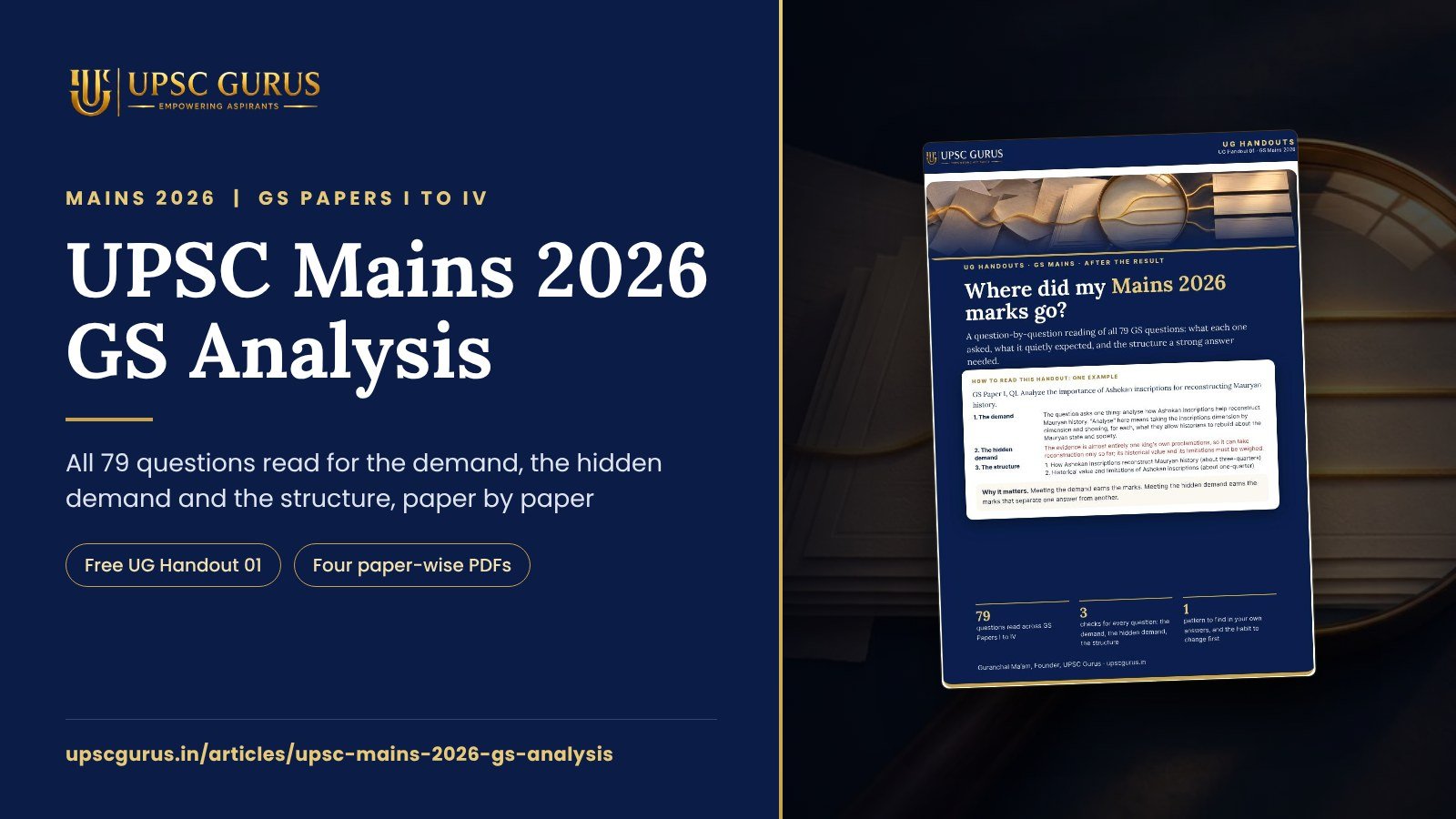
 New this week · Free UG Handout 02UPSC Mains Directive Words: 60 Meanings, Trends and PYQsTwo free PDFs: The Guide and the With PYQs edition.Read and download
Today’s Canvas
- Legislature cannot directly annul a judgment: Supreme Court strikes down 2022 Karnataka law validating tainted 2011 KPSC selectionGS II
- UP SIR: ECI tells Supreme Court bulk Form 7 deletion requests were fake and not acted upon; Court orders corrective stepsGS II
- Supreme Court: banks must compensate digital arrest and cyber fraud victims, at least the amount lost, where their lack of due diligence enabled the fraudGS II, GS III
- Kerala High Court strikes down rule barring women from working in toddy shops; says it violates Articles 14, 15, 19 and 21GS II
- Deep dive: the Law of the Sea and the right of transit passage through straits such as HormuzGS II
- Jaishankar in Atlanta for G20 Foreign Ministers’ Meeting; Quad ministers to meet on the sidelinesGS II
- Israel’s full count: Netanyahu bloc 53, Eisenkot bloc 48, Arab parties 19; no side reaches 61 as coalition talks beginGS II
- Curtain-raiser: 28th Commonwealth summit in Antigua and Barbuda from 1 November; Jaishankar to lead India’s delegationGS II
- World Bank: about 496 million Indians rose above the USD 4.20-a-day poverty line between 2011-12 and 2023-24; extreme poverty fell from 27.1% to 2.6%GS III
- Goyal: no sensitive interest of farmers compromised in India-US trade deal; farm groups seek detailsGS III
- 14th International Tourism Mart for the North East opens in Tawang, the first there in 13 yearsGS III
- Arnab’s remnant moves inland: red alert for Bihar on 30 October as Andhra puts crop damage above 80,000 hectaresGS I / GS III
- Environment Ministry workshop on coastal resilience: from hazard mapping to local planning and investmentGS I / GS III
Polity, governance and social justice
Legislature cannot directly annul a judgment: Supreme Court strikes down 2022 Karnataka law validating tainted 2011 KPSC selection
In short: The Court held that a validating law may remove the basis of a judgment but cannot simply overturn it; Karnataka must hold fresh recruitment for the posts.
Why in news
On 29 October 2026, a Bench of Justices J B Pardiwala and K Vinod Chandran (Srinivasa T. v. State of Karnataka) struck down the Karnataka Civil Services (Validation of Selection and Appointment of 2011 Batch Gazetted Probationers) Act, 2022. The Act had sought to validate a recruitment of 362 Group A and B gazetted probationers that the courts had earlier set aside over manipulation and corruption in the Karnataka Public Service Commission (KPSC). Appointments made under the Act were held vitiated.
Concept: Validating laws: what a legislature can and cannot do
A legislature may pass a validating law, even with retrospective effect, to cure the defect a court identified: it changes the law on which the judgment rested, so that the judgment would not have been given on the amended law. What it cannot do is declare a court’s binding decision ineffective, because that would make the legislature an appellate court and breach the separation of powers, part of the basic structure. In NHPC Ltd v. State of Himachal Pradesh (6 September 2023), the Supreme Court restated these principles, relying on Indian Aluminium Co. v. State of Kerala (1996), and added that a law enacted only to defy a court’s ruling may be struck down as colourable legislation. Here the Court found the 2022 Act did not remove the basis of the earlier rulings but directly annulled a final judgment.
Key facts for Prelims
- The 2011 notification drew over 1.38 lakh applicants; a CID inquiry ordered in 2013 alleged manipulation, corruption and nepotism involving KPSC officials, including identical interview marks for many candidates.
- Directions: fresh recruitment for the vacant posts under existing rules, with a one-time age relaxation for candidates not found tainted; no back wages or notional appointment from an earlier date.
- The Court said equity could not be claimed under an invalid Act, and even untainted candidates could not benefit from it.
- Article 315 provides for State Public Service Commissions; their members are appointed by the Governor (Article 316) but can be removed only by the President (Article 317).
Mains analysis and way forward
Mains analysis
- The ruling protects finality of judgments: if legislatures could reverse adverse decisions directly, judicial review would lose its force.
- Validating laws are legitimate tools for curing technical defects; the line is crossed when they serve to reward a process that courts found tainted.
- Recruitment integrity is central to trust in the civil services; compromised selections hurt deserving candidates and the quality of governance for decades.
- The case shows the cost of delay: a recruitment notified in 2011 is being redone in 2026, with candidates’ careers in limbo.
Way forward
- States can strengthen Public Service Commissions through transparent evaluation, recorded interviews and audit trails, so that disputes are fewer and quicker to settle.
- Legislatures may seek legal scrutiny of validating Bills to check that they cure the defect identified rather than override a decision.
- Time-bound inquiries and fast-tracked litigation in recruitment cases would limit the human cost of delay.
Connect the dots: GS II: separation of powers, judicial review, State PSCs (Articles 315 to 323); GS IV: probity and fairness in public recruitment.
Sources: LiveLaw: Legislature cannot directly annul judgment: Supreme Court strikes down 2022 Karnataka law validating tainted 2011 civil service selection, 29 Oct 2026; SCC Online: Supreme Court lays down principles for legislative power of abrogating a law (NHPC Ltd), 8 Sep 2023
UP SIR: ECI tells Supreme Court bulk Form 7 deletion requests were fake and not acted upon; Court orders corrective steps
In short: The Court asked the ECI to examine further irregularities flagged by petitioners and file a compliance report, and reviewed Kerala and Chhattisgarh revisions too.
Why in news
On 30 October 2026, a Bench of CJI Surya Kant and Justices Joymalya Bagchi and V Mohana heard Tanuj Punia v. Election Commission of India on the Special Intensive Revision (SIR) in Uttar Pradesh. The ECI said its officers had cross-checked complaints, found that bulk Form 7s seeking deletion of voters were false, and took no action on them. The Court directed that the petitioners give the ECI a note of further irregularities, which the ECI must examine, correct and report on.
Concept: Form 7 and the safeguards against wrongful deletion
Electoral rolls are prepared and revised under the Representation of the People Act, 1950 and the Registration of Electors Rules, 1960, under the superintendence of the Election Commission (Article 324). Form 6 is used to seek inclusion of a name and Form 7 to object to an entry, such as seeking the deletion of a voter who is dead, has shifted or is not eligible. Because Form 7 can be used against any listed voter, an objection must be inquired into before a name is removed, and the person concerned is to be given an opportunity to be heard. Making a false declaration in connection with the rolls is an offence under Section 31 of the 1950 Act. Bulk filing of objections against one group of voters is therefore a test of whether these checks work.
Key facts for Prelims
- The petitioner alleged that 32 Form 7s were filed against members of one community in one constituency, two of them signed by Booth Level Officers.
- Kerala SIR: the Court asked the ECI to consider “sympathetically” the cases of persons who could not submit enumeration forms for lack of time; the CJI said correction of rolls is a continuing process.
- Chhattisgarh SIR: the ECI, which had not filed a reply since notice in December, was given four weeks to file a counter-affidavit.
Mains analysis and way forward
Mains analysis
- Universal adult franchise (Article 326) depends on accurate rolls; wrongful deletion silently disenfranchises, often those least able to contest it.
- The ECI’s cross-verification shows the safeguards can work, but bulk false objections also show how the process can be misused against particular groups.
- Petitioners argued that unchecked filings in one State were followed by similar ones elsewhere; prompt action and prosecution for false declarations deter repetition.
- Treating roll correction as a continuing process reassures voters, but it needs accessible, time-bound remedies at the booth level.
Way forward
- Publish data on Form 7 filings, rejections and actions taken against false declarations, constituency-wise.
- Flag bulk or patterned objections automatically for senior review, and notify affected voters by SMS and in person before any deletion.
Connect the dots: GS II: Article 324, 325 and 326, Representation of the People Act, 1950, electoral reforms; GS IV: institutional integrity.
Supreme Court: banks must compensate digital arrest and cyber fraud victims, at least the amount lost, where their lack of due diligence enabled the fraud
In short: In its suo motu digital arrest case, the Court said RBI’s coming rules must make financial institutions indemnify victims when their due diligence fails.
Why in news
On 29 October 2026, a Bench of CJI Surya Kant and Justices Joymalya Bagchi and V Mohana, hearing the suo motu case In Re: Victims of Digital Arrest Related to Forged Documents, recorded that regulatory measures proposed by the RBI must mandate financial institutions to indemnify digital arrest and cyber fraud victims, with compensation not less than the amount lost, where a failure of due diligence by the institution caused the fraud. The Bench said institutions found negligent must face strict liability.
Concept: Who bears the loss in an unauthorised bank transaction?
RBI’s circular of 6 July 2017 on limiting customers’ liability in unauthorised electronic banking transactions sets the present framework. A customer has zero liability if the fraud results from the bank’s own negligence or deficiency, or from a third-party breach that the customer reports within three working days. Liability is capped (Rs 5,000 to Rs 25,000 depending on the account) if reporting is delayed by four to seven working days, while a customer who shared credentials bears the loss until reporting. The burden of proving customer liability lies on the bank, which must credit the disputed amount within ten working days of notice and resolve the complaint within 90 days. In a digital arrest, fraudsters pose as police or investigating agencies and pressure victims into transferring money themselves, so the transfers often fall outside this framework’s protection.
Key facts for Prelims
- RBI’s KYC Amendment Directions, 2026 are expected to be notified by 30 November and operational by 31 December, the Court was told; it will examine them.
- The RBI is to submit a list of all authorised financial institutions; the Court said it could issue directions covering them all without making each bank a party.
- The Attorney General said the RBI, MeitY and the Department of Telecommunications are working on measures, and that liability of bank officials found colluding with fraudsters is under consideration.
Mains analysis and way forward
Mains analysis
- Fraud money moves through accounts that banks open and monitor; tying compensation to due diligence gives banks a direct incentive to detect mule accounts and unusual transfers.
- Existing protection covers transactions the customer did not authorise; victims who are coerced into making transfers themselves need a separate safeguard.
- Strict liability must be balanced with clear standards of due diligence, so that banks know what is expected and honest customers are not denied credit or services.
- Cyber fraud spans banks, telecom networks and messaging platforms; the Bench also asked whether intermediaries such as WhatsApp are covered.
Way forward
- Risk-based monitoring, cooling-off periods or holds on unusual high-value transfers, and quick freezing of mule accounts can stop money before it disappears.
- Awareness that no agency conducts arrests over video calls, along with the 1930 helpline and the cybercrime portal for quick reporting, remains the first line of defence.
Connect the dots: GS II: judicial activism, regulatory bodies (RBI); GS III: cyber security, banking, financial inclusion; GS IV: accountability of institutions.
Sources: LiveLaw: Supreme Court says banks must compensate cyber fraud victims if it took place due to bank’s lack of due diligence, 29 Oct 2026; News On AIR: SC calls for compensation to digital fraud victims, 29 Oct 2026; RBI: Customer Protection: Limiting Liability of Customers in Unauthorised Electronic Banking Transactions, 6 July 2017
Kerala High Court strikes down rule barring women from working in toddy shops; says it violates Articles 14, 15, 19 and 21
In short: Safety concerns must be met by making workplaces safe, not by shutting women out of jobs, the Court said, relying on the Supreme Court’s Anuj Garg ruling.
Why in news
In a judgment reported on 29 October 2026, Justice P Gopinath of the Kerala High Court (Sophy v. State of Kerala) struck down Rule 7(37) of the Kerala Abkari Shops Disposal Rules, 2002, which barred women from employment in any capacity in toddy shops. The petitioner, the widow of a toddy shop employee in Thrissur, had been refused compassionate appointment under the Rule; her claim must now be considered without it.
Concept: Protection or exclusion? Article 15 and sex-based job bars
Article 15(1) bars the State from discriminating on grounds of sex, while Article 15(3) allows special provisions for women and children. Courts have read 15(3) as enabling measures that advance women, not restrictions that take away their opportunities in the name of protection. In Anuj Garg v. Hotel Association of India (2007), the Supreme Court struck down Section 30 of the Punjab Excise Act, 1914, which barred women (and men under 25) from working where liquor was served, observing that empowerment, rather than curbs on women’s freedom, was the sounder approach. Any such restriction must be justified and proportionate: the State should address the risks women face at work instead of removing women from work.
Key facts for Prelims
- The State argued the Rule protected women from exploitation in often remote toddy shops and that liquor trade is res extra commercium (a trade in which no fundamental right can be claimed).
- The Court distinguished Kerala PSC v. Manjusha (2009), which upheld excluding women from night watchman posts, finding no material that similar hazards applied in toddy shops.
- Earlier Kerala High Court rulings struck down similar bars: Dhanyamol v. State of Kerala (2011) on Rule 27A of the Foreign Liquor Rules, and Sanuja v. Kerala State Beverages Corporation (2016) on foreign liquor shops.
- Any licence condition for the toddy shop licensee that relied on the Rule also cannot stand.
Mains analysis and way forward
Mains analysis
- Protective exclusion often reinforces stereotypes about what work women can do and pushes them out of livelihoods, especially in informal and family-linked jobs.
- Compassionate appointment is a social security measure; barring a widow from her late husband’s workplace defeats its very purpose.
- The safety concern is genuine, but the remedy lies in workplace safeguards, such as the internal and local committees under the POSH Act, 2013, not in prohibition.
- Rules found unconstitutional in one form can survive in parallel rules; a systematic review of service and licensing rules is needed.
Way forward
- States can audit excise, labour and service rules for sex-based bars and replace them with safety obligations on employers.
- Licensing conditions can require safe premises, lighting, grievance redress and transport where needed, rather than restrict who may work.
Connect the dots: GS II: Articles 14, 15, 16, 19(1)(g) and 21, gender justice; GS I: women’s work and empowerment; GS IV: fairness and dignity.
Sources: LiveLaw: Kerala High Court strikes down rule prohibiting women from working in toddy shops, 29 Oct 2026; LiveLaw column: Can’t women serve liquor in bars? Constitutional analysis of legal restrictions
International relations
Deep dive: the Law of the Sea and the right of transit passage through straits such as Hormuz
In short: Under UNCLOS, ships and aircraft enjoy transit passage through straits used for international navigation, which bordering States must not hamper or suspend; some straits instead have non-suspendable innocent passage.
Why in news
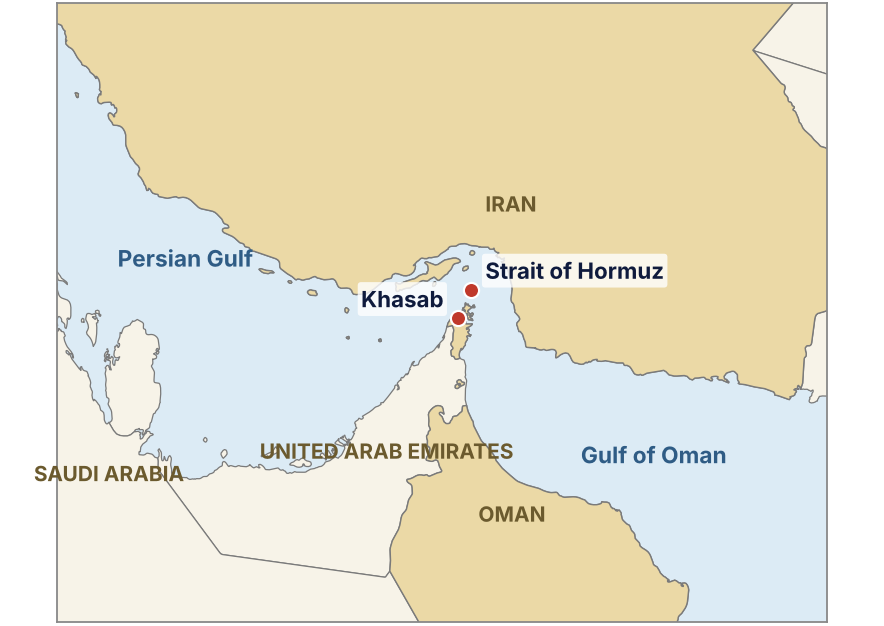
The UK Maritime Trade Operations centre said that late on 29 October an outbound tanker about 25 nautical miles north-east of Khasab, Oman, was approached by a small boat that attached two explosive devices to its hull; the crew were safe and the fire was put out. Iran’s navy said the ship hit a naval mine in a restricted area. The same day, the Houthis said they had attacked Saudi sites including Ras Tanura, the Rabigh refinery and an Aramco facility at Abqaiq. This follows a month in which Iran’s Revolutionary Guards have said tankers using routes it calls “illegal” hit mines its forces laid in the Strait of Hormuz, and Iran has demanded that all ships seek its authorisation before transiting. About one-fifth of global oil consumption passed through the strait before the war began in late February 2026, so the legal rules on passage through straits now shape energy prices and India’s energy security.
Concept: Innocent passage and transit passage under UNCLOS
The UN Convention on the Law of the Sea (UNCLOS) divides the sea into zones: a territorial sea of up to 12 nautical miles, a contiguous zone up to 24 nautical miles and an exclusive economic zone (EEZ) up to 200 nautical miles from the baselines. In the territorial sea, ships of all States enjoy innocent passage, which is innocent so long as it is not prejudicial to the peace, good order or security of the coastal State, and the coastal State may temporarily suspend it in specified areas for security. Straits used for international navigation have a stronger regime under Part III (Articles 37 to 44): all ships and aircraft enjoy transit passage, defined as the freedom of navigation and overflight solely for continuous and expeditious transit. Bordering States may regulate traffic through non-discriminatory laws, but Article 44 says they “shall not hamper transit passage” and “there shall be no suspension of transit passage”. Ships in transit, in turn, must proceed without delay and refrain from any threat or use of force against the bordering States.
Key facts for Prelims
- Transit passage covers both ships and aircraft, including overflight; innocent passage applies only to ships and gives no right of overflight.
- Article 45 keeps innocent passage, without any right of suspension, in straits excluded from transit passage (for example, straits between a part of the high seas or an EEZ and the territorial sea of a foreign State).
- In the EEZ, all States, coastal or land-locked, enjoy freedoms of navigation and overflight and of laying submarine cables and pipelines (Article 58).
- Iran signed UNCLOS on 10 December 1982 but has not ratified it; the United States is not a party; Oman, the other State bordering Hormuz, ratified it on 17 August 1989.
Mains analysis and way forward
Mains analysis
- Choke points turn law into economics: when transit through Hormuz falls, crude and freight costs rise for import-dependent economies such as India, showing why the rule against suspending transit passage is central to energy security.
- Because neither Iran nor the United States is a party to UNCLOS, the dispute turns on whether the transit passage rule binds them as customary international law, a question the treaty text alone cannot settle; this weakens enforcement in the very strait where it matters most.
- Demands for prior authorisation, mined “prohibited” routes and counter-blockades all sit uneasily with Articles 38 and 44, which bar bordering States from hampering or suspending transit, and illustrate how armed conflict tests rules written for peacetime.
- For India, which ratified UNCLOS in 1995 and backs freedom of navigation in the Indo-Pacific, consistency matters: the same principle it invokes in the South China Sea applies in the Gulf, and also limits what India itself may do in its own waters.
Way forward
- Support de-mining, escort and information-sharing arrangements through the International Maritime Organization and regional maritime security mechanisms, while keeping India’s naval deployments defensive and rules-based.
- Reduce exposure to single choke points through strategic petroleum reserves, diversified crude sourcing and longer-term contracts on routes that avoid Hormuz.
- Press diplomatically for wider ratification of UNCLOS and for disputes over passage to be settled through its dispute-settlement procedures rather than force.
Connect the dots: GS II: international treaties, effect of policies of other countries on India’s interests; GS III: energy security, maritime security; GS I: important straits and choke points.
Sources: ANI: Tanker attacked with explosive devices in Strait of Hormuz, crew safe: UKMTO, 30 October 2026; Business Standard (Reuters): Oil prices rise on supply concerns as Houthis attack Saudi Arabia, 30 October 2026; United Nations: UNCLOS text, Parts II, III and V; United Nations: UNCLOS Part III, Straits used for international navigation; UN Treaty Collection: status of UNCLOS (Chapter XXI-6); Al Jazeera: Iran says two tankers catch fire after hitting mines in Strait of Hormuz, 18 October 2026; Bernama (Xinhua): IRGC says tankers hit mines laid by its forces in Hormuz, 20 October 2026; AP via NY1: Iran says 7 tankers on fire or damaged overnight in the Strait of Hormuz, 22 October 2026
Jaishankar in Atlanta for G20 Foreign Ministers’ Meeting; Quad ministers to meet on the sidelines
In short: G20 foreign ministers meet in Atlanta on 30-31 October under the US presidency; energy, supply chains and safe sea lanes top the agenda.
Why in news
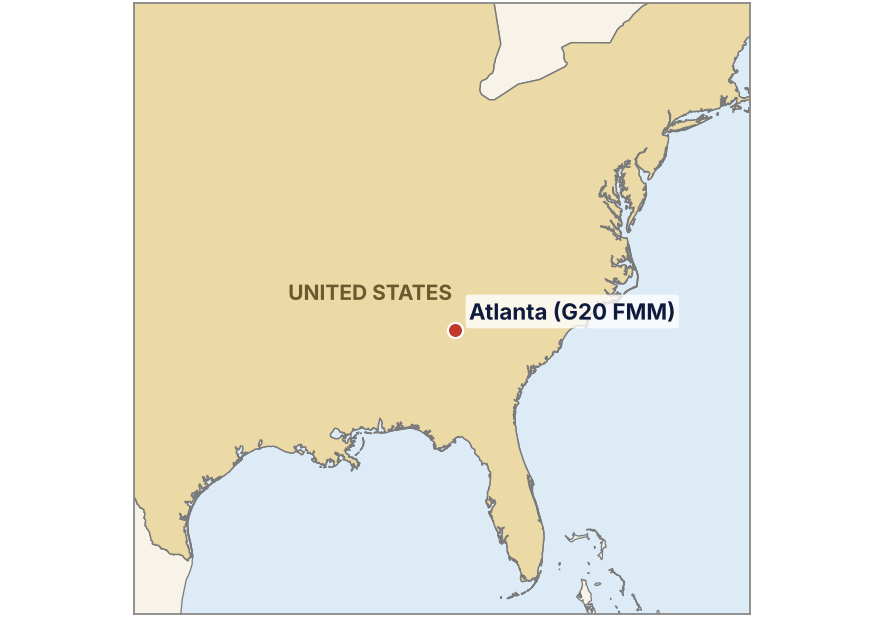
External Affairs Minister S Jaishankar arrived in Atlanta late on 29 October for the G20 Foreign Ministers’ Meeting on 30-31 October, chaired by US Secretary of State Marco Rubio. He will also join a Quad Foreign Ministers’ Meeting on the sidelines, the third of the year, after meetings in New Delhi on 26 May and Manila on 22 July 2026. The State Department has listed freedom of navigation, energy and food security and supply chains as the issues to address.
Concept: The G20: origin, membership and how it works
The G20 began in 1999 as a forum of finance ministers and central bank governors after the Asian financial crisis, and was raised to a leaders’ summit in 2008 after the global financial crisis. It has 19 countries plus the European Union and, since India’s presidency in 2023, the African Union. It has no permanent secretariat: a rotating presidency sets the agenda, supported by the previous and next presidencies (the troika). Work runs on two tracks, a Finance Track and a Sherpa Track, with ministerial meetings such as this one feeding the leaders’ summit.
Key facts for Prelims
- The US holds the G20 presidency in 2026 and describes its approach as returning the G20 to its “core economic mission”.
- The G20 Leaders’ Summit is scheduled in Miami on 14 and 15 December 2026.
- The Quad groups India, the US, Japan and Australia; India is the current Quad chair, and a Quad leaders’ summit is likely in Manila in November, the first in two years.
- After Atlanta, Jaishankar leads India’s delegation to the Commonwealth Heads of Government Meeting in St John’s, Antigua and Barbuda, on 1-4 November.
Mains analysis and way forward
Mains analysis
- With the Strait of Hormuz disrupted, India’s priorities at the G20 (energy, fertiliser and LNG supplies, safe sea lanes) are matters of direct national interest, not abstract diplomacy.
- The Quad meeting on the sidelines shows how India uses plurilateral groupings alongside larger forums: the G20 for global economic rules, the Quad for Indo-Pacific public goods such as maritime awareness and resilient supply chains.
- A “back to basics” G20 narrows the agenda to growth and energy; India, which placed development, climate finance and the Global South at the centre in 2023, will need to keep those issues alive without the forum fragmenting.
Way forward
- Push for practical G20 outcomes on supply-chain resilience and critical minerals that include developing economies, not only producers and large buyers.
- Use the Quad ministerial to give concrete content to a leaders’ summit, especially maritime domain awareness, health and disaster response in the Indo-Pacific.
Connect the dots: GS II: bilateral, regional and global groupings and agreements involving India; effect of policies of developed countries on India’s interests.
Sources: ThePrint: Jaishankar set to travel to US, attend G20 and Quad meetings, 28 October 2026; Millennium Post: EAM Jaishankar in US for G20 Foreign Ministers’ meet, 30 October 2026; Telangana Today: Jaishankar joins G20 foreign ministers’ meet in Atlanta, 30 October 2026
Israel’s full count: Netanyahu bloc 53, Eisenkot bloc 48, Arab parties 19; no side reaches 61 as coalition talks begin
In short: With all votes counted, no bloc has a majority in Israel’s 120-seat Knesset; official results go to President Herzog on 4 November.
Why in news
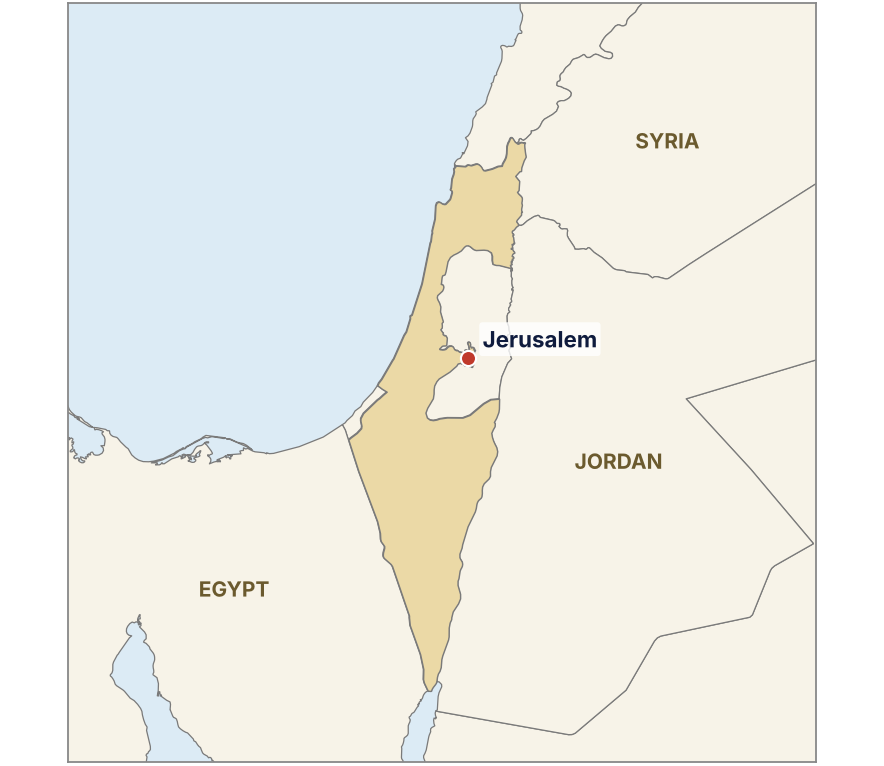
Counting for Israel’s 27 October election finished on 29 October. Likud won 27 seats and Gadi Eisenkot’s Yashar 21; the pro-Netanyahu bloc has 53 seats, the anti-Netanyahu bloc 48 and Arab parties 19, so neither side reaches the 61 needed for a majority. President Isaac Herzog has urged parties to avoid another early election and to negotiate with an open mind.
Concept: How Israel elects its Knesset and forms a government
All 120 members of the Knesset are elected by proportional representation from closed party lists in a single nationwide constituency, with a threshold of 3.25% of the vote; seats are allocated by the Bader-Ofer (D’Hondt) method. Because no party usually wins a majority, governments are coalitions. After the official results, the President consults every party in the new Knesset and gives the task of forming a government to the member most likely to succeed, who has 28 days, extendable by up to 14 days. India, by contrast, uses first-past-the-post in single-member constituencies for the Lok Sabha.
Key facts for Prelims
- Turnout was 77.9%, with 5,716,665 votes cast.
- The new Knesset (the 26th) is due to be sworn in on 10 November.
- Three lists fell below the 3.25% threshold, including The Reservists with 2.7%.
- Arab parties won 19 seats: the Joint List 11 and Ra’am 8.
Mains analysis and way forward
Mains analysis
- Proportional representation gives small parties strong bargaining power; a fragmented result can make coalition-building slow and governments fragile.
- Whether Arab parties support a government from outside or inside has become a defining question of Israeli coalition politics.
- For India, continuity in Israel matters for defence supplies, agriculture and water technology, and the India-Middle East-Europe Economic Corridor, but India deals with Israel as a State, whichever coalition governs.
Way forward
- India should keep its balanced West Asia policy: a strong partnership with Israel alongside support for a negotiated two-State solution.
- Students can use this case to compare PR and first-past-the-post: representation versus stability.
Connect the dots: GS II: comparison of the Indian constitutional scheme with that of other countries; effect of policies and politics of other countries on India’s interests.
Sources: The National: Israeli parties begin coalition talks with all votes counted, 29 October 2026; The Times of Israel: Liveblog, 30 October 2026
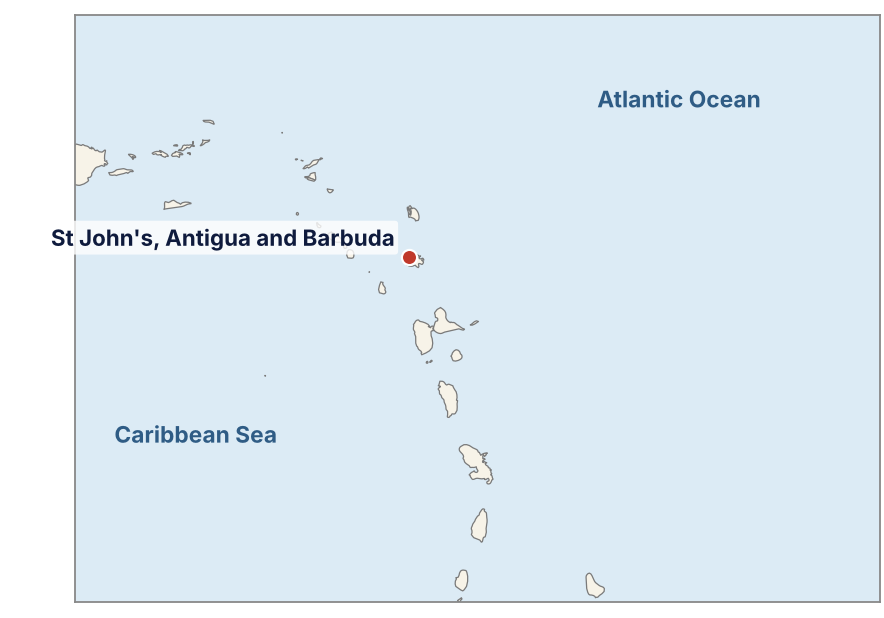
Curtain-raiser: 28th Commonwealth summit in Antigua and Barbuda from 1 November; Jaishankar to lead India’s delegation
In short: CHOGM 2026 meets in St John’s on 1-4 November on partnerships and investment; climate resilience and small island States are central.
Why in news
The 28th Commonwealth Heads of Government Meeting (CHOGM) will be held in St John’s, Antigua and Barbuda, from 1 to 4 November 2026 on the theme “Accelerating Partnerships and Investment for a Prosperous Commonwealth”. External Affairs Minister S Jaishankar will lead India’s delegation, travelling on from the G20 meeting in Atlanta.
Concept: The Commonwealth: from Empire to a voluntary association
The Commonwealth is a voluntary association of 56 independent countries, most of them former British territories. The London Declaration of 1949 allowed India to stay a member as a republic, accepting the British monarch only as the symbol of the free association and Head of the Commonwealth; this made the modern Commonwealth possible. Its shared values are set out in the Singapore Declaration (1971), the Harare Declaration (1991) and the Commonwealth Charter (2013). CHOGM, usually held every two years, is its main decision-making meeting, and the Secretariat in London is headed by a Secretary-General.
Key facts for Prelims
- The Commonwealth Secretary-General is Shirley Botchwey of Ghana, in office since 1 April 2025.
- The host chair is Prime Minister Gaston Browne of Antigua and Barbuda.
- Focus areas include climate resilience, trade, innovation, equality and sustainable development; issues of Small Island Developing States are also expected to feature.
- India hosted CHOGM in New Delhi in 1983.
Mains analysis and way forward
Mains analysis
- For India, the Commonwealth offers a low-cost platform to reach small and island States in the Caribbean, Pacific and Africa, many of them partners in climate and disaster-resilience initiatives.
- The association’s relevance is questioned because it has no binding power; its value lies in shared legal and administrative traditions, the English language and networks for education and trade.
- Debates on reparations for slavery and on climate finance show the Global South using the forum to press historical and developmental claims.
Way forward
- India can bring practical offers such as capacity building, digital public infrastructure and the Coalition for Disaster Resilient Infrastructure to small island members.
- A focus on trade facilitation and investment among members can give the Commonwealth an economic purpose that complements its values agenda.
Connect the dots: GS II: regional and global groupings involving India; important international institutions, their structure and mandate. GS I: decolonisation and the post-war world.
Sources: Commonwealth Secretariat: Antigua and Barbuda ignites Commonwealth journey to CHOGM 2026; ThePrint: Jaishankar set to travel to US, attend G20 and Quad meetings, 28 October 2026; Wikipedia: 2026 Commonwealth Heads of Government Meeting (edition number and Secretary-General’s term)
Economy and reports
World Bank: about 496 million Indians rose above the USD 4.20-a-day poverty line between 2011-12 and 2023-24; extreme poverty fell from 27.1% to 2.6%
In short: World Bank brief records one of the fastest poverty declines anywhere, but flags flat real earnings, rising youth unemployment and a poverty belt from UP to Bengal.
Why in news
The World Bank’s October 2026 Poverty and Equity Brief for India, reported on 30 October, estimates that about 496 million Indians rose above the lower-middle-income poverty line of USD 4.20 a day (2021 PPP) between 2011-12 and 2023-24. Extreme poverty fell from 27.1% to 2.6%, and the share living below the lower-middle-income line of USD 4.20 a day (2021 PPP) fell from 57.7% to 16.1%.
Concept: How the World Bank measures poverty
The World Bank sets international poverty lines in purchasing power parity (PPP) dollars, so that a dollar buys the same basket in every country. Since its June 2025 update, based on 2021 PPPs, it uses three lines: USD 3.00 a day for extreme poverty, USD 4.20 a day as the typical line of lower-middle-income countries (India’s group) and USD 8.30 a day for upper-middle-income countries. These are headcount measures built from household consumption surveys, which is why a change in survey design can shift the estimate. Multidimensional poverty, by contrast, counts deprivations in health, education and living standards using the Alkire-Foster method behind the global MPI of UNDP and Oxford’s OPHI and NITI Aayog’s National MPI.
Key facts for Prelims
- At USD 4.20 a day, the brief projects poverty at 14.2% in 2026, falling to 12.1% by 2028; it calls these indicative microsimulation estimates.
- Multidimensional poverty (OPHI MPI) fell from 53.8% in 2005-06 to 16.4% in 2019-21; the World Bank’s own multidimensional measure is 15.5% for 2022-23.
- Employment rose by about 134 million between 2017 and 2023, nearly twice the growth of the working-age population, much of it from rural women entering paid work.
- Youth unemployment rose from 14.6% to 15.9% between Q1 FY26 and Q1 FY27; about 57% of India’s poor live in a contiguous belt from Uttar Pradesh to West Bengal.
Mains analysis and way forward
Mains analysis
- The fall in extreme poverty reflects broad-based gains in consumption, aided by direct benefit transfers, free foodgrains, housing, sanitation and electrification that raised living standards beyond income alone.
- The brief itself cautions that part of the gain may reflect better measurement, so comparisons across survey rounds need care before they guide policy.
- Job growth concentrated in low-productivity work, flat real earnings and rising youth unemployment show that escaping extreme poverty is not the same as achieving secure, middle-class livelihoods.
- Spatial concentration of poverty in the eastern Gangetic belt makes a case for region-specific strategies on agriculture, manufacturing jobs and human capital.
Way forward
- Shift the policy lens from the USD 3.00 line to the USD 4.20 line and to vulnerability, since many households sit just above the threshold.
- Pair welfare with productive employment: skilling, labour-intensive manufacturing and safe, accessible work for young women.
- Release regular, comparable consumption surveys so that poverty trends can be tracked transparently.
Connect the dots: Links to GS III inclusive growth and poverty measurement; GS II welfare schemes; GS I regional disparities and women’s work.
Sources: ANI: India records one of the fastest poverty declines in the world, poverty down from 27.1% to 2.6%: World Bank, 30 Oct 2026; The Tribune: India’s extreme poverty declines from 27.1% to 2.6% in 12 years: World Bank, 30 Oct 2026; Outlook: World Bank: India lifted 496 million people out of poverty between 2011 and 2023, 30 Oct 2026
Goyal: no sensitive interest of farmers compromised in India-US trade deal; farm groups seek details
In short: As the first phase of the India-US pact nears completion, the Centre says farm safeguards hold while farm unions demand the text be made public.
Why in news
Commerce and Industry Minister Piyush Goyal said on 29 October in New Delhi that “not a single sensitive interest of our farmers or any stakeholder has been compromised” in the India-US trade deal, and that people would welcome it once details are public. He spoke at the Fourth National Conference on India’s Industrial Transformation, organised by ISID and IDRA. The two sides unveiled a framework in February 2026 but have not yet signed the pact.
Concept: How trade agreements protect sensitive sectors
A free trade agreement rarely removes every tariff. Countries keep an exclusion or negative list of products that get no tariff cut, use tariff-rate quotas that allow only a fixed volume at a lower duty, phase cuts over many years and add bilateral safeguard clauses that let duties be raised again if imports surge and hurt domestic producers. Rules of origin stop third-country goods from routing through a partner, and sanitary and phytosanitary (SPS) measures under the WTO SPS Agreement let a country set science-based food safety and plant and animal health standards. India has traditionally kept dairy and key staples among its most protected lines because they support the livelihoods of small and marginal farmers.
Key facts for Prelims
- Samyukt Kisan Morcha, a coalition of more than 100 farm groups, said earlier in October that the deal eliminates India’s high tariffs on farm goods including maize, almonds, walnuts, apples and soybean oil, and plans protests in November (Reuters).
- Goyal said India’s nine FTAs and trade agreements give preferential access to economies with a combined GDP of about USD 60 trillion, against about USD 10 trillion for agreements concluded before 2014, and now cover 38 developed and relatively prosperous countries.
- He named quality, global market access, economies of scale and inclusivity as the four drivers of industrial transformation, and said the first Startup Fund of Funds is fully used and a second is in place.
Mains analysis and way forward
Mains analysis
- Cheaper imports of tree nuts, fruit or edible oil can lower consumer prices and processing costs, but can also depress farm-gate prices for Indian growers if safeguards are weak.
- Opacity breeds mistrust: farm groups fear subsidised US produce, so publishing tariff schedules and safeguard triggers early can settle doubts that rumour otherwise fills.
- Market access in return, especially for labour-intensive goods such as textiles, leather and gems and jewellery, is where India’s comparative advantage lies, as Goyal noted.
- Modern agreements now cover services, investment, skills, technology and climate cooperation, so they need to be judged as packages rather than tariff line by tariff line.
Way forward
- Consult farmer organisations and States before signing, and share the final schedule of concessions and safeguards in plain language.
- Use the period of phased tariff cuts to raise farm productivity, storage and processing so that domestic producers can compete.
- Keep a monitoring system that can trigger the bilateral safeguard quickly if imports surge.
Connect the dots: Links to GS III external sector, WTO and agriculture (market access, domestic support, export competition) and GS II India-US relations.
Sources: PIB, Ministry of Commerce and Industry: Goyal calls for quality, scale and global market access to drive India’s industrial transformation, 29 Oct 2026; Reuters via AJOT: India says trade deal with US will not hurt its farmers, 29 Oct 2026; IANS via TenNews: India-US trade deal safeguards sensitive interests of farmers, other stakeholders: Piyush Goyal, 29 Oct 2026
14th International Tourism Mart for the North East opens in Tawang, the first there in 13 years
In short: Tawang hosts the North East’s flagship tourism mart with a record 43 foreign buyers; easing access to protected areas is on the agenda.

Why in news
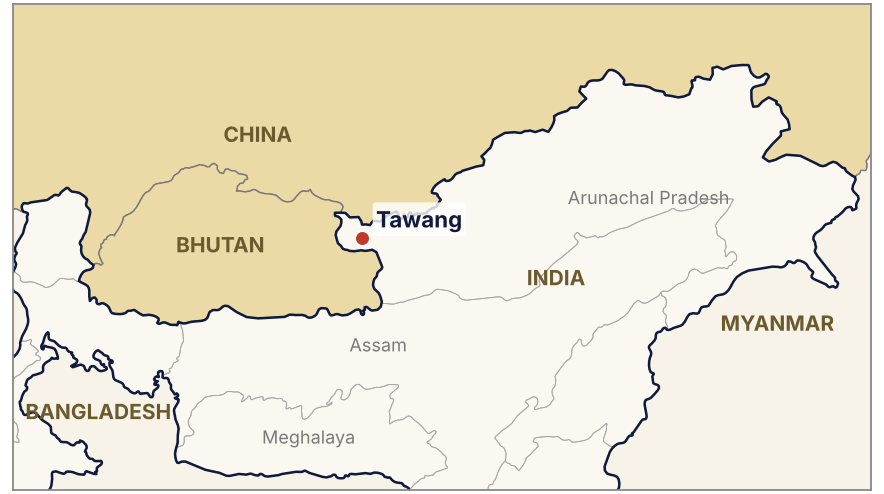
The 14th International Tourism Mart (ITM) for the North Eastern Region opened at Tawang, Arunachal Pradesh, on 29 October and runs till 31 October, in the presence of Union Tourism and Culture Minister Gajendra Singh Shekhawat and Chief Minister Pema Khandu. It brings 43 international buyers from 22 countries to meet tourism businesses from all eight North Eastern States. The Ministry of Tourism organises the annual mart with the North Eastern States; this is Tawang’s first edition since 2013.
Concept: Inner Line Permit and Protected Area Permit
Large parts of the North East need special permission to enter. The Inner Line Permit (ILP), rooted in the Bengal Eastern Frontier Regulation, 1873, is required by Indian citizens from outside the State to enter Arunachal Pradesh, Nagaland, Mizoram and Manipur; it was designed to protect tribal land and culture. Foreign tourists need a Protected Area Permit (PAP) or Restricted Area Permit (RAP), issued under orders of 1958 and 1963, for sensitive border areas; all of Arunachal Pradesh falls under the PAP regime. These rules balance security and cultural protection with tourism, which is why tourist access to protected and restricted areas is a technical session at this ITM.
Key facts for Prelims
- Over 200 participants are expected; buyers come from countries including Australia, Bhutan, France, Germany, Japan, Singapore, Thailand, the UAE, the UK and the US.
- The 30 October programme includes B2B meetings and a Regional Meeting of North Eastern Tourism Ministers chaired by Shekhawat; technical sessions cover the live events and concert economy.
- Site visits include Tawang Monastery, Urgelling Gompa, Jang Waterfall and Pankang Teng Tso Lake; the 13th ITM was held in Gangtok, Sikkim, in November 2025.
- Shekhawat said the ITM is “not merely a tourism marketplace” but a platform for partnerships, and highlighted adventure, music and concert tourism.
Mains analysis and way forward
Mains analysis
- Tourism suits the North East because it is labour-intensive, spreads income to homestays, guides and crafts, and builds on biodiversity and living cultures rather than heavy industry.
- Permit regimes, limited air and road links and short seasons keep many foreign tourists away; simpler online permits can widen access without diluting security.
- In border districts such as Tawang, tourism also supports vibrant, populated frontier villages, which has strategic value.
- Fragile mountain ecosystems call for carrying-capacity limits, waste management and community ownership so that growth does not erode what visitors come to see.
Way forward
- Create single-window, digital ILP and PAP issuance with clear timelines for tourists.
- Develop circuits that link the eight States so that visitors stay longer and spread spending.
- Train local youth in hospitality and guiding, and set environmental standards for high-altitude sites.
Connect the dots: Links to GS III tourism and infrastructure, GS I geography of the North East and Buddhist heritage, and GS II tribal safeguards.
Sources: PIB, Ministry of Tourism: Tawang to host 14th International Tourism Mart from 29-31 October 2026, 28 Oct 2026; ANI: 14th International Tourism Mart inaugurated in Arunachal Pradesh’s Tawang, 30 Oct 2026
Environment and disaster management
Arnab’s remnant moves inland: red alert for Bihar on 30 October as Andhra puts crop damage above 80,000 hectares
In short: Cyclone Arnab has weakened over land, but its moisture is still travelling north, bringing very heavy rain far from the coast where it struck.
Why in news
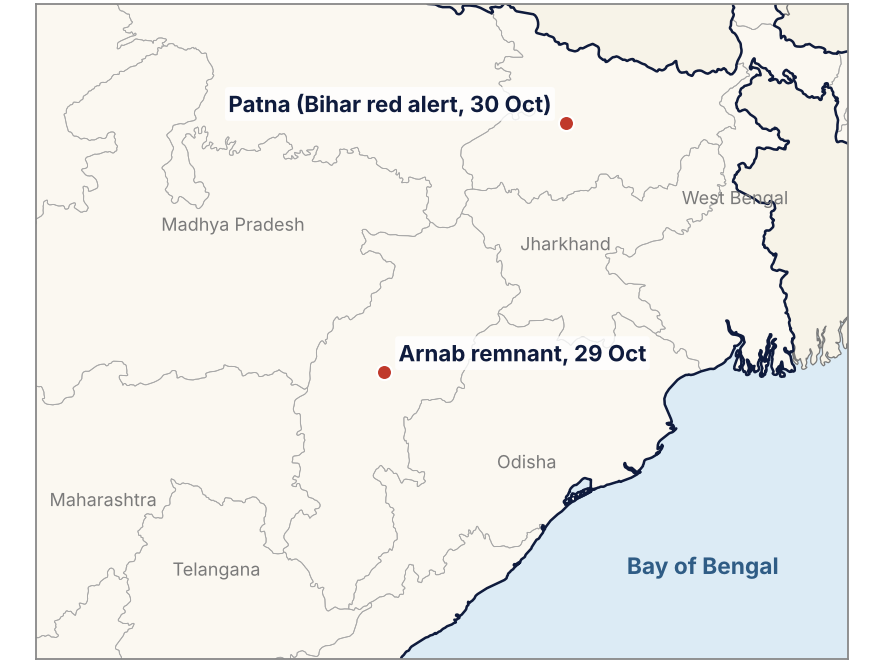
On the night of 29 October, IMD said the depression left by Cyclone Arnab lay over central Chhattisgarh and adjoining Odisha and would weaken into a well-marked low over north Chhattisgarh. IMD issued a red alert for very heavy to extremely heavy rain in Bihar for 30 October. In Andhra Pradesh, preliminary estimates put crop damage at over 70,000 hectares of paddy and over 10,000 hectares of horticulture.
Concept: What happens to a cyclone after landfall
A cyclone draws its energy from warm sea water, through the latent heat released when water vapour condenses. Once it crosses the coast, that supply is cut and friction over land breaks up its circulation. So it weakens step by step on the IMD scale: cyclonic storm (34 to 47 knots), deep depression (28 to 33 knots), depression (17 to 27 knots) and then a low-pressure area. Wind falls fast, but the moisture it carries does not vanish. Steering winds carry the remnant inland, where hills and other weather systems can lift that moisture and wring out very heavy rain hundreds of kilometres from the landfall point.
Key facts for Prelims
- IMD’s 30 October alerts: orange for East Uttar Pradesh, Sub-Himalayan West Bengal, Sikkim and the Andaman and Nicobar Islands; thunderstorms with hail for East Rajasthan, Haryana, Chandigarh, Uttarakhand and West Uttar Pradesh.
- Chhattisgarh: red alert for Raigarh and surrounding areas; schools closed in several districts; Union Home Minister Amit Shah reviewed the situation with Chief Minister Vishnu Deo Sai on 29 October.
- Andhra Pradesh: over 28,000 people moved to relief shelters; ex gratia of Rs 5 lakh announced for the family of each person who died.
- IMD colour codes: green (no action), yellow (be updated), orange (be prepared), red (take action).
Mains analysis and way forward
Mains analysis
- Damage does not end at the coast: inland rain from a remnant system can hit farms, schools and roads in States that never faced the cyclone’s winds.
- Paddy near harvest in October is especially exposed; crop loss assessments decide input subsidy and relief under the SDRF and NDRF norms.
- Early evacuation has cut deaths from Bay of Bengal cyclones sharply; the next challenge is cutting economic loss, from crops to power lines.
Way forward
- Impact-based forecasts that follow the remnant inland, so States beyond the coast act in time.
- Quick, digitised crop-loss surveys and crop insurance claims settled before the rabi sowing window.
Connect the dots: GS I cyclones and their life cycle; GS III disaster management (Sendai Framework, NDMA, SDRF and NDRF); agriculture and crop insurance.
Sources: News On AIR: IMD issues red alert for very heavy to extremely heavy rainfall in Bihar tomorrow, 29 Oct 2026; News On AIR: Heavy rain in Chhattisgarh; schools closed in several districts, 29 Oct 2026; News On AIR: Cyclone Arnab damages over 80,000 hectares of crops in Andhra Pradesh, updated 30 Oct 2026
Environment Ministry workshop on coastal resilience: from hazard mapping to local planning and investment
In short: India has mapped its coastal risks; the next step, the Environment Secretary said, is to turn those maps into district-level plans and investment.
Why in news
On 29 October, a two-day National Workshop on Enhancing Coastal Resilience through Adaptive Strategies opened in New Delhi under the Green Climate Fund project Enhancing Climate Resilience of India’s Coastal Communities. Environment Secretary Narendra Bhooshan said India has built a scientific base through shoreline-change assessments, hazard-line mapping and coastal vulnerability assessments, and the priority now is to use it in planning, infrastructure and investment at State, district and local levels.
Concept: Coastal ecosystems as natural defences, and the hazard line
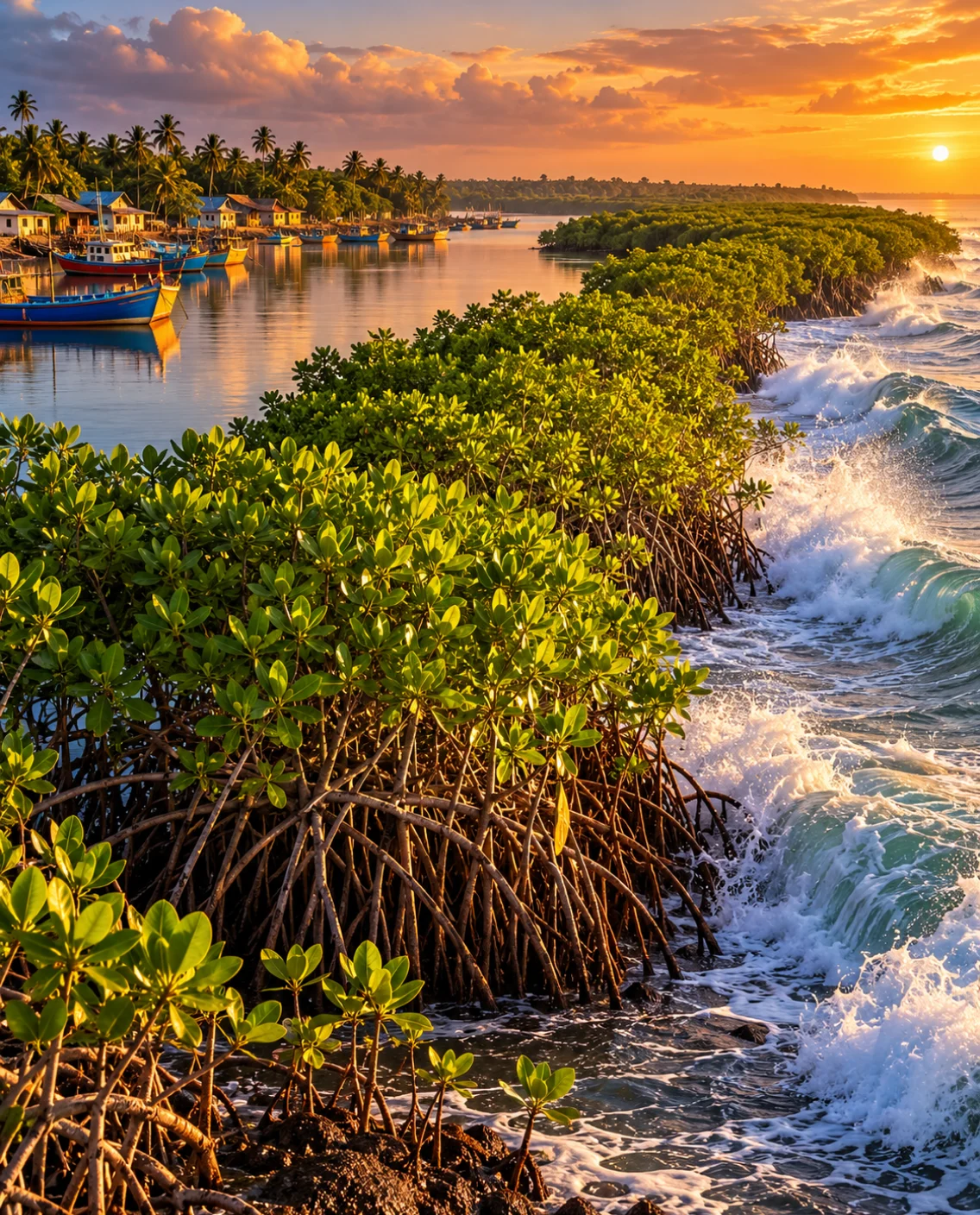
Coastal ecosystems work as natural barriers. Mangroves, with their dense prop roots, slow waves and reduce the force of storm surges; seagrass meadows and salt marshes hold sediment and calm near-shore waters; coral reefs break waves before they reach the shore. Unlike sea walls, these defences repair themselves, store carbon (blue carbon) and support fisheries. The hazard line, mapped by the Survey of India, shows coastal areas at risk from flooding, sea-level rise and shoreline change; under the CRZ Notification, 2019 it guides disaster management and adaptation planning and is shown in Coastal Zone Management Plans, but it does not itself set CRZ regulatory boundaries. The Green Climate Fund, set up under the UNFCCC in 2010, finances adaptation and mitigation in developing countries.
Key facts for Prelims
- The GCF project covers Andhra Pradesh, Maharashtra and Odisha; it is executed by the Environment Ministry with UNDP support, with US$43.42 million from the GCF.
- It targets about 17.4 lakh direct beneficiaries, half of them women; 2,985.91 hectares of mangroves had been restored by 2023.
- UNDP India Resident Representative Angela Lusigi linked ecosystem restoration to livelihoods and women’s enterprise.
Mains analysis and way forward
Mains analysis
- Nature-based solutions are cheaper over time than hard engineering alone and bring livelihood gains, but they need space, time and protection from reclamation.
- Maps and assessments help only if they shape local land use, port and tourism projects, and building rules.
- Coastal resilience links climate adaptation with fisher livelihoods, women’s income and disaster risk reduction.
Way forward
- Fold hazard-line and vulnerability maps into district disaster management plans and coastal zone management plans.
- Pair mangrove and seagrass restoration with community stewardship and steady finance beyond project cycles.
Connect the dots: GS I coastal landforms; GS III climate adaptation, CRZ, blue carbon, Green Climate Fund, disaster risk reduction.
Sources: News On AIR: Environment Ministry holds national workshop on coastal resilience for Viksit Bharat 2047, 29 Oct 2026; UNDP Climate Change Adaptation: Enhancing Climate Resilience of India’s Coastal Communities (project page)
In brief
- Personality in the news: Sardar Vallabhbhai Patel: Sardar Vallabhbhai Patel, India’s first Deputy Prime Minister and Minister of Home Affairs, was born on 31 October 1875, and his 151st birth anniversary on 31 October 2026 is observed as Rashtriya Ekta Diwas, first celebrated in 2014. The Prime Minister is to attend the celebrations and watch the Ekta Diwas Parade at Kevadia (Ekta Nagar), Gujarat, where contingents of the BSF, CRPF, CISF, ITBP and SSB will march; Union Home Secretary Govind Mohan said this year’s most significant feature is the commemoration of the end of armed Naxalism. Patel is remembered for unifying over 560 princely states into the Union of India.
- Places in the news: Ekta Nagar (Kevadia), Gujarat: Ekta Nagar, previously Kevadia, hosts the Rashtriya Ekta Diwas celebrations on 31 October 2026 at the Statue of Unity, Sardar Patel’s 182-metre statue commemorated on 31 October 2018. The statue stands on Sadhu Bet island in the Narmada River, downstream of the Sardar Sarovar Dam and about 90 km southeast of Vadodara.
- Places in the news: Yerevan, Armenia: Yerevan, the capital of Armenia, hosts the 17th Conference of the Parties (COP17) to the UN Convention on Biological Diversity, which opened on 19 October 2026 as the first global review of progress under the Kunming-Montreal Global Biodiversity Framework. The city lies on the Hrazdan River about 23 km from the Turkish frontier, with Mount Ararat visible to the south across the border.
- Supreme Court on NCLT autonomy: On 29 October 2026, a Bench of CJI Surya Kant and Justices Joymalya Bagchi and V Mohana (Ziyaul Haq v. Union of India) voiced concern that the Ministry of Corporate Affairs had taken control of staff appointments at the National Company Law Tribunal through an outsourced process. The CJI said the power of appointment must rest with the NCLT President, suggested recruitment through the UPSC or SSC, and the Court issued notice on the larger institutional question.
- Supreme Court upholds bail for Khurram Parvez: On 30 October 2026, a Bench of Justices M M Sundresh and P B Varale dismissed the NIA’s appeal against the Delhi High Court’s July 2026 order granting bail to Kashmiri activist Khurram Parvez in a UAPA case, citing his long incarceration. He was arrested in November 2021; framing of charges has been deferred pending a supplementary chargesheet.
- State IIP base revision: MoSPI and Keralam’s Department of Economics and Statistics held a regional workshop in Thiruvananthapuram from 28 to 30 October 2026 to help 16 States and UTs revise their State-level Index of Industrial Production. The proposed new base year is 2022-23 (from 2011-12), with NIC 2025 to be adopted and State methods aligned with the national IIP.
- NSIC dividend: The National Small Industries Corporation, a Schedule A Mini Ratna company under the MSME Ministry, presented a dividend of Rs 47.76 crore for 2025-26 to the Government on 28 October 2026. It reported revenue of Rs 3,767 crore and profit after tax of Rs 159 crore.
- India Post for KYC: The Department of Posts and UTI Asset Management Company signed an MoU in Mumbai on 29 October 2026 to extend their partnership. India Post will carry out KYC verification for mutual fund investors at their doorsteps, including in remote and underserved areas.
- Navy training squadron leaves Colombo: The Indian Navy’s First Training Squadron (INS Tir, INS Sujata and ICGS Sarathi) left Colombo on 29 October after a Passage Exercise (PASSEX) with Sri Lankan Navy ship SLNS Nandimithra, the Ministry of Defence said on 30 October. Trainees had visited the Naval and Maritime Academy in Trincomalee during the port call.
- India and Armenia hold 12th Foreign Office Consultations: Secretary (West) Sibi George and Armenia’s Deputy Foreign Minister Mnatsakan Safaryan co-chaired the 12th India-Armenia Foreign Office Consultations in New Delhi on 29 October, reviewing trade, science and technology, AI, education and counter-terrorism. The 13th round will be held in Armenia, ahead of 35 years of diplomatic ties in 2027.
- Foreign Secretary to visit Kathmandu: Foreign Secretary Vikram Misri is expected in Kathmandu from 4 to 6 November, and Nepal’s Prime Minister Balendra Shah may make his first official visit to New Delhi around 22 November, the Kathmandu Post reported on 29 October; neither government has formally announced the Prime Minister’s visit.
- COP17 final day in Yerevan: The UN Biodiversity Conference (CBD COP17) in Yerevan was scheduled to close on Friday, 30 October 2026. Going into the last days, texts on who should contribute to biodiversity finance and on reforming incentives harmful to nature were still unresolved; final decisions were awaited at the time of writing.
- Chhattisgarh: rain from Arnab remnant: Schools were closed in several Chhattisgarh districts as the weakening remnant of Cyclone Arnab brought heavy rain on 29 October; IMD placed Raigarh and surrounding areas on red alert, and Union Home Minister Amit Shah reviewed the situation with Chief Minister Vishnu Deo Sai.
- NVS-03 launched for NavIC: ISRO’s GSLV-F18, the 20th GSLV flight, lifted off from the Second Launch Pad at Sriharikota at 11:51 pm on 30 October 2026 and placed the NVS-03 navigation satellite in a geosynchronous transfer orbit. NavIC had only three satellites providing services against the four needed for standalone positioning; NVS-03, which adds an L1 signal to the L5 and S-band signals and carries an indigenous atomic clock, is meant to restore that minimum.
Prelims practice: 5 questions
Choose an option to see the answer and explanation. Your score appears when all five are answered.
Mains practice
Validating laws are a legitimate legislative tool, but they cannot be used to overrule a judicial verdict. Discuss with reference to the doctrine of separation of powers and recent judgments of the Supreme Court.
Show the answer outline
Introduction (about 30 words)
- Begin with the Supreme Court’s 29 October 2026 judgment striking down the 2022 Karnataka law that sought to validate a selection the courts had set aside.
What a validating law may do
- Cure the defect a court identified, with retrospective effect, by changing the legal basis on which the judgment rested.
- The legislature must have competence over the subject, and the cure must be general, not aimed at reversing a particular decree.
What it may not do
- Directly annul or overrule a judgment, or declare a verdict ineffective: that is an exercise of judicial power.
- Such a law offends the separation of powers and the rule of law, both part of the basic structure.
Recent judgments
- NHPC Ltd (2023) set out the tests for a valid validating law.
- The Karnataka judgment of 29 October 2026 applies them to a public service selection already found tainted.
Way forward
- Legislatures should cure defects through prospective, general rules; governments should act on judgments instead of legislating around them.
Conclusion (about 30 words)
- Respect for final judgments is the hinge between legislative power and judicial review; validating laws must repair the law, not reverse the courts.
Tip: Name the two tests (remove the basis of the judgment; no direct overruling) and cite the Karnataka judgment of 29 October 2026.
Current Canvas is prepared by the UPSC Gurus editorial desk. Every fact is checked against official releases and reliable reporting, with sources listed under each story. Editions are compiled each month into Current Canvas Monthly, a free magazine.
About images: photographs and illustrations in Current Canvas are AI-generated for illustration only. They are not news photographs of the events described.