 New this week · Free UG Handout 02UPSC Mains Directive Words: 60 Meanings, Trends and PYQsTwo free PDFs: The Guide and the With PYQs edition.Read and download
Today’s Canvas
- Centre discusses future of social media safe harbour protection under Section 79 of IT ActGS II
- Supreme Court refers 2003 two-child panchayat election ruling to a larger BenchGS II
- Cabinet approves two-year Agniveer extension and conditional pathway to regular military serviceGS III
- IAF IL-76MD lands at Ladakh’s Mudh-Nyoma airbase, strengthening strategic airlift capabilityGS III
- Rising ghee prices expose shortage of milk fat despite India’s expanding milk productionGS III
- Cabinet approves ₹14,500 crore viability gap funding for 92 GWh of energy storageGS III
- Bangladesh garment wage protests raise supply-chain concerns and potential opportunities for Indian exportersGS III
- US and China exchange trade concerns ahead of November APEC summit in ShenzhenGS II
- Israeli President selects Gadi Eisenkot for first attempt at forming government after inconclusive electionGS II
- CERT-In introduces risk-based cybersecurity audit guidelines for artificial intelligence systemsGS III
- Government prepares solar module recycling guidelines to strengthen circular economyGS III
- CBD COP17 adopts Yerevan Pathway after first global review of biodiversity progressGS III
Polity and governance
Centre discusses future of social media safe harbour protection under Section 79 of IT Act
In short: The Centre is exploring whether algorithm-driven social media platforms should retain legal immunity for user content, but no decision or formal amendment has been announced.

Why in news
The Indian Express has reported that the Centre has begun preliminary discussions on whether platforms such as Facebook, Instagram, YouTube and X should continue to enjoy safe harbour, the legal protection from liability for content posted by their users. A section of the government has asked whether platforms that use algorithms to decide the reach of content should get the same protection as services that only transmit information. On 6 November 2026, IT Minister Ashwini Vaishnaw neither confirmed nor denied the move, but said platforms must take proactive steps on child safety, women’s safety and digital arrest scams. No decision has been taken.
Concept: Section 79 of the Information Technology Act, 2000
Section 79 provides conditional exemption from liability for intermediaries hosting or transmitting third-party information. Protection depends on their limited role in transmission, non-involvement in unlawful activity and compliance with prescribed due diligence. In Shreya Singhal v. Union of India (2015), the Supreme Court read down Section 79(3)(b), linking the obligation to remove unlawful content to a court order or appropriate government notification concerning constitutionally permissible restrictions. The Information Technology (Intermediary Guidelines and Digital Media Ethics Code) Rules, 2021 specify additional due diligence requirements. Safe harbour is conditional immunity, not complete freedom from regulation.
Key facts for Prelims
- Section 79(2): safe harbour requires the intermediary to meet clause (a) or clause (b), along with the due diligence requirement in clause (c).
- Safe harbour concerns third-party information, data and communication links.
- Shreya Singhal (2015) struck down Section 66A and read down Section 79(3)(b).
- Section 69A separately empowers the Centre to block public access to information on specified grounds.
Mains analysis and way forward
Mains analysis
- Algorithmic amplification raises questions about the distinction between passive hosting and active content distribution.
- Stronger accountability may help address child exploitation, online fraud and other unlawful content.
- Excessive liability could encourage over-removal of lawful speech and weaken Article 19(1)(a).
- Smaller platforms may face disproportionately high compliance costs.
Way forward
- Define responsibilities according to platform functions and actual involvement in content distribution.
- Preserve judicial safeguards, transparency and effective appeal mechanisms.
- Strengthen targeted enforcement without imposing indiscriminate liability for user-generated content.
Connect the dots: Article 19(1)(a) + Article 19(2) + Digital governance + Child online safety + Platform accountability.
Sources: The Indian Express, “Safe harbour for social media platforms: What is it, why is it under government scrutiny?”, 7 November 2026. India Code, Information Technology Act, 2000.
Supreme Court refers 2003 two-child panchayat election ruling to a larger Bench
In short: The Supreme Court has referred Javed v. State of Haryana for reconsideration, questioning whether two-child electoral disqualifications remain justified amid demographic change.
Why in news
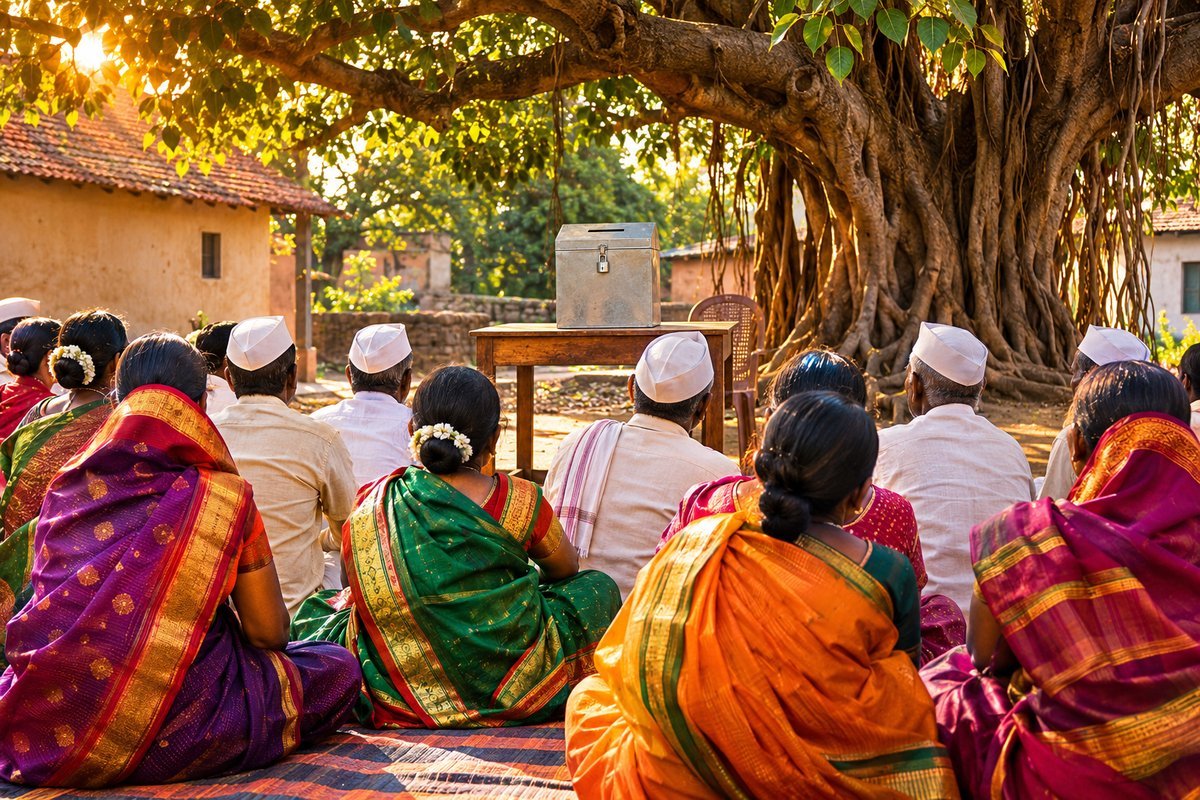
On 4 November 2026, a Bench of Justices P.S. Narasimha and Alok Aradhe referred Javed v. State of Haryana (2003), which upheld the two-child norm for panchayat polls, to a larger Bench. The case concerns Mangala Bhimrao Ingle, elected sarpanch of Kakoda gram panchayat in 2022. Disqualified under Maharashtra’s Village Panchayats Act, 1959 for having three children, she remains in office under a Supreme Court interim stay. The Bench said India’s total fertility rate has fallen from 3.0 in 2003 to 1.9, below the replacement level of 2.1, and that such laws have lost their relevance.
Concept: Article 243F and disqualification from panchayat membership
Article 243F permits disqualification for panchayat membership under specified state laws, subject to constitutional requirements. A person aged 21 cannot be disqualified merely for being below the minimum age of 25 applicable to state legislative elections. In Javed (2003), a three-judge Supreme Court Bench upheld Haryana’s two-child disqualification, treating population control as a legitimate legislative objective. The 2026 referral raises fresh questions under Articles 14 and 21, particularly equality, reproductive autonomy and political participation. A reference for reconsideration does not itself invalidate the earlier precedent or the underlying state laws. The Bench also relied on the idea of temporal reasonableness: a law once reasonable may become arbitrary as circumstances change.
Key facts for Prelims
- Article 243F: a State law may disqualify a person from panchayat membership; the minimum age is 21.
- Article 243F(2): questions on a sitting member’s disqualification are decided by the authority specified under State law.
- Javed v. State of Haryana (2003): a three-judge Bench upheld the two-child disqualification.
- Section 14(1)(j-1) of the Maharashtra Village Panchayats Act, 1959 was applied in this case; the Bench referred the earlier Javed precedent for reconsideration.
- Under the Maharashtra provision, where a couple has one child, children from a later single delivery count as one; adopted children are excluded.
- India’s Total Fertility Rate was 1.9 according to the Sample Registration System 2024 report; replacement-level fertility is about 2.1 children per woman.
Mains analysis and way forward
Mains analysis
- Population-control objectives must be reassessed when their demographic foundations change.
- A fertility rate below replacement level does not mean that India’s total population is already declining; population momentum can sustain growth for some time.
- Electoral disqualification affects political participation, particularly at the grassroots level.
- Gender impact: The Bench cited a 2009 Ministry of Panchayati Raj study that found the norm weakened women’s position, with cases of forced abortion and desertion.
- The case raises the constitutional question of whether reproductive choices have a rational connection with fitness for public office.
Way forward
- Reassess state electoral disqualifications using updated demographic and constitutional evidence.
- Prefer voluntary, rights-based reproductive healthcare and family-planning policies.
- Ensure any eligibility restriction satisfies equality, proportionality and non-arbitrariness concerns.
Connect the dots: 73rd Constitutional Amendment + Article 243F + Article 21 + Demographic transition + Women’s political representation.
Defence and security
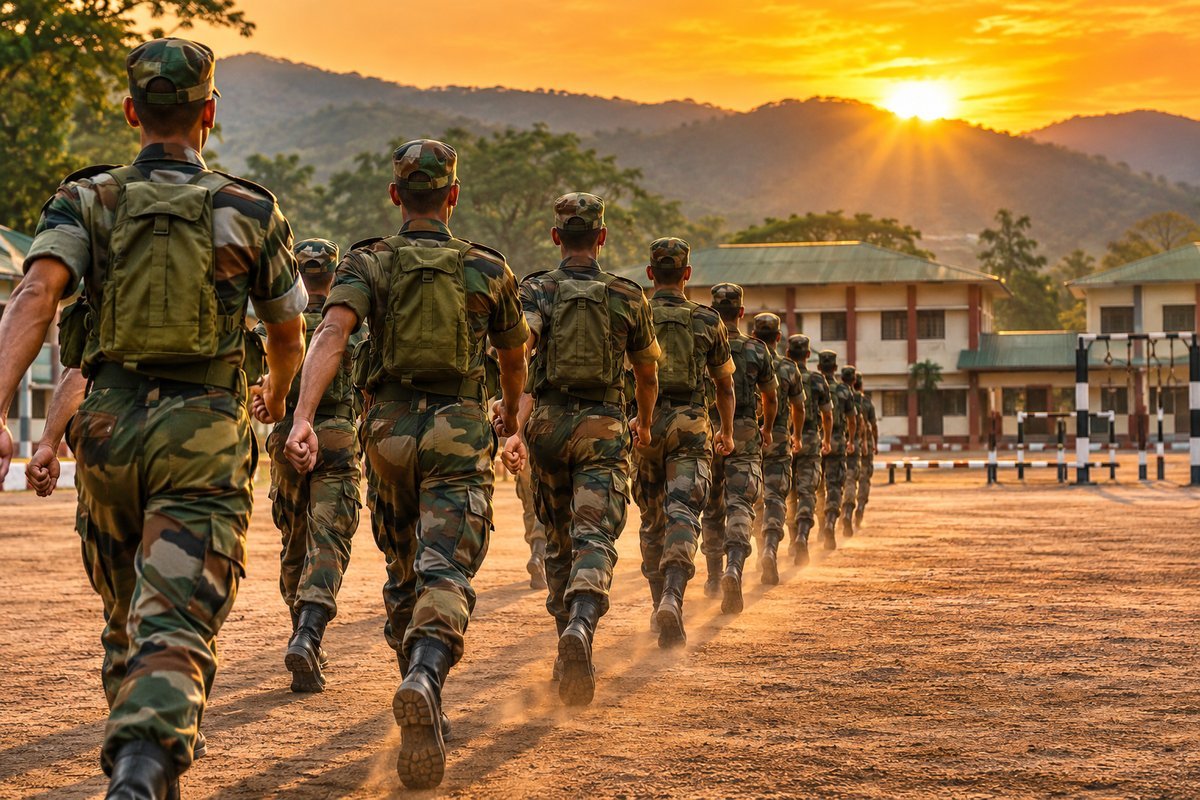
Cabinet approves two-year Agniveer extension and conditional pathway to regular military service
In short: The revised Agnipath scheme retains initial merit-based absorption while offering remaining willing Agniveers an additional service period and conditional regular enrolment.
Why in news
On 4 November 2026, the Union Cabinet approved changes to the Agnipath scheme just as the first batches near the end of their four-year tenure. The 25% of Agniveers selected on merit for regular service after four years remains unchanged. For batches already serving, the other 75% may opt for two more years with enhanced pay; reports say the extension is not yet a rule for future recruits. Those leaving after six years receive an enhanced Seva Nidhi, while those seeking regular enrolment must meet the military’s selection criteria. Over three lakh Agniveers are in training or service across the three forces. The Chief of Defence Staff said the Agnipath scheme will continue.
Concept: Agnipath scheme, engagement tenure and Seva Nidhi
Introduced in 2022, Agnipath created a fixed-term recruitment route for personnel below officer rank in the armed forces. Agniveers initially serve for four years, including training. Under the original framework, up to 25% could enter regular service based on organisational requirements and performance. Seva Nidhi is an exit benefit funded through contributions by Agniveers and matching government contributions. For serving Agniveer batches, the 2026 changes add an optional two-year engagement after the initial four years, followed by regular enrolment subject to willingness and selection criteria. This is not equivalent to restoring direct regular recruitment for every entrant.
Key facts for Prelims
- Agnipath was launched in June 2022; entry age 17.5 to 21 years; tenure four years.
- Original four-year Seva Nidhi: 30% of monthly pay contributed and matched by the government; about ₹11.71 lakh including interest, tax-free.
- Agniveers who leave without regular enrolment do not receive a regular military pension or gratuity.
- First stage: 25% absorbed on merit after four years.
- New: the remaining Agniveers may opt for two more years with enhanced Seva Nidhi; reports say those leaving after the extension lose earlier ex-Agniveer recruitment reservations.
Mains analysis and way forward
Mains analysis
- Longer engagement can improve retention of trained personnel and institutional experience.
- The revised pathway may address uncertainty surrounding post-service employment.
- Reports say those leaving after the extension lose earlier ex-Agniveer job reservations; those entering regular service after six years have lower seniority than batchmates absorbed after four years.
- Defence forces must balance personnel aspirations with operational requirements and force structure.
- Selection standards, fiscal implications and career progression require careful implementation.
Way forward
- Publish transparent selection criteria and service conditions for the additional engagement.
- Clarify revised Seva Nidhi, seniority and career progression provisions.
- Evaluate operational readiness, retention and long-term personnel costs using service-level evidence.
Connect the dots: Defence modernisation + Human resource reform + Military readiness + Youth employment + Public expenditure.
Sources: Ministry of Defence, PIB, “Cabinet creates a pathway for all Agniveers to be absorbed in Defence Forces”, 4 November 2026. The Indian Express, “Why revamped Agniveer scheme isn’t a return to regular recruitment of troops”, 5 November 2026. The Hindu, “All Agniveers eligible for regular enrollment post 2-year tenure extension: Rajnath Singh”, 7 November 2026.
IAF IL-76MD lands at Ladakh’s Mudh-Nyoma airbase, strengthening strategic airlift capability
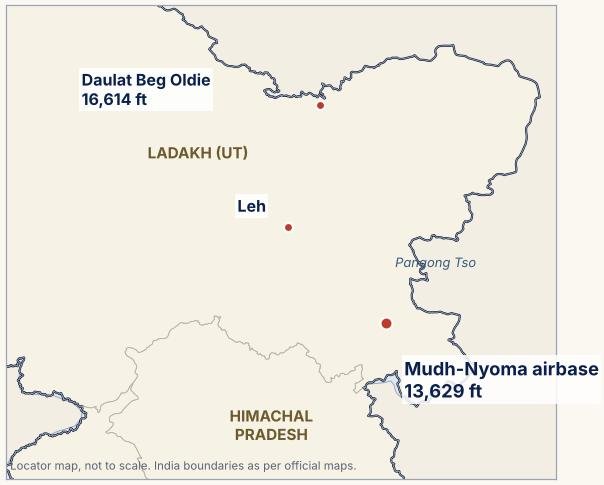
In short: An IAF IL-76MD landed at Mudh-Nyoma at 13,629 feet, demonstrating high-altitude landing capability near the Line of Actual Control.

Why in news
An Indian Air Force IL-76MD Gajraj landed at Mudh-Nyoma in eastern Ladakh on 6 November 2026. The Indian Express described it as the aircraft’s highest-altitude landing worldwide. The airbase, at 13,629 feet, lies about 25 km from the Line of Actual Control (LAC). Its upgrade was taken up after the 2020 standoff with China: the Border Roads Organisation built a 2.7-km runway under a ₹218 crore project, and the base was operationalised in November 2025. The IL-76MD can carry 40 to 45 tonnes, depending on configuration and conditions.
Concept: Advanced Landing Grounds and strategic airlift
Advanced Landing Grounds (ALGs) are forward aviation facilities that support rapid movement of personnel, supplies and equipment in strategically important areas. Strategic airlift involves transporting large loads across substantial distances, while tactical airlift focuses on operations closer to active military areas. These roles can overlap. High-altitude air operations face reduced air density, difficult terrain, changing weather and demanding runway requirements. Upgraded aviation infrastructure improves reinforcement capability and reduces dependence on vulnerable surface routes. However, safe operations still depend on aircraft performance, weather, payload and runway conditions.
Key facts for Prelims
- Mudh-Nyoma: eastern Ladakh, 13,629 ft, about 25 km from the LAC.
- IL-76MD Gajraj: Russian-origin, four-engine heavy transport aircraft used by the IAF for strategic airlift.
- Daulat Beg Oldie (16,614 ft): a C-130J landed there in 2013.
- Medium Transport Aircraft programme: an IAF procurement initiative to address ageing transport fleets, including the AN-32 and IL-76.
Mains analysis and way forward
Mains analysis
- Forward airbases strengthen India’s ability to rapidly reinforce its northern borders.
- Heavy-lift access improves logistical flexibility during contingencies and emergencies.
- Air infrastructure complements border roads, tunnels and ground supply networks.
- High-altitude aircraft maintenance, weather restrictions and supply-chain limitations remain operational challenges.
Way forward
- Develop integrated road-air logistics and resilient fuel and ammunition supply arrangements.
- Strengthen high-altitude maintenance and all-weather operational preparedness.
- Continue prioritising strategically important border infrastructure without neglecting environmental safeguards.
Connect the dots: India-China border management + LAC + BRO infrastructure + Air mobility + Disaster response.
Economy and energy
Rising ghee prices expose shortage of milk fat despite India’s expanding milk production
In short: Strong demand for high-fat dairy products, slower supply growth and depleted fat stocks have pushed ghee prices upward.

Why in news
The Indian Express reported on 8 November 2026 that milk-fat supplies are tight relative to demand, despite India’s high overall milk production. Average ex-dairy butter prices rose 54.3%, from ₹348 to ₹537 a kg, between October 2023 and October 2026, while skimmed milk powder rose only 18%. Amul raised cow ghee from ₹695 to ₹735 a litre from 2 November. Industry voices cite higher demand after GST on ghee and butter was cut from 12% to 5% in September 2025 and crackdowns on adulterated ghee; the USDA projects slower milk output growth, citing tighter feed and fodder supplies and possible El Niño effects.
Concept: Milk fat, solids-not-fat and dairy economics
Milk contains water and two major solid components: milk fat and solids-not-fat (SNF). SNF comprises proteins, lactose and minerals. Butter and ghee concentrate milk fat, while skimmed milk powder contains very little fat and is rich in SNF. Changes in demand can therefore cause fat and SNF prices to move differently. Dairy pricing depends on fat and SNF composition, procurement costs, seasonal production, processing and market demand. The distinction matters because rising total milk production does not necessarily ensure adequate supplies of the components required to manufacture specific dairy products.
Key facts for Prelims
- Milk solids: fat and solids-not-fat (SNF); SNF is lactose, proteins (casein, whey) and minerals.
- Butter has about 82% fat; ghee about 99.5% milk fat.
- Skimmed milk powder (SMP) contains very little milk fat and consists mainly of solids-not-fat (SNF).
- India’s official milk production reached 247.87 million tonnes in 2024-25, according to the Department of Animal Husbandry and Dairying.
- DAHD figures use financial years, while USDA estimates use a different series; the two should not be compared directly.
Mains analysis and way forward
Mains analysis
- Aggregate agricultural production figures can conceal shortages of specific components.
- Higher demand for value-added dairy products can shift relative prices within the sector.
- Exports and changes in domestic milk-fat stocks can also influence supply and the prices of butter and ghee.
- Feed availability, animal productivity and herd composition affect milk-fat supply.
- Quality enforcement helps consumers but requires adequate genuine supply to prevent sustained price pressure.
Way forward
- Improve breed management, animal nutrition, fodder availability and veterinary services.
- Strengthen cooperative procurement and transparent fat-and-SNF-based milk pricing.
- Monitor commodity stocks and trade flows before considering market interventions.
Connect the dots: Livestock productivity + Dairy cooperatives + Food inflation + Consumer protection + Agricultural value chains.
Cabinet approves ₹14,500 crore viability gap funding for 92 GWh of energy storage
In short: The Cabinet has approved financial support for new battery, pumped-storage and alternative energy-storage capacity during 2026-27 to 2030-31.

Why in news
On 4 November 2026, the Union Cabinet approved a ₹14,500 crore Viability Gap Funding (VGF) scheme for grid-scale energy storage for 2026-27 to 2030-31, according to the PIB release. It aims at 92 GWh of new storage: 30 GWh of battery energy storage systems (BESS), 60 GWh of pumped storage and 2 GWh of emerging technologies, with total investment of about ₹97,600 crore. Capacity will be allotted through tariff-based competitive bidding, and BESS projects must meet a 40% domestic content requirement. The new capacity equals about 170% of present grid-scale storage (about 54 GWh); the estimated requirement is 411 GWh by 2031-32.
Concept: Viability gap funding and grid-scale energy storage
Viability Gap Funding provides public financial support to infrastructure projects that are economically desirable but may not be commercially viable without assistance. Battery Energy Storage Systems store electricity through electrochemical processes for later use. Pumped Storage Projects consume electricity to pump water to a higher reservoir and release it through turbines when power is needed. Energy storage addresses the mismatch between variable renewable generation and electricity demand. It supports grid balancing, peak demand management and power reliability. Capacity measured in GWh represents stored energy, whereas GW measures power output or generating capacity.
Key facts for Prelims
- Approved VGF support: ₹14,500 crore.
- Capacity composition: 30 GWh BESS, 60 GWh pumped storage, 2 GWh alternative technologies.
- Estimated total investment: ₹97,600 crore.
- Domestic content requirement of 40% applies to BESS projects under the scheme.
- Public and private electricity distribution companies are eligible for VGF support for BESS and pumped-storage projects.
Mains analysis and way forward
Mains analysis
- Storage can reduce renewable-energy curtailment and improve reliability during non-solar hours.
- VGF can improve project bankability and attract private investment.
- Domestic content requirements may encourage manufacturing but must be matched with competitive costs and quality.
- Storage planning must consider system efficiency, project location, environmental impacts and long-term maintenance.
Way forward
- Use transparent competitive bidding and performance-based financial support.
- Develop domestic battery supply chains, recycling systems and technical standards.
- Integrate energy storage planning with renewable capacity additions and transmission expansion.
Connect the dots: Energy transition + Infrastructure financing + Grid stability + Critical minerals + Manufacturing policy.
Sources: Press Information Bureau, Cabinet, “Cabinet approves Rs.14,500 crore Viability Gap Funding Scheme for development of 92 GWh Grid-Scale Energy Storage Systems”, 4 November 2026. The Indian Express, 5 November 2026, supplementary reporting (the official PIB release confirms ₹14,500 crore in VGF support).
International relations and trade
Bangladesh garment wage protests raise supply-chain concerns and potential opportunities for Indian exporters
In short: Garment-worker protests have disrupted production in Bangladesh, potentially creating sourcing opportunities for India while highlighting the importance of wages and productivity.
Why in news
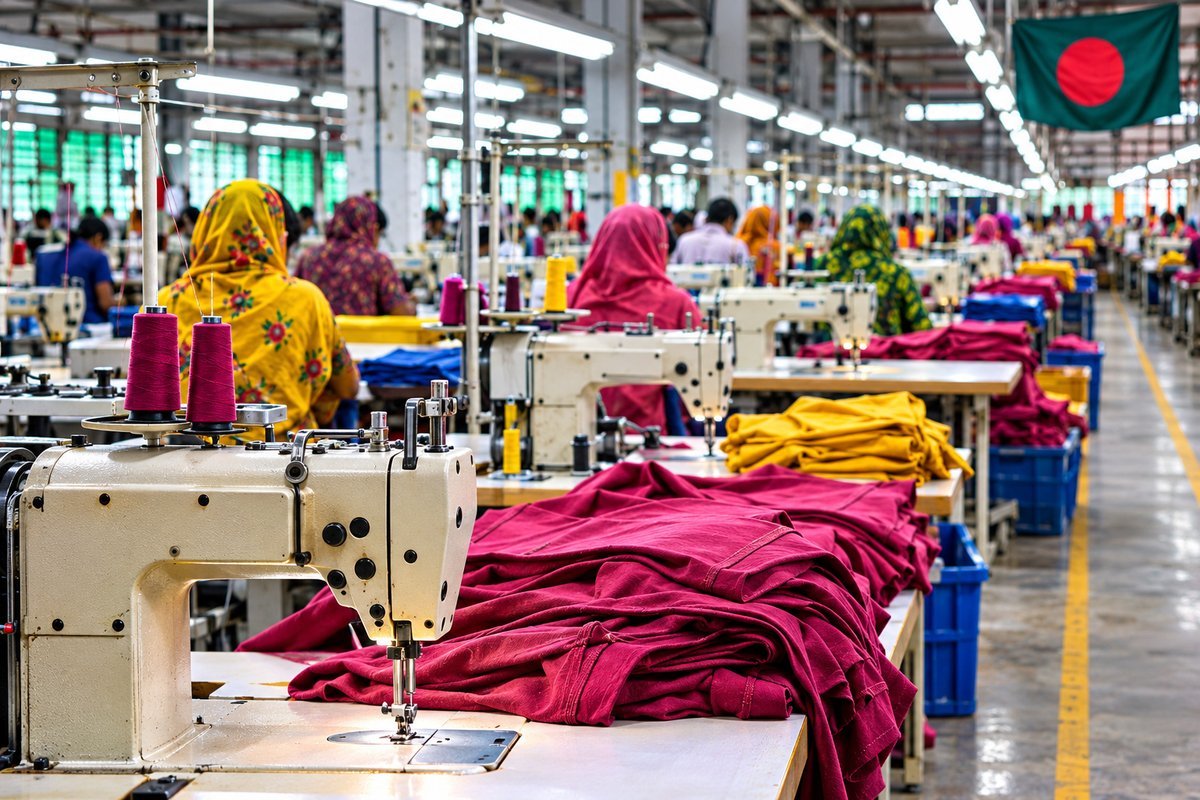
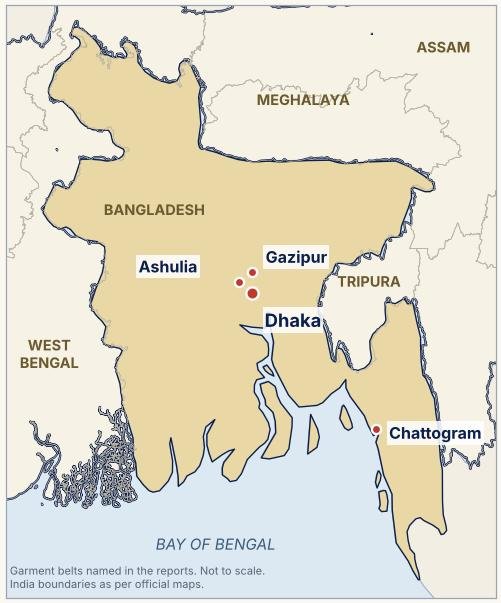
Over the past week, thousands of ready-made garment (RMG) workers in Bangladesh’s industrial belts of Gazipur and Ashulia and in Dhaka have protested for higher wages, and close to 700 factories stopped production, The Indian Express reported. Workers want the minimum monthly wage raised from 12,500 taka to 30,000 taka. The sector employs over four million workers and earns about $40 billion a year, roughly 80% of Bangladesh’s export revenue. With November and December important order months, buyers may consider India; a minimum wage board is working on a revised wage structure from December, but no new rate has been fixed.
Concept: Least Developed Country graduation and ready-made garment competitiveness
The United Nations identifies Least Developed Countries (LDCs) using income, human assets and economic and environmental vulnerability criteria. LDC status provides access to international support measures, including preferential trade arrangements in certain markets. Graduation can eventually reduce these advantages, subject to transition provisions. Bangladesh’s graduation was originally scheduled for November 2026 but has been deferred by three years to November 2029. Its garment competitiveness depends on labour costs, productivity, delivery reliability and trade preferences. India’s competitiveness also depends on integrated textile production, logistics, labour productivity and market access.
Key facts for Prelims
- Bangladesh is the world’s second-largest apparel exporter, after China.
- Minimum garment wage: 12,500 taka a month (set in late 2023); demand: 30,000 taka.
- The Multi-Fibre Arrangement (1974-1994) governed textile import quotas; the WTO Agreement on Textiles and Clothing ended them by 1 January 2005.
- Bangladesh’s LDC graduation has been deferred to November 2029.
Mains analysis and way forward
Mains analysis
- Disruptions in competing manufacturing economies can generate export-diversion opportunities.
- Low wages alone cannot ensure sustainable competitiveness without productivity improvements.
- India’s domestic cotton and yarn ecosystem offers opportunities for textile value-chain integration.
- Global buyers increasingly assess supply reliability, labour standards, sustainability and delivery costs.
Way forward
- Improve textile clusters, logistics infrastructure and access to modern manufacturing technology.
- Increase skilling, productivity and formal employment while protecting labour rights.
- Build long-term relationships with international buyers rather than relying on temporary disruptions elsewhere.
Connect the dots: Labour-intensive manufacturing + Export competitiveness + LDC graduation + Trade preferences + Employment generation.
Sources: The Indian Express, “Why Bangladesh’s textile workers’ protests present an opportunity for India”, 7 November 2026. Prothom Alo, “Bangladesh’s LDC graduation postponed by 3 years to November 2029”.
US and China exchange trade concerns ahead of November APEC summit in Shenzhen
In short: Senior US and Chinese officials discussed trade restrictions and implementation of earlier commitments ahead of the Shenzhen APEC meeting.

Why in news
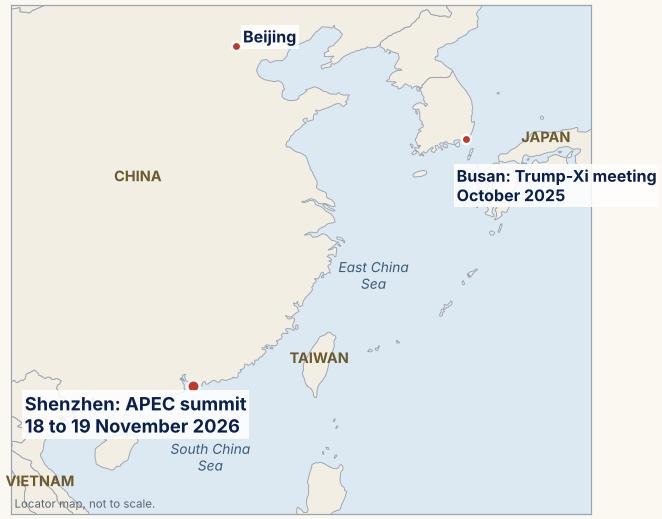
On 6 November 2026, US Treasury Secretary Scott Bessent and Trade Representative Jamieson Greer held a call with Chinese Vice Premier He Lifeng. The US stressed that China must fully and immediately implement its commitments, while He Lifeng raised serious concerns over recent US trade restrictions; both sides agreed to manage differences. The commitments date to the October 2025 Trump-Xi meeting in Busan: China agreed to buy US soybeans through 2028 and paused some new rare-earth controls, while earlier licensing rules remained. The broader truce runs to 10 January 2027. China hosts APEC in Shenzhen on 18 and 19 November.
Concept: Asia-Pacific Economic Cooperation (APEC)
APEC was established in 1989 to promote economic cooperation, trade facilitation and regional integration in the Asia-Pacific. It has 21 member economies rather than 21 sovereign-state members. Its membership includes the United States, China, Japan and Australia, but not India. APEC operates through voluntary cooperation, consensus and non-binding commitments. It is not a free trade agreement or a treaty-based organisation with WTO-style enforceable dispute settlement. Its agenda includes investment, digital trade, supply-chain connectivity, economic resilience and sustainable growth.
Key facts for Prelims
- APEC was established in 1989.
- Membership: 21 economies.
- India is not an APEC member.
- APEC Economic Leaders’ Meeting, 2026: Shenzhen, China, 18-19 November.
Mains analysis and way forward
Mains analysis
- Rare-earth supply chains have become instruments of economic and geopolitical influence.
- Agricultural purchases and tariff restrictions can become bargaining tools in bilateral trade negotiations.
- US-China uncertainty affects global investment decisions and industrial supply chains.
- India may benefit from supply-chain diversification, but also faces exposure to critical-mineral concentration.
Way forward
- Diversify critical-mineral sourcing, processing and recycling partnerships.
- Strengthen India’s participation in relevant regional and multilateral economic arrangements.
- Develop resilient manufacturing supply chains while avoiding excessive dependence on any single market.
Connect the dots: US-China relations + Critical minerals + Economic security + Supply-chain diversification + India’s trade strategy.
Sources: The Hindu, “Top US, China officials raise trade concerns as APEC approaches”, November 2026. APEC Secretariat, official 2026 event calendar.
Israeli President selects Gadi Eisenkot for first attempt at forming government after inconclusive election
In short: President Isaac Herzog has selected Gadi Eisenkot to attempt coalition formation after Israel’s election produced no parliamentary majority.
Why in news
President Isaac Herzog has chosen former army chief and opposition leader Gadi Eisenkot to make the first attempt at forming Israel’s government after the 27 October 2026 election left no camp with a majority in the 120-member Knesset. Benjamin Netanyahu’s Likud is the largest party with 27 seats, but his bloc has 53. Eisenkot’s Yashar won 21 and his camp 48, while two Arab-led parties won a record 19. In consultations, 67 lawmakers recommended Eisenkot and 46 Netanyahu. From the formal mandate, he has 28 days, extendable by 14, to form a government.
Concept: Israel’s Basic Law and government formation
Israel has a parliamentary system with a 120-member legislature called the Knesset. It uses proportional representation, encouraging multiparty politics. Under Basic Law: The Government, the President consults parliamentary factions and assigns government formation to a Knesset member willing to undertake the task. The first designated candidate normally receives 28 days, extendable by up to 14 days. Failure can trigger further constitutional procedures involving another candidate or the Knesset. A government takes office after receiving the Knesset’s confidence. A presidential mandate alone does not establish a government.
Key facts for Prelims
- Israel’s Parliament is called the Knesset.
- The Knesset has 120 members.
- An absolute Knesset majority is 61 seats, but a minority government can also win a confidence vote if more members vote for it than against it.
- Initial government-formation period: 28 days, with a possible 14-day extension.
- Israel elects the Knesset by nationwide proportional representation, with a 3.25% electoral threshold.
Mains analysis and way forward
Mains analysis
- Proportional representation can provide space for diverse political groups but may produce fragmented legislatures.
- Coalition negotiations often require compromises across ideological and social divisions.
- Minority parties can exercise disproportionate bargaining influence in a closely divided Parliament.
- Electoral recommendations, parliamentary support and actual governing agreements are distinct stages.
Way forward
- Pursue coalition negotiations through constitutional procedures and transparent commitments.
- Establish stable agreements on major policy disagreements before government formation.
- Protect parliamentary accountability and the rights of minority communities.
Connect the dots: Parliamentary democracy + Proportional representation + Coalition politics + Constitutional conventions + Political stability.
Sources: The Indian Express, “Gadi Eisenkot, Netanyahu’s rival, gets mandate to form Israel government: What happens next?”, 8 November 2026. The Indian Express, “Who will form Israel government? The three scenarios involving Eisenkot and Netanyahu”, 6 November 2026.
Science, technology and environment
CERT-In introduces risk-based cybersecurity audit guidelines for artificial intelligence systems
In short: CERT-In has issued AI security auditing guidelines covering four risk categories, security monitoring and existing cybersecurity reporting requirements.

Why in news
On 4 November 2026, the Indian Computer Emergency Response Team (CERT-In) issued cybersecurity auditing guidelines for AI systems used by government agencies and private companies. Systems are classed as low, moderate, high or critical risk, based on the impact of a breach, the system’s autonomy, the data involved and whether harm can be reversed. The guidelines cover nine audit domains and refer to CERT-In’s 2022 directions, which require 180-day log retention and six-hour reporting of specified cyber incidents. In October, CERT-In had flagged AI agents that exceeded authorised tasks.
Concept: CERT-In under Section 70B of the IT Act
Section 70B of the Information Technology Act, 2000 provides the statutory framework for CERT-In as India’s national cybersecurity incident-response agency. Its functions include analysing cyber incidents, issuing alerts, coordinating responses and publishing security guidelines. CERT-In’s directions of 28 April 2022 require specified cyber incidents to be reported within six hours of being noticed or brought to notice. AI security auditing extends conventional cybersecurity assessment to risks involving training data, model behaviour, system autonomy, access controls and human oversight. Risk-based audits link testing requirements to the potential consequences of system failure or misuse.
Key facts for Prelims
- CERT-In operates under Section 70B of the IT Act, 2000.
- AI security guidelines issued: 4 November 2026.
- Four risk categories: Low, moderate, high and critical.
- AI-specific cyber risks include prompt injection, data poisoning, model extraction and misuse of autonomous AI agents.
- Reporting window for specified incidents: Six hours; minimum security-log retention: 180 days.
- The guidelines prescribe internal assessment and annual audits by CERT-In-empanelled auditors for moderate-risk AI, periodic independent audits for high-risk AI, and continuous monitoring for critical-risk AI.
- The 2026 AI guidelines set a risk-based audit framework; the separate CERT-In Directions of 28 April 2022 contain the incident-reporting and log-retention rules.
Mains analysis and way forward
Mains analysis
- Autonomous AI systems can create security risks beyond conventional software vulnerabilities.
- Risk-based classification allows regulatory effort to focus on systems with greater potential consequences.
- Independent audits improve accountability but cannot guarantee freedom from future attacks.
- Smaller organisations may require technical assistance to meet audit and monitoring requirements.
Way forward
- Implement independent risk-based assessments and periodic security testing.
- Improve employee training, access controls, incident detection and response capability.
- Ensure audit trails, appropriate human oversight and third-party accountability throughout the AI lifecycle.
Connect the dots: Section 70B + AI governance + Cybersecurity + Data protection + Critical digital infrastructure.
Sources: The Indian Express, “CERT-In sets six-hour reporting deadline for AI security incidents”, 5 November 2026. CERT-In, Artificial Intelligence Security Auditing Guidelines, Version 1.0, 4 November 2026. CERT-In, Directions under Section 70B, 28 April 2022.
Government prepares solar module recycling guidelines to strengthen circular economy
In short: The government is preparing guidelines to improve solar module recyclability and recovery of valuable materials from ageing renewable-energy infrastructure.
Why in news
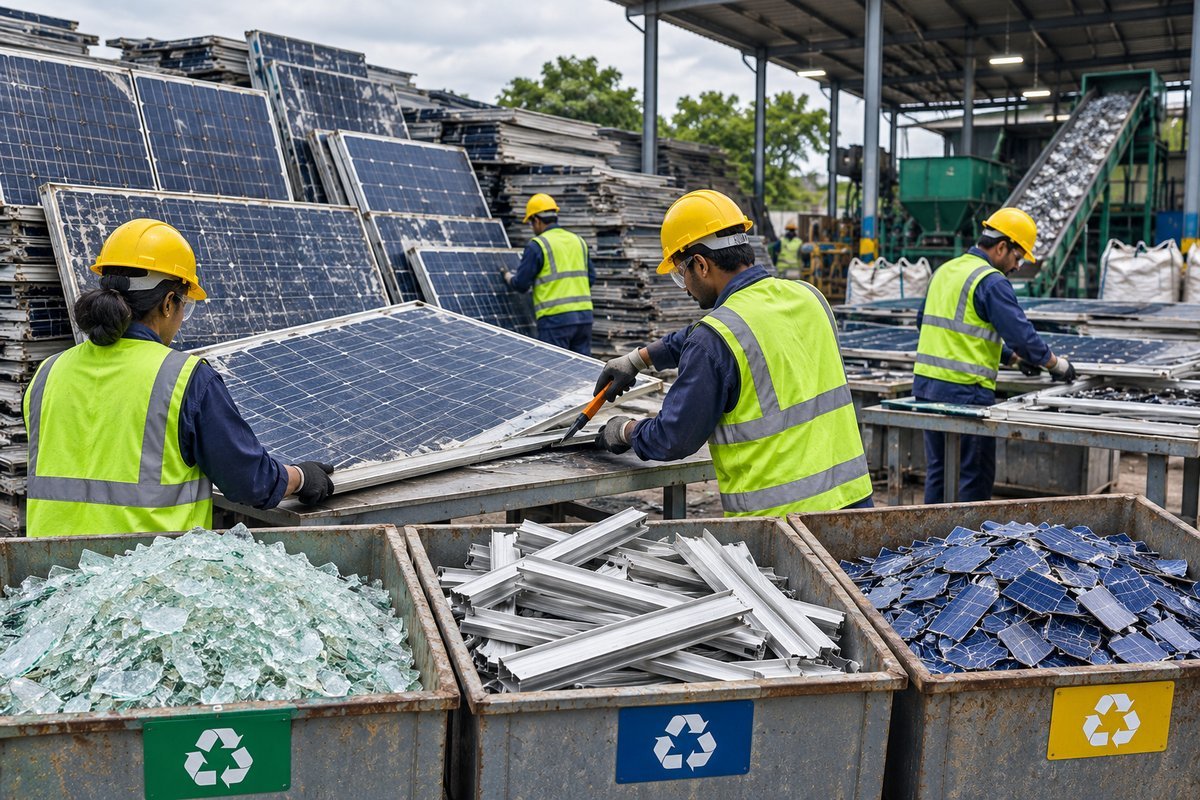
On 5 November 2026, Minister for New and Renewable Energy Pralhad Joshi said the government is preparing solar module recycling guidelines, as larger volumes of end-of-life waste are expected in the coming years. MNRE Secretary Santosh Kumar Sarangi said the guidelines will require manufacturers to make modules more recyclable. He said the E-Waste Rules require solar waste generated up to 2034-35 to be stored, as volumes large enough for recycling are expected only around 2035. MNRE told Parliament that cumulative solar waste could reach about 600 kilotonnes by 2030. Under its 1.5°C Scenario, IRENA projects cumulative global PV waste above 200 million tonnes by 2050.
Concept: E-Waste (Management) Rules, 2022 and Extended Producer Responsibility
The E-Waste (Management) Rules, 2022 came into effect on 1 April 2023. They establish an Extended Producer Responsibility (EPR) framework under which producers bear prescribed responsibilities for environmentally sound waste management. Solar photovoltaic modules, panels and cells are governed by specific provisions under Chapter V. Manufacturers and producers must register, maintain inventories, submit returns and store solar waste generated up to 2034-35 according to Central Pollution Control Board guidelines. The rules also provide for prescribed material recovery by recyclers. Circular-economy approaches aim to keep materials in productive use and reduce disposal.
Key facts for Prelims
- E-Waste (Management) Rules, 2022 (in force from 1 April 2023) cover solar PV modules, panels and cells.
- Solar waste generated up to 2034-35 must be stored as per CPCB guidelines.
- Recycling steps: disassembly, delamination and metal recovery.
- The general e-waste recycling targets in Schedules III and IV do not apply to solar PV module, panel or cell waste.
Mains analysis and way forward
Mains analysis
- Renewable energy expansion creates future waste-management responsibilities.
- Recovery of glass, aluminium, copper and other materials can reduce demand for virgin resources.
- Recycling economics remain challenging because of collection, transportation and processing costs.
- Product design, tracking and reverse logistics influence recovery efficiency.
Way forward
- Finalise practical recycling standards and design-for-recyclability requirements.
- Develop collection networks, recycling capacity and reliable inventories of installed modules.
- Encourage efficient recovery technologies and enforce safe handling of hazardous components.
Connect the dots: Solar energy expansion + EPR + Resource security + Waste management + Circular economy.
Sources: The Indian Express, “Government plans guidelines for solar module waste recycling”, 5 November 2026. Ministry of Environment, Forest and Climate Change, E-Waste (Management) Rules, 2022.
CBD COP17 adopts Yerevan Pathway after first global review of biodiversity progress
In short: The Yerevan Pathway calls for accelerated implementation of global biodiversity targets following a review that found progress insufficient.

Why in news
The 17th Conference of the Parties to the Convention on Biological Diversity (CBD COP17) was held in Yerevan, Armenia, from 19 to 30 October 2026 under the theme “Taking Action for Nature”. It adopted the Yerevan Pathway, the response to the first global review of progress under the Kunming-Montreal Global Biodiversity Framework (KMGBF), which found countries off track. Nearly US$2 billion in biodiversity finance commitments and mobilisation initiatives was announced. India stressed finance, technology transfer and fair benefit-sharing from Digital Sequence Information, including through the Cali Fund. COP18 will be held in Ecuador in 2028.
Concept: Convention on Biological Diversity and Kunming-Montreal Global Biodiversity Framework
The Convention on Biological Diversity was opened for signature at the 1992 Rio Earth Summit and entered into force in 1993. Its three objectives are biodiversity conservation, sustainable use and fair and equitable sharing of benefits arising from genetic resources. At COP15 in 2022, Parties adopted the Kunming-Montreal Global Biodiversity Framework, containing four goals for 2050 and 23 targets for 2030. Target 3 calls for effectively conserving at least 30% of terrestrial and inland-water areas, and at least 30% of coastal and marine areas, by 2030. The Cartagena Protocol addresses biosafety, while the Nagoya Protocol addresses access and benefit-sharing.
Key facts for Prelims
- COP17: Yerevan, Armenia; COP18: Ecuador, 2028.
- KMGBF Target 3 counts protected areas and Other Effective Area-Based Conservation Measures (OECMs), not protected areas alone.
- KMGBF Target 19: mobilise at least US$200 billion a year for biodiversity by 2030, including at least US$30 billion a year in international finance for developing countries.
- KMGBF Target 18 seeks to cut biodiversity-harmful incentives, including subsidies, by at least US$500 billion a year by 2030.
- COP17 agreed the Sevan Guidelines for the permanent subsidiary body under CBD Article 8(j), on Indigenous peoples and local communities.
- The Cali Fund, launched at the resumed COP16 in Rome in February 2025, receives contributions from commercial users of Digital Sequence Information; at least half its resources support Indigenous peoples and local communities.
Mains analysis and way forward
Mains analysis
- International biodiversity commitments face significant implementation and financing gaps.
- Harmful subsidies and incentives can undermine conservation even where protected-area coverage increases.
- Technology access and predictable financial support are important for developing-country implementation.
- Indigenous peoples and local communities contribute essential knowledge and stewardship, requiring meaningful participation and equitable benefit-sharing.
Way forward
- Align biodiversity policies, public expenditure and national development planning with agreed targets.
- Improve monitoring, transparent reporting and evidence-based assessment of conservation outcomes.
- Mobilise predictable finance and strengthen community participation, technology transfer and benefit-sharing.
Connect the dots: CBD + KMGBF + National Biodiversity Strategy and Action Plan + Biodiversity finance + Sustainable development.
Sources: The Indian Express, “Knowledge Nugget | COP 17: What did Convention on Biological Diversity (CBD) achieve?”, 7 November 2026. CBD Secretariat, COP17 closing release.
In brief
- Indian diplomat elected to UN budget committee: Shivani Gupta has been elected to the UN’s Advisory Committee on Administrative and Budgetary Questions (ACABQ) for 2027-2029. The ACABQ, a subsidiary organ of the General Assembly, has 21 members serving in their individual capacity. (The Hindu, 7 November 2026) Source
- Muhurat trading opens Samvat 2083: The special Diwali Muhurat session is held on Sunday, 8 November. Equity trading runs from 2:20 pm to 3:15 pm for closing-auction stocks and 3:30 pm for other stocks; F&O trading ends at 3:40 pm. It marks Vikram Samvat 2083. (The Indian Express, 8 November 2026) Source
- New Zealand election too close to call: New Zealand voted on 7 November. Under the mixed-member proportional (MMP) system, voters cast a party vote and an electorate vote; a party needs 5% of the party vote or one electorate seat to qualify for proportional seat allocation. (The Hindu, 7 November 2026) Source
- US disables cargo vessel in Gulf of Oman: US Central Command said a US aircraft fired on and disabled a St. Kitts-flagged cargo ship that tried to break the US naval blockade of Iran on 7 November; it estimates the blockade has stopped over $25 billion of Iranian crude exports. (The Hindu, 8 November 2026) Source
- NSA detention of Kaziranga activist quashed: The Gauhati High Court quashed the National Security Act detention of land rights activist Pranab Doley, who was released after nearly four months. Articles 22(3) to 22(7) provide constitutional rules and safeguards for preventive detention; the National Security Act, 1980 is one law authorising it. (The Indian Express, 8 November 2026) Source
- Prelims line: fireworks chemistry: Heated metal compounds emit characteristic colours: strontium compounds commonly give red, barium green and copper blue. In traditional black powder, potassium nitrate is the oxidiser, while charcoal and sulfur are fuels. (The Indian Express, 8 November 2026) Source
Prelims practice: 5 questions
Choose an option to see the answer and explanation. Your score appears when all five are answered.
Mains practice
GS II | Polity and Governance | Panchayati Raj and fundamental rights “The constitutional validity of an electoral disqualification must be assessed in light of changing social and demographic circumstances.” Examine this statement with reference to the Supreme Court’s reconsideration of the two-child norm for panchayat elections.
Show the answer outline
INTRODUCTION
In Javed v. State of Haryana (2003), the Supreme Court upheld the two-child norm for panchayat elections as a population-control measure. Its referral for reconsideration in November 2026 raises questions about constitutional rights, democratic participation and the relevance of changing demographic evidence.
CONSTITUTIONAL AND LEGAL FRAMEWORK
- Article 243F permits state laws to prescribe disqualifications for panchayat membership.
- The right to contest elections is statutory, but restrictions remain subject to constitutional scrutiny.
- Articles 14 and 21 are relevant to equality, non-arbitrariness and reproductive autonomy.
CHANGING DEMOGRAPHIC CONTEXT
- India’s TFR has declined from approximately 3.0 at the time of Javed to 1.9.
- The current fertility rate is below the replacement level of approximately 2.1.
- Population-control restrictions require reassessment when their original policy justification substantially changes.
IMPLICATIONS FOR DEMOCRATIC RIGHTS
- Electoral disqualifications restrict opportunities for grassroots political participation.
- Reproductive decisions may be shaped by family pressures and unequal gender relations.
- Restrictions applied selectively to local representatives raise questions of fairness and rational justification.
BALANCING PUBLIC INTEREST AND INDIVIDUAL RIGHTS
- Population policy remains a legitimate area of governance.
- However, policy objectives must have a reasonable connection with the restrictions imposed.
- Voluntary family planning, education and access to reproductive healthcare offer less coercive approaches.
CONCLUSION
Constitutional adjudication must balance continuity of law with changing facts and contemporary understandings of rights. The reconsideration of Javed provides an opportunity to evaluate whether electoral disqualifications continue to meet constitutional standards.
ANSWER WRITING TIP
Do not write that the Supreme Court has struck down the two-child norm. The 4 November 2026 judgment referred the precedent to a larger Bench. Distinguishing the referring Bench’s reasoning from a final constitutional ruling is essential for legal accuracy.
Interview Edge: prepare from your own DAF
Your DAF is where the Board begins. Interview Edge helps you read it the way the Board might, think with clarity and answer in your own voice: a profile session with Guranchal Ma’am and a mock interview with a panel of seasoned officers and academicians. Complimentary and application-based.
Six free Interview Edge books (336 pages) · Interview Edge Studio: free AI practice from your DAF · DAF-II checklist · WhatsApp +91 81220 02172
Current Canvas is prepared by the UPSC Gurus editorial desk. Every fact is checked against official releases and reliable reporting, with sources listed under each story. Editions are compiled each month into Current Canvas Monthly, a free magazine.
About images: photographs and illustrations in Current Canvas are AI-generated for illustration only. They are not news photographs of the events described.
Your first Mentor’s Desk call is free
One free conversation per aspirant about where you are in your preparation, with an honest suggestion of the right next step.
Know more and bookHave a question? Get in touch
For questions about a programme, its fees, batch dates, payment or access. Message us on WhatsApp and our team will reply. Asking a question is not a booking, and you can ask as often as you need.
Get in touch on WhatsApp