 New this week · Free UG Handout 02UPSC Mains Directive Words: 60 Meanings, Trends and PYQsTwo free PDFs: The Guide and the With PYQs edition.Read and download
Today’s Canvas
Tuesday’s news turned on institutions and their limits. The Supreme Court closed a long-pending privilege reference while leaving its hard question open, and grew to near full strength. A Nobel honoured decades of patient science at the South Pole. Attacks on shipping reminded us that Indian seafarers carry the risks of distant conflicts. Read today’s stories as studies in balance: between rights and order, heritage and energy, ambition and patience.
About 16 minutes to read the key points; Mains analysis opens under each story.
- Nobel Prize in Physics 2026 to Francis Halzen for IceCube and the discovery of cosmic high-energy neutrinosGS III
- Seven-judge SC Bench closes 2003 reference on legislative privilege and free speech, leaves law openGS II
- India condemns projectile attack on MT On Peace in the Strait of Hormuz; 11 Indian seafarers injuredGS II
- CAQM orders NCR industries to install PTZ cameras on fuel storage and charging points by 31 October 2026GS III
- MoSPI proposes adding education, health and public administration to the Index of Services ProductionGS III
- HAL Koraput delivers its 2,000th aero-engine; capacity for AL-31FP and Shakti engines to expandGS III
- Concerns grow over proposed Singareni opencast coal mine about 5 km from UNESCO-listed Ramappa TempleGS I
- Centre flags law-and-order risk as offline Bluetooth messaging app Bitchat is pulled from Indian app storesGS III
- ARIES-led decade-long study of blazar OJ 287 offers fresh clues to a rare giant binary black hole systemGS III
- Saudi-led coalition steps up strikes on Houthi targets in Yemen as fighting nears Bab el-MandebGS I
- Census 2027: population enumeration completed in snow-bound areas of Jammu and Kashmir and LadakhGS II
- Francis Halzen wins the 2026 physics Nobel for IceCube and the discovery of high-energy cosmic neutrinos.
- A seven-judge Supreme Court Bench closed the 2003 privilege versus free speech reference as infructuous, leaving the law open.
- Eleven Indian crew were injured when MT On Peace was hit in the Strait of Hormuz; India called for an end to attacks on shipping.
- CAQM directed NCR industries to put fuel storage and charging points under live camera watch by 31 October.
- MoSPI proposes adding education, health and public administration to the Index of Services Production, taking coverage to 78.4%.
- HAL Koraput delivered its 2,000th aero-engine as capacity for AL-31FP and Shakti engines expands.
Polity and governance
Seven-judge SC Bench closes 2003 reference on legislative privilege and free speech, leaves law open
In short: The Court closed a 23-year-old reference as infructuous; the core question of privilege versus press freedom awaits a future case.
Why in news
On 6 October 2026, a seven-judge Bench led by CJI Surya Kant disposed of the reference in N. Ravi v Speaker, Legislative Assembly, Chennai as infructuous, after Tamil Nadu told the Court that the 2003 Assembly resolution had been revoked in 2004. The Bench expressly left the questions of law open for an appropriate case.
Background
In April 2003 The Hindu published an editorial, “Rising Intolerance”, criticising the then State government. On 7 November 2003 the Speaker held this to be a breach of privilege, and the House ordered action against five senior members of the paper’s staff. On 10 November 2003 the Supreme Court stayed the arrests, and in December 2003 the matter was referred to a Constitution Bench, which later sent it to seven judges. The Bench that closed it comprised CJI Surya Kant and Justices Aravind Kumar, P.K. Mishra, Joymalya Bagchi, Vipul Pancholi, Shree Chandrashekhar and V. Mohana. Journalists and others had sought to intervene, relying on the 2024 Sita Soren ruling that privileges are functional and bounded.
Key facts for Prelims
- Article 105(3) (Parliament) and Article 194(3) (State Legislatures): powers, privileges and immunities as defined by law; until then, as they stood before Section 26 of the Constitution (Forty-fourth Amendment) Act, 1978 came into force.
- Before the 44th Amendment, Article 194(3) linked privileges to those of the British House of Commons at the commencement of the Constitution.
- Neither Parliament nor any State has enacted a comprehensive law codifying legislative privileges.
- Pandit M.S.M. Sharma v Shri Krishna Sinha and the Keshav Singh Presidential Reference (Article 143) are the leading earlier rulings on privilege versus fundamental rights.
- Sita Soren v Union of India (2024, seven judges): a legislator taking a bribe is not protected by privilege.
Mains analysis and way forward
Mains analysis
- Judicial restraint: closing an academic reference reflects the principle that constitutional courts decide live disputes, not abstract questions, but leaves journalists and legislators without settled guidance.
- Unresolved tension: privileges exist so that legislatures can function without obstruction, yet using them to punish criticism can chill Article 19(1)(a) freedoms, including press freedom.
- Codification gap: since privileges remain uncodified, their scope is decided case by case, which favours unpredictability; the functional test in Sita Soren offers a direction.
- Ethical dimension: both institutions, legislature and press, serve the public; mutual restraint, accuracy in reporting and tolerance of criticism strengthen democratic accountability.
Way forward
- Consider a law under Articles 105(3) and 194(3) that defines privileges narrowly and functionally, with procedural safeguards for those accused of breach.
- Adopt model guidelines for Privileges Committees: notice, a hearing and proportionate outcomes, with a preference for corrections over punishment.
- Encourage press councils and editors’ bodies to resolve complaints of misreporting quickly, reducing the need for privilege action.
Connect the dots: Links to parliamentary privileges, Fundamental Rights (Article 19), judicial review and separation of powers, and ethics in public institutions.
Sources: LiveLaw: Supreme Court 7-judge reference on legislative privilege closed as 2003 Tamil Nadu Assembly decision withdrawn, 6 Oct 2026; ThePrint: SC’s 7-judge bench disposes of reference on extent of legislative privileges vs free speech, 6 Oct 2026
Census 2027: population enumeration completed in snow-bound areas of Jammu and Kashmir and Ladakh
In short: The first count of India’s 16th Census is done in 5,292 enumeration blocks, months ahead of the rest of the country.
Why in news
On 6 October 2026, census authorities for Jammu and Kashmir and Ladakh said population enumeration in the snow-bound areas was complete, covering 5,292 enumeration blocks in the designated snow-bound areas: 4,597 in Jammu and Kashmir and 695 in Ladakh. The reference date for these areas is 1 October 2026, while the rest of India will be counted with reference to 1 March 2027.
Background
The Centre notified the 16th Census, including caste enumeration, on 16 June 2025, with an early schedule for Ladakh and the snow-bound areas of Jammu and Kashmir, Himachal Pradesh and Uttarakhand. In these areas, self-enumeration ran from 17 to 31 August 2026 and field enumeration began on 1 September in Udhampur district, followed by a revision round from 1 to 5 October. The houseless population and special charges such as defence and CAPF establishments were included.
Key facts for Prelims
- 16th Census of India, notified 16 June 2025; includes caste enumeration.
- Reference date: 1 October 2026 for Ladakh and snow-bound areas of Jammu and Kashmir, Himachal Pradesh and Uttarakhand; 1 March 2027 for the rest of India.
- Snow-bound enumeration: 5,292 blocks (4,597 in J&K, 695 in Ladakh).
- Self-enumeration (digital) in snow-bound areas: 17 to 31 August 2026.
- The Census is conducted under the Census Act, 1948; Census is Entry 69 of the Union List.
Mains analysis and way forward
Mains analysis
- Why an early count: winter makes high-altitude areas inaccessible in February-March, so a separate reference date ensures complete coverage.
- Digital census: self-enumeration improves speed and accuracy but requires connectivity, digital literacy and assisted options so that no household is missed.
- Policy significance: fresh data, the first since 2011, will shape delimitation, welfare targeting, Finance Commission formulas and planning.
- Inclusion: counting the houseless and remote populations matters for equity in schemes and representation.
Way forward
- Publish coverage and quality-check results transparently to build public confidence in the data.
- Provide assisted enumeration and multilingual support in remote and low-connectivity areas in the main phase.
- Plan early data release and anonymised micro-data access for researchers and States.
Connect the dots: Links to the Census and its role in governance, delimitation, federal finance and social justice.
Sources: UNI India: Over 5,292 blocks covered as population enumeration in snow-bound areas of J&K, Ladakh successfully completed, 6 Oct 2026; ThePrint: Census 2027 phase II launched in snow-bound areas of J&K, Ladakh, 1 Sep 2026; Deccan Herald: First population count since 2011: Gazette notification for Census 2027, 16 Jun 2025
International relations

India condemns projectile attack on MT On Peace in the Strait of Hormuz; 11 Indian seafarers injured
In short: An attack on a Panama-flagged vessel off Oman injured 11 Indian crew, sharpening India’s focus on seafarer safety in West Asian waters.
Why in news
On 6 October 2026, India’s Ministry of External Affairs condemned a projectile attack on the Panama-flagged tanker MT On Peace in the Strait of Hormuz, following reports of an attack on a tanker in the area on 5 October. Of its 19 crew, 17 were Indian; 12 were injured, 11 of them Indian, and were evacuated with Omani help to Khasab for treatment.
Background
The MEA called continuing attacks on shipping in the region a “cause of deep concern”, urged their “immediate cessation”, and said commercial shipping, seafarers and civilian infrastructure must not be targeted and that navigation through international waterways should be restored. The incident comes amid wider conflict in West Asia, with hostilities also affecting the Red Sea. India is among the largest suppliers of seafarers to global shipping, so attacks on merchant vessels anywhere in the region directly affect Indian nationals and their families.
Key facts for Prelims
- Strait of Hormuz: links the Persian Gulf with the Gulf of Oman and the Arabian Sea; Iran lies to the north and Oman’s Musandam peninsula to the south.
- Khasab: main town of Oman’s Musandam Governorate, on the southern shore of the strait.
- Part III of UNCLOS provides for the right of transit passage through straits used for international navigation.
- Operation Sankalp: Indian Navy deployment since June 2019 to safeguard Indian-flagged vessels in the Gulf region.
- Information Fusion Centre – Indian Ocean Region (IFC-IOR), Gurugram, set up in 2018, shares maritime domain awareness with partner countries.
Mains analysis and way forward
Mains analysis
- Human security at sea: Indian seafarers form a large share of crews on foreign-flagged ships, so the State’s duty of care extends beyond Indian-flagged vessels, through consular, medical and repatriation support.
- Economic exposure: a large part of India’s crude oil and LPG imports pass through Hormuz; disruption raises freight, insurance and energy costs and feeds inflation.
- Diplomatic balance: India has strong ties with Gulf states and Iran alike, and its statement focused on principles (freedom of navigation, protection of civilians) rather than on attributing blame.
- Role of littoral partners: Oman’s swift evacuation of the injured shows the value of India’s defence and maritime partnership with Oman.
Way forward
- Strengthen crew-welfare protocols with shipping companies and manning agencies, including risk allowances, insurance and rapid repatriation.
- Keep naval escort and maritime domain awareness assets ready in the Gulf of Oman and Arabian Sea, coordinated through IFC-IOR.
- Back multilateral efforts at the International Maritime Organization for the safety of shipping and seafarers in conflict zones.
Connect the dots: Links to India and West Asia, energy security, the Indian diaspora and seafarers, UNCLOS, and maritime security in the Indian Ocean.
Saudi-led coalition steps up strikes on Houthi targets in Yemen as fighting nears Bab el-Mandeb
In short: Operations along Yemen’s Red Sea coast put the Bab el-Mandeb chokepoint, vital to Asia-Europe trade, back at the centre of the conflict.
Why in news
On 6 October 2026, according to the coalition’s own statements, the Saudi-led coalition reported strikes on Houthi weapons depots and boat and mine storage at Hodeidah, a ballistic missile launch platform in Sanaa and a store of 20 missiles in Saada. It also said it thwarted planned attacks on southern Red Sea waterways. Saudi-backed forces claimed advances at Dhubab and Bab al-Mandab, which Houthi-affiliated media said were repelled; Reuters could not independently confirm the full extent of the gains. Reuters also verified footage of government fighters driving vehicles over Houthi opponents, an incident the Giants Brigade said it was investigating.
Background
Yemen’s internationally recognised government has launched an offensive reported in English as “Yemen Dawn” (translations differ) with Saudi air support to retake Houthi-held territory. Bahrain’s Foreign Ministry backed Saudi efforts to support the recognised government, restore State institutions and seek a political solution. Fighting along the Red Sea coast raises the risk to merchant shipping that uses the Bab el-Mandeb and the Suez Canal route between Asia and Europe.
Key facts for Prelims
- Bab el-Mandeb: strait between Yemen (Arabian Peninsula) and Djibouti and Eritrea (Horn of Africa); links the Red Sea with the Gulf of Aden.
- Hodeidah: Yemen’s main Red Sea port; Sanaa: capital, held by the Houthis; Saada: Houthi stronghold in the north.
- Dhubab lies on Yemen’s Red Sea coast near the strait.
- Houthis: also known as Ansar Allah, a Zaidi Shia movement in northern Yemen.
- Red Sea, Bab el-Mandeb and Suez Canal together form the shortest sea route between the Indian Ocean and the Mediterranean.
Mains analysis and way forward
Mains analysis
- Chokepoint vulnerability: a narrow strait means even limited attacks can force shipping to divert around the Cape of Good Hope, raising costs and delivery times for Indian exporters.
- Regionalisation of conflict: the Yemen war is now tied to the broader West Asian confrontation, drawing in several Gulf and regional states.
- Humanitarian cost: renewed fighting around Hodeidah threatens a port through which much of Yemen’s food and fuel arrives.
- India’s interests: safety of the large Indian diaspora in the Gulf, energy imports and trade routes call for sustained naval presence and quiet diplomacy with all sides.
Way forward
- Support UN-led political processes for Yemen and humanitarian access to Hodeidah port.
- Continue Indian Navy deployments in the Gulf of Aden and Arabian Sea to protect merchant shipping.
- Diversify trade logistics, including the India-Middle East-Europe Economic Corridor and Cape routes, to reduce dependence on a single chokepoint.
Connect the dots: Links to world geography (straits and chokepoints), India’s maritime trade, and India and West Asia.
Sources: News On AIR: Saudi-led coalition operations intensify against Houthi targets in Yemen, 6 Oct 2026; Just Security: Early Edition, 6 Oct 2026
Economy
MoSPI proposes adding education, health and public administration to the Index of Services Production
In short: The monthly services index would cover 78.4% of services GVA, up from about 60%, by adding three large public-facing sectors.
Why in news
On 6 October 2026, the Ministry of Statistics and Programme Implementation released an approach paper to expand the Index of Services Production (ISP). It proposes adding education, human health and residential care, and public administration and defence, raising sub-sectors from 19 to 22. Comments are invited until 16 October 2026.
Background
Services account for more than half of India’s Gross Value Added. MoSPI began a trial monthly ISP for the formal sector in July 2026 with 2024-25 as the base year, using GST outward-supply data, bank deposits and loans, insurance income, and passenger and freight volumes. The three new sectors made up nearly 21% of services GVA in 2024-25: public administration and defence 10.68%, education 7.15% and health 2.96%. The paper suggests public spending data from PFMS for the public part and UPI transactions, identified by merchant category codes, for the private part of education and health, and a sum-of-costs approach for public administration.
Key facts for Prelims
- ISP: a monthly index of services output compiled by MoSPI; trial series from July 2026, base year 2024-25.
- Proposed additions: education; human health and residential care; public administration and defence. Sub-sectors would rise from 19 to 22.
- Coverage would rise from about 60% to 78.4% of services GVA.
- Data sources proposed: PFMS (central spending), CAG monthly State Accounts, and UPI merchant category codes.
- The Index of Industrial Production (IIP) is the corresponding monthly index for industry.
Mains analysis and way forward
Mains analysis
- Filling a blind spot: India has long had a monthly industrial index but no comparable services gauge, although services are the largest part of the economy.
- Better policymaking: timely services data helps monetary policy, GDP nowcasting and fiscal planning, especially for employment-intensive sectors.
- Measurement challenges: UPI records payments rather than physical output and cannot separate public from private providers; government spending can swing month to month; monthly State data on education and health spending are not yet available.
- Credibility of statistics: an open consultation on methodology builds trust in official data, which matters for investors and for international comparisons.
Way forward
- Publish detailed metadata and revision policies so that users understand the limits of early estimates.
- Work with States to produce monthly education and health expenditure data so that the public component is complete.
- Validate UPI-based proxies against periodic surveys before the expanded index becomes official.
Connect the dots: Links to measurement of growth, national income accounting, the services sector, and the role of official statistics in governance.
Sources: Business Standard: MoSPI proposes adding health, education to services production index, 6 Oct 2026; News On AIR: MoSPI releases approach paper to expand scope of Index of Services Production, 6 Oct 2026; NewKerala: MoSPI floats paper expanding coverage of Index of Services Production, 6 Oct 2026
Environment
CAQM orders NCR industries to install PTZ cameras on fuel storage and charging points by 31 October 2026
In short: Live video of fuel areas, streamed to pollution regulators, aims to stop NCR industries burning unapproved fuels before winter.
Why in news
On 6 October 2026, the Commission for Air Quality Management in NCR and Adjoining Areas (CAQM) directed industries in the National Capital Region to install additional Pan-Tilt-Zoom (PTZ) cameras covering all fuel-storage and fuel-charging areas by 31 October 2026. Where gas is used, the gas gauge or meter must also be in view, and the concerned pollution control boards must report implementation status to CAQM by 1 November 2026.
Background
Feeds must stream in real time to the Central Pollution Control Board (CPCB) and the relevant State Pollution Control Board or the Delhi Pollution Control Committee, with power backup and connectivity arranged by industries; CPCB and the boards must build portals to receive them. The order follows repeated findings by CAQM flying squads of industries using fuels outside the approved fuel list for NCR. It supplements earlier CPCB requirements for PTZ cameras with Online Continuous Emission Monitoring Systems (OCEMS). The Federation of Indian Micro and Small and Medium Enterprises (FISME) has warned of cost and compliance burdens for small units.
Key facts for Prelims
- CAQM: statutory body under the Commission for Air Quality Management in National Capital Region and Adjoining Areas Act, 2021; issues directions under Section 12 of the Act.
- Deadlines: cameras by 31 October 2026; pollution control boards to report implementation status to CAQM by 1 November 2026.
- PTZ (Pan-Tilt-Zoom) cameras must cover fuel storage and charging points; gas meters where gas is the fuel.
- OCEMS: Online Continuous Emission Monitoring Systems that transmit stack emission data to regulators.
- CAQM also enforces the Graded Response Action Plan (GRAP) for NCR.
Mains analysis and way forward
Mains analysis
- Fuel is the first line of control: industrial emissions depend heavily on what is burnt, so verifying fuel use at source is cheaper than cleaning up after combustion.
- Technology for enforcement: remote video adds a visual record to OCEMS data, reduces dependence on physical inspections and limits discretion.
- Limits: cameras show activity, not pollutant levels; regulators need staff and analytics to act on large volumes of footage, or the system becomes symbolic.
- MSME concerns: compliance costs and tight timelines weigh more on small units; uneven compliance may shift burning to less visible locations.
Way forward
- Offer cost support or shared monitoring arrangements for micro and small units, linked to cluster-level clean-fuel supply such as piped natural gas.
- Use automated analytics to flag anomalies and publish compliance dashboards for transparency.
- Pair enforcement with assured availability and fair pricing of approved fuels across NCR.
Connect the dots: Links to air pollution control, statutory bodies (CAQM, CPCB), environmental governance and MSMEs.
Sources: KNN India: New CAQM mandate to install PTZ camera in industries to add compliance burden on MSMEs: FISME, 7 Oct 2026; TeamLease RegTech: CAQM mandates installation of PTZ cameras at industries (PIB release dated 6 Oct 2026)
Science and technology

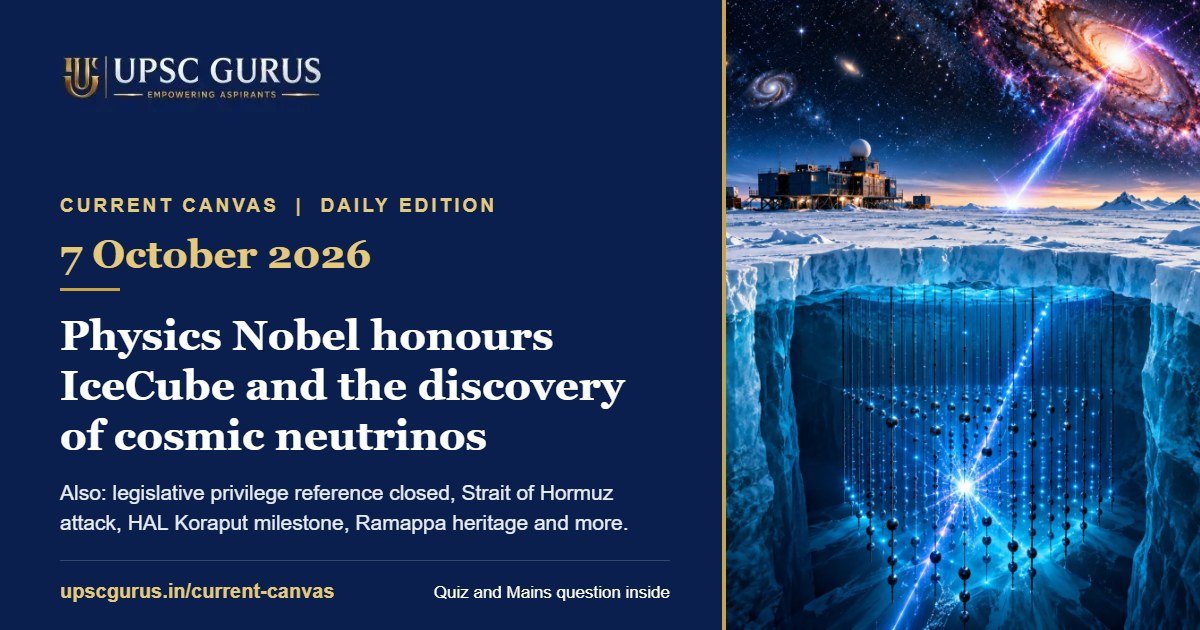
Nobel Prize in Physics 2026 to Francis Halzen for IceCube and the discovery of cosmic high-energy neutrinos
In short: A detector built from a cubic kilometre of Antarctic ice has opened neutrino astronomy, earning its chief architect the 2026 physics Nobel.
Why in news
On 6 October 2026, the Royal Swedish Academy of Sciences awarded the Nobel Prize in Physics to Belgian-American physicist Francis Halzen “for decisive contributions to the IceCube Neutrino Observatory and the discovery of high-energy neutrinos of astrophysical origin”. He is the sole laureate, and the prize carries 12 million Swedish kronor.
Background
Halzen, 82, has been at the University of Wisconsin-Madison since 1972 and is the principal investigator of IceCube. He was the first to see that the clear glacial ice at the South Pole could be used to track neutrinos, and presented this vision in 1988. IceCube embeds more than 5,000 light sensors in about one cubic kilometre of ice, at depths of roughly 1.5 to 2.5 km; construction took seven years. Neutrinos carry no electric charge and almost no mass, so they pass through matter almost untouched; the rare collision with an atomic nucleus gives off a flash of light that the sensors record. Nobel Committee chair Mark Pearce credited Halzen’s “tenacity and scientific vision” in leading an international team.
Key facts for Prelims
- Laureate: Francis Halzen (Belgian-American), University of Wisconsin-Madison; sole winner of the 2026 physics prize, announced 6 October 2026 in Stockholm.
- Prize money: 12 million Swedish kronor; medals are presented in Stockholm on 10 December, the anniversary of Alfred Nobel’s death.
- IceCube Neutrino Observatory: about one cubic kilometre of Antarctic ice at the South Pole, more than 5,000 light sensors, 1.5 to 2.5 km deep; run by an international collaboration of several hundred scientists.
- Neutrinos: electrically neutral particles with extremely small but non-zero mass; detected indirectly through light from secondary charged particles produced when they rarely interact with matter.
- The 2025 physics prize went to John Clarke, Michel Devoret and John Martinis.
Mains analysis and way forward
Mains analysis
- New window on the universe: neutrinos travel in straight lines and are not deflected by magnetic fields or absorbed by dust, so they can point back to violent sources that light and charged cosmic rays cannot reveal.
- Big science as patient institution-building: the prize rewards a decades-long effort, from a 1988 idea to a seven-year construction programme, showing how sustained funding and international collaboration convert bold ideas into results.
- Using nature as an instrument: turning a polar ice sheet into a detector is a lesson in frugal, location-specific engineering that developing science systems can adapt.
- Relevance for India: it strengthens the case for consistent support to basic research, long-gestation facilities and participation in global collaborations, alongside public outreach that builds trust in such projects.
Way forward
- Sustain long-horizon funding for basic science through mission-mode support and stable institutional grants rather than short project cycles.
- Deepen Indian participation in international detector and observatory consortia so that students and engineers gain hands-on exposure.
- Pair large research facilities with early, transparent engagement with local communities and environmental safeguards.
Connect the dots: Links to GS III science and technology (particle physics, space science, achievements of science), and to research funding and international scientific cooperation.
Sources: Daily Maverick (Reuters): Francis Halzen wins 2026 Nobel Prize in Physics, 6 Oct 2026; Spectrum News 1: UW professor wins Nobel Prize in physics, 6 Oct 2026; Times Higher Education: South Pole neutrino discovery wins physics Nobel, 6 Oct 2026; Free Press Journal: Nobel Prize in Physics 2026 awarded to Francis Halzen, 6 Oct 2026
ARIES-led decade-long study of blazar OJ 287 offers fresh clues to a rare giant binary black hole system
In short: An Indian-led campaign of 106 scientists tracked OJ 287 for ten years, refining the picture of two supermassive black holes in orbit.
Why in news
On 6 October 2026, the Department of Science and Technology highlighted a study led by the Aryabhatta Research Institute of Observational Sciences (ARIES), Nainital, that tracked changes in the brightness and colour of the blazar OJ 287 from 2015 to 2025. The campaign, led by Dr Alok C. Gupta, involved 106 scientists from 48 institutions in 18 countries using about two dozen telescopes.
Background
OJ 287, about four billion light-years away, is thought to host two supermassive black holes orbiting each other every 12 years. As a blazar, it has powerful jets of plasma moving at nearly the speed of light and pointed towards Earth. A Finnish team identified its double-peaked brightness pattern in 1988, using optical records going back to 1880. Using eight optical spectra taken between 21 October and 22 November 2017 at the Steward Observatory in the United States, the team estimated the central black hole’s mass at no less than 3.89 billion times that of the Sun. The work builds on research since 2017 by Gupta and Professor Mauri J. Valtonen of the University of Turku, Finland.
Key facts for Prelims
- ARIES (Aryabhatta Research Institute of Observational Sciences), Nainital: institute under the Department of Science and Technology.
- OJ 287: blazar about four billion light-years away; two supermassive black holes with a 12-year orbital cycle.
- Blazar: an active galactic nucleus whose relativistic jet points almost directly towards Earth.
- Central black hole mass estimated at least 3.89 billion solar masses.
- Campaign scale: 106 scientists, 48 institutions, 18 countries, 2015 to 2025.
Mains analysis and way forward
Mains analysis
- Long-baseline astronomy: dense, decade-long monitoring is what allows periodic signals to be separated from random flaring, and India’s observatories can lead such campaigns.
- Indian leadership in global networks: coordinating 48 institutions shows India’s growing role in observational astrophysics beyond being a data user.
- Link to frontier physics: binary supermassive black holes are expected sources of low-frequency gravitational waves, connecting optical astronomy with future detectors.
- Capacity building: such projects train young researchers and justify sustained support for mid-sized telescopes.
Way forward
- Sustain funding for long-term monitoring programmes at Indian observatories, not only flagship facilities.
- Strengthen data-sharing and open archives so that Indian datasets are widely used and cited.
- Link optical studies with radio, X-ray and gravitational-wave efforts, including India’s planned LIGO-India detector.
Connect the dots: Links to GS III achievements of Indians in science and technology, space science and astronomy.
Security and defence

HAL Koraput delivers its 2,000th aero-engine; capacity for AL-31FP and Shakti engines to expand
In short: Six decades after it was set up, HAL’s Odisha engine division hits a milestone as India pushes for self-reliance in aircraft propulsion.
Why in news
On 6 October 2026, Defence Minister Rajnath Singh witnessed the delivery of the 2,000th aero-engine from HAL’s Koraput Division at Sunabeda, Odisha. He announced a Rs 335 crore expansion of AL-31FP output from 30 to 50 engines a year and the establishment of a Rs 218 crore second Shakti engine line of up to 100 engines a year, scheduled for completion in 2028-29.
Background
The Koraput Division, established in 1964, has made engines for the MiG-21, MiG-27, MiG-29 and Su-30MKI, and has overhauled more than 9,000 engines. HAL is building 240 AL-31FP engines for the Su-30MKI under a Rs 26,000 crore contract signed in September 2024, and has delivered 63 against a target of 60 by the end of the contract’s second year. Shakti, developed with Safran Helicopter Engines, powers the Dhruv Advanced Light Helicopter and the Prachand Light Combat Helicopter. Singh said about Rs 5,000 crore is proposed for indigenous high-thrust engine capability linked to the Advanced Medium Combat Aircraft (AMCA), including raw-material indigenisation with MIDHANI and India’s first indigenous high-thrust engine test facility.
Key facts for Prelims
- HAL Koraput Division (Sunabeda, Odisha): established 1964; 2,000th engine delivered on 6 October 2026.
- AL-31FP: engine of the Su-30MKI; capacity to rise from 30 to 50 a year (Rs 335 crore).
- Shakti: turboshaft engine made with Safran; Indian version of the Ardiden 1H1; powers Dhruv ALH and Prachand LCH.
- MIDHANI (Mishra Dhatu Nigam Limited), Hyderabad: defence PSU for special alloys and critical materials.
- AMCA: India’s fifth-generation fighter programme, which needs a high-thrust engine.
Mains analysis and way forward
Mains analysis
- Engines as the core gap: airframes and avionics have been indigenised faster than propulsion, which needs metallurgy, precision manufacturing and extensive testing; Singh called the engine the heart of the aircraft.
- Fleet readiness: higher AL-31FP and Shakti output supports availability of the Su-30MKI fleet and of indigenous helicopters such as Prachand.
- From licence production to design: decades of licensed manufacture and overhaul have built skills, but true self-reliance needs design ownership and test infrastructure.
- Regional development: an aerospace ecosystem around Koraput, with MSMEs, start-ups and academia, can bring high-skill jobs to a tribal-majority district of Odisha.
Way forward
- Fund materials science (single-crystal blades, superalloys) and test facilities as long-term national assets.
- Use co-development partnerships with technology transfer to shorten the path to an indigenous high-thrust engine.
- Integrate private suppliers and MSMEs into the engine supply chain with assured orders and quality certification.
Connect the dots: Links to indigenisation of defence technology, defence production and the Defence Acquisition Procedure, and Make in India.
Sources: Business Standard: HAL to set up new Shakti engine production line at Odisha facility, 6 Oct 2026; PSU Connect: HAL Koraput delivers 2,000th aero-engine; capacity boost announced, 6 Oct 2026; Swarajya: HAL Koraput delivers 2000th aero engine after six decades of production, 7 Oct 2026
Centre flags law-and-order risk as offline Bluetooth messaging app Bitchat is pulled from Indian app stores
In short: Removal of an internet-free messaging app raises questions on regulating peer-to-peer technologies while protecting rights.
Why in news
Reports on 6 October 2026 quoted government sources as saying the offline messaging app Bitchat was removed because it posed a law-and-order concern. The removal itself was first reported on 3 October, when Twitter co-founder Jack Dorsey shared Apple’s notice that it had taken the app off the India App Store following a government direction; it was also pulled from the Google Play Store.
Background
Bitchat lets users send messages over Bluetooth, hopping from phone to phone without needing the internet. Indian authorities had earlier acted against the app’s code repository in July 2026, during protests over exam paper leaks. The latest removal comes as a nationwide agitation against the Chief Election Commissioner continues. Apps that work without internet servers fall outside the usual tools of internet shutdowns or platform takedowns, which is why they draw attention during public-order situations. The government’s stated public-order concern is not a judicial finding that the app is unlawful.
Key facts for Prelims
- Bitchat: offline, Bluetooth-based multi-hop (mesh-style) messaging app developed by Jack Dorsey.
- Section 69A, Information Technology Act, 2000: empowers the Centre to block public access to online information on grounds including public order; procedure in the 2009 Blocking Rules.
- Shreya Singhal v Union of India (2015): Supreme Court upheld Section 69A and its rules while striking down Section 66A.
- Anuradha Bhasin v Union of India (2020): restrictions on communication must be necessary, proportionate and reviewable.
Mains analysis and way forward
Mains analysis
- Security logic: decentralised, internet-free networks can be used to coordinate unlawful activity and spread rumours beyond the reach of normal monitoring.
- Rights logic: the same tools help in disasters, network outages and remote areas, and support free expression; blanket removal affects lawful users.
- Procedural transparency: blocking orders are typically confidential; reasoned, published orders and review would improve accountability.
- Technological limits: removing an app from stores does not erase copies already installed or open-source code, so regulation needs more than takedowns.
Way forward
- Publish reasoned orders, with time limits and periodic review, when apps are blocked on public-order grounds.
- Develop a policy on peer-to-peer and mesh communication that recognises their disaster-response value.
- Invest in counter-misinformation capacity and community communication rather than relying mainly on access restrictions.
Connect the dots: Links to challenges to internal security through communication networks, cyber security, Article 19 freedoms and reasonable restrictions.
Society and culture

Concerns grow over proposed Singareni opencast coal mine about 5 km from UNESCO-listed Ramappa Temple
In short: Heritage groups and political leaders seek to halt a 300-metre-deep mine near an 800-year-old Kakatiya temple and its lake.
Why in news
On 6 October 2026, former MP B. Vinod Kumar urged the Centre and Telangana to scrap Singareni Collieries Company Limited’s proposed PVNR opencast coal mine at Venkatapuram in Mulugu district, about 5 km from the Ramappa Temple. Two days earlier, the Kakatiya Heritage Trust had petitioned Union Minister G. Kishan Reddy, warning of risks to the temple and Ramappa Lake. On 5 October, Singareni called the reports baseless, saying the project would proceed only after a comprehensive scientific study, with decisions based on reports from the Archaeological Survey of India and other institutions, and that it would do nothing to harm the temple.
Background
The mine would be dug to about 300 metres. Vinod Kumar said SCCL’s own estimate puts the reserves at about 19 years. The Trust says the area has complex geology with faults, fractures and joints; these are concerns raised by petitioners, not established findings. The Kakatiya Rudreshwara (Ramappa) Temple was inscribed on the UNESCO World Heritage List in 2021; UNESCO has encouraged India to submit a proposed extension of the property’s protected setting by February 2027; no extension has yet been approved.
Key facts for Prelims
- Kakatiya Rudreshwara (Ramappa) Temple, Palampet, Mulugu district, Telangana; UNESCO World Heritage Site since 2021.
- Work began in 1213 CE in the Kakatiya period under Recharla Rudra, a feudatory of the Kakatiya ruler Ganapati Deva; the temple bears the name of its sculptor, Ramappa.
- Known for lightweight porous “floating bricks” in its vimana, a sand-box foundation, and carved bracket figures depicting regional dance traditions.
- Proposed PVNR opencast mine of Singareni Collieries Company Limited at Venkatapuram, about 5 km away, about 300 m deep.
- Ramappa Lake (cheruvu) is part of the temple’s historic water landscape.
Mains analysis and way forward
Mains analysis
- Development versus heritage: a mine with a life of about two decades is weighed against a monument eight centuries old; heritage loss is irreversible while energy can be sourced elsewhere.
- Scientific risk assessment: blasting vibrations, groundwater change and slope stability in fractured rock need independent study before any clearance, including a Heritage Impact Assessment as UNESCO expects.
- Cultural landscape: the temple, its tank and surrounding villages form one system; protecting only the structure ignores the setting that gives it value.
- Cooperative federalism: heritage (Centre and ASI), mining (coal company and State) and environment clearances require joint decision-making.
Way forward
- Commission an independent Heritage Impact Assessment and make it public before any further land acquisition.
- Define and notify an adequate buffer zone, consistent with the proposed expansion of the heritage-site area.
- Explore alternative blocks or underground methods that reduce vibration and surface disturbance.
Connect the dots: Links to Indian architecture (Kakatiya temples), conservation of heritage, environmental impact assessment, and mining and sustainable development.
Sources: Telangana Today: BRS opposes Singareni open-cast mining near Ramappa temple, 6 Oct 2026; UNI India: Singareni says reports of threat to Ramappa Temple baseless, 5 Oct 2026; Deccan Chronicle: Open-cast mining poses threat to Ramappa temple: Trust, 4 Oct 2026
In brief
- Personality in the news: Justice Sunita Agarwal: On 6 October 2026, CJI Surya Kant administered the oath to Justices Sunita Agarwal, Devendra Kumar Upadhyaya and Aparesh Kumar Singh, taking the Supreme Court to 37 judges against a sanctioned 38 (raised first by an Ordinance of 16 May 2026, since replaced by the Supreme Court (Number of Judges) Amendment Act, 2026). Justice Agarwal, earlier Chief Justice of the Gujarat High Court with Allahabad as parent High Court, becomes the third sitting woman judge and is due to retire on 29 April 2031.
- Bypolls in three States and a UT: On 6 October 2026, voting was held for five Assembly seats (Nandigram and Rejinagar in West Bengal, Madurantakam (SC) and Dharapuram (SC) in Tamil Nadu, and Thattanchavady in Puducherry) and the Nagaon Lok Sabha seat in Assam. Counting was scheduled for 9 October.
- Monsoon withdrawal continues: On 6 October 2026, the IMD said conditions were favourable over the next two to three days for further withdrawal of the southwest monsoon from most of Marathwada and Vidarbha, more parts of Maharashtra and Chhattisgarh, and parts of Telangana and north interior Karnataka, while heavy rain was likely at isolated places in south India.
- Delhi High Court on court-ordered deposits: In a ruling of 23 September 2026 reported on 6 October, a Division Bench of Justices Avneesh Jhingan and Shail Jain held that a bank cannot arbitrarily cut the interest rate on a fixed deposit made under court orders; banks’ freedom to set term-deposit rates under the RBI framework is subject to non-discrimination within the same category.
- Sarais Act, 1867 in the news: A viral online debate on 6 October 2026 drew attention to the Sarais Act, 1867, which regulates sarais (inns) for travellers; claims that it gives every passer-by a right to use any hotel’s facilities are not settled law. The Act remains on India Code, though the Law Commission has called it obsolete and recommended repeal.
Prelims practice: 5 questions
Choose an option to see the answer and explanation. Your score appears when all five are answered.
Mains practice
Legislative privileges are essential for the independent functioning of Parliament and State Legislatures, but their exercise must be reconciled with constitutional rights. Examine the case for and challenges of codifying legislative privileges in India.
Show the answer outline
Introduction (about 30 words)
- On 6 October 2026 the Supreme Court closed the N. Ravi reference (2003) as infructuous, leaving open how far privileges under Articles 105(3) and 194(3) can restrict Article 19(1)(a).
Purpose and sources of privileges
- Freedom of speech in the House, immunity for proceedings, control over internal matters; uncodified, still tied to the pre-44th Amendment position.
- Case law: M.S.M. Sharma, Keshav Singh Reference, Sita Soren (2024) functional test.
Why the issue persists
- 2003 episode: privilege action over a critical editorial; arrests stayed by the Court within days.
- Uncodified privileges create uncertainty for the press and citizens; legislature acts as judge in its own cause.
Case for codification
- Clarity, predictability and alignment with Fundamental Rights; procedural fairness (notice, hearing, proportionate outcomes).
- Courts can review a statute more clearly than unwritten conventions.
Concerns and balance
- Codification may invite judicial scrutiny of internal proceedings and reduce flexibility.
- Middle path: a narrow, functional statute plus model rules for Privileges Committees; self-regulation by the press for misreporting.
Conclusion (about 30 words)
- A short, rights-respecting law would protect what legislatures genuinely need to function, while ensuring that criticism, the lifeblood of democracy, is met with reply rather than punishment.
Tip: Pair the 2003 privilege episode with Sita Soren’s functional test to show both the problem and a judicially recognised solution in any answer on privileges or press freedom.
Current Canvas is prepared by the UPSC Gurus editorial desk. Every fact is checked against official releases and reliable reporting, with sources listed under each story. Editions are compiled each month into Current Canvas Monthly, a free magazine.
About images: photographs and illustrations in Current Canvas are AI-generated for illustration only. They are not news photographs of the events described.
Your first Mentor’s Desk call is free
One free conversation per aspirant about where you are in your preparation, with an honest suggestion of the right next step.
Know more and bookHave a question? Get in touch
For questions about a programme, its fees, batch dates, payment or access. Message us on WhatsApp and our team will reply. Asking a question is not a booking, and you can ask as often as you need.
Get in touch on WhatsApp