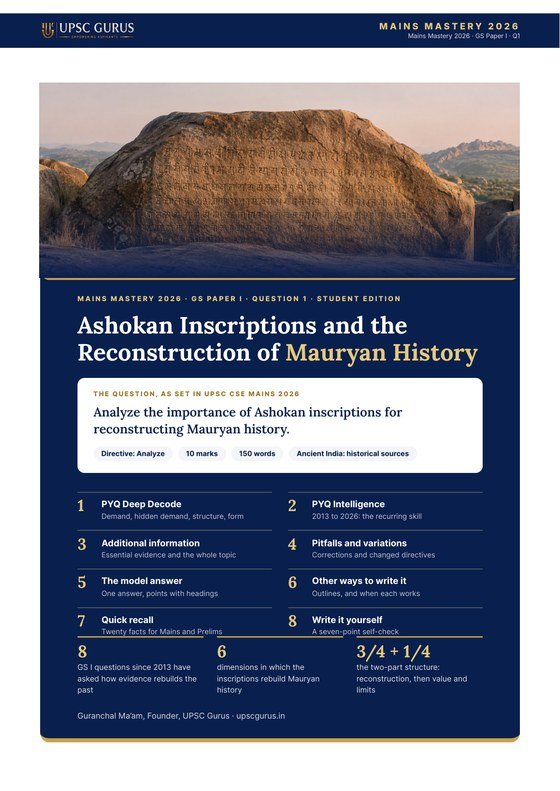
To use UPSC previous year questions (PYQs) well, read them alongside the syllabus from your first week, look at a topic’s questions before you study it, and solve them again after you finish it. For Prelims, learn from every option and sort your mistakes by cause. For Mains, tag each question to a syllabus line, find its directive word and exact demand, and write a few timed answers every week.
At a glance
- Start in week one: PYQs are a map for studying, not a test you save for the end.
- Prelims: analyse the last 10 years in depth, topic by topic; use older papers to see recurring themes.
- Mains: use GS questions from 2013 onwards, when the present four-paper GS pattern began.
- Review beats volume: mark every question as knew it, could eliminate or no idea, and note why.
- Keep a rhythm: timed Prelims questions through the week, and three Mains PYQ answers every week.
Why PYQs are essential to UPSC preparation
The syllabus tells you what to study. Previous year questions show you how UPSC actually examines it. A syllabus line such as “environmental ecology” covers a vast area; ten years of questions show you whether UPSC tends to test definitions, relationships between concepts, applications, or the difference between two similar ideas.
PYQs show three things that textbook reading alone may not:
- Depth: how far into a topic the exam goes, so you stop over-reading some chapters and under-reading others.
- Recurring themes: areas UPSC returns to, often through differently framed questions.
- Demand: in Mains, a question that asks you to examine a policy needs a different answer from one that asks you to describe it.
One caution: PYQs are not a prediction tool. A topic that appeared often may not appear again, and a topic absent for years has not become unimportant. Use PYQs to understand the exam, not to guess the next paper.
When should you start solving UPSC PYQs?
In your first week. You do not need to finish your books first; a few questions read before a chapter tell you what to look for. Follow this loop for every topic:
- Read the syllabus line for the topic.
- Read five to ten PYQs on it, without solutions. Notice the terms and distinctions being tested.
- Study the chapter from your usual source.
- Return to the same questions and attempt them on your own.
- Write down what you still need to revise.
For example, before reading Fundamental Rights, look at the questions UPSC has asked on constitutional protections, reasonable restrictions and how rights apply in practice. You will open the chapter with sharper questions in mind. If you are new to the syllabus itself, our guide to the UPSC syllabus in simple words is a good companion to this loop.
For CSE 2027: the UPSC Annual Calendar 2027 schedules the Civil Services Preliminary Examination for 23 May 2027 (dates can be changed by UPSC). That leaves time to build PYQ practice into every week, rather than squeezing it into the last month.
How many years of UPSC PYQs should you solve?
| Stage | Depth | Why |
|---|---|---|
| Prelims GS Paper I | Last 10 years (for CSE 2027, that is 2017 to 2026), topic by topic, every option reviewed | Shows the current style of questions |
| Prelims, older years | Read for themes, not for facts | Recurring concepts; check that any law, scheme or figure is still current |
| CSAT | Last 10 years, timed | Shows the level of comprehension, reasoning and numeracy expected |
| Mains GS I to IV | 2013 onwards, sorted by syllabus topic | The present four-paper GS pattern began in 2013 |
These are sensible working ranges, not official rules. If you are just starting, do not treat the full collection as this week’s task: begin with the questions on the topics you are studying now, and let the rest follow your syllabus. Ten papers analysed honestly will teach you more than thirty papers attempted and forgotten.
How to analyse UPSC Prelims PYQs: five steps
First, the rules that shape your method. In the CSE 2026 scheme, General Studies Paper I has 100 questions for 200 marks, and General Studies Paper II (CSAT) has 80 questions for 200 marks, qualifying at 33 percent. Each paper is two hours long. A wrong answer costs one-third of the marks for that question; an unanswered question costs nothing. So accuracy and judgement matter as much as knowledge.
Step 1: Read the questions before the chapter
This is the loop above in action. Before studying a topic, say monetary policy, read its PYQs without the answers and note the concept and the distinction each one tests.
Step 2: Solve under time
After the topic, attempt its questions without notes and with a timer. Do not check answers between questions. As your preparation grows, move to full papers on the real two-hour clock.
Step 3: Review every option, not just the answer
This is where most of the learning happens. For each question, explain why the right option is right and why each wrong option is wrong. In statement-based questions, judge each statement separately. A wrong option often points to a concept you have not yet studied.
Step 4: Sort every attempt into three groups
- Knew it: you understood the concept and could justify the answer.
- Could eliminate: you reached the answer by removing options, but your understanding was partial.
- No idea: you could not reach the answer with reasonable confidence.
Record two things for every question: the outcome (correct, incorrect or unattempted) and which of these three describes how you got there. Then add one word for the cause of any trouble: missing fact, confused concept, misread question, or time pressure. A correct answer that came from a guess still goes on your revision list, and a confident answer that turned out wrong deserves the closest look of all.
A worked Prelims example from 2023
UPSC Prelims 2023, General Studies Paper I:
Consider the following statements: 1. If the election of the President of India is declared void by the Supreme Court of India, all acts done by him/her in the performance of duties of his/her office of President before the date of decision become invalid. 2. Election for the post of the President of India can be postponed on the ground that some Legislative Assemblies have been dissolved and elections are yet to take place. 3. When a Bill is presented to the President of India, the Constitution prescribes time limits within which he/she has to declare his/her assent. How many of the above statements are correct? (a) Only one (b) Only two (c) All three (d) None
- Statement 1 is incorrect. Article 71(2) protects acts done by the President before the Supreme Court’s decision; they do not become invalid.
- Statement 2 is incorrect. Article 62(1) requires the election to be completed before the outgoing President’s term ends, and Article 71(4) says the election cannot be called in question because of any vacancy in the electoral college, including dissolved Assemblies.
- Statement 3 is incorrect. Article 111 sets out the President’s options on a Bill but prescribes no time limit for assent.
- Answer: (d) None. In the “how many are correct” format, judge each statement on its own before you count; that independent judgement matters more here than elimination.
What this one question teaches: UPSC tests the exact wording of constitutional provisions, so the provisions on the President’s election (Articles 54 to 62 and 71) and on assent to Bills (Article 111) belong on your Polity map. If you had marked statement 3 correct, the cause is a confused concept, and the fix is to read Article 111 itself rather than a summary of it.
Step 5: Make a one-page PYQ map for each subject
| Subject | What the PYQs tend to test | What to do |
|---|---|---|
| Polity | Provisions, powers of institutions, exceptions | Revise related articles and bodies together |
| Economy | Concepts, cause and effect, policy tools | Explain each mechanism in your own words |
| Environment | Species, ecosystems, conservation, ecological links | Tie every fact to the concept behind it |
| History and Culture | Movements, personalities, institutions, art forms | Revise events in their context and sequence |
| Geography | Physical processes, locations, spatial relationships | Practise with a map beside you |
| CSAT | Comprehension, reasoning, basic numeracy | Time every set; note question types that cost you most |
Keep each map to a page: the themes that keep returning, your repeated mistakes, and what to revise next. It guides your next study session; it is not another set of notes.
Try it free: Prelims Replay lets you attempt the actual UPSC Prelims papers from 2017 to 2026, GS Paper I and CSAT, on the two-hour clock with UPSC marking, an explanation for every question and subject-wise accuracy. It is free with a one-time sign-up, and it saves your attempts, so your error log builds itself.
How to use Mains PYQs for answer writing
Each of the four Mains GS papers carries 250 marks and lasts three hours. Recent GS I, II and III papers have 20 questions: ten of 10 marks to be answered in about 150 words, and ten of 15 marks in about 250 words. GS IV (Ethics) follows its own format, with a section of case studies. The skill being tested is reading the question precisely and answering it within those limits.
- Tag the question to a syllabus line. Many questions link two areas; note the main one and any secondary link. Over time you will see how UPSC turns broad headings into specific questions.
- Find the directive word. Discuss, examine, analyse, evaluate, comment and explain each ask for something different. Our free handout on the 60 Mains directive words explains each one with PYQs.
- Find the exact demand. Underline the subject, the directive and any limits in the question. A question on local institutions in disaster management is not asking for everything you know about disasters.
- Write three answers a week, timed. Use the marks and word limits printed on the paper. As a flexible practice guide, not a UPSC rule, allow about 7 minutes for a 10-mark answer and 10 minutes for a 15-mark one; across a full paper that leaves about ten minutes to read the paper and review.
- Check against the question first. Use the short checklist below, and only then look at any model answer, to spot dimensions you missed.
A six-point check for every Mains answer:
- Demand: did you answer every part, in the way the directive asks?
- Relevance: is every point about this question, not the topic in general?
- Support: are your main arguments backed by a relevant example, provision or reliable evidence where needed?
- Balance: where the question invites it, did you show more than one side?
- Structure: a brief introduction, a clearly organised body and a conclusion that fits the question?
- Limits: close to the word limit and within your time?
A worked example from Mains 2025
UPSC CSE Mains 2025, General Studies Paper II, Question 6, 10 marks, about 150 words:
“Women’s social capital complements in advancing empowerment and gender equity. Explain.”
- Syllabus link: GS II, the role of self-help groups, associations and other stakeholders in development processes; with a secondary link to GS I, the role of women and women’s organisations.
- Directive: “Explain” asks you to show how social capital helps, through reasons and a mechanism, not to list facts on women’s empowerment.
- Demand: the key word is “complements”. Social capital works alongside laws, schemes and incomes; it does not replace them.
- Plan: one line defining social capital (networks, trust and shared norms that let people act together). Three or four body points: access to information, collective savings and credit, a stronger voice in local decisions, mutual support. One example, such as women’s self-help groups. A one-line conclusion: social capital multiplies the effect of institutional support, while structural barriers still need policy attention.
Planned this way, the answer stays tied to the question instead of becoming a general essay on gender. Notice too that social capital is a sociology concept: this is one of many places where clear concepts from Sociology lift a GS answer.
Common mistakes with PYQs
- Memorising model answers: they can show a structure, but they do not teach you to handle a question framed differently.
- Reading solutions first: recognising an explanation feels like understanding it. Attempt first, then read.
- Leaving CSAT for later: it is qualifying, not optional. Practise its comprehension, reasoning and numeracy questions every week.
- Collecting too many compilations: one set of official papers with your own notes beats several untouched books.
A simple four-week PYQ routine
| Week | Prelims | Mains | By the end of the week |
|---|---|---|---|
| 1 | Polity and Economy PYQs topic by topic; one CSAT set | Three GS answers | Two subject maps and an error log |
| 2 | History and Geography PYQs; one CSAT set | Three GS answers | Updated maps, weak topics listed |
| 3 | Environment and Science PYQs; re-attempt last week’s wrong answers | Three GS answers | Concepts revised, better answer plans |
| 4 | One full timed GS paper and one CSAT paper; full review | Three GS answers | Consolidated maps and next month’s priorities |
Fit the subject order to your own plan; if you need help building that plan, the free study timetable maker on Mentor’s Desk lays out your week. After four weeks, read your error log and give more time to the concepts you keep getting wrong, rather than revising every subject equally.
Frequently asked questions
When should I start solving UPSC PYQs?
In your first week. Read a topic’s questions before you study it and attempt them again afterwards. Move to full timed papers as your preparation grows.
How many years of PYQs are enough for Prelims?
The last 10 years, analysed option by option, are a strong base. Older papers help you see recurring themes. UPSC sets no official number; the quality of your review matters more.
Do UPSC questions repeat?
Themes and concepts recur, but exact questions rarely do, and the framing changes. Learn the concept behind each question so you can answer an unfamiliar version of it.
Should a beginner solve Mains PYQs?
Yes. Begin by reading the questions and making short answer outlines. Once you have studied a topic, write full timed answers. This teaches you to read questions early, which helps both Prelims and Mains.
Where can I get official UPSC previous year papers?
On upsc.gov.in, under Examination, then Previous Question Papers. You can also read and attempt every Prelims and Mains paper from 2017 to 2026 free in our Open Library.
Free tools to put this into practice
- Prelims Replay: every Prelims paper from 2017 to 2026 as a timed test, by year or by subject.
- Mains Replay: 170 actual Mains papers from 2017 to 2026, GS I to IV, Essay and optionals, to read online, download, and write under a three-hour clock.
- Current Canvas: our daily current affairs, with every story tagged to the syllabus, so you can link each PYQ theme to what is in the news.
Free for every aspirant: sign up once, free, to start Prelims Replay, keep your attempts and results saved, download the daily Current Canvas Brief and hear when new papers and practice resources are added.
If you would like guidance
Solving PYQs on your own builds the habit; a full-length test series is one more way to see how that habit holds up across a whole paper. Prelims Booster takes you from the free PYQ papers to a Prelims 2027 test series: 12 GS and 6 CSAT full-length tests for Rs 1,999, or those plus 20 subject-wise sectional tests for Rs 3,499, all online, timed, marked the UPSC way and explained question by question, valid till Prelims 2027.
For Mains, write a full actual paper from Mains Replay and send it for PYQ Paper Evaluation, Rs 1,499 per paper, with written evaluation and a personal feedback session. To ask anything before you decide, WhatsApp us at +91 81220 02172, and we will be glad to help.
Sources
- UPSC, Civil Services Examination 2026 notification (scheme of examination, marks, duration, CSAT qualifying standard, negative marking)
- UPSC, Annual Calendar 2027 (Civil Services Preliminary Examination 2027 date)
- UPSC, Previous Question Papers
- Constitution of India (Articles 71 and 111)
- UPSC, Civil Services (Main) Examination 2025, General Studies Paper II (Question 6, marks and word limits)
Your first Mentor’s Desk call is free
One free conversation per aspirant about where you are in your preparation, with an honest suggestion of the right next step.
Know more and bookHave a question? Get in touch
For questions about a programme, its fees, batch dates, payment or access. Message us on WhatsApp and our team will reply. Asking a question is not a booking, and you can ask as often as you need.
Get in touch on WhatsApp