 New this week · Free UG Handout 02UPSC Mains Directive Words: 60 Meanings, Trends and PYQsTwo free PDFs: The Guide and the With PYQs edition.Read and download
Today’s Canvas
- Supreme Court: commercial crop cultivation alone cannot establish forest rightsGS II
- Congress questions delay in proroguing the Lok Sabha amid the delimitation debateGS II
- Manipur High Court keeps Census 2027 operations on hold at least until 30 April 2027GS II
- Delhi’s air stays very poor after Deepavali; Punjab records 1,152 farm fires in a dayGS III
- COP31 opens in Turkiye as WMO says 2026 will rank among the four warmest yearsGS III
- Forest panel recommends Stage I clearance for the Panari pumped storage project in a tiger corridorGS III
- Villages without 4G connectivity fall by about 75% in four yearsGS II
- Revised MRPs of 1,364 anti-cancer formulations take effect; government projects Rs 3,540 crore in annual savingsGS II
- NMC warns students against unauthorised medical colleges and misleading approval claimsGS II
- RBI extends supersession of the Abhyudaya Co-operative Bank board by another yearGS III
- Modi and Zelenskyy speak as India engages Kyiv and Moscow ahead of peace talksGS II
- Gadi Eisenkot gets the mandate to form Israel’s government but faces a coalition testGS II
Polity and governance
Supreme Court: commercial crop cultivation alone cannot establish forest rights
In short: The Supreme Court has clarified that commercial cultivation cannot, by itself, justify occupation of forest land under the Forest Rights Act, 2006.
Why in news
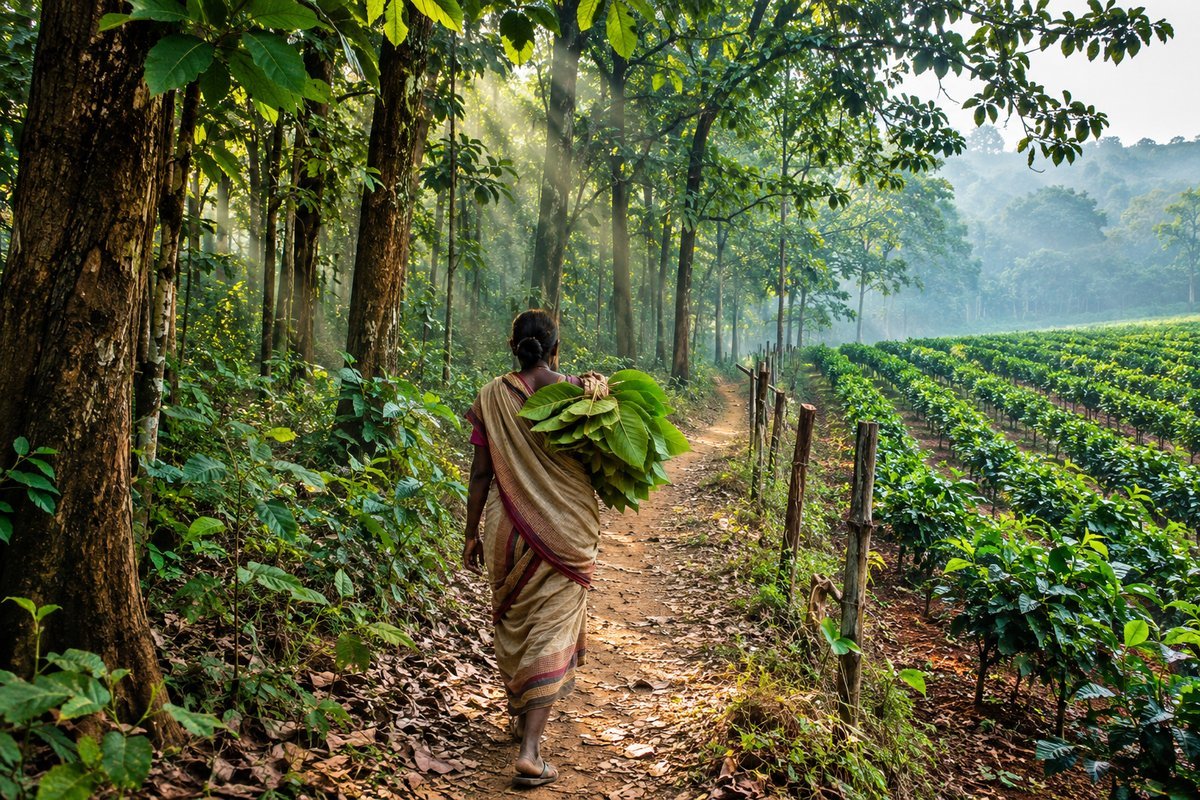
In an order dated 6 November 2026, the Supreme Court examined forest occupation and silk cotton cultivation in Tamil Nadu’s Megamalai region, part of the Srivilliputhur-Megamalai Tiger Reserve. A Bench of Justices Vikram Nath and Sandeep Mehta distinguished commercial crop cultivation from traditional forest produce collection. It constituted a Special Committee headed by former Chief Justice of India B.R. Gavai to supervise claim disposal and scrutinise decisions made by the competent authorities under the Forest Rights Act. The Court directed Tamil Nadu to constitute the remaining Gram Sabhas within 30 days and complete the statutory adjudication of claims within five months of their constitution. In the Megamalai case, the Court excluded the identified temporary residents and outside-forest cultivators from FRA consideration because cultivation alone did not establish their statutory eligibility.
Concept: Forest Rights Act, 2006
The Scheduled Tribes and Other Traditional Forest Dwellers (Recognition of Forest Rights) Act, 2006 addresses historical injustice caused by the non-recognition of customary forest rights. It recognises individual rights, including habitation and self-cultivation for livelihood, and community rights involving grazing, fishing, minor forest produce and management of community forest resources. The Gram Sabha initiates verification of claims and passes resolutions for further examination by statutory committees. The Act combines livelihood security with forest conservation. It does not confer unrestricted ownership or permit commercial occupation merely because land has been cultivated.
Key facts for Prelims
- Section 3(1)(a) recognises rights to hold and live on forest land for habitation or self-cultivation for livelihood, subject to statutory conditions; under Section 4(3), the land must have been occupied before 13 December 2005.
- Section 3(1)(c) recognises ownership, collection, use and disposal rights over traditionally collected minor forest produce; Section 3(1)(i) recognises the right to protect, regenerate, conserve or manage community forest resources.
- Other Traditional Forest Dwellers must show primary residence in forests for at least three generations (75 years) before 13 December 2005 and dependence on forests for bona fide livelihood needs.
- Section 4(5) bars eviction of forest-dwelling Scheduled Tribes and Other Traditional Forest Dwellers from occupied forest land until rights verification is complete; Section 4(6) limits recognised Section 3(1)(a) land rights to actual occupation, up to four hectares.
- Under Section 4(4), recognised forest rights are heritable but cannot be sold or transferred.
- Under Section 6, the Gram Sabha initiates the claims process. Sub-Divisional and District Level Committees examine claims, with the District Level Committee making the final decision.
Mains analysis and way forward
Mains analysis
- Historical justice: The FRA corrects exclusionary forest governance by recognising legitimate rights of forest-dependent communities.
- Conservation: Commercial plantations may alter forest ecology, but lawful traditional cultivation must not be confused with encroachment.
- Procedural fairness: Verification must rely on statutory eligibility, evidence and due process rather than blanket assumptions.
- Community governance: Gram Sabhas strengthen local participation, traditional knowledge and accountability in forest management.
Way forward
- Complete pending forest-rights verification through functioning Gram Sabhas and statutory committees.
- Distinguish lawful individual and community rights from commercial occupation using transparent, evidence-based procedures.
- Protect biodiversity while ensuring that genuine rights holders receive legal safeguards against unlawful eviction.
Connect the dots: GS II tribal welfare and decentralisation | GS III biodiversity conservation, sustainable livelihoods and environmental governance.
Sources: The Hindu, “Commercial cultivation within forest land not protected under FRA, 2006: Supreme Court”, 9 November 2026. Ministry of Tribal Affairs, Forest Rights Act.
Congress questions delay in proroguing the Lok Sabha amid the delimitation debate
In short: Congress alleges that keeping the Monsoon Session unprorogued could facilitate another attempt to pass delimitation-related constitutional amendments.

Why in news
On 9 November 2026, Congress general secretary Jairam Ramesh questioned why the Lok Sabha had not been prorogued even 88 days after its adjournment sine die. He alleged that the delay was intended to allow the government to secure the numbers required for delimitation-related Bills. The Constitution (131st Amendment) Bill, 2026 was defeated in the Lok Sabha on 17 April 2026. Parliamentary Affairs Minister Kiren Rijiju has maintained that no constitutional deadline exists for prorogation. The allegation remains a political claim, not an established finding.
Concept: Adjournment, Prorogation and Dissolution
Article 85 empowers the President to summon each House of Parliament and prorogue it. Summoning begins a parliamentary session. Adjournment temporarily suspends a sitting, while adjournment sine die ends sittings without fixing the next date. Prorogation formally ends a session, generally on government advice. Dissolution ends the life of the Lok Sabha. Under Article 107(3), pending Bills do not lapse merely because Parliament is prorogued. Dissolution, however, causes certain pending Bills to lapse. The Constitution requires no fixed interval between adjournment sine die and prorogation.
Key facts for Prelims
- Article 85: The President summons Parliament and prorogues either House; the President can dissolve the Lok Sabha.
- Under Article 368, a constitutional amendment Bill must be passed by each House separately with the special majority; there is no joint sitting for such Bills.
- The maximum interval between the last sitting of one session and the first sitting of the next is six months.
- Articles 82 and 170 govern readjustment of Lok Sabha and State Assembly constituencies following a Census.
- Under the present constitutional provisions, the freeze on relevant seat readjustments continues until figures from the first Census taken after 2026 are published. Allocation of Lok Sabha seats among States rests on the 1971 Census, while constituency boundaries were last broadly readjusted using 2001 Census figures.
Mains analysis and way forward
Mains analysis
- Constitutional legality: Delayed prorogation is not automatically unconstitutional because Article 85 does not prescribe a prorogation deadline.
- Parliamentary scrutiny: The timing of sessions may affect opportunities for consultation, debate and preparation.
- Federalism: Delimitation raises concerns about changes in the relative parliamentary representation of States with different population-growth rates.
- Constitutional amendments: Most constitutional amendment Bills require a majority of the total membership and two-thirds of members present and voting in each House. Certain changes additionally require State ratification.
Way forward
- Hold an all-party consultation before introducing major delimitation-related constitutional changes.
- Publish proposed formulas and assess implications for regional representation and federal balance.
- Ensure adequate parliamentary debate without treating procedural legality as a substitute for political consensus.
Connect the dots: Parliamentary procedure | Constitutional amendment | Population policy | Federal representation | Women’s political reservation.
Sources: The Hindu, “Prorogation record set to give time to Shah to manipulate ‘super-tainted’ 2/3rd majority: Congress”, 9 November 2026. Lok Sabha Secretariat, Parliamentary FAQ.
Manipur High Court keeps Census 2027 operations on hold at least until 30 April 2027
In short: The High Court has continued the suspension of Census operations in Manipur while directing examination of objections concerning displaced populations and enumeration.

Why in news
On 4 November 2026, a Division Bench of the Manipur High Court directed that Census 2027 operations in the State remain on hold until 30 April 2027. It asked the Registrar General and Census Commissioner of India to examine seven representations and issue a reasoned decision by that date. The representations cite continuing instability, displacement, enumeration safeguards and demands concerning the National Register of Citizens. The Court also provided a further four-week pause after the representations are decided to allow legal challenges.
Concept: Census Act, 1948 and Census 2027
The Census Act, 1948 provides the legal framework for population enumeration in India. The Office of the Registrar General and Census Commissioner, under the Ministry of Home Affairs, coordinates the exercise. Census 2027 is India’s first digital Census, using mobile-based data collection and offering an option of self-enumeration. Its first phase, Houselisting and Housing Census, records housing conditions and amenities. The second phase, Population Enumeration, collects individual demographic and socioeconomic details, including caste. Accurate Census data supports welfare planning, resource allocation, demographic analysis and future delimitation under constitutional provisions.
Key facts for Prelims
- The Census is a Union subject under Entry 69 of the Union List in the Seventh Schedule.
- The Census Act was enacted in 1948; the last completed nationwide population Census was in 2011. Census 2027 is India’s 16th Census; its reference date is 1 March 2027, and 1 October 2026 for snow-bound areas.
- Census 2027 includes caste enumeration during the Population Enumeration phase, not the Houselisting phase.
- The High Court’s order concerns Manipur. It is not a nationwide suspension of Census 2027.
- Section 15 of the Census Act, 1948 keeps individual Census records confidential; they are not open to public inspection and are generally not admissible as evidence.
Mains analysis and way forward
Mains analysis
- Data integrity: Conflict and displacement can affect household identification, residence records and completeness of enumeration.
- Administrative trust: Communities may question the fairness of data collection in a politically sensitive environment.
- Policy consequences: Delayed or incomplete data can weaken planning for health, education and rehabilitation.
- Rights protection: Census enumeration must be distinguished from citizenship verification or determination of nationality.
Way forward
- Establish special enumeration procedures for internally displaced persons and conflict-affected areas.
- Ensure transparent review of representations, adequate enumerator training and independent quality checks.
- Resume operations when reliable enumeration and reasonable safeguards can be ensured.
Connect the dots: GS I population distribution | GS II governance, social justice and citizenship debates | Disaster and conflict-related displacement.
Sources: The Hindu, “Manipur Census to remain on hold until April 2027, says High Court”, 9 November 2026. The Indian Express, “Manipur census to remain on hold till April 2027, orders high court”, 9 November 2026.
Environment and climate
Delhi’s air stays very poor after Deepavali; Punjab records 1,152 farm fires in a day
In short: Delhi experienced severe pollution at several monitoring stations, while different AQI methods produced sharply contrasting readings across public and private platforms.
Why in news
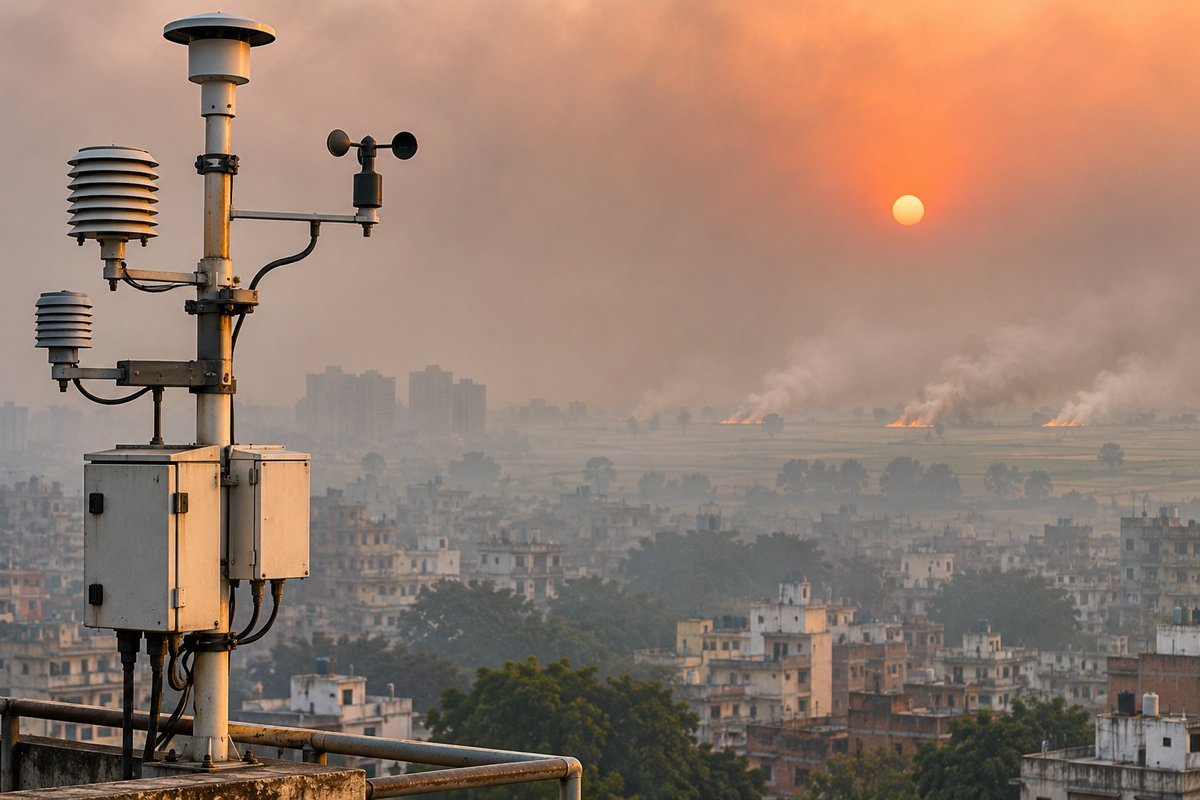
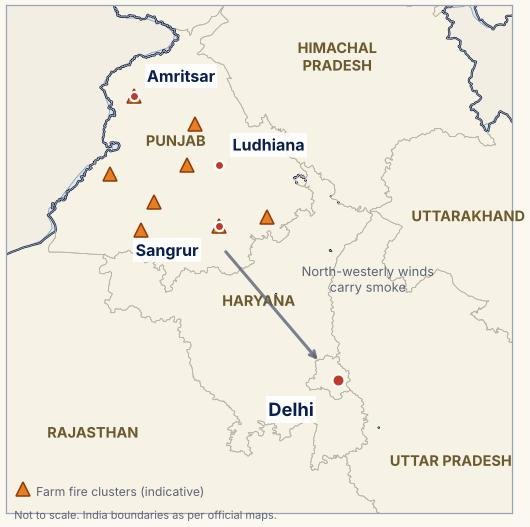
On 9 November 2026, the day after Deepavali, Delhi experienced heavy smog. The CPCB’s citywide 24-hour AQI was reported at 370, categorised as “very poor”, although several stations crossed 400, the “severe” threshold. Private platforms displayed substantially higher numbers using different scales and methods. Stage III of the Graded Response Action Plan had been enforced since 6 November. Separately, Punjab recorded 1,152 farm-fire detections on 8 November, taking its season’s cumulative count to 4,459, according to official monitoring data.
Concept: Air Quality Index and GRAP
India’s National Air Quality Index, introduced in 2014, converts measured concentrations of up to eight pollutants into a single index, capped at 500. The highest pollutant sub-index determines the reported AQI. Private platforms may apply US EPA breakpoints, use different averaging periods, choose different monitoring locations or rely on low-cost sensors rather than reference-grade monitoring stations. The Commission for Air Quality Management invokes and oversees GRAP’s four stages in Delhi-NCR, while designated agencies implement the measures. Emergency restrictions may be imposed in advance when forecasts indicate sustained deterioration, even before a threshold is crossed.
Key facts for Prelims
- India’s AQI categories include Poor (201-300), Very Poor (301-400) and Severe (401-500).
- AQI pollutants: PM10, PM2.5, SO2, NO2, CO, O3, NH3 and lead.
- GRAP Stage III corresponds to Delhi AQI 401-450; Stage IV applies above 450. Forecast-based early invocation is permitted.
- The Commission for Air Quality Management (CAQM), which runs GRAP, is a statutory body under the Commission for Air Quality Management in National Capital Region and Adjoining Areas Act, 2021.
Mains analysis and way forward
Mains analysis
- Interpretation: AQI figures from different methods cannot be directly compared without matching scales, locations and averaging periods.
- Multiple sources: Vehicles, industries, construction dust, firecrackers and crop-residue burning contribute to seasonal pollution.
- Meteorology: Low wind speeds and reduced atmospheric mixing can trap pollutants near the ground.
- Governance: GRAP addresses immediate health risks, but lasting improvement requires sustained emission reductions.
Way forward
- Improve transparency by publishing pollutant concentrations, monitoring methods and complete station-level data.
- Expand alternatives to stubble burning through residue-management machinery, affordable collection and viable biomass markets.
- Strengthen year-round transport, industrial and dust-control policies alongside emergency measures.
Connect the dots: Environmental pollution | Public health | Agricultural sustainability | Centre-State coordination | Technology in monitoring.
Sources: The Indian Express, “Delhi’s AQI is 370, but some platforms show 1,000: Why do readings differ?”, 9 November 2026. The Hindu, “Punjab records season’s biggest single-day jump in farm fires on Deepavali”, 9 November 2026.
COP31 opens in Turkiye as WMO says 2026 will rank among the four warmest years
In short: COP31 began in Antalya amid concerns over inadequate climate finance, slow implementation of commitments and increasingly extreme weather.

Why in news
COP31 opened in Antalya, Türkiye, on 9 November 2026 and runs until 20 November. Türkiye holds the COP31 Presidency, while Australia serves as President of Negotiations under a special partnership arrangement. The World Meteorological Organization reported that 2026 is on course to rank among the four warmest years recorded. Global average surface temperature during January to September 2026 was approximately 1.47°C above the 1850-1900 average. UN Secretary-General António Guterres warned of a new age of climate extremes. Negotiations focus on implementation, mitigation, finance, adaptation and a just transition.
Concept: UNFCCC, Paris Agreement and Climate Finance
The Conference of the Parties (COP) is the decision-making body of the United Nations Framework Convention on Climate Change, adopted in 1992. The Paris Agreement, adopted at COP21 in 2015, seeks to hold global warming well below 2°C while pursuing efforts to limit it to 1.5°C. A single year above 1.5°C does not by itself mean the Paris long-term goal has been breached. Countries submit Nationally Determined Contributions (NDCs) describing their climate actions. The New Collective Quantified Goal on Climate Finance (NCQG), adopted at COP29, calls for at least $300 billion a year for developing countries by 2035, led by developed countries; a broader goal seeks to scale finance from all public and private sources to $1.3 trillion a year.
Key facts for Prelims
- COP31: Antalya, Türkiye, 9-20 November 2026.
- The WMO’s 1.47°C estimate concerns January-September 2026, not the final annual global temperature.
- COP29 was held in Baku, Azerbaijan, in 2024, where the NCQG was agreed.
- NDCs are country-determined climate commitments under Article 4 of the Paris Agreement. The Global Goal on Adaptation is addressed under Article 7.
Mains analysis and way forward
Mains analysis
- Implementation gap: The central challenge is converting national climate pledges into measurable emissions reductions and greater resilience.
- Finance inequality: Developing countries argue that affordable, predictable finance is essential for a fair energy transition.
- Adaptation: Extreme heat, floods, drought and coastal risks require investments beyond emissions reduction.
- India’s position: Ahead of COP31, India called for predictable, largely public and concessional finance, technology transfer, voluntary adaptation indicators and respect for nationally determined climate action.
Way forward
- Improve accountability for finance commitments and reduce barriers to accessing adaptation funds.
- Accelerate clean energy and resilient infrastructure while protecting development needs and affordable energy access.
- Strengthen early-warning systems, climate observations and locally appropriate adaptation measures.
Connect the dots: Climate science | International environmental agreements | Sustainable development | Disaster management | Climate justice.
Sources: The Hindu, “COP31 opens as climate and geopolitical pressures mount”, 9 November 2026. The Hindu, “2026 to be one of four warmest years on record: World Meteorological Organization”, 9 November 2026. WMO, State of the Climate Update 2026, 9 November 2026. PIB, “India to pursue Solution-oriented and Equitable Climate Action at UNFCCC COP31 in Antalya”, 3 November 2026.
Forest panel recommends Stage I clearance for the Panari pumped storage project in a tiger corridor
In short: A proposed 1,800 MW pumped storage project has received a favourable Forest Advisory Committee recommendation despite concerns over habitat fragmentation.

Why in news
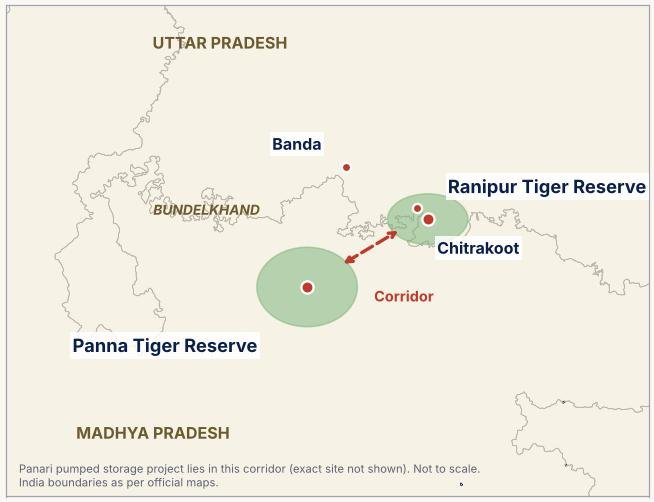
The Indian Express reported on 10 November 2026 that the Forest Advisory Committee, at its 23 October meeting, recommended in-principle forest clearance for the 1,800 MW Panari Pumped Storage Project. The proposal involves diverting approximately 511.91 hectares of forest land across Panna and Satna districts of Madhya Pradesh. About 211.7 hectares fall within an NTCA-approved tiger corridor. The project could involve felling approximately 1.32 lakh trees. The recommendation is not final forest clearance, and wildlife connectivity concerns remain significant. The Standing Committee of the National Board for Wildlife had separately recommended wildlife clearance on 9 July 2026, subject to conditions.
Concept: Pumped Storage and Forest Clearance
Pumped storage hydropower stores electricity by moving water between reservoirs at different elevations. During periods of surplus electricity, water is pumped uphill. During peak demand, it flows downhill through turbines to generate power. Such projects can balance variable solar and wind generation. Forest diversion for non-forest purposes requires Central Government approval under the Van (Sanrakshan Evam Samvardhan) Adhiniyam, 1980. Stage I is conditional in-principle approval, followed by compliance with specified requirements and Stage II final approval. A tiger corridor connects habitats, enabling animal movement and maintaining genetic exchange.
Key facts for Prelims
- The National Tiger Conservation Authority (NTCA) is a statutory body constituted under Section 38L of the Wildlife (Protection) Act, 1972.
- Forest diversion proposed: 511.91 hectares, including approximately 211.7 hectares within the North Eastern Tiger Corridor of Panna Tiger Reserve.
- The corridor connects Panna Tiger Reserve in Madhya Pradesh with Ranipur Tiger Reserve in Uttar Pradesh. Ranipur was notified as a tiger reserve in 2022.
- The Forest Advisory Committee advises on forest diversion proposals; its recommendation does not itself constitute final approval.
Mains analysis and way forward
Mains analysis
- Energy security: Pumped storage can support grid stability and renewable energy integration.
- Ecological costs: Reservoirs, roads and other infrastructure may fragment habitats and disrupt wildlife movement.
- Mitigation limits: Compensatory afforestation cannot fully replace mature forests or restore an existing ecological corridor.
- Regulatory scrutiny: Wildlife clearance, forest clearance, environmental assessment and forest-rights compliance serve distinct purposes.
Way forward
- Independently assess alternative locations and project designs with lower ecological impacts.
- Protect functional wildlife corridors through scientifically evaluated mitigation and long-term monitoring.
- Make clearance conditions, compliance reports and cumulative ecological assessments publicly accessible.
Connect the dots: Renewable energy transition | Forest conservation law | Tiger corridors | Environmental impact assessment | Sustainable infrastructure.
Economy, health and technology
Villages without 4G connectivity fall by about 75% in four years
In short: Government data show major gains in rural 4G availability, but remote, tribal and geographically difficult areas remain underserved.

Why in news
Department of Telecommunications data obtained by The Hindu under the Right to Information Act show that villages without 4G connectivity declined from 45,180 in 2022 to 11,372 in 2026, a reduction of approximately 75%. The 4G saturation project, BSNL network expansion and private operators contributed to this improvement. As of 31 August 2026, Odisha had 1,789 villages without 4G coverage, followed by Arunachal Pradesh with 1,518. These counts also include some uninhabited villages. The remaining gaps highlight geographical, infrastructure and affordability challenges despite expanded network availability.
Concept: Digital Bharat Nidhi and BharatNet
The Universal Service Obligation Fund, created under the Indian Telegraph Act, 1885, became the Digital Bharat Nidhi under the Telecommunications Act, 2023. It supports connectivity and related telecommunications development in underserved areas. The 4G saturation project aims to extend mobile broadband to uncovered villages, particularly through supported infrastructure deployment. BharatNet is a separate programme intended to provide broadband connectivity to Gram Panchayats through a national fibre-based network. Connecting a Gram Panchayat through BharatNet and providing reliable 4G coverage throughout every surrounding village are different objectives. Both contribute to digital inclusion.
Key facts for Prelims
- Under Section 25 of the Telecommunications Act, 2023, Digital Bharat Nidhi can fund telecom access in underserved rural, remote and urban areas, and research, development and pilot projects.
- Digital Bharat Nidhi is established under Section 24 of the Telecommunications Act, 2023.
- BharatNet targets broadband connectivity to Gram Panchayats; 4G saturation addresses mobile-network coverage in uncovered villages.
- Under Section 25 of the Telecommunications Act, 2023, money for Digital Bharat Nidhi is first credited to the Consolidated Fund of India and then appropriated by Parliament.
Mains analysis and way forward
Mains analysis
- Service delivery: Reliable internet can improve access to digital payments, education, telemedicine and government services.
- Social inequality: Tribal, remote and hilly settlements face higher infrastructure costs and operational difficulties.
- Meaningful access: Coverage alone does not guarantee affordable devices, sufficient data, reliable speeds or digital literacy.
- Infrastructure resilience: Rural towers require dependable electricity, backhaul connectivity and maintenance.
Way forward
- Prioritise remaining underserved villages using habitation, population and terrain-based assessments.
- Measure service quality, affordability and uptime alongside nominal network coverage.
- Combine connectivity investment with digital-skills training, accessible services and device affordability initiatives.
Connect the dots: Digital India | Rural development | Tribal inclusion | Digital public infrastructure | Universal service obligations.
Sources: The Hindu, “Number of villages without 4G connectivity falls by three-fourths in four years”, 9 November 2026. Department of Telecommunications, Telecommunications Act and Digital Bharat Nidhi.
Revised MRPs of 1,364 anti-cancer formulations take effect; government projects Rs 3,540 crore in annual savings
In short: The National Pharmaceutical Pricing Authority’s trade-margin intervention has lowered reported MRPs for numerous anti-cancer formulations.

Why in news
On 9 November 2026, revised maximum retail prices became effective for 1,364 anti-cancer formulations, following an NPPA intervention covering 137 anti-cancer drugs. As of 8 November, 85 pharmaceutical companies had reported revised MRPs for formulations covering 121 drugs. According to the Department of Pharmaceuticals, 679 brands reported price reductions exceeding 50%, with the highest reported reduction reaching 96.45%. The government estimates annual consumer savings of Rs 3,540.38 crore. This figure is a projection, not an independently measured amount already saved by patients.
Concept: NPPA, DPCO and Trade Margin Rationalisation
The National Pharmaceutical Pricing Authority operates under the Department of Pharmaceuticals, Ministry of Chemicals and Fertilizers. It regulates medicine prices under the Drugs (Prices Control) Order, 2013, issued under the Essential Commodities Act, 1955. Scheduled formulations are subject to notified ceiling prices. For these non-scheduled anti-cancer drugs, NPPA capped the margin between the price to stockist or distributor and the MRP (excluding GST) at 30% of MRP. Its purpose is to reduce excessive supply-chain markups. Lower MRPs can improve affordability, but treatment access also depends on availability, diagnosis and healthcare financing.
Key facts for Prelims
- NPPA: National Pharmaceutical Pricing Authority, under the Department of Pharmaceuticals.
- DPCO, 2013: The principal framework for regulating prices of medicines, including scheduled formulations.
- NPPA used Paragraph 19 of the DPCO, 2013 to cap trade margins for 137 non-scheduled anti-cancer drugs at 30% of MRP, excluding GST.
- Consumers can verify prices through the Pharma Sahi Daam application or NPPA website and lodge overcharging complaints through Pharma Jan Samadhan.
Mains analysis and way forward
Mains analysis
- Affordability: Reduced retail prices can lessen out-of-pocket expenditure for costly cancer treatment.
- Supply chains: High distribution margins may raise patient costs without corresponding improvements in therapeutic value.
- Access limitations: Price reductions alone cannot address shortages of diagnostic services, oncology specialists or treatment facilities.
- Regulatory balance: Price interventions must protect consumers while maintaining supply and competition.
Way forward
- Monitor actual retail prices, medicine availability and compliance across pharmacies and hospitals.
- Strengthen public procurement, generic-medicine access and financial protection for cancer patients.
- Evaluate realised savings using market and prescription data rather than relying only on projected benefits.
Connect the dots: Right to health | Pharmaceutical regulation | Out-of-pocket expenditure | Universal health coverage | Consumer protection.
Sources: The Hindu, “Revised MRPs of 1,364 anti-cancer formulations come into effect; consumers to save ₹3,540 crore/year”, 9 November 2026. PIB, “Revised MRPs of 1,364 Anti-Cancer Formulations Come into Effect from Today”, 9 November 2026.
NMC warns students against unauthorised medical colleges and misleading approval claims
In short: The NMC has advised students to verify the official approval status of medical institutions and courses before seeking admission or paying fees.

Why in news
The National Medical Commission published an advisory on 6 November 2026, dated 5 November, warning students and parents about unauthorised medical institutions and misleading approval claims. The advisory, reported on 9 November, asks prospective students to consult official regulatory records before admission or payment. The advisory warns against misleading advertisements, unauthorised admission offers and potentially forged regulatory documents, and urges students to verify every claim through official channels. The Commission has urged verification through its official website and relevant regulatory and counselling portals.
Concept: National Medical Commission Act, 2019
The National Medical Commission Act, 2019 created the NMC to regulate medical education and professional standards, replacing the Medical Council of India. Its autonomous boards include the Undergraduate Medical Education Board, Postgraduate Medical Education Board, Medical Assessment and Rating Board, and Ethics and Medical Registration Board. Section 28 requires prior permission from the Medical Assessment and Rating Board to establish a new medical college, start a postgraduate course or increase the number of seats. The Medical Assessment and Rating Board assesses compliance and grants applicable permissions. Recognition, permission for courses and approved seat capacity must be verified separately.
Key facts for Prelims
- The NMC is a statutory body established under the National Medical Commission Act, 2019.
- The Medical Assessment and Rating Board handles assessment and permission for new medical institutions and specified course or seat expansions.
- NEET-UG is the common entrance examination for undergraduate medical education covered by the NMC framework.
- Permission to establish a college does not automatically authorise every course or an unlimited number of seats.
Mains analysis and way forward
Mains analysis
- Student protection: Fraudulent institutions can cause financial loss, educational disruption and uncertainty over professional qualifications.
- Regulatory transparency: Public access to accurate approval records can reduce opportunities for misrepresentation.
- Information gaps: Students may struggle to distinguish institutional registration, course recognition and annual seat permissions.
- Governance: Effective oversight requires coordination among regulators, universities, counselling bodies and State authorities.
Way forward
- Maintain easily searchable, updated public lists of approved institutions, courses and sanctioned seats.
- Strengthen enforcement against forged approvals, deceptive advertising and unauthorised admissions.
- Encourage students to cross-check official counselling allocations and regulatory status before paying fees.
Connect the dots: Education governance | Professional regulation | Consumer protection | Public health workforce | Digital transparency.
Sources: The Hindu, “NMC cautions students against fake medical colleges, asks them to verify approvals”, 9 November 2026. National Medical Commission, advisory dated 5 November 2026, published 6 November 2026.
RBI extends supersession of the Abhyudaya Co-operative Bank board by another year
In short: The RBI has extended the bank board’s supersession until November 2027, continuing administrator-led oversight in the public interest.

Why in news
On 9 November 2026, the Reserve Bank of India announced another one-year extension of the supersession of Abhyudaya Co-operative Bank’s Board of Directors, effective 24 November 2026. The RBI originally superseded the Mumbai-based bank’s board on 24 November 2023 over material concerns about poor governance. Extensions followed in 2024 and 2025. Under the latest decision, Satya Prakash Pathak will continue as Administrator, assisted by the existing Committee of Advisors. The RBI stated that continued supersession was necessary in the public interest.
Concept: RBI Regulation of Urban Co-operative Banks
Urban co-operative banks perform banking functions but are also organised under co-operative law. The Banking Regulation Act, 1949, as applicable to co-operative banks through Section 56, gives the RBI regulatory and supervisory powers. Section 36AAA provides for supersession of a co-operative bank’s board under specified circumstances. The Banking Regulation (Amendment) Act, 2020 strengthened RBI oversight of co-operative banks, including governance and regulatory powers. Co-operative societies remain subject to relevant co-operative legislation for non-banking matters. This division of responsibilities requires coordination between banking regulators and co-operative authorities.
Key facts for Prelims
- The RBI invoked Section 36AAA read with Section 56 of the Banking Regulation Act, 1949.
- Abhyudaya Co-operative Bank’s board was first superseded on 24 November 2023.
- DICGC insurance covers eligible principal and interest up to Rs 5 lakh per depositor per insured bank, aggregating deposits held in the same right and same capacity.
- Supersession of a bank’s board does not automatically mean bank liquidation or trigger deposit insurance payments.
- DICGC payouts may follow liquidation or licence cancellation, eligible reconstruction or merger schemes, or RBI all-inclusive directions restricting withdrawals (within 90 days under Section 18A of the DICGC Act). Board supersession alone does not trigger payment.
Mains analysis and way forward
Mains analysis
- Governance: Weak board oversight can increase operational, credit and depositor risks in co-operative banks.
- Regulatory intervention: Supersession allows a regulator-appointed administrator to oversee operations when statutory conditions are met.
- Depositor confidence: Effective supervision can reduce uncertainty and support banking-system credibility.
- Institutional reform: Co-operative banks must balance democratic member participation with professional management and prudential safeguards.
Way forward
- Strengthen board competence, internal audits, risk controls and transparent financial reporting.
- Establish measurable governance improvements and a credible roadmap for restoring normal board functioning.
- Improve depositor awareness of insurance coverage, complaint channels and regulatory restrictions.
Connect the dots: Financial regulation | Co-operative federalism | Corporate governance | Depositor protection | Banking stability.
Sources: The Hindu, “RBI extends Abhyudaya Bank supersession by another year”, 10 November 2026. RBI, “Supersession of Board of Directors of Abhyudaya Co-operative Bank Ltd., Mumbai – Extension of period”, 9 November 2026. DICGC, Depositor FAQs.
International relations
Modi and Zelenskyy speak as India engages Kyiv and Moscow ahead of peace talks
In short: India engaged both Ukraine and Russia diplomatically as Zelenskyy said New Delhi was willing to help establish Black Sea food corridors.

Why in news
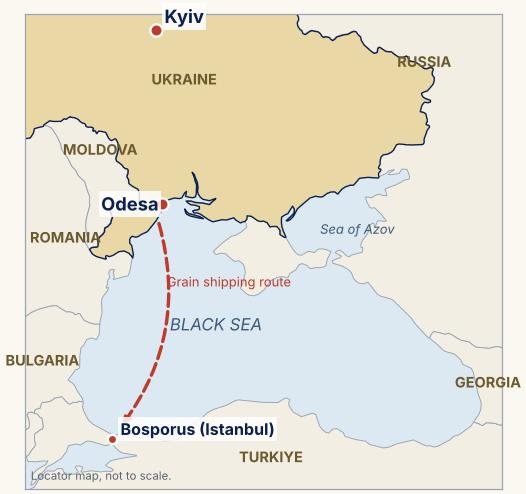
On 9 November 2026, Prime Minister Narendra Modi spoke with Ukrainian President Volodymyr Zelenskyy ahead of US-brokered Russia-Ukraine peace talks scheduled to begin in Abu Dhabi on 10 November. External Affairs Minister S. Jaishankar separately spoke with Russian Foreign Minister Sergey Lavrov. Modi reiterated India’s commitment to a peaceful resolution. Zelenskyy said India was ready to mediate in establishing food corridors through the Black Sea, where disruption affects agricultural exports. The reported proposal should not be confused with a concluded agreement or an operational corridor.
Concept: India’s Diplomatic Approach and Black Sea Food Security
India maintains diplomatic relations with both Russia and Ukraine and has advocated dialogue, diplomacy and a peaceful resolution of the conflict. It also emphasises international law, sovereignty and territorial integrity. The Black Sea is an important maritime outlet for agricultural exports, particularly from Ukraine and Russia. Interruptions to port operations, shipping routes and agricultural trade can affect global food availability and prices, especially in import-dependent countries. Humanitarian initiatives involving safe commercial shipping can support confidence-building, but a proposed corridor requires security arrangements and agreement among relevant parties.
Key facts for Prelims
- The Black Sea is connected to the Mediterranean Sea through the Bosporus, Sea of Marmara and Dardanelles.
- Ukraine’s major Black Sea grain-export ports include Odesa, Chornomorsk and Pivdennyi.
- The Montreux Convention, 1936 governs the passage of merchant ships and warships through the Bosporus and Dardanelles, with different rules for each.
- The proposed Indian role in food corridors was described by Zelenskyy. It was not announced as a final agreement.
Mains analysis and way forward
Mains analysis
- Strategic autonomy: India’s engagement with both parties preserves channels for dialogue without requiring alignment with either military bloc.
- Humanitarian diplomacy: Food security and safe shipping offer potential areas for practical co-operation.
- Geopolitical risks: Continuing hostilities and disagreements over security guarantees complicate ceasefire proposals.
- Global South interests: Grain disruption can disproportionately affect food-importing developing countries.
Way forward
- Support negotiated arrangements consistent with international law and respect for sovereignty.
- Encourage verifiable maritime safety measures and the protection of civilian shipping infrastructure.
- Continue humanitarian engagement and maintain diplomatic communication with all relevant parties.
Connect the dots: Strategic autonomy | International humanitarian concerns | Maritime security | Global food security | Peaceful dispute resolution.
Sources: The Hindu, “PM Modi speaks to Ukrainian President Zelenskyy on Kyiv-Moscow conflict, bilateral relations”, 10 November 2026. The Indian Express, “India ready to help set up food corridors, says Ukrainian President Zelenskyy after phone call with PM Modi”, 10 November 2026.
Gadi Eisenkot gets the mandate to form Israel’s government but faces a coalition test
In short: Eisenkot has received the mandate to form Israel’s next government, but parliamentary recommendations do not automatically translate into coalition support.

Why in news
Following Israel’s October 2026 election, President Isaac Herzog formally tasked Gadi Eisenkot with forming a government on 8 November. Parties representing 67 members of the 120-seat Knesset had recommended Eisenkot, while 46 recommended Benjamin Netanyahu and seven made no recommendation. However, Eisenkot’s immediate party grouping accounts for only 48 seats. Building a governing coalition would require agreement among parties divided by ideology, religious policy and positions concerning Arab-party participation. Netanyahu remains caretaker Prime Minister until a new government is formed.
Concept: Israel’s Parliamentary System
Israel has a unicameral Parliament called the Knesset, comprising 120 members elected through nationwide proportional representation. Governments usually require coalitions because no single party routinely obtains a majority. After consultations, the President assigns a Knesset member the task of forming a government. Under Israel’s Basic Law: The Government, the initial period is 28 days, with a possible extension of up to 14 days. A coalition ordinarily seeks at least 61 seats to secure a majority. Recommendations to the President do not legally guarantee subsequent support for a government.
Key facts for Prelims
- Israel’s Parliament: Knesset, with 120 members.
- Ordinary absolute-majority benchmark: 61 of 120 seats.
- Presidential mandate: 28 days to form a government, extendable by up to 14 days.
- Israel elects the Knesset by nationwide proportional representation; a party list needs at least 3.25% of valid votes to win seats.
Mains analysis and way forward
Mains analysis
- Coalition complexity: Parties opposing Netanyahu may differ sharply on security, religion, identity and governance.
- Representation: Proportional representation enables diverse political voices but can produce difficult coalition negotiations.
- Regional diplomacy: A change in government may affect approaches to Gaza, regional security and relations with neighbouring States.
- India-Israel relations: Defence, technology, agriculture and innovation ties have institutional foundations extending beyond individual governments. Policy priorities may nevertheless change.
Way forward
- Evaluate Israeli political developments through confirmed parliamentary outcomes rather than predictions about leadership.
- Maintain continuity in India’s bilateral co-operation while monitoring changes in regional policy.
- Continue supporting regional stability, dialogue and a negotiated two-State solution to the Israel-Palestine conflict.
Connect the dots: Comparative parliamentary systems | Coalition politics | West Asian geopolitics | India’s strategic partnerships | Regional security.
Sources: The Indian Express, “Can Eisenkot unseat Netanyahu: Path ahead, and one major roadblock”, 8 November 2026. The Hindu, Editorial, “Point of no return: On Israel’s next government”, 10 November 2026. Office of the President of Israel, “President Herzog Tasks Gadi Eisenkot with Forming a Government”, 8 November 2026.
In brief
- Booker Prize 2026: M. John Harrison, aged 81, won the 2026 Booker Prize for his novel The End of Everything, becoming the oldest winner in the prize’s history. Source
- OALP deepwater bidding: The government has reportedly extended the deadline for deepwater and ultra-deepwater oil and gas exploration bids under OALP rounds X and XI to 10 December 2026. OALP stands for Open Acreage Licensing Policy. Source
- Mumbai to Navi Mumbai flight shift: Mumbai’s airport operator proposes a destination-based reallocation of international flights serving 14 destinations from Chhatrapati Shivaji Maharaj International Airport to Navi Mumbai, starting with the summer 2027 schedule. Affected airlines have objected and questioned the regulatory approval for the changes. Source
- Tiger sighted in Debrigarh: A Royal Bengal tiger was detected in Odisha’s Debrigarh Wildlife Sanctuary, raising interest in its potential as tiger habitat. PRELIMS: Debrigarh is located in Bargarh district, along the Hirakud Reservoir in western Odisha. Source
- Indian allegedly detained in Russia: The family of a man from Chhattisgarh alleges that he was detained in Russia and pressured to join the Russian military. These are allegations and have not been officially confirmed. Source
- Nepal and climate litigation: A commentary argues that Nepal could explore legal action against major carbon-emitting countries over flood-related losses. Climate litigation raises questions of State responsibility, causation, compensation and jurisdiction. The article is a legal argument, not a report that Nepal has filed such a case. Source
Prelims practice: 5 questions
Choose an option to see the answer and explanation. Your score appears when all five are answered.
Mains practice
GS II and III | Tribal rights and forest governance “The Forest Rights Act, 2006 seeks to reconcile historical justice for forest-dwelling communities with ecological conservation.” Discuss the challenges in distinguishing legitimate forest rights from commercial occupation of forest land, in light of the Supreme Court’s 6 November 2026 order.
Show the answer outline
INTRODUCTION
- The Forest Rights Act, 2006 recognises the customary rights of forest-dwelling Scheduled Tribes and other traditional forest dwellers.
- Its objectives include correcting historical injustice, securing livelihoods and strengthening community-based conservation.
HISTORICAL JUSTICE AND FOREST RIGHTS
- Individual rights protect eligible habitation and self-cultivation for livelihood.
- Community rights cover traditional forest-resource use and sustainable management.
- The Gram Sabha plays a central role in identifying and verifying claims.
CHALLENGE OF COMMERCIAL OCCUPATION
- Commercial crop cultivation cannot, by itself, establish a legal forest right.
- Plantation activity may alter habitats, affect biodiversity and create pressure for further land conversion.
- However, traditional cultivation by eligible communities must not be treated automatically as illegal encroachment.
BALANCING CONSERVATION AND LIVELIHOODS
- Forest conservation and community rights need not be competing objectives.
- Local ecological knowledge and community participation can strengthen biodiversity protection.
- Scientific evidence, statutory eligibility and procedural safeguards must guide decisions.
INSTITUTIONAL REFORMS
- Complete pending claims through empowered Gram Sabhas and statutory committees.
- Use transparent records, fair hearings and independent oversight to prevent arbitrary decisions.
- Integrate livelihood support, habitat protection and lawful rehabilitation where applicable.
CONCLUSION
Effective forest governance requires recognising lawful customary rights while preventing commercial misuse of forest land. Evidence-based verification, community participation and statutory safeguards can make historical justice and biodiversity conservation mutually reinforcing.
TIP: In a 15-mark answer, distinguish traditional self-cultivation, collection of minor forest produce and commercial plantations. They are not legally interchangeable. Use Sections 3, 4 and 6 of the FRA and the Supreme Court’s Megamalai order of 6 November 2026 to support the argument.
Read. Practise. Be guided.
DAF-II opens tomorrow, 11 November. Your DAF is not a script; it is where the conversation begins. Read the six free Interview Edge books (336 pages), practise from your own DAF in Interview Edge Studio, and apply for Interview Edge: a one-to-one profile session with Guranchal Ma’am and a mock interview with a panel of seasoned officers and academicians. Complimentary and application-based.
Six free books · Interview Edge Studio · DAF-II checklist · WhatsApp +91 81220 02172
Current Canvas is prepared by the UPSC Gurus editorial desk. Every fact is checked against official releases and reliable reporting, with sources listed under each story. Editions are compiled each month into Current Canvas Monthly, a free magazine.
About images: photographs and illustrations in Current Canvas are AI-generated for illustration only. They are not news photographs of the events described.
Your first Mentor’s Desk call is free
One free conversation per aspirant about where you are in your preparation, with an honest suggestion of the right next step.
Know more and bookHave a question? Get in touch
For questions about a programme, its fees, batch dates, payment or access. Message us on WhatsApp and our team will reply. Asking a question is not a booking, and you can ask as often as you need.
Get in touch on WhatsApp