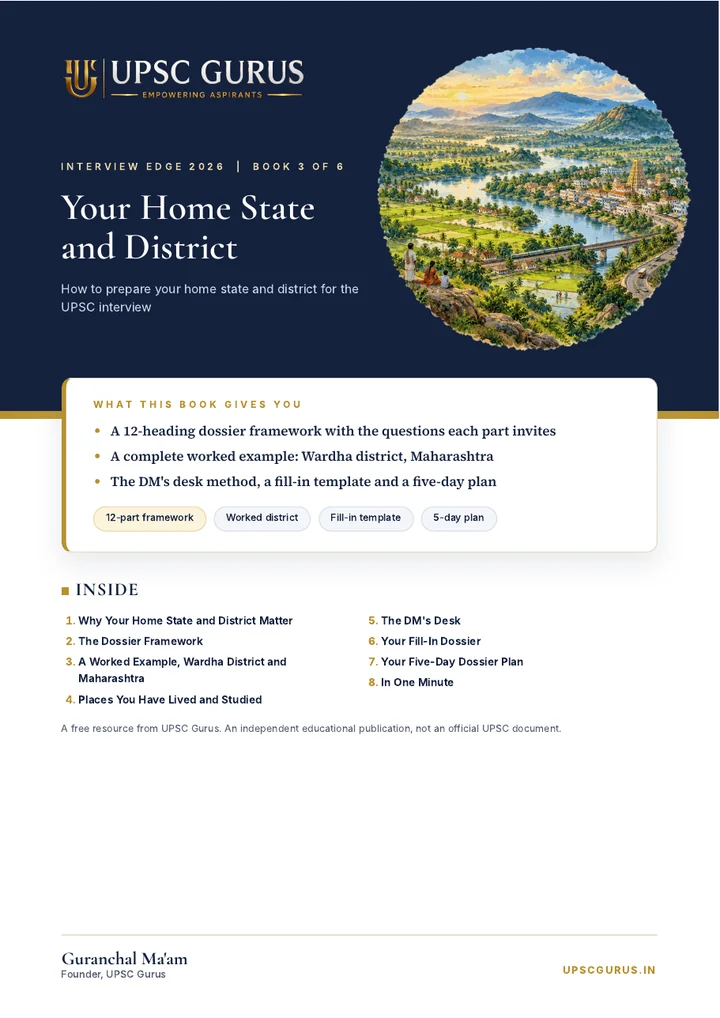
Your Home State and District
How to prepare your home state and district for the UPSC interview.
Before you begin
Dear Candidate,
You do not need to know every village, every date or every scheme to speak meaningfully about the place you come from. You need to understand it.
I have met candidates who explained international affairs beautifully yet found it harder to discuss a problem in their own district. I have also met candidates whose understanding of home came from ordinary, everyday observation. They spoke with clarity because they had thought about what they had seen.
Perhaps you grew up in a village, studied in a small town, moved between states, or lived mostly away from your home district. Each experience gives you a different perspective, and none is less valuable.
As you work through this book, connect three things: what you know, what reliable evidence tells you, and what you would do with that understanding in public service. Be accurate with facts, thoughtful with opinions and open about what you have not experienced.
You are preparing for a grounded conversation about a place that is part of your story.
Warmly,
Guranchal Ma’am
Founder, UPSC Gurus
How to use this book
1. Who it is for: Every candidate, whether you have lived in one district all your life or moved between several places.
2. If you have 30 minutes: Read the 12 headings at a glance (2.2), Rohan’s revision card (3.6) and the 45-second administrative answer (5.7), then fill the district identity sheet (6.1).
3. The full route: Read Chapters 1 to 5, fill the template in Chapter 6, and follow the five-day plan in Chapter 7.
4. Your model is Chapter 3: Rohan Deshmukh is fictional; the facts about Wardha and Maharashtra are real and sourced.
5. Every sample answer is an illustration of thinking, not a script. Book 4, Chapter 3 has ten more home-state answers, thought through.
1. Why Your Home State and District Matter
How often these questions arise, what they let you show, and how to prepare with the right depth instead of piling up facts.
1.1 How often these questions arise
| DAF area | Share of recalled interviews with at least one question on it |
|---|---|
| Home state | 47% |
| Home district or city | 37% |
Source: Independent corpus of 2,560 candidate-recalled interview transcripts, CSE 2021-2025; not official UPSC statistics.
Home state came up in almost half of these interviews, home district or city in more than a third. Both can appear in one interview, so the shares cannot be added.
The collection is not random, so it cannot predict the questions any one candidate will receive.
The practical conclusion: your home state and district deserve a defined place in your preparation, not unlimited time.
1.2 What a local question lets you show
The CSE 2026 Notice describes the Personality Test as an assessment of personal suitability for a career in public service, through “a natural, though directed and purposive conversation”. It expects candidates to take an intelligent interest in events within and outside their own state. Book 2 explains the seven qualities the Notice names.
Source: UPSC Civil Services Examination 2026 Notice, Section II(C).
| Question | What it lets you show |
|---|---|
| What is your district known for? | Awareness, clarity, picking out what matters |
| Why is agriculture difficult in parts of your district? | Understanding of causes and local conditions |
| Why has your district developed differently from a neighbouring one? | Comparison and analytical reasoning |
| What is one important problem in your district? | Ability to identify and prioritise |
| What would you do as District Magistrate? | Administrative judgement and practical thinking |
| Why do people migrate from your area? | Social and economic understanding without oversimplification |
These are reasonable interpretations, not a confidential UPSC scoring framework.
1.3 Five levels of a strong local answer
- Identify: one accurate fact
- Explain: a cause
- Connect: who or what it affects
- Evaluate: what works and what does not
- Respond: a feasible action and a way to measure it
Not every question needs all five. A factual question stops at the first level; a “what would you do” question needs the last.
Illustration: drinking-water reliability (hypothetical, not a claim about any district)
Identify: “Some settlements face interruptions in drinking-water supply.”
Explain: “Causes can include seasonal source depletion, inadequate storage, distribution losses and power cuts.”
Connect: “Unreliable supply affects sanitation, household routines and the time people spend arranging water, and the burden differs across households.”
Evaluate: “New infrastructure may improve coverage, but having a connection is different from receiving reliable, safe water.”
Respond: “I would first examine habitation-level supply data and complaints, find the causes of interruption, and prioritise repairs and vulnerable settlements. I would track actual supply reliability, not only completed works.”
The last answer does more than announce a solution. It shows a way of making a decision.
1.4 Four question types
| Type | Example | How to answer |
|---|---|---|
| Factual | “Which river is associated with your district?” | Answer directly, add one detail if it helps, and stop |
| Explanatory | “Why has industrial development been uneven across your state?” | Name the main factors (connectivity, investment, skills, markets, infrastructure, history), show how they work, note regional variation, conclude with balance |
| Comparison | “How is your district different from a neighbouring one?” | Compare geography, economy, infrastructure, society and outcomes; say why the difference matters |
| Opinion or administrative | “As District Magistrate, what would be your first priority?” | Separate what you know, what evidence you need, what you value and what lies within your authority, then choose an action (Chapter 5) |
You are not expected to know district administration in detail before joining the service. You are expected to show how you would approach responsibility.
1.5 Worked exchange: making an answer more useful
Board: “You come from Wardha. What is one development issue you would like to understand more deeply?”
Weaker answer: “Ma’am, I think my district needs better roads, more industries, good schools, better healthcare and more employment. If I become an officer, I will work hard to improve all these things.”
Why it falls short: It lists everything, chooses nothing and promises improvement without a process.
More thoughtful answer: “Ma’am, I would like to understand the connection between local employment and migration, particularly among young people. Living in different parts of Maharashtra has made me curious about how opportunities vary between places. Before calling it the district’s biggest problem, I would want to examine employment and migration data, and speak to young people, employers and local institutions about the reasons behind their choices.”
Why it works: One issue, linked to experience, with no assumption presented as fact and a clear idea of the evidence needed.
Possible follow-up: “Suppose young people are leaving because local wages are low. Would you still try to stop migration?”
Illustrative response: “Not necessarily, Ma’am. Migration can also be an opportunity. I would distinguish people who move by choice from those who move because they have no viable local option, and focus on widening opportunities and protecting workers rather than treating every move as a failure.”
The underlying skill is separating a problem from an assumption about the problem.
1.6 What to prepare first
An editorial order for limited time, not a UPSC ranking.
| Priority | Material | Target |
|---|---|---|
| 1 | District identity | Explain your district clearly in 60 seconds |
| 2 | Three major district issues | Causes, affected groups and possible responses |
| 3 | State economy and regional differences | Strengths and disparities without generalising |
| 4 | District geography, economy and agriculture | Link physical conditions with livelihoods |
| 5 | History and culture | Important contributions and distinctive features |
| 6 | Social indicators | Selected figures with dates, read correctly |
| 7 | Governance and schemes | Implementation, not just names |
| Priority | Material | Target |
|---|---|---|
| 8 | Recent developments | Significance and likely consequences |
| 9 | Administrative situations | Practical, lawful decisions |
The minimum useful knowledge test: for each topic, can you explain it to someone unfamiliar with your district, state one reliable fact, say why it matters, separate observation from conclusion, and handle one follow-up? If yes, that topic is prepared.
1.7 Six habits that strengthen preparation
| Avoid | Do instead |
|---|---|
| Memorising unrelated facts | Build connected explanations |
| Calling your district the best or worst | Name specific strengths and challenges |
| Describing every local issue as a failure | Recognise progress, constraints and remaining gaps |
| Repeating a headline as your own judgement | Separate reported facts from your interpretation |
| Offering one solution for every problem | Match the response to the cause |
| Implying you witnessed what you did not | Say whether you know it through experience, data or reporting |
I N O N E M I N U T E
1. Home state and district questions appear often; give them a defined, not unlimited, share of preparation.
2. Prepare facts, but practise interpretation and judgement.
3. Connect personal experience with reliable evidence.
4. One specific, defensible answer is worth more than a long list of general statements.
2. The Dossier Framework
A reusable 12-heading framework for any Indian state and district: what to know under each heading, the questions it can generate, and how to turn facts into understanding you can speak about.
2.1 What your finished dossier looks like
| Document | Length | Purpose |
|---|---|---|
| District identity and facts | 1 page | Essential facts and distinctive features |
| District understanding | 2 pages | Economy, society, history and major issues |
| Home-state overview | 1 page | State context, economy and regional differences |
| Current developments and administration | 1 page | Recent issues, governance and decisions |
| Source register As needed | Date and source for every figure |
The guiding rule: every important entry answers four questions. What is the fact? Why does it matter? What does it reveal about the place? What question could follow? For figures, add the source, reference period and status.
2.2 The 12 headings at a glance
| No. | Heading | Central question | District depth | State depth |
|---|---|---|---|---|
| 1 | Geography and rivers | How does the physical setting shape life here? | Detailed local setting | Major regions and rivers |
| 2 | History | How did this place become what it is? | Key district milestones | Major transformations |
| 3 | People, languages and culture | Who lives here, and what makes the society distinctive? | Specific local traditions | Broad cultural diversity |
| 4 | Economy | How does the district earn its living? | Local livelihoods | Sectoral structure and regional differences |
| No. | Heading | Central question | District depth | State depth |
|---|---|---|---|---|
| 5 | Agriculture | How do farming and environment interact? | Crops, conditions and markets | Agricultural regions and policies |
| 6 | Industry and services | Where do non-farm opportunities come from? | Locally important activities | Industrial geography |
| 7 | Social indicators | How well are people doing, and for whom? | Selected district indicators | State comparisons |
| 8 | Governance and key schemes | How do services and programmes reach people? | Implementation and local institutions | Major programmes and priorities |
| 9 | Issues and challenges | What deserves serious attention? | Three welldeveloped problems | Major statewide challenges |
| 10 | Personalities | Who shaped the place, and how? | Strong local connections | Significant state contributions |
| 11 | Recent news | What important developments are under way? | Five selected developments | Major state developments |
| 12 | The DM’s desk | How would you approach a real decision? | Practical local decisions | State and district roles |
The state dossier gives context; the district dossier gives depth. Do not build both at equal length. The framework was created for this book; UPSC does not prescribe it.
2.3 Heading 1: Geography and rivers
Know (district): location, neighbouring districts, area and headquarters, rivers and tributaries, terrain, geology and soils, rainfall pattern and seasonal risks, protected areas. Know (state): physiographic regions, neighbouring states, river basins, climate, forests and environmental vulnerabilities.
Geography becomes useful when you can explain its consequences.
| Physical feature | What it shapes |
|---|---|
| Rainfall variability | Crop choices, irrigation, water security |
| River system | Drinking water, irrigation, floods, ecology |
| Soil | Crop suitability, erosion, land management |
| Terrain | Transport costs, access to services |
| Forests | Biodiversity, conservation, forest-dependent livelihoods |
| Physical feature | What it shapes |
|---|---|
| Climate | Agriculture, public health, disaster preparedness |
Typical questions: Which are the major rivers of your district? How does its geography affect its economy? Why does your region face water stress or flooding? What environmental problem deserves attention?
Prepare one explanatory chain: physical condition -> effect on livelihoods -> governance issue -> response. For example, irregular rainfall -> uncertain crop-water availability -> risky farm planning -> water budgeting and irrigation suited to the district’s hydrology.
Your output: a concise description, the principal rivers, and two links between geography and people’s lives.
2.4 Heading 2: History
Know: the district’s historical formation, important kingdoms or administrations, the freedom movement and local contributions, social reformers and institutions, when and why the present district was formed, heritage sites, and the events that shaped its present identity. For the state, prepare major periods and transformations.
History is more than dates. Ask what changed, who was involved, what followed, and whether it still shapes the district.
Typical questions: How did your district get its name? What was your region’s contribution to the freedom movement? What is one lesser-known contribution of your area? How would you preserve a local heritage site?
Method: event -> context -> significance -> present relevance. For heritage protection, move from importance to conservation, community participation and sustainable management.
Avoid: local legends presented as established history; dynastic detail without significance; assuming all residents read local history the same way.
Your output: five milestones, three contributions and a short account of how the past connects with the present.
2.5 Heading 3: People, languages and culture
Know: population and rural-urban distribution, social composition and diversity, principal languages and dialects, festivals, crafts and performance traditions, characteristic food, social change (urbanisation, mobility, new livelihoods) and cultural institutions.
Demographic figures: always attach the year: “Population: [figure] (Census 2011).” Record any later estimate separately with its method and year, never as a fresh Census count.
Typical questions: What makes your district’s culture distinctive? Which languages are spoken there? How has migration affected your region? Is a local tradition changing, and why? How would you protect heritage without restricting people’s choices?
From description to understanding: a dish opens questions about crops, seasons and trade; a festival about community institutions. Such links matter most when your hobbies overlap with local culture.
Respectful language: say “The district has several communities with distinct cultural traditions”, not “The people of this community are naturally hardworking”. The first describes diversity; the second assigns a trait to an entire community.
Your output: a short demographic profile, three cultural features you can explain, and one example of continuity or change.
2.6 Heading 4: Economy
Know: the major economic activities, where people work, what income indicators suggest, regional differences, how roads, power and markets affect production, what encourages or holds back investment, and what drives migration.
For your state: GSDP; sector shares and growth of agriculture, industry and services; per capita income; regional disparities; employment; public investment; state finances. Note whether a figure is at current or constant prices, and whether it is an advance, provisional or revised estimate.
A useful distinction: economic growth concerns output, employment concerns work opportunities, and development outcomes concern people’s living conditions. They are connected, not interchangeable.
Typical questions: What drives your state’s economy? Why is development uneven across regions? What could make your district more economically resilient?
Mini-example. “If your state’s economy is growing, why might some districts still face employment difficulties?”
“Ma’am, growth may be concentrated in particular sectors or places. Some activities produce substantial output without proportionate employment, while workers elsewhere may lack skills, transport or market access. I would look at both the sectoral pattern of growth and the location and quality of jobs before concluding.”
Your output: three economic strengths, two structural concerns and one explanation of regional variation.
2.7 Heading 5: Agriculture
Agriculture gets its own heading because it connects geography, household livelihoods, markets, technology and policy.
Know: cropping pattern and why, seasons and crop calendars, irrigation sources and limits, landholding differences, inputs (seeds, fertiliser, machinery, labour, credit), markets (storage, transport, processing, prices), risks (weather, pests, costs, debt, price swings) and allied activities such as livestock, horticulture and fisheries.
Typical questions: Why are your district’s main crops grown there? What problems do farmers face? Does more irrigation always improve sustainability? How could farmers earn more without simply producing more?
The five-part crop explanation: for each major crop, prepare suitability (why here), production (what it needs), risk (what makes it uncertain), market (how it is sold) and policy (what could improve outcomes).
Avoid a one-solution answer. Asked how to raise farm incomes, weigh productivity and costs, crop choice, storage and processing, market access, risk management and allied livelihoods, then choose
what suits the district.
Your output: a crop profile, one crop-to-market explanation, and two farming challenges with possible responses.
2.8 Heading 6: Industry and services
Know: the local manufacturing profile, micro and small enterprises, raw materials, the work industries create, transport, power and land, the match between skills and jobs, the role of trade, education, health and tourism, and what stops enterprises from growing.
Three different questions:
| Question | What it examines |
|---|---|
| How do we attract investment? | Conditions for productive business |
| How do we create employment? | Work opportunities, skills, labour demand |
| How do we improve livelihoods? | Earnings, stability, working conditions |
An industrial project may serve all three, but not automatically or equally.
Typical questions: Why have some industries developed in particular places? What prevents small enterprises from expanding? Can a district develop without becoming an industrial centre?
Method: take one locally important industry and trace inputs -> production -> workforce -> market -> constraints -> opportunities, separating the interests of producers, workers, consumers and nearby communities.
Your output: two significant industries or service activities, their importance and a realistic account of their challenges.
2.9 Heading 7: Social indicators
Indicators move you from broad statements to measurable outcomes.
Know: education (literacy, enrolment, attendance, learning), health and nutrition, gender, demography, water and sanitation, housing, work participation, and access to services across groups and places.
Three rules:
1. A figure needs a date. “Literacy was X% in Census 2011”, not “Literacy is X%”.
2. Indicators have definitions. Literacy, enrolment and learning measure different things, as do access to a facility and reliable service.
3. An average conceals differences between rural and urban areas, blocks, women and men, and social groups.
Discuss an indicator in this order:
- Value and year: the figure with its source period
- Comparison: state or national figure from the same survey
- Interpretation: what it measures
- Limitation: what it cannot tell you
- Policy relevance: how the district could investigate and respond
Typical questions: Why might literacy improve without equivalent learning? Which groups face greater barriers to healthcare? How would you find the areas that need most attention? Why do two indicators sometimes tell different stories?
Your output: five to seven indicators, each with source, year and a one-line interpretation.
2.10 Heading 8: Governance and key schemes
A useful governance note explains how a programme reaches people, not merely what it is called. Know the principal district offices, rural and urban local bodies, the main public services, and how complaints are raised and monitored.
The six-question scheme card:
| Question | Your note |
|---|---|
| 1. What problem does it address? | One sentence |
| 2. Who is eligible? | Intended beneficiaries |
| 3. What does it provide? | Main benefit or service |
| 4. Who implements it? | Responsible institutions |
| 5. What can go wrong? | A plausible implementation challenge |
| 6. How would success be judged? | A measurable outcome |
Typical questions: Why might eligible people miss a benefit? How would you improve last-mile delivery?
Worked illustration. “Suppose an eligible student has not received a scholarship. What would you examine?”
“I would first find where the application is held up: eligibility verification, documents, institutional submission, processing or payment. The student should get a clear explanation and a practical grievance route, with the rules applied fairly.” This traces the delivery chain instead of assuming wrongdoing or promising payment outside procedure.
Avoid: judging a scheme a success because money was sanctioned, or a failure because of one complaint; confusing expenditure with outcomes; suggesting a District Magistrate can exercise every department’s powers.
Your output: five relevant programmes, each on a scheme card.
2.11 Heading 9: Issues and challenges
Prepare three issues you can discuss seriously rather than twenty with one sentence each. For each, cover definition, evidence, causes, who is most affected, the existing response, why the problem persists, a reasonable action and how progress would be measured (the issue sheet in 6.4).
Distinguish four kinds of statement:
| Statement | Example | Status |
|---|---|---|
| Verified fact | “The published report records X for the stated year.” | Source-based |
| Personal observation | “I noticed this problem in my neighbourhood.” | Experience-based |
| Interpretation | “I think poor maintenance may be contributing.” | Reasoned assessment |
| Proposal | “I would prioritise a maintenance audit.” | Recommended action |
Never present the last three as verified district-wide facts.
Typical questions: What is your district’s most pressing challenge? What would you prioritise with limited resources? Would your solution create new problems? How would you know it worked?
Your output: three complete issue sheets.
2.12 Heading 10: Personalities
Prepare people for their contribution, not their fame. Choose for genuine local relevance across history and the freedom movement, social reform and public life, arts and culture, science and education, and sport or enterprise.
For each, know: who they are, their link with the place, their specific contribution, the context that shaped it, why it matters, and what you find worth learning from it.
Typical questions: Name a significant personality from your district. How is their contribution relevant today? Which personality from your state do you admire, and why? What is one limitation of a historical figure’s approach?
Respect does not require calling every decision beyond criticism; recognise the contribution and discuss limitations respectfully.
Your output: five personalities you can discuss beyond their names.
2.13 Heading 11: Recent news
Choose developments that reveal something about policy, society, the economy, the environment or governance, not every newspaper mention of your district.
The current-affairs card: headline, date, location, verified facts, significance, and the policy question it raises.
Separate three things: an announcement is not implementation, and a completed project is not automatically a successful outcome.
Typical questions: What is an important recent development, and why? Who might benefit, and what concerns could arise? How would you judge whether it succeeded?
Your output: five developments with dates, facts and a question each.
2.14 Heading 12: The DM’s desk
This heading turns knowledge into decision-making. You need not know the working of every district office; you need to show a responsible approach. Practise five situations: drinking-water disruption, a flood warning, falling school attendance, complaints about welfare delivery, and a dispute over a public project.
Be decisive about the need to act, careful about choosing an action before you know the facts, and never promise powers you may not legally hold. Chapter 5 gives the full method.
Your output: five practised situations, each with first actions, responsible institutions, constraints and measures of success.
2.15 Sources: build without getting lost
| Source | Best used for | Label it as |
|---|---|---|
| Census of India, Population Finder and District Census Handbooks | Population, settlement and Census social characteristics | Census 2011 |
| NFHS-5, Ministry of Health and Family Welfare | Health, nutrition and household indicators | NFHS-5, 2019-21 |
| State economic survey | State economy and development | Survey year and estimate status |
| Central Ground Water Board district reports | Rivers, geology, soils, rainfall, groundwater | Report and year |
| District statistical publications | District economic and social statistics | Title and reference year |
| Departmental records | Programme coverage and implementation | Department and reporting date |
Next come district websites, government orders, state policies and project documents. Credible reporting and your own observation then help you find developments and questions, but neither should silently replace published evidence.
The source register:
| Claim | Value | Reference period | Source | Status |
|---|---|---|---|---|
| Population | [Figure] | Census 2011 | Census of India | Census count |
| Nutrition indicator | [Figure] | NFHS-5 period | NFHS-5 | Survey estimate |
| Claim | Value | Reference period | Source | Status |
|---|---|---|---|---|
| State growth | [Figure] | 2025-26 | State Economic Survey | Advance estimate |
| Scheme progress | [Figure] | Reporting date | Department report | Administrative record |
| Recent project | [Description] | Date | Official communication | Announced or completed |
A data-quality habit: when two official figures differ, check the year, definition, coverage, and whether one is an estimate or a later revision. Record the difference; never average incompatible figures.
2.16 From fact to understanding
| Layer | Content | Example prompt |
|---|---|---|
| A. Fact | Accurate information | What are the major crops? |
| B. Explanation | Why it matters | Why are these crops grown? |
| C. Contrast | A difficulty, change or comparison | How do farming conditions differ within the district? |
| D. Policy angle | A response or judgement | What would make livelihoods more resilient? |
If a fact cannot be explained, connected or used to answer a question, it deserves little space. Basic identifiers, such as the principal river, are the exception.
The three-question drill: take one district fact and ask what is happening in your district, whether it differs elsewhere in your state and why, and what government could reasonably do. A local farm constraint, for instance, links to regional farming differences and then to the national question of agricultural resilience.
I N O N E M I N U T E
1. Prepare your district and state through 12 connected headings, the district in depth and the state as context.
2. For each important fact, understand its cause, significance and implications.
3. Tie every figure to its source, reference period and status.
4. Prepare three district issues particularly well.
5. The dossier is complete when you can discuss the place naturally, not when it has the most pages.
Practise this on your own DAF
Interview Edge Studio reads every entry of your DAF and builds the questions a board can ask, with follow-ups and feedback on your answers. Free with a one-time sign-up, in English or Hindi.
Open Interview Edge StudioExplore Interview Edge3. A Worked Example, Wardha District and Maharashtra
A completed, compact dossier for Rohan Deshmukh, our fictional candidate from Wardha, with a source and reference year for every figure. It is a model of selection and interpretation, not a list to memorise.
3.1 Meet the candidate
Rohan Deshmukh (fictional; full profile in Book 1, Chapter 4): from Wardha, Maharashtra; B.Tech in Civil Engineering, VNIT Nagpur; two years as a site engineer in Pune; optional Geography; birdwatcher around the Bor Tiger Reserve; cooks regional Vidarbha food; led a college rainwater-harvesting project.
His natural connections:
Wardha -> agriculture -> water resources -> civil engineering -> public administration.
Wardha -> Sevagram -> Gandhian thought -> rural development -> public-service values.
Wardha -> Bor Tiger Reserve -> birdwatching -> biodiversity -> conservation and livelihoods.
One discussion on agriculture can draw in his district, optional, food, water and administration. Rohan’s strength is not that he knows more facts; it is that his knowledge connects.
3.2 The district identity card
| Indicator | Wardha | Source |
|---|---|---|
| Region | Vidarbha, Maharashtra (Nagpur division) | District Administration |
| Headquarters | Wardha | District Administration |
| Area | 6,309 sq km | Census 2011 |
| Population | 13,00,774 | Census 2011 |
| Males / females | 6,68,385 / 6,32,389 | Census 2011 |
| Rural population | 8,77,474 (67.46%) | Census 2011 |
| Urban population | 4,23,300 (32.54%) | Census 2011 |
| Density | 206 persons per sq km | Census 2011 |
| Sex ratio | 946 females per 1,000 males | Census 2011 |
| Literacy (age 7 and above) | 86.99% | Census 2011 |
| Female literacy | 81.81% | Census 2011 |
| Indicator | Wardha | Source |
|---|---|---|
| Tahsils | 8: Wardha, Deoli, Seloo, Arvi, Ashti, Karanja, Hinganghat, Samudrapur | Central Ground Water Board; District Administration |
| Main languages | Marathi and Hindi | District Administration |
| Principal river | Wardha River (Godavari basin) | Central Ground Water Board |
| Historical association | Sevagram Ashram and Gandhian constructive work | District Administration |
Sources: Census of India, District Census Handbook, Wardha, 2011; Wardha District Administration; Central Ground Water Board, Wardha District.
Data note: some official pages round the area to 6,310 sq km; this dossier uses the Census 2011 handbook figure of 6,309 sq km with the other Census figures.
Wardha in three sentences:
1. Wardha is a Vidarbha district historically associated with Mahatma Gandhi’s Sevagram Ashram and Vinoba Bhave’s Paramdham Ashram at Paunar.
2. Its economy rests on agriculture, especially cotton, soybean and pigeon pea, with cotton ginning and pressing and GI-tagged Waigaon turmeric among its identified products.
3. It is a rich case for understanding rain-fed farming, water management, village industries and the balance between conservation and development.
3.3 Wardha’s 12-heading dossier
HEADING 1: GEOGRAPHY AND RIVERS
| What to know | Verified facts | Why it matters |
|---|---|---|
| Location | Vidarbha region of eastern Maharashtra | Regional development context |
| Neighbours | Amravati, Nagpur, Chandrapur and Yavatmal districts | Regional comparisons |
| Main river | The Wardha River drains the entire district, which lies in the Godavari basin | Water supply and irrigation |
| Tributaries | Yashoda, Wunna and Bakli; the Dham flows through Seloo taluka | Reservoirs, irrigation, ecology |
| Geology and soils | Mostly Deccan Trap basalt; black and dark brown soils cover almost the whole district | Suits cotton and soybean; shapes groundwater |
| Rainfall | Normal annual rainfall of about 985 to 1,100 mm, rising from northwest to southeast | Rain-fed farming and drought risk |
| Forest and wildlife | Bor Tiger Reserve | Biodiversity, tourism, conservation |
Source: Central Ground Water Board, Wardha District; Wardha District Administration.
“How does geography influence Wardha’s development?” Black soils on basalt suit cotton and soybean, but basalt aquifers hold limited groundwater, so a mostly rain-fed district is exposed to rainfall swings. Rohan links this to water planning without blaming every water problem on geography alone.
HEADING 2: HISTORY
| Event or association | Verified fact | Source |
|---|---|---|
| District formation | Separated from Nagpur district in 1862, with headquarters at Kawatha near Pulgaon | District Administration |
| Headquarters | Moved in 1866 to Palakwadi village, rebuilt as Wardha town | District Administration |
| Gandhi and Sevagram | Gandhi walked to Segaon (later Sevagram) on 30 April 1936 and lived there until 1946 | Sevagram Ashram Pratishthan |
| Vinoba Bhave | Set up the Paramdham Ashram at Paunar in 1938 | Jamnalal Bajaj Foundation; mkgandhi.org |
| Basic education | The Wardha scheme of basic education (Nai Talim), centred on learning through productive work, emerged from the Wardha Educational Conference of 1937 | Historical record |
Sources: Wardha District Administration, History; Sevagram Ashram, Founding; Jamnalal Bajaj Foundation, Paunar Ashram; Vinoba Bhave: A Life Sketch.
What Rohan understands: Gandhi’s constructive programme aimed at social and economic transformation, not only independence. Nai Talim linked education with productive work. Vinoba’s Bhoodan movement, which began at Pochampalli on 18 April 1951, raised questions about land, inequality and voluntary redistribution.
Likely follow-up: “Can Gandhian village industries remain relevant in a technology-driven economy?” A thoughtful answer weighs employment, appropriate technology, decentralised production, markets and productivity, without treating traditional and modern production as opposites.
HEADING 3: PEOPLE, LANGUAGES AND CULTURE
| Element | Wardha dossier |
|---|---|
| Languages | Marathi and Hindi |
| Regional identity | Part of Vidarbha, within Maharashtra’s wider diversity |
| Cultural heritage | Gandhian institutions, khadi and village industries |
| Important sites | Sevagram Ashram, Paramdham Ashram at Paunar, Gitai Mandir, Magan Sangrahalaya |
| Personal link | Cooking Vidarbha food ties Rohan to local crops and food traditions |
“What does Vidarbha’s food tell us about its society?” Rohan picks three dishes he actually cooks, knows their ingredients, explains genuine links with crops such as pigeon pea or with climate and household practice, and avoids claiming one dish represents every community. His hobby should sound like something he enjoys, not a cultural lecture.
HEADING 4: ECONOMY
| Component | Wardha’s position | Interview significance |
|---|---|---|
| Agriculture | Cotton, soybean and pigeon pea are prominent | Crop economics, price risk, farm livelihoods |
| Cotton processing | Ginning, pressing and spinning | Local value addition and jobs |
| Turmeric | Waigaon turmeric from Samudrapur taluka received a Geographical Indication tag in 2016 | Branding, quality, producer incomes |
| Rural enterprises | Khadi and village-industry heritage | Small-enterprise development |
| Services | Education, healthcare and trade | Diversified livelihoods |
Sources: Wardha District Administration, Economy; Spices Board of India, list of GI-tagged spices.
“What would you do to strengthen Wardha’s economy?” Agriculture -> processing -> skills -> local enterprise -> markets -> better livelihoods. A large factory is not the only route.
HEADING 5: AGRICULTURE
| Area | District fact or focus |
|---|---|
| Major crops | Cotton, soybean and pigeon pea |
| Cultivable area | 4,34,442 hectares, of which 3,93,958 hectares were sown in kharif 2025 |
| Kharif 2025 outcome | Final average crop index (paisewari) of 47 paise; none of the 1,339 assessed villages exceeded 50 paise |
| Causes reported | Erratic early rains, excess rain and flooding, and yellow mosaic and charcoal rot in soybean |
| Value addition | Cotton ginning and pressing; turmeric and pulse processing |
Source: District final kharif paisewari, approved by the Collector, reported by Navbharat Live, 3 January 2026.
Why it matters: a paisewari below 50 paise signals a seriously reduced harvest and is used in Maharashtra to identify villages for relief. Kharif 2025 suffered from excess rain, while 2026 brought a deficit (Heading 11): rainfall variability in both directions is the real story.
“How would you make cotton cultivation more economically resilient?” Reduce avoidable production risk, improve access to technology and agronomic advice, strengthen processing and market links, diversify where suitable, and support risk management without promising guaranteed income.
HEADING 6: INDUSTRY AND SERVICES
One District One Product: Maharashtra’s ODOP Policy 2022 names three products for Wardha: Waigaon turmeric, cotton ginning and pressing, and pulses (pigeon pea). All three grow out of the farm base.
Source: Government of Maharashtra, ODOP Policy 2022.
| Strength | Opportunity | Constraint to examine |
|---|---|---|
| Cotton production | Local ginning, pressing and further processing | Raw-material quality, costs, technology |
| GI-tagged Waigaon turmeric | Branding, certification, wider markets | Grading, processing capacity, producer organisation |
| Pigeon pea | Dal milling and value addition | Price swings and storage |
| Village-industry heritage | Niche products and small enterprises | Productivity and market access |
“Why process cotton locally rather than sell it raw?” More local enterprise, skills and jobs, provided the units are viable, use suitable technology, offer decent conditions and reach markets.
HEADING 7: SOCIAL INDICATORS
| Census 2011 | Wardha | Maharashtra |
|---|---|---|
| Literacy (age 7 and above) | 86.99% | 82.34% |
| Female literacy | 81.81% | 75.87% |
| Sex ratio (females per 1,000 males) | 946 | 929 |
Sources: Wardha District Census Handbook, 2011; Maharashtra State Data Bank.
| Maharashtra, children under five | NFHS-5 (2019-21) |
|---|---|
| Stunted (low height for age) | 35.2% |
| Wasted (low weight for height) | 25.6% |
| Underweight (low weight for age) | 36.1% |
Source: Ministry of Women and Child Development, state-wise NFHS-5 data, PIB, March 2022.
What the figures teach: Wardha’s 2011 literacy was above the state rate, but that does not prove all its education outcomes are better. Nutrition is a separate dimension from a different survey and period; even in a state with a large economy, more than one in three young children was stunted. At district level, an administrator would look at block-wise and Anganwadi growth-monitoring data before concluding.
HEADING 8: GOVERNANCE AND KEY SCHEMES
Wardha has a District Collectorate, 8 tahsils, a Zilla Parishad, Panchayat Samitis, Gram Panchayats and municipal councils. Agriculture, water resources, rural water supply, health, education and rural development departments come in depending on the issue.
Worked scheme: Jal Jeevan Mission in Wardha
| Status (Rural Water Supply Department data, May 2026) | Schemes |
|---|---|
| Drinking-water schemes sanctioned | 839 |
| Fully complete, with household tap connections | 528 |
| 75-99% complete | 159 |
| Work halted for want of funds | 152 |
The district had received ₹240 crore, about ₹62 crore of contractor bills were pending, and the mission’s national timeline has been extended to 2028.
Source: Navbharat Live, 31 May 2026.
“How would you judge whether Jal Jeevan Mission has succeeded in Wardha?” A completed scheme is an output. The outcome is safe, adequate water reaching every household through the year, so look at functional taps, water quality, hours and seasonal reliability of supply, source sustainability in summer, and how fast complaints are resolved.
HEADING 9: ISSUES AND CHALLENGES
Rohan chooses three issues he can support with evidence.
Water security and
| Child nutrition | Agricultural value addition |
|---|---|
| drought | |
| Why selected Weak 2026 monsoon, NFHS-5: over a third of slow water-scarcity Maharashtra’s under- | Cotton, Waigaon turmeric and pigeon pea named in |
| works, September 2026 fives stunted and state drought declaration underweight | the state ODOP policy |
| covering Wardha | |
| What to assess Rainfall, reservoirs, Diet quality, illness, groundwater in basalt sanitation, health access, | Technology, finance, skills, energy costs, |
| aquifers, supply reliability household circumstances | market access |
| Response Safe drinking water first; Identify vulnerable blocks repair weak systems and and villages; coordinate | Support viable enterprises, producer |
| complete stalled Jal health, Anganwadi and Jeevan Mission schemes; nutrition services; close | organisations, quality and market links |
| then groundwater delivery gaps management, demand | |
| planning and suitable farming practices | |
| Success measure Reliable drinking-water Better nutrition and delivery; more health indicators, with | Sustainable businesses, better jobs, better |
| sustainable resource use service-quality monitoring | producer prices |
| Likely challenge “Would you restrict “Can more food agricultural water use?” distribution solve it?” | “Should government subsidise every processing unit?” |
| Good thinking Weigh severity, legal Food matters, but so do authority, drinking-water diet quality, health, care, | Target identifiable barriers, follow the rules, |
| needs, crop condition, sanitation and effective fairness and livelihoods services | judge cost-effectiveness; the business must be viable on its own |
Rohan does not say “Wardha’s three biggest problems are X, Y and Z.” He says, “These are three issues I would prioritise for discussion because I can connect them with evidence and possible responses.” That is far easier to defend.
HEADING 10: PERSONALITIES
| Personality | Connection with Wardha | What Rohan understands |
|---|---|---|
| Mahatma Gandhi | Lived at Sevagram from 1936 | Constructive work, rural development, self-reliance, Nai Talim |
| Acharya Vinoba Bhave | Paramdham Ashram, Paunar, from 1938 | Bhoodan, Gramdan and voluntary social change |
| Jamnalal Bajaj | Walked with Gandhi to Segaon in 1936; closely tied to Wardha’s constructive institutions | Philanthropy, social responsibility, institution-building |
Sources: Sevagram Ashram, Founding; Jamnalal Bajaj Foundation.
“What can today’s administrators learn from Gandhian constructive work?” Community participation, dignity of labour, decentralised solutions and ethical leadership, alongside modern technology, scale and institutional accountability.
HEADING 11: RECENT DEVELOPMENTS
| Date | Development | Why it matters |
|---|---|---|
| 3 January 2026 | Final kharif 2025 paisewari of 47 paise; no assessed village above 50 paise | Crop-loss assessment and relief eligibility |
| 31 May 2026 | Jal Jeevan Mission: 528 of 839 schemes complete, 152 halted for funds | Implementation gaps and financing |
| 2 July 2026 | Only 132.2 mm of rain by early July; the water-scarcity plan listed 906 measures in 777 villages (about ₹36.43 crore), with slow progress on well deepening | Preparedness and execution |
| 25 September 2026 | Maharashtra government resolution declaring drought in 265 talukas, with Wardha among the Vidarbha districts covered | Relief and coordination |
Sources: Navbharat Live, 3 January 2026; Navbharat Live, 31 May 2026; Navbharat Live, 2 July 2026; Down To Earth, 26 September 2026. Dossier date: 29 October 2026.
What Rohan understands: the September resolution announced land-revenue concessions, restructured crop loans, suspended farm-loan recovery, concessions on agricultural pump bills, examfee waivers, expanded employment-guarantee works, tanker supply where needed, fodder arrangements and water-conservation works; direct crop-loss assistance was to be declared separately. He distinguishes a declaration, an assessment, a relief decision and the actual delivery of help.
HEADING 12: THE DM’S DESK
Situation: after a deficient monsoon, Wardha faces serious water stress. Rohan’s order of priorities: drinking water, livestock, standing crops, protection of the resource against illegal extraction, clear public communication, and monitoring. Section 5.5 works this scenario through in full.
3.4 Maharashtra: Rohan’s state-level dossier
| Indicator | Maharashtra | Source |
|---|---|---|
| Capital | Mumbai | Government of Maharashtra |
| Population | 11,23,74,333 | Census 2011 |
| Literacy | 82.34% | Census 2011 |
| Female literacy | 75.87% | Census 2011 |
| Sex ratio | 929 | Census 2011 |
| Principal regions | Konkan, Western Maharashtra, Marathwada, Vidarbha and North Maharashtra (Khandesh) | Regional geography |
| Economy (2025-26 advance estimates) | Value | |
| Nominal GSDP | ₹51,00,597 crore | |
| Real GSDP (constant prices) | ₹28,82,699 crore | |
| Real growth | 7.9% (7.3% in 2024-25) | |
| Agriculture and allied growth | 3.4% | |
| Industry growth | 5.7% | |
| Services growth | about 9% | |
| Per capita income | ₹3,47,903 (national: ₹2,19,575) | |
| Share of India’s nominal GDP, 2024-25 | about 14%, the highest of any state |
Source: Economic Survey of Maharashtra 2025-26 (March 2026), as reported by All India Radio News and Free Press Journal.
Interpretation: services grew fastest and account for nearly 60% of gross state value added, while agriculture grew slowest. Growth rates are not sector shares, and neither tells you where people actually work.
“Maharashtra has the largest state economy. Why is development still uneven across its districts?” The size of a state economy says little about each district. Industry, infrastructure, skills and markets are unevenly spread, and farm-dependent areas face different risks from large cities. Policy should widen access to capabilities and opportunities while respecting local conditions; a district is not backward simply because it is largely rural.
3.5 Two sample exchanges
Illustrations of thinking, not scripts. Book 4, Chapter 3 works through more Wardha and Maharashtra questions in full.
Board: “Wardha’s literacy was above the Maharashtra average in Census 2011. Does that mean education is not a problem there?”
Illustrative answer: “Not necessarily, Ma’am. The Census figure tells us something important, but not whether students are learning at the expected level, whether schools are equally accessible, or whether higher education leads to suitable work. I would treat literacy as one positive indicator and examine learning, attendance and opportunities separately.”
Why it works: it respects the evidence without stretching it. Follow-up: “Which single education indicator would you examine first, and why?”
Board: “What would you do to improve employment opportunities in Wardha?”
Illustrative answer: “Ma’am, I would begin by understanding the kinds of work people are seeking and the skills available locally. Cotton and turmeric processing are worth examining because the district already grows these crops. But I would not limit it to one industry; I would also look at services, small enterprises and the barriers that stop businesses from growing.”
Why it works: a genuine local strength, approached through evidence. Follow-up: “What if new industries need skills local workers do not have?”
3.6 Rohan’s one-page revision card
WARDHA: THE ESSENTIALS
| Area | Recall point |
|---|---|
| Identity | Vidarbha, Maharashtra; 8 tahsils; area 6,309 sq km |
| Census 2011 | Population 13,00,774; literacy 86.99%; female literacy 81.81%; sex ratio 946 |
| Geography | Wardha River, Godavari basin; Deccan basalt and black soils; Bor Tiger Reserve |
| History | Separated from Nagpur 1862; Gandhi at Sevagram 1936; Vinoba at Paunar 1938 |
| Agriculture | Cotton, soybean, pigeon pea; kharif 2025 paisewari 47 paise |
| Industry | ODOP: Waigaon turmeric (GI, 2016), cotton ginning and pressing, pigeon pea |
| Governance | Jal Jeevan Mission: 528 of 839 schemes complete (May 2026) |
| Current issue | 2026 drought declaration and water allocation |
| Administrative scenario | Drinking water first, livestock and farming needs, transparent decisions |
MAHARASHTRA: THE ESSENTIALS
| Area | Recall point |
|---|---|
| Census 2011 | Population 11,23,74,333; literacy 82.34%; sex ratio 929 |
| Economy, 2025-26 AE | Nominal GSDP ₹51,00,597 crore; real growth 7.9%; per capita income ₹3,47,903 |
| Sectors | Services fastest (about 9%); agriculture slowest (3.4%) |
| National share | About 14% of India’s nominal GDP (2024-25) |
| Nutrition | NFHS-5: 35.2% of under-fives stunted |
| Analytical issue | Uneven regional development |
| Personal connection | Wardha, Nagpur and Pune |
Five connections Rohan practises: Geography (basalt, black soils, rainfall swings, water risk); Civil Engineering (water schemes, maintenance, stalled works); History (Gandhian constructive work and participation); Birdwatching (Bor Tiger Reserve and responsible conservation); Maharashtra (how opportunities differ between rain-fed districts and large cities).
3.7 What makes this a finished dossier
| What he knows | What he can explain | What he does not pretend to know |
|---|---|---|
| Wardha’s Census 2011 literacy | Why literacy alone does not establish educational quality | The learning level of every school |
| The ODOP products | How processing could add value | The profitability of every unit |
| NFHS-5 nutrition figures | Why nutrition needs a multisectoral response | The exact cause of every outcome |
| The 2026 drought declaration | How to approach water allocation | The requirement of every settlement |
| Gandhian institutions | Their relevance to public service | That historical approaches transfer unchanged |
The final test: can Rohan speak about Wardha for a minute, answer a factual follow-up, consider another view and explain a reasonable administrative decision? That is the standard.
I N O N E M I N U T E
1. Wardha’s identity links Gandhian history, rain-fed agriculture, agro-processing and natural resources.
2. Census 2011 gives demographic context; NFHS-5, administrative data and dated reporting answer other questions.
3. Maharashtra’s 2025-26 advance estimates give the state picture; keep them distinct from Census figures.
4. A finished dossier does not make you an expert on every local issue. It makes you informed, thoughtful and at ease discussing your place.
4. Places You Have Lived and Studied
A light method for places beyond your home district, where you grew up, studied or worked, that connects personal experience with local knowledge without a full dossier for each.
4.1 Make your place inventory
Your home district is not necessarily the place you know best. Prepare each place according to your connection with it.
| Place | Your connection | Preparation depth |
|---|---|---|
| Home district | Recorded in your application | Full 12-heading dossier |
| Home state | Recorded in your application | State overview |
| Childhood district | Grew up or went to school there | Local identity, changes observed, major issues |
| College city | Studied there | Education, economy, culture, urban issues |
| Employment district | Worked there | Local context and what your work taught you |
| Other significant residence | Lived there for a meaningful period | Distinctive features and personal connection |
For a place where you lived briefly, three real observations are worth more than pages of unfamiliar facts.
4.2 The five-question place card
| Question | Your preparation |
|---|---|
| 1. Why was I there? | Childhood, education, work or family |
| 2. What makes the place distinctive? | Two or three reliable facts |
| 3. What did I personally experience? | One specific observation |
| 4. What issue can I discuss? | One local development or challenge |
| 5. What did it teach me? | A genuine insight, without exaggeration |
The experience boundary: separate “I experienced”, “I observed”, “I learnt” (from study or reliable sources) and “I believe” (your interpretation). Working on a few construction sites does not tell you how every project in a city runs.
4.3 Worked example: Rohan’s three places (fictional)
| Place | Connection | Focus | Likely question |
|---|---|---|---|
| Wardha | Home district | Full dossier (Chapter 3) | What do you value about your home district? |
| Nagpur | Engineering education | Education, urban infrastructure, regional economy | Did Nagpur change your view of Vidarbha? |
| Pune | Two years of work | Construction, project delivery, urban growth | What did work teach you that college did not? |
“You have lived in larger cities. What do you value about your home district?”
“Ma’am, I value Wardha’s connection with Gandhian constructive work and its strong agricultural identity. Living in other cities has made me more interested in how employment and educational opportunities differ between places. I would not say one kind of place is better; they offer different opportunities and face different challenges.”
“Did studying in Nagpur change your understanding of Vidarbha?”
“Yes, Ma’am. I met people from different backgrounds and came to see the region beyond my own district. It made me more interested in how education, infrastructure and employment connect, though I would be careful about generalising from my college experience.”
“What did working in Pune teach you that college did not?”
“Ma’am, college gave me the technical foundation, but a live project taught me coordination and accountability. A technical solution is useful only when it can be delivered safely, with attention to resources, people and timelines. I also learnt to tell a problem I could solve myself from one that needed a decision from someone with greater responsibility.”
4.4 A contrasting profile: Meera Iyer (fictional)
From Thrissur, Kerala; BA Economics; worked in a rural livelihoods NGO; optional Sociology; Carnatic music and running. Her places link naturally to cultural identity and local institutions (Thrissur), employment and household income (Economics), implementation challenges (NGO work) and community institutions (Sociology).
“What did working with a rural livelihoods organisation teach you about development?”
“Ma’am, I learnt that a programme can look well designed on paper and still be hard for people to access. I became more alert to practical barriers such as information, documents, time and local circumstances. I also learnt that beneficiaries are not a uniform group; people with similar problems may need different kinds of support.”
Specific, reflective, and free of claims about an entire population.
4.5 If you have little connection with your recorded home district
Many candidates have lived mostly elsewhere. That needs no apology.
| Situation | What to do |
|---|---|
| You moved away as a child | Be open: “Ma’am, I moved away quite young, so I would not claim the same firsthand familiarity as someone who lived there throughout. My family connection remains, and I have prepared its main geographical, historical and development features.” |
| You studied entirely outside your state | Prepare the home-state overview and one fair comparison with the state where you studied, without ranking either |
| You lived in several places | Choose the two or three that shaped you most; asked which influenced you most, answer with a real experience, not a contest between places |
| You have never visited a famous local site | Never invent a visit: “Ma’am, I have not visited it personally. I know its significance, but I would not describe it as though I had seen it.” |
4.6 The comparison drill
Prepare three comparisons: home district and college city, college city and workplace, and home state and another state. For each, ask what difference you noticed, what might explain it, where your observation is limited, and what it taught you. Never rank places or people, and never generalise a city from limited experience.
I N O N E M I N U T E
1. Prepare every significant place in your story, but not to equal depth.
2. Use the five-question place card beyond your home district.
3. Personal experience is valuable because it is specific; be open about its limits.
4. Compare places thoughtfully, without ranking their people or cultures.
5. The DM’s Desk
A practical way to answer “If you were the District Magistrate…” questions: prioritise, act within lawful authority, coordinate, protect people and explain decisions, without an unrealistic list of solutions.
5.1 Understand the responsibility
The District Magistrate or Collector has important administrative and coordinating functions but does not personally exercise every power of the police, courts, municipal bodies or specialised departments. Coordination must also respect the lawful functions of elected rural and urban local governments, which the Constitution recognises.
For disasters the framework is statutory: under the Disaster Management Act, 2005 (as amended in 2025), the Collector, District Magistrate or Deputy Commissioner chairs the District Disaster Management Authority, which plans, coordinates and implements disaster management in the district.
Sources: Disaster Management Act, 2005, Sections 25 and 30; Ministry of Panchayati Raj.
5.2 The eight-step decision method
A thinking sequence, not a speech to recite.
| Step | Question | What it shows |
|---|---|---|
| 1. Define | What exactly is the problem? | Clarity |
| 2. Protect | Is anyone in immediate danger? | Appropriate urgency |
| 3. Establish | What information is reliable? | Evidence-based judgement |
| 4. Identify authority | Who has legal responsibility? | Institutional awareness |
| 5. Prioritise | What must happen first? | Ability to choose |
| 6. Coordinate | Who must work together? | Administrative understanding |
| 7. Communicate | What should the public know? | Transparency and empathy |
| 8. Review | How will we know it worked? | Accountability |
Not every situation needs all eight in order. In an emergency, protection and fact-finding run together, and rescue never waits for a full report; a planning question needs more diagnosis and consultation.
5.3 Choose the first action intelligently
| Problem type | First priority |
|---|---|
| Immediate threat to life | Emergency protection and response |
| Credible allegation of abuse | Protect affected persons and start the proper legal process |
| Essential service disruption | Restore safe access and find the cause |
| Persistent programme failure | Examine evidence and the delivery chain |
| Long-term development problem | Diagnose, prioritise and plan with the right institutions |
| Disputed public decision | Examine legality, evidence, affected interests and alternatives |
The priority test: how urgent is it, who faces the greatest harm, what is known and unknown, which action is lawful and feasible, what resources exist, is it reversible, and what harm might it cause unintentionally?
5.4 Five situations for practice
SITUATION 1: UNSAFE DRINKING WATER
Board: “Residents say their drinking water has become unsafe. What will you do?”
Sequence: safe alternative water now -> sampling and testing -> responsible water and health authorities identified -> fault corrected -> residents informed -> quality and supply monitored.
Illustrative answer: “Ma’am, my first concern would be that residents have safe drinking water while the problem is investigated. I would coordinate with the water-supply and health authorities for testing and immediate alternatives, and once the cause is known, ensure the right agency corrects it. I would keep residents informed and check that safe, reliable supply has actually returned.”
Follow-up: “What if laboratory results take time?” Precautions should not wait for full confirmation when the risk is credible.
SITUATION 2: FALLING SCHOOL ATTENDANCE
Board: “Several government schools show declining attendance. What would you do?”
Sequence: school-wise and area-wise records -> conversations with schools, families and local bodies -> separate transport, health, safety, economic and school-level barriers -> responses matched to causes -> child-protection concerns through proper procedure -> track sustained attendance, not shortterm enrolment.
Illustrative answer: “Ma’am, I would not assume one reason explains falling attendance everywhere. I would ask the education authorities to find patterns in the records, and I would want families and students to be heard. The response might differ from school to school, and we should monitor whether children return regularly.”
Follow-up: “What if parents do not cooperate?” Understand their reasons, explain the value of education, use existing support and handle protection concerns lawfully, without treating all parents as
negligent.
SITUATION 3: FLOODING
Board: “Heavy rainfall has caused flooding in parts of your district. What are your priorities?”
Sequence: warnings, rescue, evacuation and emergency medical help -> shelter, drinking water, sanitation and supplies -> damage assessment and critical services -> relief and rehabilitation through applicable procedures -> review of vulnerabilities and preparedness.
Source: Disaster Management Act, 2005, Sections 30, 34 and 41.
Illustrative answer: “Ma’am, the immediate priority would be saving lives and protecting people in vulnerable places. I would activate the disaster-response arrangements, coordinate the responsible agencies and keep the public informed. Once the immediate risk was controlled, the focus would move to essential services, damage assessment and recovery, and then to what the event revealed about our preparedness.”
Follow-up: “What if some residents refuse to evacuate?” Explain the danger clearly, involve trusted local representatives and follow the applicable emergency procedures, without dismissing residents.
SITUATION 4: FAVOURITISM IN WELFARE DELIVERY
Board: “Citizens allege that an influential person’s relatives received benefits unfairly. What would you do?”
Sequence: secure records -> examine eligibility and selection -> fair hearing under the applicable process -> proven irregularities corrected by competent authorities -> complainants protected from retaliation -> stronger transparency and controls.
Illustrative answer: “Ma’am, I would treat the complaint seriously but not assume guilt because an allegation has been made. I would ensure an impartial examination of eligibility and records. If an irregularity were established, the competent authority should act under the rules, and I would also check whether the selection process needs stronger safeguards.”
Follow-up: “What if a powerful person asks you to drop the matter?” Stay courteous but firm, keep proper records and continue the lawful process.
SITUATION 5: DEVELOPMENT VERSUS ENVIRONMENT
Board: “A proposed industrial project may create jobs but could damage a local ecosystem. What would you recommend?”
Consider: legal approvals and environmental requirements; which impacts are established, uncertain or disputed; what jobs, for whom and on what terms; which habitats are affected; alternatives in location, design or technology; whether affected communities have been heard; how compliance will be monitored.
Illustrative answer: “Ma’am, I would not treat jobs and environmental protection as automatically opposed. I would examine the legal requirements, the likely benefits and the environmental impacts, along with alternatives, mitigation and the concerns of affected communities. Any recommendation must follow the proper approval process and rest on evidence rather than pressure from either side.”
Follow-up: “What if the promoter says delay will cost jobs?” Recognise the concern and process efficiently, but do not bypass mandatory safeguards.
5.5 A complete Wardha scenario
A hypothetical exercise, not an account of an actual decision.
Several Wardha villages report severe water shortages after a weak monsoon. Farmers seek irrigation releases, livestock owners need water for animals, and some settlements say tankers arrive irregularly. You are the District Magistrate.
Competing needs: households need safe, adequate drinking water; livestock owners need water and fodder; farmers need to protect crops and livelihoods; vulnerable settlements need reliable, fair access; water agencies must balance available water, source sustainability and distribution capacity.
| Priority | Administrative response | What to establish |
|---|---|---|
| 1. Drinking water | Identify settlements facing immediate shortage; arrange safe supply (tankers, acquired wells); fix delivery failures | Availability, quality and vulnerable households |
| 2. Livestock | Coordinate water and fodder | Livestock needs and available resources |
| 3. Agriculture | Assess standing crops and essential irrigation needs | Crop stage, available water and applicable rules |
| 4. Resource protection | Act against illegal or wasteful extraction under applicable law | Actual extraction and evidence |
| 5. Communication | Explain decisions, supply schedules and grievance channels | Whether residents receive clear information |
| 6. Monitoring | Review supply reliability, reservoir and groundwater levels, and complaints | Whether conditions improve |
| 7. Longer term | Source sustainability, completion of stalled water schemes, maintenance and water-use planning | Whether the next dry year is easier |
Constraints: limited water, differing needs, delivery capacity, budget and staff, allocation rules, and disagreement among affected groups.
Measures of success: settlements receiving adequate, safe and reliable supply; supply failures and resolution time; source and storage levels; whether vulnerable settlements are reached; complaint resolution and public communication.
A strong spoken response: “Ma’am, my first priority would be safe drinking water, particularly in the most vulnerable settlements. I would want a reliable picture of available water, actual supply gaps and the needs of livestock and agriculture, with the relevant departments coordinating supply and resource management together. I would explain the basis of allocation decisions publicly and monitor whether the arrangements work. For the longer term, I would focus on source sustainability and reducing avoidable losses.”
Why it works: the priority is clear, without pretending the other needs do not matter.
5.6 Handling difficult follow-ups
| Board’s follow-up | A useful direction |
|---|---|
| “What if you have no additional funds?” | Essential priorities, available lawful resources, reallocation, higher-level support |
| “What if the public disagrees?” | Listen, explain evidence and legal limits, consider feasible alternatives |
| “What if influential groups oppose your allocation?” | Explain the legal basis, apply consistent criteria, hear legitimate concerns, implement transparently |
| “What if your officers give conflicting reports?” | Reconcile records, seek independent information, avoid unsupported conclusions |
| “What if your first decision fails?” | Acknowledge it, find the cause, correct the response |
| “What if your solution helps one group but harms another?” | Weigh severity, fairness, alternatives, safeguards and legal duties |
| “What if you do not know the relevant rule?” | State the principle and say the decision must follow the applicable legal authority |
Judgement includes recognising uncertainty, consulting expertise and taking responsibility for a lawful decision. Book 5, Chapter 7 covers staying calm under such pressure.
5.7 The 45-second administrative answer
- Priority: what matters first
- Evidence: what you must establish
- Action: who does what, within lawful authority
- Outcome: how you will know it worked
This is a practice structure, not a required duration. A complex question may need more; a simple one, less.
I N O N E M I N U T E
1. Begin with the problem and its urgency, not a list of schemes.
2. Protect people, establish facts and act through proper legal authority.
3. Coordinate, prioritise and communicate.
4. Recognise trade-offs without becoming indecisive.
5. Judge success by outcomes, not announcements or activity.
6. Your Fill-In Dossier
A ready template for your district, state and other places. Fill it directly, keep the source register beside it, and use the completed pages for practice.
6.1 District identity sheet
| Field | Your entry |
|---|---|
| District | |
| State | |
| District headquarters | |
| Region within the state | |
| Neighbouring districts | |
| Area, with source and year | |
| Population, with source and year | |
| Rural-urban distribution, with source and year | |
| Literacy, with source and year | |
| Sex ratio, with source and year | |
| Principal languages | |
| Major rivers | |
| Main economic activities | |
| Distinctive historical association | |
| One feature I consider especially important |
My district in two sentences:
1.
2.
6.2 The 12-heading district worksheet
Ready? (facts /
| Heading | Essential facts | What they mean | Source and year | significance / |
|---|---|---|---|---|
| follow-up) | ||||
| 1. Geography and rivers | ||||
| 2. History | ||||
| 3. People, languages and | ||||
| culture | ||||
| 4. Economy | ||||
| 5. Agriculture | ||||
| 6. Industry and services | ||||
| 7. Social indicators | ||||
| 8. Governance and key schemes | ||||
| 9. Issues and challenges | ||||
| 10. Personalities | ||||
| 11. Recent news | ||||
| 12. The DM’s desk |
Ready means: a short, accurate, dated note; you can say why it matters without notes; and you can handle one follow-up asking for a cause, comparison, judgement or response. Build a first version, speak through it, find the gaps and improve.
6.3 State overview sheet
| Area | Your preparation |
|---|---|
| State and capital | |
| Main geographical regions | |
| Principal rivers | |
| Major historical contributions | |
| Main languages and cultural features | |
| Population, source and year |
| Area | Your preparation |
|---|---|
| Literacy, source and year | |
| Principal economic sectors | |
| GSDP, price basis, estimate status and year | |
| Economic growth, price basis and year | |
| Per capita income, source and year | |
| Important agricultural activities | |
| Major industries and services | |
| Regional development differences | |
| Three important development issues | |
| Three recent significant developments, with dates |
State and district comparison
| Dimension | My district | My state | What the difference means |
|---|---|---|---|
| Economic structure | |||
| Agriculture | |||
| Industry and services | |||
| Literacy | |||
| One health or nutrition indicator | |||
| Infrastructure or public services |
Compare figures only when their definitions, coverage and reference periods match.
6.4 My three priority issue sheets
Complete once for each issue.
Name of issue:
| Question | My response |
|---|---|
| What exactly is the problem? | |
| What evidence supports it? | |
| Source and reference year | |
| What are the principal causes? |
| Question | My response |
|---|---|
| Which groups or areas are affected? | |
| What is already being done? | |
| What gaps remain? | |
| What would I prioritise? | |
| Which institutions would be involved? | |
| How would I measure improvement? |
My 60-second explanation:
One difficult follow-up, and how I would respond:
6.5 Recent developments sheet
| Date | Development | Verified fact | Significance | Possible question |
|---|
Mark each as announced, under implementation or showing results, and note its source and date.
6.6 Places I have lived, studied and worked
| Place | Why I was there | One observation | One local issue | What I learnt |
|---|
Three comparisons I can explain:
1.
2.
3.
6.7 My DM’s desk worksheet
Administrative situation:
| Step | My response |
|---|---|
| Immediate priority | |
| Facts needed | |
| Most affected people |
| Step | My response |
|---|---|
| Legal or institutional responsibility | |
| First administrative action | |
| Departments or institutions to coordinate | |
| Resource or implementation constraint | |
| Public communication | |
| Outcome measure | |
| Likely unintended consequence |
My answer in about 45 seconds:
A reasonable counter-question, and my response:
6.8 Source and confidence register
Year or reporting
| Claim | Figure or finding | Source | Status |
|---|---|---|---|
| period |
Status labels: Census count; survey estimate; administrative record; advance or provisional estimate (subject to revision); confirmed event (dated report or official record); personal observation; interpretation; proposal. Never describe a survey estimate as an exact count, or an announcement as an outcome.
6.9 The final speaking sheet
Complete these seven sentences in your own words.
1. My district is distinctive because:
2. Its economy is closely connected with:
3. One important historical or cultural contribution is:
4. A development strength I recognise is:
5. An important challenge I would like to understand better is:
6. If I were responsible for that challenge, my first priority would be:
7. Living or growing up in this place has taught me:
Read them once, close the page, and explain the same ideas in fresh words.
6.10 Your dossier audit
Every figure has a source and reference period.
Figures from different years are not presented as if collected together.
Estimates, counts, announcements and outcomes are kept distinct.
My three issues are specific and evidence-led.
My state overview gives context without duplicating the district dossier.
My lived experiences are recorded accurately.
I can answer without reading from the dossier.
I N O N E M I N U T E
1. Fill the identity sheet and 12-heading worksheet first, then the state overview and three issue sheets.
2. Keep lived experience separate from published fact.
3. Keep your final revision pages short enough to read in a few minutes.
7. Your Five-Day Dossier Plan
A five-day method, 60 to 90 minutes a day, to build, test and refine your dossier in the right order. Adjust it to the time you have.
7.1 The five days
End-of-day test
| Day | Time | Main work | Output |
|---|---|---|---|
| (without notes) | |||
| 1. Foundation | 75 min | District identity (15), geography and rivers (20), state overview and economy (20), sources and years (10), speak it aloud (10) | Identity sheet, state Where is your outline district, what is distinctive, and how does geography shape livelihoods? |
| 2. People and history | 60 min | Five milestones (15), five personalities (15), languages and culture (10), place cards (10), speaking (10) | Cultural and Why is your district personal notes historically significant? Can you discuss one tradition without stereotyping? |
| 3. Livelihoods | 90 min | Agriculture (20), industry and services (15), state economy and regions (15), indicators (20), source audit (10), speaking (10) | Economic and What sustains social profile livelihoods? Which indicator matters, and what can it not tell you? |
| 4. Issues and administration | 90 min | Three issue sheets (30), five scheme cards (15), five dated developments (15), two DM scenarios (20), note weak spots (10) | Issue sheets, DM For each issue: notes problem, evidence, persistence, who is affected, what helps, how to measure |
| 5. Conversation | 75 min | Review one-page notes (15), 12question self-mock (20), review answers (15), fix weaknesses (15), redo the opening question (10) | Interview-ready The 12 questions dossier below |
7.2 The 12-question self-mock
Ask someone to read these aloud, or record yourself.
1. Tell me about your home district.
2. What is it best known for?
3. How does geography influence local livelihoods?
4. What is one important historical contribution?
5. What are the principal economic activities?
6. Why is development uneven within your state?
7. Which social indicator deserves attention in your district?
8. What is one significant recent development?
9. What is the most important challenge you would like to address?
10. What did living or studying elsewhere teach you?
11. If you were District Magistrate, what would be your first priority?
12. What if I disagree with your assessment of that priority?
The follow-up rule: for any three answers, add a follow-up (Why? What evidence? Compared with what? What if it fails?) and answer it freshly. Book 6, Chapter 8 has many more practice questions on home state and district.
7.3 Assess your answers
| Criterion | 0: Needs work | 1: Developing | 2: Ready |
|---|---|---|---|
| Accuracy | Incorrect or unsupported | Mostly accurate | Accurate and properly qualified |
| Relevance | Misses the question | Partly answers | Answers directly |
| Explanation | Only names facts | Some reasoning | Clear cause or connection |
| Balance | Ignores key considerations | Recognises some | Weighs them |
| Practical judgement | Unrealistic | Partly feasible | Feasible and bounded |
| Natural delivery | Sounds memorised | Occasionally mechanical | Conversational and attentive |
A UPSC Gurus practice tool out of 12, not an official rubric or a prediction of marks. Frequent zeros call for stronger knowledge or structure; mostly ones, for answering first and then explaining; mostly twos, for unfamiliar follow-ups. The useful result is the weakness you find, not the total.
7.4 If you have only 30 minutes
For someone with an existing foundation, not a substitute for building the dossier.
| Minutes | Task |
|---|---|
| 0-5 | Read your district identity sheet |
| 5-10 | Revise the state overview and three comparisons |
| 10-17 | Review three district issues and responses |
| 17-22 | Revise recent developments and dates |
| Minutes | Task |
|---|---|
| 22-27 | Answer two questions aloud, one factual and one administrative |
| 27-30 | Fix your most important factual gap and close the notes |
7.5 If you have more time
Do not expand the dossier; deepen it. Strengthen the sources behind key claims, the links to your state and experience, and your judgement with incomplete facts. A useful 20-minute repeat session: five minutes each on one district issue, one state question, one administrative situation and one unexpected follow-up, rotating subjects.
7.6 Final preparation checklist
My 12-heading district dossier and state overview are complete, with dated sources.
I understand three priority district issues.
I can discuss the places where I studied or worked.
I answer factual questions without unnecessary explanation.
I answer administrative questions without unrealistic promises.
I can speak naturally, without reading notes, and handle unfamiliar follow-ups.
I N O N E M I N U T E
1. Use the first three days to build reliable knowledge.
2. Use Day 4 for issues, governance and judgement.
3. Use Day 5 for conversation, not more material.
4. Improve your weakest area instead of expanding everything.
8. In One Minute
The whole book as one compact readiness card.
8.1 Match the answer to the question
| If the board asks | Your first response should |
|---|---|
| “What?” | State the fact |
| “Why?” | Explain the cause or reasoning |
| “How is it different?” | Compare meaningful dimensions |
| “What do you think?” | Give a balanced, reasoned judgement |
| “What would you do?” | Name priorities, evidence and feasible action |
| “Are you sure?” | Separate what you know from what you are unsure of |
| “What if that fails?” | Explain how you would reassess and adapt |
Listen to the whole question, answer what was asked, and stop when the answer is complete. Let the question set the depth, using the five levels in 1.3. For presence, calm and respectful disagreement, see Book 5, The Interview Mind.
8.2 The final five-question self-test
Close your notes and answer:
1. What is distinctive about my district? A specific answer, not a slogan.
2. What is one development strength? Backed by a fact or clear explanation.
3. What issue deserves attention? With evidence, causes and the people affected.
4. What would I do with administrative responsibility? Priorities, lawful action and accountability.
5. What has this place taught me? A personal answer, not a memorised lesson.
If these five answers are clear, your preparation has a strong foundation.
Your district is part of your experience, not merely a collection of facts. Accuracy gives your answers credibility; understanding gives them depth. Practise the skill of conversation, not the reproduction of scripts.
From reading to a real conversation
Interview Edge gives you a one-on-one profiling session with Guranchal Ma'am, with feedback after every answer, and a full mock interview before a panel of seasoned officers and academicians. Online, complimentary, by application.
Apply for Interview EdgeDownload this book as PDFThe other five Interview Edge books
 Book 1The DAF Decoder
 Book 2Essential Qualities
 Book 4100 Answers, Thought Through
 Book 5The Interview Mind
 Book 6From Result to Board
Your first Mentor’s Desk call is free
One free conversation per aspirant about where you are in your preparation, with an honest suggestion of the right next step.
Know more and bookHave a question? Get in touch
For questions about a programme, its fees, batch dates, payment or access. Message us on WhatsApp and our team will reply. Asking a question is not a booking, and you can ask as often as you need.
Get in touch on WhatsApp